
Submitted by-
Arnab Pran Bordoloi (08)
Tikendrajit Gogoi (45)
Victor Khasnabish(47)
Utpal Kumar Nath(46)
Dipanjana DeyChoudhury(16)
Bhavika Umarigar (10)
Jiabur Rahman(20)
.
Marketing logistics are basically physical distributor of goods.it
involves planning,delivering,controlloing the flow of physical goods
to a market as well as the material and information neccessary to
meet customer demands.the demand of the customer must be
made at profit that increases revenue for the organisation.
Logistics is the management of the flow of resources between the
point of origin and the point of consumption in order to meet some
requirements.
Reserve logistics
Millitary logistics
Inbound logistics
Third party logistics
Fourth party logistics
Outbound logistics
 to make available right quantity of right quality products at right
place and time in right condition.
 to offer best service to the consumers.
 to reduce the cost of operations.
 to maintain transparency in operations.
To deliver a product with utmost caution and in scientefic way
Removal of hectic schedules and methods
To reserve customer satisfaction and company reputation
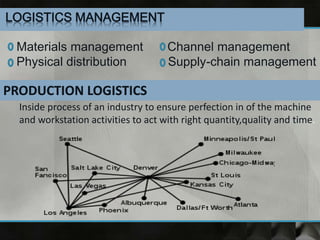
LOGISTICS MANAGEMENT
Materials management Channel management
Physical distribution Supply-chain management
PRODUCTION LOGISTICS
Inside process of an industry to ensure perfection in of the machine
and workstation activities to act with right quantity,quality and time.
 Meaning:
Wholesaling includes all the activities in selling
goods or services to those who buy for resale or
business use. It excludes manufacturers and farmers
because they are engaged primarily in production,
and it excludes retailers.
Wholesalers also called distributors differ from
retailers in a number of ways.
 Wholesalers’ sales help manufacturers reach many
small business customers at relatively low cost
 Promote greater transparency and better price
formation through a clearer interplay of supply
&demand
 Sell a large amount of any product to the end buyer
 Supply information to suppliers & customers
regarding competitor’s activities ,new products price
developments & so on.
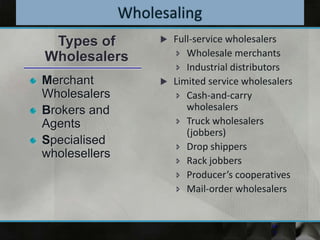
 Full-service wholesalers
 Wholesale merchants
 Industrial distributors
 Limited service wholesalers
 Cash-and-carry
wholesalers
 Truck wholesalers
(jobbers)
 Drop shippers
 Rack jobbers
 Producer’s cooperatives
 Mail-order wholesalers
14-
7
Merchant
Wholesalers
Brokers and
Agents
Specialised
wholesellers
Types of
Wholesalers
Wholesaling has been growing due to two key factors:
Many factories are located far from buyers
 An increasing need to adapt product quantities,
features, or packages to meet buyer needs
Growth of wholesalers
Market logistic decision
order processing
Warehousing
Inventory
transportation
 Logistics planning should be integrated into the
firm’s strategic planning process.
 Logistics departments must be guided by a clear
vision and must measure output regularly
logistics environment
Controllable elements
Uncontrollable elements
 Political and legal systems of foreign markets
 Economic conditions
 Degree of competition in each market
 Geographic structure of the foreign market
 Social and cultural norms of various target markets
Controllable elements
Customer service
Inventory issues
Packaging issues
Transportation
Warehousing and storage
 Customer service issues
 Inventory issues
 Packaging issues
 Transportation issues
 Warehousing and storage issues
Customer Service Issues
Requires different types of transport carriers,
Multiple transfers and handling
Time in transit vary from shipment to shipment
Inventory Issues
Includes unique factors such as currency exchange
rates, greater distances and custom duties
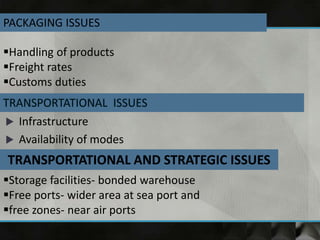
 Infrastructure
 Availability of modes
Storage facilities- bonded warehouse
Free ports- wider area at sea port and
free zones- near air ports
PACKAGING ISSUES
Handling of products
Freight rates
Customs duties
TRANSPORTATIONAL AND STRATEGIC ISSUES
 A warehouse is a commercial building for storage
of goods.
 Stored goods can include any raw materials,
packing materials, spare parts, components, or
finished goods associated with agriculture,
manufacturing and production.
 Private Warehouses
 Public Warehouses
 Government Warehouses
 Bonded Warehouses
 Co-operative Warehouses
 Should be located at a convenient place.
 Mechanical appliances should be there to loading
and unloading the goods.
 Adequate space should be available inside the
building .
 Protect the goods from sunlight, rain, wind, dust,
moisture and pests.
 The building should be fitted with latest fire-
fighting equipments
 Receiving
 Pre-packaging
 Put-away
 Storage
 Order picking
 Packing and Shipping
 Transportation
 Protection and preservation of goods
 Reduces risk of loss
 Easy handling
 Creation of employment
 Convenient location
 More complex to resolve problems caused by
incorrect processing.
 Requires expert knowledge to configure for
maximum benefit
 Space may not be available.
 Lack of flexibility
THANK YOU

Marketing,logistics,wholeselling and warehousing

  • 1.
    Submitted by- Arnab PranBordoloi (08) Tikendrajit Gogoi (45) Victor Khasnabish(47) Utpal Kumar Nath(46) Dipanjana DeyChoudhury(16) Bhavika Umarigar (10) Jiabur Rahman(20)
  • 2.
    . Marketing logistics arebasically physical distributor of goods.it involves planning,delivering,controlloing the flow of physical goods to a market as well as the material and information neccessary to meet customer demands.the demand of the customer must be made at profit that increases revenue for the organisation. Logistics is the management of the flow of resources between the point of origin and the point of consumption in order to meet some requirements. Reserve logistics Millitary logistics Inbound logistics Third party logistics Fourth party logistics Outbound logistics
  • 3.
     to makeavailable right quantity of right quality products at right place and time in right condition.  to offer best service to the consumers.  to reduce the cost of operations.  to maintain transparency in operations. To deliver a product with utmost caution and in scientefic way Removal of hectic schedules and methods To reserve customer satisfaction and company reputation
  • 4.
    LOGISTICS MANAGEMENT Materials managementChannel management Physical distribution Supply-chain management PRODUCTION LOGISTICS Inside process of an industry to ensure perfection in of the machine and workstation activities to act with right quantity,quality and time.
  • 5.
     Meaning: Wholesaling includesall the activities in selling goods or services to those who buy for resale or business use. It excludes manufacturers and farmers because they are engaged primarily in production, and it excludes retailers. Wholesalers also called distributors differ from retailers in a number of ways.
  • 6.
     Wholesalers’ saleshelp manufacturers reach many small business customers at relatively low cost  Promote greater transparency and better price formation through a clearer interplay of supply &demand  Sell a large amount of any product to the end buyer  Supply information to suppliers & customers regarding competitor’s activities ,new products price developments & so on.
  • 7.
     Full-service wholesalers Wholesale merchants  Industrial distributors  Limited service wholesalers  Cash-and-carry wholesalers  Truck wholesalers (jobbers)  Drop shippers  Rack jobbers  Producer’s cooperatives  Mail-order wholesalers 14- 7 Merchant Wholesalers Brokers and Agents Specialised wholesellers Types of Wholesalers
  • 8.
    Wholesaling has beengrowing due to two key factors: Many factories are located far from buyers  An increasing need to adapt product quantities, features, or packages to meet buyer needs Growth of wholesalers
  • 9.
    Market logistic decision orderprocessing Warehousing Inventory transportation
  • 10.
     Logistics planningshould be integrated into the firm’s strategic planning process.  Logistics departments must be guided by a clear vision and must measure output regularly logistics environment Controllable elements Uncontrollable elements
  • 11.
     Political andlegal systems of foreign markets  Economic conditions  Degree of competition in each market  Geographic structure of the foreign market  Social and cultural norms of various target markets Controllable elements Customer service Inventory issues Packaging issues Transportation Warehousing and storage
  • 12.
     Customer serviceissues  Inventory issues  Packaging issues  Transportation issues  Warehousing and storage issues Customer Service Issues Requires different types of transport carriers, Multiple transfers and handling Time in transit vary from shipment to shipment Inventory Issues Includes unique factors such as currency exchange rates, greater distances and custom duties
  • 13.
     Infrastructure  Availabilityof modes Storage facilities- bonded warehouse Free ports- wider area at sea port and free zones- near air ports PACKAGING ISSUES Handling of products Freight rates Customs duties TRANSPORTATIONAL AND STRATEGIC ISSUES
  • 14.
     A warehouseis a commercial building for storage of goods.  Stored goods can include any raw materials, packing materials, spare parts, components, or finished goods associated with agriculture, manufacturing and production.
  • 15.
     Private Warehouses Public Warehouses  Government Warehouses  Bonded Warehouses  Co-operative Warehouses
  • 16.
     Should belocated at a convenient place.  Mechanical appliances should be there to loading and unloading the goods.  Adequate space should be available inside the building .  Protect the goods from sunlight, rain, wind, dust, moisture and pests.  The building should be fitted with latest fire- fighting equipments
  • 17.
     Receiving  Pre-packaging Put-away  Storage  Order picking  Packing and Shipping  Transportation
  • 18.
     Protection andpreservation of goods  Reduces risk of loss  Easy handling  Creation of employment  Convenient location
  • 19.
     More complexto resolve problems caused by incorrect processing.  Requires expert knowledge to configure for maximum benefit  Space may not be available.  Lack of flexibility
  • 20.