Drivers of Supply Chain
Performance
• Facilities
• places where inventory is stored, assembled, or fabricated
• production sites and storage sites
• Inventory
• raw materials, WIP, finished goods within a supply chain
• inventory policies
• Transportation
• moving inventory from point to point in a supply chain
• combinations of transportation modes and routes
• Information
• data and analysis regarding inventory, transportation, facilities throughout the supply chain
• potentially the biggest driver of supply chain performance
• Sourcing
• functions a firm performs and functions that are outsourced
• Pricing
• Price associated with goods and services provided by a firm to the supply chain
Facilities
• Role in the supply chain
• the “where” of the supply chain
• manufacturing or storage (warehouses)
• Role in the competitive strategy
• economies of scale (efficiency priority)
• larger number of smaller facilities (responsiveness priority)
• Example 3.1: Toyota and Honda
• Components of facilities decisions
Components of Facilities Decisions
• Location
• centralization (efficiency) vs. decentralization (responsiveness)
• other factors to consider (e.g., proximity to customers)
• Capacity (flexibility versus efficiency)
• Manufacturing methodology (product focused versus process
focused)
• Warehousing methodology (SKU storage, job lot storage, cross-
docking)
• Overall trade-off: Responsiveness versus efficiency
Inventory
• Role in the supply chain
• Role in the competitive strategy
• Components of inventory decisions
Inventory: Role in the Supply Chain
• Inventory exists because of a mismatch between supply and demand
• Source of cost and influence on responsiveness
• Impact on
• material flow time: time elapsed between when material enters the supply
chain to when it exits the supply chain
• throughput
• rate at which sales to end consumers occur
• I = RT (Little’s Law)
• I = inventory; R = throughput; T = flow time
• Example
• Inventory and throughput are “synonymous” in a supply chain
Inventory: Role in Competitive Strategy
• If responsiveness is a strategic competitive priority, a firm can locate
larger amounts of inventory closer to customers
• If cost is more important, inventory can be reduced to make the firm
more efficient
• Trade-off
• Example 3.2 – Nordstrom
Components of Inventory Decisions
• Cycle inventory
• Average amount of inventory used to satisfy demand between shipments
• Depends on lot size
• Safety inventory
• inventory held in case demand exceeds expectations
• costs of carrying too much inventory versus cost of losing sales
• Seasonal inventory
• inventory built up to counter predictable variability in demand
• cost of carrying additional inventory versus cost of flexible production
• Overall trade-off: Responsiveness versus efficiency
• more inventory: greater responsiveness but greater cost
• less inventory: lower cost but lower responsiveness
Transportation
• Role in the supply chain
• Role in the competitive strategy
• Components of transportation decisions
Transportation: Role in
the Supply Chain
• Moves the product between stages in the supply chain
• Impact on responsiveness and efficiency
• Faster transportation allows greater responsiveness but lower
efficiency
• Also affects inventory and facilities
Transportation:
Role in the Competitive Strategy
• If responsiveness is a strategic competitive priority, then faster
transportation modes can provide greater responsiveness to
customers who are willing to pay for it
• Can also use slower transportation modes for customers whose
priority is price (cost)
• Can also consider both inventory and transportation to find the right
balance
• Example 3.3: Laura Ashley
Components of
Transportation Decisions
• Mode of transportation:
• air, truck, rail, ship, pipeline, electronic transportation
• vary in cost, speed, size of shipment, flexibility
• Route and network selection
• route: path along which a product is shipped
• network: collection of locations and routes
• In-house or outsource
• Overall trade-off: Responsiveness versus efficiency
Information
• Role in the supply chain
• Role in the competitive strategy
• Components of information decisions
Information: Role in
the Supply Chain
• The connection between the various stages in the supply chain –
allows coordination between stages
• Crucial to daily operation of each stage in a supply chain – e.g.,
production scheduling, inventory levels
Information:
Role in the Competitive Strategy
• Allows supply chain to become more efficient and more responsive at
the same time (reduces the need for a trade-off)
• Information technology
• What information is most valuable?
• Example 3.4: Andersen Windows
• Example 3.5: Dell
Components of Information Decisions
• Push (MRP) versus pull (demand information transmitted quickly
throughout the supply chain)
• Coordination and information sharing
• Forecasting and aggregate planning
• Enabling technologies
• EDI
• Internet
• ERP systems
• Supply Chain Management software
• RFID
• Overall trade-off: Responsiveness versus efficiency
Sourcing
• Role in the supply chain
• Role in the competitive strategy
• Components of sourcing decisions
Sourcing: Role in
the Supply Chain
• Set of business processes required to purchase goods and services in
a supply chain
• Supplier selection, single vs. multiple suppliers, contract negotiation

Sourcing:
Role in the Competitive Strategy
• Sourcing decisions are crucial because they affect the level of
efficiency and responsiveness in a supply chain
• In-house vs. outsource decisions- improving efficiency and
responsiveness
• Example zara
Components of Sourcing Decisions
• In-house versus outsource decisions
• Supplier evaluation and selection
• Procurement process
• Overall trade-off: Increase the supply chain profits
Pricing
1. Role in the supply chain
• Role in the competitive strategy
• Components of pricing decisions
Pricing: Role in
the Supply Chain
• Pricing determines the amount to charge customers in a supply chain
• Pricing strategies can be used to match demand and supply
Role in the Competitive Strategy
• Firms can utilize optimal pricing strategies to improve efficiency and
responsiveness
• Low price and low product availability; vary prices by response times
• Example 3.7: Amazon
Components of Pricing Decisions
• Pricing and economies of scale
• Everyday low pricing versus high-low pricing
• Fixed price versus menu pricing
• Overall trade-off: Increase the firm profits
Obstacles to Achieving
Strategic Fit
• Increasing variety of products
• Decreasing product life cycles
• Increasingly demanding customers
• Fragmentation of supply chain ownership
• Globalization
• Difficulty executing new strategies
The Role of Distribution
in the Supply Chain
• Distribution: the steps taken to move and store a product from the
supplier stage to the customer stage in a supply chain
• Distribution directly affects cost and the customer experience and
therefore drives profitability
• Choice of distribution network can achieve supply chain objectives
from low cost to high responsiveness
• Examples: Wal-Mart, Dell, Proctor & Gamble, Grainger
Factors Influencing
Distribution Network Design
• Distribution network performance evaluated along two dimensions at
the highest level:
• Customer needs that are met
• Cost of meeting customer needs
• Distribution network design options must therefore be compared
according to their impact on customer service and the cost to provide
this level of service
• Elements of customer service influenced by network structure:
• Response time
• Product variety
• Product availability
• Customer experience
• Order visibility
• Returnability
• Supply chain costs affected by network structure:
• Inventories
• Transportation
• Facilities and handling
• Information
Design Options for a
Distribution Network
• Manufacturer Storage with Direct Shipping
• Manufacturer Storage with Direct Shipping and In-Transit Merge
• Distributor Storage with Carrier Delivery
• Distributor Storage with Last Mile Delivery
• Manufacturer or Distributor Storage with Consumer Pickup
• Retail Storage with Consumer Pickup
4-30
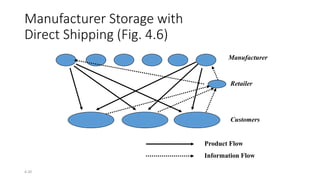
Manufacturer Storage with
Direct Shipping (Fig. 4.6)
Manufacturer
Retailer
Customers
Product Flow
Information Flow
4-31
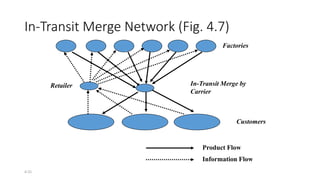
In-Transit Merge Network (Fig. 4.7)
Factories
Retailer
Product Flow
Information Flow
In-Transit Merge by
Carrier
Customers
4-32
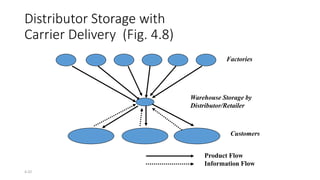
Distributor Storage with
Carrier Delivery (Fig. 4.8)
Factories
Customers
Product Flow
Information Flow
Warehouse Storage by
Distributor/Retailer
4-33
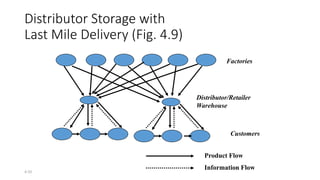
Distributor Storage with
Last Mile Delivery (Fig. 4.9)
Factories
Customers
Product Flow
Information Flow
Distributor/Retailer
Warehouse
4-34
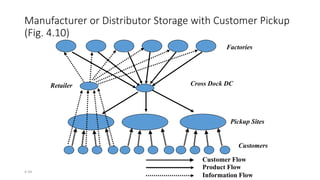
Manufacturer or Distributor Storage with Customer Pickup
(Fig. 4.10)
Factories
Retailer
Pickup Sites
Product Flow
Information Flow
Cross Dock DC
Customer Flow
Customers
Network Design Decisions
• Facility role
• Facility location
• Capacity allocation
• Market and supply allocation
5-35
Factors Influencing
Network Design Decisions
• Strategic
• Technological
• Macroeconomic
• Political
• Infrastructure
• Competitive
• Logistics and facility costs
5-36
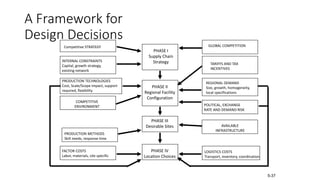
A Framework for
Design Decisions
PHASE I
Supply Chain
Strategy
PHASE II
Regional Facility
Configuration
PHASE III
Desirable Sites
PHASE IV
Location Choices
Competitive STRATEGY
INTERNAL CONSTRAINTS
Capital, growth strategy,
existing network
PRODUCTION TECHNOLOGIES
Cost, Scale/Scope impact, support
required, flexibility
COMPETITIVE
ENVIRONMENT
PRODUCTION METHODS
Skill needs, response time
FACTOR COSTS
Labor, materials, site specific
GLOBAL COMPETITION
TARIFFS AND TAX
INCENTIVES
REGIONAL DEMAND
Size, growth, homogeneity,
local specifications
POLITICAL, EXCHANGE
RATE AND DEMAND RISK
AVAILABLE
INFRASTRUCTURE
LOGISTICS COSTS
Transport, inventory, coordination
5-37
Drivers of Supply Chain Performance.pptx

Drivers of Supply Chain Performance.pptx

  • 1.
    Drivers of SupplyChain Performance
  • 2.
    • Facilities • placeswhere inventory is stored, assembled, or fabricated • production sites and storage sites • Inventory • raw materials, WIP, finished goods within a supply chain • inventory policies • Transportation • moving inventory from point to point in a supply chain • combinations of transportation modes and routes • Information • data and analysis regarding inventory, transportation, facilities throughout the supply chain • potentially the biggest driver of supply chain performance • Sourcing • functions a firm performs and functions that are outsourced • Pricing • Price associated with goods and services provided by a firm to the supply chain
  • 3.
    Facilities • Role inthe supply chain • the “where” of the supply chain • manufacturing or storage (warehouses) • Role in the competitive strategy • economies of scale (efficiency priority) • larger number of smaller facilities (responsiveness priority) • Example 3.1: Toyota and Honda • Components of facilities decisions
  • 4.
    Components of FacilitiesDecisions • Location • centralization (efficiency) vs. decentralization (responsiveness) • other factors to consider (e.g., proximity to customers) • Capacity (flexibility versus efficiency) • Manufacturing methodology (product focused versus process focused) • Warehousing methodology (SKU storage, job lot storage, cross- docking) • Overall trade-off: Responsiveness versus efficiency
  • 5.
    Inventory • Role inthe supply chain • Role in the competitive strategy • Components of inventory decisions
  • 6.
    Inventory: Role inthe Supply Chain • Inventory exists because of a mismatch between supply and demand • Source of cost and influence on responsiveness • Impact on • material flow time: time elapsed between when material enters the supply chain to when it exits the supply chain • throughput • rate at which sales to end consumers occur • I = RT (Little’s Law) • I = inventory; R = throughput; T = flow time • Example • Inventory and throughput are “synonymous” in a supply chain
  • 7.
    Inventory: Role inCompetitive Strategy • If responsiveness is a strategic competitive priority, a firm can locate larger amounts of inventory closer to customers • If cost is more important, inventory can be reduced to make the firm more efficient • Trade-off • Example 3.2 – Nordstrom
  • 8.
    Components of InventoryDecisions • Cycle inventory • Average amount of inventory used to satisfy demand between shipments • Depends on lot size • Safety inventory • inventory held in case demand exceeds expectations • costs of carrying too much inventory versus cost of losing sales • Seasonal inventory • inventory built up to counter predictable variability in demand • cost of carrying additional inventory versus cost of flexible production • Overall trade-off: Responsiveness versus efficiency • more inventory: greater responsiveness but greater cost • less inventory: lower cost but lower responsiveness
  • 9.
    Transportation • Role inthe supply chain • Role in the competitive strategy • Components of transportation decisions
  • 10.
    Transportation: Role in theSupply Chain • Moves the product between stages in the supply chain • Impact on responsiveness and efficiency • Faster transportation allows greater responsiveness but lower efficiency • Also affects inventory and facilities
  • 11.
    Transportation: Role in theCompetitive Strategy • If responsiveness is a strategic competitive priority, then faster transportation modes can provide greater responsiveness to customers who are willing to pay for it • Can also use slower transportation modes for customers whose priority is price (cost) • Can also consider both inventory and transportation to find the right balance • Example 3.3: Laura Ashley
  • 12.
    Components of Transportation Decisions •Mode of transportation: • air, truck, rail, ship, pipeline, electronic transportation • vary in cost, speed, size of shipment, flexibility • Route and network selection • route: path along which a product is shipped • network: collection of locations and routes • In-house or outsource • Overall trade-off: Responsiveness versus efficiency
  • 13.
    Information • Role inthe supply chain • Role in the competitive strategy • Components of information decisions
  • 14.
    Information: Role in theSupply Chain • The connection between the various stages in the supply chain – allows coordination between stages • Crucial to daily operation of each stage in a supply chain – e.g., production scheduling, inventory levels
  • 15.
    Information: Role in theCompetitive Strategy • Allows supply chain to become more efficient and more responsive at the same time (reduces the need for a trade-off) • Information technology • What information is most valuable? • Example 3.4: Andersen Windows • Example 3.5: Dell
  • 16.
    Components of InformationDecisions • Push (MRP) versus pull (demand information transmitted quickly throughout the supply chain) • Coordination and information sharing • Forecasting and aggregate planning • Enabling technologies • EDI • Internet • ERP systems • Supply Chain Management software • RFID • Overall trade-off: Responsiveness versus efficiency
  • 17.
    Sourcing • Role inthe supply chain • Role in the competitive strategy • Components of sourcing decisions
  • 18.
    Sourcing: Role in theSupply Chain • Set of business processes required to purchase goods and services in a supply chain • Supplier selection, single vs. multiple suppliers, contract negotiation
  • 19.
    Sourcing: Role in theCompetitive Strategy • Sourcing decisions are crucial because they affect the level of efficiency and responsiveness in a supply chain • In-house vs. outsource decisions- improving efficiency and responsiveness • Example zara
  • 20.
    Components of SourcingDecisions • In-house versus outsource decisions • Supplier evaluation and selection • Procurement process • Overall trade-off: Increase the supply chain profits
  • 21.
    Pricing 1. Role inthe supply chain • Role in the competitive strategy • Components of pricing decisions
  • 22.
    Pricing: Role in theSupply Chain • Pricing determines the amount to charge customers in a supply chain • Pricing strategies can be used to match demand and supply
  • 23.
    Role in theCompetitive Strategy • Firms can utilize optimal pricing strategies to improve efficiency and responsiveness • Low price and low product availability; vary prices by response times • Example 3.7: Amazon
  • 24.
    Components of PricingDecisions • Pricing and economies of scale • Everyday low pricing versus high-low pricing • Fixed price versus menu pricing • Overall trade-off: Increase the firm profits
  • 25.
    Obstacles to Achieving StrategicFit • Increasing variety of products • Decreasing product life cycles • Increasingly demanding customers • Fragmentation of supply chain ownership • Globalization • Difficulty executing new strategies
  • 26.
    The Role ofDistribution in the Supply Chain • Distribution: the steps taken to move and store a product from the supplier stage to the customer stage in a supply chain • Distribution directly affects cost and the customer experience and therefore drives profitability • Choice of distribution network can achieve supply chain objectives from low cost to high responsiveness • Examples: Wal-Mart, Dell, Proctor & Gamble, Grainger
  • 27.
    Factors Influencing Distribution NetworkDesign • Distribution network performance evaluated along two dimensions at the highest level: • Customer needs that are met • Cost of meeting customer needs • Distribution network design options must therefore be compared according to their impact on customer service and the cost to provide this level of service
  • 28.
    • Elements ofcustomer service influenced by network structure: • Response time • Product variety • Product availability • Customer experience • Order visibility • Returnability • Supply chain costs affected by network structure: • Inventories • Transportation • Facilities and handling • Information
  • 29.
    Design Options fora Distribution Network • Manufacturer Storage with Direct Shipping • Manufacturer Storage with Direct Shipping and In-Transit Merge • Distributor Storage with Carrier Delivery • Distributor Storage with Last Mile Delivery • Manufacturer or Distributor Storage with Consumer Pickup • Retail Storage with Consumer Pickup
  • 30.
    4-30 Manufacturer Storage with DirectShipping (Fig. 4.6) Manufacturer Retailer Customers Product Flow Information Flow
  • 31.
    4-31 In-Transit Merge Network(Fig. 4.7) Factories Retailer Product Flow Information Flow In-Transit Merge by Carrier Customers
  • 32.
    4-32 Distributor Storage with CarrierDelivery (Fig. 4.8) Factories Customers Product Flow Information Flow Warehouse Storage by Distributor/Retailer
  • 33.
    4-33 Distributor Storage with LastMile Delivery (Fig. 4.9) Factories Customers Product Flow Information Flow Distributor/Retailer Warehouse
  • 34.
    4-34 Manufacturer or DistributorStorage with Customer Pickup (Fig. 4.10) Factories Retailer Pickup Sites Product Flow Information Flow Cross Dock DC Customer Flow Customers
  • 35.
    Network Design Decisions •Facility role • Facility location • Capacity allocation • Market and supply allocation 5-35
  • 36.
    Factors Influencing Network DesignDecisions • Strategic • Technological • Macroeconomic • Political • Infrastructure • Competitive • Logistics and facility costs 5-36
  • 37.
    A Framework for DesignDecisions PHASE I Supply Chain Strategy PHASE II Regional Facility Configuration PHASE III Desirable Sites PHASE IV Location Choices Competitive STRATEGY INTERNAL CONSTRAINTS Capital, growth strategy, existing network PRODUCTION TECHNOLOGIES Cost, Scale/Scope impact, support required, flexibility COMPETITIVE ENVIRONMENT PRODUCTION METHODS Skill needs, response time FACTOR COSTS Labor, materials, site specific GLOBAL COMPETITION TARIFFS AND TAX INCENTIVES REGIONAL DEMAND Size, growth, homogeneity, local specifications POLITICAL, EXCHANGE RATE AND DEMAND RISK AVAILABLE INFRASTRUCTURE LOGISTICS COSTS Transport, inventory, coordination 5-37