Midhun Abraham
ISBR Business School, University of Mysore
Jan 2017
SUPPLY CHAIN MANAGEMENT
SOME IMPORTANT CONCEPTS...
1
CONTENTS
Supply chain .......................................................................................................................................... 2
How to create an effective supply chain?............................................................................................... 3
Current challenges in supply chain ........................................................................................................ 4
Service chain management.................................................................................................................... 5
Lean management................................................................................................................................. 6
Delayed differentiation ........................................................................................................................... 7
How is the number of SKUs calculated? ................................................................................................ 8
Reverse logistics.................................................................................................................................... 8
Humanitarian logistics............................................................................................................................ 9
2
SUPPLY CHAIN
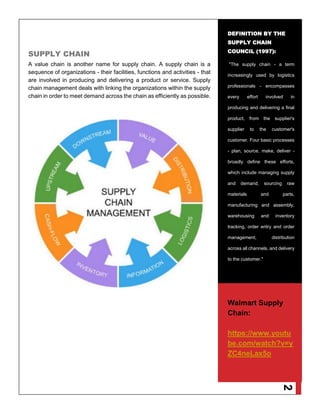
A value chain is another name for supply chain. A supply chain is a
sequence of organizations - their facilities, functions and activities - that
are involved in producing and delivering a product or service. Supply
chain management deals with linking the organizations within the supply
chain in order to meet demand across the chain as efficiently as possible.
DEFINITION BY THE
SUPPLY CHAIN
COUNCIL (1997):
"The supply chain - a term
increasingly used by logistics
professionals - encompasses
every effort involved in
producing and delivering a final
product, from the supplier's
supplier to the customer's
customer. Four basic processes
- plan, source, make, deliver -
broadly define these efforts,
which include managing supply
and demand, sourcing raw
materials and parts,
manufacturing and assembly,
warehousing and inventory
tracking, order entry and order
management, distribution
across all channels, and delivery
to the customer."
Walmart Supply
Chain:
https://www.youtu
be.com/watch?v=y
ZC4neLax5o
3
HOW TO CREATE AN EFFECTIVE SUPPLY
CHAIN?
SUPPLIER RELATIONSHIP MANAGEMENT (SRM)
Suppliers are the supporters and resource providers for any
organization. SRM is the discipline of working collaboratively with
suppliers in order to maximize the value derived from those supplier
relationships. It is a part of strategic sourcing, determining and
communicating needs and expectations to a supplier, measuring
performance, and invoking actions for compliance.
Value generation for suppliers is given more emphasis these days for
strong strategic relationship, enabling minimized inventory through Just
in Time (JIT) and Vendor-managed inventory (VMI).
INTERNAL SUPPLY CHAIN MANAGEMENT (ISCM)
Internal supply chain refers to the chain of activities within a company
that concludes
with providing a product to the customer. This process involves multiple
functions within
companies – sales, production, and distribution. ISCM is driven by the
value promises of top management and employees delivering the
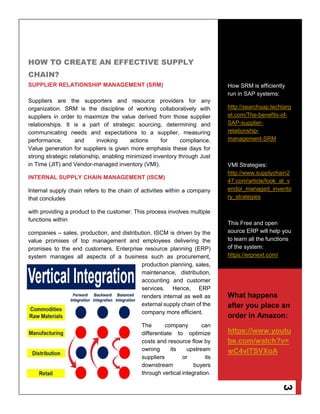
promises to the end customers. Enterprise resource planning (ERP)
system manages all aspects of a business such as procurement,
production planning, sales,
maintenance, distribution,
accounting and customer
services. Hence, ERP
renders internal as well as
external supply chain of the
company more efficient.
The company can
differentiate to optimize
costs and resource flow by
owning its upstream
suppliers or its
downstream buyers
through vertical integration.
How SRM is efficiently
run in SAP systems:
http://searchsap.techtarg
et.com/The-benefits-of-
SAP-supplier-
relationship-
management-SRM
VMI Strategies:
http://www.supplychain2
47.com/article/look_at_v
endor_managed_invento
ry_strategies
This Free and open
source ERP will help you
to learn all the functions
of the system:
https://erpnext.com/
What happens
after you place an
order in Amazon:
https://www.youtu
be.com/watch?v=
wC4vITSVXoA
4
CUSTOMER RELATIONSHIP MANAGEMENT (CRM)
CRM is a term that refers to practices, strategies and technologies that
companies use to manage and analyze customer interactions and data
throughout the customer lifecycle, with the goal of improving business
relationships with customers, assisting in customer retention and driving
sales growth.
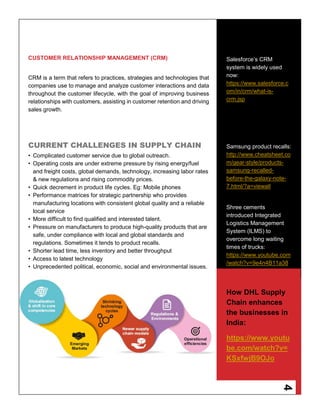
CURRENT CHALLENGES IN SUPPLY CHAIN
• Complicated customer service due to global outreach.
• Operating costs are under extreme pressure by rising energy/fuel
and freight costs, global demands, technology, increasing labor rates
& new regulations and rising commodity prices.
• Quick decrement in product life cycles. Eg: Mobile phones
• Performance matrices for strategic partnership who provides
manufacturing locations with consistent global quality and a reliable
local service
• More difficult to find qualified and interested talent.
• Pressure on manufacturers to produce high-quality products that are
safe, under compliance with local and global standards and
regulations. Sometimes it tends to product recalls.
• Shorter lead time, less inventory and better throughput
• Access to latest technology
• Unprecedented political, economic, social and environmental issues.
Salesforce’s CRM
system is widely used
now:
https://www.salesforce.c
om/in/crm/what-is-
crm.jsp
Samsung product recalls:
http://www.cheatsheet.co
m/gear-style/products-
samsung-recalled-
before-the-galaxy-note-
7.html/?a=viewall
Shree cements
introduced Integrated
Logistics Management
System (ILMS) to
overcome long waiting
times of trucks:
https://www.youtube.com
/watch?v=9e4n4B11a38
How DHL Supply
Chain enhances
the businesses in
India:
https://www.youtu
be.com/watch?v=
KSxfwjB9OJo
5
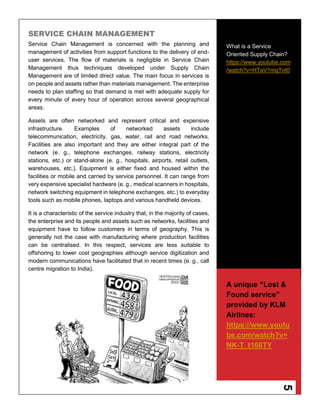
SERVICE CHAIN MANAGEMENT
Service Chain Management is concerned with the planning and
management of activities from support functions to the delivery of end-
user services. The flow of materials is negligible in Service Chain
Management thus techniques developed under Supply Chain
Management are of limited direct value. The main focus in services is
on people and assets rather than materials management. The enterprise
needs to plan staffing so that demand is met with adequate supply for
every minute of every hour of operation across several geographical
areas.
Assets are often networked and represent critical and expensive
infrastructure. Examples of networked assets include
telecommunication, electricity, gas, water, rail and road networks.
Facilities are also important and they are either integral part of the
network (e. g., telephone exchanges, railway stations, electricity
stations, etc.) or stand-alone (e. g., hospitals, airports, retail outlets,
warehouses, etc.). Equipment is either fixed and housed within the
facilities or mobile and carried by service personnel. It can range from
very expensive specialist hardware (e. g., medical scanners in hospitals,
network switching equipment in telephone exchanges, etc.) to everyday
tools such as mobile phones, laptops and various handheld devices.
It is a characteristic of the service industry that, in the majority of cases,
the enterprise and its people and assets such as networks, facilities and
equipment have to follow customers in terms of geography. This is
generally not the case with manufacturing where production facilities
can be centralised. In this respect, services are less suitable to
offshoring to lower cost geographies although service digitization and
modern communications have facilitated that in recent times (e. g., call
centre migration to India).
What is a Service
Oriented Supply Chain?
https://www.youtube.com
/watch?v=HTaV1mqTnt0
A unique “Lost &
Found service”
provided by KLM
Airlines:
https://www.youtu
be.com/watch?v=
NK-T_t166TY
6
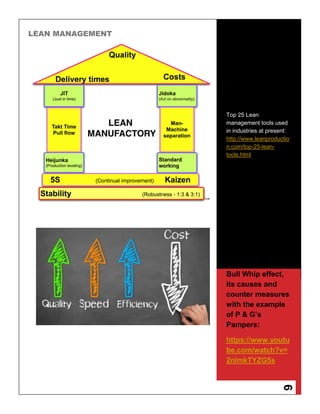
LEAN MANAGEMENT
Top 25 Lean
management tools used
in industries at present:
http://www.leanproductio
n.com/top-25-lean-
tools.html
Bull Whip effect,
its causes and
counter measures
with the example
of P & G’s
Pampers:
https://www.youtu
be.com/watch?v=
2nlmkTYZG5s
7
DELAYED DIFFERENTIATION
Delayed differentiation or Postponement is a concept where the
manufacturing process starts by making a generic or family product that
is later differentiated into a specific end-product. Hence the customer
can have high level of customization.
The basic properties are kept the same but the customization takes
place after acquiring the current knowledge of the market, requirements.
This is done for the purpose of reducing the risk and uncertainties.
There is a distortion and irregularities in the information flow which
cannot be speculated. Postponement aims to keep this distortion
minimum and thus helps to avoid stock out cost and obsolescence.
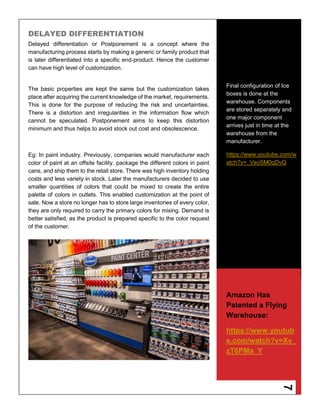
Eg: In paint industry. Previously, companies would manufacturer each
color of paint at an offsite facility, package the different colors in paint
cans, and ship them to the retail store. There was high inventory holding
costs and less variety in stock. Later the manufacturers decided to use
smaller quantities of colors that could be mixed to create the entire
palette of colors in outlets. This enabled customization at the point of
sale. Now a store no longer has to store large inventories of every color,
they are only required to carry the primary colors for mixing. Demand is
better satisfied, as the product is prepared specific to the color request
of the customer.
Final configuration of Ice
boxes is done at the
warehouse. Components
are stored separately and
one major component
arrives just in time at the
warehouse from the
manufacturer.
https://www.youtube.com/w
atch?v=_VsoSM0qDvQ
Amazon Has
Patented a Flying
Warehouse:
https://www.youtub
e.com/watch?v=Xv_
zT6PMa_Y
8
HOW IS THE NUMBER OF SKUS
CALCULATED?
SKUs are calculated by adding up all products and product variants
manufactured or stored. Every product and product variant counts
toward the SKU total, whether or not you have entered a custom SKU
code for that product or variant.
For example: In a Photo studio: A photograph that only comes in color
and one size will count as one SKU. A photograph that comes in color,
black & white, or sepia and only one size will count as three SKU's.
A photograph that comes in color, black & white, or sepia AND comes
in 5x7, 8x10, and 11x17 has nine SKU's.
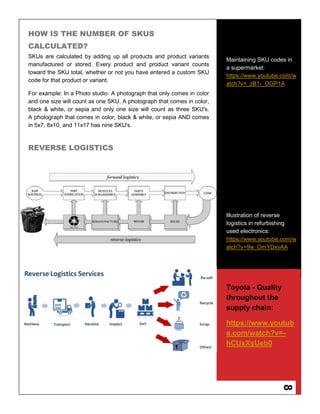
REVERSE LOGISTICS
Maintaining SKU codes in
a supermarket:
https://www.youtube.com/w
atch?v=_zB1-_OGP1A
Illustration of reverse
logistics in refurbishing
used electronics:
https://www.youtube.com/w
atch?v=9w_OmYDxvAA
Toyota - Quality
throughout the
supply chain:
https://www.youtub
e.com/watch?v=-
hCUxXsUeb0
9
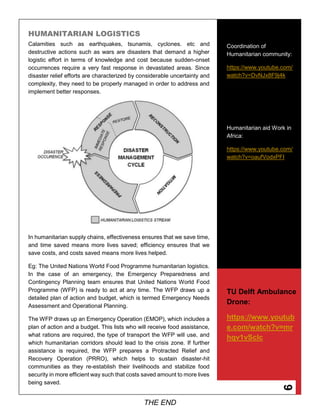
HUMANITARIAN LOGISTICS
Calamities such as earthquakes, tsunamis, cyclones. etc and
destructive actions such as wars are disasters that demand a higher
logistic effort in terms of knowledge and cost because sudden-onset
occurrences require a very fast response in devastated areas. Since
disaster relief efforts are characterized by considerable uncertainty and
complexity, they need to be properly managed in order to address and
implement better responses.
In humanitarian supply chains, effectiveness ensures that we save time,
and time saved means more lives saved; efficiency ensures that we
save costs, and costs saved means more lives helped.
Eg: The United Nations World Food Programme humanitarian logistics.
In the case of an emergency, the Emergency Preparedness and
Contingency Planning team ensures that United Nations World Food
Programme (WFP) is ready to act at any time. The WFP draws up a
detailed plan of action and budget, which is termed Emergency Needs
Assessment and Operational Planning.
The WFP draws up an Emergency Operation (EMOP), which includes a
plan of action and a budget. This lists who will receive food assistance,
what rations are required, the type of transport the WFP will use, and
which humanitarian corridors should lead to the crisis zone. If further
assistance is required, the WFP prepares a Protracted Relief and
Recovery Operation (PRRO), which helps to sustain disaster-hit
communities as they re-establish their livelihoods and stabilize food
security in more efficient way such that costs saved amount to more lives
being saved.
Coordination of
Humanitarian community:
https://www.youtube.com/
watch?v=DvNJx8F9j4k
Humanitarian aid Work in
Africa:
https://www.youtube.com/
watch?v=oaufVodxPFI
TU Delft Ambulance
Drone:
https://www.youtub
e.com/watch?v=mr
hqv1vScIc
THE END

Supply chain management - Some important concepts..

  • 1.
    Midhun Abraham ISBR BusinessSchool, University of Mysore Jan 2017 SUPPLY CHAIN MANAGEMENT SOME IMPORTANT CONCEPTS...
  • 2.
    1 CONTENTS Supply chain ..........................................................................................................................................2 How to create an effective supply chain?............................................................................................... 3 Current challenges in supply chain ........................................................................................................ 4 Service chain management.................................................................................................................... 5 Lean management................................................................................................................................. 6 Delayed differentiation ........................................................................................................................... 7 How is the number of SKUs calculated? ................................................................................................ 8 Reverse logistics.................................................................................................................................... 8 Humanitarian logistics............................................................................................................................ 9
  • 3.
    2 SUPPLY CHAIN A valuechain is another name for supply chain. A supply chain is a sequence of organizations - their facilities, functions and activities - that are involved in producing and delivering a product or service. Supply chain management deals with linking the organizations within the supply chain in order to meet demand across the chain as efficiently as possible. DEFINITION BY THE SUPPLY CHAIN COUNCIL (1997): "The supply chain - a term increasingly used by logistics professionals - encompasses every effort involved in producing and delivering a final product, from the supplier's supplier to the customer's customer. Four basic processes - plan, source, make, deliver - broadly define these efforts, which include managing supply and demand, sourcing raw materials and parts, manufacturing and assembly, warehousing and inventory tracking, order entry and order management, distribution across all channels, and delivery to the customer." Walmart Supply Chain: https://www.youtu be.com/watch?v=y ZC4neLax5o
  • 4.
    3 HOW TO CREATEAN EFFECTIVE SUPPLY CHAIN? SUPPLIER RELATIONSHIP MANAGEMENT (SRM) Suppliers are the supporters and resource providers for any organization. SRM is the discipline of working collaboratively with suppliers in order to maximize the value derived from those supplier relationships. It is a part of strategic sourcing, determining and communicating needs and expectations to a supplier, measuring performance, and invoking actions for compliance. Value generation for suppliers is given more emphasis these days for strong strategic relationship, enabling minimized inventory through Just in Time (JIT) and Vendor-managed inventory (VMI). INTERNAL SUPPLY CHAIN MANAGEMENT (ISCM) Internal supply chain refers to the chain of activities within a company that concludes with providing a product to the customer. This process involves multiple functions within companies – sales, production, and distribution. ISCM is driven by the value promises of top management and employees delivering the promises to the end customers. Enterprise resource planning (ERP) system manages all aspects of a business such as procurement, production planning, sales, maintenance, distribution, accounting and customer services. Hence, ERP renders internal as well as external supply chain of the company more efficient. The company can differentiate to optimize costs and resource flow by owning its upstream suppliers or its downstream buyers through vertical integration. How SRM is efficiently run in SAP systems: http://searchsap.techtarg et.com/The-benefits-of- SAP-supplier- relationship- management-SRM VMI Strategies: http://www.supplychain2 47.com/article/look_at_v endor_managed_invento ry_strategies This Free and open source ERP will help you to learn all the functions of the system: https://erpnext.com/ What happens after you place an order in Amazon: https://www.youtu be.com/watch?v= wC4vITSVXoA
  • 5.
    4 CUSTOMER RELATIONSHIP MANAGEMENT(CRM) CRM is a term that refers to practices, strategies and technologies that companies use to manage and analyze customer interactions and data throughout the customer lifecycle, with the goal of improving business relationships with customers, assisting in customer retention and driving sales growth. CURRENT CHALLENGES IN SUPPLY CHAIN • Complicated customer service due to global outreach. • Operating costs are under extreme pressure by rising energy/fuel and freight costs, global demands, technology, increasing labor rates & new regulations and rising commodity prices. • Quick decrement in product life cycles. Eg: Mobile phones • Performance matrices for strategic partnership who provides manufacturing locations with consistent global quality and a reliable local service • More difficult to find qualified and interested talent. • Pressure on manufacturers to produce high-quality products that are safe, under compliance with local and global standards and regulations. Sometimes it tends to product recalls. • Shorter lead time, less inventory and better throughput • Access to latest technology • Unprecedented political, economic, social and environmental issues. Salesforce’s CRM system is widely used now: https://www.salesforce.c om/in/crm/what-is- crm.jsp Samsung product recalls: http://www.cheatsheet.co m/gear-style/products- samsung-recalled- before-the-galaxy-note- 7.html/?a=viewall Shree cements introduced Integrated Logistics Management System (ILMS) to overcome long waiting times of trucks: https://www.youtube.com /watch?v=9e4n4B11a38 How DHL Supply Chain enhances the businesses in India: https://www.youtu be.com/watch?v= KSxfwjB9OJo
  • 6.
    5 SERVICE CHAIN MANAGEMENT ServiceChain Management is concerned with the planning and management of activities from support functions to the delivery of end- user services. The flow of materials is negligible in Service Chain Management thus techniques developed under Supply Chain Management are of limited direct value. The main focus in services is on people and assets rather than materials management. The enterprise needs to plan staffing so that demand is met with adequate supply for every minute of every hour of operation across several geographical areas. Assets are often networked and represent critical and expensive infrastructure. Examples of networked assets include telecommunication, electricity, gas, water, rail and road networks. Facilities are also important and they are either integral part of the network (e. g., telephone exchanges, railway stations, electricity stations, etc.) or stand-alone (e. g., hospitals, airports, retail outlets, warehouses, etc.). Equipment is either fixed and housed within the facilities or mobile and carried by service personnel. It can range from very expensive specialist hardware (e. g., medical scanners in hospitals, network switching equipment in telephone exchanges, etc.) to everyday tools such as mobile phones, laptops and various handheld devices. It is a characteristic of the service industry that, in the majority of cases, the enterprise and its people and assets such as networks, facilities and equipment have to follow customers in terms of geography. This is generally not the case with manufacturing where production facilities can be centralised. In this respect, services are less suitable to offshoring to lower cost geographies although service digitization and modern communications have facilitated that in recent times (e. g., call centre migration to India). What is a Service Oriented Supply Chain? https://www.youtube.com /watch?v=HTaV1mqTnt0 A unique “Lost & Found service” provided by KLM Airlines: https://www.youtu be.com/watch?v= NK-T_t166TY
  • 7.
    6 LEAN MANAGEMENT Top 25Lean management tools used in industries at present: http://www.leanproductio n.com/top-25-lean- tools.html Bull Whip effect, its causes and counter measures with the example of P & G’s Pampers: https://www.youtu be.com/watch?v= 2nlmkTYZG5s
  • 8.
    7 DELAYED DIFFERENTIATION Delayed differentiationor Postponement is a concept where the manufacturing process starts by making a generic or family product that is later differentiated into a specific end-product. Hence the customer can have high level of customization. The basic properties are kept the same but the customization takes place after acquiring the current knowledge of the market, requirements. This is done for the purpose of reducing the risk and uncertainties. There is a distortion and irregularities in the information flow which cannot be speculated. Postponement aims to keep this distortion minimum and thus helps to avoid stock out cost and obsolescence. Eg: In paint industry. Previously, companies would manufacturer each color of paint at an offsite facility, package the different colors in paint cans, and ship them to the retail store. There was high inventory holding costs and less variety in stock. Later the manufacturers decided to use smaller quantities of colors that could be mixed to create the entire palette of colors in outlets. This enabled customization at the point of sale. Now a store no longer has to store large inventories of every color, they are only required to carry the primary colors for mixing. Demand is better satisfied, as the product is prepared specific to the color request of the customer. Final configuration of Ice boxes is done at the warehouse. Components are stored separately and one major component arrives just in time at the warehouse from the manufacturer. https://www.youtube.com/w atch?v=_VsoSM0qDvQ Amazon Has Patented a Flying Warehouse: https://www.youtub e.com/watch?v=Xv_ zT6PMa_Y
  • 9.
    8 HOW IS THENUMBER OF SKUS CALCULATED? SKUs are calculated by adding up all products and product variants manufactured or stored. Every product and product variant counts toward the SKU total, whether or not you have entered a custom SKU code for that product or variant. For example: In a Photo studio: A photograph that only comes in color and one size will count as one SKU. A photograph that comes in color, black & white, or sepia and only one size will count as three SKU's. A photograph that comes in color, black & white, or sepia AND comes in 5x7, 8x10, and 11x17 has nine SKU's. REVERSE LOGISTICS Maintaining SKU codes in a supermarket: https://www.youtube.com/w atch?v=_zB1-_OGP1A Illustration of reverse logistics in refurbishing used electronics: https://www.youtube.com/w atch?v=9w_OmYDxvAA Toyota - Quality throughout the supply chain: https://www.youtub e.com/watch?v=- hCUxXsUeb0
  • 10.
    9 HUMANITARIAN LOGISTICS Calamities suchas earthquakes, tsunamis, cyclones. etc and destructive actions such as wars are disasters that demand a higher logistic effort in terms of knowledge and cost because sudden-onset occurrences require a very fast response in devastated areas. Since disaster relief efforts are characterized by considerable uncertainty and complexity, they need to be properly managed in order to address and implement better responses. In humanitarian supply chains, effectiveness ensures that we save time, and time saved means more lives saved; efficiency ensures that we save costs, and costs saved means more lives helped. Eg: The United Nations World Food Programme humanitarian logistics. In the case of an emergency, the Emergency Preparedness and Contingency Planning team ensures that United Nations World Food Programme (WFP) is ready to act at any time. The WFP draws up a detailed plan of action and budget, which is termed Emergency Needs Assessment and Operational Planning. The WFP draws up an Emergency Operation (EMOP), which includes a plan of action and a budget. This lists who will receive food assistance, what rations are required, the type of transport the WFP will use, and which humanitarian corridors should lead to the crisis zone. If further assistance is required, the WFP prepares a Protracted Relief and Recovery Operation (PRRO), which helps to sustain disaster-hit communities as they re-establish their livelihoods and stabilize food security in more efficient way such that costs saved amount to more lives being saved. Coordination of Humanitarian community: https://www.youtube.com/ watch?v=DvNJx8F9j4k Humanitarian aid Work in Africa: https://www.youtube.com/ watch?v=oaufVodxPFI TU Delft Ambulance Drone: https://www.youtub e.com/watch?v=mr hqv1vScIc THE END