Project  Management Essentials August 2009
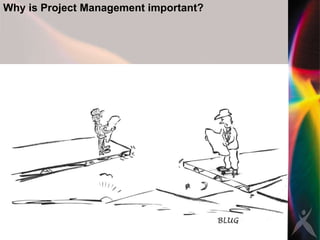
Why is Project Management important?
What is a Project? A temporary  endeavour  undertaken to   accomplish a  unique purpose
Project Methodology Describes every step in the  project life cycle in depth
Scope Management Risk Management Change Management Stakeholder Management Project Review Key Concepts
Scope  Management
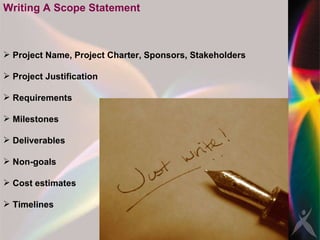
Writing A Scope Statement Project Name, Project Charter, Sponsors, Stakeholders Project Justification Requirements Milestones Deliverables Non-goals Cost estimates Timelines
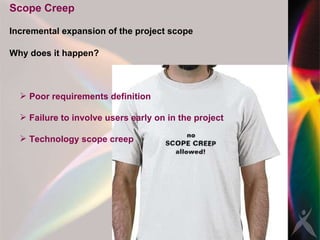
Scope Creep Incremental expansion of the project scope Why does it happen? Poor requirements definition Failure to involve users early on in the project Technology scope creep
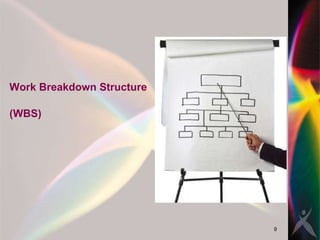
Work Breakdown Structure  (WBS)
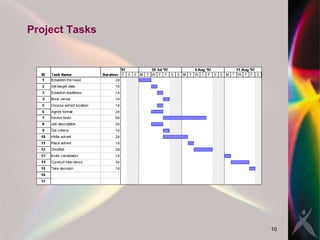
Project Tasks
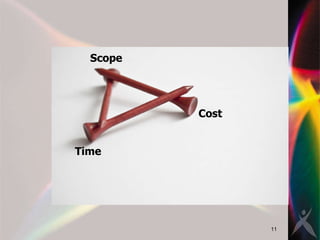
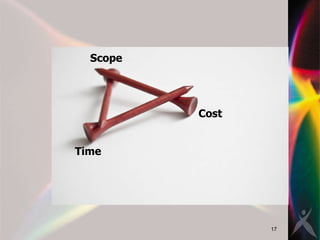
Scope Cost Time
Risk Management
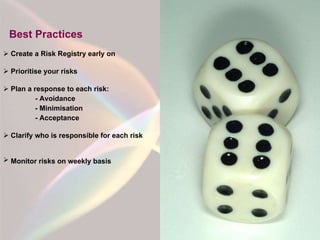
Best Practices Create a Risk Registry early on Prioritise your risks Plan a response to each risk: - Avoidance  - Minimisation  - Acceptance Clarify who is responsible for each risk Monitor risks on weekly basis
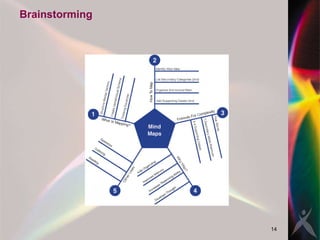
Brainstorming
 
Project Change Management
Scope Cost Time
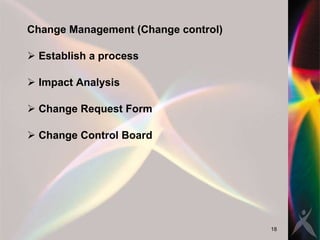
Change Management (Change control) Establish a process Impact Analysis Change Request Form Change Control Board
Stakeholders
Managing Stakeholders Identify who the stakeholders are View project from their perspective Ways to Influence
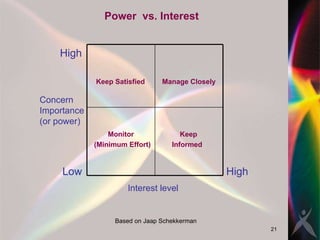
High Low High Concern Importance (or power) Interest level Based on Jaap Schekkerman   Power  vs. Interest Keep  Informed Monitor (Minimum Effort) Manage Closely Keep Satisfied
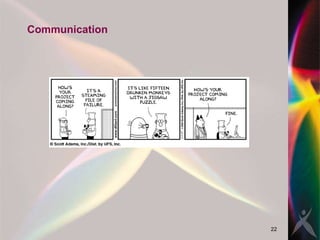
Communication
Project Post-Mortem
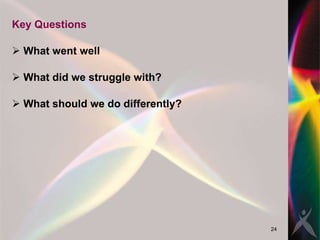
Key Questions What went well What did we struggle with? What should we do differently?
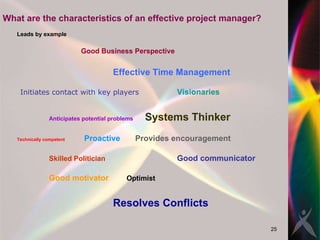
Leads by example Good Business Perspective Effective Time Management Initiates contact with key players Visionaries Anticipates potential problems Systems Thinker Technically competent   Proactive  Provides encouragement Skilled Politician Good communicator Good motivator  Optimist Resolves Conflicts What are the characteristics of an effective project manager?

Project Management 101

Editor's Notes

  • #2 La Sagrada Familia in Barcelona begun construction in 1882 – not expected to be finished till 2026
  • #3 Many reasons why projects fail – failure includes costs more, takes longer, nobody is happy, etc. Incomplete project scope Project stakeholders not committed or opposed No one keeping track of tasks, dependencies or ownership A project management process gives people a framework to operate from Research paper claimed that 78% of projects run using PRINCE2 methodology were successful vs 38% success rate without PRINCE2
  • #4 What a project isn’t: Explorations Creating the same thing multiple times A program No constraints on time, cost or performance
  • #5 … . , so you know exactly which tasks to complete, when and how. Whether you're an expert or a novice, it helps you complete tasks faster   Why do you need one? That way, you can apply the same approach to every project you undertake
  • #7 According to the Guide to the Project Management Body of Knowledge (PMBOK) "Project Scope Management includes the processes required to ensure that the project includes all the work required, and only the work required, to complete the project successfully. It is primarily concerned with defining and controlling what is or is not included in the project." [1]
  • #8 Use SMART goals Milestones are concrete evidence of progress – should be tied to deliverables – milestones help generate momentum Non-goals – important to state what is not in scope
  • #10 You build the WBS by starting with the end objective and then break down each objective into components and all steps necessary to complete the task. From this you can build a project scope plan or a statement of work (SOW)
  • #12 Each side represents a constraint – one side of the triangle cannot be changed without affecting the others Then ask: what’s The other constraint? QUALITY As a customer you get to pick two constraints but vendor must control the other one The discipline of project management is all about meeting these constraints
  • #14 Risk avoidance – reduce the project scope to avoid the risk Minimisation – might be to break down the project into smaller chunks
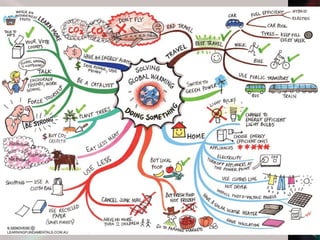
  • #15 Mind map is just a graphical presentation of a thought process Tony Buzan claims to have invented it – has certainly popularised – claims that traditional outlines force readers to scan left – right and top-bottom while readers actually tend to scan a page in a non-linear fashion Good for brainstorming and problem solving and outlining complexity in a project Research has shown it has an impact on memory recall (though limited)
  • #17 Change Management has many contexts – specifically we’re looking at how to control changes in projects
  • #19 Impact analysis on : scope, requirements, deliverables, schedule, resources and budget
  • #20 Why are stakeholders important? The benefits of using a stakeholder-based approach are that: You can use the opinions of the most powerful stakeholders to shape your projects at an early stage. Not only does this make it more likely that they will support you, their input can also improve the quality of your project. Gaining support from powerful stakeholders can help you to win more resources – this makes it more likely that your projects will be successful. By communicating with stakeholders early and often, you can ensure that they know what you are doing and fully understand the benefits of your project – this means they can support you actively when necessary. You can anticipate what people's reaction to your project may be, and build into your plan the actions that will win people's support.
  • #21 Stakeholders = Either involved or affected by project activities What roles they should play What they need from you What the project needs from them Who to build/nuture relationships with Who to inform and consult about project Stakeholders Perspective How do they view the project? What differences exist between the PM and stakeholders? What sources of influence does the PM have over stakeholders?
  • #24 Proj