BUSINESS
FUNDAMENTALS
SUPPLY and DEMAND
SUPPLY AND DEMAND
Supply
 represents willingness to sell

at certain price
 relationship between price

and the quantity supplied
(actually sell)

Demand
 represents willingness and

ability to buy at a certain price
 relationship between price and

quantity demanded (actually
buy)
SUPPLY
Is the quantity of goods or services that

businesses are willing and able to provide
within a range of prices that people would be
willing to pay
Law of Supply: the relationship of increasing

the quantity supplied as price increases.
CONDITIONS THAT AFFECT SUPPLY:
 Change in the number of producers (more

businesses, more supply, decrease in price)

 Price of related goods: (cost of IPODs increase

the demand for MP3 players increases)

 Change in technology: (MP3 technology makes

the availability demand for CD Walkmans
decrease and the supply of CD walkmans
increase)

 Change in the cost of production: (the lower the

cost of production the more that is produced,
consider resources)
DEMAND
Is the quantity of a good or service that

consumers are willing and able to buy at a
particular price.
Law of Demand: Consumers will increase the

quantity demanded of a good or service as
prices decease and the reverse as prices
increase
CONDITIONS THAT AFFECT DEMAND:
A change in consumer tastes, awareness

and interest in good or service
Change in consumer income

A change in consumer expectations of future

market conditions
A change in population
PRICE
is determined by supply and demand

and the cost of production.
SUPPLY AND DEMAND CURVE
Supply Curve
 Law of Supply
 the higher the price of the

product, the more the
producer will supply

Demand Curve
 Law of Demand
 the higher the price

of the product, the
less the consumer
will demand

 Positive relationship

with price, the curve is
upward sloping

 Negative relationship

with price, the curve
is downward
sloping
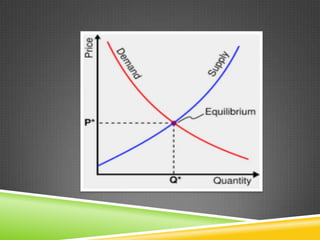
SUPPLY AND DEMAND CURVE
Equilibrium is reached when both curves

intersect.
 At this point, the price is just high enough so that the quantity

people want to buy is equal to the quantity business want to
sell
 the quantity demanded = the quantity supplied
Supply and Demand

Supply and Demand

  • 1.
  • 2.
    SUPPLY AND DEMAND Supply represents willingness to sell at certain price  relationship between price and the quantity supplied (actually sell) Demand  represents willingness and ability to buy at a certain price  relationship between price and quantity demanded (actually buy)
  • 3.
    SUPPLY Is the quantityof goods or services that businesses are willing and able to provide within a range of prices that people would be willing to pay Law of Supply: the relationship of increasing the quantity supplied as price increases.
  • 4.
    CONDITIONS THAT AFFECTSUPPLY:  Change in the number of producers (more businesses, more supply, decrease in price)  Price of related goods: (cost of IPODs increase the demand for MP3 players increases)  Change in technology: (MP3 technology makes the availability demand for CD Walkmans decrease and the supply of CD walkmans increase)  Change in the cost of production: (the lower the cost of production the more that is produced, consider resources)
  • 5.
    DEMAND Is the quantityof a good or service that consumers are willing and able to buy at a particular price. Law of Demand: Consumers will increase the quantity demanded of a good or service as prices decease and the reverse as prices increase
  • 6.
    CONDITIONS THAT AFFECTDEMAND: A change in consumer tastes, awareness and interest in good or service Change in consumer income A change in consumer expectations of future market conditions A change in population
  • 7.
    PRICE is determined bysupply and demand and the cost of production.
  • 8.
    SUPPLY AND DEMANDCURVE Supply Curve  Law of Supply  the higher the price of the product, the more the producer will supply Demand Curve  Law of Demand  the higher the price of the product, the less the consumer will demand  Positive relationship with price, the curve is upward sloping  Negative relationship with price, the curve is downward sloping
  • 9.
    SUPPLY AND DEMANDCURVE Equilibrium is reached when both curves intersect.  At this point, the price is just high enough so that the quantity people want to buy is equal to the quantity business want to sell  the quantity demanded = the quantity supplied