SUPPLY AND DEMAND
Supply and demand trends form the basis of the
modern economy. Each specific good or service will
have its own supply and demand patterns based on
price, utility and personal preference. If people
demand a good and are willing to pay more for it,
producers will add to the supply. As the supply
increases, the price will fall given the same level of
demand. Ideally, markets will reach a point of
equilibrium where the supply equals the demand (no
excess supply and no shortages) for a given price
point; at this point, consumer utility and producer
profits are maximized
LAW OF SUPPLY
Table of supply schedule
The relationship between price and quantity supplied is usually a
positive relationship. A rise in price is associated with a rise in quantity
supplied.
Definitions
— In the words of Dooley. "The law of supply states that other things
being equal the higher the price, the greater the quantity supplied or the
lower the price, the smaller the quantity supplied.“
— According to Lipsey, "The law of supply states that other things being
equal, the quantity of any commodity that firms will produce and offer for
sale is positively related to the commodity's own price, rising when price
rises and falling when price falls."
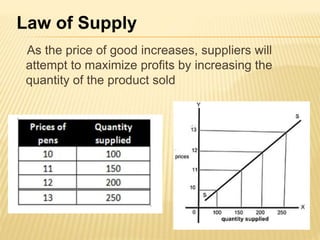
As the price of good increases, suppliers will
attempt to maximize profits by increasing the
quantity of the product sold
Law of Supply
ELASTICITY OF SUPPLY
The Price Elasticity of Supply measures the rate of
response of quantity demand due to a price change. If
you've already read
Elasticity of Demand and understand it, you may want to
just skim this section, as the calculations are similar
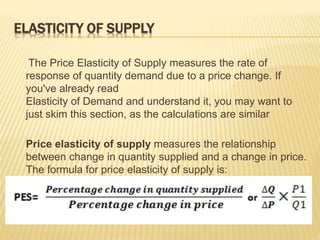
Price elasticity of supply measures the relationship
between change in quantity supplied and a change in price.
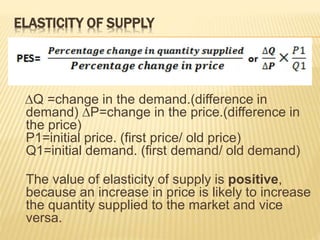
The formula for price elasticity of supply is:
ELASTICITY OF SUPPLY
∆Q =change in the demand.(difference in
demand) ∆P=change in the price.(difference in
the price)
P1=initial price. (first price/ old price)
Q1=initial demand. (first demand/ old demand)
The value of elasticity of supply is positive,
because an increase in price is likely to increase
the quantity supplied to the market and vice
versa.
FOUR TYPES OF ELASTICITIES OF SUPPLY
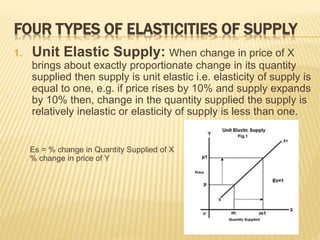
1. Unit Elastic Supply: When change in price of X
brings about exactly proportionate change in its quantity
supplied then supply is unit elastic i.e. elasticity of supply is
equal to one, e.g. if price rises by 10% and supply expands
by 10% then, change in the quantity supplied the supply is
relatively inelastic or elasticity of supply is less than one.
Es = % change in Quantity Supplied of X
% change in price of Y
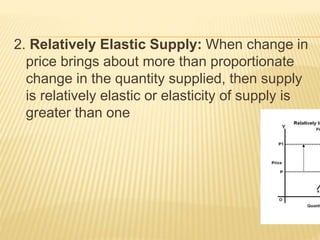
2. Relatively Elastic Supply: When change in
price brings about more than proportionate
change in the quantity supplied, then supply
is relatively elastic or elasticity of supply is
greater than one
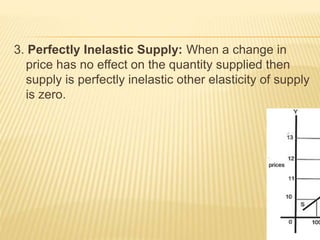
3. Perfectly Inelastic Supply: When a change in
price has no effect on the quantity supplied then
supply is perfectly inelastic other elasticity of supply
is zero.
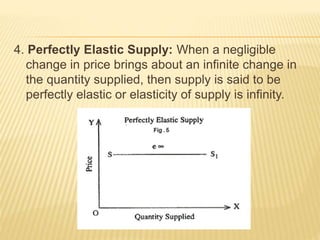
4. Perfectly Elastic Supply: When a negligible
change in price brings about an infinite change in
the quantity supplied, then supply is said to be
perfectly elastic or elasticity of supply is infinity.
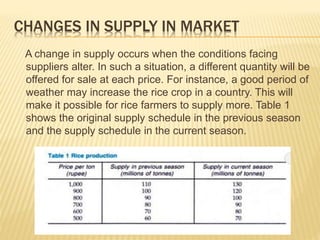
CHANGES IN SUPPLY IN MARKET
A change in supply occurs when the conditions facing
suppliers alter. In such a situation, a different quantity will be
offered for sale at each price. For instance, a good period of
weather may increase the rice crop in a country. This will
make it possible for rice farmers to supply more. Table 1
shows the original supply schedule in the previous season
and the supply schedule in the current season.
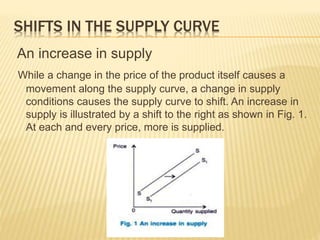
SHIFTS IN THE SUPPLY CURVE
An increase in supply
While a change in the price of the product itself causes a
movement along the supply curve, a change in supply
conditions causes the supply curve to shift. An increase in
supply is illustrated by a shift to the right as shown in Fig. 1.
At each and every price, more is supplied.
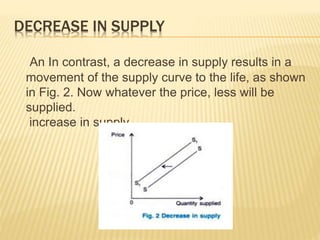
DECREASE IN SUPPLY
An In contrast, a decrease in supply results in a
movement of the supply curve to the life, as shown
in Fig. 2. Now whatever the price, less will be
supplied.
increase in supply
CAUSES OF CHANGES IN SUPPLY
Among the factors that can cause a change
in supply are changes in the costs of
production, improvements in technology,
taxes, subsidies, weather conditions, health
of livestock and crops. It is also affected by
the price of other products. Disasters, wars,
discoveries of new sources and depletion
also contribute to this change of
commodities.
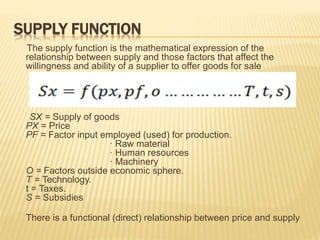
SUPPLY FUNCTION
The supply function is the mathematical expression of the
relationship between supply and those factors that affect the
willingness and ability of a supplier to offer goods for sale
SX = Supply of goods
PX = Price
PF = Factor input employed (used) for production.
· Raw material
· Human resources
· Machinery
O = Factors outside economic sphere.
T = Technology.
t = Taxes.
S = Subsidies
There is a functional (direct) relationship between price and supply
THANKS

Supply

  • 1.
    SUPPLY AND DEMAND Supplyand demand trends form the basis of the modern economy. Each specific good or service will have its own supply and demand patterns based on price, utility and personal preference. If people demand a good and are willing to pay more for it, producers will add to the supply. As the supply increases, the price will fall given the same level of demand. Ideally, markets will reach a point of equilibrium where the supply equals the demand (no excess supply and no shortages) for a given price point; at this point, consumer utility and producer profits are maximized
  • 2.
    LAW OF SUPPLY Tableof supply schedule The relationship between price and quantity supplied is usually a positive relationship. A rise in price is associated with a rise in quantity supplied. Definitions — In the words of Dooley. "The law of supply states that other things being equal the higher the price, the greater the quantity supplied or the lower the price, the smaller the quantity supplied.“ — According to Lipsey, "The law of supply states that other things being equal, the quantity of any commodity that firms will produce and offer for sale is positively related to the commodity's own price, rising when price rises and falling when price falls."
  • 3.
    As the priceof good increases, suppliers will attempt to maximize profits by increasing the quantity of the product sold Law of Supply
  • 4.
    ELASTICITY OF SUPPLY ThePrice Elasticity of Supply measures the rate of response of quantity demand due to a price change. If you've already read Elasticity of Demand and understand it, you may want to just skim this section, as the calculations are similar Price elasticity of supply measures the relationship between change in quantity supplied and a change in price. The formula for price elasticity of supply is:
  • 5.
    ELASTICITY OF SUPPLY ∆Q=change in the demand.(difference in demand) ∆P=change in the price.(difference in the price) P1=initial price. (first price/ old price) Q1=initial demand. (first demand/ old demand) The value of elasticity of supply is positive, because an increase in price is likely to increase the quantity supplied to the market and vice versa.
  • 6.
    FOUR TYPES OFELASTICITIES OF SUPPLY 1. Unit Elastic Supply: When change in price of X brings about exactly proportionate change in its quantity supplied then supply is unit elastic i.e. elasticity of supply is equal to one, e.g. if price rises by 10% and supply expands by 10% then, change in the quantity supplied the supply is relatively inelastic or elasticity of supply is less than one. Es = % change in Quantity Supplied of X % change in price of Y
  • 7.
    2. Relatively ElasticSupply: When change in price brings about more than proportionate change in the quantity supplied, then supply is relatively elastic or elasticity of supply is greater than one
  • 8.
    3. Perfectly InelasticSupply: When a change in price has no effect on the quantity supplied then supply is perfectly inelastic other elasticity of supply is zero.
  • 9.
    4. Perfectly ElasticSupply: When a negligible change in price brings about an infinite change in the quantity supplied, then supply is said to be perfectly elastic or elasticity of supply is infinity.
  • 10.
    CHANGES IN SUPPLYIN MARKET A change in supply occurs when the conditions facing suppliers alter. In such a situation, a different quantity will be offered for sale at each price. For instance, a good period of weather may increase the rice crop in a country. This will make it possible for rice farmers to supply more. Table 1 shows the original supply schedule in the previous season and the supply schedule in the current season.
  • 11.
    SHIFTS IN THESUPPLY CURVE An increase in supply While a change in the price of the product itself causes a movement along the supply curve, a change in supply conditions causes the supply curve to shift. An increase in supply is illustrated by a shift to the right as shown in Fig. 1. At each and every price, more is supplied.
  • 12.
    DECREASE IN SUPPLY AnIn contrast, a decrease in supply results in a movement of the supply curve to the life, as shown in Fig. 2. Now whatever the price, less will be supplied. increase in supply
  • 13.
    CAUSES OF CHANGESIN SUPPLY Among the factors that can cause a change in supply are changes in the costs of production, improvements in technology, taxes, subsidies, weather conditions, health of livestock and crops. It is also affected by the price of other products. Disasters, wars, discoveries of new sources and depletion also contribute to this change of commodities.
  • 14.
    SUPPLY FUNCTION The supplyfunction is the mathematical expression of the relationship between supply and those factors that affect the willingness and ability of a supplier to offer goods for sale SX = Supply of goods PX = Price PF = Factor input employed (used) for production. · Raw material · Human resources · Machinery O = Factors outside economic sphere. T = Technology. t = Taxes. S = Subsidies There is a functional (direct) relationship between price and supply
  • 15.