STAFF SUPERVISION
SHAMIMA AKTER
BOT, MRS (ENROLLING)
ASSISTANT PROFESSOR,
DEPARTMENT OF OCCUPATIONAL THERAPY
BANGLADESH HEALTH PROFESSIONS INSTITUTE
CENTRE FOR THE REHABILITATION OF THE PARALYSED
CHAPAIN, SAVAR
Supervision is:
“....a mutual process that fosters growth and
development, assures appropriate utilisation of
training and potential, encourages creativity
and innovation and provides guidance,
support, encouragement and respect while
working towards a goal.” (AOTA, 1994)
Continue...
 “....regular discussion between an individual
and his or her manager. It is used at all grade
levels to facilitate learning, offer guidance,
promote the sharing of information, air
concerns and problems and foster the
maintenance of standards. It gives support and
encouragement to staff as they develop skills
and confidence.” (Turner et. al., 1992)
3 Major Components of
Supervision
 Administrative
 Educational
 Supportive
To be an effective supervisor, you need to be
skilled at each of the three areas.
Administrative Supervision
Relates to ensuring that work is performed and
is performed in a manner that is consistent
with agency policies.
Some specific areas would focus on:
Caseworker contact and punctuality ( in terms
of meeting attendance and completing
paperwork)
Educational Supervision
@ Occasionally
referred to as a
clinical
supervision,
educational
supervision
involves teaching
a supervisee
skills while also
developing their
self-awareness at
the same time.
@ This is done by
analyzing the
social worker’s
interactions with
clients and then
teaching them
how to provide
specific services
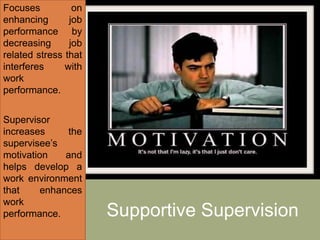
Supportive Supervision
Focuses on
enhancing job
performance by
decreasing job
related stress that
interferes with
work
performance.
Supervisor
increases the
supervisee’s
motivation and
helps develop a
work environment
that enhances
work
performance.
Importance of Supervision
 Supervision is the primary means through
which all applied mental health fields are
taught. However, supervision is a balancing
act. Good supervision is a skill of balancing
the needs of the clients.
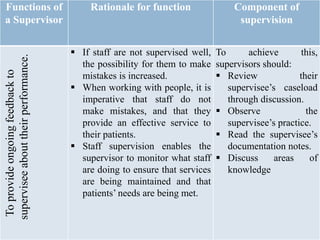
Functions of
a Supervisor
Rationale for function Component of
supervision
To
provide
ongoing
feedback
to
supervisee
about
their
performance.
 If staff are not supervised well,
the possibility for them to make
mistakes is increased.
 When working with people, it is
imperative that staff do not
make mistakes, and that they
provide an effective service to
their patients.
 Staff supervision enables the
supervisor to monitor what staff
are doing to ensure that services
are being maintained and that
patients’ needs are being met.
To achieve this,
supervisors should:
 Review their
supervisee’s caseload
through discussion.
 Observe the
supervisee’s practice.
 Read the supervisee’s
documentation notes.
 Discuss areas of
knowledge
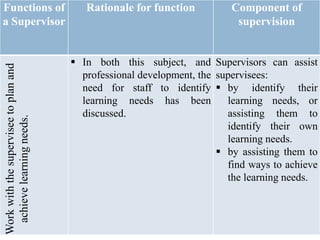
Functions of
a Supervisor
Rationale for function Component of
supervision
Work
with
the
supervisee
to
plan
and
achieve
learning
needs.
 In both this subject, and
professional development, the
need for staff to identify
learning needs has been
discussed.
Supervisors can assist
supervisees:
 by identify their
learning needs, or
assisting them to
identify their own
learning needs.
 by assisting them to
find ways to achieve
the learning needs.
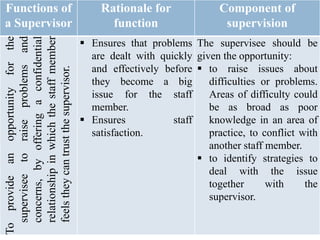
Functions of
a Supervisor
Rationale for
function
Component of
supervision
To
provide
an
opportunity
for
the
supervisee
to
raise
problems
and
concerns,
by
offering
a
confidential
relationship
in
which
the
staff
member
feels
they
can
trust
the
supervisor.
 Ensures that problems
are dealt with quickly
and effectively before
they become a big
issue for the staff
member.
 Ensures staff
satisfaction.
The supervisee should be
given the opportunity:
 to raise issues about
difficulties or problems.
Areas of difficulty could
be as broad as poor
knowledge in an area of
practice, to conflict with
another staff member.
 to identify strategies to
deal with the issue
together with the
supervisor.
Functions of
a Supervisor
Rationale for function Component of
supervision
To
offer
guidance
to
the
supervisee.
 Assists the
supervisee to
learn about a
variety of
different things.
 Provide the staff
member with
advice or guidance
about clinical
issues, dealing
with other staff,
making future
professional plans,
and other issues.
Functions
of a
Supervisor
Rationale for function Component of
supervision
To
act
as
a
role
model
to
the
supervisee.
 We often learn more from
“doing as others do, not as
they say”.
 An effective way of
learning is to observe the
behaviours and actions of
someone we look up to.
 Can assist in changing
inappropriate attitudes.
 Supervisor to role
model appropriate
behaviours and
actions at all
times.
Functions of a
Supervisor
Rationale for
function
Component of
supervision
 To motivate the
supervisee.
 Assists the
supervisee to
maintain interest
and enthusiasm.
 Provide positive
feedback
 Provide ideas
about future plans
How should staff supervision be
structured?
 Considering the structure of supervision is
essential to ensuring that supervision is
provided effectively.
 Supervision structure can differ significantly
from one organization to the next.
 However, there are a number of common
elements which assist in the provision of a
successful supervision program.
Who?
 Each staff member should have a dedicated
supervisor.
 The supervisor does not necessarily have to be
the manager of the department.
 Senior staff can supervise junior staff, and the
manager can supervise senior staff.
 Even the manager should seek supervision
from someone.
What?
 Supervision sessions should be an
opportunity for the staff member and his or
her supervisor to have detailed
discussions.
 Session times should be well planned in
advance. Supervision sessions should
last for approximately one hour.
Continue...
 An agenda can ensure that all required areas
are covered in the supervision session. Items
which should be included on a supervision
agenda include:
 a review of the staff member’s case load
 a discussion of the staff member’s learning needs
 an opportunity for the staff member to raise
concerns or issues
 Other items may need to be included on the
agenda in different work places.
When?
 As aforementioned, supervision sessions
should be scheduled in advance.
 The frequency of supervision will vary between
organisations and between individuals.
 For example, senior staff do not usually require
supervision as regularly as junior staff.
Continue...
 However, supervision sessions should be
planned to occur at regular intervals (such as
once a week, once a fortnight, once a month).
 Like other tasks that are not directly related to
our clinical caseload, supervision can be easily
overlooked.
 Ensuring that supervision sessions are
planned in advance means that staff are more
likely to make the effort to participate in
supervision.
Where?
 Supervision sessions should be conducted in
a quiet environment where the chance of
interruptions is minimal.
 Staff members are unlikely to feel comfortable
to tell their supervisor about confidential things
if they are in an environment where they are
likely to be interrupted or overheard.
THANKS A LOT
Supervision
Feedback to workers needs to be constructive.
Supervision needs criteria against which
performance can be measured. These ‘targets’
are recorded in the work plan.
Performance measurement techniques should
be broad and include quantitative (eg. four
newsletters produced) and qualitative (eg.
responds well to the hard of hearing).
Supervision
 Types of Supervision
Internal Supervision (Also called Management
or Administrative Supervision)
External Supervision (Also called Professional
Supervision)
Supportive supervision
Supervision
 Supportive supervision
“a process that promotes quality at all levels of
the health system by strengthening the
relationships within that system, with an
emphasis on identifying and solving problems
and contributing to the optimization of the
allocation of resources – promotion of high
standards, teamwork and better
communication in both directions.
Supervision
One of the cornerstones of supportive
supervision is to work with health staff to set
goals, monitor performance, identify and
correct problems and proactively improve
service quality.
Supervisor
Criteria of a good supervisor:
To be effective, a supervisor must have the
following criteria:
1. Technical competence
2. Managerial skill (Leadership qualities)
3. Initiative
4. Sense of responsibility
5. Tact and persuasion.
Supervisory styles
Dr.Kamal Ahmed MBBS.MPH.MPhil.
28
Talk but also listen; lead but also cooperate;
act but also interact.
A balanced style can help to maintain a mutually
beneficial supervisory relationship. The required
balance is often between complementary
activities that conflict only when one has too
great an emphasis, e.g., cooperation or
leadership, listening or talking, and focusing on
the relationship or the task. You might need to
set aside more time during supervision, or
manage time differently, to attend to both sides.
Supervisory styles
Dr.Kamal Ahmed MBBS.MPH.MPhil.
29
In order to position oneself in the center, that is,
to achieve a balance, it is necessary to do the
following:
 not focusing on ego-issues (i.e., taking
something personally)
 having an open attitude to embrace alternative
perspectives and new information
 maintaining a collaborative, problem solving
mindset
Supervisory styles
Dr.Kamal Ahmed MBBS.MPH.MPhil.
30
Gatfield (2005) has proposed four main
supervisory styles, based on a model utilising
'support' and 'structure'.
Supervisory styles
Dr.Kamal Ahmed MBBS.MPH.MPhil.
31
Pastoral Style

Low structure and high support

Candidate has personal low management skill
but takes advantage of all the support facilities
that are on offer

Supervisor provides considerable personal
care and support but not necessarily in a task-
driven, directive capacity
Supervisory styles
Dr.Kamal Ahmed MBBS.MPH.MPhil.
32
Contractual Style

High structure and high support

Candidate highly motivated and able to take
direction and to act on own initiative

Supervisor able to administer direction and
exercises good management skills and
interpersonal relationships
Supervisory styles
Dr.Kamal Ahmed MBBS.MPH.MPhil.
33
Laissez-faire Style

Low structure low support

Candidate has limited levels of motivation and
management skills

Supervisor in non-directive and not committed
to high levels of personal interaction

Supervisor may appear uncaring and
uninvolved
Supervisory styles
Dr.Kamal Ahmed MBBS.MPH.MPhil.
34
Directorial Style
 High structure and low support
 Candidate highly motivated and sees the
necessity to take advantage of engaging in high
structural activities such as setting objectives,
completing and submitting work on time on own
initiative without taking advantage of institutional
support
 Supervisor has a close and regular interactive
relationship with the candidate, but avoids non-
task issues

Supervision.pptx

  • 1.
    STAFF SUPERVISION SHAMIMA AKTER BOT,MRS (ENROLLING) ASSISTANT PROFESSOR, DEPARTMENT OF OCCUPATIONAL THERAPY BANGLADESH HEALTH PROFESSIONS INSTITUTE CENTRE FOR THE REHABILITATION OF THE PARALYSED CHAPAIN, SAVAR
  • 2.
    Supervision is: “....a mutualprocess that fosters growth and development, assures appropriate utilisation of training and potential, encourages creativity and innovation and provides guidance, support, encouragement and respect while working towards a goal.” (AOTA, 1994)
  • 3.
    Continue...  “....regular discussionbetween an individual and his or her manager. It is used at all grade levels to facilitate learning, offer guidance, promote the sharing of information, air concerns and problems and foster the maintenance of standards. It gives support and encouragement to staff as they develop skills and confidence.” (Turner et. al., 1992)
  • 4.
    3 Major Componentsof Supervision  Administrative  Educational  Supportive To be an effective supervisor, you need to be skilled at each of the three areas.
  • 5.
    Administrative Supervision Relates toensuring that work is performed and is performed in a manner that is consistent with agency policies. Some specific areas would focus on: Caseworker contact and punctuality ( in terms of meeting attendance and completing paperwork)
  • 6.
    Educational Supervision @ Occasionally referredto as a clinical supervision, educational supervision involves teaching a supervisee skills while also developing their self-awareness at the same time. @ This is done by analyzing the social worker’s interactions with clients and then teaching them how to provide specific services
  • 7.
    Supportive Supervision Focuses on enhancingjob performance by decreasing job related stress that interferes with work performance. Supervisor increases the supervisee’s motivation and helps develop a work environment that enhances work performance.
  • 8.
    Importance of Supervision Supervision is the primary means through which all applied mental health fields are taught. However, supervision is a balancing act. Good supervision is a skill of balancing the needs of the clients.
  • 9.
    Functions of a Supervisor Rationalefor function Component of supervision To provide ongoing feedback to supervisee about their performance.  If staff are not supervised well, the possibility for them to make mistakes is increased.  When working with people, it is imperative that staff do not make mistakes, and that they provide an effective service to their patients.  Staff supervision enables the supervisor to monitor what staff are doing to ensure that services are being maintained and that patients’ needs are being met. To achieve this, supervisors should:  Review their supervisee’s caseload through discussion.  Observe the supervisee’s practice.  Read the supervisee’s documentation notes.  Discuss areas of knowledge
  • 10.
    Functions of a Supervisor Rationalefor function Component of supervision Work with the supervisee to plan and achieve learning needs.  In both this subject, and professional development, the need for staff to identify learning needs has been discussed. Supervisors can assist supervisees:  by identify their learning needs, or assisting them to identify their own learning needs.  by assisting them to find ways to achieve the learning needs.
  • 11.
    Functions of a Supervisor Rationalefor function Component of supervision To provide an opportunity for the supervisee to raise problems and concerns, by offering a confidential relationship in which the staff member feels they can trust the supervisor.  Ensures that problems are dealt with quickly and effectively before they become a big issue for the staff member.  Ensures staff satisfaction. The supervisee should be given the opportunity:  to raise issues about difficulties or problems. Areas of difficulty could be as broad as poor knowledge in an area of practice, to conflict with another staff member.  to identify strategies to deal with the issue together with the supervisor.
  • 12.
    Functions of a Supervisor Rationalefor function Component of supervision To offer guidance to the supervisee.  Assists the supervisee to learn about a variety of different things.  Provide the staff member with advice or guidance about clinical issues, dealing with other staff, making future professional plans, and other issues.
  • 13.
    Functions of a Supervisor Rationale forfunction Component of supervision To act as a role model to the supervisee.  We often learn more from “doing as others do, not as they say”.  An effective way of learning is to observe the behaviours and actions of someone we look up to.  Can assist in changing inappropriate attitudes.  Supervisor to role model appropriate behaviours and actions at all times.
  • 14.
    Functions of a Supervisor Rationalefor function Component of supervision  To motivate the supervisee.  Assists the supervisee to maintain interest and enthusiasm.  Provide positive feedback  Provide ideas about future plans
  • 15.
    How should staffsupervision be structured?  Considering the structure of supervision is essential to ensuring that supervision is provided effectively.  Supervision structure can differ significantly from one organization to the next.  However, there are a number of common elements which assist in the provision of a successful supervision program.
  • 16.
    Who?  Each staffmember should have a dedicated supervisor.  The supervisor does not necessarily have to be the manager of the department.  Senior staff can supervise junior staff, and the manager can supervise senior staff.  Even the manager should seek supervision from someone.
  • 17.
    What?  Supervision sessionsshould be an opportunity for the staff member and his or her supervisor to have detailed discussions.  Session times should be well planned in advance. Supervision sessions should last for approximately one hour.
  • 18.
    Continue...  An agendacan ensure that all required areas are covered in the supervision session. Items which should be included on a supervision agenda include:  a review of the staff member’s case load  a discussion of the staff member’s learning needs  an opportunity for the staff member to raise concerns or issues  Other items may need to be included on the agenda in different work places.
  • 19.
    When?  As aforementioned,supervision sessions should be scheduled in advance.  The frequency of supervision will vary between organisations and between individuals.  For example, senior staff do not usually require supervision as regularly as junior staff.
  • 20.
    Continue...  However, supervisionsessions should be planned to occur at regular intervals (such as once a week, once a fortnight, once a month).  Like other tasks that are not directly related to our clinical caseload, supervision can be easily overlooked.  Ensuring that supervision sessions are planned in advance means that staff are more likely to make the effort to participate in supervision.
  • 21.
    Where?  Supervision sessionsshould be conducted in a quiet environment where the chance of interruptions is minimal.  Staff members are unlikely to feel comfortable to tell their supervisor about confidential things if they are in an environment where they are likely to be interrupted or overheard.
  • 22.
  • 23.
    Supervision Feedback to workersneeds to be constructive. Supervision needs criteria against which performance can be measured. These ‘targets’ are recorded in the work plan. Performance measurement techniques should be broad and include quantitative (eg. four newsletters produced) and qualitative (eg. responds well to the hard of hearing).
  • 24.
    Supervision  Types ofSupervision Internal Supervision (Also called Management or Administrative Supervision) External Supervision (Also called Professional Supervision) Supportive supervision
  • 25.
    Supervision  Supportive supervision “aprocess that promotes quality at all levels of the health system by strengthening the relationships within that system, with an emphasis on identifying and solving problems and contributing to the optimization of the allocation of resources – promotion of high standards, teamwork and better communication in both directions.
  • 26.
    Supervision One of thecornerstones of supportive supervision is to work with health staff to set goals, monitor performance, identify and correct problems and proactively improve service quality.
  • 27.
    Supervisor Criteria of agood supervisor: To be effective, a supervisor must have the following criteria: 1. Technical competence 2. Managerial skill (Leadership qualities) 3. Initiative 4. Sense of responsibility 5. Tact and persuasion.
  • 28.
    Supervisory styles Dr.Kamal AhmedMBBS.MPH.MPhil. 28 Talk but also listen; lead but also cooperate; act but also interact. A balanced style can help to maintain a mutually beneficial supervisory relationship. The required balance is often between complementary activities that conflict only when one has too great an emphasis, e.g., cooperation or leadership, listening or talking, and focusing on the relationship or the task. You might need to set aside more time during supervision, or manage time differently, to attend to both sides.
  • 29.
    Supervisory styles Dr.Kamal AhmedMBBS.MPH.MPhil. 29 In order to position oneself in the center, that is, to achieve a balance, it is necessary to do the following:  not focusing on ego-issues (i.e., taking something personally)  having an open attitude to embrace alternative perspectives and new information  maintaining a collaborative, problem solving mindset
  • 30.
    Supervisory styles Dr.Kamal AhmedMBBS.MPH.MPhil. 30 Gatfield (2005) has proposed four main supervisory styles, based on a model utilising 'support' and 'structure'.
  • 31.
    Supervisory styles Dr.Kamal AhmedMBBS.MPH.MPhil. 31 Pastoral Style  Low structure and high support  Candidate has personal low management skill but takes advantage of all the support facilities that are on offer  Supervisor provides considerable personal care and support but not necessarily in a task- driven, directive capacity
  • 32.
    Supervisory styles Dr.Kamal AhmedMBBS.MPH.MPhil. 32 Contractual Style  High structure and high support  Candidate highly motivated and able to take direction and to act on own initiative  Supervisor able to administer direction and exercises good management skills and interpersonal relationships
  • 33.
    Supervisory styles Dr.Kamal AhmedMBBS.MPH.MPhil. 33 Laissez-faire Style  Low structure low support  Candidate has limited levels of motivation and management skills  Supervisor in non-directive and not committed to high levels of personal interaction  Supervisor may appear uncaring and uninvolved
  • 34.
    Supervisory styles Dr.Kamal AhmedMBBS.MPH.MPhil. 34 Directorial Style  High structure and low support  Candidate highly motivated and sees the necessity to take advantage of engaging in high structural activities such as setting objectives, completing and submitting work on time on own initiative without taking advantage of institutional support  Supervisor has a close and regular interactive relationship with the candidate, but avoids non- task issues