Download to read offline
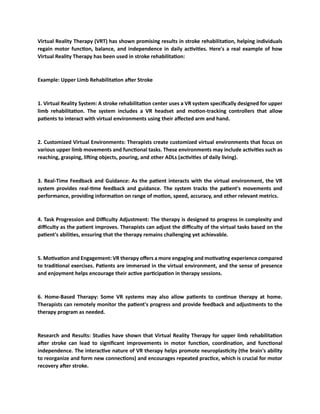
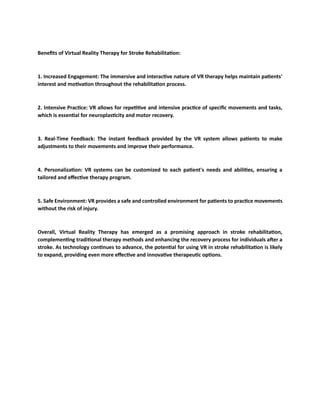

Virtual Reality Therapy (VRT) has shown promising results in stroke rehabilitation, helping individuals regain motor function, balance, and independence in daily activities. Here is an example: 1. A stroke rehabilitation center uses a VR system for upper limb rehabilitation with a headset and motion-tracking controllers. 2. Therapists create customized virtual environments focusing on upper limb movements and tasks like reaching and grasping. 3. The VR system provides real-time feedback and guidance on patients' movements and performance. 4. Therapy progresses in complexity as patients improve, with therapists adjusting difficulty levels. Studies show VRT can significantly improve motor function and coordination after stroke.


