




Prof. S. S. Bhange
“MAUT HALTEN UND WEITER DIENEN”
(“SHUT UP DO AS WAS TOLD.”)
 The motto of the prussian army‘s sergeant.
 “People become resources to be developed,
rather than human beings who are valued in
themselves and who are encouraged to choose
and shape their own future.”
Gareth Morgan
 “The assets make things possible
The people make things happen.”
Definition
Personnel Management is that part of the total
management which specially deals with human
resource in respect of:
1. Their procurement,
2. Their development in terms of skills, knowledge and
attitude,
3. Their motivation towards the attainment of
organisational objectives by creating and
maintaining an organisational climate to such
development.
Administrative discipline of hiring and developing
employees so that they become more valuable to the
organization.
It includes
(1) conducting job analyses,
(2) planning personnel needs, and recruitment,
(3) selecting the right people for the job,
(4) orienting and training,
(5) determining and managing wages and salaries,
(6) providing benefits and incentives,
(7) appraising performance,
(8) resolving disputes,
(9) communicating with all employees at all levels.
Personnel management is concerned with:
 Obtaining, developing and motivating the human
resources required by the organization to achive its
objectives.
 developing an organization structure and climate and
evolving a management style which will promote co-
operation and commitment thorughout the
organization.
Personnel management is concerned with:
 Making the best use of the skills and capacities of all
those employed in the organization,
 Ensuring that the organization meets its social and
legal responsibilities towards its employees, with
particulare regard to the condition of employment and
quality of working life provided for them.
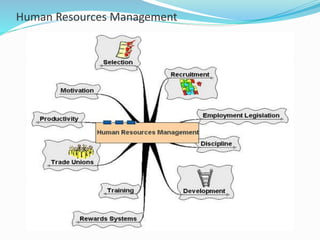
Human Resources Management
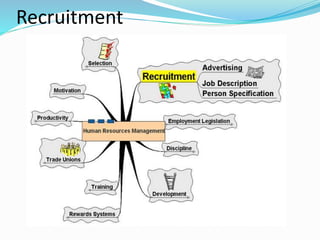
Recruitment
RECRUITMENT
The process of attracting
individuals in sufficient numbers
with the right skills and at
appropriate times to apply for open
positions within the organization.
Definition and Meaning of
Recruitment
 According to Edwin B. Flippo,“ Recruitment is the
process of searching the candidates for employment and
stimulating them to apply for jobs in the organization ”
 Meaning:
• Recruitment is the activity that links the employers and
the job seekers.
• A process of finding and attracting capable applicants for
employment
Recruitment needs are of three
types
 PLANNED
The needs arising from changes in organization and retirement
policy.
ANTICIPATED
Anticipated needs are those movements in personnel, which an
organization can predict by studying trends in internal and external
environment.
UNEXPECTED
Resignation, deaths, accidents, illness give rise to unexpected
needs.
IMPORTANCE OF RECRUITMENT
• Attract and encourage more and more candidates to apply
in the organisation.
• Create a talent pool of candidates to enable the selection of
best candidates for the organisation.
• Recruitment is the process which links the employers with
the employees.
• Increase the pool of job candidates at minimum cost.
• Help increase the success rate of selection process.
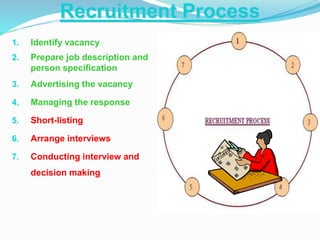
Recruitment Process
1. Identify vacancy
2. Prepare job description and
person specification
3. Advertising the vacancy
4. Managing the response
5. Short-listing
6. Arrange interviews
7. Conducting interview and
decision making
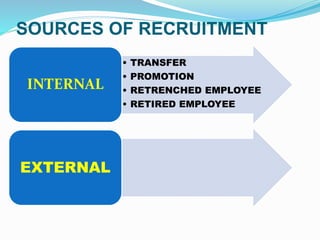
SOURCES OF RECRUITMENT
• TRANSFER
• PROMOTION
• RETRENCHED EMPLOYEE
• RETIRED EMPLOYEE
INTERNAL
EXTERNAL
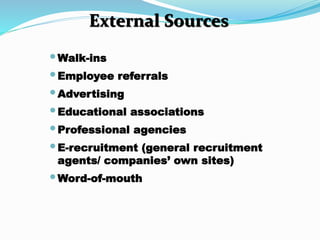
•Walk-ins
•Employee referrals
•Advertising
•Educational associations
•Professional agencies
•E-recruitment (general recruitment
agents/ companies’ own sites)
•Word-of-mouth
External Sources
Importance of Recruitment and Selection
• Helps to get a proper candidate.
• Help to increase success rate or individual &
organization.
• Help to reduce the probability of turnover
• Helps to get organizations legal and social obligations.
• Helps to increase organization and individual
effectiveness.
Orientation is the process of acquainting new employees with the
organization. Orientation topics range from such basic items as the
location of the company cafeteria to such concerns as various
career paths within the firm.
Hence we can say that induction or orientation is the process
through which a new employee is introduced to the job and the
organization.
In the words of Armstrong, induction is "the process of receiving
and welcoming an employee when he first joins a company and
giving him the basic information he needs to settle down quickly
and start work.
Definition: Orientation is a systematic and planned
introduction of employees to their jobs, their co-
workers and the organization.
It is also called as Induction.
Orientation is designed to provide a new employee
with the information he/she needs to function
comfortably and effectively in the organization.
Should be a process, not an event.
 To reduce start up costs (associated with job
learning)
 To reduce anxiety
 To reduce employee turnover
 To save time for supervisor & colleagues
 To Develop Realistic Job Expectations and Job
Satisfaction
The idea is to make the new employees feel ‘at home’ in
the new environment
Expedite proficiency
Enhance adjustment to work group and norms
Encourage positive attitude
The terms and conditions of employment
It helps a new employ to know the job, its content,
policies, rules & regulations and the people with whom he is
supposed to interact.
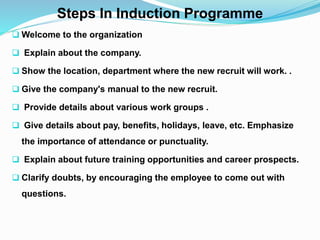
Steps In Induction Programme
 Welcome to the organization
 Explain about the company.
 Show the location, department where the new recruit will work. .
 Give the company's manual to the new recruit.
 Provide details about various work groups .
 Give details about pay, benefits, holidays, leave, etc. Emphasize
the importance of attendance or punctuality.
 Explain about future training opportunities and career prospects.
 Clarify doubts, by encouraging the employee to come out with
questions.
The areas covered in
employee induction
programme may be stated
as follows - CONTENT of
induction
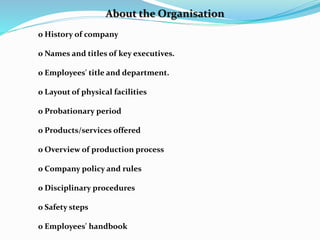
About the Organisation
o History of company
o Names and titles of key executives.
o Employees' title and department.
o Layout of physical facilities
o Probationary period
o Products/services offered
o Overview of production process
o Company policy and rules
o Disciplinary procedures
o Safety steps
o Employees' handbook
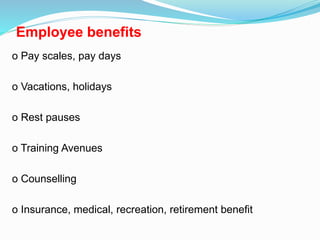
Employee benefits
o Pay scales, pay days
o Vacations, holidays
o Rest pauses
o Training Avenues
o Counselling
o Insurance, medical, recreation, retirement benefit
Job duties
 Job location
 o Job tasks
 o Job safety needs
 o Overview of jobs
 o Job objectives
 o Relationship with other jobs
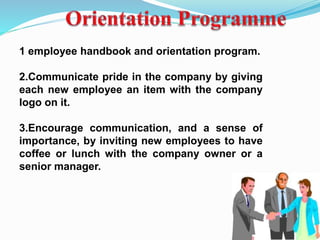
1 employee handbook and orientation program.
2.Communicate pride in the company by giving
each new employee an item with the company
logo on it.
3.Encourage communication, and a sense of
importance, by inviting new employees to have
coffee or lunch with the company owner or a
senior manager.
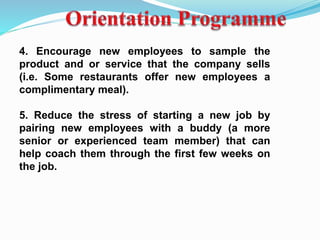
4. Encourage new employees to sample the
product and or service that the company sells
(i.e. Some restaurants offer new employees a
complimentary meal).
5. Reduce the stress of starting a new job by
pairing new employees with a buddy (a more
senior or experienced team member) that can
help coach them through the first few weeks on
the job.
Too much paperwork
high Cost to company
Only expenditure no income
Information overload
Too much “selling” of the organization
Too much one-way communication
Difficult for the employee to relate
Concept of Wage and Salary
Administration
Concept of Wage and Salary
Administration
 Refers to the establishment & implementation of
sound policies and practices of employee
compensation
 Includes areas as Job Evaluation, Surveys of Wages &
Salaries, Establishing rules for administering wages,
Profit Sharing, Wage changes & adjustments,
Supplementary payments, Control of compensation
costs
Purpose
 To establish & maintain an equitable wage & salary
structure and an equitable labour-cost structure.
Other objectives include:
 To recruit persons for a firm
 To control payroll costs
 To satisfy people, to reduce the incidence of quitting
grievances, & fractions over pay, &
 To motivate people to perform better
Important Definitions
 Compensation:
Money received in the performance of work , plus the
many kinds of benefits and services that organisations
provide their employees.
 Wages (or PAY)
The remuneration paid, for the service of labour in
production, periodically to an employee
 Difference between Wages and Salary
Wages: Hourly/daily rate, blue collar workers
Salary: weekly/Monthly rates, white Collar workers
The Wage determination Process
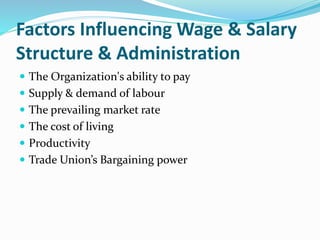
Factors Influencing Wage & Salary
Structure & Administration
 The Organization's ability to pay
 Supply & demand of labour
 The prevailing market rate
 The cost of living
 Productivity
 Trade Union’s Bargaining power
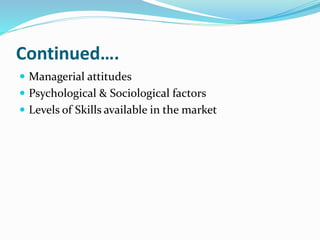
Continued….
 Managerial attitudes
 Psychological & Sociological factors
 Levels of Skills available in the market
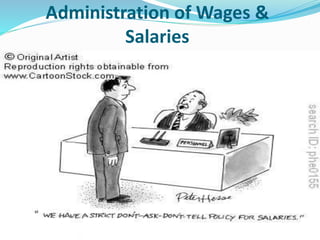
Administration of Wages &
Salaries
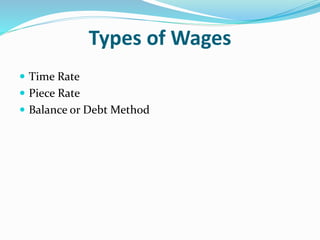
Types of Wages
 Time Rate
 Piece Rate
 Balance or Debt Method
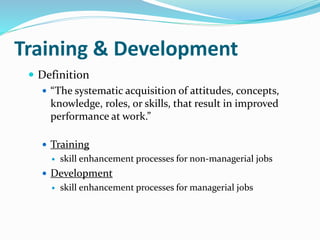
Training & Development
 Definition
 “The systematic acquisition of attitudes, concepts,
knowledge, roles, or skills, that result in improved
performance at work.”
 Training
 skill enhancement processes for non-managerial jobs
 Development
 skill enhancement processes for managerial jobs
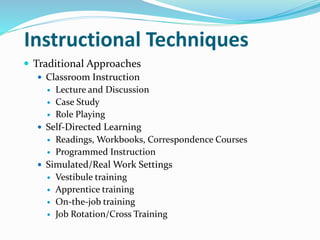
Instructional Techniques
 Traditional Approaches
 Classroom Instruction
 Lecture and Discussion
 Case Study
 Role Playing
 Self-Directed Learning
 Readings, Workbooks, Correspondence Courses
 Programmed Instruction
 Simulated/Real Work Settings
 Vestibule training
 Apprentice training
 On-the-job training
 Job Rotation/Cross Training
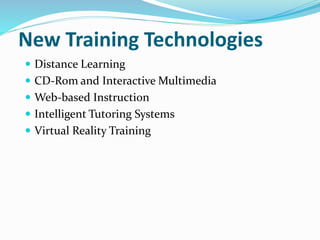
New Training Technologies
 Distance Learning
 CD-Rom and Interactive Multimedia
 Web-based Instruction
 Intelligent Tutoring Systems
 Virtual Reality Training

Personnel management by Prof.Saurabh S. Bhange

  • 1.
  • 2.
    “MAUT HALTEN UNDWEITER DIENEN” (“SHUT UP DO AS WAS TOLD.”)  The motto of the prussian army‘s sergeant.  “People become resources to be developed, rather than human beings who are valued in themselves and who are encouraged to choose and shape their own future.” Gareth Morgan  “The assets make things possible The people make things happen.”
  • 4.
    Definition Personnel Management isthat part of the total management which specially deals with human resource in respect of: 1. Their procurement, 2. Their development in terms of skills, knowledge and attitude, 3. Their motivation towards the attainment of organisational objectives by creating and maintaining an organisational climate to such development.
  • 6.
    Administrative discipline ofhiring and developing employees so that they become more valuable to the organization. It includes (1) conducting job analyses, (2) planning personnel needs, and recruitment, (3) selecting the right people for the job, (4) orienting and training, (5) determining and managing wages and salaries, (6) providing benefits and incentives, (7) appraising performance, (8) resolving disputes, (9) communicating with all employees at all levels.
  • 7.
    Personnel management isconcerned with:  Obtaining, developing and motivating the human resources required by the organization to achive its objectives.  developing an organization structure and climate and evolving a management style which will promote co- operation and commitment thorughout the organization.
  • 8.
    Personnel management isconcerned with:  Making the best use of the skills and capacities of all those employed in the organization,  Ensuring that the organization meets its social and legal responsibilities towards its employees, with particulare regard to the condition of employment and quality of working life provided for them.
  • 10.
  • 11.
  • 12.
    RECRUITMENT The process ofattracting individuals in sufficient numbers with the right skills and at appropriate times to apply for open positions within the organization.
  • 13.
    Definition and Meaningof Recruitment  According to Edwin B. Flippo,“ Recruitment is the process of searching the candidates for employment and stimulating them to apply for jobs in the organization ”  Meaning: • Recruitment is the activity that links the employers and the job seekers. • A process of finding and attracting capable applicants for employment
  • 14.
    Recruitment needs areof three types  PLANNED The needs arising from changes in organization and retirement policy. ANTICIPATED Anticipated needs are those movements in personnel, which an organization can predict by studying trends in internal and external environment. UNEXPECTED Resignation, deaths, accidents, illness give rise to unexpected needs.
  • 15.
    IMPORTANCE OF RECRUITMENT •Attract and encourage more and more candidates to apply in the organisation. • Create a talent pool of candidates to enable the selection of best candidates for the organisation. • Recruitment is the process which links the employers with the employees. • Increase the pool of job candidates at minimum cost. • Help increase the success rate of selection process.
  • 16.
    Recruitment Process 1. Identifyvacancy 2. Prepare job description and person specification 3. Advertising the vacancy 4. Managing the response 5. Short-listing 6. Arrange interviews 7. Conducting interview and decision making
  • 17.
    SOURCES OF RECRUITMENT •TRANSFER • PROMOTION • RETRENCHED EMPLOYEE • RETIRED EMPLOYEE INTERNAL EXTERNAL
  • 18.
    •Walk-ins •Employee referrals •Advertising •Educational associations •Professionalagencies •E-recruitment (general recruitment agents/ companies’ own sites) •Word-of-mouth External Sources
  • 19.
    Importance of Recruitmentand Selection • Helps to get a proper candidate. • Help to increase success rate or individual & organization. • Help to reduce the probability of turnover • Helps to get organizations legal and social obligations. • Helps to increase organization and individual effectiveness.
  • 21.
    Orientation is theprocess of acquainting new employees with the organization. Orientation topics range from such basic items as the location of the company cafeteria to such concerns as various career paths within the firm. Hence we can say that induction or orientation is the process through which a new employee is introduced to the job and the organization. In the words of Armstrong, induction is "the process of receiving and welcoming an employee when he first joins a company and giving him the basic information he needs to settle down quickly and start work.
  • 22.
    Definition: Orientation isa systematic and planned introduction of employees to their jobs, their co- workers and the organization. It is also called as Induction. Orientation is designed to provide a new employee with the information he/she needs to function comfortably and effectively in the organization. Should be a process, not an event.
  • 23.
     To reducestart up costs (associated with job learning)  To reduce anxiety  To reduce employee turnover  To save time for supervisor & colleagues  To Develop Realistic Job Expectations and Job Satisfaction
  • 24.
    The idea isto make the new employees feel ‘at home’ in the new environment Expedite proficiency Enhance adjustment to work group and norms Encourage positive attitude The terms and conditions of employment It helps a new employ to know the job, its content, policies, rules & regulations and the people with whom he is supposed to interact.
  • 25.
    Steps In InductionProgramme  Welcome to the organization  Explain about the company.  Show the location, department where the new recruit will work. .  Give the company's manual to the new recruit.  Provide details about various work groups .  Give details about pay, benefits, holidays, leave, etc. Emphasize the importance of attendance or punctuality.  Explain about future training opportunities and career prospects.  Clarify doubts, by encouraging the employee to come out with questions.
  • 26.
    The areas coveredin employee induction programme may be stated as follows - CONTENT of induction
  • 27.
    About the Organisation oHistory of company o Names and titles of key executives. o Employees' title and department. o Layout of physical facilities o Probationary period o Products/services offered o Overview of production process o Company policy and rules o Disciplinary procedures o Safety steps o Employees' handbook
  • 28.
    Employee benefits o Payscales, pay days o Vacations, holidays o Rest pauses o Training Avenues o Counselling o Insurance, medical, recreation, retirement benefit
  • 29.
    Job duties  Joblocation  o Job tasks  o Job safety needs  o Overview of jobs  o Job objectives  o Relationship with other jobs
  • 30.
    1 employee handbookand orientation program. 2.Communicate pride in the company by giving each new employee an item with the company logo on it. 3.Encourage communication, and a sense of importance, by inviting new employees to have coffee or lunch with the company owner or a senior manager.
  • 31.
    4. Encourage newemployees to sample the product and or service that the company sells (i.e. Some restaurants offer new employees a complimentary meal). 5. Reduce the stress of starting a new job by pairing new employees with a buddy (a more senior or experienced team member) that can help coach them through the first few weeks on the job.
  • 32.
    Too much paperwork highCost to company Only expenditure no income Information overload Too much “selling” of the organization Too much one-way communication Difficult for the employee to relate
  • 35.
    Concept of Wageand Salary Administration
  • 36.
    Concept of Wageand Salary Administration  Refers to the establishment & implementation of sound policies and practices of employee compensation  Includes areas as Job Evaluation, Surveys of Wages & Salaries, Establishing rules for administering wages, Profit Sharing, Wage changes & adjustments, Supplementary payments, Control of compensation costs
  • 37.
    Purpose  To establish& maintain an equitable wage & salary structure and an equitable labour-cost structure. Other objectives include:  To recruit persons for a firm  To control payroll costs  To satisfy people, to reduce the incidence of quitting grievances, & fractions over pay, &  To motivate people to perform better
  • 38.
    Important Definitions  Compensation: Moneyreceived in the performance of work , plus the many kinds of benefits and services that organisations provide their employees.  Wages (or PAY) The remuneration paid, for the service of labour in production, periodically to an employee  Difference between Wages and Salary Wages: Hourly/daily rate, blue collar workers Salary: weekly/Monthly rates, white Collar workers
  • 39.
  • 40.
    Factors Influencing Wage& Salary Structure & Administration  The Organization's ability to pay  Supply & demand of labour  The prevailing market rate  The cost of living  Productivity  Trade Union’s Bargaining power
  • 41.
    Continued….  Managerial attitudes Psychological & Sociological factors  Levels of Skills available in the market
  • 42.
  • 43.
    Types of Wages Time Rate  Piece Rate  Balance or Debt Method
  • 45.
    Training & Development Definition  “The systematic acquisition of attitudes, concepts, knowledge, roles, or skills, that result in improved performance at work.”  Training  skill enhancement processes for non-managerial jobs  Development  skill enhancement processes for managerial jobs
  • 46.
    Instructional Techniques  TraditionalApproaches  Classroom Instruction  Lecture and Discussion  Case Study  Role Playing  Self-Directed Learning  Readings, Workbooks, Correspondence Courses  Programmed Instruction  Simulated/Real Work Settings  Vestibule training  Apprentice training  On-the-job training  Job Rotation/Cross Training
  • 47.
    New Training Technologies Distance Learning  CD-Rom and Interactive Multimedia  Web-based Instruction  Intelligent Tutoring Systems  Virtual Reality Training