Supervision
 Supervision is not the act of instructing students—thatis, teaching—but
rather the actions that enable teachers to improveinstruction for
students.”
 Supervision process
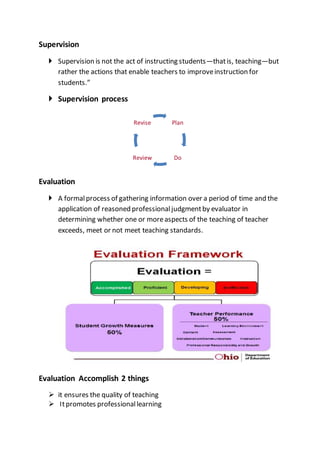
Evaluation
 A formalprocess of gathering information over a period of time and the
application of reasoned professionaljudgmentby evaluator in
determining whether one or moreaspects of the teaching of teacher
exceeds, meet or not meet teaching standards.
Evaluation Accomplish 2 things
 it ensures the quality of teaching
 Itpromotes professionallearning
Plan
DoReview
Revise
 Component of integrated of supervision and evaluation
 Goal setting
 Evaluation tool and instrument
 supervision and technique style
 focused assistance
6/7/2015
Division of
Education
Supervisory Styles
• Directive control
• Directive informational
• Collaborative
• Nondirective
Functions of supervision
 Set objectives /expectations
 Monitor performance /provide feedback
 Ensure supplies
 Address training anddevelopment needs
 Solve problems jointly
 Motivate andsupport providers toimprove performance
 What supervisors do?
 Translate the policies and objectives of the agency into specific work
duties and timelines;
 Select the jobs to be completed;
 Assign workers who willcomplete the jobs;
 Determine when the jobs will be completed;
 Review whether or not the work is being completed and up to agency
standards;
 Evaluate employees;
Circle of supervision
 Pre-observation ; A meeting between the teacher and evaluator to
determine the context of observation the purposeof the data collection
 observation; the evaluator will conduct the observation,typically in the
teacher classroom. A written summary is prepared and shared at the
post-observation.
 Post-observation; a meeting between the teacher and the evaluator to
collaboratively discuss theobservation.Descriptivefeedback provided to
the teacher
Differentiatedapproach3 supervisory choice for teacher
IntensiveDevelopment; a systematic, sequential and cycle supervisory
process that involves the interaction between supervisor and teacher
Cooperative development; a process of fostering teacher growth
through a systematic collaboration with the peers.
Self-directive development; the individual teacher works independently
on a programof a professionalgrowth
Staff development is an activity or process intended to improve skill,
attitude ,understanding or performancein presentor future roles [
Fullen 1990]
The only way we are going to get from wherewe are wherewe want to
be is through staff development
Quality supervision requires
 Clear and specific worker objectives.
 Awareness of worker’s needs.
 Willingness to facilitate the step-by-step progression of workers.
 A willingness to accept the diversity of workers including differences in
viewing the role of working, differences in motivation, differences in
interest and differences in cultural perspectives

Supervision

  • 1.
    Supervision  Supervision isnot the act of instructing students—thatis, teaching—but rather the actions that enable teachers to improveinstruction for students.”  Supervision process Evaluation  A formalprocess of gathering information over a period of time and the application of reasoned professionaljudgmentby evaluator in determining whether one or moreaspects of the teaching of teacher exceeds, meet or not meet teaching standards. Evaluation Accomplish 2 things  it ensures the quality of teaching  Itpromotes professionallearning Plan DoReview Revise
  • 2.
     Component ofintegrated of supervision and evaluation  Goal setting  Evaluation tool and instrument  supervision and technique style  focused assistance 6/7/2015 Division of Education Supervisory Styles • Directive control • Directive informational • Collaborative • Nondirective Functions of supervision  Set objectives /expectations  Monitor performance /provide feedback  Ensure supplies  Address training anddevelopment needs  Solve problems jointly  Motivate andsupport providers toimprove performance  What supervisors do?  Translate the policies and objectives of the agency into specific work duties and timelines;  Select the jobs to be completed;  Assign workers who willcomplete the jobs;  Determine when the jobs will be completed;  Review whether or not the work is being completed and up to agency standards;  Evaluate employees;
  • 3.
    Circle of supervision Pre-observation ; A meeting between the teacher and evaluator to determine the context of observation the purposeof the data collection  observation; the evaluator will conduct the observation,typically in the teacher classroom. A written summary is prepared and shared at the post-observation.  Post-observation; a meeting between the teacher and the evaluator to collaboratively discuss theobservation.Descriptivefeedback provided to the teacher Differentiatedapproach3 supervisory choice for teacher IntensiveDevelopment; a systematic, sequential and cycle supervisory process that involves the interaction between supervisor and teacher Cooperative development; a process of fostering teacher growth through a systematic collaboration with the peers. Self-directive development; the individual teacher works independently on a programof a professionalgrowth Staff development is an activity or process intended to improve skill, attitude ,understanding or performancein presentor future roles [ Fullen 1990] The only way we are going to get from wherewe are wherewe want to be is through staff development Quality supervision requires  Clear and specific worker objectives.  Awareness of worker’s needs.  Willingness to facilitate the step-by-step progression of workers.  A willingness to accept the diversity of workers including differences in viewing the role of working, differences in motivation, differences in interest and differences in cultural perspectives