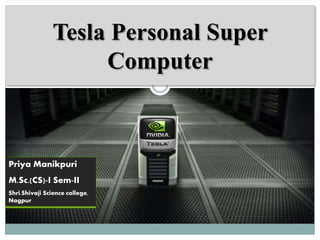
Tesla Personal Super
Computer
Priya Manikpuri
M.Sc.(CS)-I Sem-II
Shri.Shivaji Science college,
Nagpur
Contents
1. Introduction
2. Features
3. GPU Computing
4. CUDA parallel architecture and programming model.
5. Tesla C1060 Specifications and architecture.
6. Advantaged and Disadvantages
7. Future Scope
8. Conclusion
Introduction
 GPU-based desktop computer
 backed by NVIDIA
 built by Dell, Lenovo and other companies
 NVIDIA's CUDA parallel computing architecture
 933 Gigaflops peak performance
 250 times faster than standard PCs
 Tesla certified system, Windows XP(32 –bit) and Linux (64-bit and 32-
bit )are the supported platforms.
Features
 Multi-GPU Computing
 Massively Multi-threaded Computing Architecture
 4 GB High-Speed Memory per GPU
 High Speed , PCI-Express Gen 2.0 Data Transfer
 64-bit ALUs for Double-Precision Math
GPU Computing
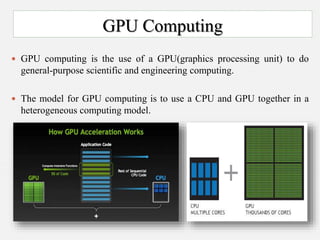
 GPU computing is the use of a GPU(graphics processing unit) to do
general-purpose scientific and engineering computing.
 The model for GPU computing is to use a CPU and GPU together in a
heterogeneous computing model.
CUDA Parallel Architecture and Programming
Model
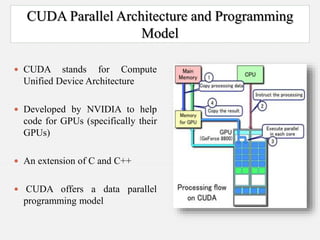
 CUDA stands for Compute
Unified Device Architecture
 Developed by NVIDIA to help
code for GPUs (specifically their
GPUs)
 An extension of C and C++
 CUDA offers a data parallel
programming model
Tesla C1060 Computing Processor
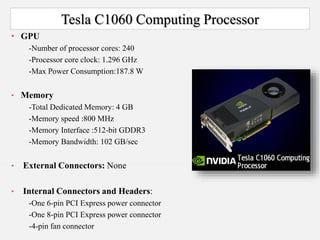
• GPU
-Number of processor cores: 240
-Processor core clock: 1.296 GHz
-Max Power Consumption:187.8 W
• Memory
-Total Dedicated Memory: 4 GB
-Memory speed :800 MHz
-Memory Interface :512-bit GDDR3
-Memory Bandwidth: 102 GB/sec
• External Connectors: None
• Internal Connectors and Headers:
-One 6-pin PCI Express power connector
-One 8-pin PCI Express power connector
-4-pin fan connector
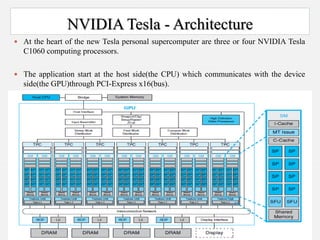
 At the heart of the new Tesla personal supercomputer are three or four NVIDIA Tesla
C1060 computing processors.
 The application start at the host side(the CPU) which communicates with the device
side(the GPU)through PCI-Express x16(bus).

NVIDIA Tesla - Architecture
 Tesla C1060 comprises of 30 Streaming
multiprocessors(SMs).
 The SM is the processing unit, and it is unified
graphics and computing multiprocessor.
 Each SM is comprised of eight scalar processors
(SPs) , 16-kb of shared chip memory, and
16,884 32-bit registers.
 Each SM has two single-precision
transcendental (Special Functions ,SF) units to
carry out transcendental functions.
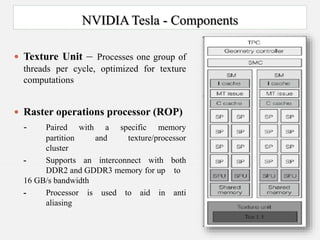
NVIDIA Tesla - Components
 Texture Unit – Processes one group of
threads per cycle, optimized for texture
computations
 Raster operations processor (ROP)
- Paired with a specific memory
partition and texture/processor
cluster
- Supports an interconnect with both
DDR2 and GDDR3 memory for up to
16 GB/s bandwidth
- Processor is used to aid in anti
aliasing
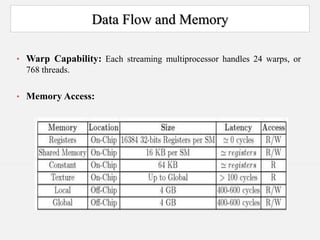
• Warp Capability: Each streaming multiprocessor handles 24 warps, or
768 threads.
• Memory Access:
Data Flow and Memory
• Memory and Interconnect:
 Bus of 384 pins with 6 independent partitions (Means many possible
connections)
 Use GDDR3 RAM, which has much higher bandwidth, though
requires more power, than DDR DRAM
 Memory traffic within the chip goes through a specific component of
the hardware that combines the various components together (the
ROP)
Data Flow and Memory
Advantages and Disadvantages
 Advantages:
 Your own Supercomputer
 Designed for Office Use
 Solve Large-scale Problems using Multiple GPUs
 They can be used in medical applications for processing brain and
body scans, resulting in faster diagnosis.
 Disadvantages:
 Overheating: If a GPU hits the maximum temperature, the driver throttles
down performance and shutdown the system.
 CUDA does not support the full C standard, as it runs host code through a
C++ compiler, which makes some valid C (but invalid C++) code fail to
compile.
Future Scope
 Although at £4,000 and £8,000 it is beyond the reach of most
consumers, the high-performance processor could become invaluable to
universities and medical institutions.
 The NVIDIA’s Tesla computer could prove invaluable to medical
researchers and accelerate the discovery cures for diseases.
 With the massively parallel architecture of the GPU, scientists and
engineers can get a quantum jump in performance and continue to
advance the pace of their work, guiding us to faster discovery in drug
research, weather modeling, oil and gas exploration, computational
finance, and more
Conclusion
 The technology represents a great leap forward in the history of
computing.
 The new computers make innovative use of graphics processing units
 The Tesla Personal Supercomputer doesn't make supercomputing
clusters obsolete but it's a major breakthrough for millions of
researchers who can take advantage of the huge heterogeneous
computing power of this system
 These supercomputers can improve the time it takes to process
information by 1,000 times.
THANK
YOU

Tesla personal super computer

  • 1.
    Tesla Personal Super Computer PriyaManikpuri M.Sc.(CS)-I Sem-II Shri.Shivaji Science college, Nagpur
  • 2.
    Contents 1. Introduction 2. Features 3.GPU Computing 4. CUDA parallel architecture and programming model. 5. Tesla C1060 Specifications and architecture. 6. Advantaged and Disadvantages 7. Future Scope 8. Conclusion
  • 3.
    Introduction  GPU-based desktopcomputer  backed by NVIDIA  built by Dell, Lenovo and other companies  NVIDIA's CUDA parallel computing architecture  933 Gigaflops peak performance  250 times faster than standard PCs  Tesla certified system, Windows XP(32 –bit) and Linux (64-bit and 32- bit )are the supported platforms.
  • 4.
    Features  Multi-GPU Computing Massively Multi-threaded Computing Architecture  4 GB High-Speed Memory per GPU  High Speed , PCI-Express Gen 2.0 Data Transfer  64-bit ALUs for Double-Precision Math
  • 5.
    GPU Computing  GPUcomputing is the use of a GPU(graphics processing unit) to do general-purpose scientific and engineering computing.  The model for GPU computing is to use a CPU and GPU together in a heterogeneous computing model.
  • 6.
    CUDA Parallel Architectureand Programming Model  CUDA stands for Compute Unified Device Architecture  Developed by NVIDIA to help code for GPUs (specifically their GPUs)  An extension of C and C++  CUDA offers a data parallel programming model
  • 7.
    Tesla C1060 ComputingProcessor • GPU -Number of processor cores: 240 -Processor core clock: 1.296 GHz -Max Power Consumption:187.8 W • Memory -Total Dedicated Memory: 4 GB -Memory speed :800 MHz -Memory Interface :512-bit GDDR3 -Memory Bandwidth: 102 GB/sec • External Connectors: None • Internal Connectors and Headers: -One 6-pin PCI Express power connector -One 8-pin PCI Express power connector -4-pin fan connector
  • 8.
     At theheart of the new Tesla personal supercomputer are three or four NVIDIA Tesla C1060 computing processors.  The application start at the host side(the CPU) which communicates with the device side(the GPU)through PCI-Express x16(bus).  NVIDIA Tesla - Architecture
  • 9.
     Tesla C1060comprises of 30 Streaming multiprocessors(SMs).  The SM is the processing unit, and it is unified graphics and computing multiprocessor.  Each SM is comprised of eight scalar processors (SPs) , 16-kb of shared chip memory, and 16,884 32-bit registers.  Each SM has two single-precision transcendental (Special Functions ,SF) units to carry out transcendental functions. NVIDIA Tesla - Components
  • 10.
    NVIDIA Tesla -Components  Texture Unit – Processes one group of threads per cycle, optimized for texture computations  Raster operations processor (ROP) - Paired with a specific memory partition and texture/processor cluster - Supports an interconnect with both DDR2 and GDDR3 memory for up to 16 GB/s bandwidth - Processor is used to aid in anti aliasing
  • 11.
    • Warp Capability:Each streaming multiprocessor handles 24 warps, or 768 threads. • Memory Access: Data Flow and Memory
  • 12.
    • Memory andInterconnect:  Bus of 384 pins with 6 independent partitions (Means many possible connections)  Use GDDR3 RAM, which has much higher bandwidth, though requires more power, than DDR DRAM  Memory traffic within the chip goes through a specific component of the hardware that combines the various components together (the ROP) Data Flow and Memory
  • 13.
    Advantages and Disadvantages Advantages:  Your own Supercomputer  Designed for Office Use  Solve Large-scale Problems using Multiple GPUs  They can be used in medical applications for processing brain and body scans, resulting in faster diagnosis.  Disadvantages:  Overheating: If a GPU hits the maximum temperature, the driver throttles down performance and shutdown the system.  CUDA does not support the full C standard, as it runs host code through a C++ compiler, which makes some valid C (but invalid C++) code fail to compile.
  • 14.
    Future Scope  Althoughat £4,000 and £8,000 it is beyond the reach of most consumers, the high-performance processor could become invaluable to universities and medical institutions.  The NVIDIA’s Tesla computer could prove invaluable to medical researchers and accelerate the discovery cures for diseases.  With the massively parallel architecture of the GPU, scientists and engineers can get a quantum jump in performance and continue to advance the pace of their work, guiding us to faster discovery in drug research, weather modeling, oil and gas exploration, computational finance, and more
  • 15.
    Conclusion  The technologyrepresents a great leap forward in the history of computing.  The new computers make innovative use of graphics processing units  The Tesla Personal Supercomputer doesn't make supercomputing clusters obsolete but it's a major breakthrough for millions of researchers who can take advantage of the huge heterogeneous computing power of this system  These supercomputers can improve the time it takes to process information by 1,000 times.
  • 16.