Computer Classification
These days,a variety of computer technology classes
are offered.
Each computer may have a different set of methods
or procedures, size, capacity, attributes, and ways of
handling data.
Computer Classification
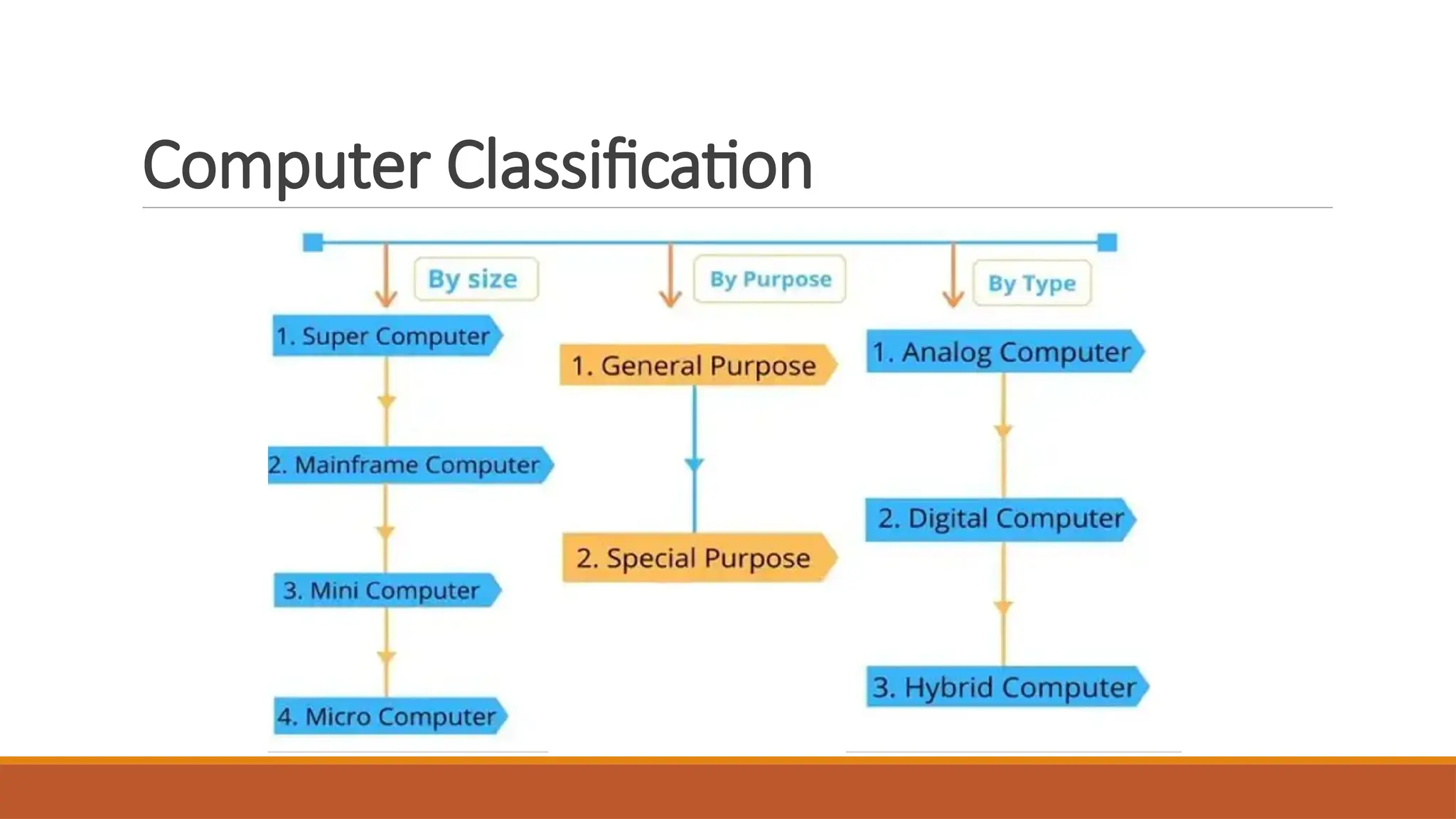
By Sizeand Capacity, [Supercomputer, Mainframe, Mini, and Micro Computer].
By Purpose [General and Special Purpose].
By Type [Analog, Digital, and Hybrid Computer].
5.
Classification According toSize
Supercomputers
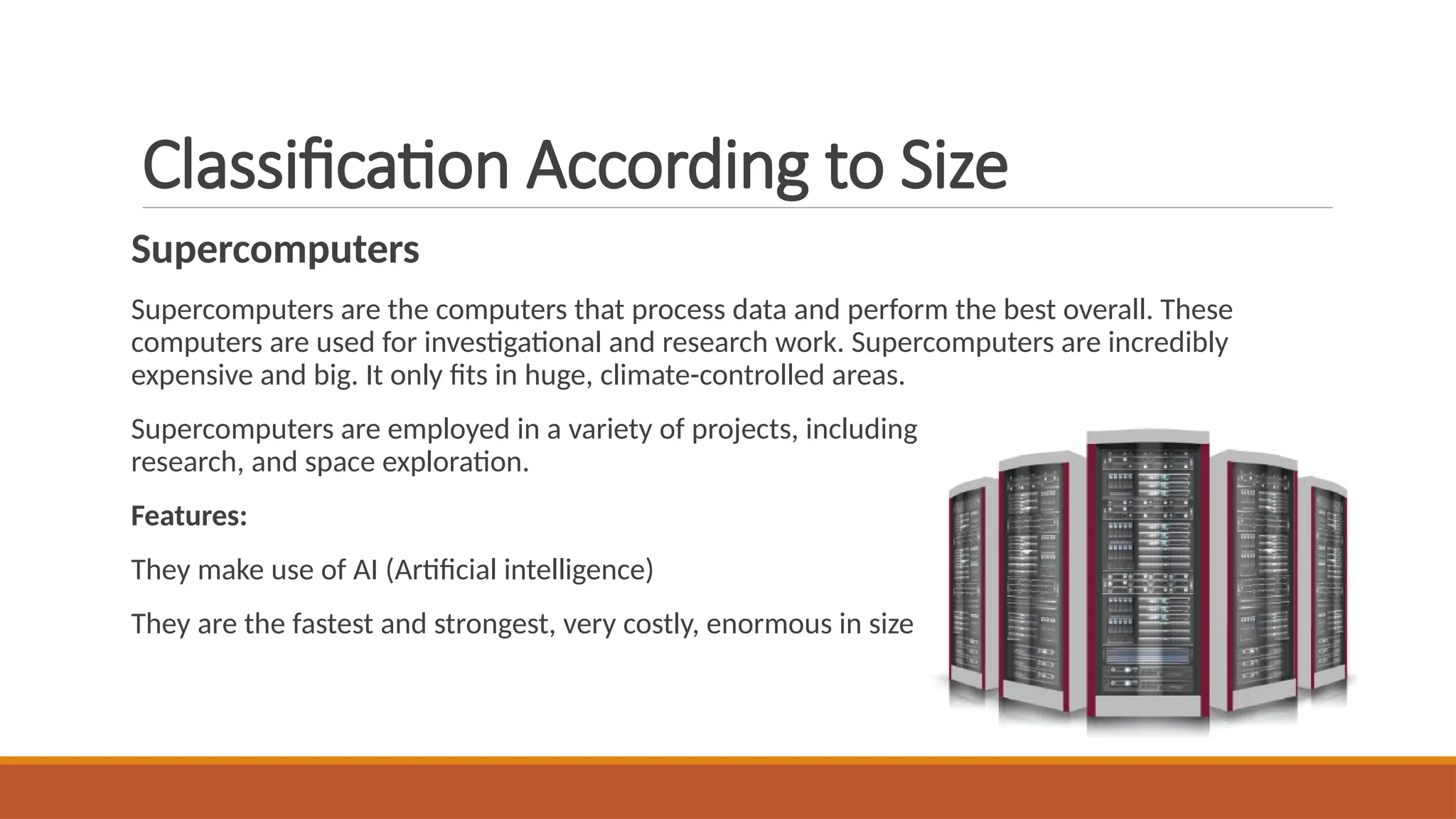
Supercomputers are the computers that process data and perform the best overall. These
computers are used for investigational and research work. Supercomputers are incredibly
expensive and big. It only fits in huge, climate-controlled areas.
Supercomputers are employed in a variety of projects, including nuclear weapon testing, seismic
research, and space exploration.
Features:
They make use of AI (Artificial intelligence)
They are the fastest and strongest, very costly, enormous in size
6.
Classification According toSize
Mainframe computers
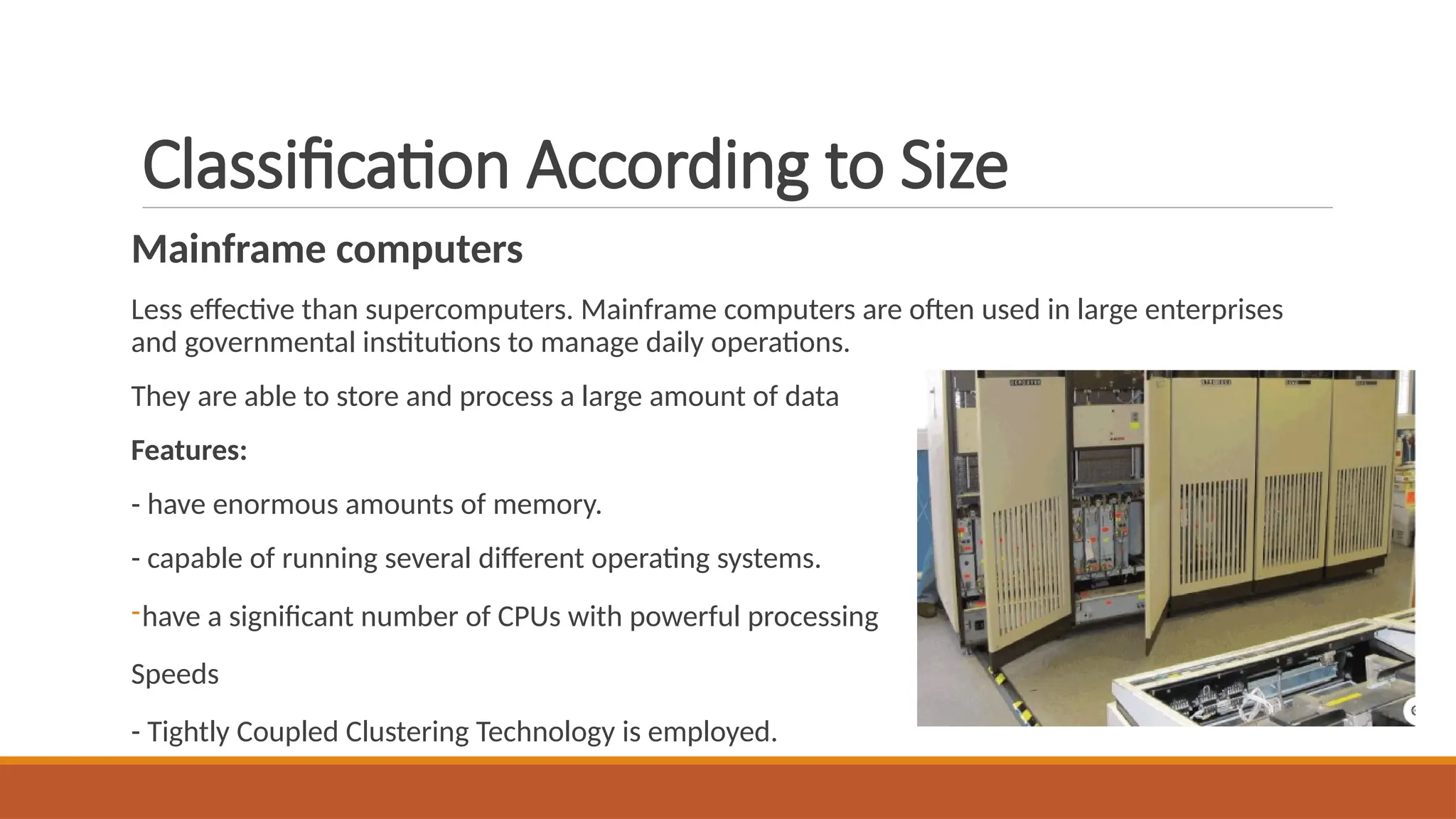
Less effective than supercomputers. Mainframe computers are often used in large enterprises
and governmental institutions to manage daily operations.
They are able to store and process a large amount of data
Features:
- have enormous amounts of memory.
- capable of running several different operating systems.
-have a significant number of CPUs with powerful processing
Speeds
- Tightly Coupled Clustering Technology is employed.
7.
Classification According toSize
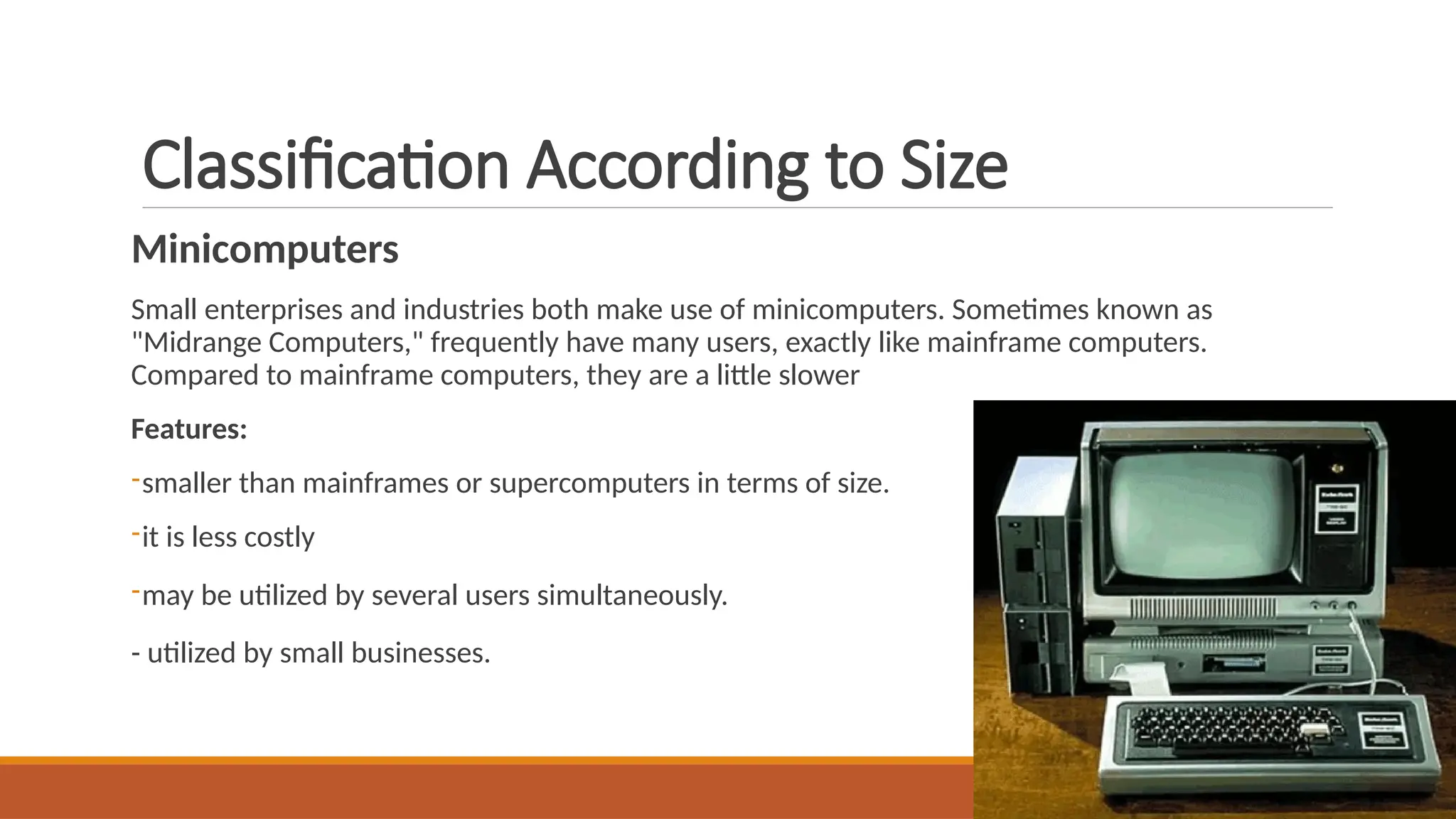
Minicomputers
Small enterprises and industries both make use of minicomputers. Sometimes known as
"Midrange Computers," frequently have many users, exactly like mainframe computers.
Compared to mainframe computers, they are a little slower
Features:
-smaller than mainframes or supercomputers in terms of size.
-it is less costly
-may be utilized by several users simultaneously.
- utilized by small businesses.
8.
Classification According toSize
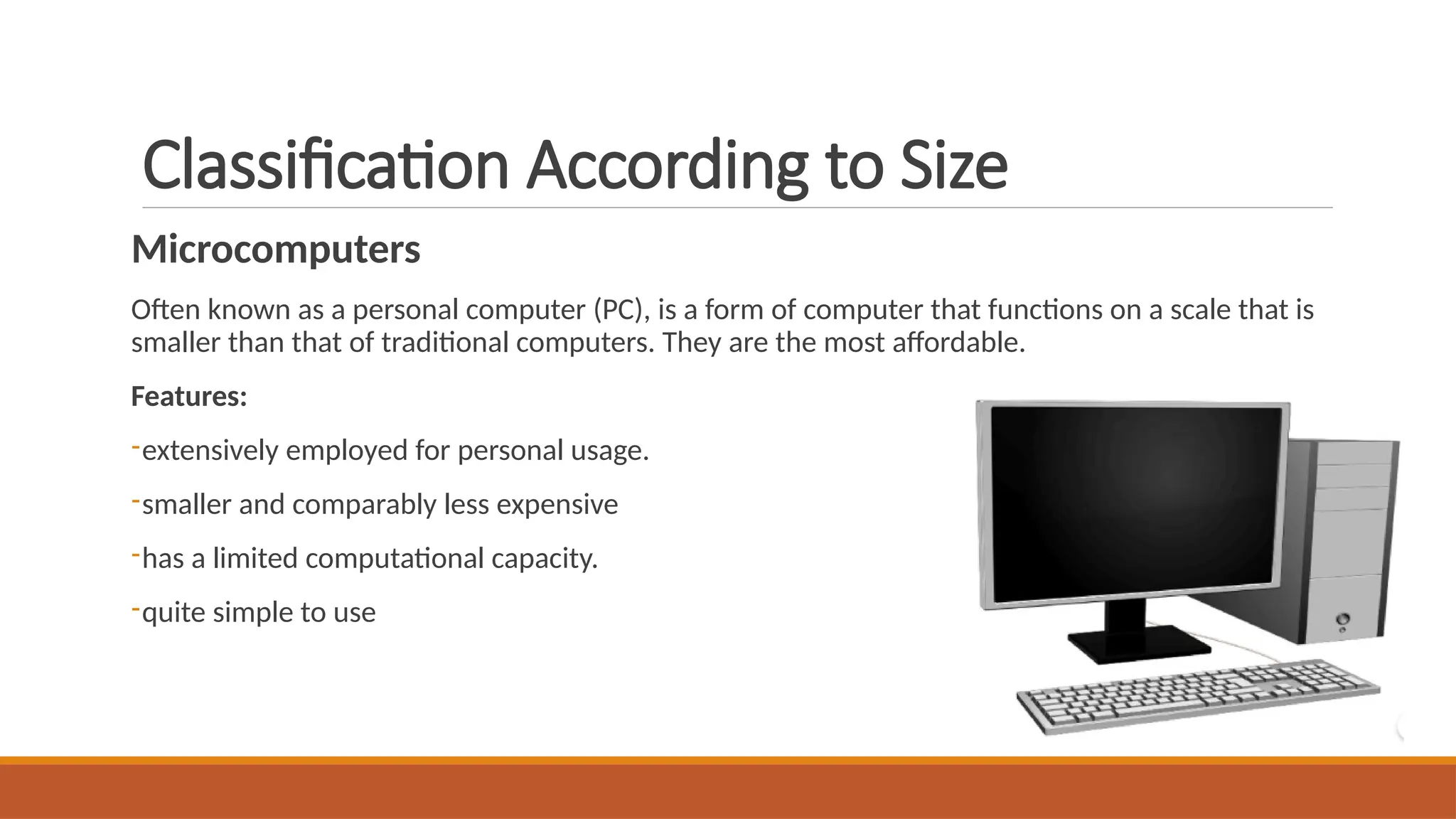
Microcomputers
Often known as a personal computer (PC), is a form of computer that functions on a scale that is
smaller than that of traditional computers. They are the most affordable.
Features:
-extensively employed for personal usage.
-smaller and comparably less expensive
-has a limited computational capacity.
-quite simple to use
9.
Classification According toPurpose
General Purpose
Can do various everyday tasks such as writing a word processing letter, Document preparation,
recording, financial analysis, Printing documents, creating databases, and calculations with
accuracy and consistency
It has versatility and useful for serving people’s basic needs at
home or in the workplace in the environment.
Examples:
Desktops, laptops, smartphones, and tablets
10.
Classification According toPurpose
Special Purpose
These computers are designed to perform a particular or specialized task.
The size, storage capacity, and cost of such computers mainly depend on the nature and size of
the work
It needs specific and input and devices as well as a compatible motherboard with the
processor to conduct work efficiently.
Examples:
Automatic teller machines (ATM), Washing machines, Surveillance equipment, Weather-
forecasting simulators, Traffic-control computers, Military planes controlling computers.
11.
Classification According toHardware
Design and Data Handling (By Type)
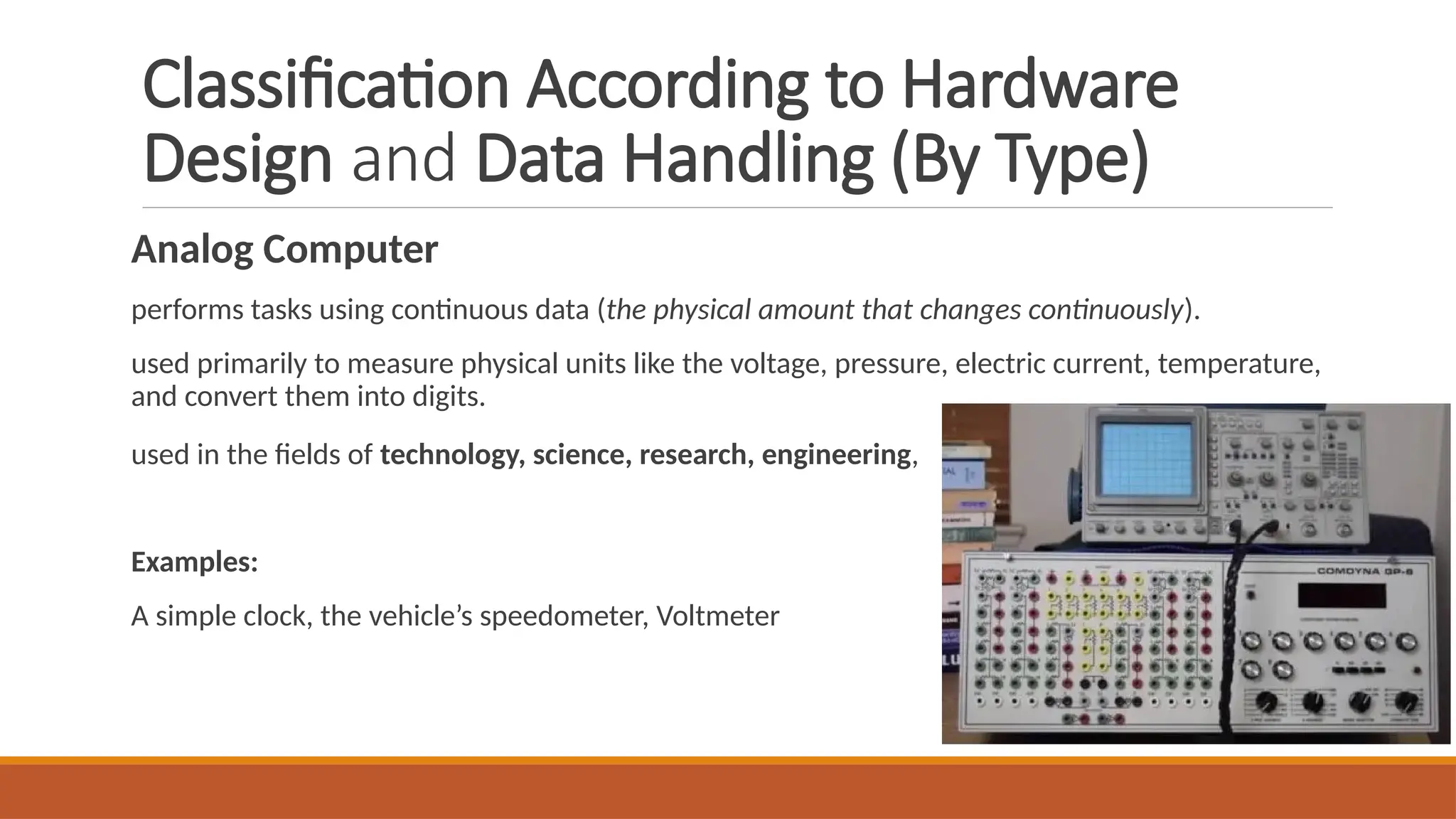
Analog Computer
performs tasks using continuous data (the physical amount that changes continuously).
used primarily to measure physical units like the voltage, pressure, electric current, temperature,
and convert them into digits.
used in the fields of technology, science, research, engineering,
Examples:
A simple clock, the vehicle’s speedometer, Voltmeter
12.
Classification According toHardware
Design and Data Handling (By Type)
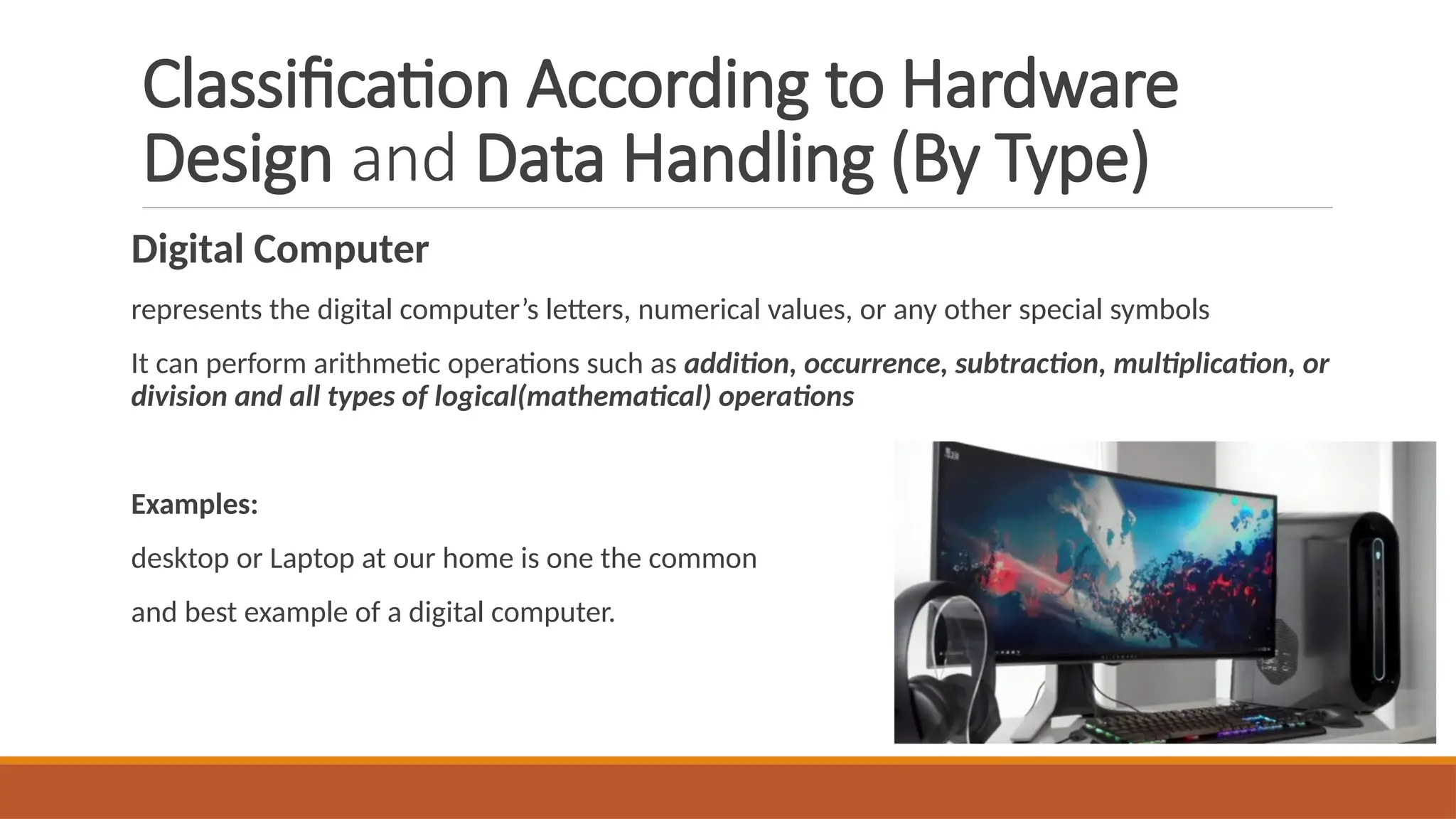
Digital Computer
represents the digital computer’s letters, numerical values, or any other special symbols
It can perform arithmetic operations such as addition, occurrence, subtraction, multiplication, or
division and all types of logical(mathematical) operations
Examples:
desktop or Laptop at our home is one the common
and best example of a digital computer.
13.
Classification According toHardware
Design and Data Handling (By Type)
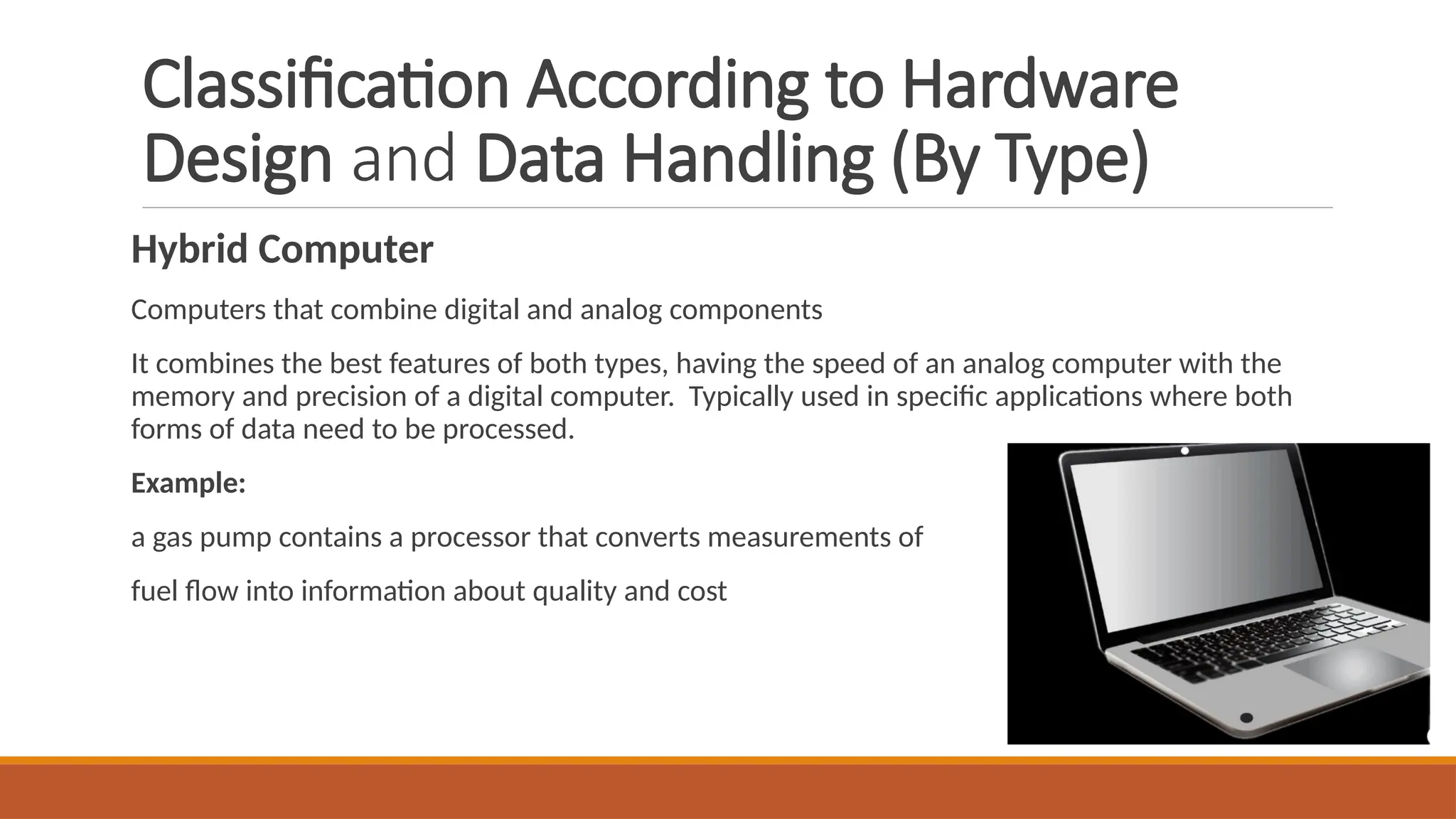
Hybrid Computer
Computers that combine digital and analog components
It combines the best features of both types, having the speed of an analog computer with the
memory and precision of a digital computer. Typically used in specific applications where both
forms of data need to be processed.
Example:
a gas pump contains a processor that converts measurements of
fuel flow into information about quality and cost

![Computer Classification
By Size and Capacity, [Supercomputer, Mainframe, Mini, and Micro Computer].
By Purpose [General and Special Purpose].
By Type [Analog, Digital, and Hybrid Computer].](https://image.slidesharecdn.com/classificationofcomputers-250823055136-0d536ff0/75/Classification-of-Computers-Computers-pptx-4-2048.jpg)


![Types of computers[6999]](https://cdn.slidesharecdn.com/ss_thumbnails/typesofcomputers6999-201007141446-thumbnail.jpg?width=640&height=640&fit=bounds)


![Coded Agents – with UiPath SDK + LangGraph [Virtual Hands-on Workshop]](https://cdn.slidesharecdn.com/ss_thumbnails/codedagentsdeck-251215155422-5497c599-thumbnail.jpg?width=640&height=640&fit=bounds)


