Presented
by
Shridhar
B. kulkarni
RIT
Islampur
Field training in
‘Transformer company’
Company Profile
Company name: Datta electricals, Engineers
and Contractors
Government of India approved,ISO 9001:2008
certified company, Govt. Licened Electrical
contractor
Name of the business: manufacturer,
Supplier,service
Stages of transformer manufacturing:
• Design and drawing
• Core assembly
• Core-coil assembly
• Tank-up process
• Paint process
• Finishing
• Testing of transformer
Design
• Voltage class
• Rating
• Frequency
• Purpose
• Type of winding
Note: Basic factors are given above . Design is done theoretically
and also by using MATLAB software
CoreAssembly
 The basic raw-material is COLD ROLLED
GRAIN ORIENTED (CRGO) Silicon Steel
 It is in the form of thin sheets & cut to size as
per design.
 Generally three different shapes of core
laminations are used in one assembly.
 The laminations are put through annealing
process.
 These laminations are assembled in such a
manner that there is no air gap between the
joints of two consecutive sheets.
 The entire assembly is done on a frame
commonly known as core channel.
 These frames being used as a clamping
support of the core assembly
Core-coil assembly
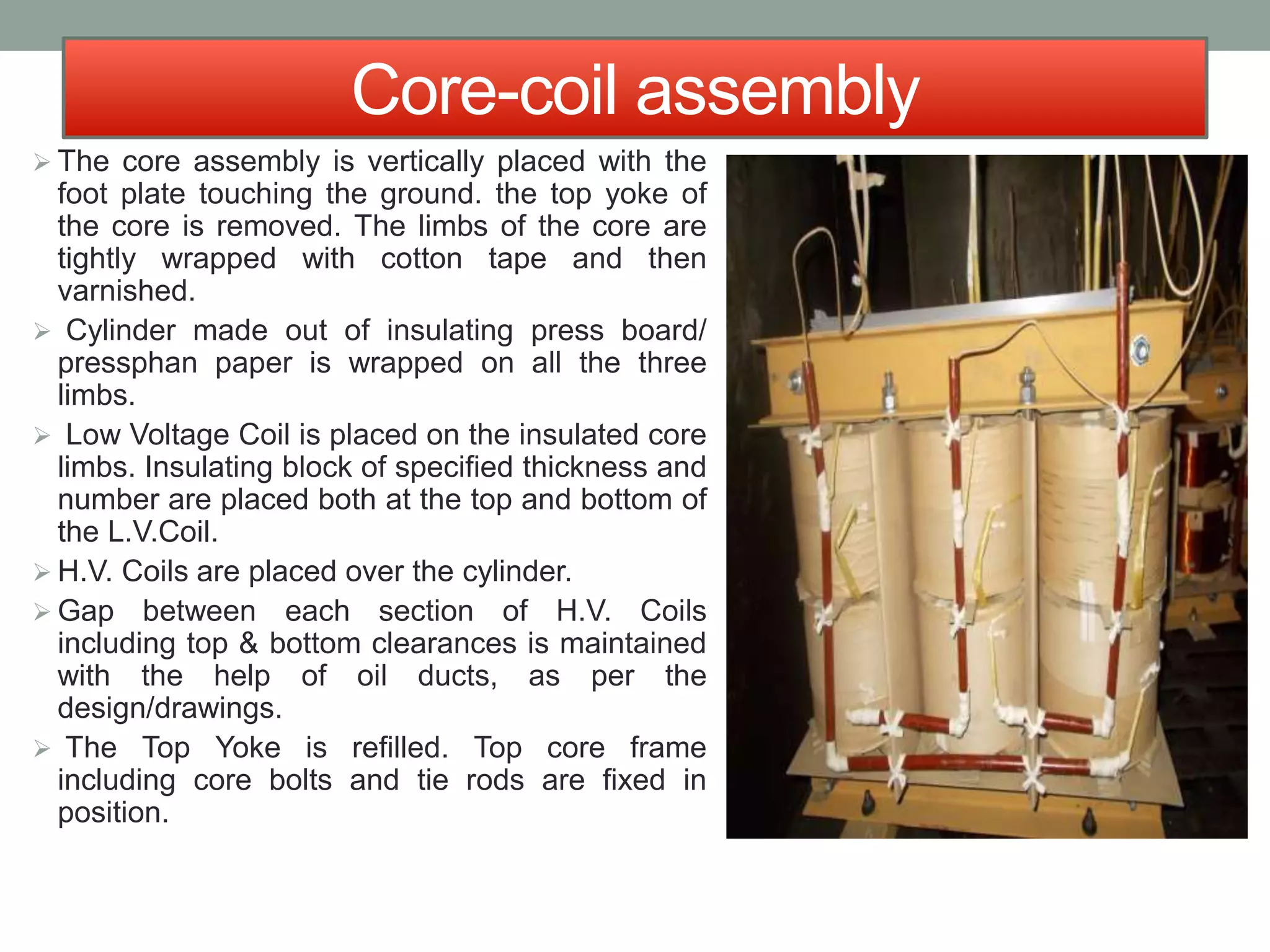
 The core assembly is vertically placed with the
foot plate touching the ground. the top yoke of
the core is removed. The limbs of the core are
tightly wrapped with cotton tape and then
varnished.
 Cylinder made out of insulating press board/
pressphan paper is wrapped on all the three
limbs.
 Low Voltage Coil is placed on the insulated core
limbs. Insulating block of specified thickness and
number are placed both at the top and bottom of
the L.V.Coil.
 H.V. Coils are placed over the cylinder.
 Gap between each section of H.V. Coils
including top & bottom clearances is maintained
with the help of oil ducts, as per the
design/drawings.
 The Top Yoke is refilled. Top core frame
including core bolts and tie rods are fixed in
position.
Tank up process
The core-coil assembly is taken out of the
oven and the "Megger test" is carried out.
The tanks, supplied by fabrication deptt. are
brought to tank-up department duly painted.
Fittings like drain valves, HV& LV
Bushings, conservator, oil level indicator
and explosion vent are fitted in the tanks.
 The Core-coil assembly is then placed into
the tank and properly locked up.
Pure filtered transformer oil is filled in the
tank to immerse the assembly only.
Connections of primary and secondary to
the terminal bushings are made. Operating
handle for ratio switch is fitted, wherever
required.
Paint Process
• Cleaning of tanks
• The cleaning of tank is done normally by chipping/grinding.
• The outside surface of the tank is short blasted to achieve a very fine and smooth
finish
• Painting of tanks
• After cleaning the tanks, a coat of hot oil resistence paint is applied on the internal
surface of the tank.
• The outside surface is painted with a coat of Red Oxide primer and subsequently
with one coat of enamel paint as per customer's requirement.
Finishing
• Fittings and accessories as per customer's specification and drawing are checked.
• Transformers are filled with oil upto the minimum level marking, wherever
necessary.
• Loose accessories like, earthing terminals, bimetallic connectors, dial type
thermometers are also checked for proper fittings.
Testing of transformer
• Measurement of winding resistance test
• Measurement of insulation resistance
• Ratio test
• Measurement of No load loss & No Load Current
• Oil Dielectric Test
• Problem – Formation of sludge in the oil of transformer after 10
to 20 years
• Suggested method – use OM4 optical fiber for detection
Oil deterioration in transformers
• Atmospheric oxygen and moisture serve as source of oxygen
• The rate of oxidation depends on oil temperature
• As temp. increases oxidative breakdown becomes faster
• This process of oxidation results in formation of sludge
• Cause-
1)insulation failure
2)SC occurs between turns
3)Breakdown of transformer
Model for sludge estimation
Conclusion
• During these 15 days of training, I analysed the typical
manufacturing process and testing methods. But
almost all transformers have 97-98% efficiency.
Therefore it is difficult to make new design which
gives more than 98%.
• But I found one problem of sludge formation in the oil
of transformer and I sugested one novel method to the
company and company is satisfied with this solution
Contact details:
Shreedhar.kulkarni65@gmail.com

Industrial training in Transformer manufacturing company

  • 1.
  • 2.
    Company Profile Company name:Datta electricals, Engineers and Contractors Government of India approved,ISO 9001:2008 certified company, Govt. Licened Electrical contractor Name of the business: manufacturer, Supplier,service
  • 3.
    Stages of transformermanufacturing: • Design and drawing • Core assembly • Core-coil assembly • Tank-up process • Paint process • Finishing • Testing of transformer
  • 4.
    Design • Voltage class •Rating • Frequency • Purpose • Type of winding Note: Basic factors are given above . Design is done theoretically and also by using MATLAB software
  • 5.
    CoreAssembly  The basicraw-material is COLD ROLLED GRAIN ORIENTED (CRGO) Silicon Steel  It is in the form of thin sheets & cut to size as per design.  Generally three different shapes of core laminations are used in one assembly.  The laminations are put through annealing process.  These laminations are assembled in such a manner that there is no air gap between the joints of two consecutive sheets.  The entire assembly is done on a frame commonly known as core channel.  These frames being used as a clamping support of the core assembly
  • 6.
    Core-coil assembly  Thecore assembly is vertically placed with the foot plate touching the ground. the top yoke of the core is removed. The limbs of the core are tightly wrapped with cotton tape and then varnished.  Cylinder made out of insulating press board/ pressphan paper is wrapped on all the three limbs.  Low Voltage Coil is placed on the insulated core limbs. Insulating block of specified thickness and number are placed both at the top and bottom of the L.V.Coil.  H.V. Coils are placed over the cylinder.  Gap between each section of H.V. Coils including top & bottom clearances is maintained with the help of oil ducts, as per the design/drawings.  The Top Yoke is refilled. Top core frame including core bolts and tie rods are fixed in position.
  • 7.
    Tank up process Thecore-coil assembly is taken out of the oven and the "Megger test" is carried out. The tanks, supplied by fabrication deptt. are brought to tank-up department duly painted. Fittings like drain valves, HV& LV Bushings, conservator, oil level indicator and explosion vent are fitted in the tanks.  The Core-coil assembly is then placed into the tank and properly locked up. Pure filtered transformer oil is filled in the tank to immerse the assembly only. Connections of primary and secondary to the terminal bushings are made. Operating handle for ratio switch is fitted, wherever required.
  • 8.
    Paint Process • Cleaningof tanks • The cleaning of tank is done normally by chipping/grinding. • The outside surface of the tank is short blasted to achieve a very fine and smooth finish • Painting of tanks • After cleaning the tanks, a coat of hot oil resistence paint is applied on the internal surface of the tank. • The outside surface is painted with a coat of Red Oxide primer and subsequently with one coat of enamel paint as per customer's requirement.
  • 9.
    Finishing • Fittings andaccessories as per customer's specification and drawing are checked. • Transformers are filled with oil upto the minimum level marking, wherever necessary. • Loose accessories like, earthing terminals, bimetallic connectors, dial type thermometers are also checked for proper fittings.
  • 10.
    Testing of transformer •Measurement of winding resistance test • Measurement of insulation resistance • Ratio test • Measurement of No load loss & No Load Current • Oil Dielectric Test
  • 11.
    • Problem –Formation of sludge in the oil of transformer after 10 to 20 years • Suggested method – use OM4 optical fiber for detection
  • 12.
    Oil deterioration intransformers • Atmospheric oxygen and moisture serve as source of oxygen • The rate of oxidation depends on oil temperature • As temp. increases oxidative breakdown becomes faster • This process of oxidation results in formation of sludge • Cause- 1)insulation failure 2)SC occurs between turns 3)Breakdown of transformer
  • 13.
    Model for sludgeestimation
  • 14.
    Conclusion • During these15 days of training, I analysed the typical manufacturing process and testing methods. But almost all transformers have 97-98% efficiency. Therefore it is difficult to make new design which gives more than 98%. • But I found one problem of sludge formation in the oil of transformer and I sugested one novel method to the company and company is satisfied with this solution
  • 15.