INTRODUCTION:
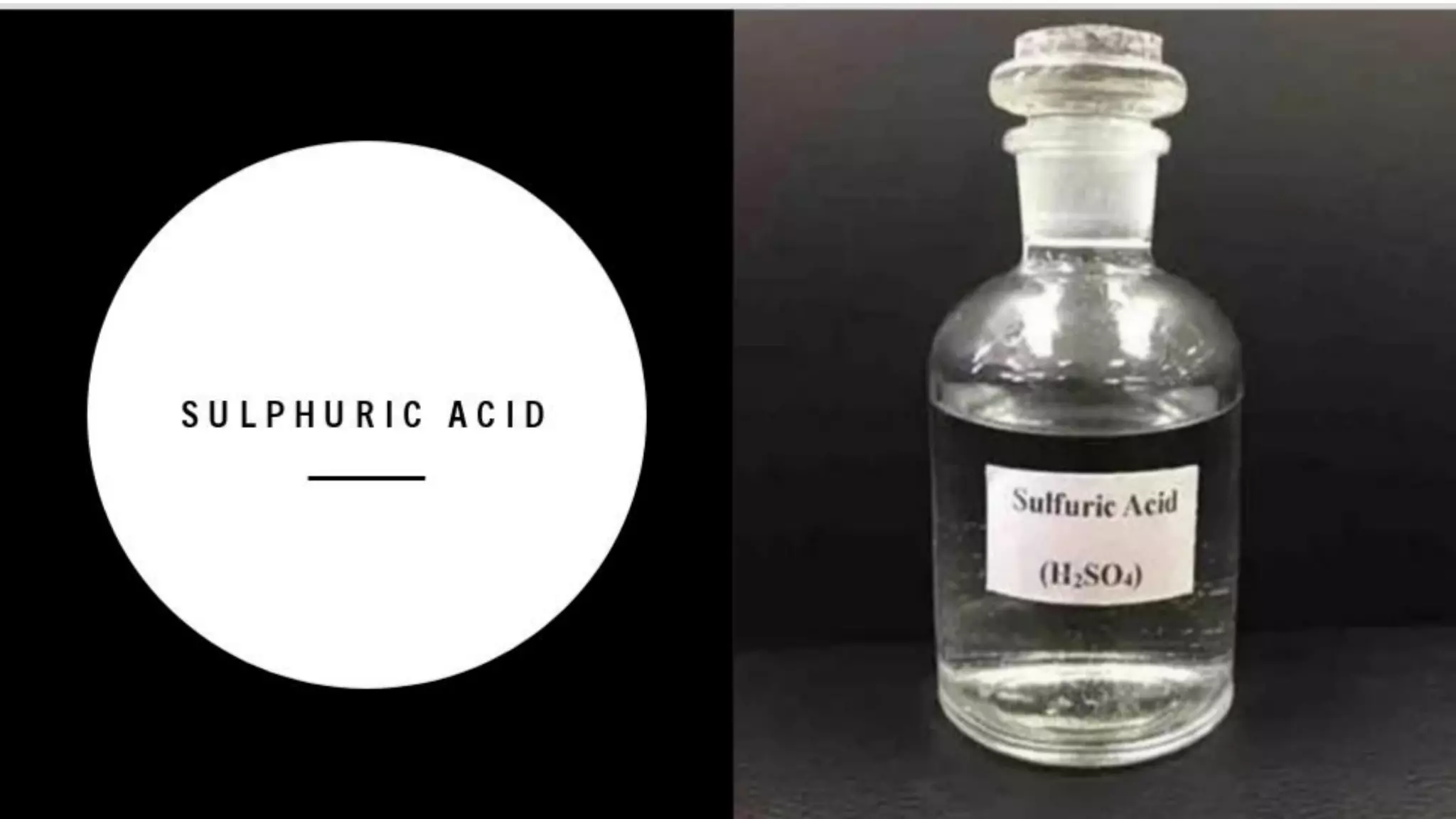
Sulfuric acid (CASRN 7664-93-9),also known as hydrogen sulfate,is a highly
corrosive,clear, colorless,odorless,strong mineral acid with the formula
H2SO4. It is also one of the top 10 chemicals released(by weight) by the
paper industry (US EPA, 2009).In modern industry,sulfuric acid is an
important commodity chemical,and is used primarily for the production of
phosphoric acid. It is also good for removingoxidation from iron and steel,so
it is used in large quantities by metal manufacturers.Sulfuricacid is a very
dangerous chemical.It is extremelycorrosiveand toxic. Exposure can occur
from inhalation, ingestion,and through skin contact.Inhalation of H2SO4
may cause irritation and/or chemicalburns to the respiratory tract, nose, and
throat. Inhalation can also be fatal as a result of spasm, inflammation,
edema of the larynx and bronchi, chemicalpneumonitis,and pulmonary
edema.
OCCURRENCE :
Pure sulfuric acid does not exist naturally on Earth due to its strong
affinity to water vapor; it is hygroscopic and readily absorbs water
vapor from the air.[6] Concentrated sulfuric acid is highly corrosive
towards other materials, from rocks to metals, since it is an oxidant
with powerful dehydrating properties. Phosphorus pentoxide is a
notable exception in that it is not dehydrated by sulfuric acid, but to the
contrary dehydrates sulfuric acid to sulfur trioxide. Upon addition of
sulfuric acid to water, a considerable amount of heat is released; thus
the reverse procedure of adding water to the acid should not be
performed since the heat released may boil the solution, spraying
droplets of hot acid during the process.Upon contact with body tissue,
sulfuric acid can cause severe acidic chemical burns and even secondary
thermal burns due to dehydration.
CONTACT PROCESS :
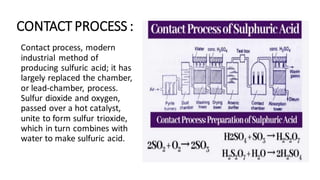
Contact process, modern
industrial method of
producing sulfuric acid; it has
largely replaced the chamber,
or lead-chamber, process.
Sulfur dioxide and oxygen,
passed over a hot catalyst,
unite to form sulfur trioxide,
which in turn combines with
water to make sulfuric acid.
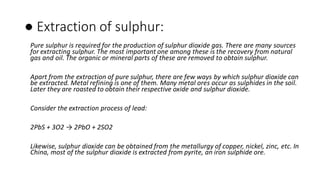
● Extraction of sulphur:
Pure sulphur is required for the production of sulphur dioxide gas. There are many sources
for extracting sulphur. The most important one among these is the recovery from natural
gas and oil. The organic or mineral parts of these are removed to obtain sulphur.
Apart from the extraction of pure sulphur, there are few ways by which sulphur dioxide can
be extracted. Metal refining is one of them. Many metal ores occur as sulphides in the soil.
Later they are roasted to obtain their respective oxide and sulphur dioxide.
Consider the extraction process of lead:
2PbS + 3O2 → 2PbO + 2SO2
Likewise, sulphur dioxide can be obtained from the metallurgy of copper, nickel, zinc, etc. In
China, most of the sulphur dioxide is extracted from pyrite, an iron sulphide ore.
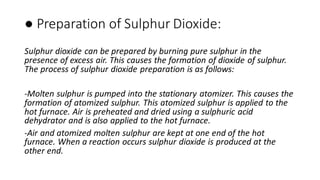
● Preparation of Sulphur Dioxide:
Sulphur dioxide can be prepared by burning pure sulphur in the
presence of excess air. This causes the formation of dioxide of sulphur.
The process of sulphur dioxide preparation is as follows:
-Molten sulphur is pumped into the stationary atomizer. This causes the
formation of atomized sulphur. This atomized sulphur is applied to the
hot furnace. Air is preheated and dried using a sulphuric acid
dehydrator and is also applied to the hot furnace.
-Air and atomized molten sulphur are kept at one end of the hot
furnace. When a reaction occurs sulphur dioxide is produced at the
other end.
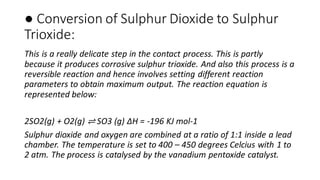
● Conversion of Sulphur Dioxide to Sulphur
Trioxide:
This is a really delicate step in the contact process. This is partly
because it produces corrosive sulphur trioxide. And also this process is a
reversible reaction and hence involves setting different reaction
parameters to obtain maximum output. The reaction equation is
represented below:
2SO2(g) + O2(g) ⇌ SO3 (g) ΔH = -196 KJ mol-1
Sulphur dioxide and oxygen are combined at a ratio of 1:1 inside a lead
chamber. The temperature is set to 400 – 450 degrees Celcius with 1 to
2 atm. The process is catalysed by the vanadium pentoxide catalyst.
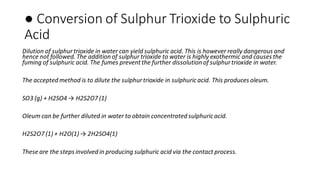
● Conversion of Sulphur Trioxide to Sulphuric
Acid
Dilution of sulphurtrioxide in water can yield sulphuric acid. This is however really dangerous and
hence not followed. The addition of sulphur trioxide to water is highly exothermic and causes the
fuming of sulphuric acid. The fumes preventthe further dissolution of sulphurtrioxide in water.
The accepted method is to dilute the sulphurtrioxide in sulphuricacid. This produces oleum.
SO3 (g) + H2SO4 → H2S2O7 (1)
Oleum can be further diluted in water to obtain concentrated sulphuricacid.
H2S2O7 (1) + H2O(1)→ 2H2SO4(1)
These are the steps involved in producing sulphuric acid via the contact process.
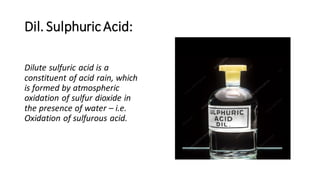
Dil. Sulphuric Acid:
Dilute sulfuric acid is a
constituent of acid rain, which
is formed by atmospheric
oxidation of sulfur dioxide in
the presence of water – i.e.
Oxidation of sulfurous acid.
Chemical Properties Of Sulphuric Acid:
Sulfuric acid is a strong dibasic acid. Also, it is diprotic and ionises in
two stages in the aqueous solution.
This chemical is highly corrosive, reactive and is soluble in water. It has
a very high oxidising power and thus, acts as a strong oxidising agent.
It has very low volatility. For this reason, it plays a part in the
preparation of more volatile acids from their comparing salts.
Concentrated sulfuric acid is a very strong dehydrating agent. Thus, this
chemical is used for drying many wet gases which do not react with the
acid.
It additionally expels water from natural mixes like starches.
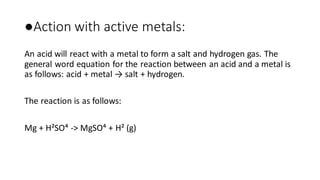
●Action with active metals:
An acid will react with a metal to form a salt and hydrogen gas. The
general word equation for the reaction between an acid and a metal is
as follows: acid + metal → salt + hydrogen.
The reaction is as follows:
Mg + H²SO⁴ -> MgSO⁴ + H² (g)
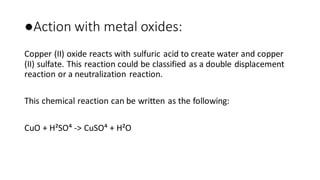
●Action with metal oxides:
Copper (II) oxide reacts with sulfuric acid to create water and copper
(II) sulfate. This reaction could be classified as a double displacement
reaction or a neutralization reaction.
This chemical reaction can be written as the following:
CuO + H²SO⁴ -> CuSO⁴ + H²O
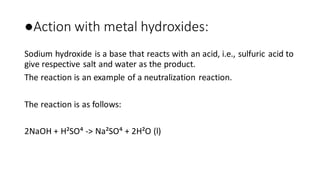
●Action with metal hydroxides:
Sodium hydroxide is a base that reacts with an acid, i.e., sulfuric acid to
give respective salt and water as the product.
The reaction is an example of a neutralization reaction.
The reaction is as follows:
2NaOH + H²SO⁴ -> Na²SO⁴ + 2H²O (l)
●Action with metal carbonates:
A metal carbonate is formed with water and carbondioxide when dilute
sulphuric acid reacts with calcium carbonate.
The reaction is as follows:
●Action with metal hydrogen Carbonates:
When acids react with metal hydrogen carbonates, they will produce
salt, and water along with carbon dioxide.
Sodium hydrogen carbonate reacts with sulphuric acid to form sodium
sulphate, water, and carbon dioxide.
The reaction is as follows:
2NaHCO³ + H²SO⁴ -> Na²SO⁴ + 2H²O + 2CO² (g)
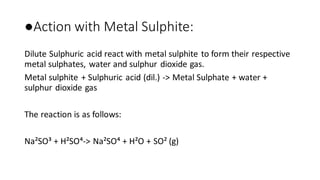
●Action with Metal Sulphite:
Dilute Sulphuric acid react with metal sulphite to form their respective
metal sulphates, water and sulphur dioxide gas.
Metal sulphite + Sulphuric acid (dil.) -> Metal Sulphate + water +
sulphur dioxide gas
The reaction is as follows:
Na²SO³ + H²SO⁴-> Na²SO⁴ + H²O + SO² (g)
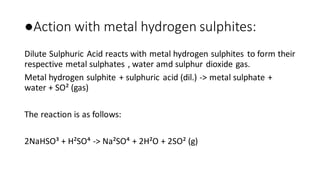
●Action with metal hydrogen sulphites:
Dilute Sulphuric Acid reacts with metal hydrogen sulphites to form their
respective metal sulphates , water amd sulphur dioxide gas.
Metal hydrogen sulphite + sulphuric acid (dil.) -> metal sulphate +
water + SO² (gas)
The reaction is as follows:
2NaHSO³ + H²SO⁴ -> Na²SO⁴ + 2H²O + 2SO² (g)
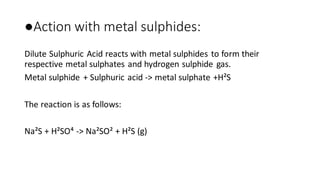
●Action with metal sulphides:
Dilute Sulphuric Acid reacts with metal sulphides to form their
respective metal sulphates and hydrogen sulphide gas.
Metal sulphide + Sulphuric acid -> metal sulphate +H²S
The reaction is as follows:
Na²S + H²SO⁴ -> Na²SO² + H²S (g)
Uses of Sulphuric Acid:
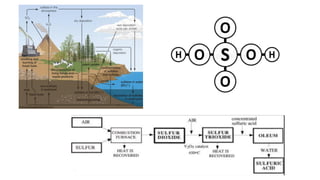
Sulfuric acid is prepared industrially by the reaction of water with sulfur
trioxide (see sulfur oxide), which in turn is made by chemical
combination of sulfur dioxide and oxygen either by the contact process
or the chamber process. In various concentrations the acid is used in
the manufacture of fertilizers, pigments, dyes, drugs, explosives,
detergents, and inorganic salts and acids, as well as in petroleum
refining and metallurgical processes. In one of its most familiar
applications, sulfuric acid serves as the electrolyte in lead–acid storage
batteries. Pure sulfuric acid has a specific gravity of 1.830 at 25 °C (77
°F); it freezes at 10.37 °C (50.7 °F).

Sulphuric acid

  • 2.
    INTRODUCTION: Sulfuric acid (CASRN7664-93-9),also known as hydrogen sulfate,is a highly corrosive,clear, colorless,odorless,strong mineral acid with the formula H2SO4. It is also one of the top 10 chemicals released(by weight) by the paper industry (US EPA, 2009).In modern industry,sulfuric acid is an important commodity chemical,and is used primarily for the production of phosphoric acid. It is also good for removingoxidation from iron and steel,so it is used in large quantities by metal manufacturers.Sulfuricacid is a very dangerous chemical.It is extremelycorrosiveand toxic. Exposure can occur from inhalation, ingestion,and through skin contact.Inhalation of H2SO4 may cause irritation and/or chemicalburns to the respiratory tract, nose, and throat. Inhalation can also be fatal as a result of spasm, inflammation, edema of the larynx and bronchi, chemicalpneumonitis,and pulmonary edema.
  • 3.
    OCCURRENCE : Pure sulfuricacid does not exist naturally on Earth due to its strong affinity to water vapor; it is hygroscopic and readily absorbs water vapor from the air.[6] Concentrated sulfuric acid is highly corrosive towards other materials, from rocks to metals, since it is an oxidant with powerful dehydrating properties. Phosphorus pentoxide is a notable exception in that it is not dehydrated by sulfuric acid, but to the contrary dehydrates sulfuric acid to sulfur trioxide. Upon addition of sulfuric acid to water, a considerable amount of heat is released; thus the reverse procedure of adding water to the acid should not be performed since the heat released may boil the solution, spraying droplets of hot acid during the process.Upon contact with body tissue, sulfuric acid can cause severe acidic chemical burns and even secondary thermal burns due to dehydration.
  • 5.
    CONTACT PROCESS : Contactprocess, modern industrial method of producing sulfuric acid; it has largely replaced the chamber, or lead-chamber, process. Sulfur dioxide and oxygen, passed over a hot catalyst, unite to form sulfur trioxide, which in turn combines with water to make sulfuric acid.
  • 6.
    ● Extraction ofsulphur: Pure sulphur is required for the production of sulphur dioxide gas. There are many sources for extracting sulphur. The most important one among these is the recovery from natural gas and oil. The organic or mineral parts of these are removed to obtain sulphur. Apart from the extraction of pure sulphur, there are few ways by which sulphur dioxide can be extracted. Metal refining is one of them. Many metal ores occur as sulphides in the soil. Later they are roasted to obtain their respective oxide and sulphur dioxide. Consider the extraction process of lead: 2PbS + 3O2 → 2PbO + 2SO2 Likewise, sulphur dioxide can be obtained from the metallurgy of copper, nickel, zinc, etc. In China, most of the sulphur dioxide is extracted from pyrite, an iron sulphide ore.
  • 7.
    ● Preparation ofSulphur Dioxide: Sulphur dioxide can be prepared by burning pure sulphur in the presence of excess air. This causes the formation of dioxide of sulphur. The process of sulphur dioxide preparation is as follows: -Molten sulphur is pumped into the stationary atomizer. This causes the formation of atomized sulphur. This atomized sulphur is applied to the hot furnace. Air is preheated and dried using a sulphuric acid dehydrator and is also applied to the hot furnace. -Air and atomized molten sulphur are kept at one end of the hot furnace. When a reaction occurs sulphur dioxide is produced at the other end.
  • 8.
    ● Conversion ofSulphur Dioxide to Sulphur Trioxide: This is a really delicate step in the contact process. This is partly because it produces corrosive sulphur trioxide. And also this process is a reversible reaction and hence involves setting different reaction parameters to obtain maximum output. The reaction equation is represented below: 2SO2(g) + O2(g) ⇌ SO3 (g) ΔH = -196 KJ mol-1 Sulphur dioxide and oxygen are combined at a ratio of 1:1 inside a lead chamber. The temperature is set to 400 – 450 degrees Celcius with 1 to 2 atm. The process is catalysed by the vanadium pentoxide catalyst.
  • 9.
    ● Conversion ofSulphur Trioxide to Sulphuric Acid Dilution of sulphurtrioxide in water can yield sulphuric acid. This is however really dangerous and hence not followed. The addition of sulphur trioxide to water is highly exothermic and causes the fuming of sulphuric acid. The fumes preventthe further dissolution of sulphurtrioxide in water. The accepted method is to dilute the sulphurtrioxide in sulphuricacid. This produces oleum. SO3 (g) + H2SO4 → H2S2O7 (1) Oleum can be further diluted in water to obtain concentrated sulphuricacid. H2S2O7 (1) + H2O(1)→ 2H2SO4(1) These are the steps involved in producing sulphuric acid via the contact process.
  • 10.
    Dil. Sulphuric Acid: Dilutesulfuric acid is a constituent of acid rain, which is formed by atmospheric oxidation of sulfur dioxide in the presence of water – i.e. Oxidation of sulfurous acid.
  • 11.
    Chemical Properties OfSulphuric Acid: Sulfuric acid is a strong dibasic acid. Also, it is diprotic and ionises in two stages in the aqueous solution. This chemical is highly corrosive, reactive and is soluble in water. It has a very high oxidising power and thus, acts as a strong oxidising agent. It has very low volatility. For this reason, it plays a part in the preparation of more volatile acids from their comparing salts. Concentrated sulfuric acid is a very strong dehydrating agent. Thus, this chemical is used for drying many wet gases which do not react with the acid. It additionally expels water from natural mixes like starches.
  • 12.
    ●Action with activemetals: An acid will react with a metal to form a salt and hydrogen gas. The general word equation for the reaction between an acid and a metal is as follows: acid + metal → salt + hydrogen. The reaction is as follows: Mg + H²SO⁴ -> MgSO⁴ + H² (g)
  • 13.
    ●Action with metaloxides: Copper (II) oxide reacts with sulfuric acid to create water and copper (II) sulfate. This reaction could be classified as a double displacement reaction or a neutralization reaction. This chemical reaction can be written as the following: CuO + H²SO⁴ -> CuSO⁴ + H²O
  • 14.
    ●Action with metalhydroxides: Sodium hydroxide is a base that reacts with an acid, i.e., sulfuric acid to give respective salt and water as the product. The reaction is an example of a neutralization reaction. The reaction is as follows: 2NaOH + H²SO⁴ -> Na²SO⁴ + 2H²O (l)
  • 15.
    ●Action with metalcarbonates: A metal carbonate is formed with water and carbondioxide when dilute sulphuric acid reacts with calcium carbonate. The reaction is as follows:
  • 16.
    ●Action with metalhydrogen Carbonates: When acids react with metal hydrogen carbonates, they will produce salt, and water along with carbon dioxide. Sodium hydrogen carbonate reacts with sulphuric acid to form sodium sulphate, water, and carbon dioxide. The reaction is as follows: 2NaHCO³ + H²SO⁴ -> Na²SO⁴ + 2H²O + 2CO² (g)
  • 17.
    ●Action with MetalSulphite: Dilute Sulphuric acid react with metal sulphite to form their respective metal sulphates, water and sulphur dioxide gas. Metal sulphite + Sulphuric acid (dil.) -> Metal Sulphate + water + sulphur dioxide gas The reaction is as follows: Na²SO³ + H²SO⁴-> Na²SO⁴ + H²O + SO² (g)
  • 18.
    ●Action with metalhydrogen sulphites: Dilute Sulphuric Acid reacts with metal hydrogen sulphites to form their respective metal sulphates , water amd sulphur dioxide gas. Metal hydrogen sulphite + sulphuric acid (dil.) -> metal sulphate + water + SO² (gas) The reaction is as follows: 2NaHSO³ + H²SO⁴ -> Na²SO⁴ + 2H²O + 2SO² (g)
  • 19.
    ●Action with metalsulphides: Dilute Sulphuric Acid reacts with metal sulphides to form their respective metal sulphates and hydrogen sulphide gas. Metal sulphide + Sulphuric acid -> metal sulphate +H²S The reaction is as follows: Na²S + H²SO⁴ -> Na²SO² + H²S (g)
  • 20.
    Uses of SulphuricAcid: Sulfuric acid is prepared industrially by the reaction of water with sulfur trioxide (see sulfur oxide), which in turn is made by chemical combination of sulfur dioxide and oxygen either by the contact process or the chamber process. In various concentrations the acid is used in the manufacture of fertilizers, pigments, dyes, drugs, explosives, detergents, and inorganic salts and acids, as well as in petroleum refining and metallurgical processes. In one of its most familiar applications, sulfuric acid serves as the electrolyte in lead–acid storage batteries. Pure sulfuric acid has a specific gravity of 1.830 at 25 °C (77 °F); it freezes at 10.37 °C (50.7 °F).