Catalytic reforming
• Reforming is a process carried out to raise the
octane number to a level required for high octane
motor gasoline. Such octane number boost up is
achieved mainly by the conversion of non
aromatics into aromatic components through the
process of reforming.
• Catalytic reforming is conducted in the presence
of H2 over catalyst. Catalytic reforming helps to
get reformate with octane number of 90 -95
Catalyst for reforming
• Dual function catalyst, metal function, platinum,
promote dehydrogenation and hydrogenation
reaction.
• Acidic sites required for isomerization,
dehydrocyclization, is produced by silica –
alumina.
• Monometallic reforming catalyst- Platinum
• Bimetallic catalyst – Pt-Rh (Rh improve stability of
reforming catalyst)
• Mono metallic catalyst usually contain platinum in the
range 0.25 to 0.8% by weight.
• Pt above this level cause naphthenic rings to open and
demethylation to occur while at Pt less than 0.25% wt the
catalyst become less resistant to the attack of poison.
• Bi metallic catalyst, the Pt requirement has comedown
heavily to the range 0.2 to 0.4% by wt.
• The acid activity is obtained by incorporating halogens or
silica in the alumina base.
• Majority of the catalyst make use of chlorine in the range
0.8 to 1.2% by weight.
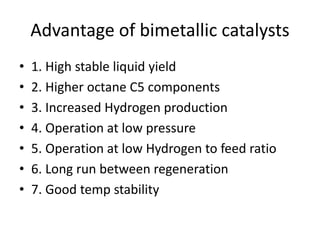
Advantage of bimetallic catalysts
• 1. High stable liquid yield
• 2. Higher octane C5 components
• 3. Increased Hydrogen production
• 4. Operation at low pressure
• 5. Operation at low Hydrogen to feed ratio
• 6. Long run between regeneration
• 7. Good temp stability
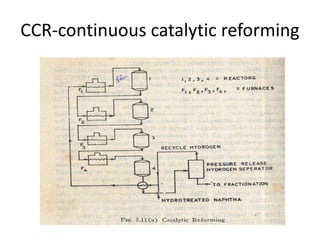
CCR-continuous catalytic reforming
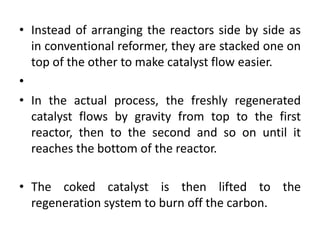
• Instead of arranging the reactors side by side as
in conventional reformer, they are stacked one on
top of the other to make catalyst flow easier.
•
• In the actual process, the freshly regenerated
catalyst flows by gravity from top to the first
reactor, then to the second and so on until it
reaches the bottom of the reactor.
• The coked catalyst is then lifted to the
regeneration system to burn off the carbon.
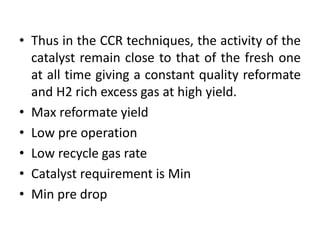
• Thus in the CCR techniques, the activity of the
catalyst remain close to that of the fresh one
at all time giving a constant quality reformate
and H2 rich excess gas at high yield.
• Max reformate yield
• Low pre operation
• Low recycle gas rate
• Catalyst requirement is Min
• Min pre drop
Modified Claus Process
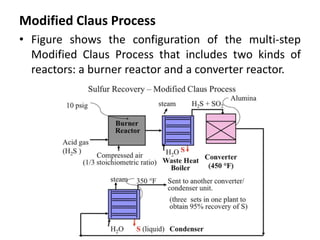
• Figure shows the configuration of the multi-step
Modified Claus Process that includes two kinds of
reactors: a burner reactor and a converter reactor.
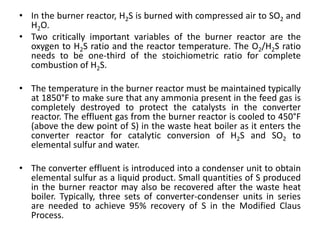
• In the burner reactor, H2S is burned with compressed air to SO2 and
H2O.
• Two critically important variables of the burner reactor are the
oxygen to H2S ratio and the reactor temperature. The O2/H2S ratio
needs to be one-third of the stoichiometric ratio for complete
combustion of H2S.
• The temperature in the burner reactor must be maintained typically
at 1850°F to make sure that any ammonia present in the feed gas is
completely destroyed to protect the catalysts in the converter
reactor. The effluent gas from the burner reactor is cooled to 450°F
(above the dew point of S) in the waste heat boiler as it enters the
converter reactor for catalytic conversion of H2S and SO2 to
elemental sulfur and water.
• The converter effluent is introduced into a condenser unit to obtain
elemental sulfur as a liquid product. Small quantities of S produced
in the burner reactor may also be recovered after the waste heat
boiler. Typically, three sets of converter-condenser units in series
are needed to achieve 95% recovery of S in the Modified Claus
Process.
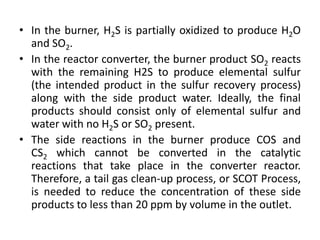
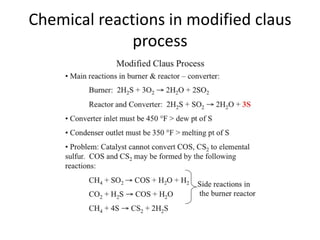
• In the burner, H2S is partially oxidized to produce H2O
and SO2.
• In the reactor converter, the burner product SO2 reacts
with the remaining H2S to produce elemental sulfur
(the intended product in the sulfur recovery process)
along with the side product water. Ideally, the final
products should consist only of elemental sulfur and
water with no H2S or SO2 present.
• The side reactions in the burner produce COS and
CS2 which cannot be converted in the catalytic
reactions that take place in the converter reactor.
Therefore, a tail gas clean-up process, or SCOT Process,
is needed to reduce the concentration of these side
products to less than 20 ppm by volume in the outlet.
Chemical reactions in modified claus
process

Catalytic reforming.pptx

  • 1.
    Catalytic reforming • Reformingis a process carried out to raise the octane number to a level required for high octane motor gasoline. Such octane number boost up is achieved mainly by the conversion of non aromatics into aromatic components through the process of reforming. • Catalytic reforming is conducted in the presence of H2 over catalyst. Catalytic reforming helps to get reformate with octane number of 90 -95
  • 2.
    Catalyst for reforming •Dual function catalyst, metal function, platinum, promote dehydrogenation and hydrogenation reaction. • Acidic sites required for isomerization, dehydrocyclization, is produced by silica – alumina. • Monometallic reforming catalyst- Platinum • Bimetallic catalyst – Pt-Rh (Rh improve stability of reforming catalyst)
  • 3.
    • Mono metalliccatalyst usually contain platinum in the range 0.25 to 0.8% by weight. • Pt above this level cause naphthenic rings to open and demethylation to occur while at Pt less than 0.25% wt the catalyst become less resistant to the attack of poison. • Bi metallic catalyst, the Pt requirement has comedown heavily to the range 0.2 to 0.4% by wt. • The acid activity is obtained by incorporating halogens or silica in the alumina base. • Majority of the catalyst make use of chlorine in the range 0.8 to 1.2% by weight.
  • 4.
    Advantage of bimetalliccatalysts • 1. High stable liquid yield • 2. Higher octane C5 components • 3. Increased Hydrogen production • 4. Operation at low pressure • 5. Operation at low Hydrogen to feed ratio • 6. Long run between regeneration • 7. Good temp stability
  • 5.
  • 6.
    • Instead ofarranging the reactors side by side as in conventional reformer, they are stacked one on top of the other to make catalyst flow easier. • • In the actual process, the freshly regenerated catalyst flows by gravity from top to the first reactor, then to the second and so on until it reaches the bottom of the reactor. • The coked catalyst is then lifted to the regeneration system to burn off the carbon.
  • 7.
    • Thus inthe CCR techniques, the activity of the catalyst remain close to that of the fresh one at all time giving a constant quality reformate and H2 rich excess gas at high yield. • Max reformate yield • Low pre operation • Low recycle gas rate • Catalyst requirement is Min • Min pre drop
  • 8.
    Modified Claus Process •Figure shows the configuration of the multi-step Modified Claus Process that includes two kinds of reactors: a burner reactor and a converter reactor.
  • 9.
    • In theburner reactor, H2S is burned with compressed air to SO2 and H2O. • Two critically important variables of the burner reactor are the oxygen to H2S ratio and the reactor temperature. The O2/H2S ratio needs to be one-third of the stoichiometric ratio for complete combustion of H2S. • The temperature in the burner reactor must be maintained typically at 1850°F to make sure that any ammonia present in the feed gas is completely destroyed to protect the catalysts in the converter reactor. The effluent gas from the burner reactor is cooled to 450°F (above the dew point of S) in the waste heat boiler as it enters the converter reactor for catalytic conversion of H2S and SO2 to elemental sulfur and water. • The converter effluent is introduced into a condenser unit to obtain elemental sulfur as a liquid product. Small quantities of S produced in the burner reactor may also be recovered after the waste heat boiler. Typically, three sets of converter-condenser units in series are needed to achieve 95% recovery of S in the Modified Claus Process.
  • 10.
    • In theburner, H2S is partially oxidized to produce H2O and SO2. • In the reactor converter, the burner product SO2 reacts with the remaining H2S to produce elemental sulfur (the intended product in the sulfur recovery process) along with the side product water. Ideally, the final products should consist only of elemental sulfur and water with no H2S or SO2 present. • The side reactions in the burner produce COS and CS2 which cannot be converted in the catalytic reactions that take place in the converter reactor. Therefore, a tail gas clean-up process, or SCOT Process, is needed to reduce the concentration of these side products to less than 20 ppm by volume in the outlet.
  • 11.
    Chemical reactions inmodified claus process