Successful Pediatric Studies:
    Key Study Design and Site Selection Considerations

1
              April 14, 2012 4:15 PM – 5:15 PM
Successful Pediatric Studies:
        Key Study Design and
    Site Selection Considerations


                 Presented by
    Charlene Sanders, M.D. and Angi Robinson
               Premier Research
                  April 14, 2012
2
Disclosure


          We have no relevant financial relationship
           in relation to this educational activity


3
Research is Making a Difference


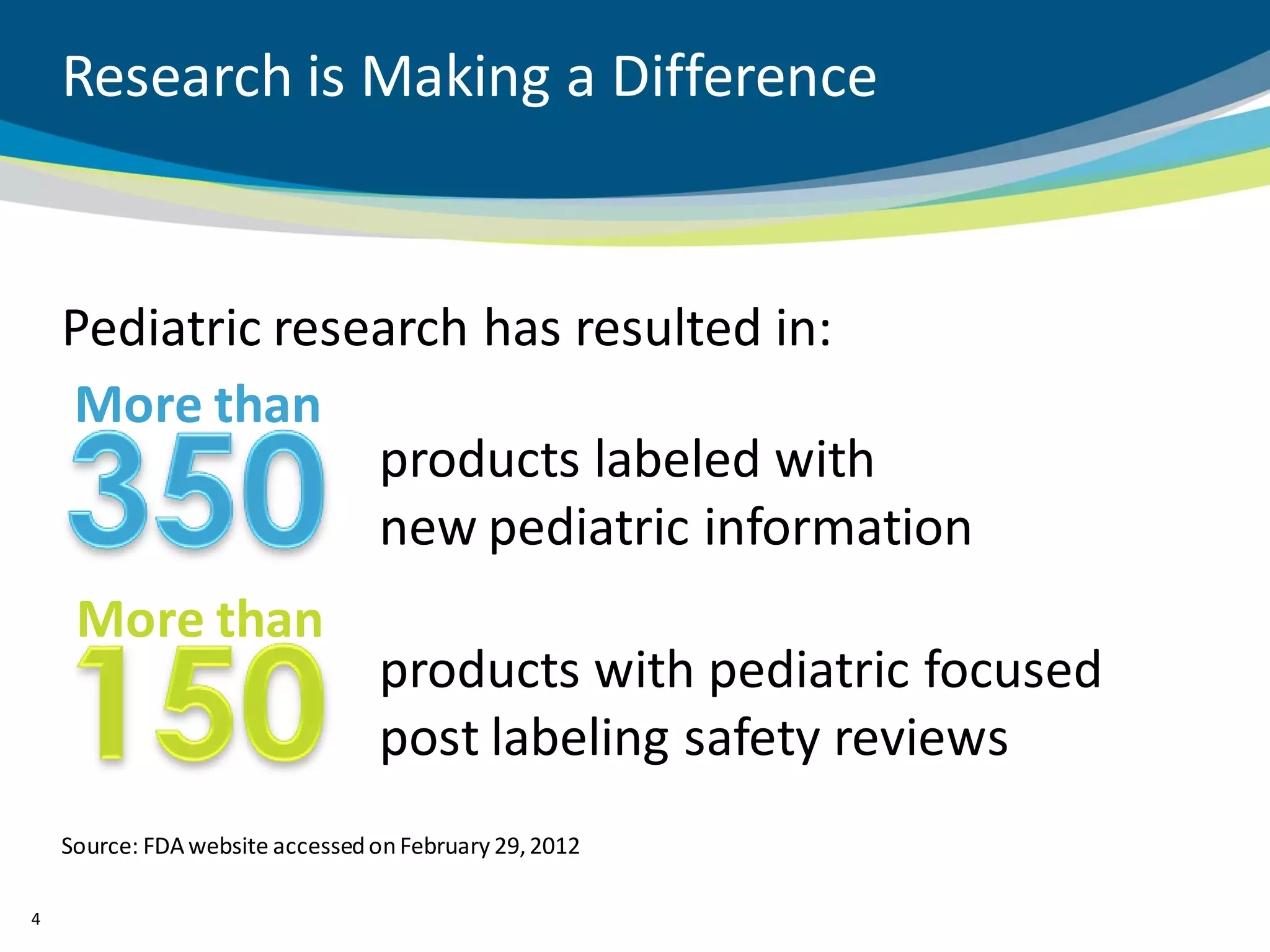
    Pediatric research has resulted in:
    More than
                  products labeled with
                  new pediatric information
     More than
                                 products with pediatric focused
                                 post labeling safety reviews
    Source: FDA website accessed on February 29, 2012

4
What Makes
    Pediatrics Different?


5
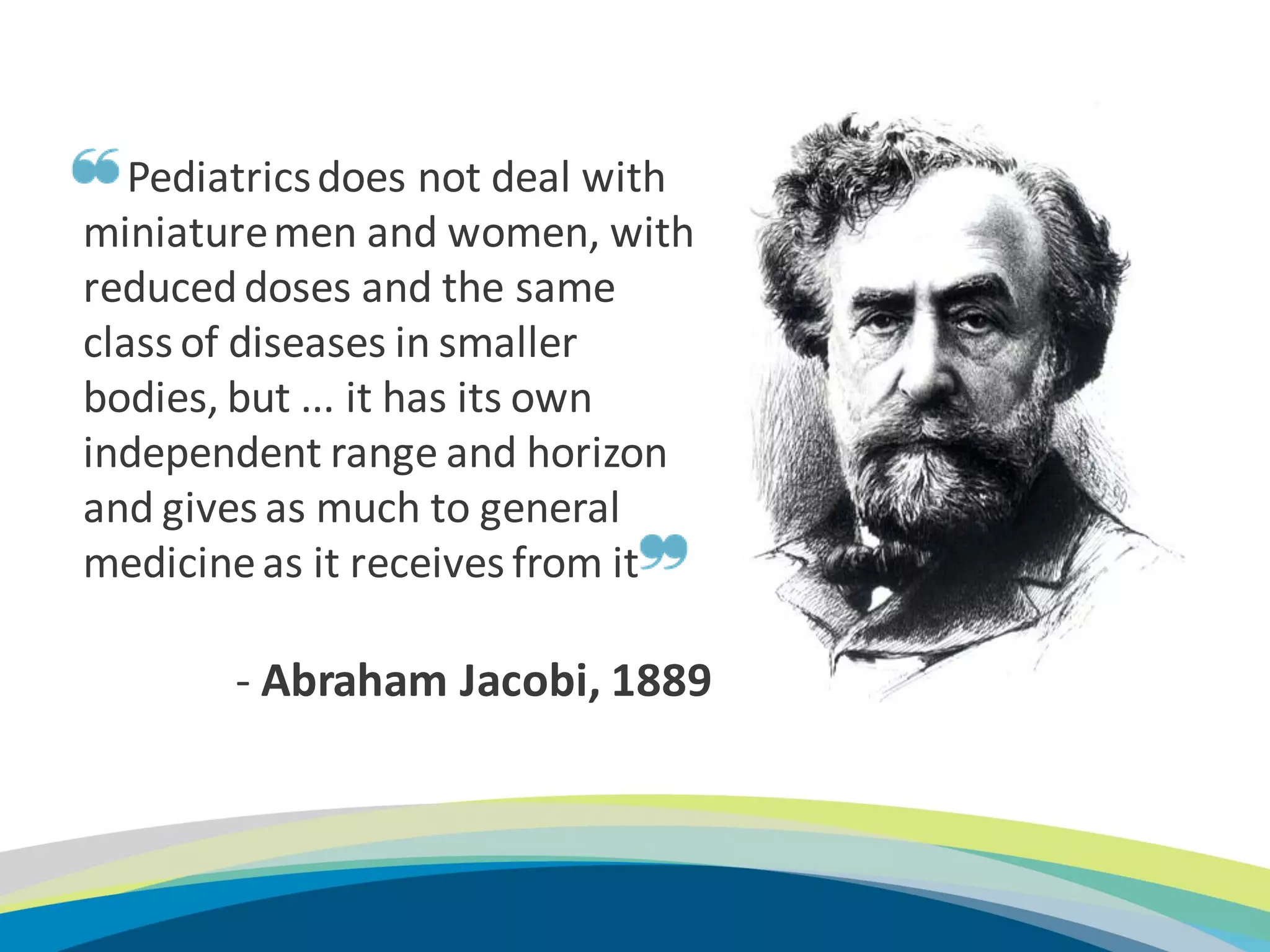
Pediatrics does not deal with
    miniature men and women, with
    reduced doses and the same
    class of diseases in smaller
    bodies, but ... it has its own
    independent range and horizon
    and gives as much to general
    medicine as it receives from it

           - Abraham Jacobi, 1889


6
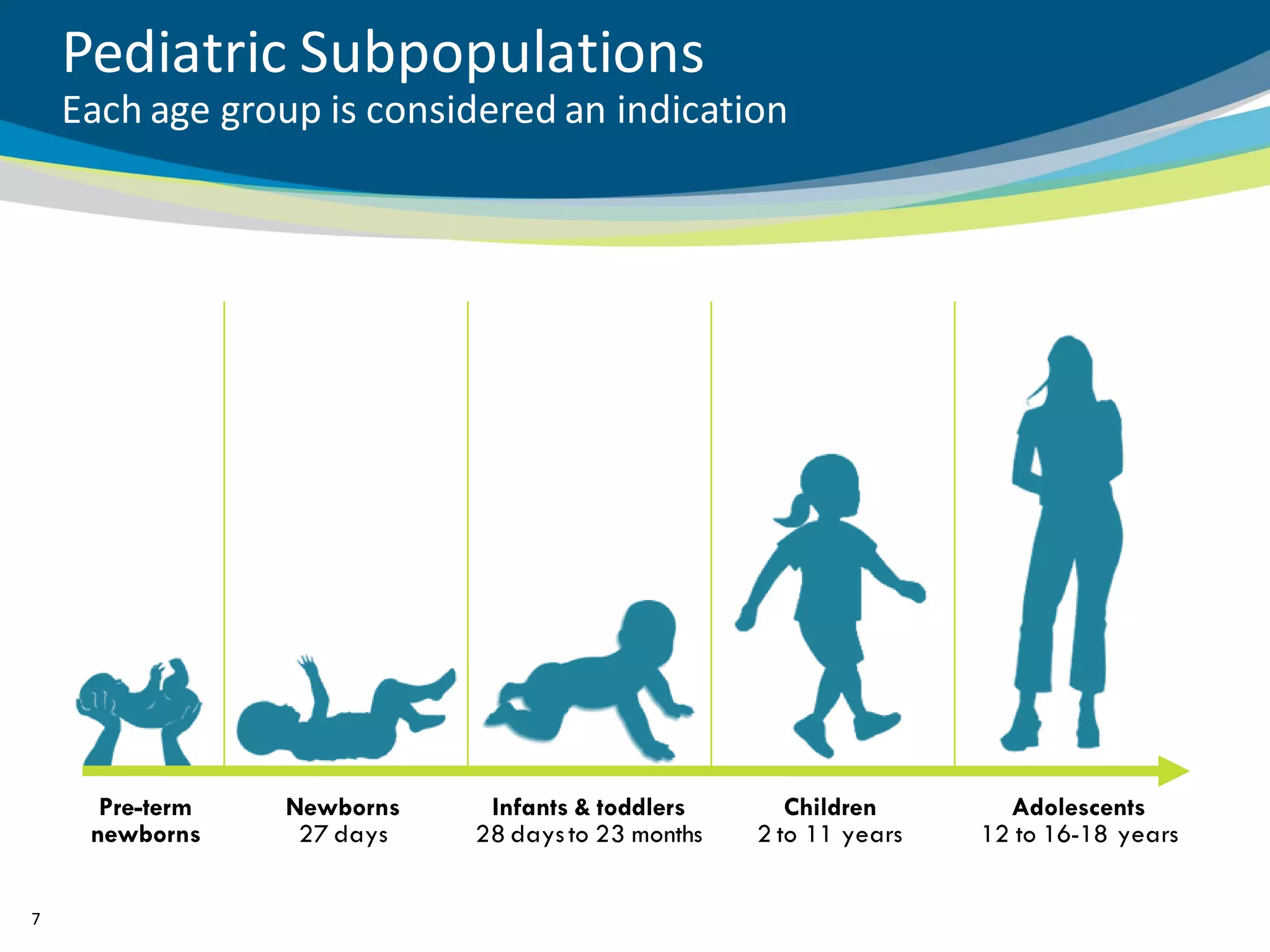
Pediatric Subpopulations
    Each age group is considered an indication


      Pre-term   Newborns    Infants & toddlers       Children       Adolescents
     newborns     27 days   28 days to 23 months   2 to 11 years   12 to 16-18 years


7
Age Appropriate Formulations


    Consider age, physical development, illness, dosage, dosing
    frequency, treatment duration, and route of administration

             Need pediatric formulations that are:
             •   Easy to both administer and swallow
             •   Acceptable in taste and volume
             •   Appropriate in dosage and strength
             •   Tolerable with minimal and safe excipients
             •   Adequate bioavailability
             •   Less frequent administration

8
Age Appropriate Formulations


    Children will refuse an unpleasant formulation
       Foster compliance by delivering formulations with an
       acceptable taste
       Poor compliance increases the risk of therapeutic failure
       and emergence of resistances

    Need to ensure safe and precise administration
       Foster compliance with an easy administration
       Provide appropriate dosing/administration devices

    Important to have child-proof container for product
9
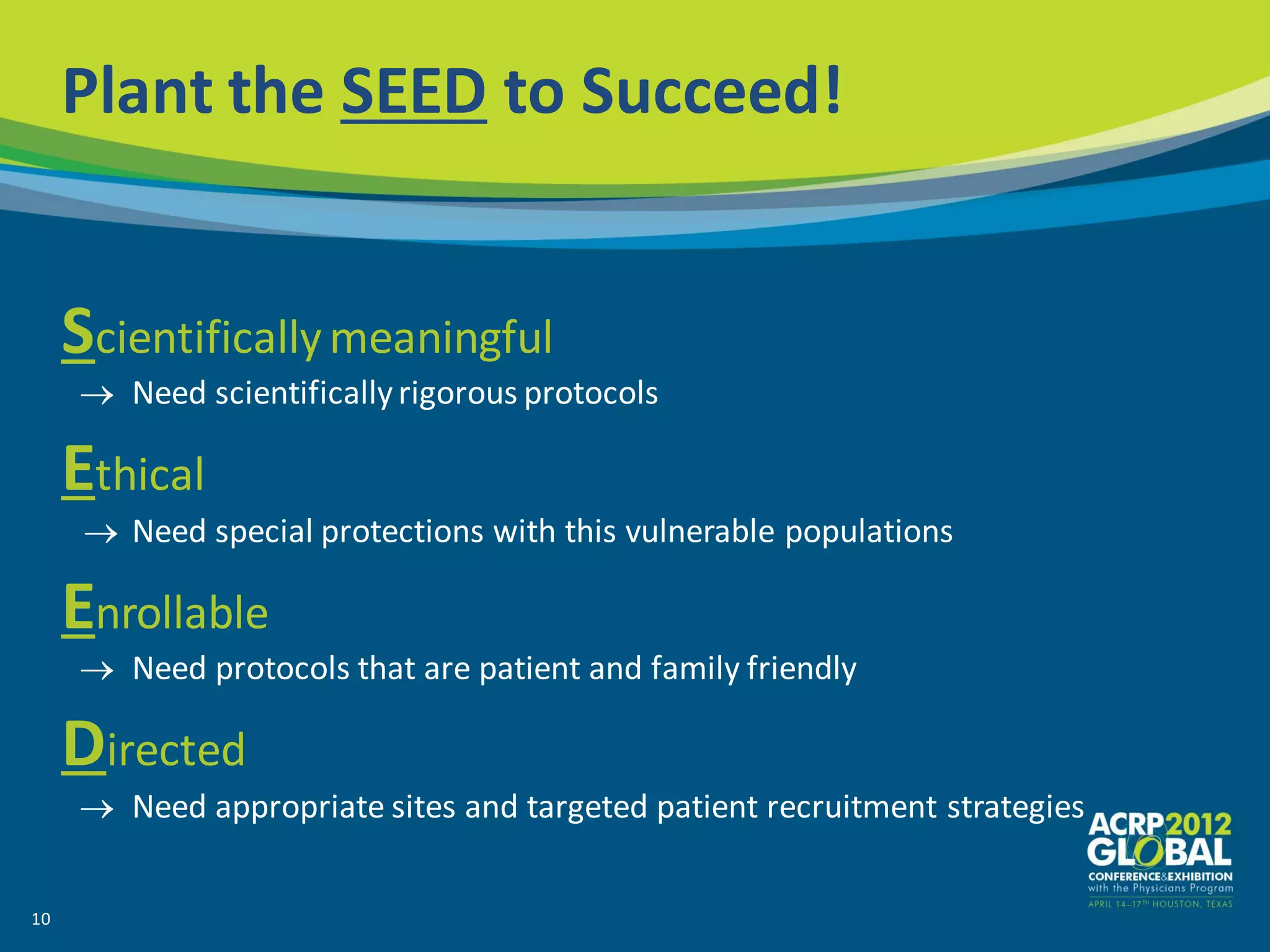
Plant the SEED to Succeed!


     Scientifically meaningful
        Need scientifically rigorous protocols

     Ethical
        Need special protections with this vulnerable populations

     Enrollable
        Need protocols that are patient and family friendly

     Directed
        Need appropriate sites and targeted patient recruitment strategies


10
Scientifically Meaningful
           Study Design


11
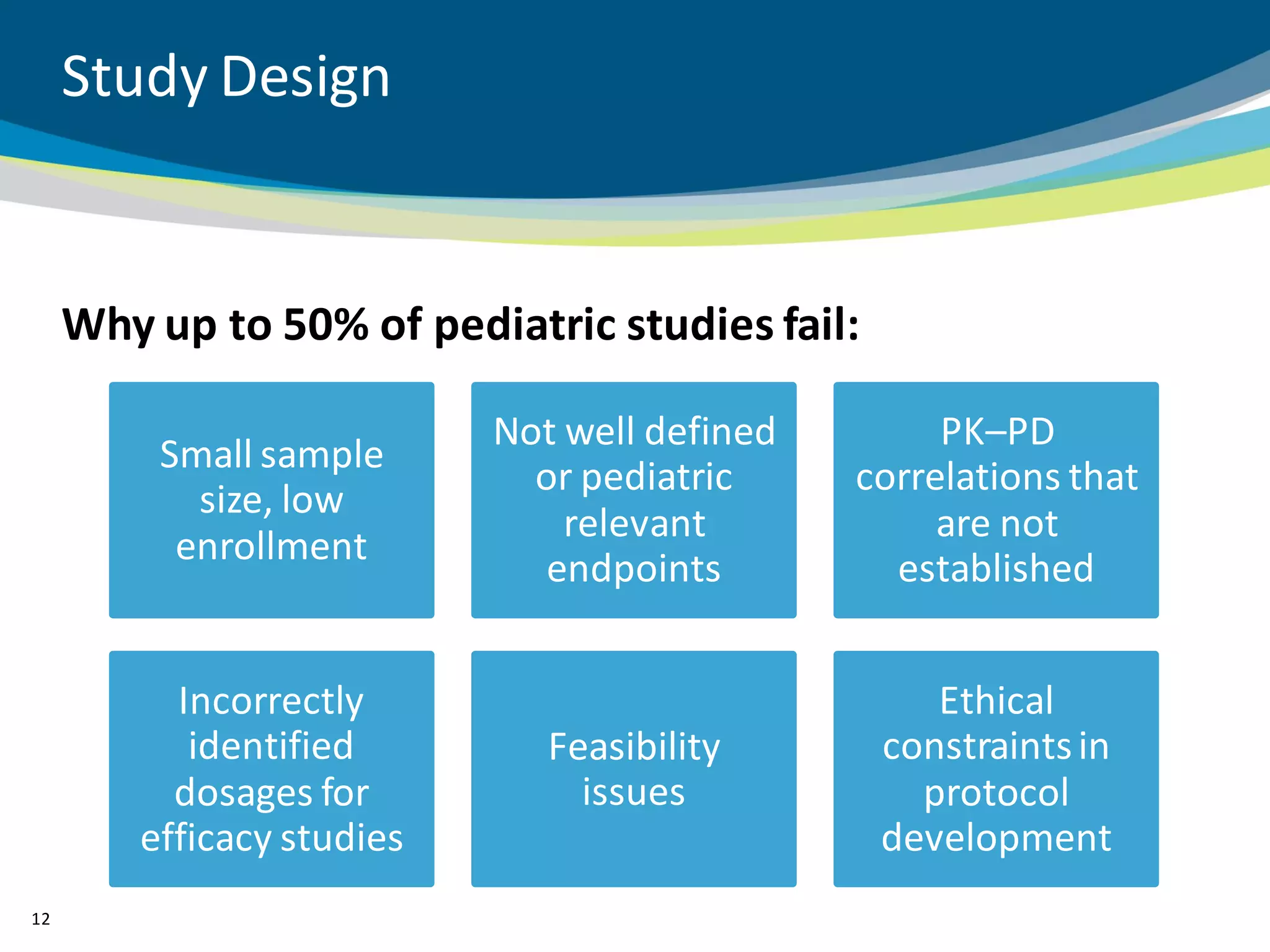
Study Design


     Why up to 50% of pediatric studies fail:

                           Not well defined        PK–PD
         Small sample
                             or pediatric     correlations that
           size, low
                               relevant            are not
          enrollment
                              endpoints         established


          Incorrectly                              Ethical
           identified         Feasibility       constraints in
          dosages for           issues            protocol
        efficacy studies                        development
12
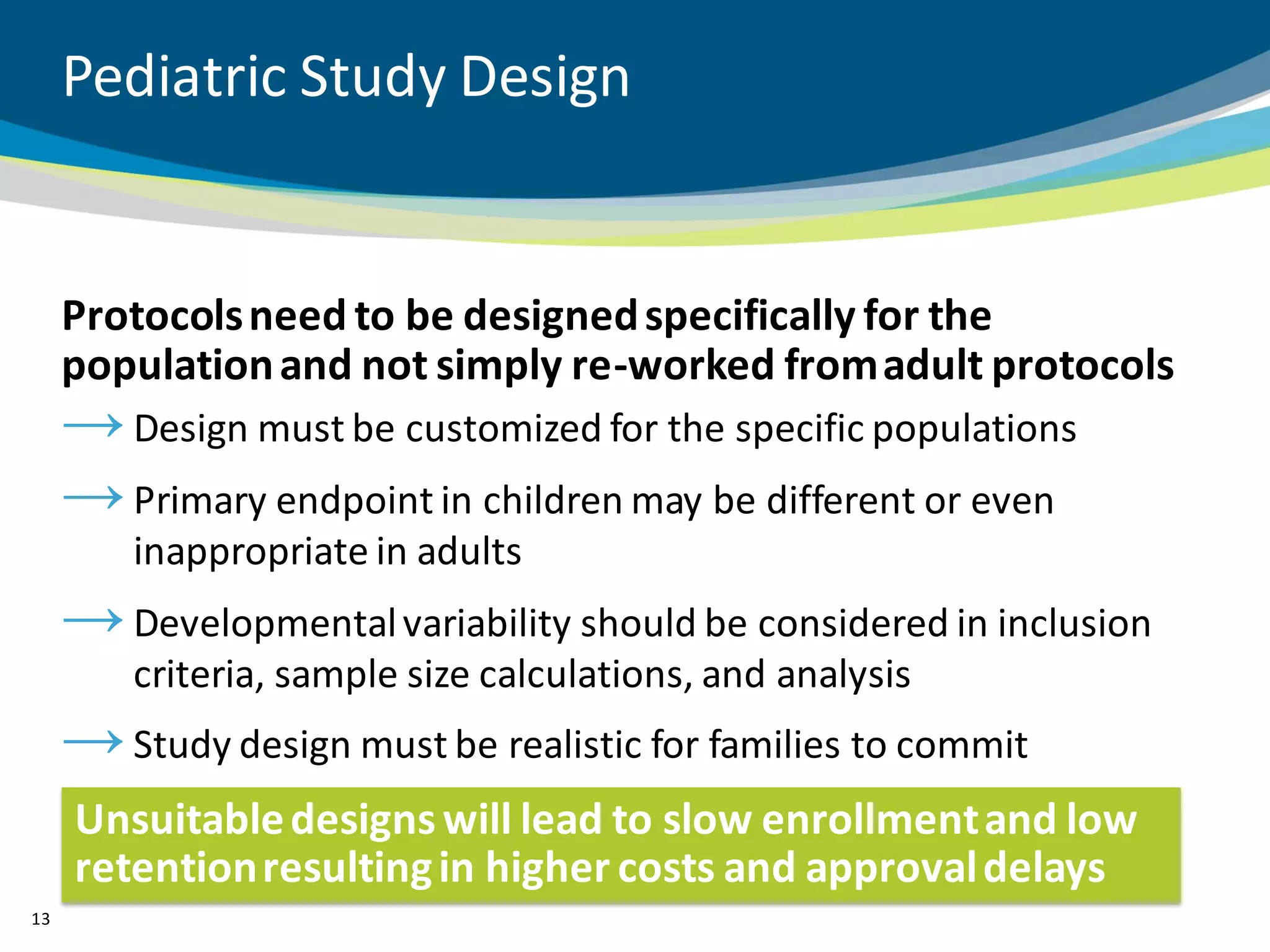
Pediatric Study Design


     Protocols need to be designed specifically for the
     population and not simply re-worked from adult protocols
     → Design must be customized for the specific populations
     → Primary endpoint in children may be different or even
         inappropriate in adults
     → Developmental variability should be considered in inclusion
         criteria, sample size calculations, and analysis
     → Study design must be realistic for families to commit
     Unsuitable designs will lead to slow enrollment and low
     retention resulting in higher costs and approval delays
13
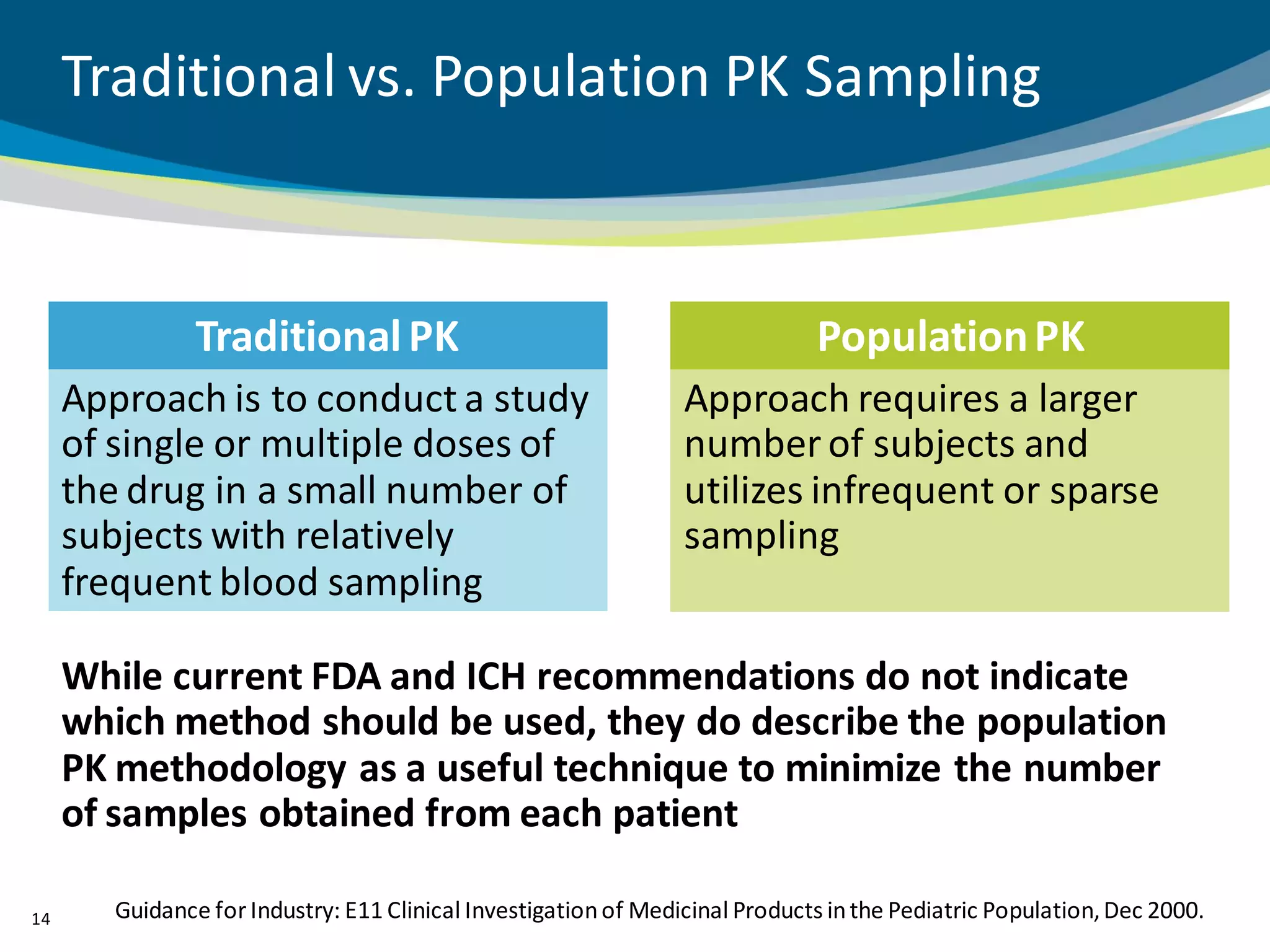
Traditional vs. Population PK Sampling


                Traditional PK                                                Population PK
     Approach is to conduct a study                              Approach requires a larger
     of single or multiple doses of                              number of subjects and
     the drug in a small number of                               utilizes infrequent or sparse
     subjects with relatively                                    sampling
     frequent blood sampling

     While current FDA and ICH recommendations do not indicate
     which method should be used, they do describe the population
     PK methodology as a useful technique to minimize the number
     of samples obtained from each patient

14      Guidance for Industry: E11 Clinical Investigation of Medicinal Products in the Pediatric Population, Dec 2000.
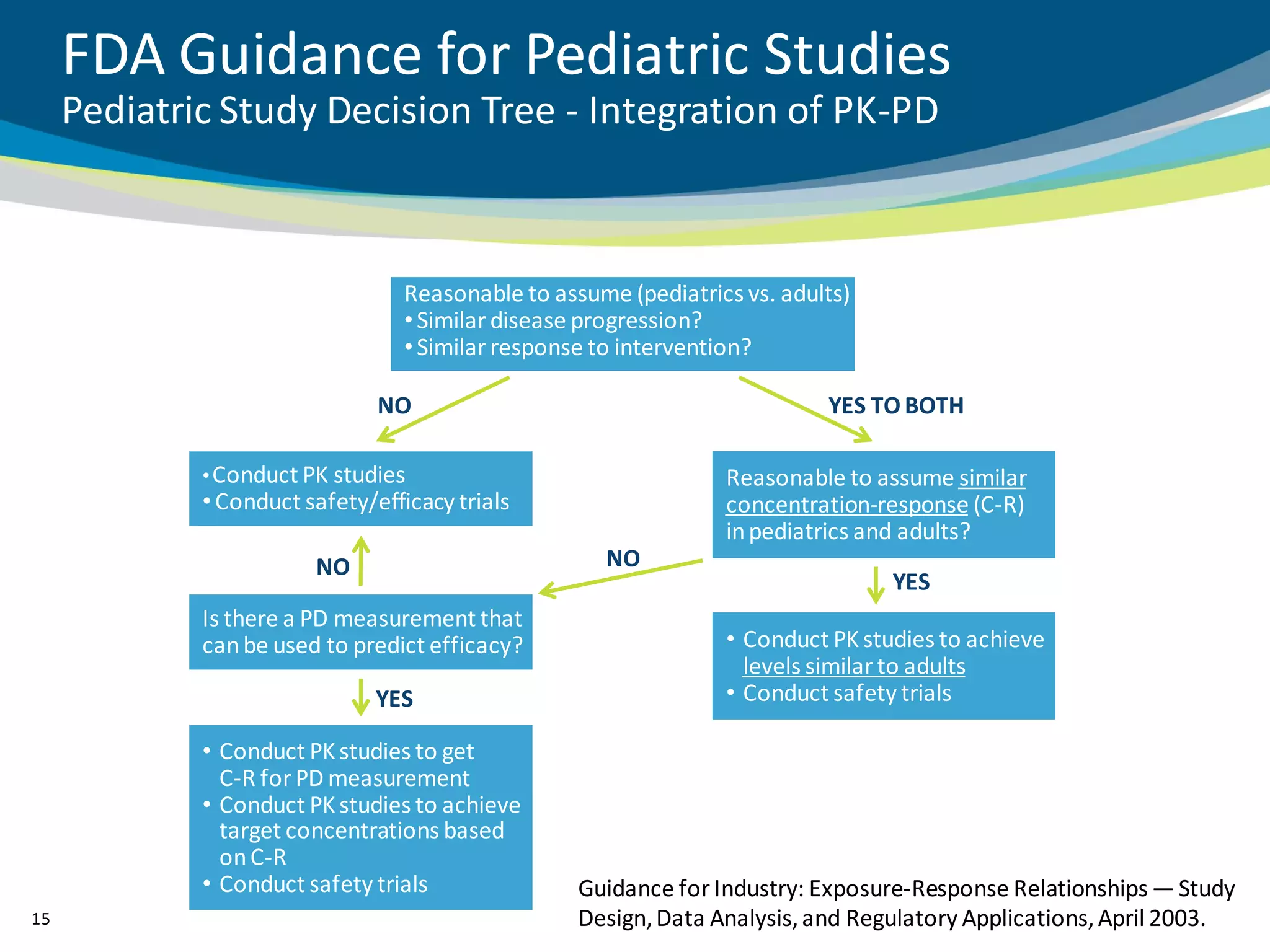
FDA Guidance for Pediatric Studies
     Pediatric Study Decision Tree - Integration of PK-PD


                                 Reasonable to assume (pediatrics vs. adults)
                                 • Similar disease progression?
                                 • Similar response to intervention?

                               NO                                         YES TO BOTH

             • Conduct PK studies                               Reasonable to assume similar
             • Conduct safety/efficacy trials                   concentration-response (C-R)
                                                                in pediatrics and adults?
                        NO                          NO
                                                                                YES
             Is there a PD measurement that
             can be used to predict efficacy?                   • Conduct PK studies to achieve
                                                                  levels similar to adults
                               YES                              • Conduct safety trials

             • Conduct PK studies to get
               C-R for PD measurement
             • Conduct PK studies to achieve
               target concentrations based
               on C-R
             • Conduct safety trials              Guidance for Industry: Exposure-Response Relationships — Study
15                                                Design, Data Analysis, and Regulatory Applications, April 2003.
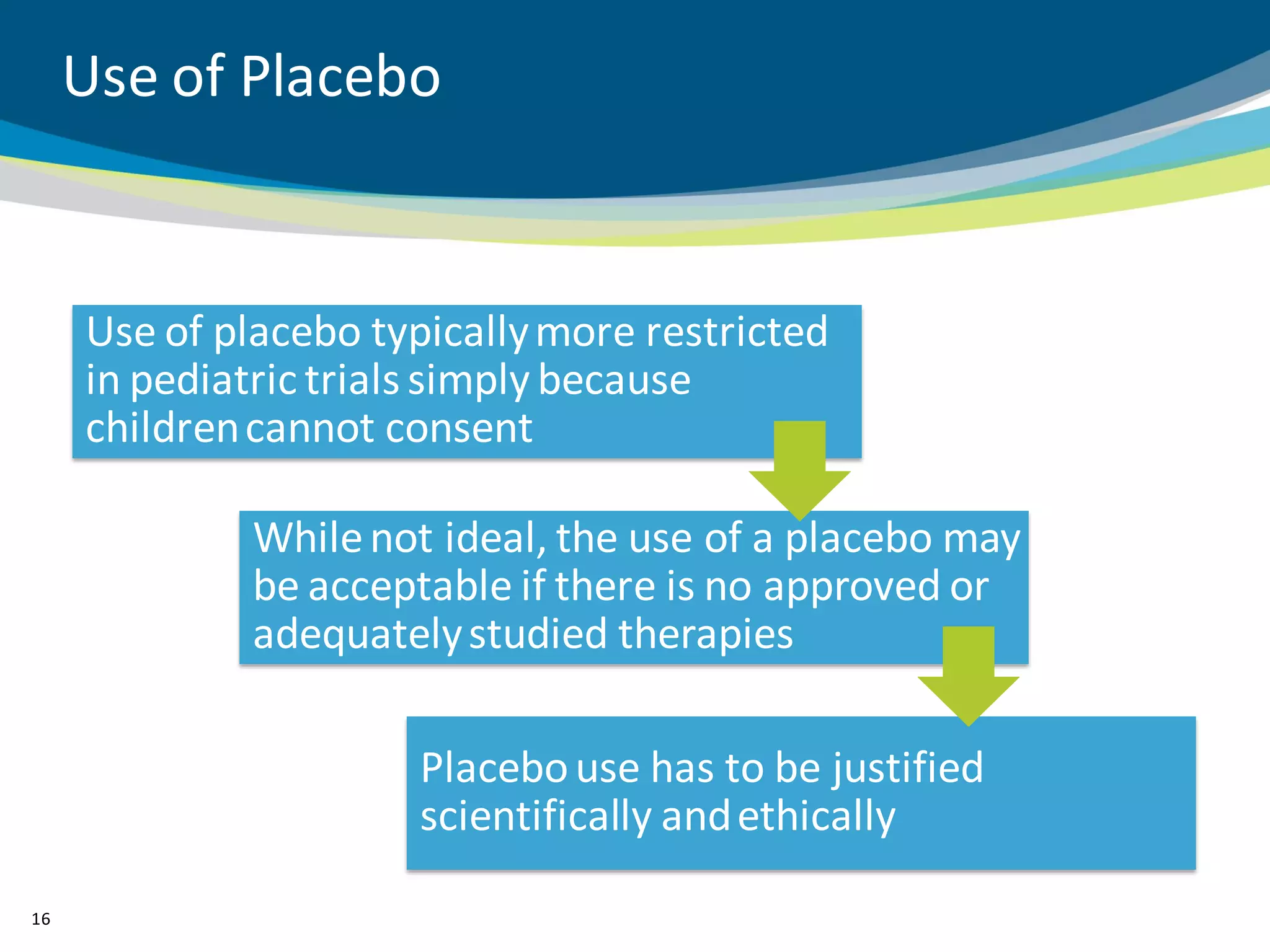
Use of Placebo


     Use of placebo typically more restricted
     in pediatric trials simply because
     children cannot consent

             While not ideal, the use of a placebo may
             be acceptable if there is no approved or
             adequately studied therapies

                      Placebo use has to be justified
                      scientifically and ethically

16
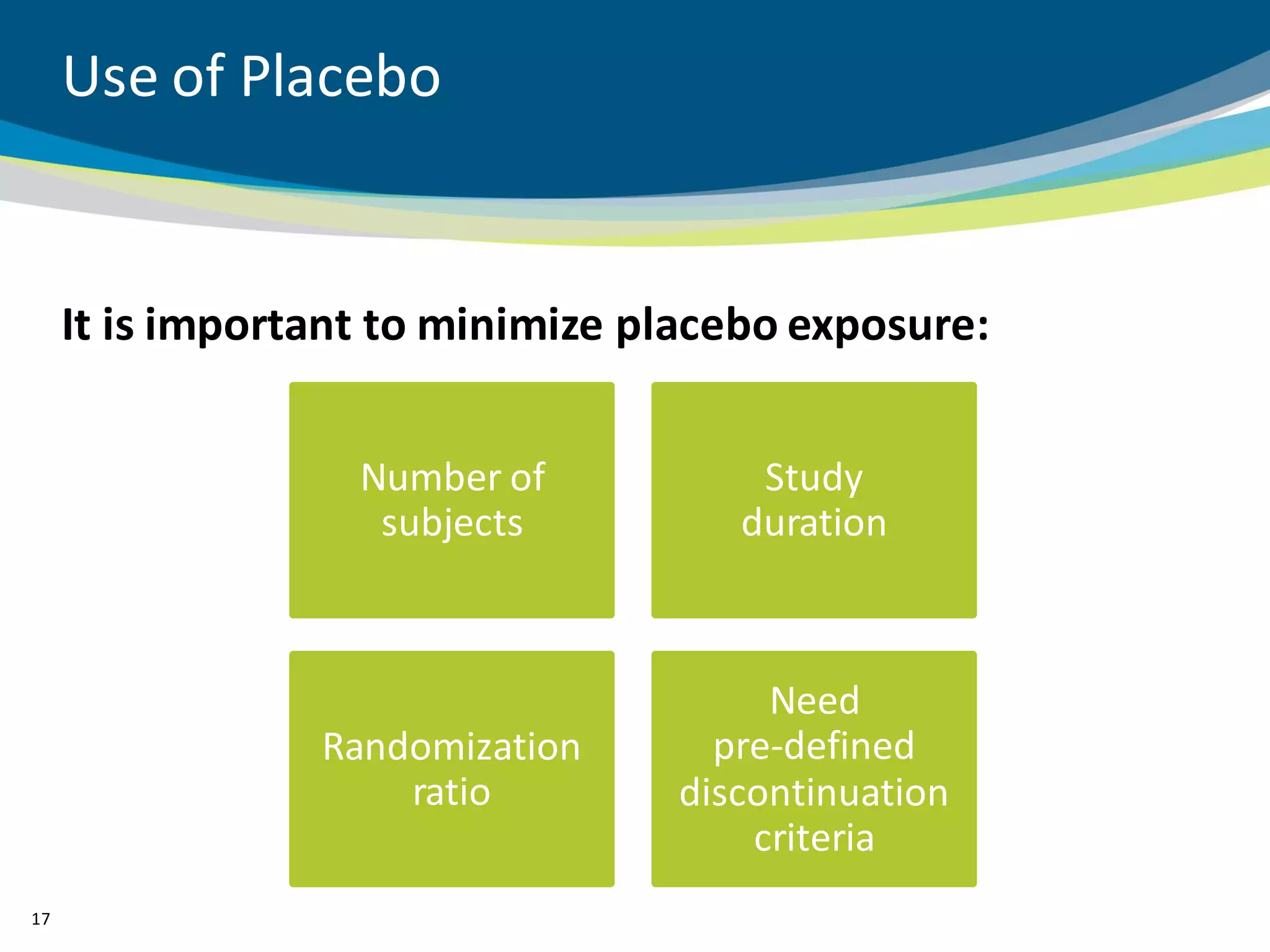
Use of Placebo


     It is important to minimize placebo exposure:


                   Number of          Study
                    subjects         duration


                                       Need
                 Randomization      pre-defined
                     ratio        discontinuation
                                      criteria
17
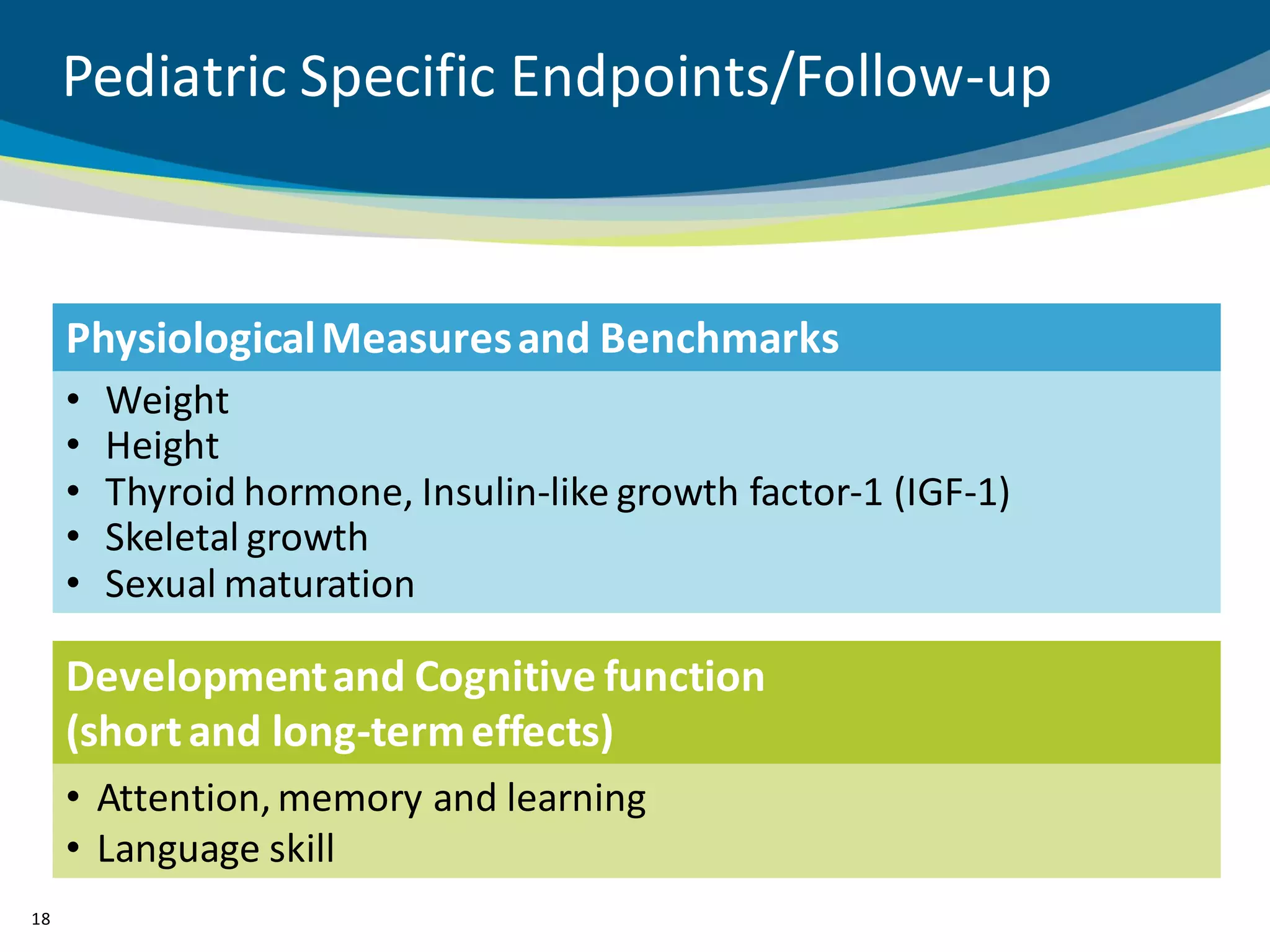
Pediatric Specific Endpoints/Follow-up


     Physiological Measures and Benchmarks
     •   Weight
     •   Height
     •   Thyroid hormone, Insulin-like growth factor-1 (IGF-1)
     •   Skeletal growth
     •   Sexual maturation

     Development and Cognitive function
     (short and long-term effects)
     • Attention, memory and learning
     • Language skill
18
Pediatric Specific Endpoints/Follow-up


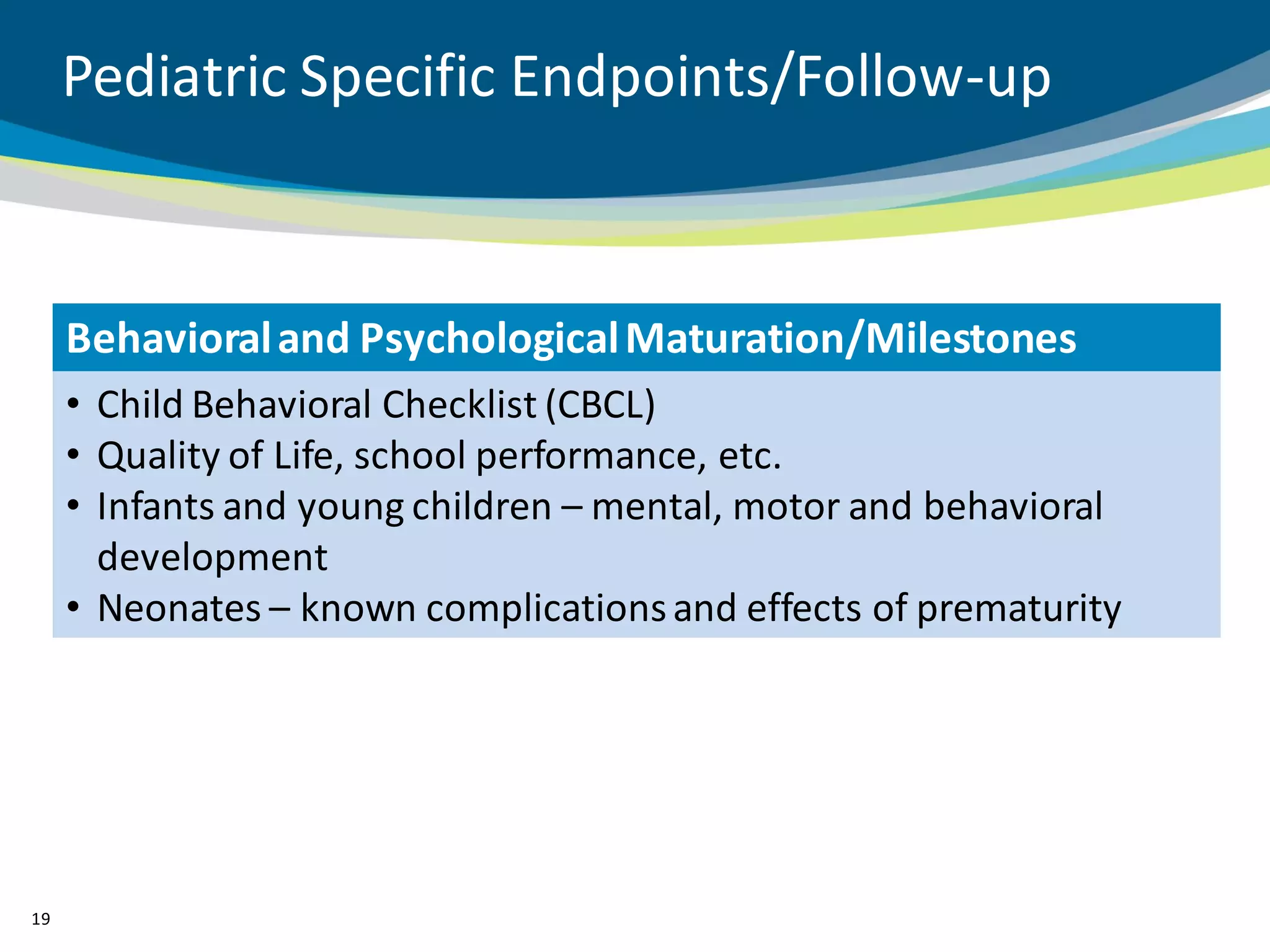
     Behavioral and Psychological Maturation/Milestones
     • Child Behavioral Checklist (CBCL)
     • Quality of Life, school performance, etc.
     • Infants and young children – mental, motor and behavioral
       development
     • Neonates – known complications and effects of prematurity


19
Duration of Treatment,
     Follow-up, and Retention


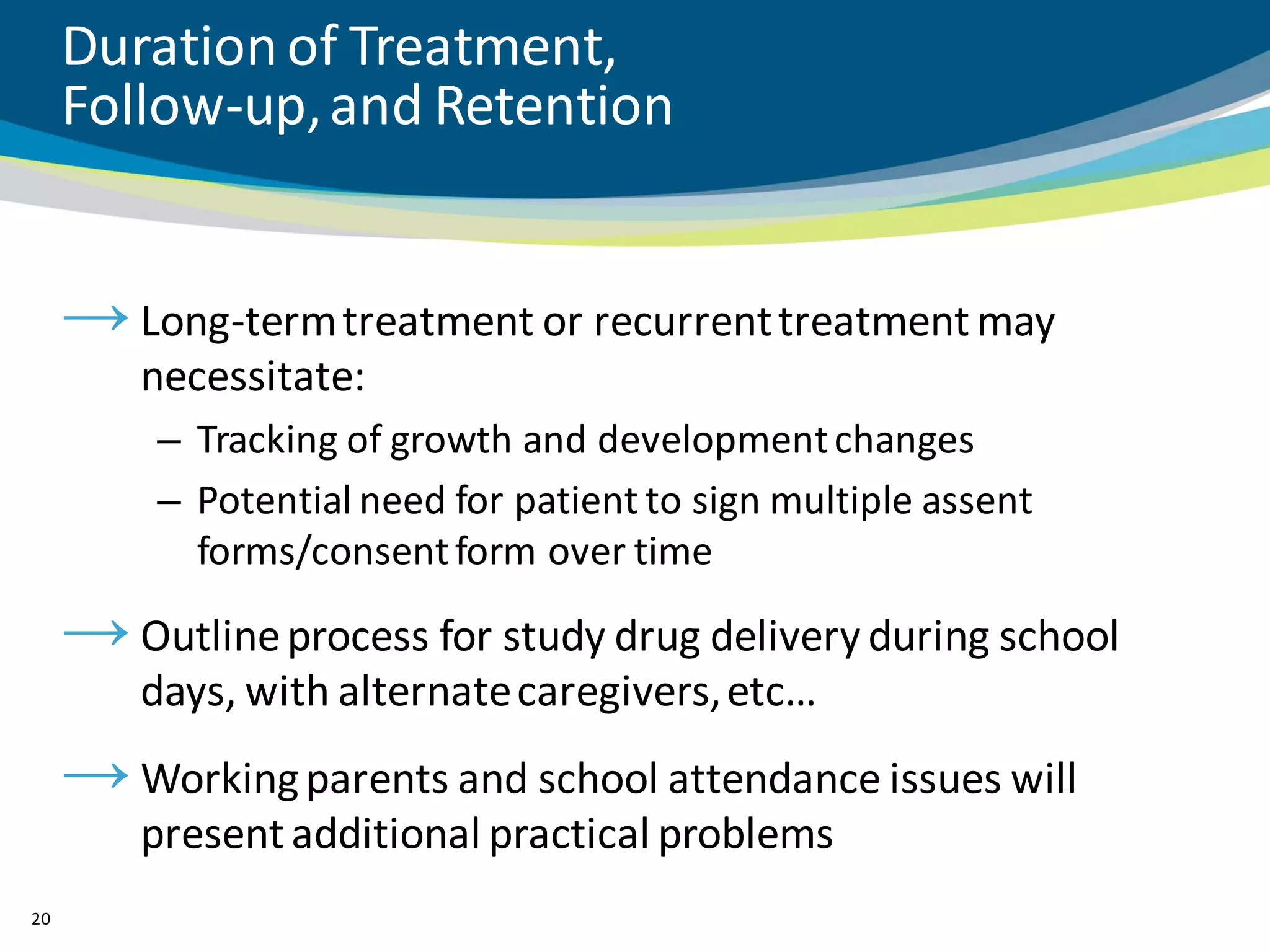
     → Long-term treatment or recurrent treatment may
         necessitate:
         – Tracking of growth and development changes
         – Potential need for patient to sign multiple assent
           forms/consent form over time

     → Outline process for study drug delivery during school
         days, with alternate caregivers, etc…
     → Working parents and school attendance issues will
         present additional practical problems
20
Ethical Considerations
     and Special Protections


21
Special Protections in Pediatric Research


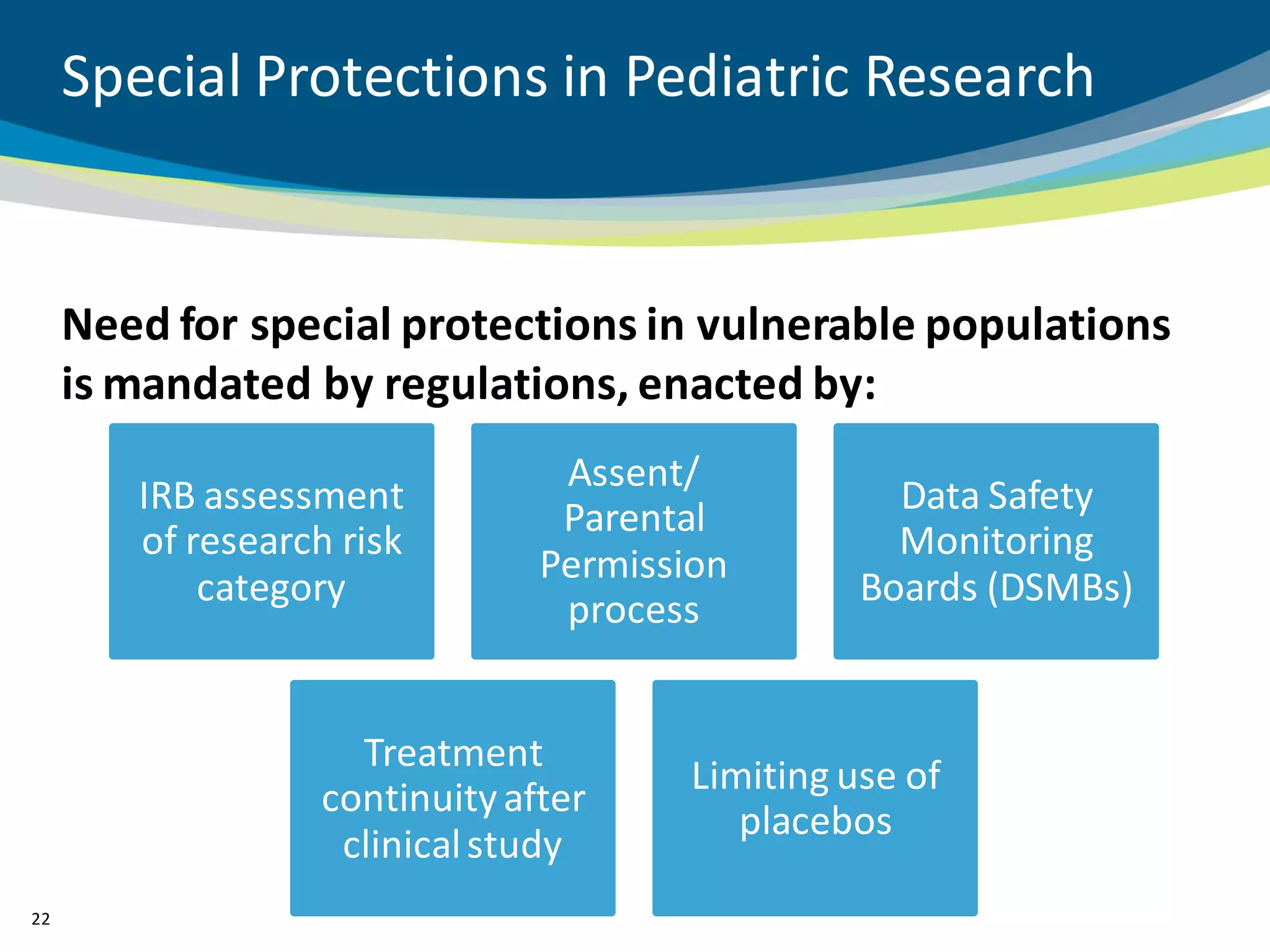
     Need for special protections in vulnerable populations
     is mandated by regulations, enacted by:
                                 Assent/
        IRB assessment                              Data Safety
                                 Parental
        of research risk                            Monitoring
                                Permission
            category                              Boards (DSMBs)
                                 process


                     Treatment
                                        Limiting use of
                   continuity after
                                           placebos
                    clinical study
22
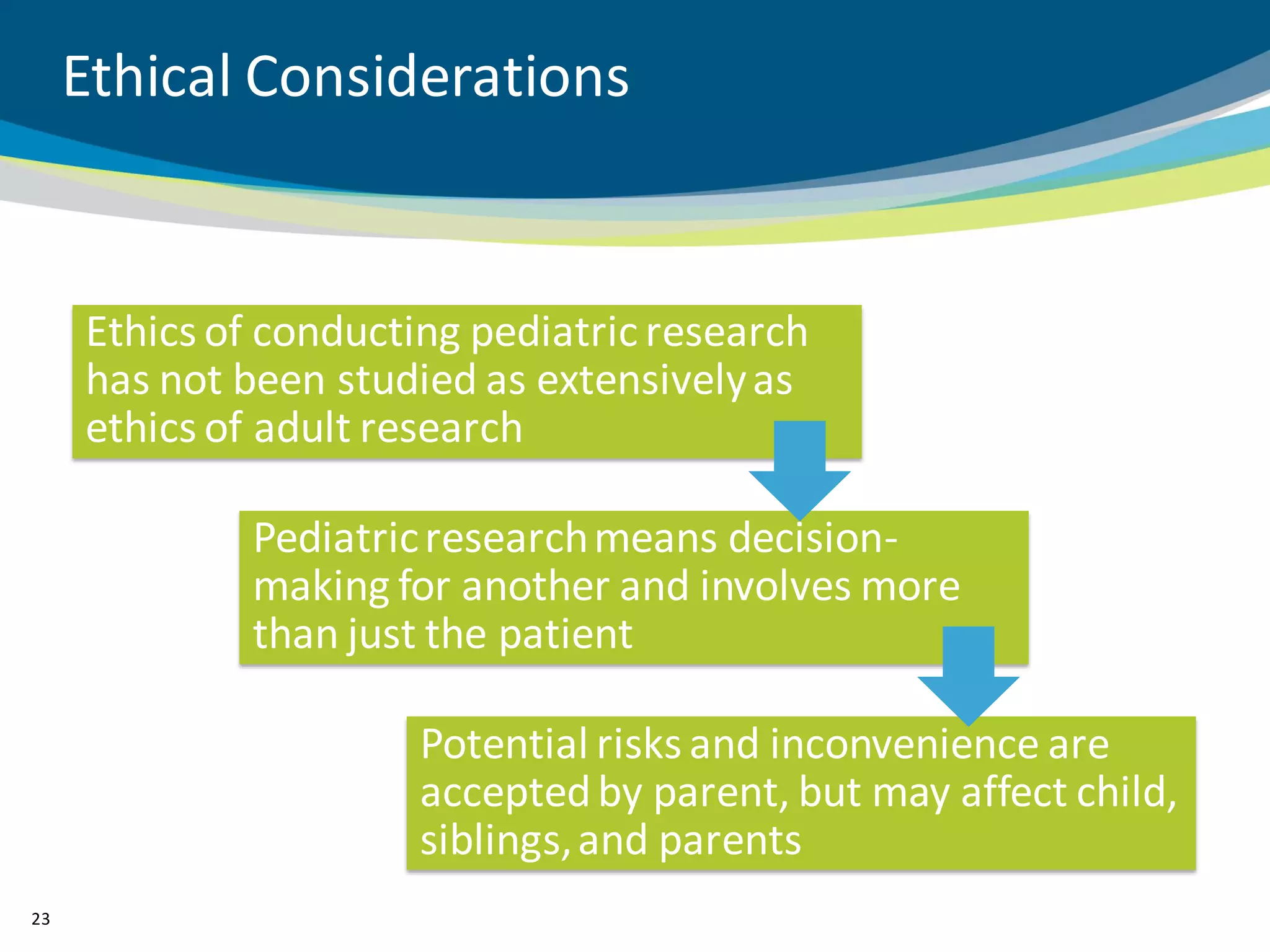
Ethical Considerations


     Ethics of conducting pediatric research
     has not been studied as extensively as
     ethics of adult research

              Pediatric research means decision-
              making for another and involves more
              than just the patient

                       Potential risks and inconvenience are
                       accepted by parent, but may affect child,
                       siblings, and parents
23
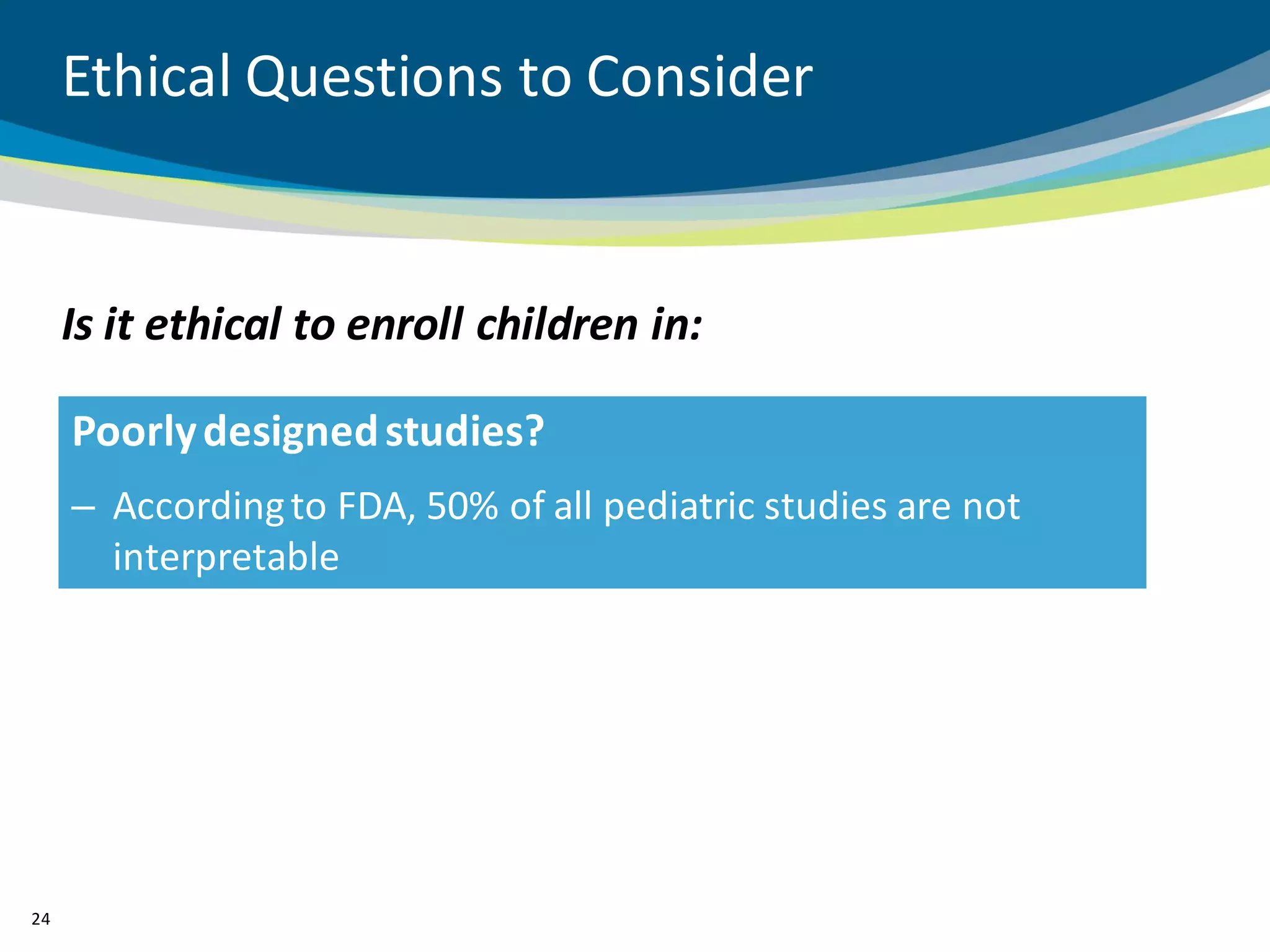
Ethical Questions to Consider


     Is it ethical to enroll children in:

     Poorly designed studies?
     – According to FDA, 50% of all pediatric studies are not
       interpretable


24
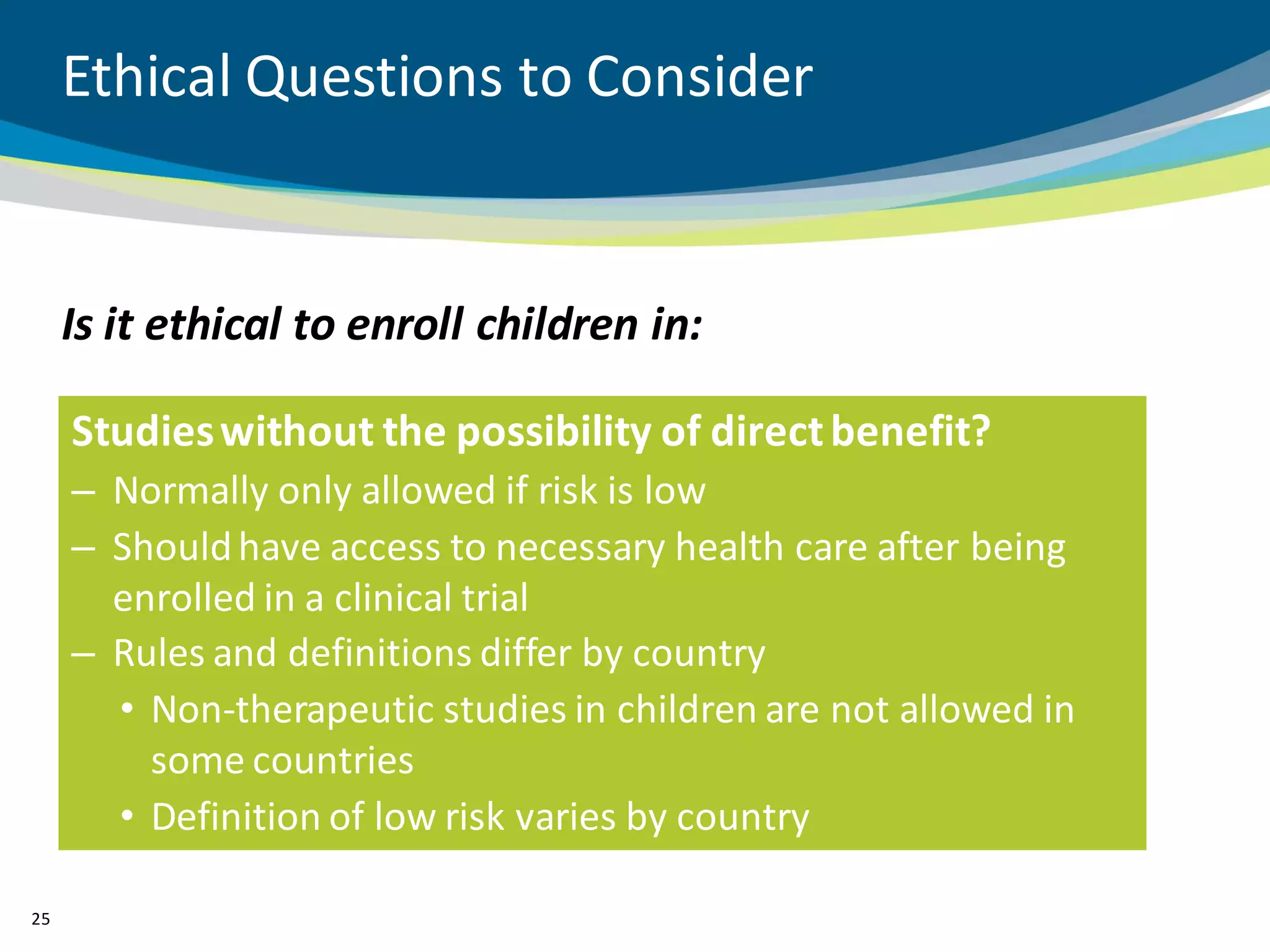
Ethical Questions to Consider


     Is it ethical to enroll children in:

     Studies without the possibility of direct benefit?
     – Normally only allowed if risk is low
     – Should have access to necessary health care after being
       enrolled in a clinical trial
     – Rules and definitions differ by country
       • Non-therapeutic studies in children are not allowed in
         some countries
       • Definition of low risk varies by country

25
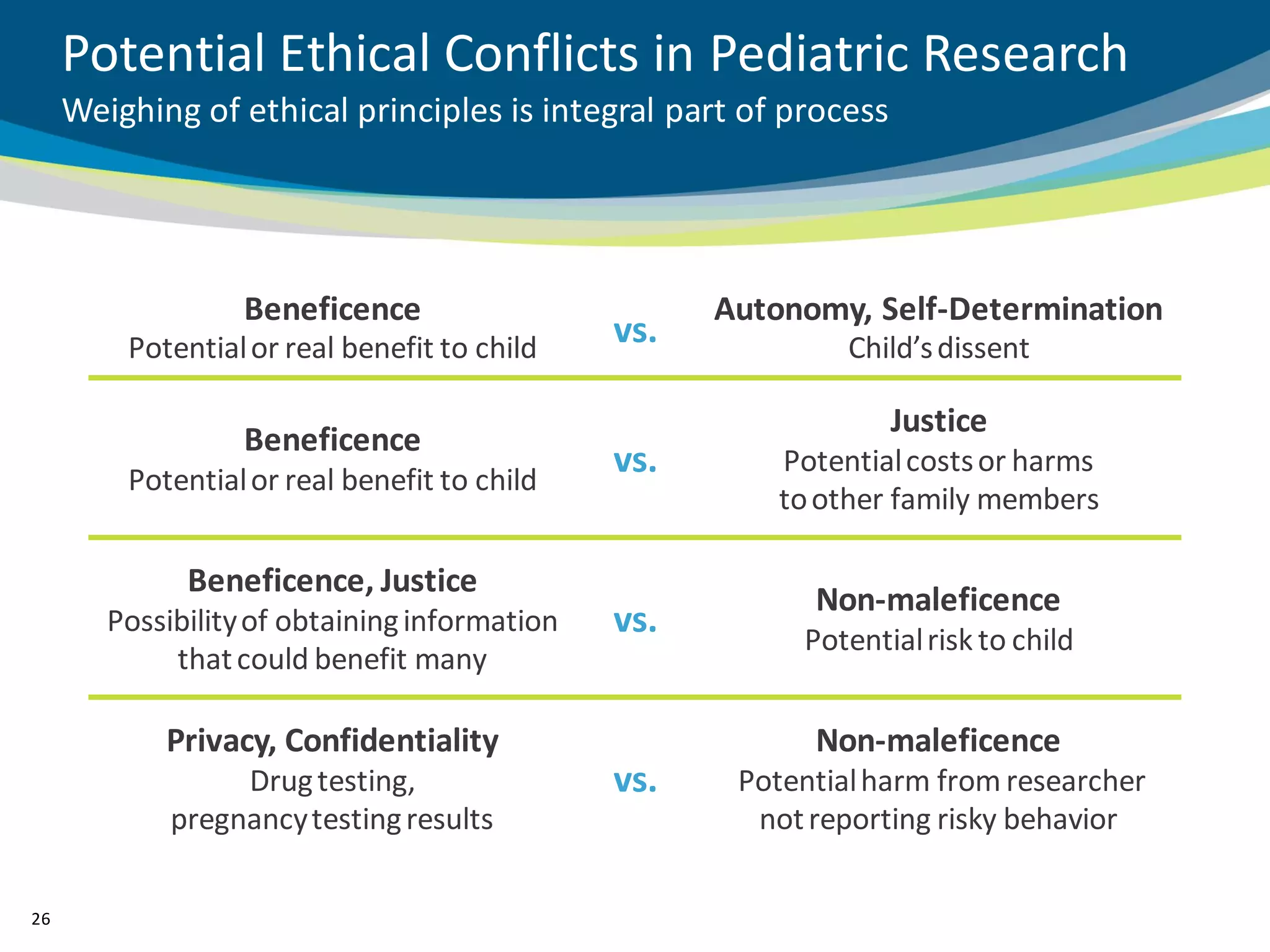
Potential Ethical Conflicts in Pediatric Research
     Weighing of ethical principles is integral part of process


                  Beneficence                        Autonomy, Self-Determination
         Potential or real benefit to child    vs.            Child’s dissent

                                                                  Justice
                  Beneficence
         Potential or real benefit to child
                                               vs.       Potential costs or harms
                                                         to other family members

              Beneficence, Justice
                                                           Non-maleficence
        Possibility of obtaining information   vs.        Potential risk to child
             that could benefit many

            Privacy, Confidentiality                       Non-maleficence
                  Drug testing,                vs.    Potential harm from researcher
             pregnancy testing results                 not reporting risky behavior

26
Enrollable Protocols


27
Child Friendly Study Procedures


     Minimize intensity and frequency of the study assessments
     • Limit number and volume of blood draws – coincide the
       collection of protocol-specified blood samples with routine
       clinical samples
     • Limit invasive procedure as much as possible

     Minimize pain and distress
     • Use topical anesthesia, butterfly needles, pediatric sampling
       tubes
     • Indwelling catheters rather than repeated venipunctures for
       blood sampling
28
Child Friendly Study Procedures


     In addition:
     • Handle pregnancy testing in minors with care

     • Consider not only the child but also the parents and
       siblings when planning the frequency and length of
       visits/assessments


29
Drug Administration Considerations


     Dosing is more difficult to manage than in adults:
     • Often based on experience in adults and weight/BSA
     • Titration rates and AE monitoring need to be carefully evaluated
     • Administration of investigational product can pose problems


     Timing of dosing can also be a challenge:
     • Issues with dosing in school-age children
     • Strict dosing times may be difficult to adhere to

30
Directed and Executable


31
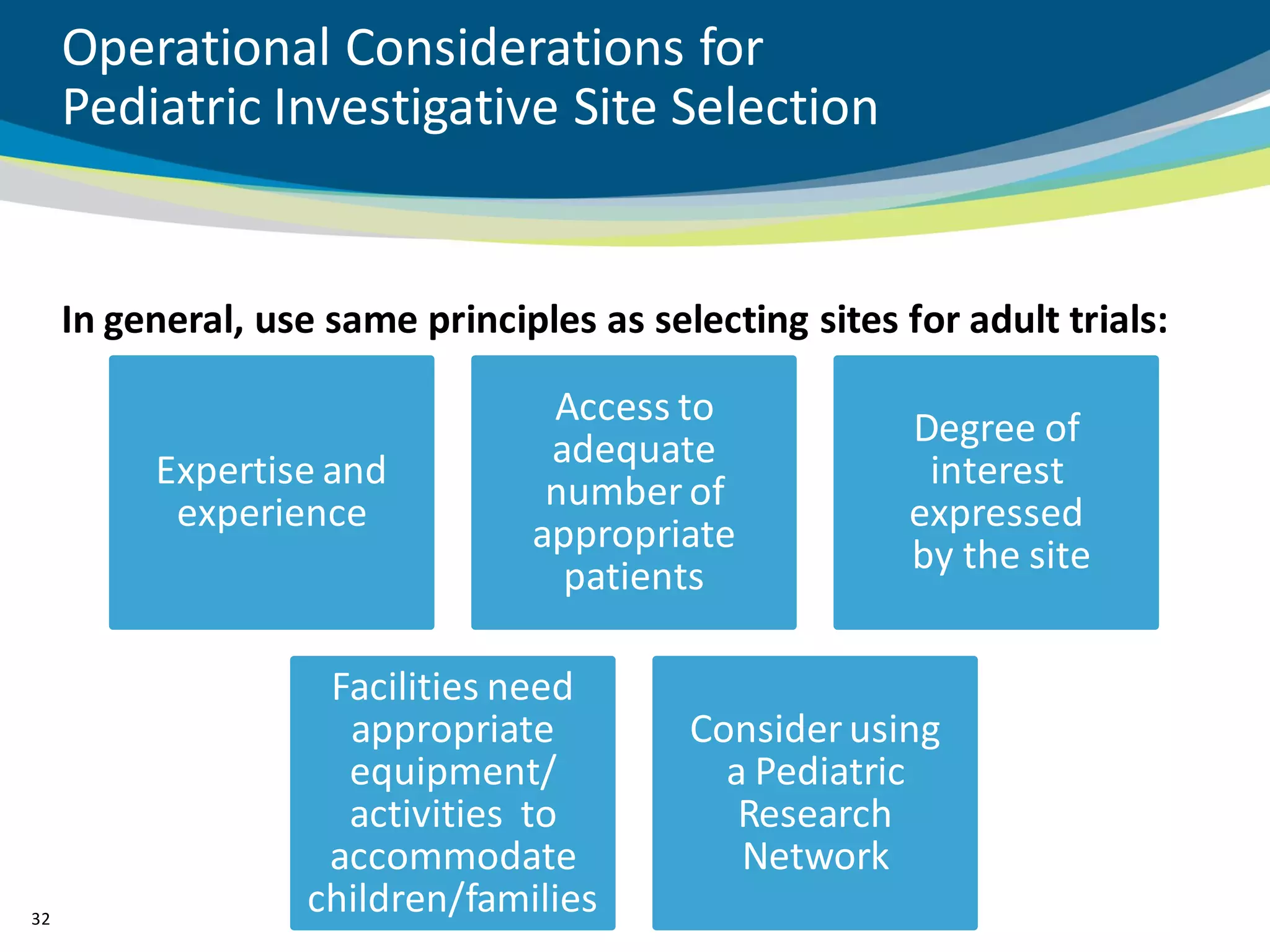
Operational Considerations for
     Pediatric Investigative Site Selection


     In general, use same principles as selecting sites for adult trials:

                                  Access to
                                                         Degree of
          Expertise and           adequate                interest
                                  number of
           experience                                    expressed
                                 appropriate             by the site
                                   patients

                     Facilities need
                      appropriate          Consider using
                      equipment/             a Pediatric
                      activities to           Research
                     accommodate              Network
32
                    children/families
Medical Considerations for
     Pediatric Investigative Site Selection


     • Absolutely MUST have person experienced in pediatric
       lab draws

     • Depending on protocol, may also need personnel
       with expertise in catheterizing small children,
       pediatric IV starts, placing pediatric NG tubes, etc.

     • Sites that are not pediatric based must have access to
       resources needed for the pediatric population

33
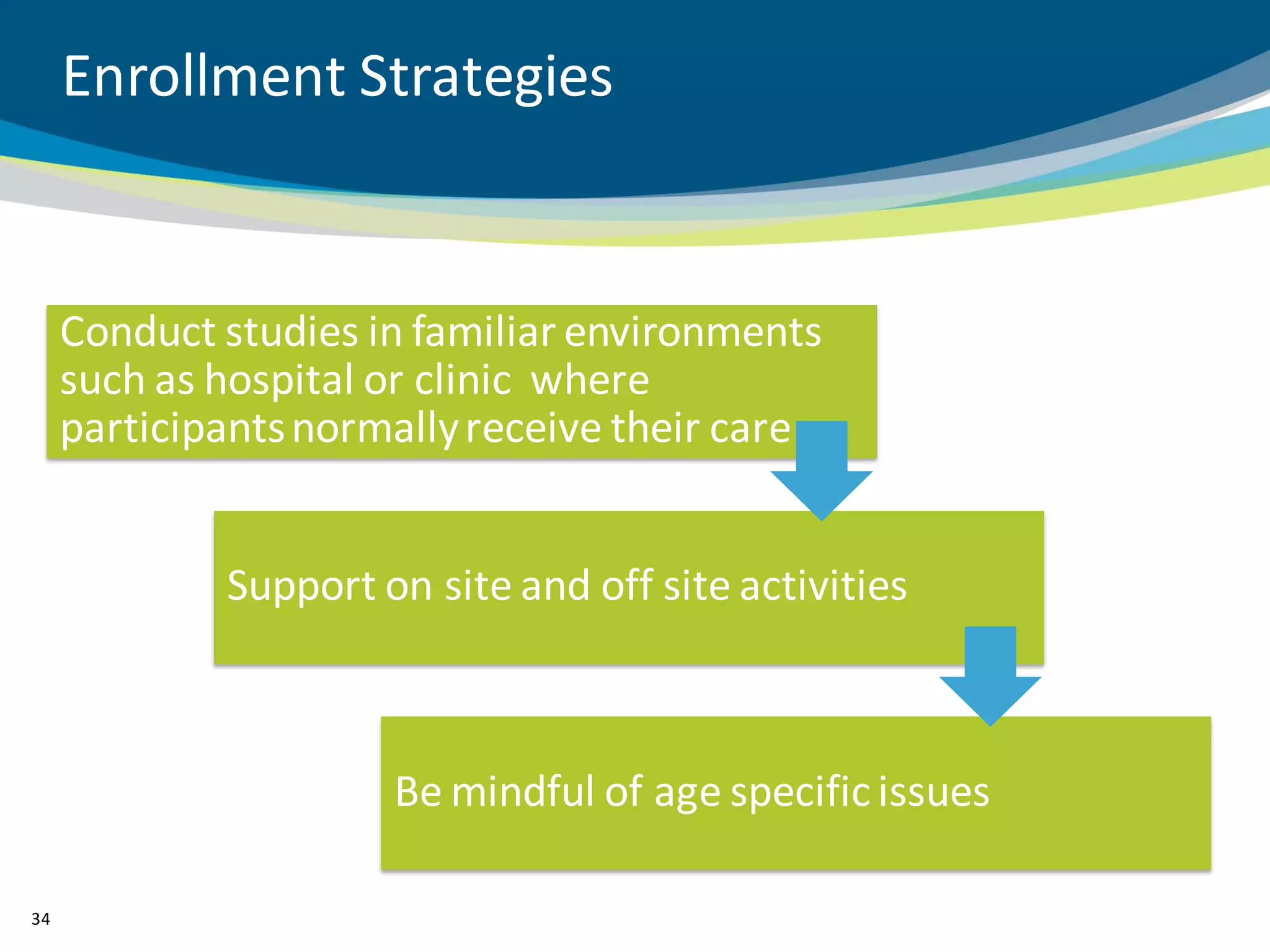
Enrollment Strategies


     Conduct studies in familiar environments
     such as hospital or clinic where
     participants normally receive their care


             Support on site and off site activities


                      Be mindful of age specific issues

34
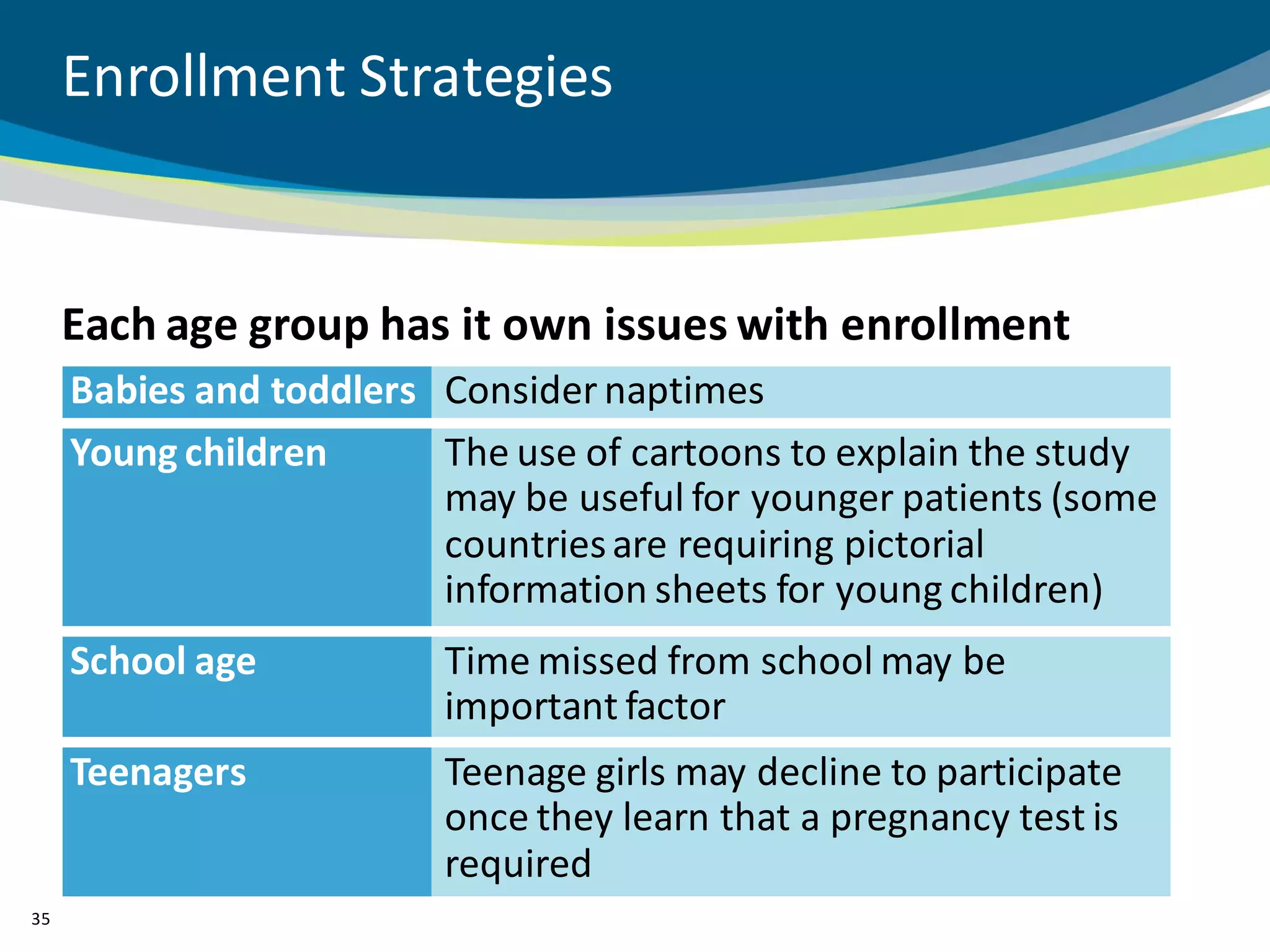
Enrollment Strategies


     Each age group has it own issues with enrollment
     Babies and toddlers Consider naptimes
     Young children      The use of cartoons to explain the study
                         may be useful for younger patients (some
                         countries are requiring pictorial
                         information sheets for young children)
     School age          Time missed from school may be
                         important factor
     Teenagers           Teenage girls may decline to participate
                         once they learn that a pregnancy test is
                         required
35
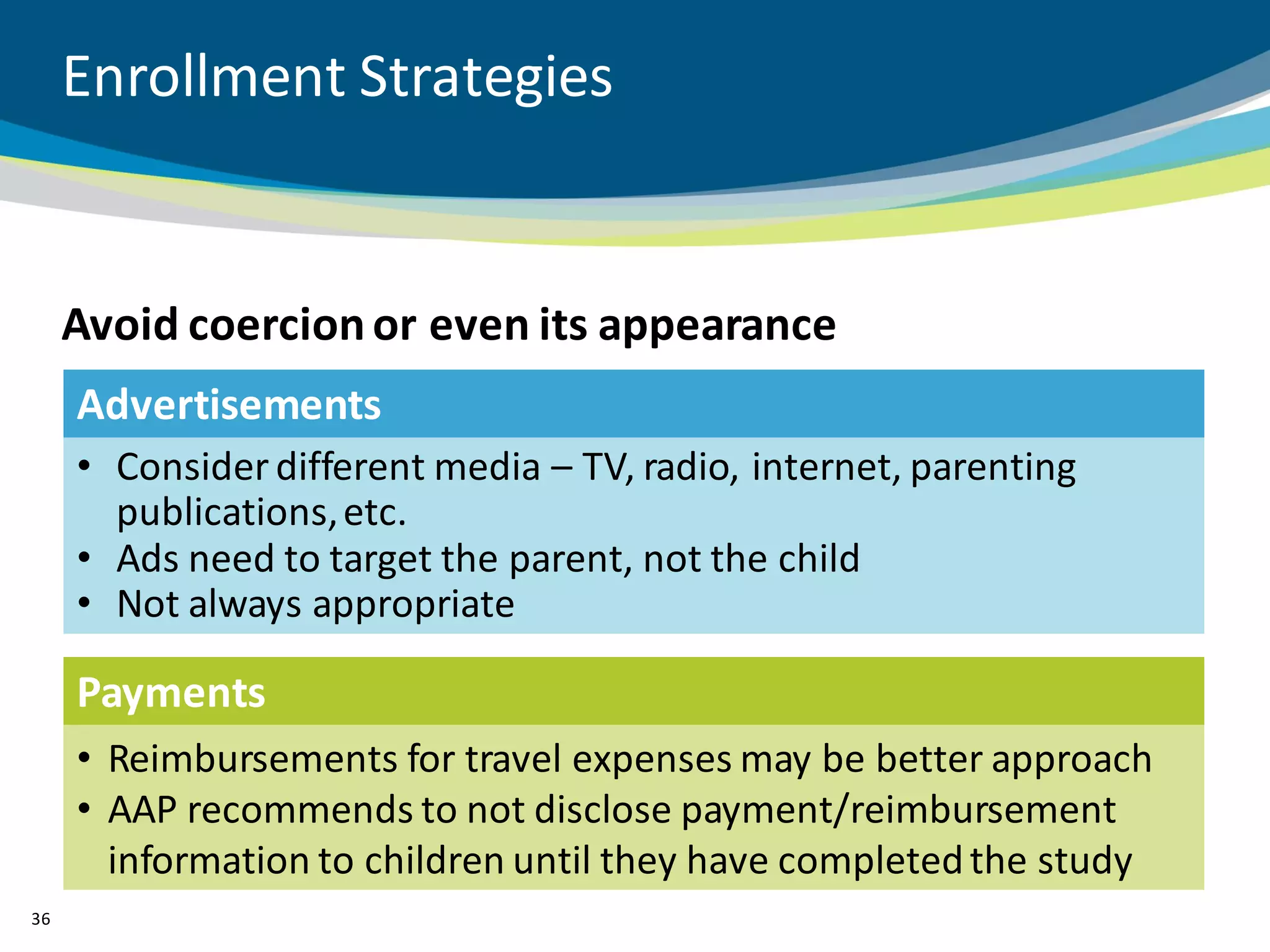
Enrollment Strategies


     Avoid coercion or even its appearance
     Advertisements
     • Consider different media – TV, radio, internet, parenting
       publications, etc.
     • Ads need to target the parent, not the child
     • Not always appropriate

     Payments
     • Reimbursements for travel expenses may be better approach
     • AAP recommends to not disclose payment/reimbursement
       information to children until they have completed the study
36
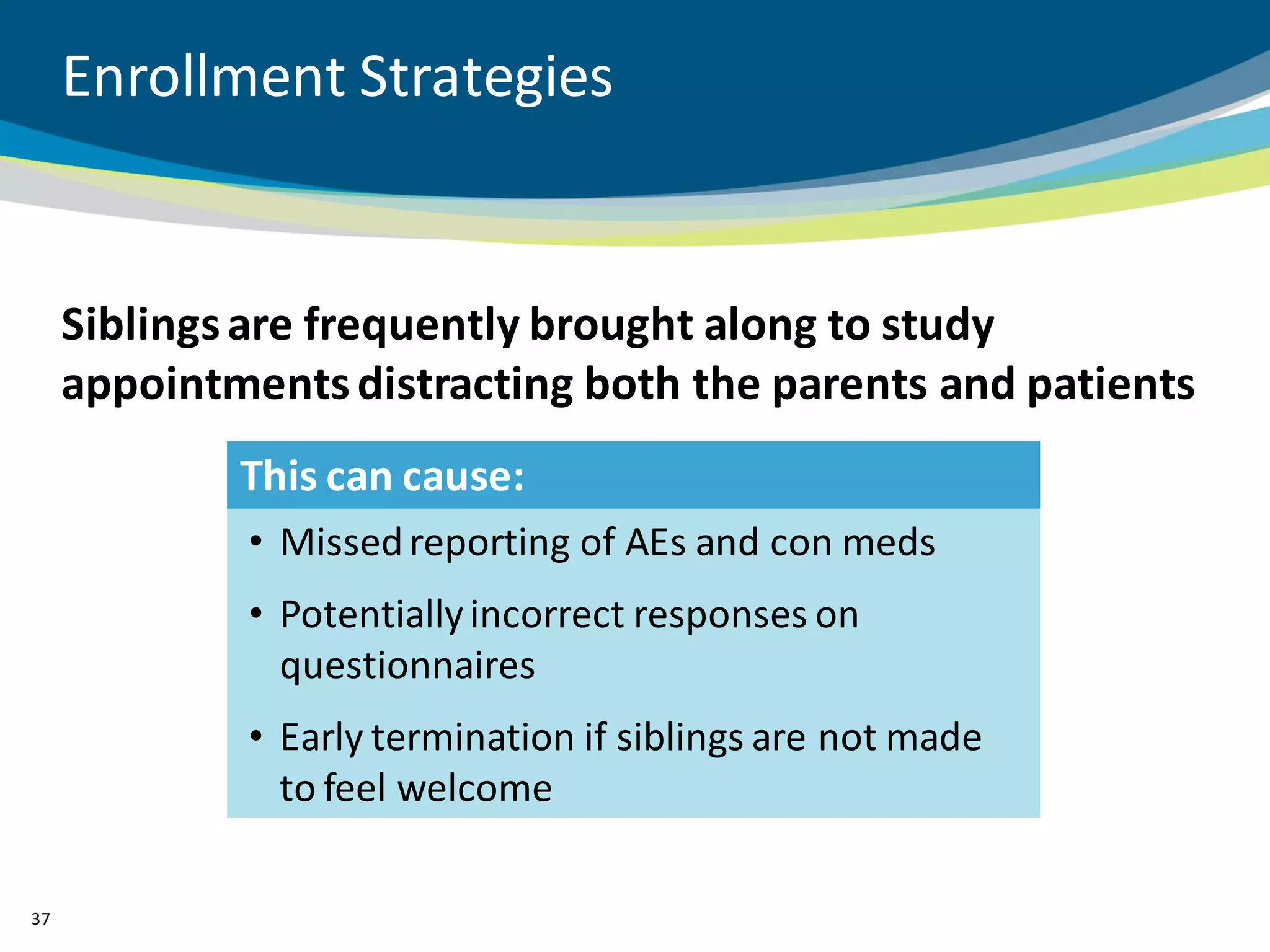
Enrollment Strategies


     Siblings are frequently brought along to study
     appointments distracting both the parents and patients
             This can cause:
             • Missed reporting of AEs and con meds
             • Potentially incorrect responses on
               questionnaires
             • Early termination if siblings are not made
               to feel welcome

37
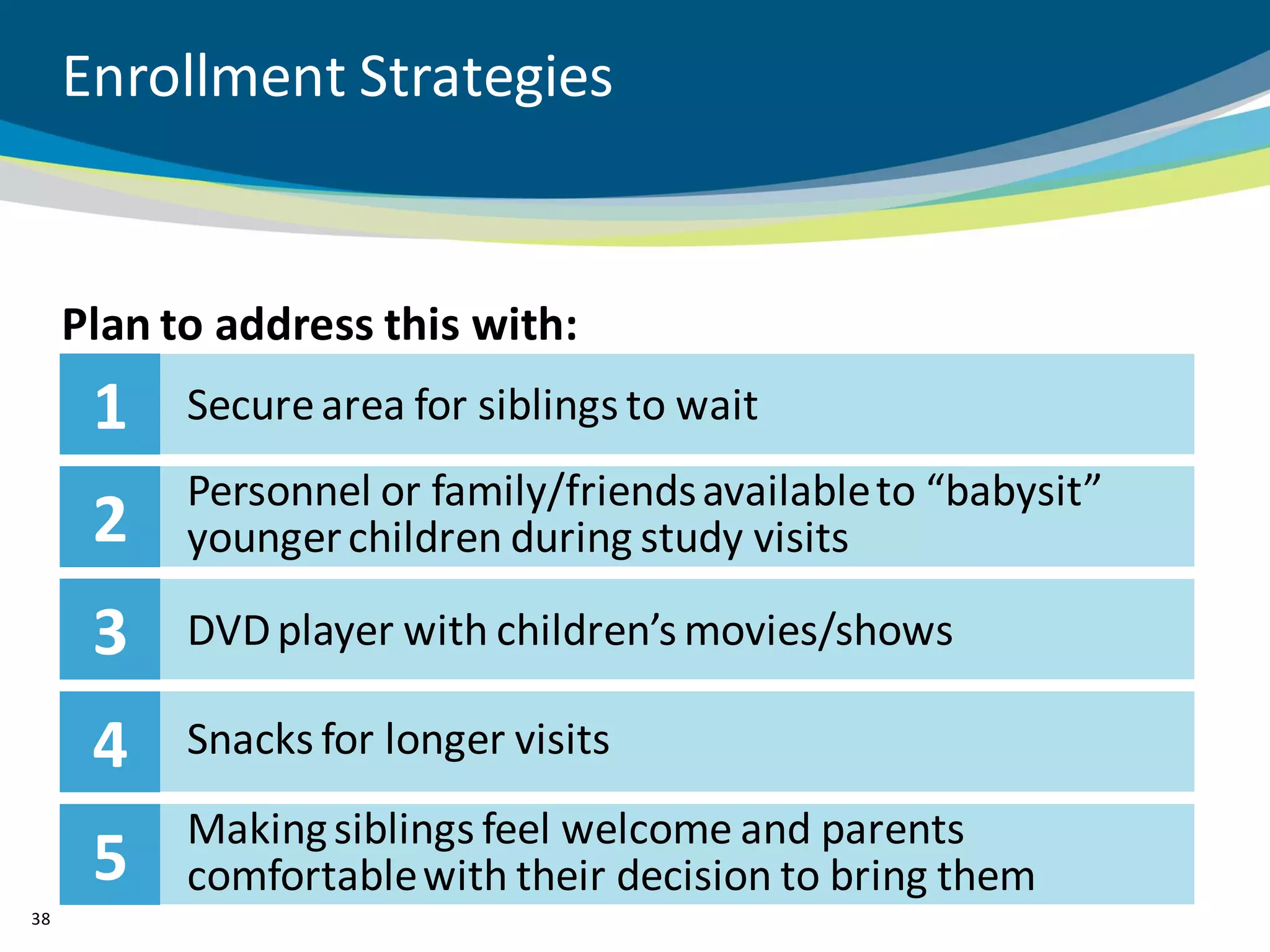
Enrollment Strategies


     Plan to address this with:
      1    Secure area for siblings to wait
           Personnel or family/friends available to “babysit”
      2    younger children during study visits

      3    DVD player with children’s movies/shows

      4    Snacks for longer visits
           Making siblings feel welcome and parents
      5    comfortable with their decision to bring them
38
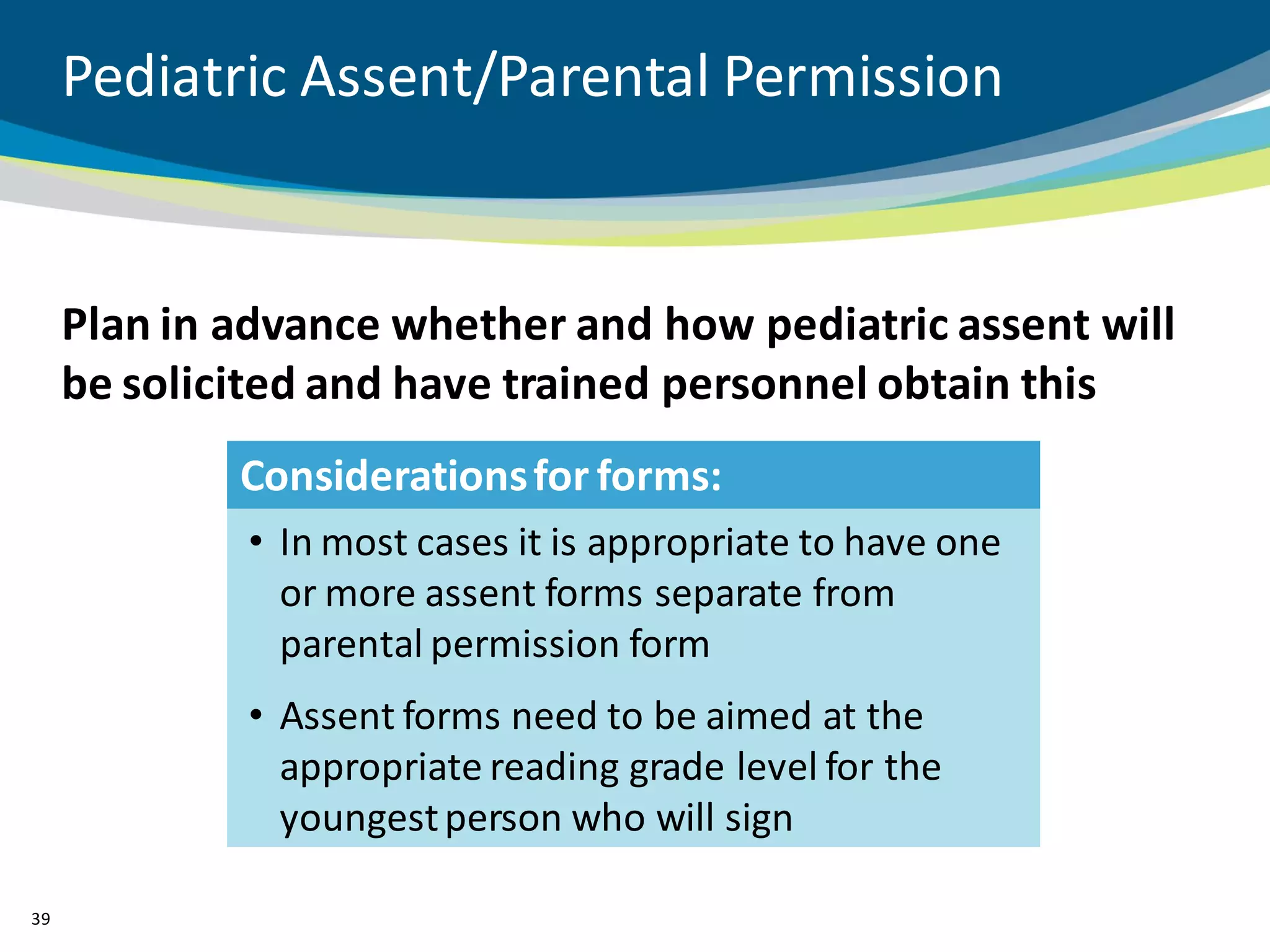
Pediatric Assent/Parental Permission


     Plan in advance whether and how pediatric assent will
     be solicited and have trained personnel obtain this
             Considerations for forms:
             • In most cases it is appropriate to have one
               or more assent forms separate from
               parental permission form
             • Assent forms need to be aimed at the
               appropriate reading grade level for the
               youngest person who will sign

39
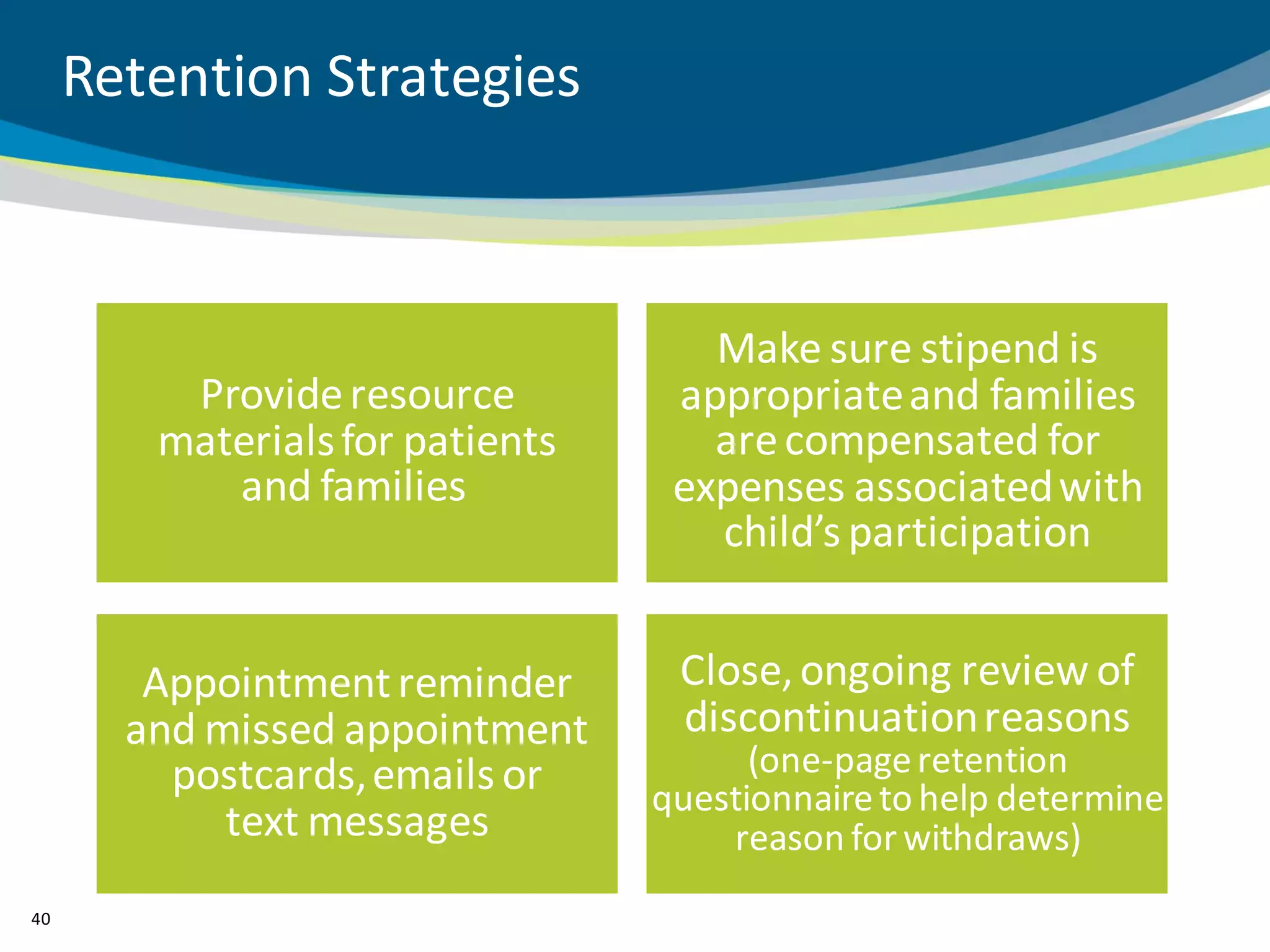
Retention Strategies


                                    Make sure stipend is
         Provide resource         appropriate and families
        materials for patients      are compensated for
           and families           expenses associated with
                                    child’s participation


        Appointment reminder      Close, ongoing review of
       and missed appointment     discontinuation reasons
         postcards, emails or          (one-page retention
                                 questionnaire to help determine
            text messages            reason for withdraws)
40
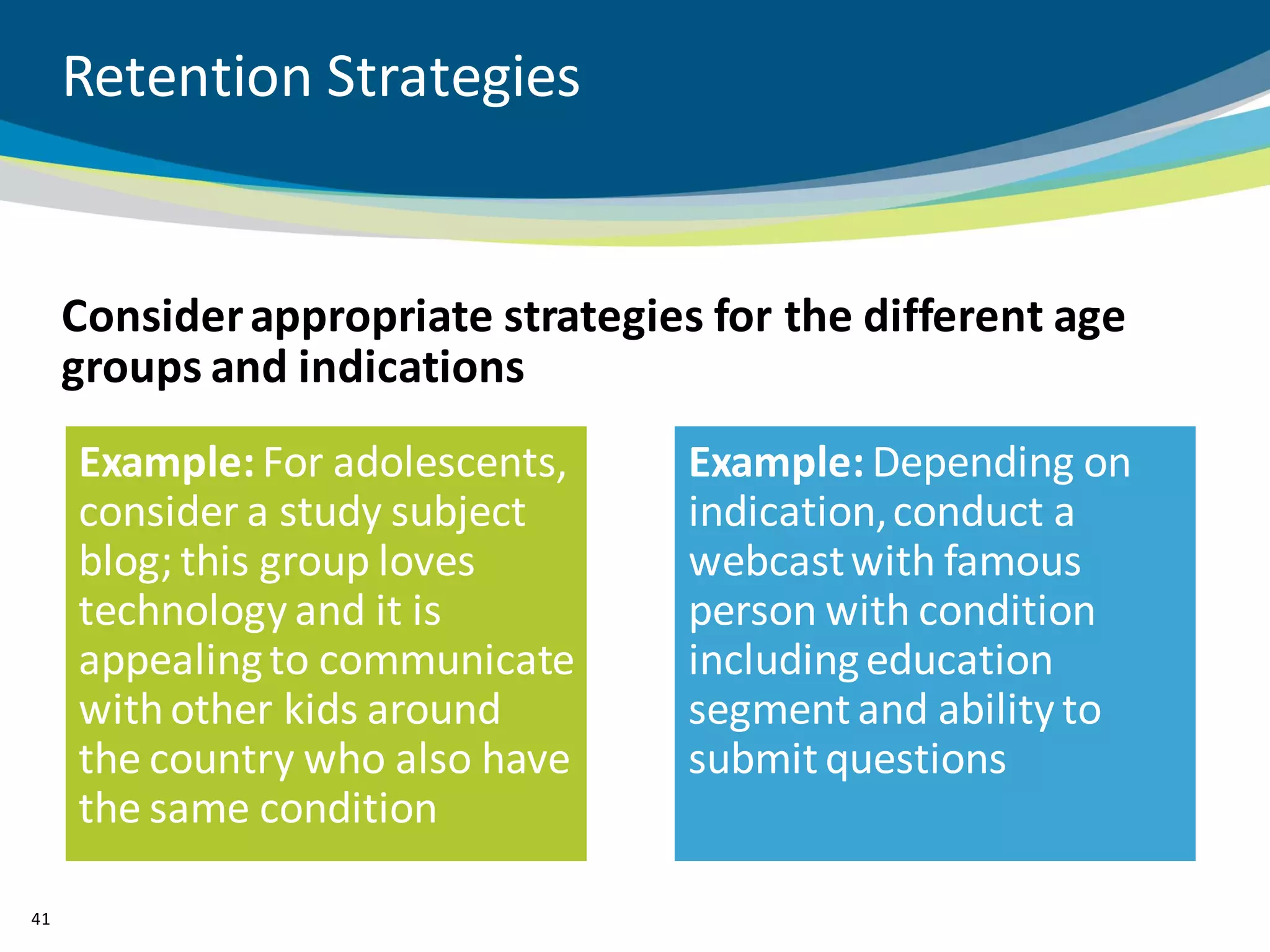
Retention Strategies


     Consider appropriate strategies for the different age
     groups and indications
     Example: For adolescents,      Example: Depending on
     consider a study subject       indication, conduct a
     blog; this group loves         webcast with famous
     technology and it is           person with condition
     appealing to communicate       including education
     with other kids around         segment and ability to
     the country who also have      submit questions
     the same condition

41
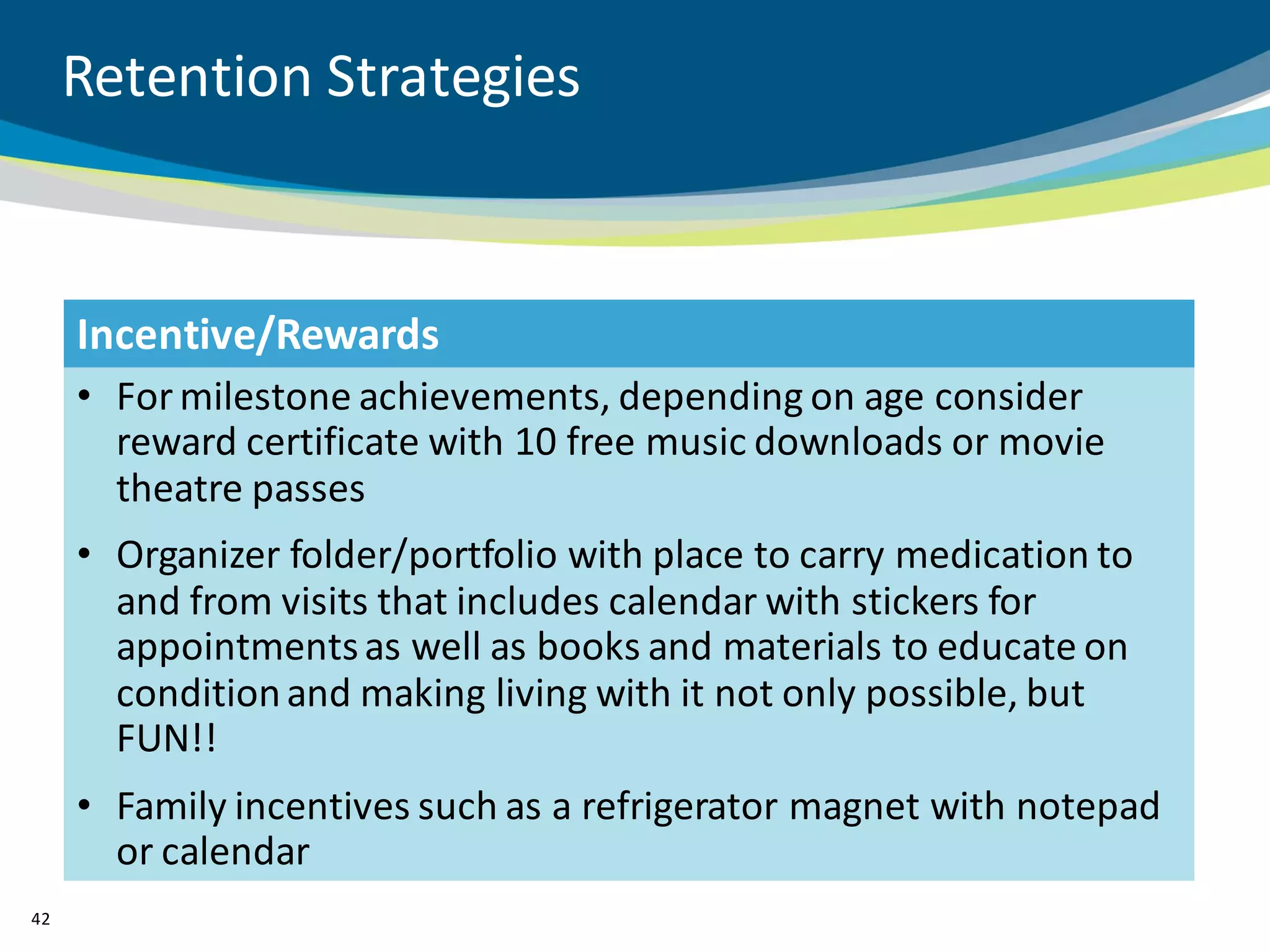
Retention Strategies


     Incentive/Rewards
     • For milestone achievements, depending on age consider
       reward certificate with 10 free music downloads or movie
       theatre passes
     • Organizer folder/portfolio with place to carry medication to
       and from visits that includes calendar with stickers for
       appointments as well as books and materials to educate on
       condition and making living with it not only possible, but
       FUN!!
     • Family incentives such as a refrigerator magnet with notepad
       or calendar
42
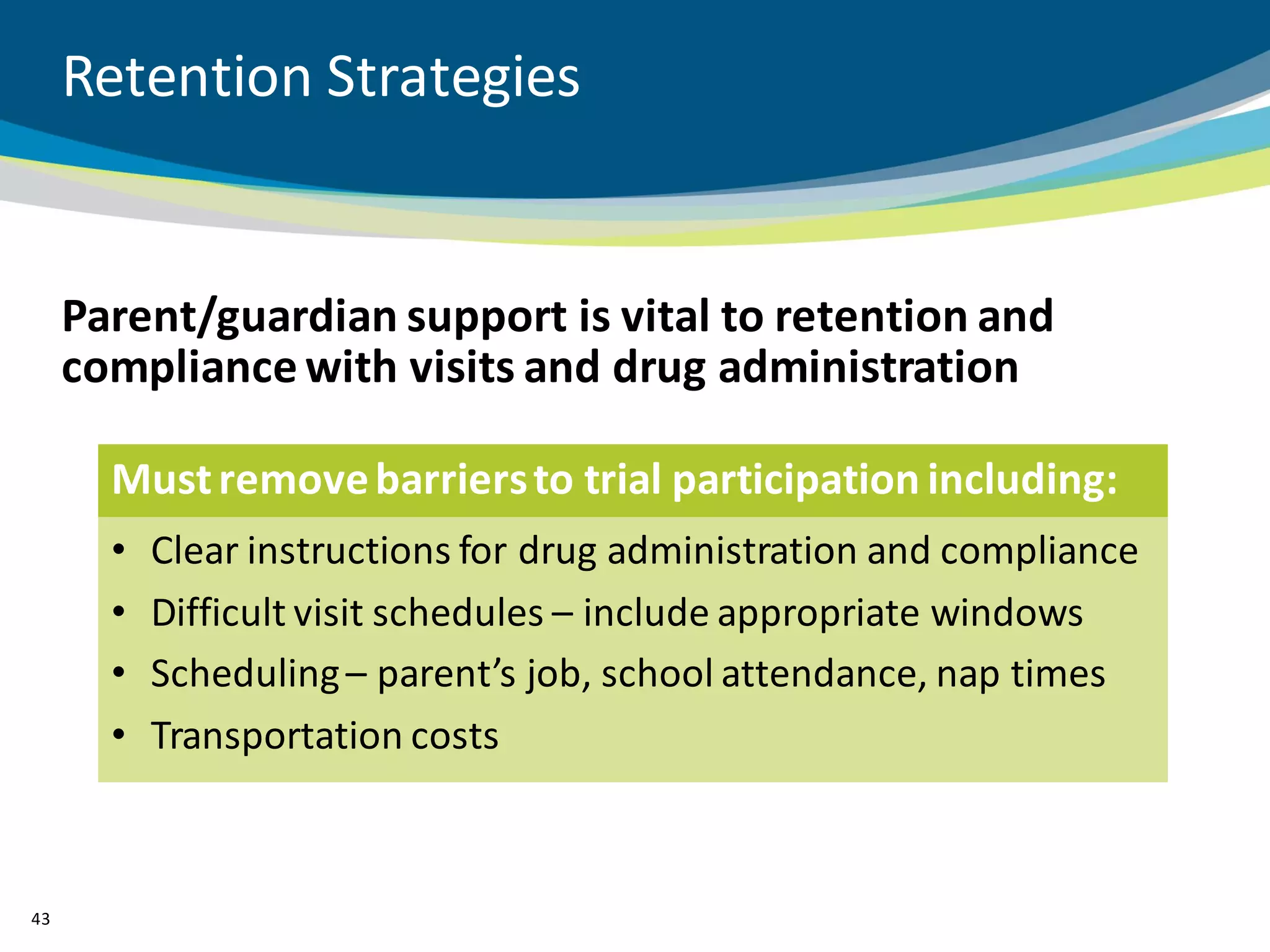
Retention Strategies


     Parent/guardian support is vital to retention and
     compliance with visits and drug administration

       Must remove barriers to trial participation including:
       •   Clear instructions for drug administration and compliance
       •   Difficult visit schedules – include appropriate windows
       •   Scheduling – parent’s job, school attendance, nap times
       •   Transportation costs


43
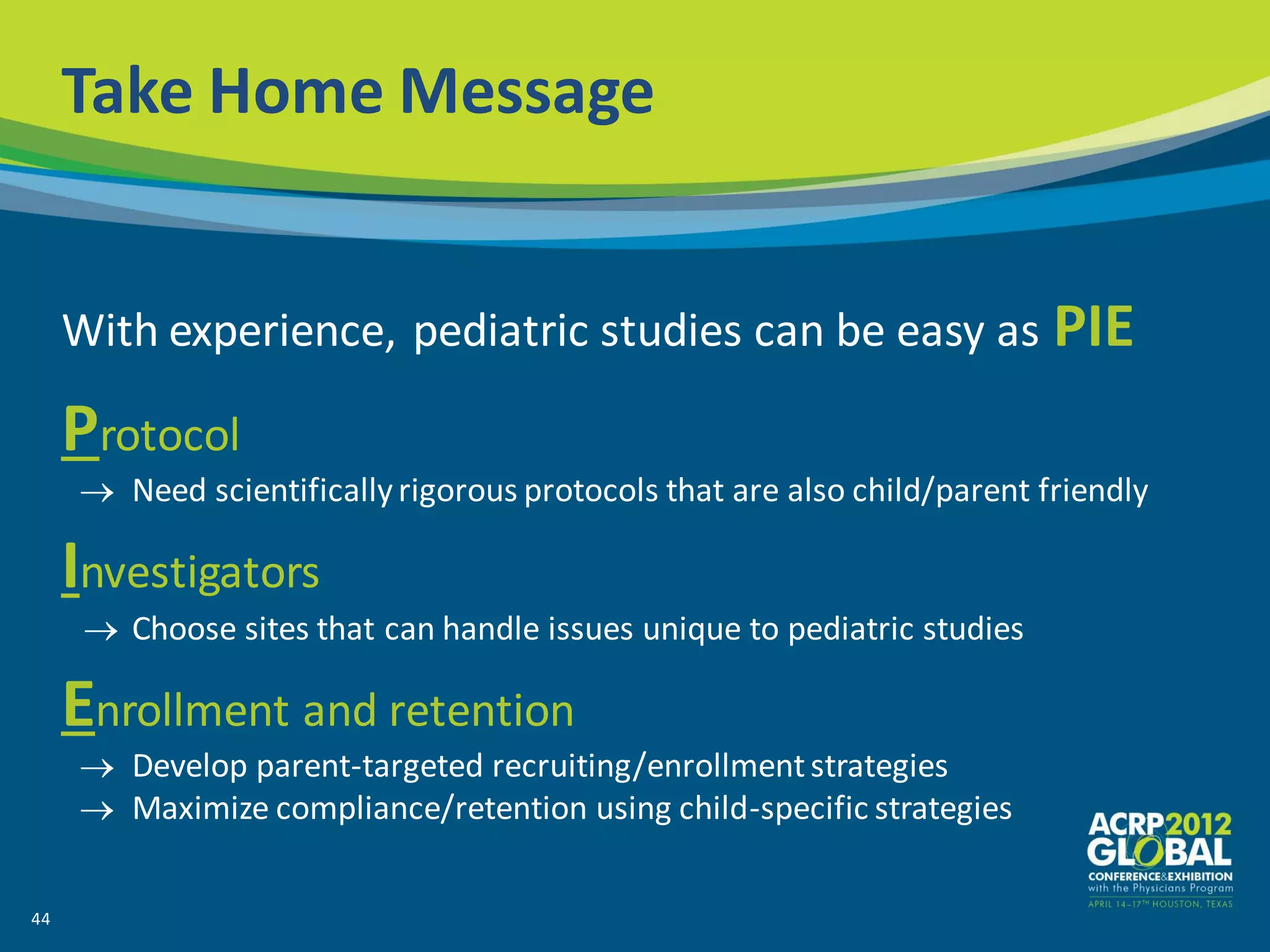
Take Home Message


     With experience, pediatric studies can be easy as PIE

     Protocol
        Need scientifically rigorous protocols that are also child/parent friendly

     Investigators
        Choose sites that can handle issues unique to pediatric studies

     Enrollment and retention
        Develop parent-targeted recruiting/enrollment strategies
        Maximize compliance/retention using child-specific strategies

44
Charlene Sanders, M.D.
        Vice President, Global Regulatory Affairs
              & Pediatric Strategic Consulting
     Email: charlene.sanders@premier-research.com
                   Phone: 215.282.5500

                      Angi Robinson
      Executive Director, Clinical Trials Management
      Email: angi.robinson@premier-research.com
                  Phone: 215.282.5500

              www.premier-research.com


45

Successful Pediatric Studies: Key Study Design and Site Selection Considerations

  • 1.
    Successful Pediatric Studies: Key Study Design and Site Selection Considerations 1 April 14, 2012 4:15 PM – 5:15 PM
  • 2.
    Successful Pediatric Studies: Key Study Design and Site Selection Considerations Presented by Charlene Sanders, M.D. and Angi Robinson Premier Research April 14, 2012 2
  • 3.
    Disclosure We have no relevant financial relationship in relation to this educational activity 3
  • 4.
    Research is Makinga Difference Pediatric research has resulted in: More than products labeled with new pediatric information More than products with pediatric focused post labeling safety reviews Source: FDA website accessed on February 29, 2012 4
  • 5.
    What Makes Pediatrics Different? 5
  • 6.
    Pediatrics does notdeal with miniature men and women, with reduced doses and the same class of diseases in smaller bodies, but ... it has its own independent range and horizon and gives as much to general medicine as it receives from it - Abraham Jacobi, 1889 6
  • 7.
    Pediatric Subpopulations Each age group is considered an indication Pre-term Newborns Infants & toddlers Children Adolescents newborns 27 days 28 days to 23 months 2 to 11 years 12 to 16-18 years 7
  • 8.
    Age Appropriate Formulations Consider age, physical development, illness, dosage, dosing frequency, treatment duration, and route of administration Need pediatric formulations that are: • Easy to both administer and swallow • Acceptable in taste and volume • Appropriate in dosage and strength • Tolerable with minimal and safe excipients • Adequate bioavailability • Less frequent administration 8
  • 9.
    Age Appropriate Formulations Children will refuse an unpleasant formulation Foster compliance by delivering formulations with an acceptable taste Poor compliance increases the risk of therapeutic failure and emergence of resistances Need to ensure safe and precise administration Foster compliance with an easy administration Provide appropriate dosing/administration devices Important to have child-proof container for product 9
  • 10.
    Plant the SEEDto Succeed! Scientifically meaningful Need scientifically rigorous protocols Ethical Need special protections with this vulnerable populations Enrollable Need protocols that are patient and family friendly Directed Need appropriate sites and targeted patient recruitment strategies 10
  • 11.
  • 12.
    Study Design Why up to 50% of pediatric studies fail: Not well defined PK–PD Small sample or pediatric correlations that size, low relevant are not enrollment endpoints established Incorrectly Ethical identified Feasibility constraints in dosages for issues protocol efficacy studies development 12
  • 13.
    Pediatric Study Design Protocols need to be designed specifically for the population and not simply re-worked from adult protocols → Design must be customized for the specific populations → Primary endpoint in children may be different or even inappropriate in adults → Developmental variability should be considered in inclusion criteria, sample size calculations, and analysis → Study design must be realistic for families to commit Unsuitable designs will lead to slow enrollment and low retention resulting in higher costs and approval delays 13
  • 14.
    Traditional vs. PopulationPK Sampling Traditional PK Population PK Approach is to conduct a study Approach requires a larger of single or multiple doses of number of subjects and the drug in a small number of utilizes infrequent or sparse subjects with relatively sampling frequent blood sampling While current FDA and ICH recommendations do not indicate which method should be used, they do describe the population PK methodology as a useful technique to minimize the number of samples obtained from each patient 14 Guidance for Industry: E11 Clinical Investigation of Medicinal Products in the Pediatric Population, Dec 2000.
  • 15.
    FDA Guidance forPediatric Studies Pediatric Study Decision Tree - Integration of PK-PD Reasonable to assume (pediatrics vs. adults) • Similar disease progression? • Similar response to intervention? NO YES TO BOTH • Conduct PK studies Reasonable to assume similar • Conduct safety/efficacy trials concentration-response (C-R) in pediatrics and adults? NO NO YES Is there a PD measurement that can be used to predict efficacy? • Conduct PK studies to achieve levels similar to adults YES • Conduct safety trials • Conduct PK studies to get C-R for PD measurement • Conduct PK studies to achieve target concentrations based on C-R • Conduct safety trials Guidance for Industry: Exposure-Response Relationships — Study 15 Design, Data Analysis, and Regulatory Applications, April 2003.
  • 16.
    Use of Placebo Use of placebo typically more restricted in pediatric trials simply because children cannot consent While not ideal, the use of a placebo may be acceptable if there is no approved or adequately studied therapies Placebo use has to be justified scientifically and ethically 16
  • 17.
    Use of Placebo It is important to minimize placebo exposure: Number of Study subjects duration Need Randomization pre-defined ratio discontinuation criteria 17
  • 18.
    Pediatric Specific Endpoints/Follow-up Physiological Measures and Benchmarks • Weight • Height • Thyroid hormone, Insulin-like growth factor-1 (IGF-1) • Skeletal growth • Sexual maturation Development and Cognitive function (short and long-term effects) • Attention, memory and learning • Language skill 18
  • 19.
    Pediatric Specific Endpoints/Follow-up Behavioral and Psychological Maturation/Milestones • Child Behavioral Checklist (CBCL) • Quality of Life, school performance, etc. • Infants and young children – mental, motor and behavioral development • Neonates – known complications and effects of prematurity 19
  • 20.
    Duration of Treatment, Follow-up, and Retention → Long-term treatment or recurrent treatment may necessitate: – Tracking of growth and development changes – Potential need for patient to sign multiple assent forms/consent form over time → Outline process for study drug delivery during school days, with alternate caregivers, etc… → Working parents and school attendance issues will present additional practical problems 20
  • 21.
    Ethical Considerations and Special Protections 21
  • 22.
    Special Protections inPediatric Research Need for special protections in vulnerable populations is mandated by regulations, enacted by: Assent/ IRB assessment Data Safety Parental of research risk Monitoring Permission category Boards (DSMBs) process Treatment Limiting use of continuity after placebos clinical study 22
  • 23.
    Ethical Considerations Ethics of conducting pediatric research has not been studied as extensively as ethics of adult research Pediatric research means decision- making for another and involves more than just the patient Potential risks and inconvenience are accepted by parent, but may affect child, siblings, and parents 23
  • 24.
    Ethical Questions toConsider Is it ethical to enroll children in: Poorly designed studies? – According to FDA, 50% of all pediatric studies are not interpretable 24
  • 25.
    Ethical Questions toConsider Is it ethical to enroll children in: Studies without the possibility of direct benefit? – Normally only allowed if risk is low – Should have access to necessary health care after being enrolled in a clinical trial – Rules and definitions differ by country • Non-therapeutic studies in children are not allowed in some countries • Definition of low risk varies by country 25
  • 26.
    Potential Ethical Conflictsin Pediatric Research Weighing of ethical principles is integral part of process Beneficence Autonomy, Self-Determination Potential or real benefit to child vs. Child’s dissent Justice Beneficence Potential or real benefit to child vs. Potential costs or harms to other family members Beneficence, Justice Non-maleficence Possibility of obtaining information vs. Potential risk to child that could benefit many Privacy, Confidentiality Non-maleficence Drug testing, vs. Potential harm from researcher pregnancy testing results not reporting risky behavior 26
  • 27.
  • 28.
    Child Friendly StudyProcedures Minimize intensity and frequency of the study assessments • Limit number and volume of blood draws – coincide the collection of protocol-specified blood samples with routine clinical samples • Limit invasive procedure as much as possible Minimize pain and distress • Use topical anesthesia, butterfly needles, pediatric sampling tubes • Indwelling catheters rather than repeated venipunctures for blood sampling 28
  • 29.
    Child Friendly StudyProcedures In addition: • Handle pregnancy testing in minors with care • Consider not only the child but also the parents and siblings when planning the frequency and length of visits/assessments 29
  • 30.
    Drug Administration Considerations Dosing is more difficult to manage than in adults: • Often based on experience in adults and weight/BSA • Titration rates and AE monitoring need to be carefully evaluated • Administration of investigational product can pose problems Timing of dosing can also be a challenge: • Issues with dosing in school-age children • Strict dosing times may be difficult to adhere to 30
  • 31.
  • 32.
    Operational Considerations for Pediatric Investigative Site Selection In general, use same principles as selecting sites for adult trials: Access to Degree of Expertise and adequate interest number of experience expressed appropriate by the site patients Facilities need appropriate Consider using equipment/ a Pediatric activities to Research accommodate Network 32 children/families
  • 33.
    Medical Considerations for Pediatric Investigative Site Selection • Absolutely MUST have person experienced in pediatric lab draws • Depending on protocol, may also need personnel with expertise in catheterizing small children, pediatric IV starts, placing pediatric NG tubes, etc. • Sites that are not pediatric based must have access to resources needed for the pediatric population 33
  • 34.
    Enrollment Strategies Conduct studies in familiar environments such as hospital or clinic where participants normally receive their care Support on site and off site activities Be mindful of age specific issues 34
  • 35.
    Enrollment Strategies Each age group has it own issues with enrollment Babies and toddlers Consider naptimes Young children The use of cartoons to explain the study may be useful for younger patients (some countries are requiring pictorial information sheets for young children) School age Time missed from school may be important factor Teenagers Teenage girls may decline to participate once they learn that a pregnancy test is required 35
  • 36.
    Enrollment Strategies Avoid coercion or even its appearance Advertisements • Consider different media – TV, radio, internet, parenting publications, etc. • Ads need to target the parent, not the child • Not always appropriate Payments • Reimbursements for travel expenses may be better approach • AAP recommends to not disclose payment/reimbursement information to children until they have completed the study 36
  • 37.
    Enrollment Strategies Siblings are frequently brought along to study appointments distracting both the parents and patients This can cause: • Missed reporting of AEs and con meds • Potentially incorrect responses on questionnaires • Early termination if siblings are not made to feel welcome 37
  • 38.
    Enrollment Strategies Plan to address this with: 1 Secure area for siblings to wait Personnel or family/friends available to “babysit” 2 younger children during study visits 3 DVD player with children’s movies/shows 4 Snacks for longer visits Making siblings feel welcome and parents 5 comfortable with their decision to bring them 38
  • 39.
    Pediatric Assent/Parental Permission Plan in advance whether and how pediatric assent will be solicited and have trained personnel obtain this Considerations for forms: • In most cases it is appropriate to have one or more assent forms separate from parental permission form • Assent forms need to be aimed at the appropriate reading grade level for the youngest person who will sign 39
  • 40.
    Retention Strategies Make sure stipend is Provide resource appropriate and families materials for patients are compensated for and families expenses associated with child’s participation Appointment reminder Close, ongoing review of and missed appointment discontinuation reasons postcards, emails or (one-page retention questionnaire to help determine text messages reason for withdraws) 40
  • 41.
    Retention Strategies Consider appropriate strategies for the different age groups and indications Example: For adolescents, Example: Depending on consider a study subject indication, conduct a blog; this group loves webcast with famous technology and it is person with condition appealing to communicate including education with other kids around segment and ability to the country who also have submit questions the same condition 41
  • 42.
    Retention Strategies Incentive/Rewards • For milestone achievements, depending on age consider reward certificate with 10 free music downloads or movie theatre passes • Organizer folder/portfolio with place to carry medication to and from visits that includes calendar with stickers for appointments as well as books and materials to educate on condition and making living with it not only possible, but FUN!! • Family incentives such as a refrigerator magnet with notepad or calendar 42
  • 43.
    Retention Strategies Parent/guardian support is vital to retention and compliance with visits and drug administration Must remove barriers to trial participation including: • Clear instructions for drug administration and compliance • Difficult visit schedules – include appropriate windows • Scheduling – parent’s job, school attendance, nap times • Transportation costs 43
  • 44.
    Take Home Message With experience, pediatric studies can be easy as PIE Protocol Need scientifically rigorous protocols that are also child/parent friendly Investigators Choose sites that can handle issues unique to pediatric studies Enrollment and retention Develop parent-targeted recruiting/enrollment strategies Maximize compliance/retention using child-specific strategies 44
  • 45.
    Charlene Sanders, M.D. Vice President, Global Regulatory Affairs & Pediatric Strategic Consulting Email: charlene.sanders@premier-research.com Phone: 215.282.5500 Angi Robinson Executive Director, Clinical Trials Management Email: angi.robinson@premier-research.com Phone: 215.282.5500 www.premier-research.com 45