AEFIADVERSE EVENT FOLLOWING
IMMUNIZATION
http://www.slideshare.net/haqinaam
Contents of this lecture
• Definition of AEFI
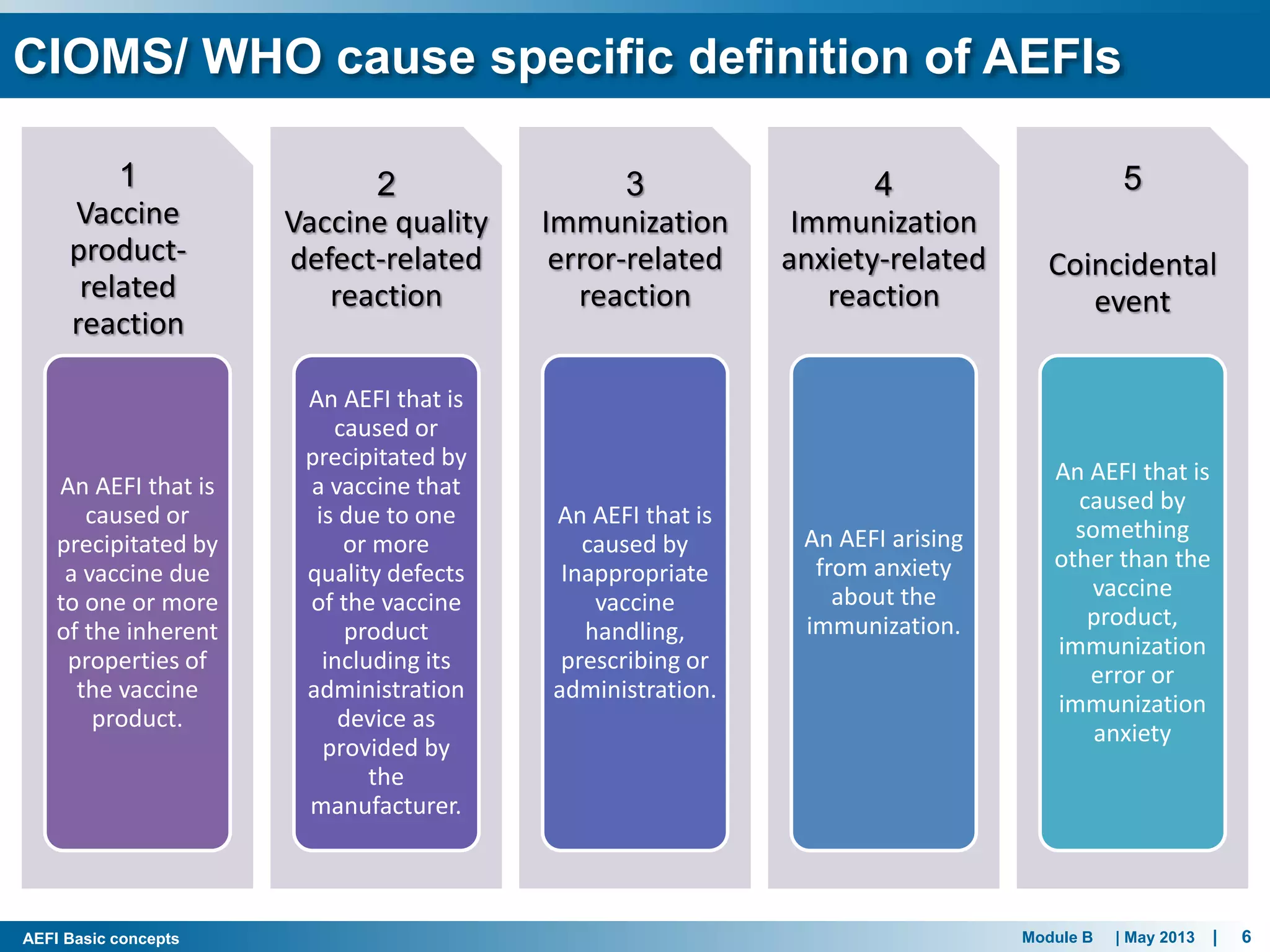
• Classification of AEFIs
• Serious AEFI
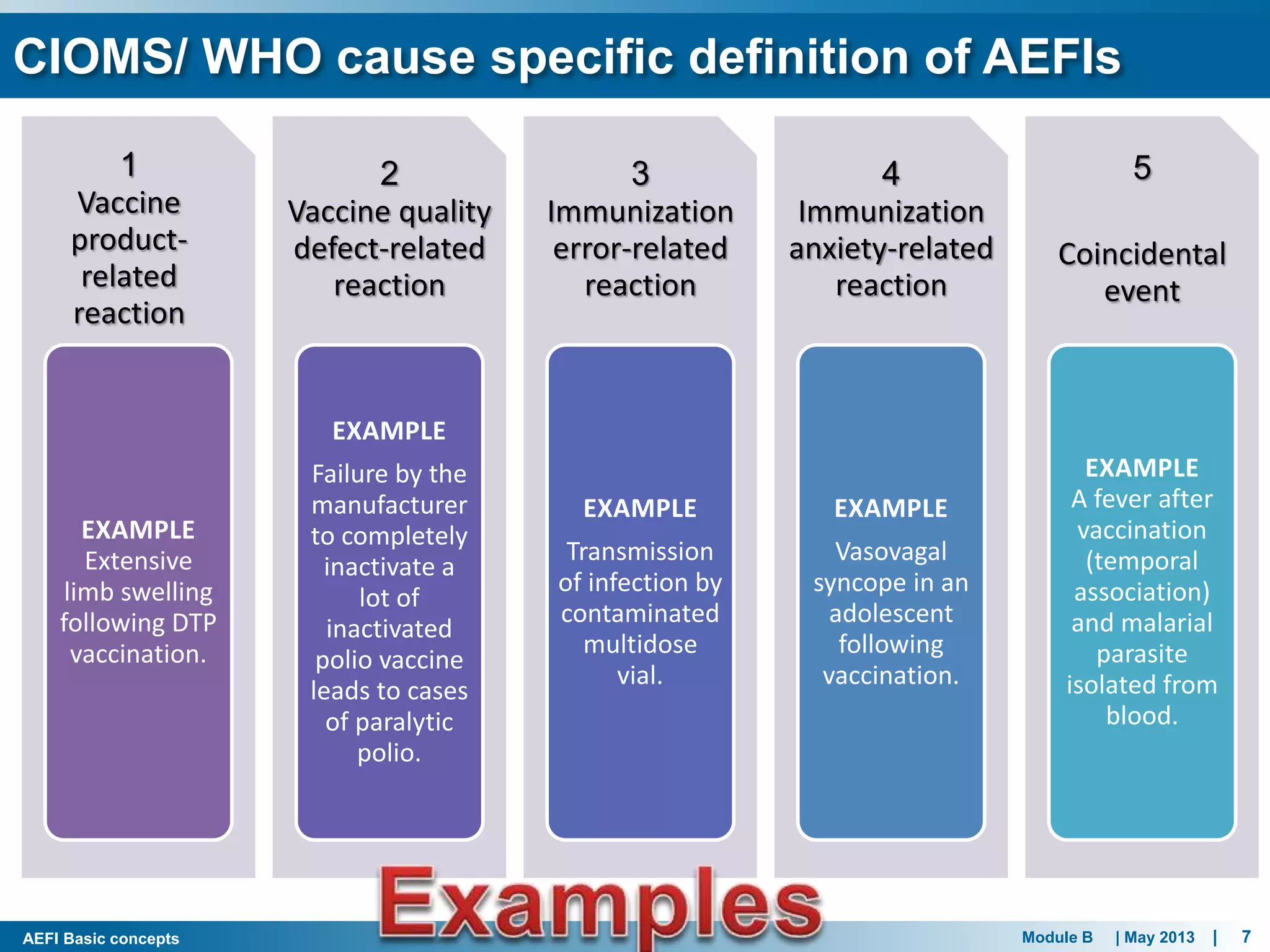
• Examples of AEFIs
• Reporting and Surveillance of AEFIs
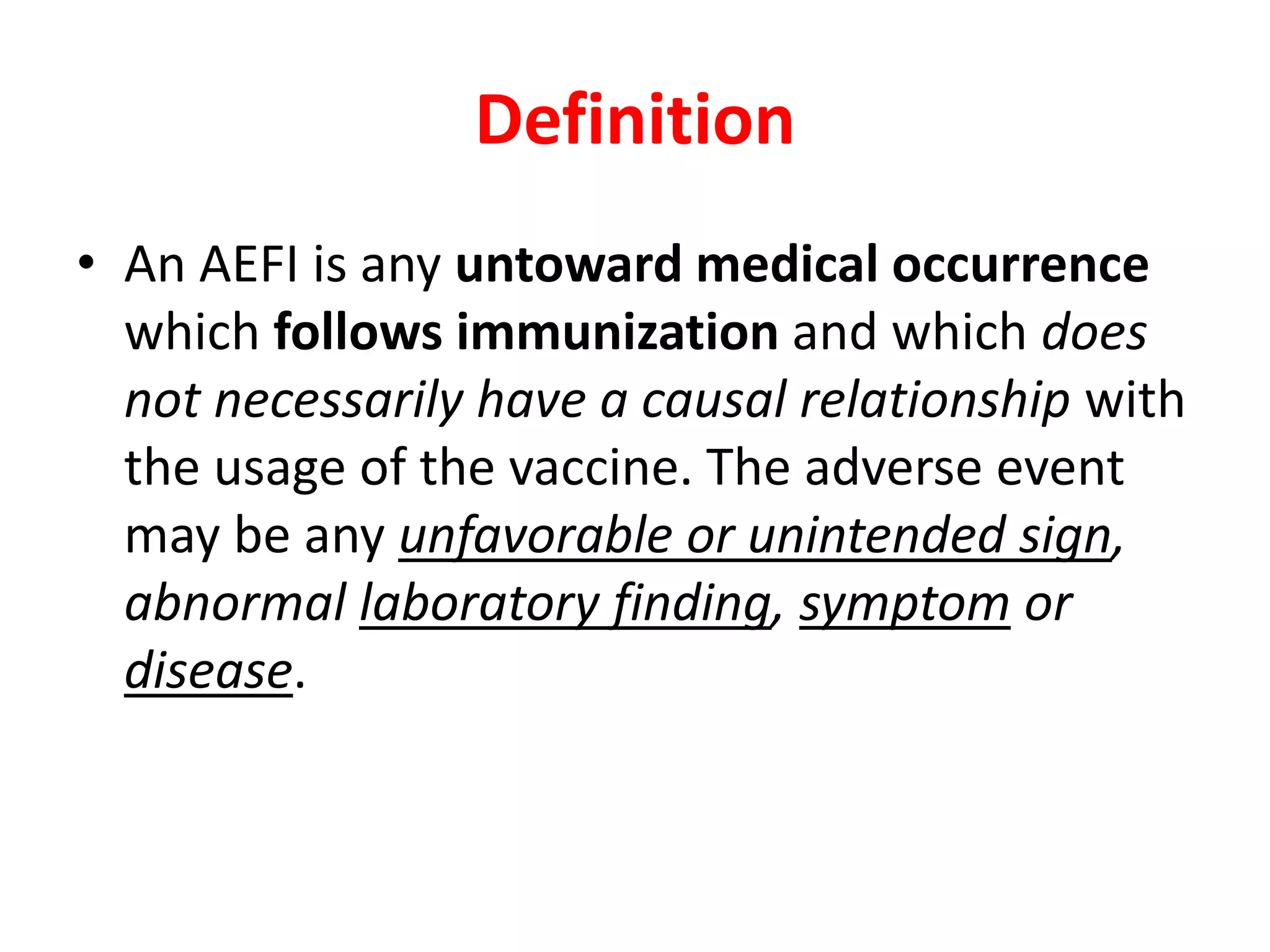
Definition
• An AEFI is any untoward medical occurrence
which follows immunization and which does
not necessarily have a causal relationship with
the usage of the vaccine. The adverse event
may be any unfavorable or unintended sign,
abnormal laboratory finding, symptom or
disease.
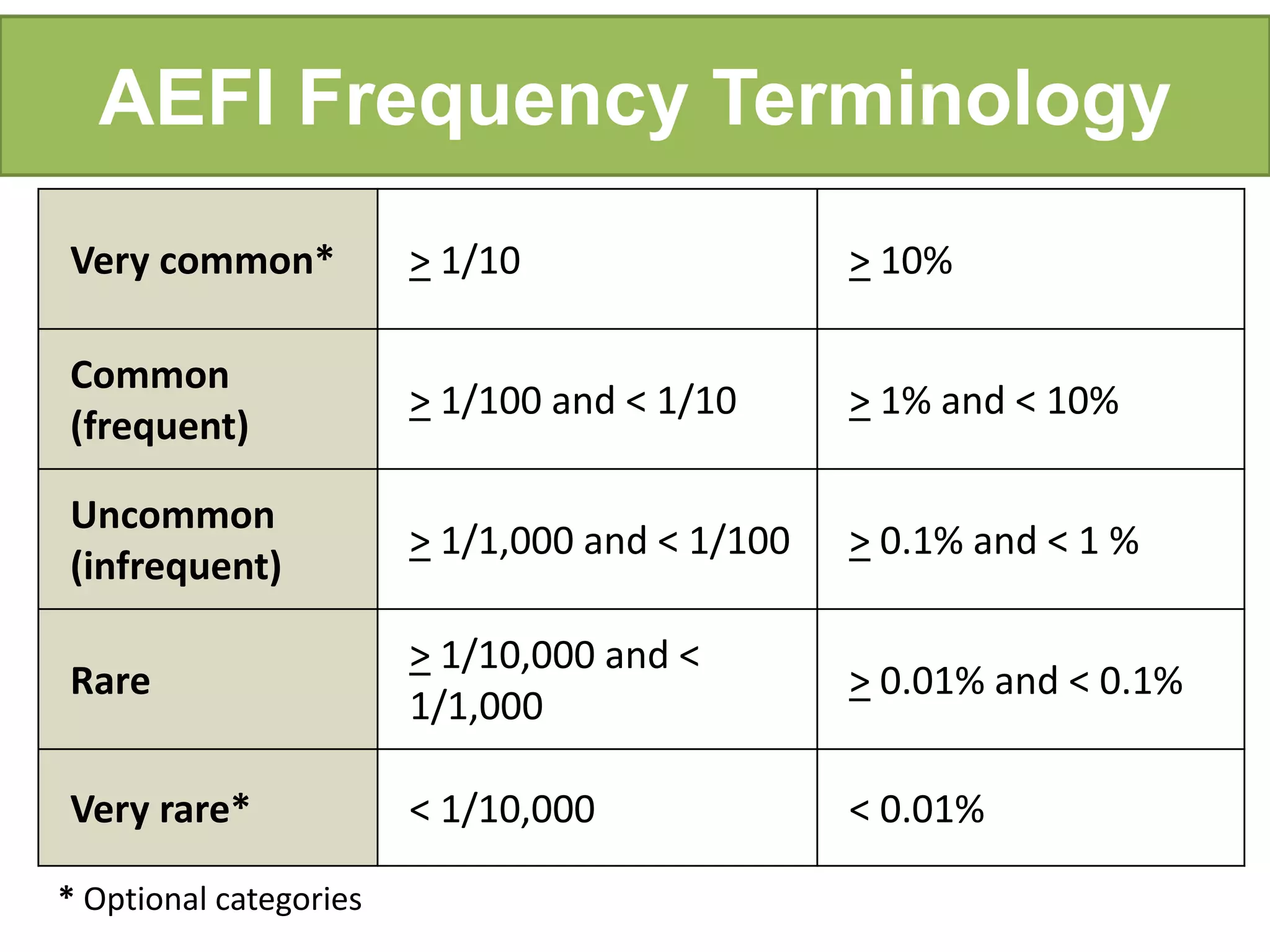
AEFI Frequency Terminology
Very common* > 1/10 > 10%
Common
(frequent)
> 1/100 and < 1/10 > 1% and < 10%
Uncommon
(infrequent)
> 1/1,000 and < 1/100 > 0.1% and < 1 %
Rare
> 1/10,000 and <
1/1,000
> 0.01% and < 0.1%
Very rare* < 1/10,000 < 0.01%
* Optional categories
Classification of AEFIs
Module B | May 2013 | 6AEFI Basic concepts
1
Vaccine
product-
related
reaction
An AEFI that is
caused or
precipitated by
a vaccine due
to one or more
of the inherent
properties of
the vaccine
product.
2
Vaccine quality
defect-related
reaction
An AEFI that is
caused or
precipitated by
a vaccine that
is due to one
or more
quality defects
of the vaccine
product
including its
administration
device as
provided by
the
manufacturer.
3
Immunization
error-related
reaction
An AEFI that is
caused by
Inappropriate
vaccine
handling,
prescribing or
administration.
4
Immunization
anxiety-related
reaction
An AEFI arising
from anxiety
about the
immunization.
5
Coincidental
event
An AEFI that is
caused by
something
other than the
vaccine
product,
immunization
error or
immunization
anxiety
CIOMS/ WHO cause specific definition of AEFIs
Module B | May 2013 | 7AEFI Basic concepts
1
Vaccine
product-
related
reaction
EXAMPLE
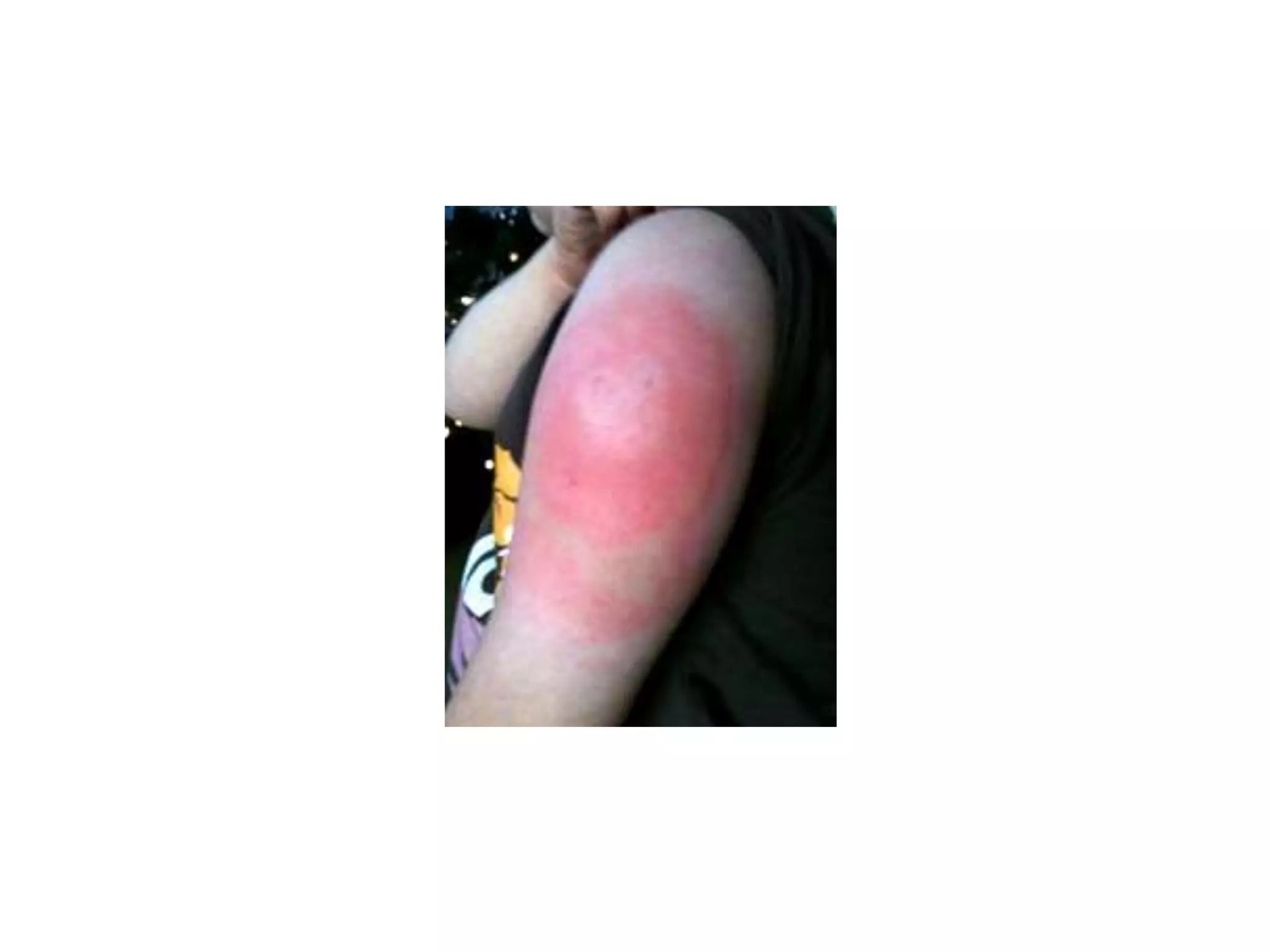
Extensive
limb swelling
following DTP
vaccination.
2
Vaccine quality
defect-related
reaction
EXAMPLE
Failure by the
manufacturer
to completely
inactivate a
lot of
inactivated
polio vaccine
leads to cases
of paralytic
polio.
3
Immunization
error-related
reaction
EXAMPLE
Transmission
of infection by
contaminated
multidose
vial.
4
Immunization
anxiety-related
reaction
EXAMPLE
Vasovagal
syncope in an
adolescent
following
vaccination.
5
Coincidental
event
EXAMPLE
A fever after
vaccination
(temporal
association)
and malarial
parasite
isolated from
blood.
CIOMS/ WHO cause specific definition of AEFIs
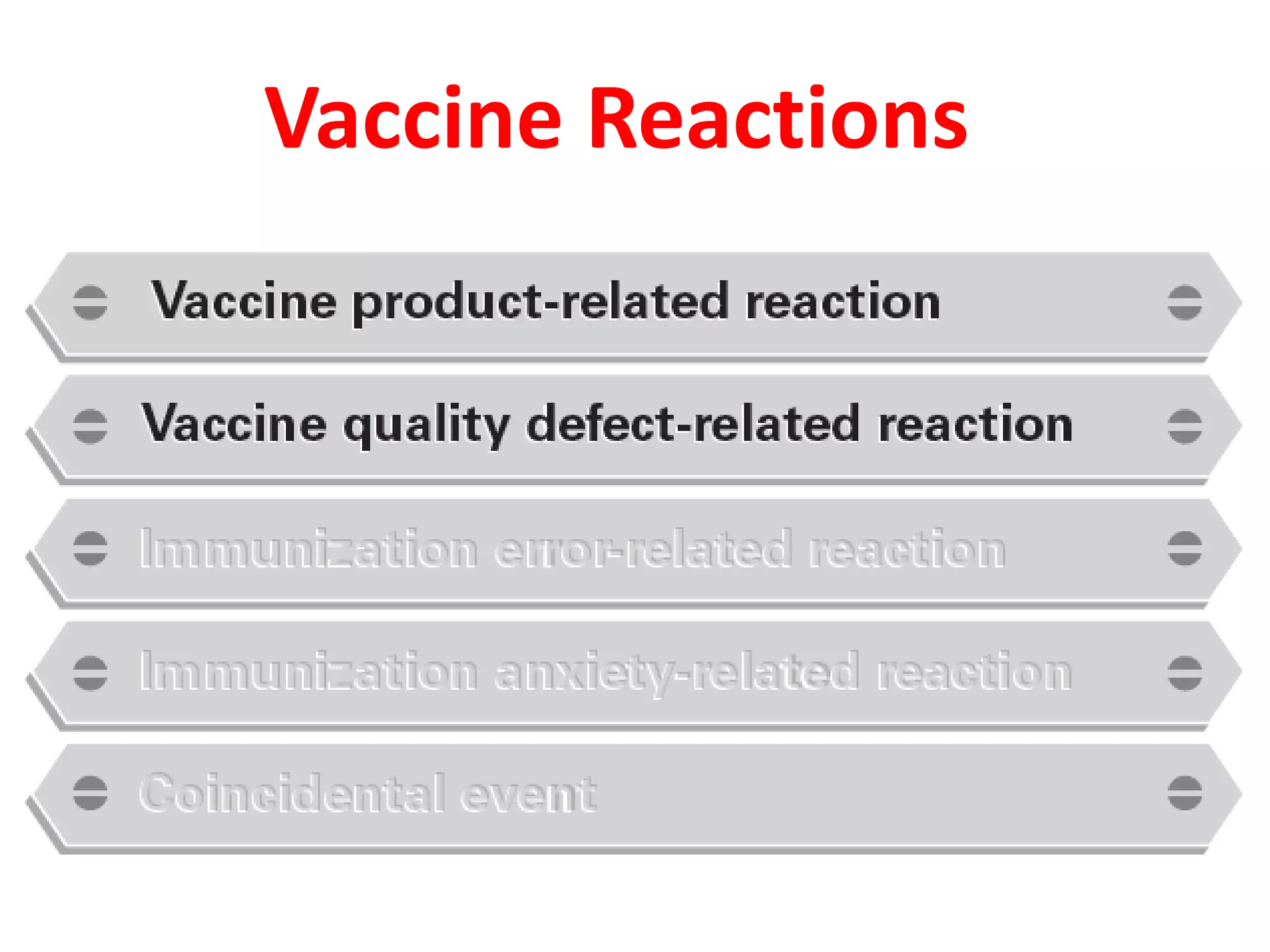
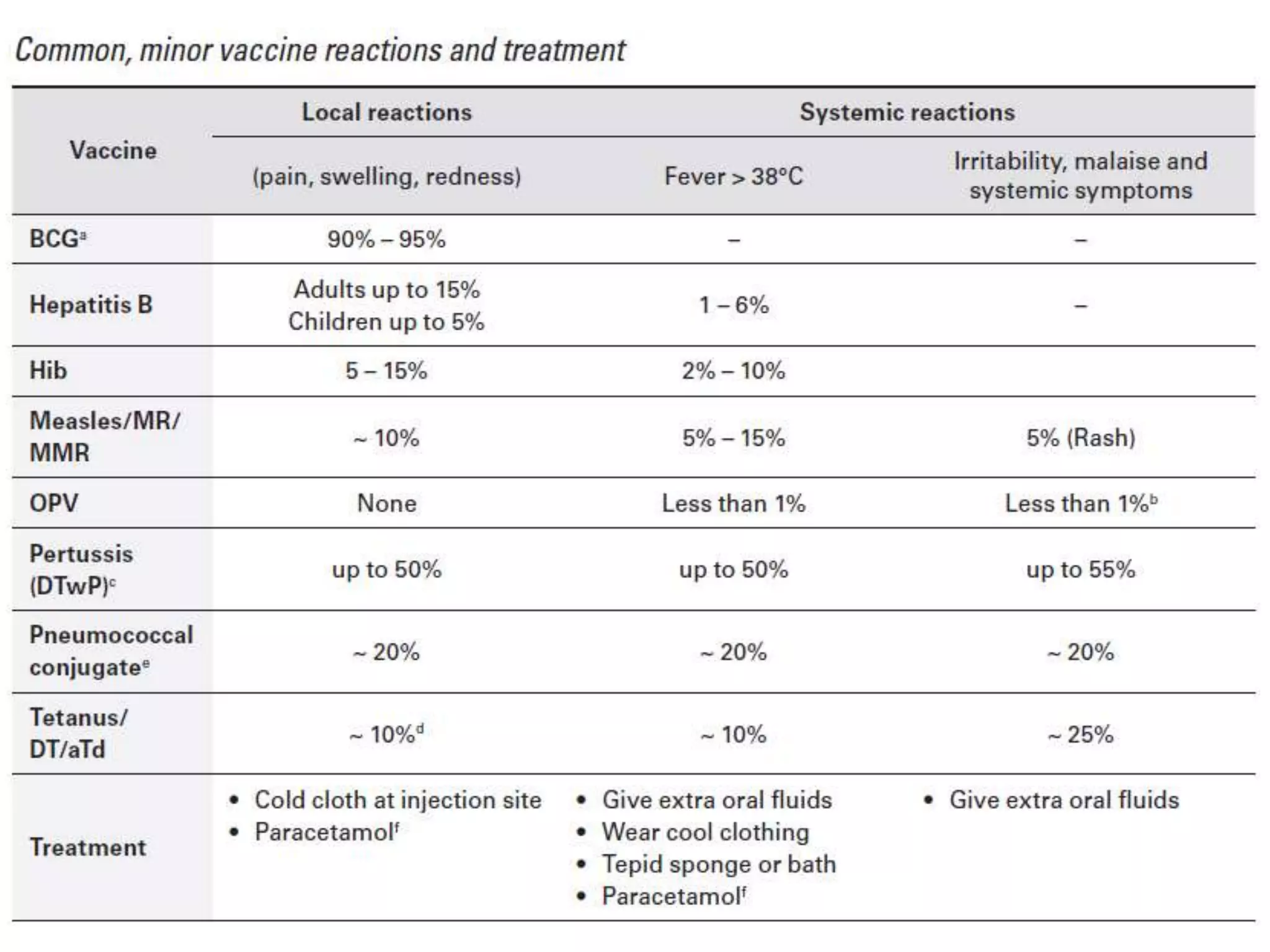
Vaccine Reactions
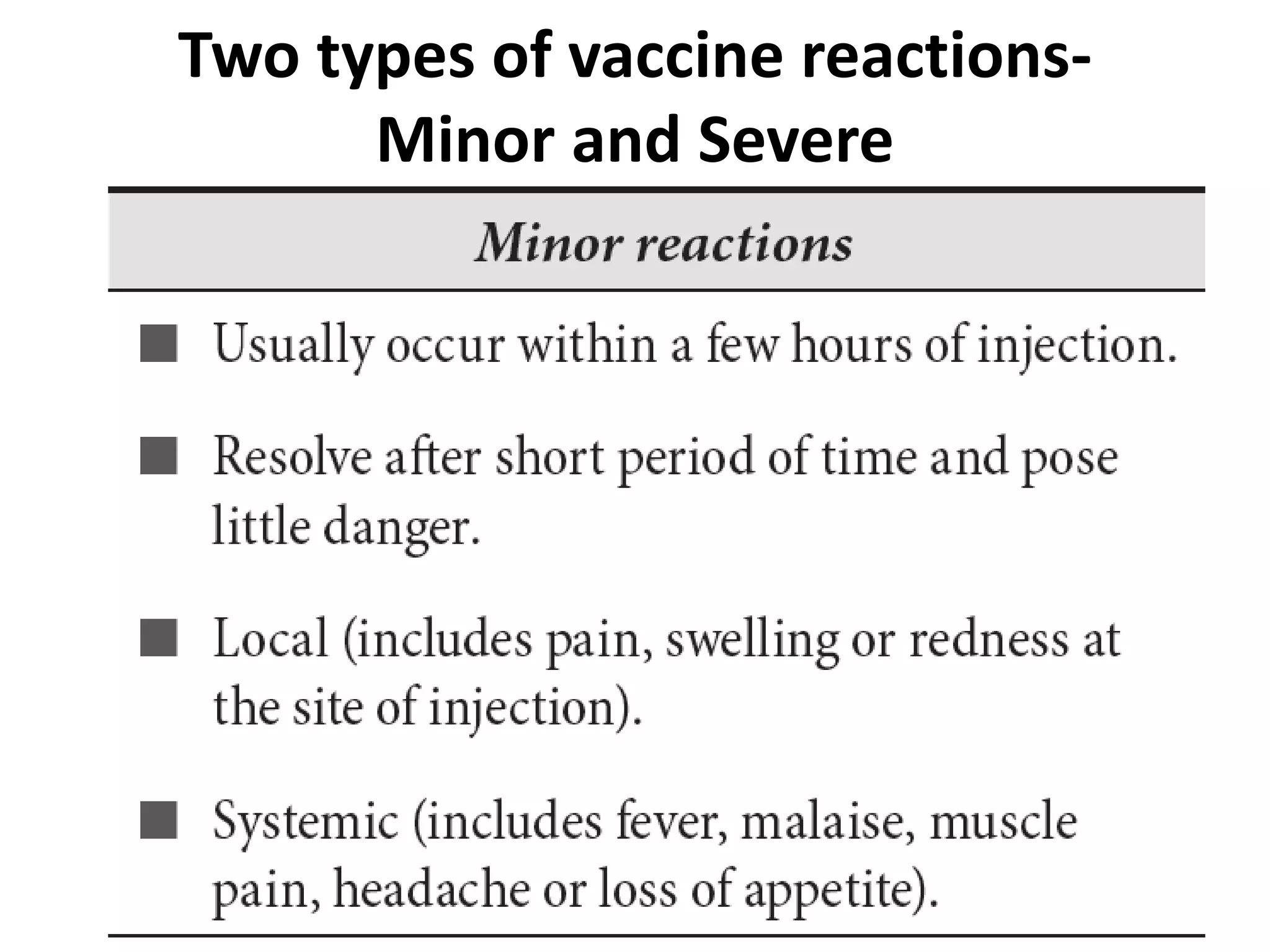
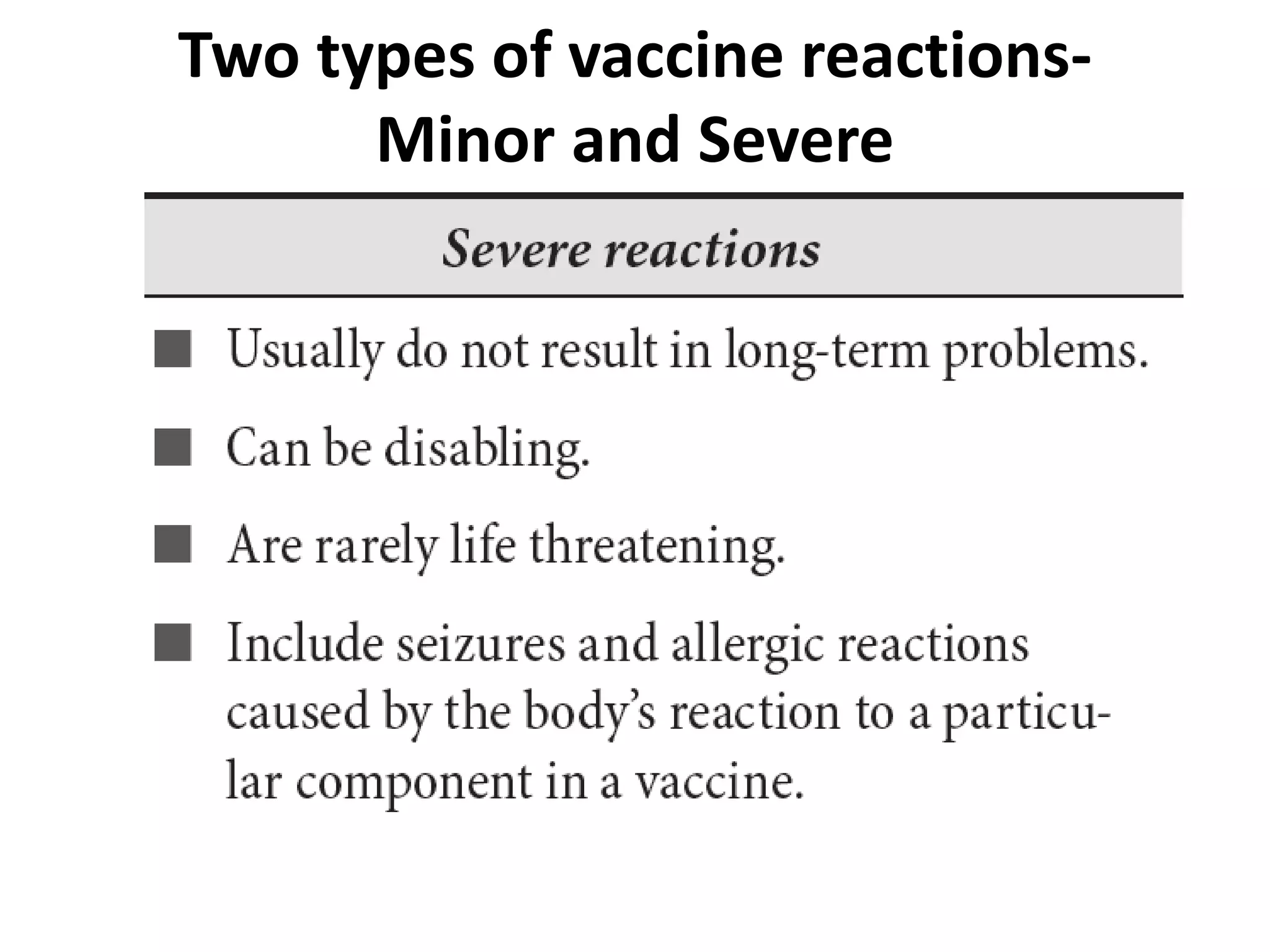
Two types of vaccine reactions-
Minor and Severe
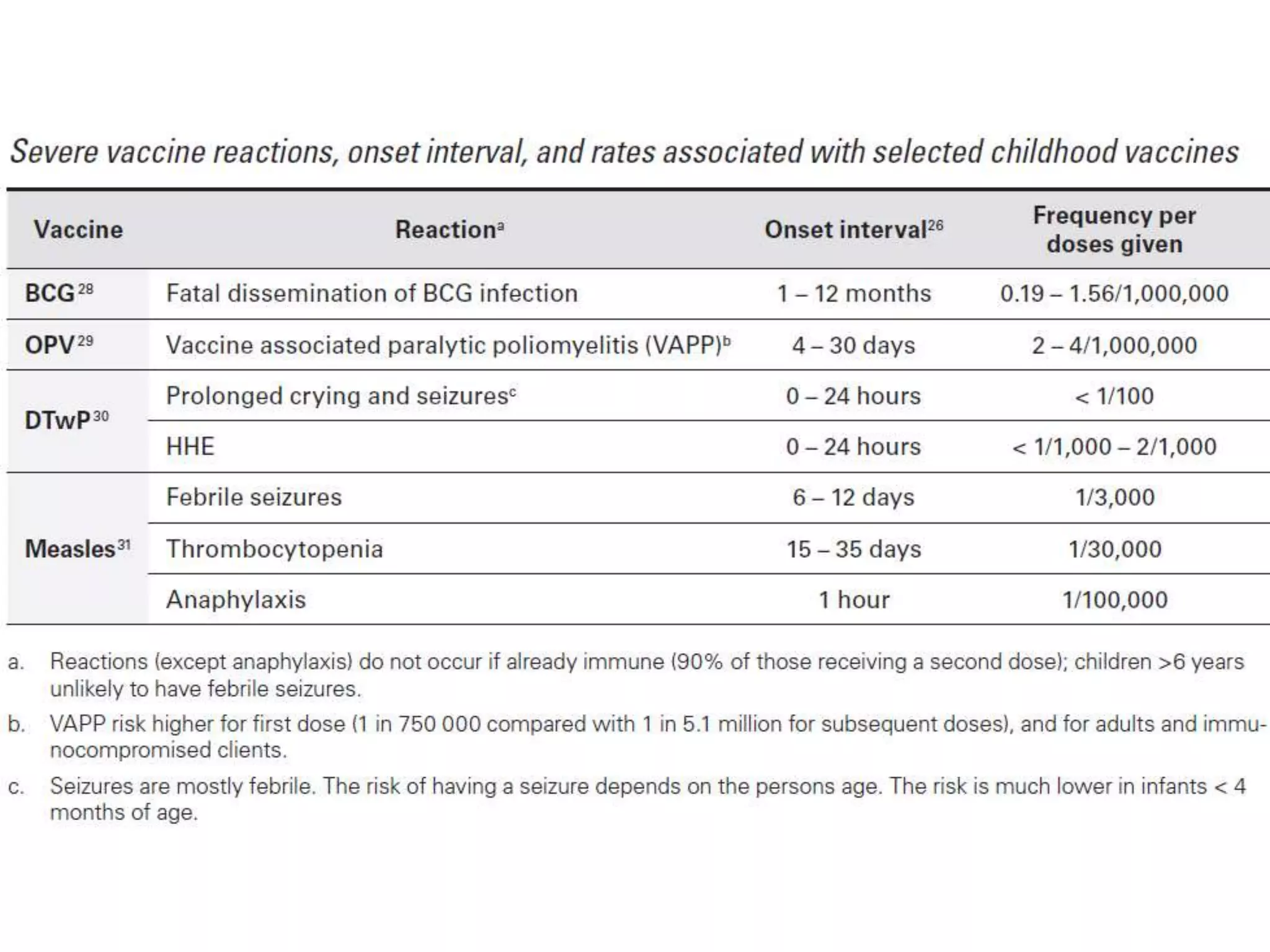
Two types of vaccine reactions-
Minor and Severe
Two types of vaccine reactions-
Minor and Severe
Antigen
[Live, Killed,
Purified,
Inactivated
toxin]
Stabilizers
(help the vaccine maintain its
effectiveness during storage)
[MgCl2, MgSO4]
Adjuvants
(improve the immune response to
vaccine antigens, most often in
killed vaccine)
[Aluminium
salts]
Antibiotics
(to prevent bacterial
contamination of the tissue
culture cells in which the viruses
are grown)
[Neomycin]
Preservatives
(added to multidose vaccines to
prevent bacterial and fungal
growth)
[Thiomersal,
Formaldehyde]
AEFI Reporting and Surveillance
Module B | May 2013 | 16AEFI Basic concepts
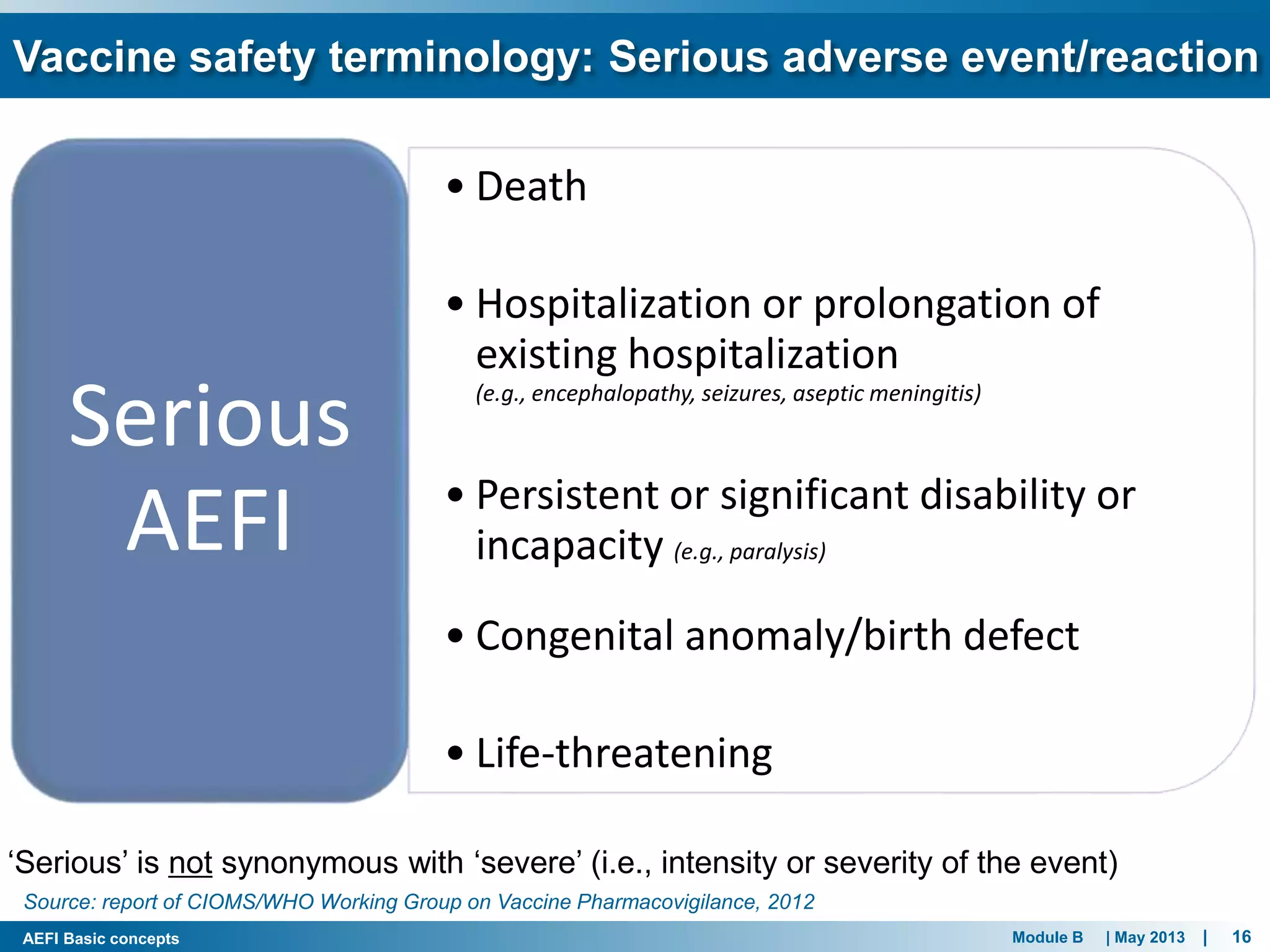
Vaccine safety terminology: Serious adverse event/reaction
• Death
• Hospitalization or prolongation of
existing hospitalization
(e.g., encephalopathy, seizures, aseptic meningitis)
• Persistent or significant disability or
incapacity (e.g., paralysis)
• Congenital anomaly/birth defect
• Life-threatening
Serious
AEFI
Source: report of CIOMS/WHO Working Group on Vaccine Pharmacovigilance, 2012
‘Serious’ is not synonymous with ‘severe’ (i.e., intensity or severity of the event)
Module B | May 2013 | 17AEFI Basic concepts
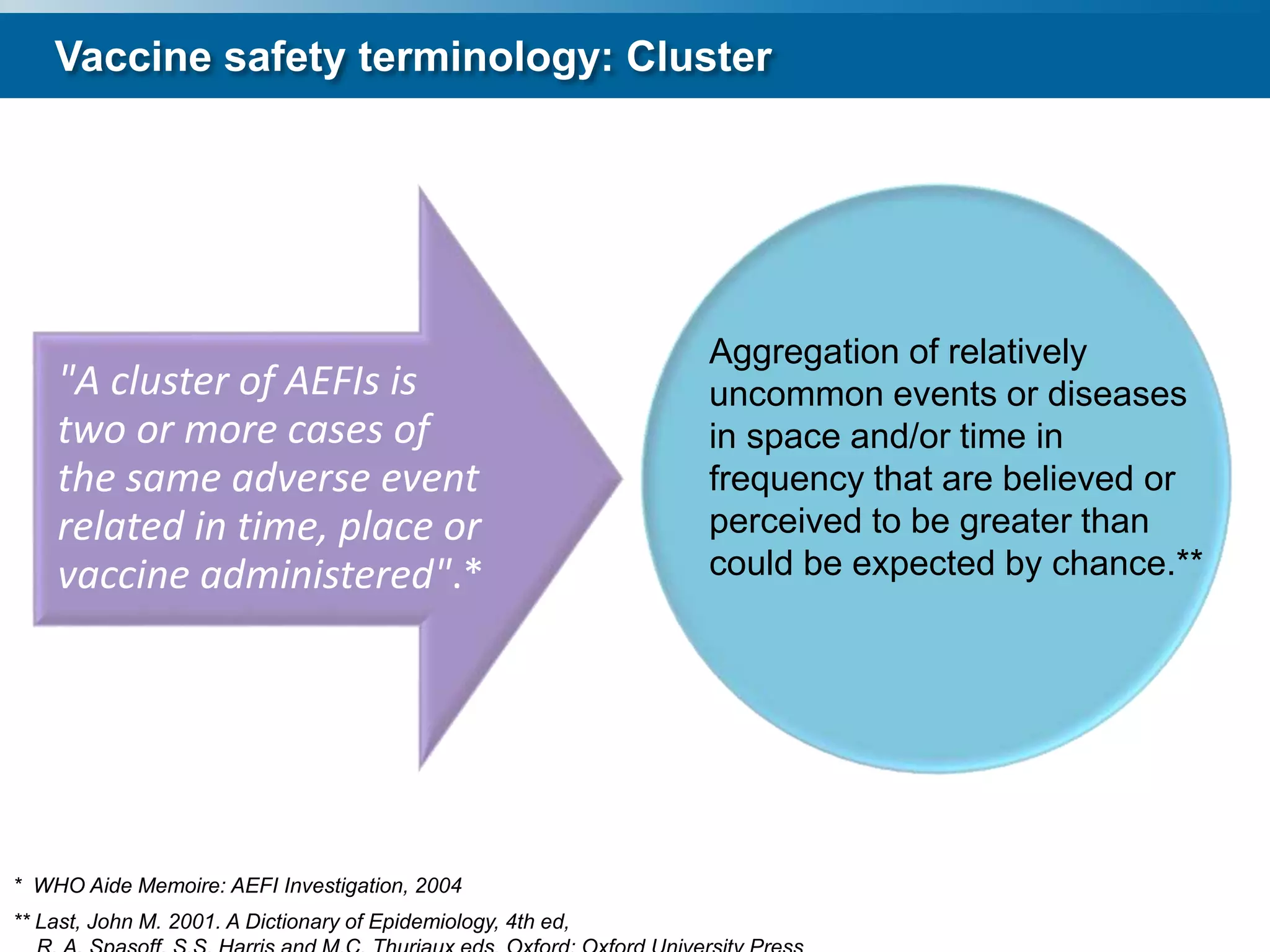
"A cluster of AEFIs is
two or more cases of
the same adverse event
related in time, place or
vaccine administered".*
* WHO Aide Memoire: AEFI Investigation, 2004
** Last, John M. 2001. A Dictionary of Epidemiology, 4th ed,
Vaccine safety terminology: Cluster
Aggregation of relatively
uncommon events or diseases
in space and/or time in
frequency that are believed or
perceived to be greater than
could be expected by chance.**
Module B | May 2013 | 18AEFI Basic concepts
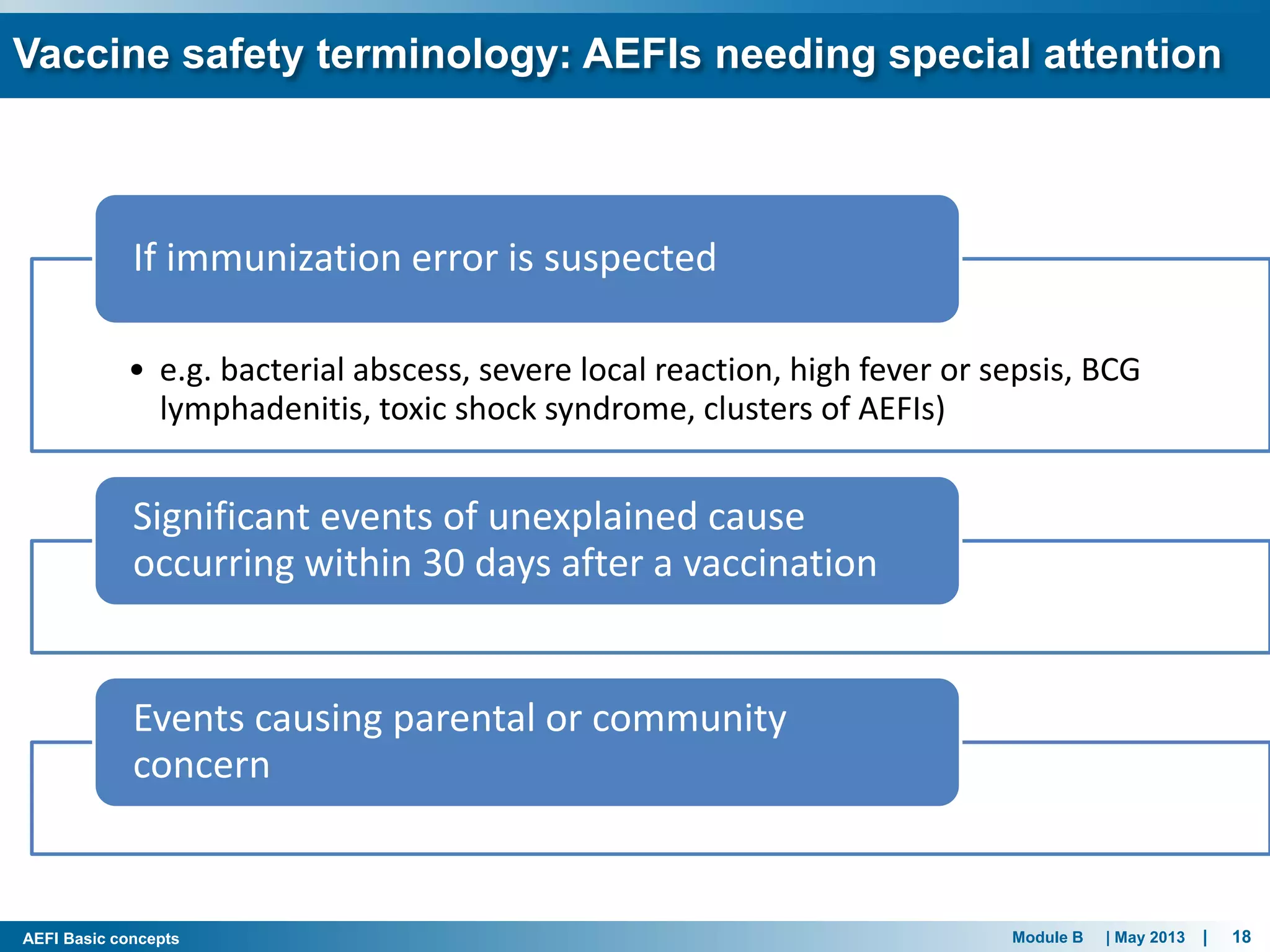
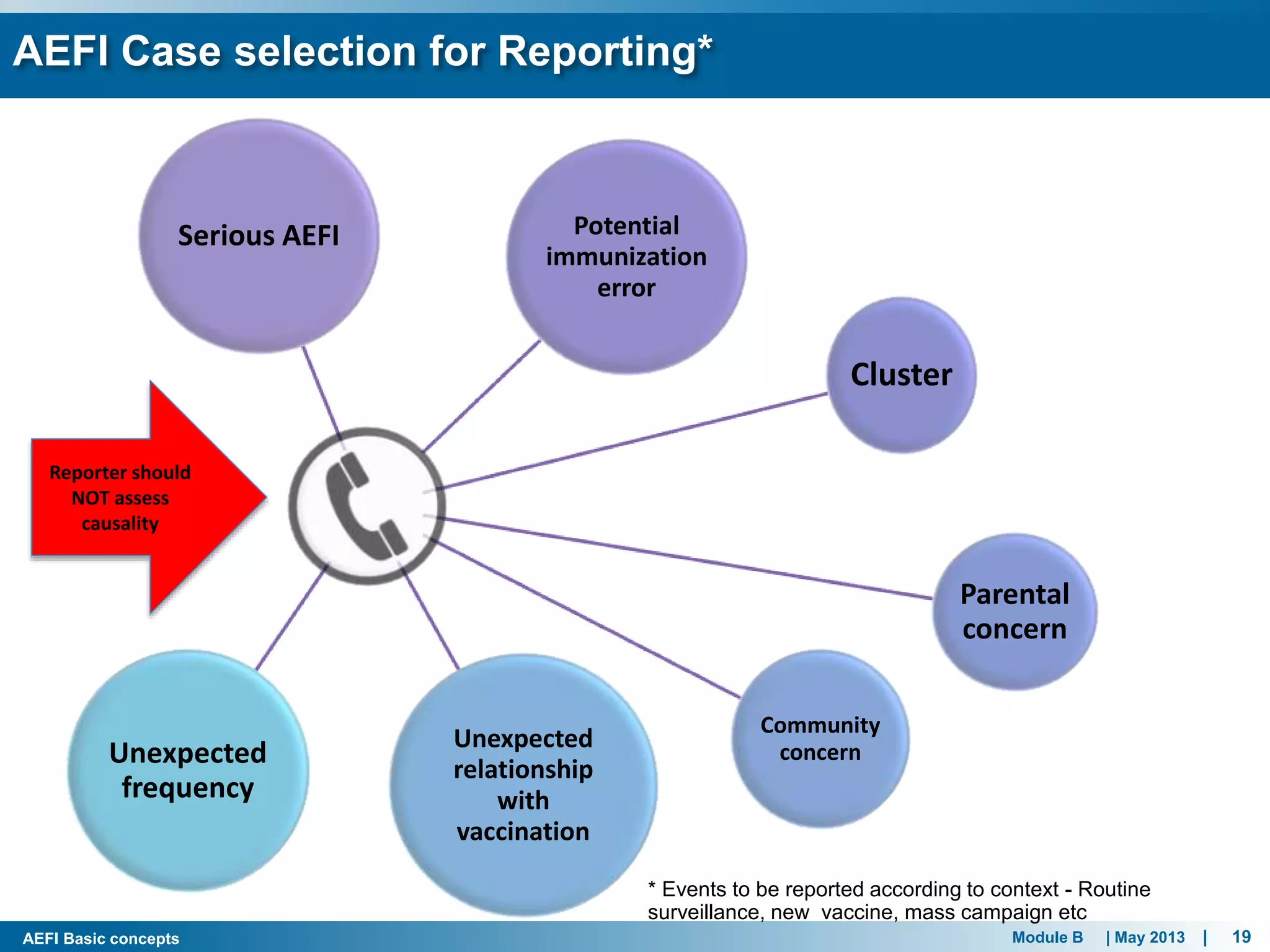
Vaccine safety terminology: AEFIs needing special attention
• e.g. bacterial abscess, severe local reaction, high fever or sepsis, BCG
lymphadenitis, toxic shock syndrome, clusters of AEFIs)
If immunization error is suspected
Significant events of unexplained cause
occurring within 30 days after a vaccination
Events causing parental or community
concern
Module B | May 2013 | 19AEFI Basic concepts
Serious AEFI Potential
immunization
error
Cluster
Parental
concern
Community
concern
Unexpected
relationship
with
vaccination
Unexpected
frequency
AEFI Case selection for Reporting*
Reporter should
NOT assess
causality
* Events to be reported according to context - Routine
surveillance, new vaccine, mass campaign etc
Module B | May 2013 | 20AEFI Basic concepts
AEFI RECORDING AND
REPORTING IN INDIA
Module B | May 2013 | 21AEFI Basic concepts
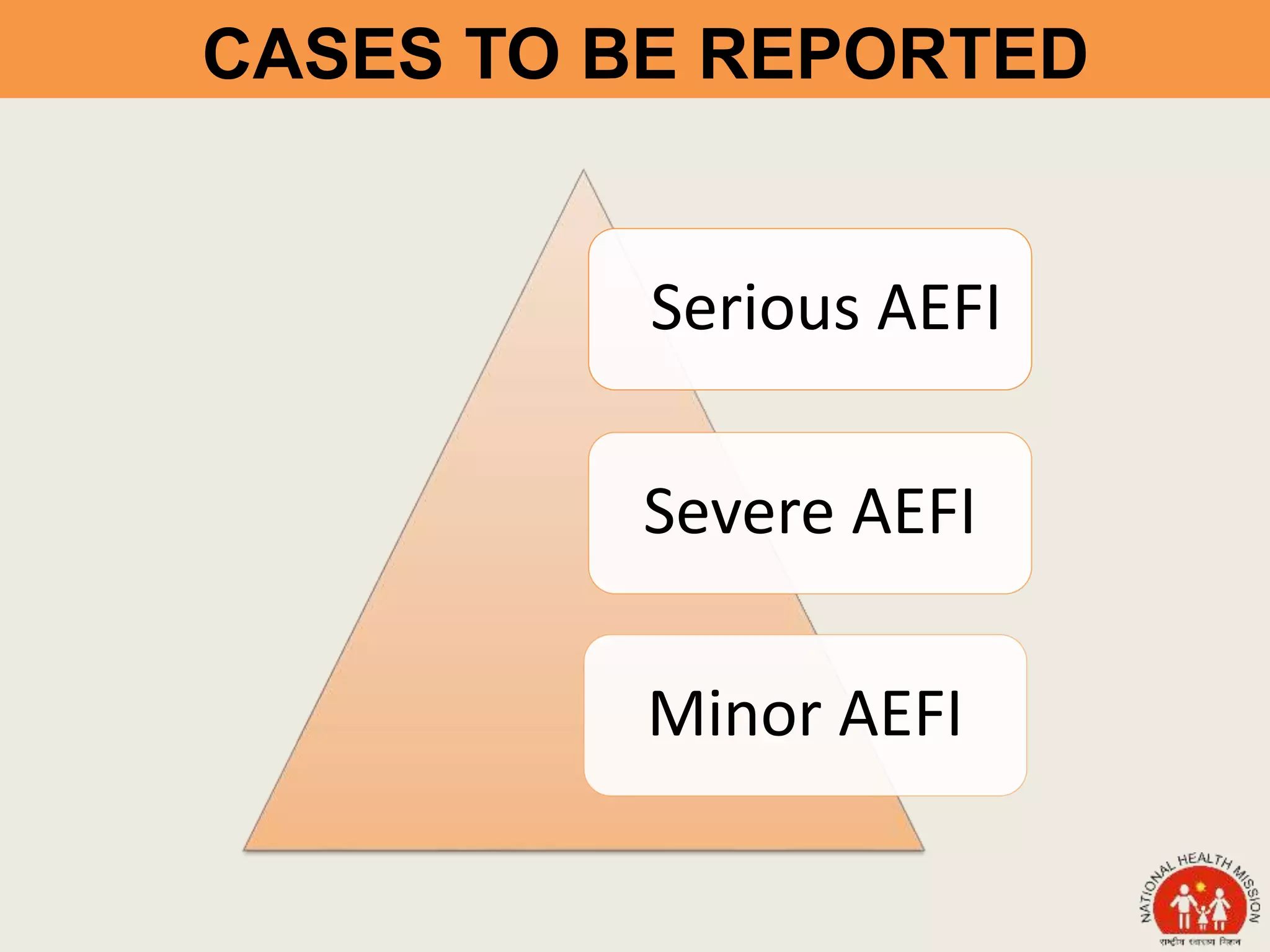
CASES TO BE REPORTED
Serious AEFI
Severe AEFI
Minor AEFI
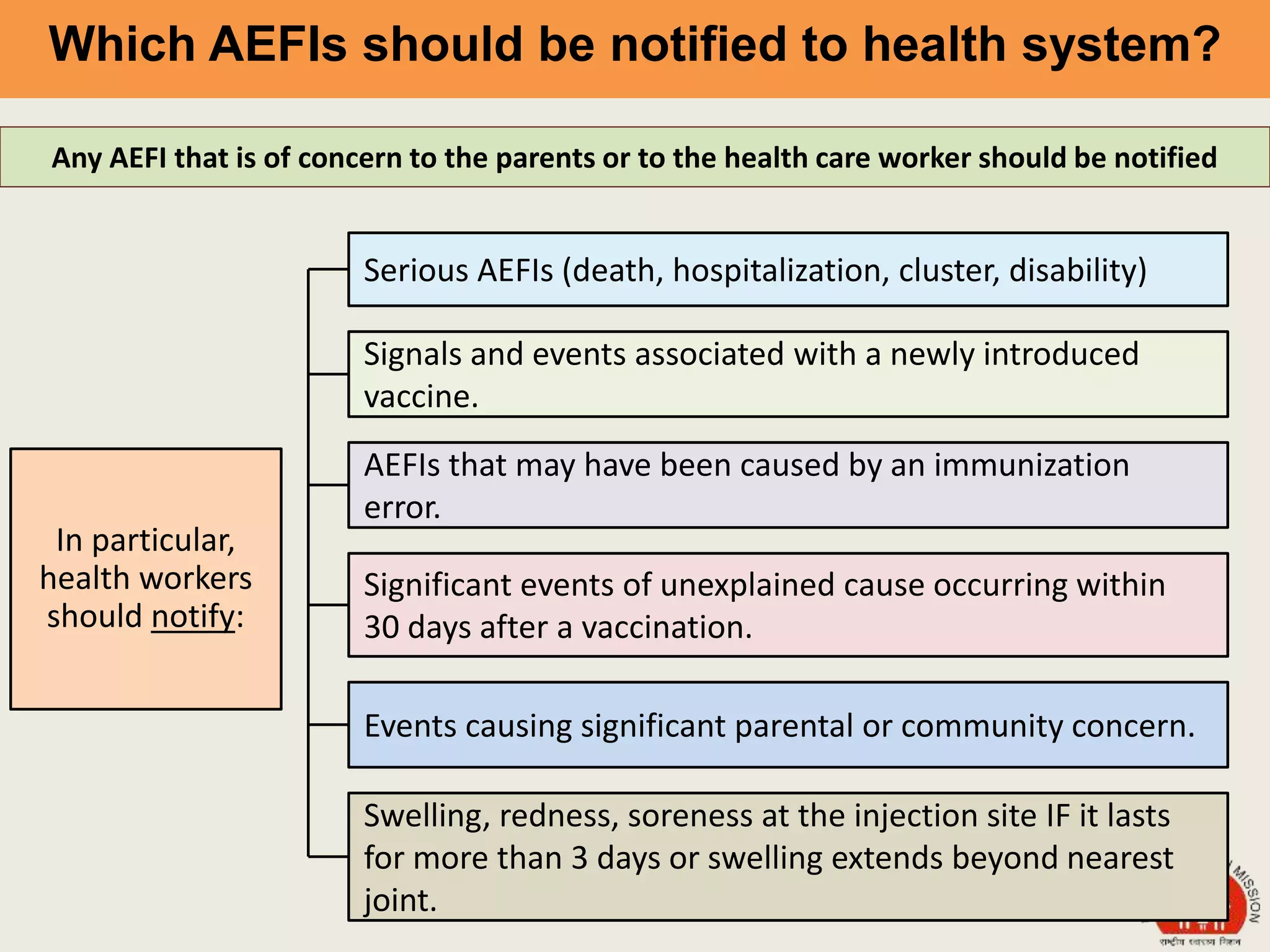
Which AEFIs should be notified to health system?
Any AEFI that is of concern to the parents or to the health care worker should be notified
In particular,
health workers
should notify:
Serious AEFIs (death, hospitalization, cluster, disability)
Signals and events associated with a newly introduced
vaccine.
AEFIs that may have been caused by an immunization
error.
Significant events of unexplained cause occurring within
30 days after a vaccination.
Events causing significant parental or community concern.
Swelling, redness, soreness at the injection site IF it lasts
for more than 3 days or swelling extends beyond nearest
joint.
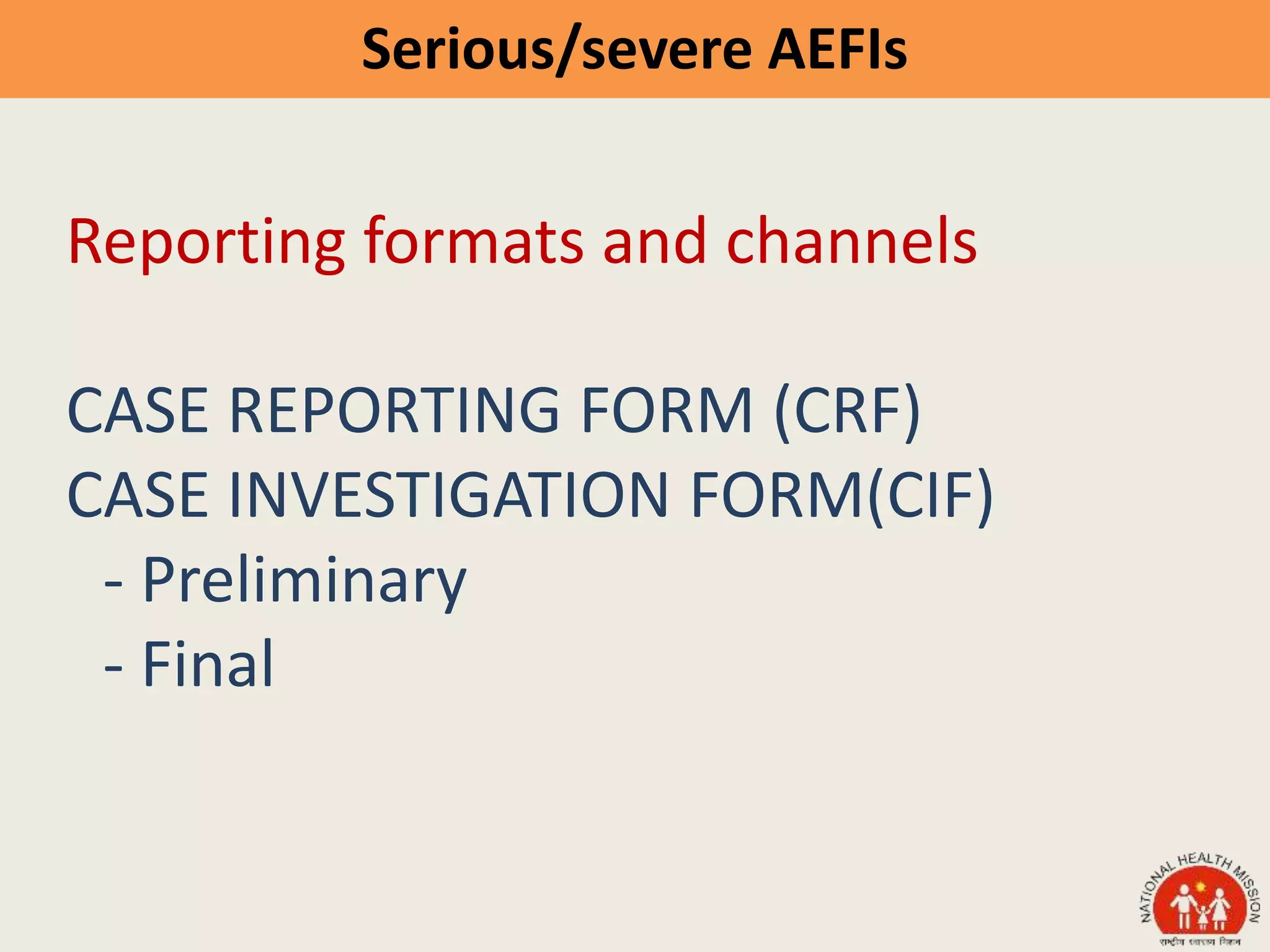
Reporting formats and channels
CASE REPORTING FORM (CRF)
CASE INVESTIGATION FORM(CIF)
- Preliminary
- Final
Serious/severe AEFIs
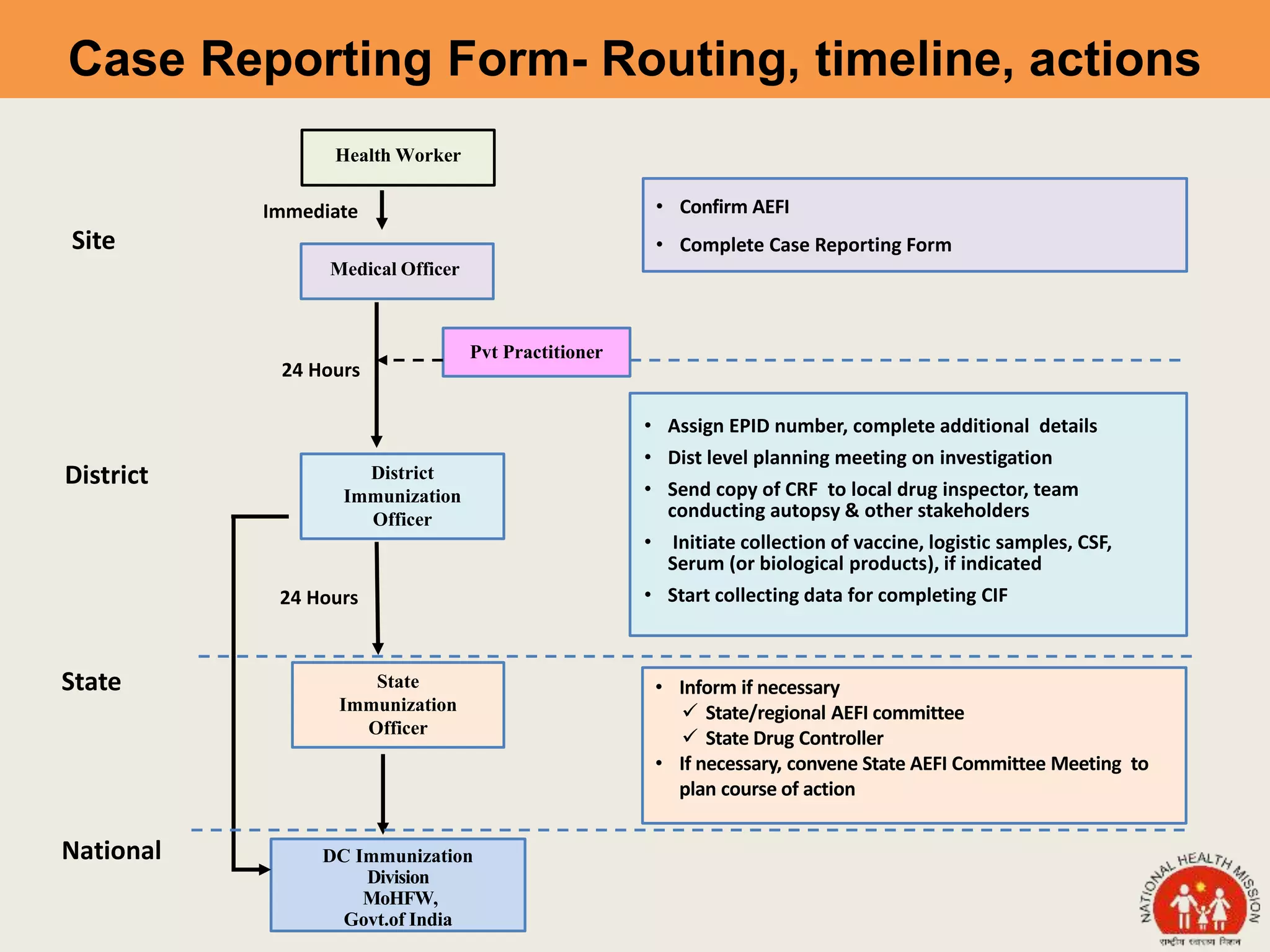
Case Reporting Form- Routing, timeline, actions
Medical Officer
Pvt Practitioner
District
Immunization
Officer
State
Immunization
Officer
DC Immunization
Division
MoHFW,
Govt.of India
• Confirm AEFI
• Complete Case Reporting Form
• Assign EPID number, complete additional details
• Dist level planning meeting on investigation
• Send copy of CRF to local drug inspector, team
conducting autopsy & other stakeholders
• Initiate collection of vaccine, logistic samples, CSF,
Serum (or biological products), if indicated
• Start collecting data for completing CIF
• Inform if necessary
 State/regional AEFI committee
 State Drug Controller
• If necessary, convene State AEFI Committee Meeting to
plan course of action
State
District
National
24 Hours
24 Hours
Site
Immediate
Health Worker
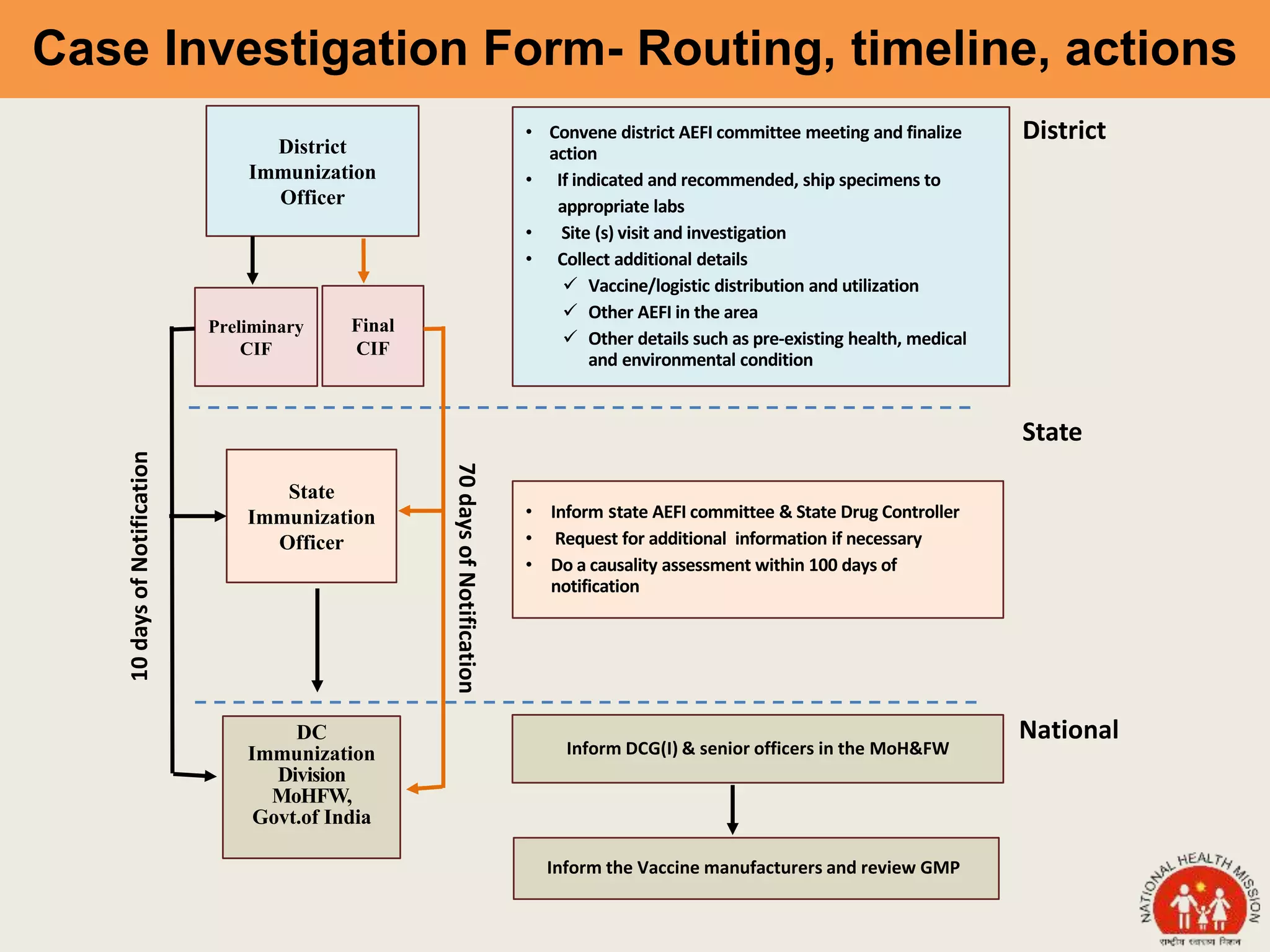
Case Investigation Form- Routing, timeline, actions
District
Immunization
Officer
Preliminary
CIF
State
Immunization
Officer
DC
Immunization
Division
MoHFW,
Govt.of India
Inform DCG(I) & senior officers in the MoH&FW
Inform the Vaccine manufacturers and review GMP
Final
CIF
10daysofNotification • Convene district AEFI committee meeting and finalize
action
• If indicated and recommended, ship specimens to
appropriate labs
• Site (s) visit and investigation
• Collect additional details
 Vaccine/logistic distribution and utilization
 Other AEFI in the area
 Other details such as pre-existing health, medical
and environmental condition
• Inform state AEFI committee & State Drug Controller
• Request for additional information if necessary
• Do a causality assessment within 100 days of
notification
70daysofNotification
State
National
District
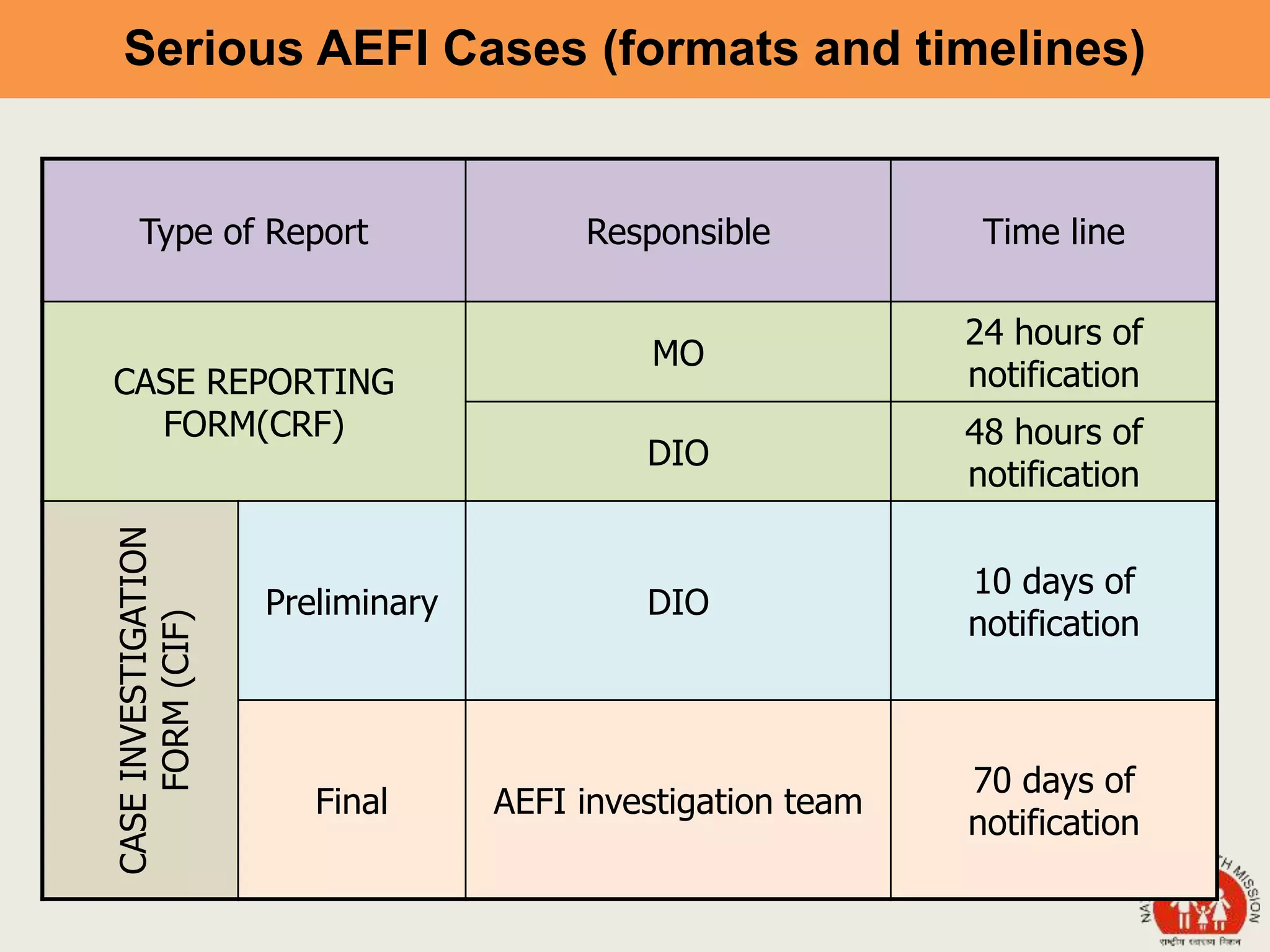
Serious AEFI Cases (formats and timelines)
Type of Report Responsible Time line
CASE REPORTING
FORM(CRF)
MO
24 hours of
notification
DIO
48 hours of
notification
CASEINVESTIGATION
FORM(CIF)
Preliminary DIO
10 days of
notification
Final AEFI investigation team
70 days of
notification
http://www.slideshare.net/haqinaam

Adverse Events Following Immunization (AEFIs)

  • 1.
  • 2.
    Contents of thislecture • Definition of AEFI • Classification of AEFIs • Serious AEFI • Examples of AEFIs • Reporting and Surveillance of AEFIs
  • 3.
    Definition • An AEFIis any untoward medical occurrence which follows immunization and which does not necessarily have a causal relationship with the usage of the vaccine. The adverse event may be any unfavorable or unintended sign, abnormal laboratory finding, symptom or disease.
  • 4.
    AEFI Frequency Terminology Verycommon* > 1/10 > 10% Common (frequent) > 1/100 and < 1/10 > 1% and < 10% Uncommon (infrequent) > 1/1,000 and < 1/100 > 0.1% and < 1 % Rare > 1/10,000 and < 1/1,000 > 0.01% and < 0.1% Very rare* < 1/10,000 < 0.01% * Optional categories
  • 5.
  • 6.
    Module B |May 2013 | 6AEFI Basic concepts 1 Vaccine product- related reaction An AEFI that is caused or precipitated by a vaccine due to one or more of the inherent properties of the vaccine product. 2 Vaccine quality defect-related reaction An AEFI that is caused or precipitated by a vaccine that is due to one or more quality defects of the vaccine product including its administration device as provided by the manufacturer. 3 Immunization error-related reaction An AEFI that is caused by Inappropriate vaccine handling, prescribing or administration. 4 Immunization anxiety-related reaction An AEFI arising from anxiety about the immunization. 5 Coincidental event An AEFI that is caused by something other than the vaccine product, immunization error or immunization anxiety CIOMS/ WHO cause specific definition of AEFIs
  • 7.
    Module B |May 2013 | 7AEFI Basic concepts 1 Vaccine product- related reaction EXAMPLE Extensive limb swelling following DTP vaccination. 2 Vaccine quality defect-related reaction EXAMPLE Failure by the manufacturer to completely inactivate a lot of inactivated polio vaccine leads to cases of paralytic polio. 3 Immunization error-related reaction EXAMPLE Transmission of infection by contaminated multidose vial. 4 Immunization anxiety-related reaction EXAMPLE Vasovagal syncope in an adolescent following vaccination. 5 Coincidental event EXAMPLE A fever after vaccination (temporal association) and malarial parasite isolated from blood. CIOMS/ WHO cause specific definition of AEFIs
  • 8.
  • 9.
    Two types ofvaccine reactions- Minor and Severe
  • 12.
    Two types ofvaccine reactions- Minor and Severe
  • 13.
    Two types ofvaccine reactions- Minor and Severe Antigen [Live, Killed, Purified, Inactivated toxin] Stabilizers (help the vaccine maintain its effectiveness during storage) [MgCl2, MgSO4] Adjuvants (improve the immune response to vaccine antigens, most often in killed vaccine) [Aluminium salts] Antibiotics (to prevent bacterial contamination of the tissue culture cells in which the viruses are grown) [Neomycin] Preservatives (added to multidose vaccines to prevent bacterial and fungal growth) [Thiomersal, Formaldehyde]
  • 15.
    AEFI Reporting andSurveillance
  • 16.
    Module B |May 2013 | 16AEFI Basic concepts Vaccine safety terminology: Serious adverse event/reaction • Death • Hospitalization or prolongation of existing hospitalization (e.g., encephalopathy, seizures, aseptic meningitis) • Persistent or significant disability or incapacity (e.g., paralysis) • Congenital anomaly/birth defect • Life-threatening Serious AEFI Source: report of CIOMS/WHO Working Group on Vaccine Pharmacovigilance, 2012 ‘Serious’ is not synonymous with ‘severe’ (i.e., intensity or severity of the event)
  • 17.
    Module B |May 2013 | 17AEFI Basic concepts "A cluster of AEFIs is two or more cases of the same adverse event related in time, place or vaccine administered".* * WHO Aide Memoire: AEFI Investigation, 2004 ** Last, John M. 2001. A Dictionary of Epidemiology, 4th ed, Vaccine safety terminology: Cluster Aggregation of relatively uncommon events or diseases in space and/or time in frequency that are believed or perceived to be greater than could be expected by chance.**
  • 18.
    Module B |May 2013 | 18AEFI Basic concepts Vaccine safety terminology: AEFIs needing special attention • e.g. bacterial abscess, severe local reaction, high fever or sepsis, BCG lymphadenitis, toxic shock syndrome, clusters of AEFIs) If immunization error is suspected Significant events of unexplained cause occurring within 30 days after a vaccination Events causing parental or community concern
  • 19.
    Module B |May 2013 | 19AEFI Basic concepts Serious AEFI Potential immunization error Cluster Parental concern Community concern Unexpected relationship with vaccination Unexpected frequency AEFI Case selection for Reporting* Reporter should NOT assess causality * Events to be reported according to context - Routine surveillance, new vaccine, mass campaign etc
  • 20.
    Module B |May 2013 | 20AEFI Basic concepts AEFI RECORDING AND REPORTING IN INDIA
  • 21.
    Module B |May 2013 | 21AEFI Basic concepts
  • 22.
    CASES TO BEREPORTED Serious AEFI Severe AEFI Minor AEFI
  • 23.
    Which AEFIs shouldbe notified to health system? Any AEFI that is of concern to the parents or to the health care worker should be notified In particular, health workers should notify: Serious AEFIs (death, hospitalization, cluster, disability) Signals and events associated with a newly introduced vaccine. AEFIs that may have been caused by an immunization error. Significant events of unexplained cause occurring within 30 days after a vaccination. Events causing significant parental or community concern. Swelling, redness, soreness at the injection site IF it lasts for more than 3 days or swelling extends beyond nearest joint.
  • 24.
    Reporting formats andchannels CASE REPORTING FORM (CRF) CASE INVESTIGATION FORM(CIF) - Preliminary - Final Serious/severe AEFIs
  • 25.
    Case Reporting Form-Routing, timeline, actions Medical Officer Pvt Practitioner District Immunization Officer State Immunization Officer DC Immunization Division MoHFW, Govt.of India • Confirm AEFI • Complete Case Reporting Form • Assign EPID number, complete additional details • Dist level planning meeting on investigation • Send copy of CRF to local drug inspector, team conducting autopsy & other stakeholders • Initiate collection of vaccine, logistic samples, CSF, Serum (or biological products), if indicated • Start collecting data for completing CIF • Inform if necessary  State/regional AEFI committee  State Drug Controller • If necessary, convene State AEFI Committee Meeting to plan course of action State District National 24 Hours 24 Hours Site Immediate Health Worker
  • 26.
    Case Investigation Form-Routing, timeline, actions District Immunization Officer Preliminary CIF State Immunization Officer DC Immunization Division MoHFW, Govt.of India Inform DCG(I) & senior officers in the MoH&FW Inform the Vaccine manufacturers and review GMP Final CIF 10daysofNotification • Convene district AEFI committee meeting and finalize action • If indicated and recommended, ship specimens to appropriate labs • Site (s) visit and investigation • Collect additional details  Vaccine/logistic distribution and utilization  Other AEFI in the area  Other details such as pre-existing health, medical and environmental condition • Inform state AEFI committee & State Drug Controller • Request for additional information if necessary • Do a causality assessment within 100 days of notification 70daysofNotification State National District
  • 27.
    Serious AEFI Cases(formats and timelines) Type of Report Responsible Time line CASE REPORTING FORM(CRF) MO 24 hours of notification DIO 48 hours of notification CASEINVESTIGATION FORM(CIF) Preliminary DIO 10 days of notification Final AEFI investigation team 70 days of notification
  • 28.