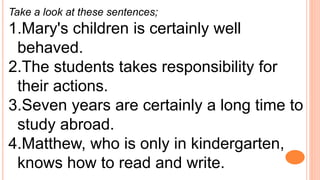
Take a look at these sentences;
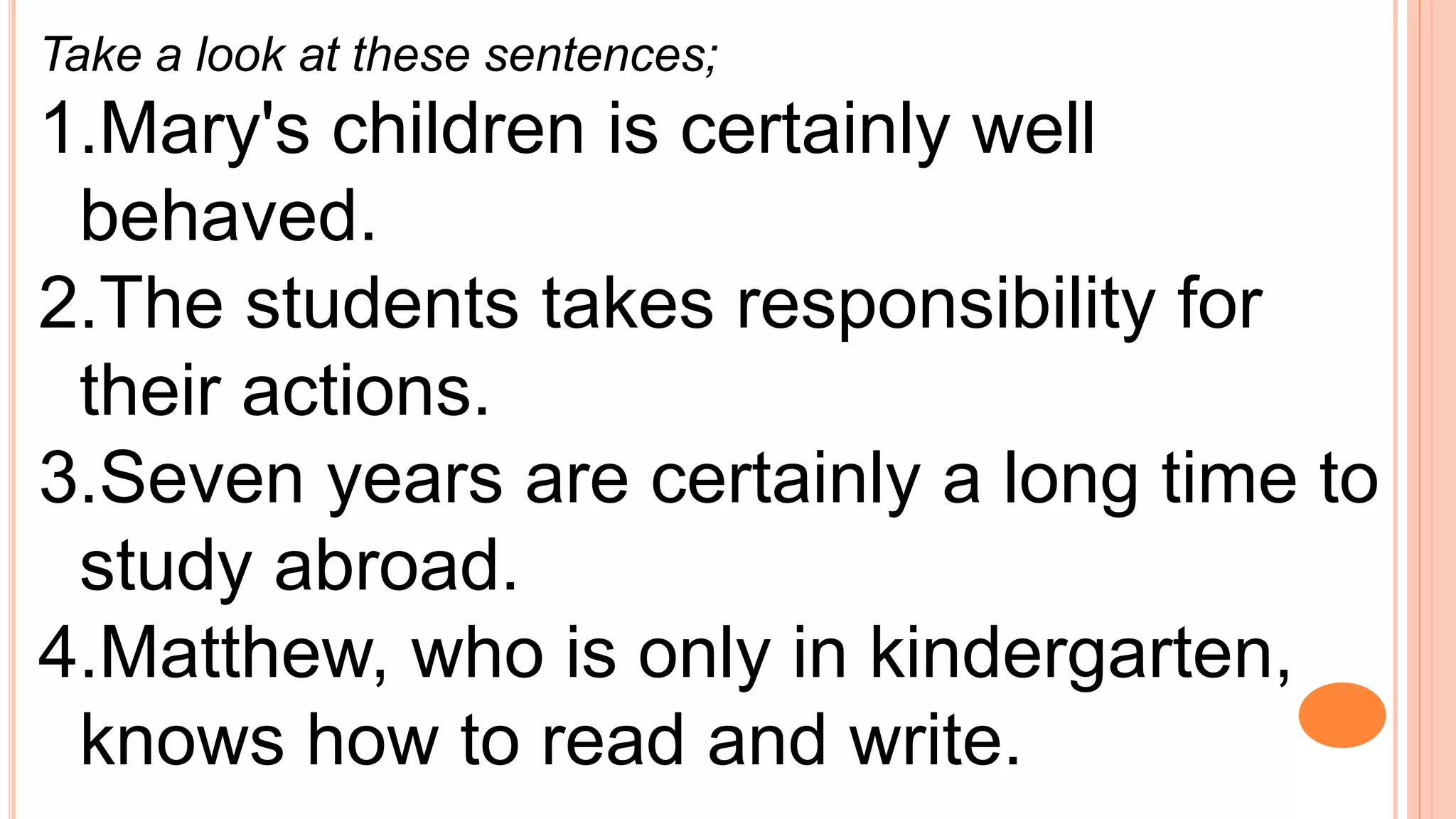
1.Mary's children is certainly well
behaved.
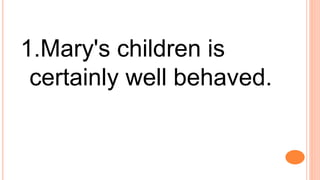
2.The students takes responsibility for
their actions.
3.Seven years are certainly a long time to
study abroad.
4.Matthew, who is only in kindergarten,
knows how to read and write.
1.Mary's children is
certainly well behaved.
2. The students takes
responsibility for their
actions.
3. Seven years are
certainly a long time to
study abroad.
4. Matthew, who is only in
kindergarten, knows how to
read and write.
RULES ON SUBJECT-VERB AGREEMENT
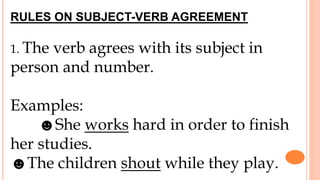
1. The verb agrees with its subject in
person and number.
Examples:
☻She works hard in order to finish
her studies.
☻The children shout while they play.
More examples :
The pencil was stolen by his
classmates.
Children tend to imitate their parent’s
attitude.
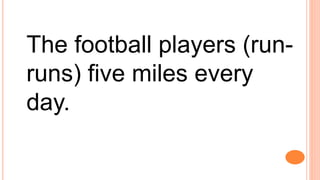
The football players (run-
runs) five miles every
day.
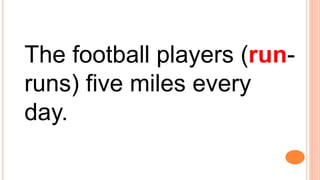
The football players (run-
runs) five miles every
day.
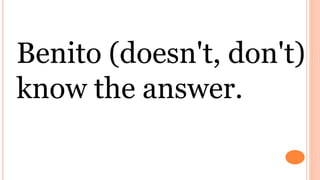
Benito (doesn't, don't)
know the answer.
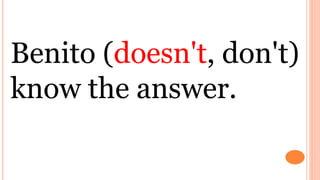
Benito (doesn't, don't)
know the answer.
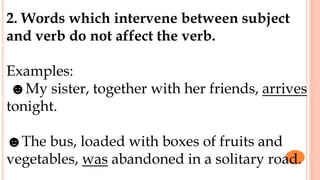
2. Words which intervene between subject
and verb do not affect the verb.
Examples:
☻My sister, together with her friends, arrives
tonight.
☻The bus, loaded with boxes of fruits and
vegetables, was abandoned in a solitary road.
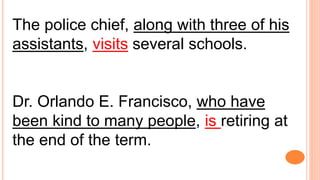
The police chief, along with three of his
assistants, visits several schools.
Dr. Orlando E. Francisco, who have
been kind to many people, is retiring at
the end of the term.
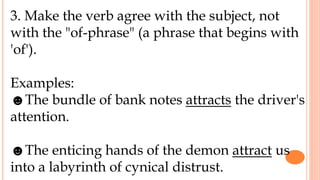
3. Make the verb agree with the subject, not
with the "of-phrase" (a phrase that begins with
'of').
Examples:
☻The bundle of bank notes attracts the driver's
attention.
☻The enticing hands of the demon attract us
into a labyrinth of cynical distrust.
6. A compound subject involving the use of "each" or "every" requires the s-form of the verb (singular).
Examples:
☻Each boy and girl has clothes made of T'boli tinalak.
☻Every man and woman helps this community become more progressive.
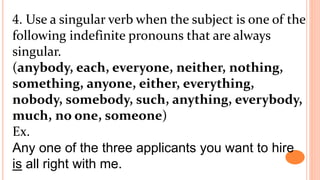
4. Use a singular verb when the subject is one of the
following indefinite pronouns that are always
singular.
(anybody, each, everyone, neither, nothing,
something, anyone, either, everything,
nobody, somebody, such, anything, everybody,
much, no one, someone)
Ex.
Any one of the three applicants you want to hire
is all right with me.
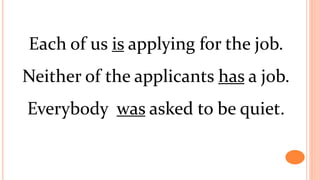
Each of us is applying for the job.
Neither of the applicants has a job.
Everybody was asked to be quiet.
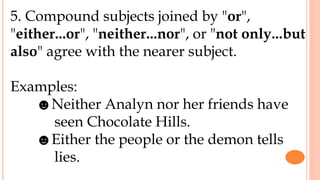
5. Compound subjects joined by "or",
"either...or", "neither...nor", or "not only...but
also" agree with the nearer subject.
Examples:
☻Neither Analyn nor her friends have
seen Chocolate Hills.
☻Either the people or the demon tells
lies.
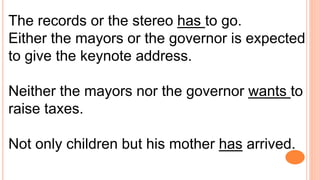
The records or the stereo has to go.
Either the mayors or the governor is expected
to give the keynote address.
Neither the mayors nor the governor wants to
raise taxes.
Not only children but his mother has arrived.
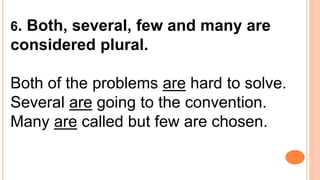
6. Both, several, few and many are
considered plural.
Both of the problems are hard to solve.
Several are going to the convention.
Many are called but few are chosen.
Exercises
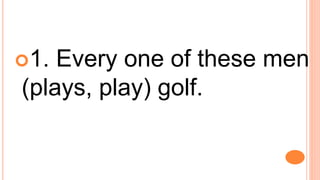
1. Every one of these men
(plays, play) golf.
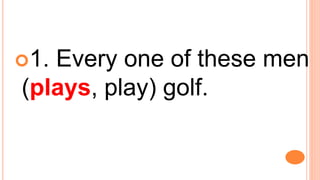
1. Every one of these men
(plays, play) golf.
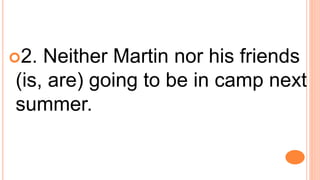
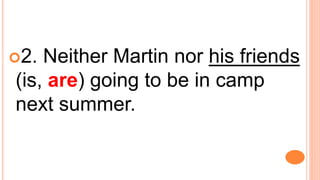
2. Neither Martin nor his friends
(is, are) going to be in camp next
summer.
2. Neither Martin nor his friends
(is, are) going to be in camp
next summer.
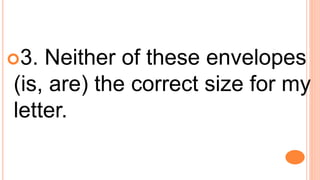
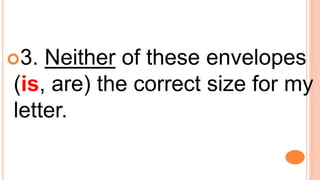
3. Neither of these envelopes
(is, are) the correct size for my
letter.
3. Neither of these envelopes
(is, are) the correct size for my
letter.
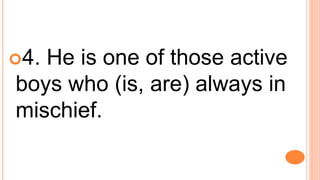
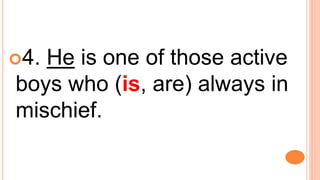
4. He is one of those active
boys who (is, are) always in
mischief.
4. He is one of those active
boys who (is, are) always in
mischief.
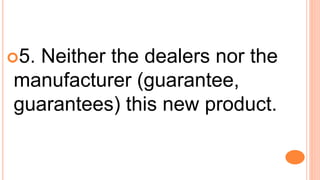
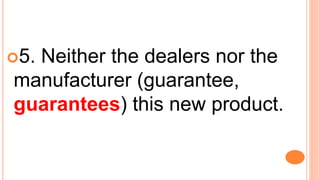
5. Neither the dealers nor the
manufacturer (guarantee,
guarantees) this new product.
5. Neither the dealers nor the
manufacturer (guarantee,
guarantees) this new product.
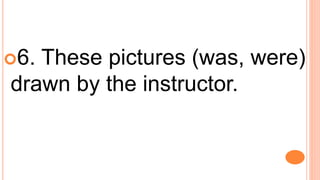
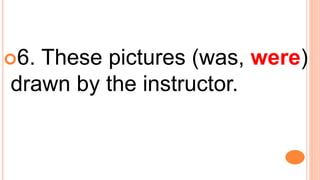
6. These pictures (was, were)
drawn by the instructor.
6. These pictures (was, were)
drawn by the instructor.
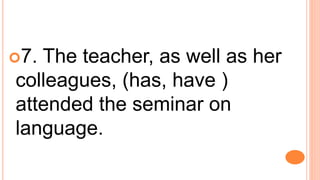
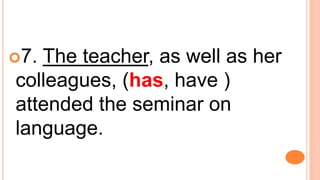
7. The teacher, as well as her
colleagues, (has, have )
attended the seminar on
language.
7. The teacher, as well as her
colleagues, (has, have )
attended the seminar on
language.
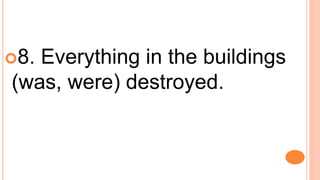
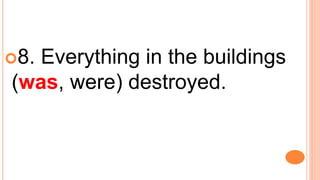
8. Everything in the buildings
(was, were) destroyed.
8. Everything in the buildings
(was, were) destroyed.
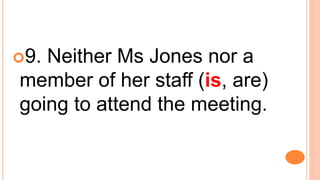
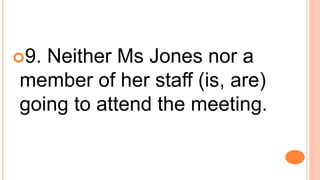
9. Neither Ms Jones nor a
member of her staff (is, are)
going to attend the meeting.
9. Neither Ms Jones nor a
member of her staff (is, are)
going to attend the meeting.
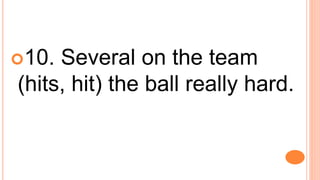
10. Several on the team
(hits, hit) the ball really hard.
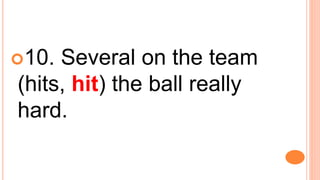
10. Several on the team
(hits, hit) the ball really
hard.
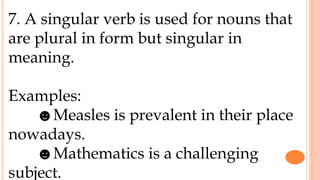
7. A singular verb is used for nouns that
are plural in form but singular in
meaning.
Examples:
☻Measles is prevalent in their place
nowadays.
☻Mathematics is a challenging
subject.
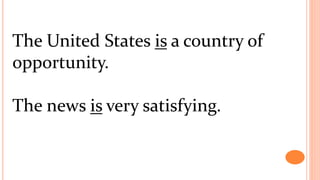
The United States is a country of
opportunity.
The news is very satisfying.
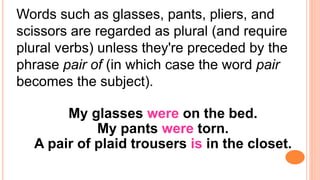
Words such as glasses, pants, pliers, and
scissors are regarded as plural (and require
plural verbs) unless they're preceded by the
phrase pair of (in which case the word pair
becomes the subject).
My glasses were on the bed.
My pants were torn.
A pair of plaid trousers is in the closet.
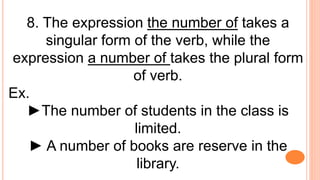
8. The expression the number of takes a
singular form of the verb, while the
expression a number of takes the plural form
of verb.
Ex.
►The number of students in the class is
limited.
► A number of books are reserve in the
library.
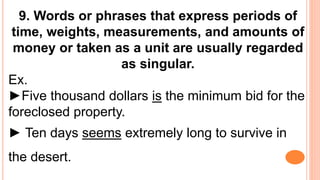
9. Words or phrases that express periods of
time, weights, measurements, and amounts of
money or taken as a unit are usually regarded
as singular.
Ex.
►Five thousand dollars is the minimum bid for the
foreclosed property.
► Ten days seems extremely long to survive in
the desert.
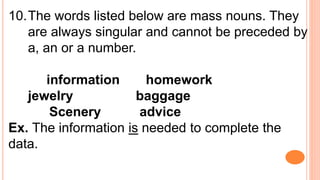
10.The words listed below are mass nouns. They
are always singular and cannot be preceded by
a, an or a number.
information homework
jewelry baggage
Scenery advice
Ex. The information is needed to complete the
data.
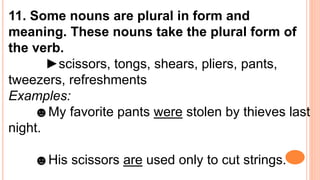
11. Some nouns are plural in form and
meaning. These nouns take the plural form of
the verb.
►scissors, tongs, shears, pliers, pants,
tweezers, refreshments
Examples:
☻My favorite pants were stolen by thieves last
night.
☻His scissors are used only to cut strings.
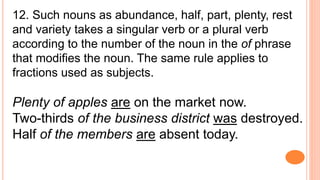
12. Such nouns as abundance, half, part, plenty, rest
and variety takes a singular verb or a plural verb
according to the number of the noun in the of phrase
that modifies the noun. The same rule applies to
fractions used as subjects.
Plenty of apples are on the market now.
Two-thirds of the business district was destroyed.
Half of the members are absent today.
13. The words there and here are
never subjects.
There are two reasons [plural
subject] for this.
There is no reason for this.
Here are two apples.
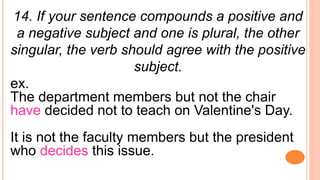
14. If your sentence compounds a positive and
a negative subject and one is plural, the other
singular, the verb should agree with the positive
subject.
ex.
The department members but not the chair
have decided not to teach on Valentine's Day.
It is not the faculty members but the president
who decides this issue.
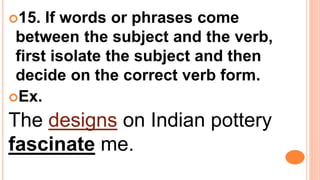
15. If words or phrases come
between the subject and the verb,
first isolate the subject and then
decide on the correct verb form.
Ex.
The designs on Indian pottery
fascinate me.
Exercise
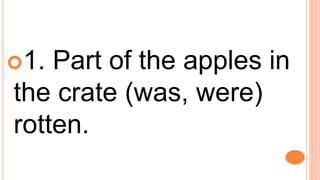
1. Part of the apples in
the crate (was, were)
rotten.
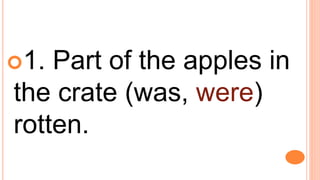
1. Part of the apples in
the crate (was, were)
rotten.
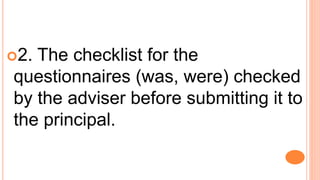
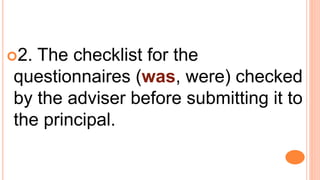
2. The checklist for the
questionnaires (was, were) checked
by the adviser before submitting it to
the principal.
2. The checklist for the
questionnaires (was, were) checked
by the adviser before submitting it to
the principal.
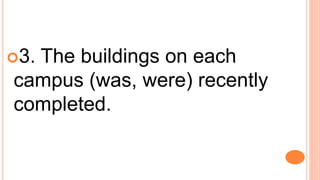
3. The buildings on each
campus (was, were) recently
completed.
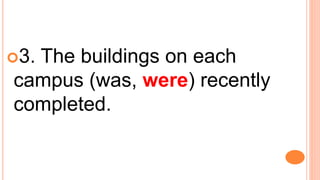
3. The buildings on each
campus (was, were) recently
completed.
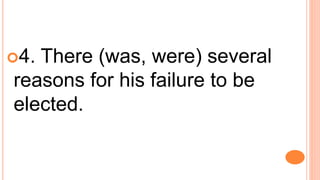
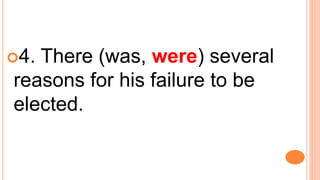
4. There (was, were) several
reasons for his failure to be
elected.
4. There (was, were) several
reasons for his failure to be
elected.
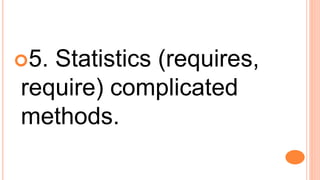
5. Statistics (requires,
require) complicated
methods.
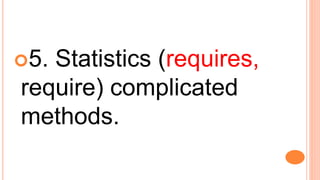
5. Statistics (requires,
require) complicated
methods.
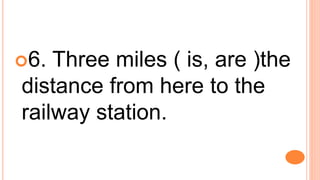
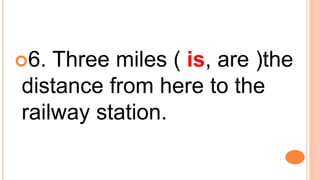
6. Three miles ( is, are )the
distance from here to the
railway station.
6. Three miles ( is, are )the
distance from here to the
railway station.
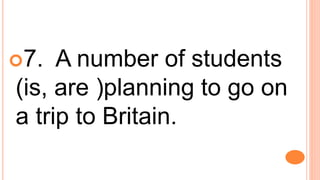
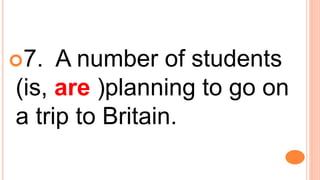
7. A number of students
(is, are )planning to go on
a trip to Britain.
7. A number of students
(is, are )planning to go on
a trip to Britain.
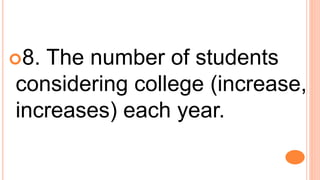
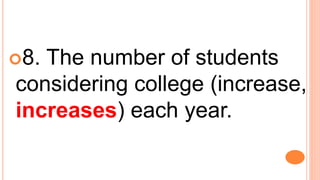
8. The number of students
considering college (increase,
increases) each year.
8. The number of students
considering college (increase,
increases) each year.
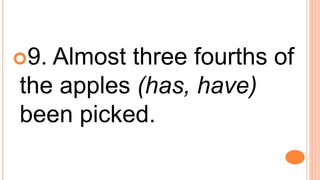
9. Almost three fourths of
the apples (has, have)
been picked.
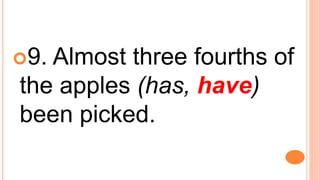
9. Almost three fourths of
the apples (has, have)
been picked.
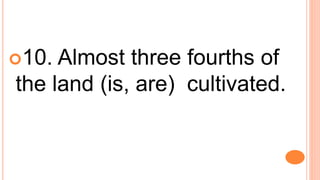
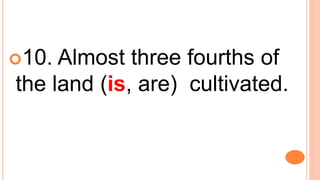
10. Almost three fourths of
the land (is, are) cultivated.
10. Almost three fourths of
the land (is, are) cultivated.
 http://ebooks.grsu.by/english_grammar/unit-3-agreement-between-
the-noun-and-the-verb.htm

Subverb agreement

  • 1.
    Take a lookat these sentences; 1.Mary's children is certainly well behaved. 2.The students takes responsibility for their actions. 3.Seven years are certainly a long time to study abroad. 4.Matthew, who is only in kindergarten, knows how to read and write.
  • 2.
  • 3.
    2. The studentstakes responsibility for their actions.
  • 4.
    3. Seven yearsare certainly a long time to study abroad.
  • 5.
    4. Matthew, whois only in kindergarten, knows how to read and write.
  • 7.
    RULES ON SUBJECT-VERBAGREEMENT 1. The verb agrees with its subject in person and number. Examples: ☻She works hard in order to finish her studies. ☻The children shout while they play.
  • 8.
    More examples : Thepencil was stolen by his classmates. Children tend to imitate their parent’s attitude.
  • 9.
    The football players(run- runs) five miles every day.
  • 10.
    The football players(run- runs) five miles every day.
  • 11.
  • 12.
  • 13.
    2. Words whichintervene between subject and verb do not affect the verb. Examples: ☻My sister, together with her friends, arrives tonight. ☻The bus, loaded with boxes of fruits and vegetables, was abandoned in a solitary road.
  • 14.
    The police chief,along with three of his assistants, visits several schools. Dr. Orlando E. Francisco, who have been kind to many people, is retiring at the end of the term.
  • 15.
    3. Make theverb agree with the subject, not with the "of-phrase" (a phrase that begins with 'of'). Examples: ☻The bundle of bank notes attracts the driver's attention. ☻The enticing hands of the demon attract us into a labyrinth of cynical distrust.
  • 16.
    6. A compoundsubject involving the use of "each" or "every" requires the s-form of the verb (singular). Examples: ☻Each boy and girl has clothes made of T'boli tinalak. ☻Every man and woman helps this community become more progressive. 4. Use a singular verb when the subject is one of the following indefinite pronouns that are always singular. (anybody, each, everyone, neither, nothing, something, anyone, either, everything, nobody, somebody, such, anything, everybody, much, no one, someone) Ex. Any one of the three applicants you want to hire is all right with me.
  • 17.
    Each of usis applying for the job. Neither of the applicants has a job. Everybody was asked to be quiet.
  • 18.
    5. Compound subjectsjoined by "or", "either...or", "neither...nor", or "not only...but also" agree with the nearer subject. Examples: ☻Neither Analyn nor her friends have seen Chocolate Hills. ☻Either the people or the demon tells lies.
  • 19.
    The records orthe stereo has to go. Either the mayors or the governor is expected to give the keynote address. Neither the mayors nor the governor wants to raise taxes. Not only children but his mother has arrived.
  • 20.
    6. Both, several,few and many are considered plural. Both of the problems are hard to solve. Several are going to the convention. Many are called but few are chosen.
  • 21.
  • 22.
    1. Every oneof these men (plays, play) golf.
  • 23.
    1. Every oneof these men (plays, play) golf.
  • 24.
    2. Neither Martinnor his friends (is, are) going to be in camp next summer.
  • 25.
    2. Neither Martinnor his friends (is, are) going to be in camp next summer.
  • 26.
    3. Neither ofthese envelopes (is, are) the correct size for my letter.
  • 27.
    3. Neither ofthese envelopes (is, are) the correct size for my letter.
  • 28.
    4. He isone of those active boys who (is, are) always in mischief.
  • 29.
    4. He isone of those active boys who (is, are) always in mischief.
  • 30.
    5. Neither thedealers nor the manufacturer (guarantee, guarantees) this new product.
  • 31.
    5. Neither thedealers nor the manufacturer (guarantee, guarantees) this new product.
  • 32.
    6. These pictures(was, were) drawn by the instructor.
  • 33.
    6. These pictures(was, were) drawn by the instructor.
  • 34.
    7. The teacher,as well as her colleagues, (has, have ) attended the seminar on language.
  • 35.
    7. The teacher,as well as her colleagues, (has, have ) attended the seminar on language.
  • 36.
    8. Everything inthe buildings (was, were) destroyed.
  • 37.
    8. Everything inthe buildings (was, were) destroyed.
  • 38.
    9. Neither MsJones nor a member of her staff (is, are) going to attend the meeting.
  • 39.
    9. Neither MsJones nor a member of her staff (is, are) going to attend the meeting.
  • 40.
    10. Several onthe team (hits, hit) the ball really hard.
  • 41.
    10. Several onthe team (hits, hit) the ball really hard.
  • 42.
    7. A singularverb is used for nouns that are plural in form but singular in meaning. Examples: ☻Measles is prevalent in their place nowadays. ☻Mathematics is a challenging subject.
  • 43.
    The United Statesis a country of opportunity. The news is very satisfying.
  • 44.
    Words such asglasses, pants, pliers, and scissors are regarded as plural (and require plural verbs) unless they're preceded by the phrase pair of (in which case the word pair becomes the subject). My glasses were on the bed. My pants were torn. A pair of plaid trousers is in the closet.
  • 45.
    8. The expressionthe number of takes a singular form of the verb, while the expression a number of takes the plural form of verb. Ex. ►The number of students in the class is limited. ► A number of books are reserve in the library.
  • 46.
    9. Words orphrases that express periods of time, weights, measurements, and amounts of money or taken as a unit are usually regarded as singular. Ex. ►Five thousand dollars is the minimum bid for the foreclosed property. ► Ten days seems extremely long to survive in the desert.
  • 47.
    10.The words listedbelow are mass nouns. They are always singular and cannot be preceded by a, an or a number. information homework jewelry baggage Scenery advice Ex. The information is needed to complete the data.
  • 48.
    11. Some nounsare plural in form and meaning. These nouns take the plural form of the verb. ►scissors, tongs, shears, pliers, pants, tweezers, refreshments Examples: ☻My favorite pants were stolen by thieves last night. ☻His scissors are used only to cut strings.
  • 49.
    12. Such nounsas abundance, half, part, plenty, rest and variety takes a singular verb or a plural verb according to the number of the noun in the of phrase that modifies the noun. The same rule applies to fractions used as subjects. Plenty of apples are on the market now. Two-thirds of the business district was destroyed. Half of the members are absent today.
  • 50.
    13. The wordsthere and here are never subjects. There are two reasons [plural subject] for this. There is no reason for this. Here are two apples.
  • 51.
    14. If yoursentence compounds a positive and a negative subject and one is plural, the other singular, the verb should agree with the positive subject. ex. The department members but not the chair have decided not to teach on Valentine's Day. It is not the faculty members but the president who decides this issue.
  • 52.
    15. If wordsor phrases come between the subject and the verb, first isolate the subject and then decide on the correct verb form. Ex. The designs on Indian pottery fascinate me.
  • 53.
  • 54.
    1. Part ofthe apples in the crate (was, were) rotten.
  • 55.
    1. Part ofthe apples in the crate (was, were) rotten.
  • 56.
    2. The checklistfor the questionnaires (was, were) checked by the adviser before submitting it to the principal.
  • 57.
    2. The checklistfor the questionnaires (was, were) checked by the adviser before submitting it to the principal.
  • 58.
    3. The buildingson each campus (was, were) recently completed.
  • 59.
    3. The buildingson each campus (was, were) recently completed.
  • 60.
    4. There (was,were) several reasons for his failure to be elected.
  • 61.
    4. There (was,were) several reasons for his failure to be elected.
  • 62.
  • 63.
  • 64.
    6. Three miles( is, are )the distance from here to the railway station.
  • 65.
    6. Three miles( is, are )the distance from here to the railway station.
  • 66.
    7. A numberof students (is, are )planning to go on a trip to Britain.
  • 67.
    7. A numberof students (is, are )planning to go on a trip to Britain.
  • 68.
    8. The numberof students considering college (increase, increases) each year.
  • 69.
    8. The numberof students considering college (increase, increases) each year.
  • 70.
    9. Almost threefourths of the apples (has, have) been picked.
  • 71.
    9. Almost threefourths of the apples (has, have) been picked.
  • 72.
    10. Almost threefourths of the land (is, are) cultivated.
  • 73.
    10. Almost threefourths of the land (is, are) cultivated.
  • 74.