SUBJECT –
VERB
AGREEMENT
BASIC RULE:
•Singular subjects
must have singular
verbs.
Plural subjects
take plural
RULES ON
SUBJECT-
VERB
AGREEMENT
1. Thepronoun“YOU”
always takes a
plural verb.
Examples:
 You were invited to come.
 You are asked to clean the
room.
 You sing so well.
2. If a sentence begins
with HERE or THERE, the
verb agrees with the
subject which follows it.Examples:
 Here are the ways on how
to preserve meat.
 There is a huge gap between
the rich and the poor.
3. If two subjects, one single and
one plural, are connected by
EITHER/OR or NEITHER/NOR,
the verb agrees with the nearer
subject.
Examples:
 Neither the players nor the
coach is joining.
 Either the conductor or the
singers are attending the
4. A singular subject followed by
intervening words or phrases such as
WITH, AS WELL AS, IN ADDITION TO,
ACCOMPANIED BY, TOGETHER WITH and
NO LESS THAN, takes a singular
verb.
Examples:
 Jake, accompanied by his
sisters, is enrolling in PCC.
 Daddy, as well as my brothers,
is enjoying the party.
5. Singular subjects joined by
AND require a plural verb,
except when they mean one
thing.
Examples:
 Larry and Mercy are
reading novels.
 My teacher and friend is
here.
6.Two singular subjects
joined by EITHER/OR or
NEITHER/NOR take a
singular verb.
Examples:
 Either Mommy or Daddy is
coming with me at the
outbound.
 Neither Ferdie nor Dulce
is waiting for you.
7. If a singular subject is
followed by a phrase
containing a plural noun, the
verb is singular.
Examples:
 One of the boys is yelling so
loud.
 One of the members is against
the rule.
8. The indefinite pronouns
SEVERAL, FEW, BOTH,
MANY , OTHERS are
always plural.
Examples:
 Both were asking to be
freed.
 Several are seeking
justice.
9. The indefinite pronouns SOME,
MOST, ALL, NONE are singular or
plural according to the meaning of
the sentence.
Examples:
 Some of the girls were
absent.
 Some of the ice cream is
left.
10. When any of the following indefinite
pronouns is the subject, the verb is singular:
EVERYBODY, EACH,
NO ONE, ANOTHER, ANYBODY, NOBODY, EVERY,
NOTHING, EVERYTHING, ANYONE, EITHER, NEITHER,
EVERYONE, SOMEBODY, SOMEONE.
Example:
 Every man and woman in this
hall is a member.
11. Expressions of time,
money, weight, and distance
are singular even if the form
is plural.
 Examples:
 Two years is a long time to wait.
 One million dollars was given
back to the owner.
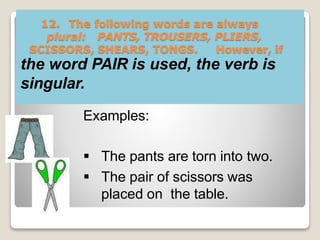
12. The following words are always
plural: PANTS, TROUSERS, PLIERS,
SCISSORS, SHEARS, TONGS. However, if
the word PAIR is used, the verb is
singular.
Examples:
 The pants are torn into two.
 The pair of scissors was
placed on the table.
13. Certain nouns, though
plural in form, are singular in
meaning and therefore take
singular verbs.
Examples:
 Mathematics is my
favorite subject.
 The latest news is alarming to
the public.
14. When the word is preceded by
A, it takes a plural verb. When
it is preceded by THE, it takes a
singular verb.
Examples:
 A number of students are
waiting outside.
 The number of students
outside is not recorded yet.
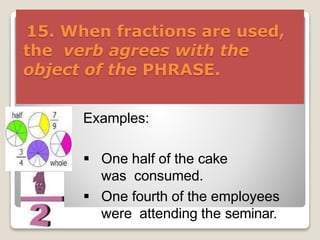
15. When fractions are used,
the verb agrees with the
object of the PHRASE.
Examples:
 One half of the cake
was consumed.
 One fourth of the employees
were attending the seminar.
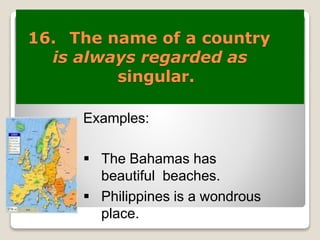
16. The name of a country
is always regarded as
singular.
Examples:
 The Bahamas has
beautiful beaches.
 Philippines is a wondrous
place.
17. Adjectives used as
nouns are considered
plural.
 Examples:
 The poor are to be helped.
 The efficient are what this
country needs.
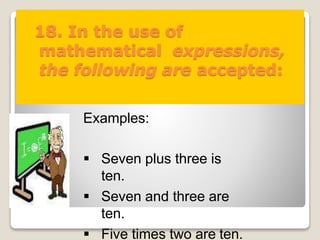
18. In the use of
mathematical expressions,
the following are accepted:
Examples:
 Seven plus three is
ten.
 Seven and three are
ten.
 Five times two are ten.
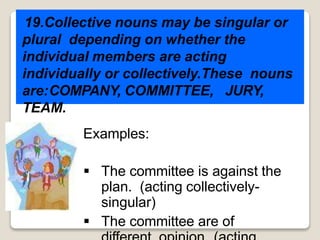
19.Collective nouns may be singular or
plural depending on whether the
individual members are acting
individually or collectively.These nouns
are:COMPANY, COMMITTEE, JURY,
TEAM.
Examples:
 The committee is against the
plan. (acting collectively-
singular)
 The committee are of
20. Titles of books, plays,
articles, movies, etc. are
regarded as
singular even though words in
the title may be plural.
Examples:
 “In DreamsBeginResponsibilities”
is a story by D. Schwartz.
 “Great Expectations” is amust-
read novel.
21. If a sentence begins with
the expletive IT, the verb is
always singular even if the
subject that follows the verb
is plural.
Examples:
 It is the schools which
must assume the
responsibility.
 It is us who must take care of
the environment.
 22. If two nouns give a single unit then it
takes singular verb.
 Exp: Rice and curry is my favourite dish.

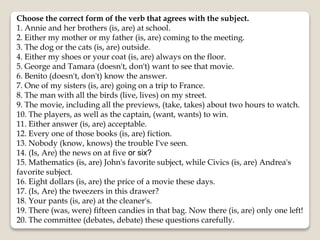
Choose the correct form of the verb that agrees with the subject.
1. Annie and her brothers (is, are) at school.
2. Either my mother or my father (is, are) coming to the meeting.
3. The dog or the cats (is, are) outside.
4. Either my shoes or your coat (is, are) always on the floor.
5. George and Tamara (doesn't, don't) want to see that movie.
6. Benito (doesn't, don't) know the answer.
7. One of my sisters (is, are) going on a trip to France.
8. The man with all the birds (live, lives) on my street.
9. The movie, including all the previews, (take, takes) about two hours to watch.
10. The players, as well as the captain, (want, wants) to win.
11. Either answer (is, are) acceptable.
12. Every one of those books (is, are) fiction.
13. Nobody (know, knows) the trouble I've seen.
14. (Is, Are) the news on at five or six?
15. Mathematics (is, are) John's favorite subject, while Civics (is, are) Andrea's
favorite subject.
16. Eight dollars (is, are) the price of a movie these days.
17. (Is, Are) the tweezers in this drawer?
18. Your pants (is, are) at the cleaner's.
19. There (was, were) fifteen candies in that bag. Now there (is, are) only one left!
20. The committee (debates, debate) these questions carefully.
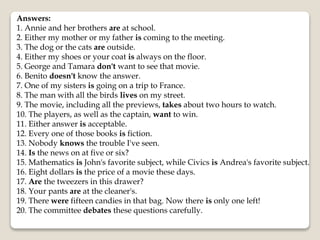
Answers:
1. Annie and her brothers are at school.
2. Either my mother or my father is coming to the meeting.
3. The dog or the cats are outside.
4. Either my shoes or your coat is always on the floor.
5. George and Tamara don't want to see that movie.
6. Benito doesn't know the answer.
7. One of my sisters is going on a trip to France.
8. The man with all the birds lives on my street.
9. The movie, including all the previews, takes about two hours to watch.
10. The players, as well as the captain, want to win.
11. Either answer is acceptable.
12. Every one of those books is fiction.
13. Nobody knows the trouble I've seen.
14. Is the news on at five or six?
15. Mathematics is John's favorite subject, while Civics is Andrea's favorite subject.
16. Eight dollars is the price of a movie these days.
17. Are the tweezers in this drawer?
18. Your pants are at the cleaner's.
19. There were fifteen candies in that bag. Now there is only one left!
20. The committee debates these questions carefully.
 english_class_ix_subject_verb_concord

english_class_ix_subject_verb_concord

  • 1.
  • 2.
    BASIC RULE: •Singular subjects musthave singular verbs. Plural subjects take plural
  • 3.
  • 4.
    1. Thepronoun“YOU” always takesa plural verb. Examples:  You were invited to come.  You are asked to clean the room.  You sing so well.
  • 5.
    2. If asentence begins with HERE or THERE, the verb agrees with the subject which follows it.Examples:  Here are the ways on how to preserve meat.  There is a huge gap between the rich and the poor.
  • 6.
    3. If twosubjects, one single and one plural, are connected by EITHER/OR or NEITHER/NOR, the verb agrees with the nearer subject. Examples:  Neither the players nor the coach is joining.  Either the conductor or the singers are attending the
  • 7.
    4. A singularsubject followed by intervening words or phrases such as WITH, AS WELL AS, IN ADDITION TO, ACCOMPANIED BY, TOGETHER WITH and NO LESS THAN, takes a singular verb. Examples:  Jake, accompanied by his sisters, is enrolling in PCC.  Daddy, as well as my brothers, is enjoying the party.
  • 8.
    5. Singular subjectsjoined by AND require a plural verb, except when they mean one thing. Examples:  Larry and Mercy are reading novels.  My teacher and friend is here.
  • 9.
    6.Two singular subjects joinedby EITHER/OR or NEITHER/NOR take a singular verb. Examples:  Either Mommy or Daddy is coming with me at the outbound.  Neither Ferdie nor Dulce is waiting for you.
  • 10.
    7. If asingular subject is followed by a phrase containing a plural noun, the verb is singular. Examples:  One of the boys is yelling so loud.  One of the members is against the rule.
  • 11.
    8. The indefinitepronouns SEVERAL, FEW, BOTH, MANY , OTHERS are always plural. Examples:  Both were asking to be freed.  Several are seeking justice.
  • 12.
    9. The indefinitepronouns SOME, MOST, ALL, NONE are singular or plural according to the meaning of the sentence. Examples:  Some of the girls were absent.  Some of the ice cream is left.
  • 13.
    10. When anyof the following indefinite pronouns is the subject, the verb is singular: EVERYBODY, EACH, NO ONE, ANOTHER, ANYBODY, NOBODY, EVERY, NOTHING, EVERYTHING, ANYONE, EITHER, NEITHER, EVERYONE, SOMEBODY, SOMEONE. Example:  Every man and woman in this hall is a member.
  • 14.
    11. Expressions oftime, money, weight, and distance are singular even if the form is plural.  Examples:  Two years is a long time to wait.  One million dollars was given back to the owner.
  • 15.
    12. The followingwords are always plural: PANTS, TROUSERS, PLIERS, SCISSORS, SHEARS, TONGS. However, if the word PAIR is used, the verb is singular. Examples:  The pants are torn into two.  The pair of scissors was placed on the table.
  • 16.
    13. Certain nouns,though plural in form, are singular in meaning and therefore take singular verbs. Examples:  Mathematics is my favorite subject.  The latest news is alarming to the public.
  • 17.
    14. When theword is preceded by A, it takes a plural verb. When it is preceded by THE, it takes a singular verb. Examples:  A number of students are waiting outside.  The number of students outside is not recorded yet.
  • 18.
    15. When fractionsare used, the verb agrees with the object of the PHRASE. Examples:  One half of the cake was consumed.  One fourth of the employees were attending the seminar.
  • 19.
    16. The nameof a country is always regarded as singular. Examples:  The Bahamas has beautiful beaches.  Philippines is a wondrous place.
  • 20.
    17. Adjectives usedas nouns are considered plural.  Examples:  The poor are to be helped.  The efficient are what this country needs.
  • 21.
    18. In theuse of mathematical expressions, the following are accepted: Examples:  Seven plus three is ten.  Seven and three are ten.  Five times two are ten.
  • 22.
    19.Collective nouns maybe singular or plural depending on whether the individual members are acting individually or collectively.These nouns are:COMPANY, COMMITTEE, JURY, TEAM. Examples:  The committee is against the plan. (acting collectively- singular)  The committee are of
  • 23.
    20. Titles ofbooks, plays, articles, movies, etc. are regarded as singular even though words in the title may be plural. Examples:  “In DreamsBeginResponsibilities” is a story by D. Schwartz.  “Great Expectations” is amust- read novel.
  • 24.
    21. If asentence begins with the expletive IT, the verb is always singular even if the subject that follows the verb is plural. Examples:  It is the schools which must assume the responsibility.  It is us who must take care of the environment.
  • 25.
     22. Iftwo nouns give a single unit then it takes singular verb.  Exp: Rice and curry is my favourite dish. 
  • 26.
    Choose the correctform of the verb that agrees with the subject. 1. Annie and her brothers (is, are) at school. 2. Either my mother or my father (is, are) coming to the meeting. 3. The dog or the cats (is, are) outside. 4. Either my shoes or your coat (is, are) always on the floor. 5. George and Tamara (doesn't, don't) want to see that movie. 6. Benito (doesn't, don't) know the answer. 7. One of my sisters (is, are) going on a trip to France. 8. The man with all the birds (live, lives) on my street. 9. The movie, including all the previews, (take, takes) about two hours to watch. 10. The players, as well as the captain, (want, wants) to win. 11. Either answer (is, are) acceptable. 12. Every one of those books (is, are) fiction. 13. Nobody (know, knows) the trouble I've seen. 14. (Is, Are) the news on at five or six? 15. Mathematics (is, are) John's favorite subject, while Civics (is, are) Andrea's favorite subject. 16. Eight dollars (is, are) the price of a movie these days. 17. (Is, Are) the tweezers in this drawer? 18. Your pants (is, are) at the cleaner's. 19. There (was, were) fifteen candies in that bag. Now there (is, are) only one left! 20. The committee (debates, debate) these questions carefully.
  • 27.
    Answers: 1. Annie andher brothers are at school. 2. Either my mother or my father is coming to the meeting. 3. The dog or the cats are outside. 4. Either my shoes or your coat is always on the floor. 5. George and Tamara don't want to see that movie. 6. Benito doesn't know the answer. 7. One of my sisters is going on a trip to France. 8. The man with all the birds lives on my street. 9. The movie, including all the previews, takes about two hours to watch. 10. The players, as well as the captain, want to win. 11. Either answer is acceptable. 12. Every one of those books is fiction. 13. Nobody knows the trouble I've seen. 14. Is the news on at five or six? 15. Mathematics is John's favorite subject, while Civics is Andrea's favorite subject. 16. Eight dollars is the price of a movie these days. 17. Are the tweezers in this drawer? 18. Your pants are at the cleaner's. 19. There were fifteen candies in that bag. Now there is only one left! 20. The committee debates these questions carefully.