Nouns “ Poetry is all nouns and verbs” Marianne More
What is a noun? A  noun  is a word used to name a person, animal, place, thing, and abstract idea.  Nouns are usually the first words which small children learn. University of Ottawa
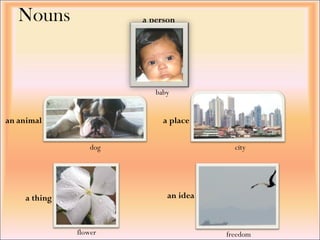
Nouns a   person an   animal a place a thing an idea flower freedom baby dog city
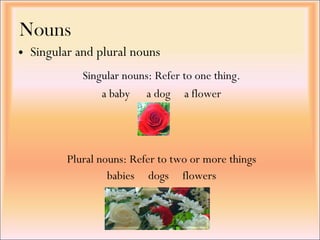
Nouns Singular and plural nouns Plural nouns: Refer to two or more things babies  dogs  flowers Singular nouns: Refer to one thing. a baby  a dog  a flower
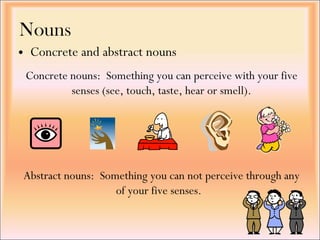
Nouns Concrete and abstract nouns Abstract nouns:  Something you can not perceive through any of your five senses.   Concrete nouns:  Something you can perceive with your five senses (see, touch, taste, hear or smell).
Collective nouns Name a group of people or thing.  This class of nouns denotes a group of people, animals, objects, or concepts or ideas as a single entity. Nouns army, troop
Compound nouns Made up of two or more words acting as a single unit.  Types: Separate words:  coffee table Hyphenated words:  editor-in-chief Combined words:  battlefield Nouns
Common nouns and Proper nouns A common noun names any type of noun (person, animal, place, thing, idea). A proper noun names an specific person, place or thing. Nouns This is a  dog .  A  dog  is a common noun. This is also an specific dog.  His name is  Homer .  Homer  is a proper noun because is the particular name of this dog.  A proper noun always begins with a capital letter.
Nouns Count nouns and Noncount nouns Count nouns: Nouns that we can count (one pencil, two pencils, three pencils).  They can be singular or plural (a book, two books). Noncount nouns:  Nouns that we can not count.  They have no plural.  Example:  bread, cheese, ice-cream, yogurt. Put  a  or  an  before singular nouns.  Do not use the articles  a  or  an  with noncount nouns.
NOUNS ARE VERY IMPORTANT.  LET'S CONTINUE STUDYING ABOUT THIS FUNDAMENTAL ELEMENT OF THE ENGLISH GRAMMAR.

Nouns

  • 1.
    Nouns “ Poetryis all nouns and verbs” Marianne More
  • 2.
    What is anoun? A noun is a word used to name a person, animal, place, thing, and abstract idea. Nouns are usually the first words which small children learn. University of Ottawa
  • 3.
    Nouns a person an animal a place a thing an idea flower freedom baby dog city
  • 4.
    Nouns Singular andplural nouns Plural nouns: Refer to two or more things babies dogs flowers Singular nouns: Refer to one thing. a baby a dog a flower
  • 5.
    Nouns Concrete andabstract nouns Abstract nouns:  Something you can not perceive through any of your five senses.  Concrete nouns:  Something you can perceive with your five senses (see, touch, taste, hear or smell).
  • 6.
    Collective nouns Namea group of people or thing.  This class of nouns denotes a group of people, animals, objects, or concepts or ideas as a single entity. Nouns army, troop
  • 7.
    Compound nouns Madeup of two or more words acting as a single unit. Types: Separate words: coffee table Hyphenated words: editor-in-chief Combined words: battlefield Nouns
  • 8.
    Common nouns andProper nouns A common noun names any type of noun (person, animal, place, thing, idea). A proper noun names an specific person, place or thing. Nouns This is a dog . A dog is a common noun. This is also an specific dog. His name is Homer . Homer is a proper noun because is the particular name of this dog. A proper noun always begins with a capital letter.
  • 9.
    Nouns Count nounsand Noncount nouns Count nouns: Nouns that we can count (one pencil, two pencils, three pencils). They can be singular or plural (a book, two books). Noncount nouns: Nouns that we can not count. They have no plural. Example: bread, cheese, ice-cream, yogurt. Put a or an before singular nouns. Do not use the articles a or an with noncount nouns.
  • 10.
    NOUNS ARE VERYIMPORTANT. LET'S CONTINUE STUDYING ABOUT THIS FUNDAMENTAL ELEMENT OF THE ENGLISH GRAMMAR.