SUBJECT-VERB AGREEMENT
English for Specific Purposes
Antonio Delgado, BSEd III
As an additional guide in
brushing up on your grammar,
keep in mind the following rules:
1.) The general rule is that singular
 subjects require singular verbs and
 plural subjects require plural verbs.
     Examples:
Robinhood steals from the rich and
 helps the poor.
The books are on the table.
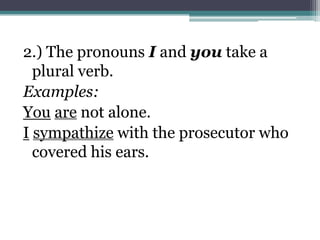
2.) The pronouns I and you take a
  plural verb.
Examples:
You are not alone.
I sympathize with the prosecutor who
  covered his ears.
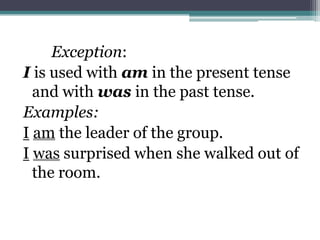
Exception:
I is used with am in the present tense
  and with was in the past tense.
Examples:
I am the leader of the group.
I was surprised when she walked out of
  the room.
3.) When the sentence begins with
 there, the verb must agree with the
 subject that follows.
Examples:
There are rice fields in Nueva Ecija.
There is a boy waiting for you outside.
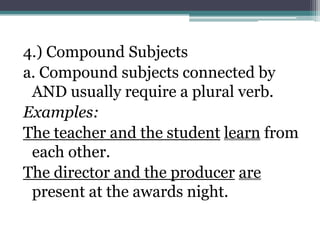
4.) Compound Subjects
a. Compound subjects connected by
 AND usually require a plural verb.
Examples:
The teacher and the student learn from
 each other.
The director and the producer are
 present at the awards night.
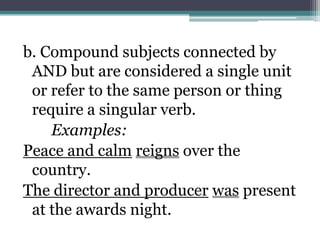
b. Compound subjects connected by
 AND but are considered a single unit
 or refer to the same person or thing
 require a singular verb.
    Examples:
Peace and calm reigns over the
 country.
The director and producer was present
 at the awards night.
Note:
When each part of the compound
 subject has a limiting word each, this
 indicates that they represent different
 persons or things and therefore the
 verb required is plural.
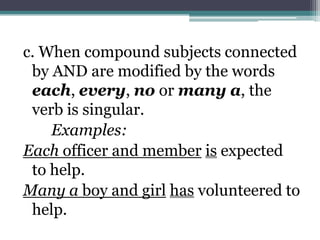
c. When compound subjects connected
 by AND are modified by the words
 each, every, no or many a, the
 verb is singular.
    Examples:
Each officer and member is expected
 to help.
Many a boy and girl has volunteered to
 help.
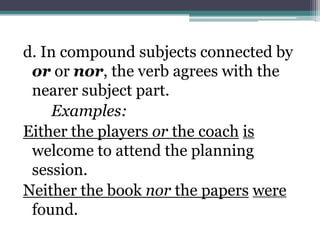
d. In compound subjects connected by
 or or nor, the verb agrees with the
 nearer subject part.
    Examples:
Either the players or the coach is
 welcome to attend the planning
 session.
Neither the book nor the papers were
 found.
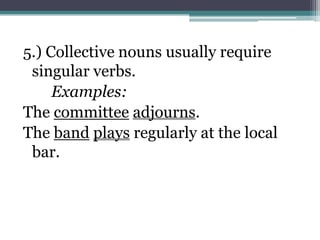
5.) Collective nouns usually require
 singular verbs.
     Examples:
The committee adjourns.
The band plays regularly at the local
 bar.
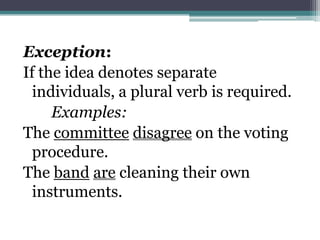
Exception:
If the idea denotes separate
  individuals, a plural verb is required.
     Examples:
The committee disagree on the voting
  procedure.
The band are cleaning their own
  instruments.
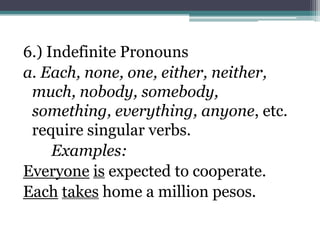
6.) Indefinite Pronouns
a. Each, none, one, either, neither,
 much, nobody, somebody,
 something, everything, anyone, etc.
 require singular verbs.
     Examples:
Everyone is expected to cooperate.
Each takes home a million pesos.
b. Both, few, several and some require
 plural verbs.
    Examples:
Many are called but few are chosen.
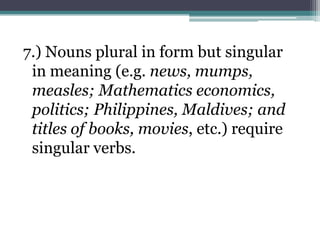
7.) Nouns plural in form but singular
 in meaning (e.g. news, mumps,
 measles; Mathematics economics,
 politics; Philippines, Maldives; and
 titles of books, movies, etc.) require
 singular verbs.
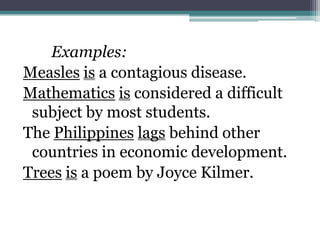
Examples:
Measles is a contagious disease.
Mathematics is considered a difficult
 subject by most students.
The Philippines lags behind other
 countries in economic development.
Trees is a poem by Joyce Kilmer.
8.) Some nouns are always plural (e.g.
 scissors, tweezers, pants, eyeglasses,
 etc.) and therefore require plural
 verbs.
    Examples:
The scissors are missing.
Your eyeglasses look good on you.
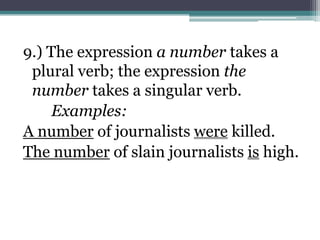
9.) The expression a number takes a
 plural verb; the expression the
 number takes a singular verb.
     Examples:
A number of journalists were killed.
The number of slain journalists is high.
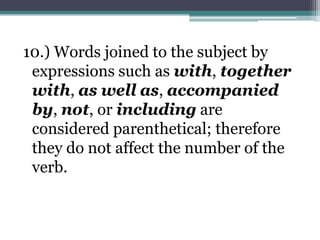
10.) Words joined to the subject by
 expressions such as with, together
 with, as well as, accompanied
 by, not, or including are
 considered parenthetical; therefore
 they do not affect the number of the
 verb.
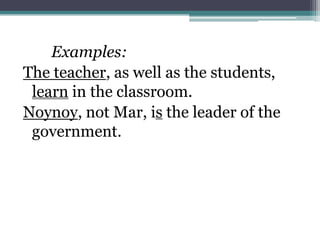
Examples:
The teacher, as well as the students,
 learn in the classroom.
Noynoy, not Mar, is the leader of the
 government.
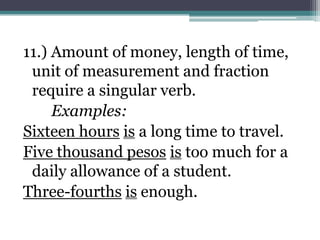
11.) Amount of money, length of time,
 unit of measurement and fraction
 require a singular verb.
     Examples:
Sixteen hours is a long time to travel.
Five thousand pesos is too much for a
 daily allowance of a student.
Three-fourths is enough.
12.) Fractions take a singular verb if
 the object of the OF-phrase that
 follows is singular; and a plural verb
 if the object of the OF-phrase is
 plural.
     Examples:
Half of the apples were rotten.
Half of the apple pie was eaten by you.
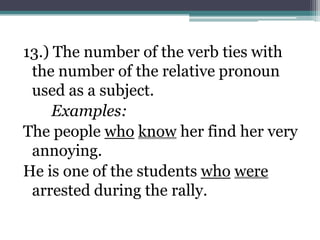
13.) The number of the verb ties with
 the number of the relative pronoun
 used as a subject.
     Examples:
The people who know her find her very
 annoying.
He is one of the students who were
 arrested during the rally.
REMEMBER:
The verb agrees with the subject, not
 the modifier, intervening phrase or
 predicate noun.
Examples:
The roots of the tree anchor it to the
 soil.
A five hundred peso-bill was found
 on the table.
My objection is the too many errors.
REMEMBER:
Sometimes, sentence might be
 grammatically correct but
 awkward.
    Examples:
Awkward: Either he or I am the
 first.
Better: Either he is the first or I am.
THE END

Subject verb agreement

  • 1.
    SUBJECT-VERB AGREEMENT English forSpecific Purposes Antonio Delgado, BSEd III
  • 2.
    As an additionalguide in brushing up on your grammar, keep in mind the following rules:
  • 3.
    1.) The generalrule is that singular subjects require singular verbs and plural subjects require plural verbs. Examples: Robinhood steals from the rich and helps the poor. The books are on the table.
  • 4.
    2.) The pronounsI and you take a plural verb. Examples: You are not alone. I sympathize with the prosecutor who covered his ears.
  • 5.
    Exception: I is usedwith am in the present tense and with was in the past tense. Examples: I am the leader of the group. I was surprised when she walked out of the room.
  • 6.
    3.) When thesentence begins with there, the verb must agree with the subject that follows. Examples: There are rice fields in Nueva Ecija. There is a boy waiting for you outside.
  • 7.
    4.) Compound Subjects a.Compound subjects connected by AND usually require a plural verb. Examples: The teacher and the student learn from each other. The director and the producer are present at the awards night.
  • 8.
    b. Compound subjectsconnected by AND but are considered a single unit or refer to the same person or thing require a singular verb. Examples: Peace and calm reigns over the country. The director and producer was present at the awards night.
  • 9.
    Note: When each partof the compound subject has a limiting word each, this indicates that they represent different persons or things and therefore the verb required is plural.
  • 10.
    c. When compoundsubjects connected by AND are modified by the words each, every, no or many a, the verb is singular. Examples: Each officer and member is expected to help. Many a boy and girl has volunteered to help.
  • 11.
    d. In compoundsubjects connected by or or nor, the verb agrees with the nearer subject part. Examples: Either the players or the coach is welcome to attend the planning session. Neither the book nor the papers were found.
  • 12.
    5.) Collective nounsusually require singular verbs. Examples: The committee adjourns. The band plays regularly at the local bar.
  • 13.
    Exception: If the ideadenotes separate individuals, a plural verb is required. Examples: The committee disagree on the voting procedure. The band are cleaning their own instruments.
  • 14.
    6.) Indefinite Pronouns a.Each, none, one, either, neither, much, nobody, somebody, something, everything, anyone, etc. require singular verbs. Examples: Everyone is expected to cooperate. Each takes home a million pesos.
  • 15.
    b. Both, few,several and some require plural verbs. Examples: Many are called but few are chosen.
  • 16.
    7.) Nouns pluralin form but singular in meaning (e.g. news, mumps, measles; Mathematics economics, politics; Philippines, Maldives; and titles of books, movies, etc.) require singular verbs.
  • 17.
    Examples: Measles is acontagious disease. Mathematics is considered a difficult subject by most students. The Philippines lags behind other countries in economic development. Trees is a poem by Joyce Kilmer.
  • 18.
    8.) Some nounsare always plural (e.g. scissors, tweezers, pants, eyeglasses, etc.) and therefore require plural verbs. Examples: The scissors are missing. Your eyeglasses look good on you.
  • 19.
    9.) The expressiona number takes a plural verb; the expression the number takes a singular verb. Examples: A number of journalists were killed. The number of slain journalists is high.
  • 20.
    10.) Words joinedto the subject by expressions such as with, together with, as well as, accompanied by, not, or including are considered parenthetical; therefore they do not affect the number of the verb.
  • 21.
    Examples: The teacher, aswell as the students, learn in the classroom. Noynoy, not Mar, is the leader of the government.
  • 22.
    11.) Amount ofmoney, length of time, unit of measurement and fraction require a singular verb. Examples: Sixteen hours is a long time to travel. Five thousand pesos is too much for a daily allowance of a student. Three-fourths is enough.
  • 23.
    12.) Fractions takea singular verb if the object of the OF-phrase that follows is singular; and a plural verb if the object of the OF-phrase is plural. Examples: Half of the apples were rotten. Half of the apple pie was eaten by you.
  • 24.
    13.) The numberof the verb ties with the number of the relative pronoun used as a subject. Examples: The people who know her find her very annoying. He is one of the students who were arrested during the rally.
  • 25.
    REMEMBER: The verb agreeswith the subject, not the modifier, intervening phrase or predicate noun. Examples: The roots of the tree anchor it to the soil. A five hundred peso-bill was found on the table. My objection is the too many errors.
  • 26.
    REMEMBER: Sometimes, sentence mightbe grammatically correct but awkward. Examples: Awkward: Either he or I am the first. Better: Either he is the first or I am.
  • 27.