Substance Abuse 
JOANNA ASARE 
WORKPLACE WELLNESS AND HEALTH PROMOTION STUDENT 
DECEMBER 11,2014
Objectives 
By the end of this webinar, you will be able to: 
• Understand what substance abuse is 
•Know the prevalence among students 
• Learn the main types of substances which students abuse 
•Understand the factors contributing to substance abuse/ why individuals may not get treatment 
•Identify signs and symptoms of substance abuse 
•Identify how substance abuse affects the brain 
• Identify the consequences of substance abuse 
•Differentiate between substance abuse and substance dependence 
•Know the types of medical treatments/resources to combat substance abuse
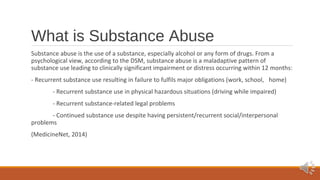
What is Substance Abuse 
Substance abuse is the use of a substance, especially alcohol or any form of drugs. From a 
psychological view, according to the DSM, substance abuse is a maladaptive pattern of 
substance use leading to clinically significant impairment or distress occurring within 12 months: 
- Recurrent substance use resulting in failure to fulfils major obligations (work, school, home) 
- Recurrent substance use in physical hazardous situations (driving while impaired) 
- Recurrent substance-related legal problems 
- Continued substance use despite having persistent/recurrent social/interpersonal 
problems 
(MedicineNet, 2014)
Stats on Substance Abuse 
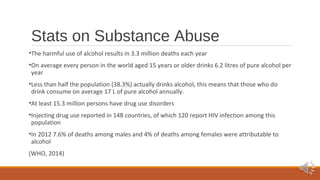
•The harmful use of alcohol results in 3.3 million deaths each year 
•On average every person in the world aged 15 years or older drinks 6.2 litres of pure alcohol per 
year 
•Less than half the population (38.3%) actually drinks alcohol, this means that those who do 
drink consume on average 17 L of pure alcohol annually. 
•At least 15.3 million persons have drug use disorders 
•Injecting drug use reported in 148 countries, of which 120 report HIV infection among this 
population 
•In 2012 7.6% of deaths among males and 4% of deaths among females were attributable to 
alcohol 
(WHO, 2014)
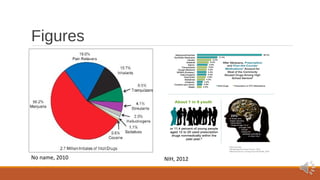
Figures 
No name, 2010 NIH, 2012
Type of Substances 
The main type of substances which people can abuse include: 
•Tobacco 
•Alcohol 
•Marijuana (grass) 
•Cocaine (crack) 
•Heroin (smack) 
•Methamphetamines (crystal meth) 
•Ecstasy (MDMA) 
•LSD (Acid) 
(WebMD, 2014)
True or False 
High School and College Students are 
experimenting with prescription 
medications 
True False
Incorrect, Try Again 
Back
You Are Correct 
According to 2010 National Survey on Drug Use and 
Health, the use of prescription drugs are on the rise 
for teenage/college students
Prevalence Among Students 
There is an increase spike in substance abuse in 
high school and college students including drug 
overdoses and binge drinking. According to the 
2010 National Survey on Drug Use and Health, 
marijuana and prescription drugs are the top 
two substances being used by students. 
(Drugwatch, 2014)
Substances Which Students Abuse 
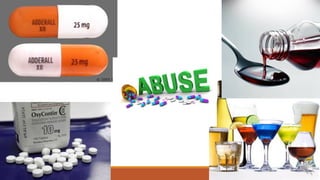
Adderall: “study drug”, used to treat ADHD. Students use it to increase their motivation, focus 
and motivation, especially during exams. Able to access this drug through people with ADHD, or 
doctors (mimic ADHD symptoms) 
Alcohol: binge drinking is commonly associated with alcohol, also mixed with energy drinks. 
Generally used in social settings 
Cold Medicine: over the counter medication is also abused since it easy to access and you do 
need a prescription for them. Some of the medications include: Tylenol Cold, Robitussin DM, 
and DayQuil 
OxyContin: widely pain reliever abused by students. Students take it since it is said that you 
become loose, but will not experience the hangover effect 
(Drugwatch, 2014)
Nine Lives- University of Western 
England
Discussion Questions 
Based on the video, think about the following questions? 
1. Why do you believe that high school/post-secondary students believe that 
they have “nine lives”? 
2. What other factors besides the ones mentioned in this video can lead to 
substance abuse in students? 
3. If you were in the situation of the girl who was asked to take drugs and saw 
the cat get killed, then resurrected, would you still partake in taking the drug, 
like the girl did?
Substance Abuse in the News 
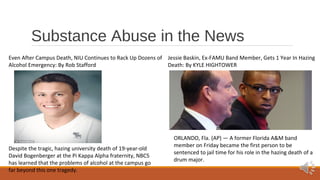
Even After Campus Death, NIU Continues to Rack Up Dozens of 
Alcohol Emergency: By Rob Stafford 
Jessie Baskin, Ex-FAMU Band Member, Gets 1 Year In Hazing 
Death: By KYLE HIGHTOWER 
ORLANDO, Fla. (AP) — A former Florida A&M band 
member on Friday became the first person to be 
sentenced to jail time for his role in the hazing death of a 
drum major. 
Despite the tragic, hazing university death of 19-year-old 
David Bogenberger at the Pi Kappa Alpha fraternity, NBC5 
has learned that the problems of alcohol at the campus go 
far beyond this one tragedy.
Factors Influencing Substance 
Abuse 
Some of the factors which influences substance abuse are: 
• Genes (family history of abuse) 
•Poor social coping skills 
•Poor school performance 
•Associating with a bad crowd/group 
•Aggressive behavior 
•Chaotic home environment 
(WebMD, 2014)
Causes of Substance Abuse & 
Addiction | Addictions- Howcast.com
Signs and Symptoms 
Some of the signs and symptoms of substance abuse include: 
•Declining grades 
•Aggressiveness and irritability 
•Forgetfulness 
•Disappearing money or valuables 
•Feeling rundown, hopeless, depressed, or even suicidal 
•Getting drunk or high on drugs on a regular basis 
•Lying, particularly about how much alcohol or other drugs he or she is using 
•Avoiding friends or family in order to get drunk or high 
•Planning drinking in advance, hiding alcohol, drinking or using other drugs alone
Signs and Symptoms (Cont’d) 
•Having to drink more to get the same high 
•Believing that in order to have fun you need to drink or use other drugs 
•Frequent hangovers 
•Pressuring others to drink or use other drugs 
•Taking risks, including sexual risks 
•Having "blackouts“ 
•Constantly talking about drinking or using other drugs 
•Getting in trouble with the law 
•Drinking and driving 
(WebMD, 2014)
Substance Dependence 
Substance dependence is the sudden or gradual dependence of a substance, 
which leads to physical and psychological distress if stopped or decrease. The 
two types of dependence are psychological and physical. 
- Psychological: emotional and mental response to the stoppage or 
decrease in substance use ( anxiety, uneasiness and depression) 
- Physical: occurs when the body reacts to the stoppage or 
decrease in substance use(pain, convulsions, trembles) 
- Polysubstance: occurs when a person takes several substances 
(cigarettes with alcohol, cocaine with heroin). Not part of 
dependence, but can pose serious health risks 
(Anoymous, n.d.)
Consequences 
• Organ damage 
• HIV and AIDS 
• Depression 
• Anxiety 
• Memory loss 
• Aggression 
• Risk for arrest and probation 
• Large fines 
• Extensive jail time 
• Job loss 
• Negative relationships 
(Summithelps, 2014)
Substance Abuse and the Brain 
Some drugs can mimic some of the brain’s 
neurotransmitters 
◦-Marijuana/ Heroin: fool the brain receptors to send abnormal messages 
◦Cocaine/Meth: release a neurotransmitter (dopamine) 
◦Affects motivation, emotions, and feelings 
◦Long-term effects can affect other neurotransmitters in the brain 
- Glutamate: affect learning 
- Lead to poor judgment, decision-making, learning, memory and 
behavioral changes 
(NIH, 2012)
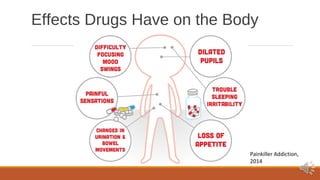
Effects Drugs Have on the Body 
Painkiller Addiction, 
2014
When to Seek Medical Treatment 
If you suspect someone with substance abuse and they experience any of the following 
symptoms, call a doctor or take them to the emergency room: 
•Seizures 
•Jaundice (yellowing of skin and eyes) 
•Leg swelling 
•Cough that will not go away 
•Fever 
•Chest pains 
•Abdominal pain 
•Severe tremors 
•(WebMD, 2014)
Resources/Treatments 
• Behavioral Treatment: how to cope with the substance abuse (Rehab) 
•Treating mental illness if needed- counselling 
•Nicotine patches/ Methadone 
•Prevention 
(WebMD, 2014) 
Websites: Drug and Alcohol Helpline: www.drugandalcoholhelpline.ca/ 
CAMH: 
camh.ca/Care_Treatment/Resources_clients.../treat_young_people.html 
Teen Challenge: www.teenchallenge.ca › Get Help
Saboteurs Against Treatment 
Though many individual do get help if they are suffering from 
substance abuse, some individuals do not. Think of the following: 
- Internal Saboteurs 
- External Saboteurs 
Why do these saboteurs have a huge impact on individuals not 
seeking help? 
What resources would you recommend to prevent these saboteurs 
from occurring?
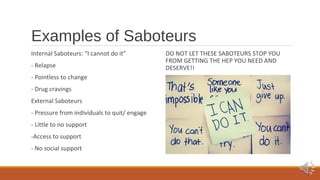
Examples of Saboteurs 
Internal Saboteurs: “I cannot do it” 
- Relapse 
- Pointless to change 
- Drug cravings 
External Saboteurs 
- Pressure from individuals to quit/ engage 
- Little to no support 
-Access to support 
- No social support 
DO NOT LET THESE SABOTEURS STOP YOU 
FROM GETTING THE HEP YOU NEED AND 
DESERVE!!
83 Percent of Students Admit to 
Drug Abuse- KTN Kenya
Discussion Questions 
Based on the video you just watch, think about the following questions: 
1. Do you believe that using drug enforcement dogs will help to combat drug 
usage in students? 
2. Are there any other reasons, besides the ones stated in this video to why 
students start using drugs? 
3. What other resources could you use to combat substance abuse among 
students?
Quiz Time
Question 1 
What is the most common use drug in Canada? 
A. Heroin 
B. Cocaine 
C. Alcohol 
D. Marijuana
Question 2 
Name the three most commonly used drugs by teenagers 
A. Alcohol, tobacco, and marijuana 
B. Alcohol, amphetamines, and marijuana 
C. Amphetamines, tobacco, and marijuana 
D. LSD, tobacco, and marijuana
Question 3 
Crack is a particularly dangerous drug because it is: 
A. Cheap 
B. Readily available 
C. Highly addictive 
D. All of the above
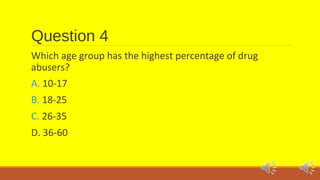
Question 4 
Which age group has the highest percentage of drug 
abusers? 
A. 10-17 
B. 18-25 
C. 26-35 
D. 36-60
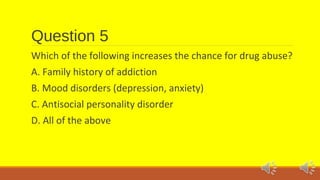
Question 5 
Which of the following increases the chance for drug abuse? 
A. Family history of addiction 
B. Mood disorders (depression, anxiety) 
C. Antisocial personality disorder 
D. All of the above
Incorrect, Try Again 
Back
Incorrect, Try Again 
Back
Incorrect, Try Again 
Back
Incorrect, Try Again 
Back
Incorrect, Try Again 
Back
You Are Correct 
Alcohol is the most common substance 
abused since it is the easiest one to get 
Next
You Are Correct 
Alcohol, tobacco, and marijuana. These three 
drugs are known as "gateway drugs" because 
they are generally the first drugs that 
teenagers are exposed to 
Next
You Are Correct 
All of the answers are correct. Small 
quantities of crack can be bought for as little 
as $5.00. The low price makes it easily 
affordable to young adults. In addition, crack 
is thought to be one of the most addictive 
drugs
You Are Correct 
18-25 is has the highest age range of 
substance abuse 
Next
You Are Correct 
Family History, Mood Disorders, and Antisocial 
personality are all factors which could lead to 
substance abuse 
Next
After this webinar 
You should now be aware of: 
•What substance abuse is 
•The prevalence among students 
• The main types of substances which students abuse 
•The factors contributing to substance abuse/ prevent individuals from getting treatments 
•Identify signs and symptoms of substance abuse 
•How substance abuse affects the brain 
• Identify the consequences of substance abuse 
•Differentiate between substance abuse and substance dependence 
•The types of medical treatments/resources to combat substance abuse
Online Quizzes 
What Do You Know About Drug Abuse? 
http://healthcare.utah.edu/healthlibrary/related/doc.php?type=40&id=DrugAbuseQuiz 
National Drug IQ Challenge 
http://teens.drugabuse.gov/quiz/national-drug-facts-week/take-iq-challenge/2014
Resources: Drugs: Shatter the 
Myths 
http://drugfactsweek.drugabuse.gov/files/teenbrochure_508.pdf 
This pdf talks about the myths about drugs and the effects it 
has on the body. It also talks about the consequences of 
taking these drugs.
Hope You Enjoy 
The Webinar 
Have A Wonderful Day

Substance abuse

  • 1.
    Substance Abuse JOANNAASARE WORKPLACE WELLNESS AND HEALTH PROMOTION STUDENT DECEMBER 11,2014
  • 2.
    Objectives By theend of this webinar, you will be able to: • Understand what substance abuse is •Know the prevalence among students • Learn the main types of substances which students abuse •Understand the factors contributing to substance abuse/ why individuals may not get treatment •Identify signs and symptoms of substance abuse •Identify how substance abuse affects the brain • Identify the consequences of substance abuse •Differentiate between substance abuse and substance dependence •Know the types of medical treatments/resources to combat substance abuse
  • 3.
    What is SubstanceAbuse Substance abuse is the use of a substance, especially alcohol or any form of drugs. From a psychological view, according to the DSM, substance abuse is a maladaptive pattern of substance use leading to clinically significant impairment or distress occurring within 12 months: - Recurrent substance use resulting in failure to fulfils major obligations (work, school, home) - Recurrent substance use in physical hazardous situations (driving while impaired) - Recurrent substance-related legal problems - Continued substance use despite having persistent/recurrent social/interpersonal problems (MedicineNet, 2014)
  • 4.
    Stats on SubstanceAbuse •The harmful use of alcohol results in 3.3 million deaths each year •On average every person in the world aged 15 years or older drinks 6.2 litres of pure alcohol per year •Less than half the population (38.3%) actually drinks alcohol, this means that those who do drink consume on average 17 L of pure alcohol annually. •At least 15.3 million persons have drug use disorders •Injecting drug use reported in 148 countries, of which 120 report HIV infection among this population •In 2012 7.6% of deaths among males and 4% of deaths among females were attributable to alcohol (WHO, 2014)
  • 5.
    Figures No name,2010 NIH, 2012
  • 6.
    Type of Substances The main type of substances which people can abuse include: •Tobacco •Alcohol •Marijuana (grass) •Cocaine (crack) •Heroin (smack) •Methamphetamines (crystal meth) •Ecstasy (MDMA) •LSD (Acid) (WebMD, 2014)
  • 7.
    True or False High School and College Students are experimenting with prescription medications True False
  • 8.
  • 9.
    You Are Correct According to 2010 National Survey on Drug Use and Health, the use of prescription drugs are on the rise for teenage/college students
  • 10.
    Prevalence Among Students There is an increase spike in substance abuse in high school and college students including drug overdoses and binge drinking. According to the 2010 National Survey on Drug Use and Health, marijuana and prescription drugs are the top two substances being used by students. (Drugwatch, 2014)
  • 12.
    Substances Which StudentsAbuse Adderall: “study drug”, used to treat ADHD. Students use it to increase their motivation, focus and motivation, especially during exams. Able to access this drug through people with ADHD, or doctors (mimic ADHD symptoms) Alcohol: binge drinking is commonly associated with alcohol, also mixed with energy drinks. Generally used in social settings Cold Medicine: over the counter medication is also abused since it easy to access and you do need a prescription for them. Some of the medications include: Tylenol Cold, Robitussin DM, and DayQuil OxyContin: widely pain reliever abused by students. Students take it since it is said that you become loose, but will not experience the hangover effect (Drugwatch, 2014)
  • 14.
    Nine Lives- Universityof Western England
  • 15.
    Discussion Questions Basedon the video, think about the following questions? 1. Why do you believe that high school/post-secondary students believe that they have “nine lives”? 2. What other factors besides the ones mentioned in this video can lead to substance abuse in students? 3. If you were in the situation of the girl who was asked to take drugs and saw the cat get killed, then resurrected, would you still partake in taking the drug, like the girl did?
  • 16.
    Substance Abuse inthe News Even After Campus Death, NIU Continues to Rack Up Dozens of Alcohol Emergency: By Rob Stafford Jessie Baskin, Ex-FAMU Band Member, Gets 1 Year In Hazing Death: By KYLE HIGHTOWER ORLANDO, Fla. (AP) — A former Florida A&M band member on Friday became the first person to be sentenced to jail time for his role in the hazing death of a drum major. Despite the tragic, hazing university death of 19-year-old David Bogenberger at the Pi Kappa Alpha fraternity, NBC5 has learned that the problems of alcohol at the campus go far beyond this one tragedy.
  • 17.
    Factors Influencing Substance Abuse Some of the factors which influences substance abuse are: • Genes (family history of abuse) •Poor social coping skills •Poor school performance •Associating with a bad crowd/group •Aggressive behavior •Chaotic home environment (WebMD, 2014)
  • 18.
    Causes of SubstanceAbuse & Addiction | Addictions- Howcast.com
  • 19.
    Signs and Symptoms Some of the signs and symptoms of substance abuse include: •Declining grades •Aggressiveness and irritability •Forgetfulness •Disappearing money or valuables •Feeling rundown, hopeless, depressed, or even suicidal •Getting drunk or high on drugs on a regular basis •Lying, particularly about how much alcohol or other drugs he or she is using •Avoiding friends or family in order to get drunk or high •Planning drinking in advance, hiding alcohol, drinking or using other drugs alone
  • 20.
    Signs and Symptoms(Cont’d) •Having to drink more to get the same high •Believing that in order to have fun you need to drink or use other drugs •Frequent hangovers •Pressuring others to drink or use other drugs •Taking risks, including sexual risks •Having "blackouts“ •Constantly talking about drinking or using other drugs •Getting in trouble with the law •Drinking and driving (WebMD, 2014)
  • 21.
    Substance Dependence Substancedependence is the sudden or gradual dependence of a substance, which leads to physical and psychological distress if stopped or decrease. The two types of dependence are psychological and physical. - Psychological: emotional and mental response to the stoppage or decrease in substance use ( anxiety, uneasiness and depression) - Physical: occurs when the body reacts to the stoppage or decrease in substance use(pain, convulsions, trembles) - Polysubstance: occurs when a person takes several substances (cigarettes with alcohol, cocaine with heroin). Not part of dependence, but can pose serious health risks (Anoymous, n.d.)
  • 22.
    Consequences • Organdamage • HIV and AIDS • Depression • Anxiety • Memory loss • Aggression • Risk for arrest and probation • Large fines • Extensive jail time • Job loss • Negative relationships (Summithelps, 2014)
  • 23.
    Substance Abuse andthe Brain Some drugs can mimic some of the brain’s neurotransmitters ◦-Marijuana/ Heroin: fool the brain receptors to send abnormal messages ◦Cocaine/Meth: release a neurotransmitter (dopamine) ◦Affects motivation, emotions, and feelings ◦Long-term effects can affect other neurotransmitters in the brain - Glutamate: affect learning - Lead to poor judgment, decision-making, learning, memory and behavioral changes (NIH, 2012)
  • 24.
    Effects Drugs Haveon the Body Painkiller Addiction, 2014
  • 25.
    When to SeekMedical Treatment If you suspect someone with substance abuse and they experience any of the following symptoms, call a doctor or take them to the emergency room: •Seizures •Jaundice (yellowing of skin and eyes) •Leg swelling •Cough that will not go away •Fever •Chest pains •Abdominal pain •Severe tremors •(WebMD, 2014)
  • 26.
    Resources/Treatments • BehavioralTreatment: how to cope with the substance abuse (Rehab) •Treating mental illness if needed- counselling •Nicotine patches/ Methadone •Prevention (WebMD, 2014) Websites: Drug and Alcohol Helpline: www.drugandalcoholhelpline.ca/ CAMH: camh.ca/Care_Treatment/Resources_clients.../treat_young_people.html Teen Challenge: www.teenchallenge.ca › Get Help
  • 27.
    Saboteurs Against Treatment Though many individual do get help if they are suffering from substance abuse, some individuals do not. Think of the following: - Internal Saboteurs - External Saboteurs Why do these saboteurs have a huge impact on individuals not seeking help? What resources would you recommend to prevent these saboteurs from occurring?
  • 28.
    Examples of Saboteurs Internal Saboteurs: “I cannot do it” - Relapse - Pointless to change - Drug cravings External Saboteurs - Pressure from individuals to quit/ engage - Little to no support -Access to support - No social support DO NOT LET THESE SABOTEURS STOP YOU FROM GETTING THE HEP YOU NEED AND DESERVE!!
  • 29.
    83 Percent ofStudents Admit to Drug Abuse- KTN Kenya
  • 30.
    Discussion Questions Basedon the video you just watch, think about the following questions: 1. Do you believe that using drug enforcement dogs will help to combat drug usage in students? 2. Are there any other reasons, besides the ones stated in this video to why students start using drugs? 3. What other resources could you use to combat substance abuse among students?
  • 31.
  • 32.
    Question 1 Whatis the most common use drug in Canada? A. Heroin B. Cocaine C. Alcohol D. Marijuana
  • 33.
    Question 2 Namethe three most commonly used drugs by teenagers A. Alcohol, tobacco, and marijuana B. Alcohol, amphetamines, and marijuana C. Amphetamines, tobacco, and marijuana D. LSD, tobacco, and marijuana
  • 34.
    Question 3 Crackis a particularly dangerous drug because it is: A. Cheap B. Readily available C. Highly addictive D. All of the above
  • 35.
    Question 4 Whichage group has the highest percentage of drug abusers? A. 10-17 B. 18-25 C. 26-35 D. 36-60
  • 36.
    Question 5 Whichof the following increases the chance for drug abuse? A. Family history of addiction B. Mood disorders (depression, anxiety) C. Antisocial personality disorder D. All of the above
  • 37.
  • 38.
  • 39.
  • 40.
  • 41.
  • 42.
    You Are Correct Alcohol is the most common substance abused since it is the easiest one to get Next
  • 43.
    You Are Correct Alcohol, tobacco, and marijuana. These three drugs are known as "gateway drugs" because they are generally the first drugs that teenagers are exposed to Next
  • 44.
    You Are Correct All of the answers are correct. Small quantities of crack can be bought for as little as $5.00. The low price makes it easily affordable to young adults. In addition, crack is thought to be one of the most addictive drugs
  • 45.
    You Are Correct 18-25 is has the highest age range of substance abuse Next
  • 46.
    You Are Correct Family History, Mood Disorders, and Antisocial personality are all factors which could lead to substance abuse Next
  • 47.
    After this webinar You should now be aware of: •What substance abuse is •The prevalence among students • The main types of substances which students abuse •The factors contributing to substance abuse/ prevent individuals from getting treatments •Identify signs and symptoms of substance abuse •How substance abuse affects the brain • Identify the consequences of substance abuse •Differentiate between substance abuse and substance dependence •The types of medical treatments/resources to combat substance abuse
  • 48.
    Online Quizzes WhatDo You Know About Drug Abuse? http://healthcare.utah.edu/healthlibrary/related/doc.php?type=40&id=DrugAbuseQuiz National Drug IQ Challenge http://teens.drugabuse.gov/quiz/national-drug-facts-week/take-iq-challenge/2014
  • 49.
    Resources: Drugs: Shatterthe Myths http://drugfactsweek.drugabuse.gov/files/teenbrochure_508.pdf This pdf talks about the myths about drugs and the effects it has on the body. It also talks about the consequences of taking these drugs.
  • 50.
    Hope You Enjoy The Webinar Have A Wonderful Day