Substance-Related
Disorders
Done By

Jaber Manasia
5th year medical student
SUBSTANCE ABUSE
• Substance abuse is significant problem for
the society and healthcare system all over
the world .
• Substance abuse is a patterned use of a
substance (drug) in which the user consumes
the substance in amounts or with methods
neither approved nor supervised by medical
professionals
SUBSTANCE ABUSE
DIAGNOSIS AND DSM-IV CRITERIA
Abuse is a pattern of substance use leading to impairment
or distress for at least 1 year with one or more of the
following manifestations :
1. Failure to fulfill obligations at work, school, or home
2. Use in dangerous situations (i.e., driving a car)
3. Recurrent substance-related legal problems
4. Continued use despite social or interpersonal problems
due to the substance use
SUBSTANCE DEPENDENCE
Dependence refers to the state of
needing a drug(s) or substance(s) to
function within normal .
SUBSTANCE DEPENDENCE
DIAGNOSIS AND DSM-IV CRITERIA
Dependence is substance use leading to impairment or
distress manifested by at least three of the following within a
12-month period :
1. Tolerance
2. Withdrawal
3. Using substance more than originally intended
4. Persistent desire or unsuccessful efforts to cut down on use
5. Significant time spent in getting, using, or recovering from
substance
6. Decreased social, occupational, or recreational activities
because of substance use
7. Continued use despite subsequent physical or psychological
problem (e.g., drinking despite worsening liver problems)
Cont …
• Psychological dependence:
Crave for taking the drug or substance is
progressive :
need → mild desire → craving → compulsion.
• Physical dependence
It is adaptation at the cellular level to drugs such
that when the drug is abruptly stopped , there is
a characteristic withdrawal or abstinence
syndrome
Cont …
A diagnosis of substance
dependence supersedes a
diagnosis of substance abuse.
Cont …
Withdrawal
The development of a substance-specific
syndrome due to the cessation of
substance use that has been heavy and
prolonged
Tolerance
The need for increased amounts of the
substance to achieve the desired effect
or diminished effect if using the same
amount of the substance
EPIDEMIOLOGY
• Lifetime prevalence of substance abuse or
dependence in the United States:
Approximately 17%
• More common in men than women
• Caffeine, alcohol, and nicotine are the most
commonly used substances.
• Depressive symptoms are common among
persons with substance abuse or
dependence.
Categories of drugs
of abuse

• Stimulants e.g. amphetamine, cocaine .
• Depressants e.g. benzodiazepines ,
barbiturates, alcohol, GHB.
• Opiates e.g. heroin, methadone, codeine,
buprenorphine , pethidine.
• Hallucinogens e.g. LSD, PCP, mushrooms,
ketamine.
• Others e.g. cannabis, volatile substances,
nicotin.
Stimulants
• These drugs potentiate neuro-transmission and
increase cortical excitability producing effects of
increased alertness and endurance, diminished
need for sleep, and a subjective sense of wellbeing.
• Include cocaine (and crack cocaine),
amphetamines, MDMA or (ecstasy), and
caffeine.
COCAINE
Cocaine blocks dopamine reuptake from the
synaptic cleft, causing a stimulant effect.
Dopamine plays a role in behavioral
reinforcement (“reward” system of the
brain).
Cocaine Intoxication
CLINICAL PRESENTATION
Cocaine intoxication often produces
euphoria, increased or decreased blood
pressure, tachycardia or bradycardia,
nausea, dilated pupils, weight loss,
psychomotor agitation or depression,
chills, and sweating.
It may also cause respiratory depression,
seizures, arrhythmias, and hallucinations
(especially tactile).
Cont …
Since cocaine is an indirect sympathomimetic,
intoxication mimics the fight-or-flight response.
• Cocaine’s vasoconstrictive effect may result in
myocardial infarction (MI) or cerebrovascular
accident (CVA).
• Chronic harmful effects include necrosis of nasal
septum, foetal damage, panic and anxiety disorders,
persecutory delusions, and psychosis.
• No tolerance.
• No physical dependence.
Cont …
DIFFERENTIAL DIAGNOSIS
Amphetamine or phencyclidine (PCP)
intoxication, sedative withdrawal
DIAGNOSTIC EVALUATION
Urine drug screen (positive for 3 days,
longer in heavy users)
TREATMENT
Intoxication
1. For mild-to-moderate agitation: Benzodiazepines
2. For severe agitation or psychosis: Haloperidol
3. Symptomatic support (i.e., control hypertension,
arrhythmias)
Dependence
1. Psychotherapy, group therapy
2. Tricyclic antidepressants (TCAs)
3. Dopamine agonists (amantadine, bromocriptine)
Cocaine Withdrawal
Abrupt abstinence is not life threatening but
produces a dysphoric “crash”: malaise, fatigue,
depression, hunger, constricted pupils, vivid
dreams, psychomotor agitation or retardation .
TREATMENT
Usually supportive—let patient sleep off crash.
AMPHETAMINES
Classic amphetamines: Dextroamphetamine (Dexedrine),
methylphenidate (Ritalin), methamphetamine (Desoxyn, ice,
speed, “crystal meth,”“crack”)
Substituted (“designer”) amphetamines: MDMA (ecstasy),
MDEA (eve)
Classic amphetamines release dopamine from nerve endings,
causing a stimulant effect. They are used medically in the
treatment of narcolepsy, attention deficit hyperactivity
disorder (ADHD), and depressive disorders.
Designer amphetamines release dopamine and serotonin
from nerve endings and have both stimulant and
hallucinogenic properties.
Amphetamine Intoxication
CLINICAL PRESENTATION
Amphetamine intoxication causes symptoms
similar to those of cocaine.
DIFFERENTIAL DIAGNOSIS
Cocaine or PCP intoxication. Chronic use in
high doses may cause a psychotic state
that is similar to schizophrenia.
Cont …
DIAGNOSTIC EVALUATION
Urine drug screen (positive for 1 to 2 days). A negative
routine drug screen does not rule out amphetamine use,
since most assays are not of adequate sensitivity.A
negative drug screen can never completely rule out
substance abuse or dependence.
TREATMENT
Similar to cocaine
Amphetamine Withdrawal
Similar to cocaine withdrawal
SEDATIVES-HYPNOTICS
• Drugs of this group produce their effects by
generalised or specific cortical depression.
• They include the benzodiazepines, alcohol, and
the barbiturates.
• They are taken for their anxiolytic and relaxant
properties alone, or as a way of counteracting
unpleasant side-effects of other drugs of abuse.
• These drugs are highly abused in the United
States since they are more readily available than
other drugs such as cocaine or opioids.
SEDATIVES-HYPNOTICS
Benzodiazepines (BDZs) are commonly used in the
treatment of anxiety disorders and are therefore
obtained easily via prescription. They potentiate the
effects of GABA by increasing the frequency of
chloride channel opening.
Barbiturates are used in the treatment of epilepsy
and as anesthetics, and they potentiate the effects
of GABA by increasing the duration of chloride
channel opening. At high doses they act as direct
GABA agonists and have a lower margin of safety
relative to BDZs.
Cont …
In combination BDZs and barbiturates are
synergistic due to their complementary
effect on GABA channel opening.
Respiratory depression can occur as a
complication.
Cont ..
Sedative-Hypnotic Intoxication
• Intoxication with sedatives produces drowsiness,
slurred speech, incoordination, ataxia, mood lability,
impaired judgment, nystagmus, respiratory
depression, and coma or death in overdose
(especially barbiturates). Symptoms are augmented
when combined with EtOH.
•

Long-term sedative use causes dependence.

• Tolerance develops rapidly (with cross tolerance to all
drugs in the benzodiazepine group & with
barbiturates), so requiring increasing doses to achieve
similar effects.
Cont …
DIFFERENTIAL DIAGNOSIS
Alcohol intoxication, generalized cerebral
dysfunction (i.e., delirium)
DIAGNOSTIC EVALUATION
Urine or serum drug screen (positive for 1
week), electrolytes, electrocardiogram
Cont …
TREATMENT
•
•

Maintain airway, breathing, and circulation.
Activated charcoal to prevent further gastrointestinal
absorption
• For barbiturates only: Alkalinize urine with sodium
bicarbonate to promote renal excretion.
• For benzodiazepines only: Flumazenil in overdose
• Supportive care—improve respiratory status, control
hypotension
Cont …
Sedative-Hypnotic Withdrawal
Abrupt abstinence after chronic use can be life threatening.
While physiological dependence is more likely with shortacting agents, longer-acting agents can also cause withdrawal
symptoms.
CLINICAL PRESENTATION
Symptoms of autonomic hyperactivity (tachycardia, sweating,
etc.), insomnia, anxiety, tremor, nausea/vomiting, delirium,
and hallucinations. Seizures may occur and can be life
threatening.
TREATMENT
Administration of a long-acting benzodiazepine such as
chlorodiazepoxide or diazepam, with tapering of the dose
Tegretol or valproic acid may be used for seizure control.
OPIATES
Examples: Heroin, codeine, dextromethorphan,
morphine, methadone, meperidine (Demerol).
These compounds stimulate opiate receptors
(mu , kappa, and delta), which are normally
stimulated by endogenous opiates and are
involved in analgesia, sedation, and
dependence. Opiates also have effects on the
dopaminergic system, which mediates their
addictive and rewarding properties. Endorphins
and enkephalins are endogenous opiates.
Cont …
Opiate Intoxication
Opiate intoxication causes drowsiness, nausea/vomiting, constipation,
slurred speech, constricted pupils, seizures, and respiratory
depression, which may progress to coma or death in overdose.
Meperidine and monoamine oxidase inhibitors taken in combination
may cause the serotonin syndrome: Hyperthermia, confusion,
hyper- or hypotension, and muscular rigidity.
DIFFERENTIAL DIAGNOSIS
Sedative-hypnotic intoxication, severe EtOH intoxication
DIAGNOSTIC EVALUATION
Rapid recovery of consciousness following the administration of
intravenous (IV) naloxone (opiate antagonist) is consistent with
opiate overdose. Urine and blood tests remain positive for 12 to 36
hours.
TREATMENT
Intoxication
Ensure adequate airway, breathing, and circulation.
Overdose
Administration of naloxone or naltrexone (opiate antagonists) will
improve respiratory depression but may cause severe
withdrawal in an opiate-dependent patient. Ventilatory support
may be required.
Dependence
Oral methadone once daily, tapered over months to years
Psychotherapy, support groups (Narcotics Anonymous, etc.)
Opiate Withdrawal
CLINICAL PRESENTATION
While not life threatening, abstinence in the opiatedependent individual leads to an unpleasant withdrawal
syndrome characterized by dysphoria, insomnia,
lacrimation, rhinorrhea, yawning, weakness, sweating,
piloerection, nausea/vomiting, fever, dilated pupils, and
muscle ache.
TREATMENT
Moderate symptoms: Clonidine and/or buprenorphine
Severe symptoms: Detox with methadone tapered over 7
days.
HALLUCINOGENS
• Hallucinogens (or psychedelics) are a
heterogeneous group of natural and synthetic
substances which produce altered sensory and
perceptual experiences.
• They include: lysergic acid diethylamide (LSD),
phenylcyclidine (PCP), ketamine, mescaline and
dimethyltriptamine (DMT).
HALLUCINOGENS
Pharmacological effects vary, but LSD is
known to act on the serotonergic system.
Tolerance to hallucinogens develops
quickly but reverses rapidly after
cessation. Hallucinogens do not cause
physical dependence or withdrawal.
Cont …
Hallucinogen Intoxication
Hallucinogens cause perceptual changes,
papillary dilation, tachycardia, tremors,
incoordination, sweating, and palpitations.
TREATMENT
Guidance and reassurance (“talking down”
the patient) are usually enough. In severe
cases, antipsychotics or benzodiazepines
may be used.
Cont …
Hallucinogen Withdrawal
No withdrawal syndrome is produced, but
patients may experience “flashbacks” later
in life (recurrence of symptoms due to
reabsorption from lipid stores).
PHENCYCLIDINE (PCP)
PCP, or “angel dust,” is a hallucinogen that
antagonizes N-methyl-D-aspartate
(NMDA) glutamate receptors and activates
dopaminergic neurons.
Ketamine is similar to PCP. Both were
developed as anesthetic agents.
Cont …
PCP Intoxication
Intoxication with PCP causes recklessness,
impulsiveness, impaired judgment, assaultiveness,
rotatory nystagmus, ataxia, hypertension,
tachycardia, muscle rigidity, and high tolerance to
pain. Overdose can cause seizures or coma.
Cont …
TREATMENT
• Monitor blood pressure, temperature, and
electrolytes.
• Acidify urine with ammonium chloride and ascorbic
acid.
• Benzodiazepines or dopamine antagonists to
control agitation and anxiety
• Diazepam for muscle spasms and seizures
• Haloperidol to control severe agitation or psychotic
symptoms
Cont …
DIFFERENTIAL DIAGNOSIS
Acute psychotic states, schizophrenia
DIAGNOSTIC EVALUATION
Urine drug screen (positive for > 1 week). Creatine
phosphokinase (CPK) and aspartate
aminotransferase (AST) are often elevated.
PCP Withdrawal
No withdrawal syndrome, but “flashbacks” may
occur
MARIJUANA
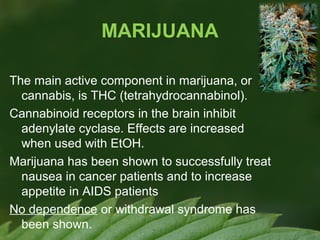
The main active component in marijuana, or
cannabis, is THC (tetrahydrocannabinol).
Cannabinoid receptors in the brain inhibit
adenylate cyclase. Effects are increased
when used with EtOH.
Marijuana has been shown to successfully treat
nausea in cancer patients and to increase
appetite in AIDS patients
No dependence or withdrawal syndrome has
been shown.
Marijuana Intoxication
Marijuana causes euphoria, impaired coordination, mild
tachycardia, conjunctival injection, dry mouth, and
increased appetite.
Marijuana can be smoked or eaten.
TREATMENT
Supportive and symptomatic
DIAGNOSTIC EVALUATION
Urine drug screen is positive for up to 4 weeks in heavy
users (released from adipose stores).
Marijuana Withdrawal
CLINICAL PRESENTATION
No withdrawal syndrome, but mild irritability,
insomnia, nausea, and decreased appetite
may occur in heavy users.
TREATMENT
Supportive and symptomatic
INHALANTS
Examples: Solvents, glue, paint thinners, fuels, isobutyl
nitrates (“rush,” “locker room,” “bolt”). Inhalants generally
act as CNS depressants. User is typically an adolescent
male.
Inhalant Intoxication
Inhalants may cause impaired judgment, belligerence,
impulsivity, perceptual disturbances, lethargy, dizziness,
nystagmus, tremor, muscle weakness, hyporeflexia, ataxia,
slurred speech, euphoria, stupor, or coma. Overdose may
be fatal secondary to respiratory depression or
arrhythmias. Long-term use may cause permanent
damage to CNS, peripheral nervous system (PNS), liver,
kidney,and muscle.
TREATMENT
• Monitor airway, breathing, and circulation.
• Symptomatic treatment as needed
• Psychotherapy and counseling for dependent patients
DIAGNOSTIC EVALUATION
Serum drug screen (positive for 4 to 10 hours)

Inhalant Withdrawal
A withdrawal syndrome does not usually occur, but
symptoms may include irritability, nausea, vomiting,
tachycardia, and occasionally hallucinations.
CAFFEINE
Caffeine is the most commonly used
psychoactive substance in the United
States, usually in the form of coffee or tea.
Caffeine acts as an adenosine antagonist,
causing increased cyclic adenosine
monophosphate (cAMP) and a stimulant
effect via the dopaminergic system.
Caffeine Intoxication
CLINICAL PRESENTATION
Intoxication may occur with consumption of over 250
mg of caffeine. Signs and symptoms include
anxiety, insomnia, twitching, rambling speech,
flushed face, diuresis, gastrointestinal disturbance,
and restlessness. Consumption of more than 1
gram of caffeine may cause tinnitus, severe
agitation, and cardiac arrhythmias. In excess of 10
g, death may occur secondary to seizures and
respiratory failure.
TREATMENT
Supportive and symptomatic
Cont …
Caffeine Withdrawal
Withdrawal symptoms resolve within 1 week and
include headache, nausea/vomiting, drowsiness,
anxiety, or depression.
TREATMENT
Taper consumption of caffeine-containing
products. Use analgesics to treat headaches.
Rarely, a short course of benzodiazepines may
be indicated to control anxiety.
NICOTINE
Nicotine is derived from the tobacco plant and
stimulates nicotinic receptors in autonomic
ganglia of the sympathetic and parasympathetic
nervous systems.
Cigarette smoking poses many health risks, and
nicotine is rapidly addictive through its effects on
the dopaminergic system.
Cont …
Nicotine Intoxication
Nicotine acts as a CNS stimulant and may cause
restlessness, insomnia, anxiety, and increased
gastrointestinal motility. Tobacco users report
improved attention, improved mood, and
decreased tension.
TREATMENT
Cessation
Cont …
Nicotine Withdrawal
Withdrawal causes intense craving, dysphoria,
anxiety, increased appetite, irritability, and
insomnia.
TREATMENT
Smoking cessation with the aid of:
1. Behavioral counseling
2. Nicotine replacement therapy (gum, transdermal
patch)
3. Zyban—antidepressant that helps reduce
cravings
4. Clonidine
Relapse after abstinence is common.
Thank you
References:
1- Jaffe JH, Anthony JC. Substance-related disorders: introduction and
overview. In: Sadock BJ, Sadock VA, eds. Kaplan & Sadock's
Comprehensive Textbook of Psychiatry. 8th ed. Vol. 1. Baltimore: Lippincott
Williams & Wilkins; 2005:1137.
2- Anthony JC. Epidemiology of drug dependence. In: Galanter M, Kleber
HD, eds. Textbook of Substance Abuse Treatment. 3rd ed. Washington,
DC: The American Psychiatric Press, Inc.; 2003.

Substance abuse by jaber

  • 1.
  • 2.
    SUBSTANCE ABUSE • Substanceabuse is significant problem for the society and healthcare system all over the world . • Substance abuse is a patterned use of a substance (drug) in which the user consumes the substance in amounts or with methods neither approved nor supervised by medical professionals
  • 3.
    SUBSTANCE ABUSE DIAGNOSIS ANDDSM-IV CRITERIA Abuse is a pattern of substance use leading to impairment or distress for at least 1 year with one or more of the following manifestations : 1. Failure to fulfill obligations at work, school, or home 2. Use in dangerous situations (i.e., driving a car) 3. Recurrent substance-related legal problems 4. Continued use despite social or interpersonal problems due to the substance use
  • 4.
    SUBSTANCE DEPENDENCE Dependence refersto the state of needing a drug(s) or substance(s) to function within normal .
  • 5.
    SUBSTANCE DEPENDENCE DIAGNOSIS ANDDSM-IV CRITERIA Dependence is substance use leading to impairment or distress manifested by at least three of the following within a 12-month period : 1. Tolerance 2. Withdrawal 3. Using substance more than originally intended 4. Persistent desire or unsuccessful efforts to cut down on use 5. Significant time spent in getting, using, or recovering from substance 6. Decreased social, occupational, or recreational activities because of substance use 7. Continued use despite subsequent physical or psychological problem (e.g., drinking despite worsening liver problems)
  • 6.
    Cont … • Psychologicaldependence: Crave for taking the drug or substance is progressive : need → mild desire → craving → compulsion. • Physical dependence It is adaptation at the cellular level to drugs such that when the drug is abruptly stopped , there is a characteristic withdrawal or abstinence syndrome
  • 7.
    Cont … A diagnosisof substance dependence supersedes a diagnosis of substance abuse.
  • 8.
    Cont … Withdrawal The developmentof a substance-specific syndrome due to the cessation of substance use that has been heavy and prolonged Tolerance The need for increased amounts of the substance to achieve the desired effect or diminished effect if using the same amount of the substance
  • 9.
    EPIDEMIOLOGY • Lifetime prevalenceof substance abuse or dependence in the United States: Approximately 17% • More common in men than women • Caffeine, alcohol, and nicotine are the most commonly used substances. • Depressive symptoms are common among persons with substance abuse or dependence.
  • 10.
    Categories of drugs ofabuse • Stimulants e.g. amphetamine, cocaine . • Depressants e.g. benzodiazepines , barbiturates, alcohol, GHB. • Opiates e.g. heroin, methadone, codeine, buprenorphine , pethidine. • Hallucinogens e.g. LSD, PCP, mushrooms, ketamine. • Others e.g. cannabis, volatile substances, nicotin.
  • 11.
    Stimulants • These drugspotentiate neuro-transmission and increase cortical excitability producing effects of increased alertness and endurance, diminished need for sleep, and a subjective sense of wellbeing. • Include cocaine (and crack cocaine), amphetamines, MDMA or (ecstasy), and caffeine.
  • 12.
    COCAINE Cocaine blocks dopaminereuptake from the synaptic cleft, causing a stimulant effect. Dopamine plays a role in behavioral reinforcement (“reward” system of the brain).
  • 13.
    Cocaine Intoxication CLINICAL PRESENTATION Cocaineintoxication often produces euphoria, increased or decreased blood pressure, tachycardia or bradycardia, nausea, dilated pupils, weight loss, psychomotor agitation or depression, chills, and sweating. It may also cause respiratory depression, seizures, arrhythmias, and hallucinations (especially tactile).
  • 14.
    Cont … Since cocaineis an indirect sympathomimetic, intoxication mimics the fight-or-flight response. • Cocaine’s vasoconstrictive effect may result in myocardial infarction (MI) or cerebrovascular accident (CVA). • Chronic harmful effects include necrosis of nasal septum, foetal damage, panic and anxiety disorders, persecutory delusions, and psychosis. • No tolerance. • No physical dependence.
  • 15.
    Cont … DIFFERENTIAL DIAGNOSIS Amphetamineor phencyclidine (PCP) intoxication, sedative withdrawal DIAGNOSTIC EVALUATION Urine drug screen (positive for 3 days, longer in heavy users)
  • 16.
    TREATMENT Intoxication 1. For mild-to-moderateagitation: Benzodiazepines 2. For severe agitation or psychosis: Haloperidol 3. Symptomatic support (i.e., control hypertension, arrhythmias) Dependence 1. Psychotherapy, group therapy 2. Tricyclic antidepressants (TCAs) 3. Dopamine agonists (amantadine, bromocriptine)
  • 17.
    Cocaine Withdrawal Abrupt abstinenceis not life threatening but produces a dysphoric “crash”: malaise, fatigue, depression, hunger, constricted pupils, vivid dreams, psychomotor agitation or retardation . TREATMENT Usually supportive—let patient sleep off crash.
  • 18.
    AMPHETAMINES Classic amphetamines: Dextroamphetamine(Dexedrine), methylphenidate (Ritalin), methamphetamine (Desoxyn, ice, speed, “crystal meth,”“crack”) Substituted (“designer”) amphetamines: MDMA (ecstasy), MDEA (eve) Classic amphetamines release dopamine from nerve endings, causing a stimulant effect. They are used medically in the treatment of narcolepsy, attention deficit hyperactivity disorder (ADHD), and depressive disorders. Designer amphetamines release dopamine and serotonin from nerve endings and have both stimulant and hallucinogenic properties.
  • 19.
    Amphetamine Intoxication CLINICAL PRESENTATION Amphetamineintoxication causes symptoms similar to those of cocaine. DIFFERENTIAL DIAGNOSIS Cocaine or PCP intoxication. Chronic use in high doses may cause a psychotic state that is similar to schizophrenia.
  • 20.
    Cont … DIAGNOSTIC EVALUATION Urinedrug screen (positive for 1 to 2 days). A negative routine drug screen does not rule out amphetamine use, since most assays are not of adequate sensitivity.A negative drug screen can never completely rule out substance abuse or dependence. TREATMENT Similar to cocaine Amphetamine Withdrawal Similar to cocaine withdrawal
  • 21.
    SEDATIVES-HYPNOTICS • Drugs ofthis group produce their effects by generalised or specific cortical depression. • They include the benzodiazepines, alcohol, and the barbiturates. • They are taken for their anxiolytic and relaxant properties alone, or as a way of counteracting unpleasant side-effects of other drugs of abuse. • These drugs are highly abused in the United States since they are more readily available than other drugs such as cocaine or opioids.
  • 22.
    SEDATIVES-HYPNOTICS Benzodiazepines (BDZs) arecommonly used in the treatment of anxiety disorders and are therefore obtained easily via prescription. They potentiate the effects of GABA by increasing the frequency of chloride channel opening. Barbiturates are used in the treatment of epilepsy and as anesthetics, and they potentiate the effects of GABA by increasing the duration of chloride channel opening. At high doses they act as direct GABA agonists and have a lower margin of safety relative to BDZs.
  • 23.
    Cont … In combinationBDZs and barbiturates are synergistic due to their complementary effect on GABA channel opening. Respiratory depression can occur as a complication.
  • 24.
    Cont .. Sedative-Hypnotic Intoxication •Intoxication with sedatives produces drowsiness, slurred speech, incoordination, ataxia, mood lability, impaired judgment, nystagmus, respiratory depression, and coma or death in overdose (especially barbiturates). Symptoms are augmented when combined with EtOH. • Long-term sedative use causes dependence. • Tolerance develops rapidly (with cross tolerance to all drugs in the benzodiazepine group & with barbiturates), so requiring increasing doses to achieve similar effects.
  • 25.
    Cont … DIFFERENTIAL DIAGNOSIS Alcoholintoxication, generalized cerebral dysfunction (i.e., delirium) DIAGNOSTIC EVALUATION Urine or serum drug screen (positive for 1 week), electrolytes, electrocardiogram
  • 26.
    Cont … TREATMENT • • Maintain airway,breathing, and circulation. Activated charcoal to prevent further gastrointestinal absorption • For barbiturates only: Alkalinize urine with sodium bicarbonate to promote renal excretion. • For benzodiazepines only: Flumazenil in overdose • Supportive care—improve respiratory status, control hypotension
  • 27.
    Cont … Sedative-Hypnotic Withdrawal Abruptabstinence after chronic use can be life threatening. While physiological dependence is more likely with shortacting agents, longer-acting agents can also cause withdrawal symptoms. CLINICAL PRESENTATION Symptoms of autonomic hyperactivity (tachycardia, sweating, etc.), insomnia, anxiety, tremor, nausea/vomiting, delirium, and hallucinations. Seizures may occur and can be life threatening. TREATMENT Administration of a long-acting benzodiazepine such as chlorodiazepoxide or diazepam, with tapering of the dose Tegretol or valproic acid may be used for seizure control.
  • 28.
    OPIATES Examples: Heroin, codeine,dextromethorphan, morphine, methadone, meperidine (Demerol). These compounds stimulate opiate receptors (mu , kappa, and delta), which are normally stimulated by endogenous opiates and are involved in analgesia, sedation, and dependence. Opiates also have effects on the dopaminergic system, which mediates their addictive and rewarding properties. Endorphins and enkephalins are endogenous opiates.
  • 29.
    Cont … Opiate Intoxication Opiateintoxication causes drowsiness, nausea/vomiting, constipation, slurred speech, constricted pupils, seizures, and respiratory depression, which may progress to coma or death in overdose. Meperidine and monoamine oxidase inhibitors taken in combination may cause the serotonin syndrome: Hyperthermia, confusion, hyper- or hypotension, and muscular rigidity. DIFFERENTIAL DIAGNOSIS Sedative-hypnotic intoxication, severe EtOH intoxication DIAGNOSTIC EVALUATION Rapid recovery of consciousness following the administration of intravenous (IV) naloxone (opiate antagonist) is consistent with opiate overdose. Urine and blood tests remain positive for 12 to 36 hours.
  • 30.
    TREATMENT Intoxication Ensure adequate airway,breathing, and circulation. Overdose Administration of naloxone or naltrexone (opiate antagonists) will improve respiratory depression but may cause severe withdrawal in an opiate-dependent patient. Ventilatory support may be required. Dependence Oral methadone once daily, tapered over months to years Psychotherapy, support groups (Narcotics Anonymous, etc.)
  • 31.
    Opiate Withdrawal CLINICAL PRESENTATION Whilenot life threatening, abstinence in the opiatedependent individual leads to an unpleasant withdrawal syndrome characterized by dysphoria, insomnia, lacrimation, rhinorrhea, yawning, weakness, sweating, piloerection, nausea/vomiting, fever, dilated pupils, and muscle ache. TREATMENT Moderate symptoms: Clonidine and/or buprenorphine Severe symptoms: Detox with methadone tapered over 7 days.
  • 32.
    HALLUCINOGENS • Hallucinogens (orpsychedelics) are a heterogeneous group of natural and synthetic substances which produce altered sensory and perceptual experiences. • They include: lysergic acid diethylamide (LSD), phenylcyclidine (PCP), ketamine, mescaline and dimethyltriptamine (DMT).
  • 33.
    HALLUCINOGENS Pharmacological effects vary,but LSD is known to act on the serotonergic system. Tolerance to hallucinogens develops quickly but reverses rapidly after cessation. Hallucinogens do not cause physical dependence or withdrawal.
  • 34.
    Cont … Hallucinogen Intoxication Hallucinogenscause perceptual changes, papillary dilation, tachycardia, tremors, incoordination, sweating, and palpitations. TREATMENT Guidance and reassurance (“talking down” the patient) are usually enough. In severe cases, antipsychotics or benzodiazepines may be used.
  • 35.
    Cont … Hallucinogen Withdrawal Nowithdrawal syndrome is produced, but patients may experience “flashbacks” later in life (recurrence of symptoms due to reabsorption from lipid stores).
  • 36.
    PHENCYCLIDINE (PCP) PCP, or“angel dust,” is a hallucinogen that antagonizes N-methyl-D-aspartate (NMDA) glutamate receptors and activates dopaminergic neurons. Ketamine is similar to PCP. Both were developed as anesthetic agents.
  • 37.
    Cont … PCP Intoxication Intoxicationwith PCP causes recklessness, impulsiveness, impaired judgment, assaultiveness, rotatory nystagmus, ataxia, hypertension, tachycardia, muscle rigidity, and high tolerance to pain. Overdose can cause seizures or coma.
  • 38.
    Cont … TREATMENT • Monitorblood pressure, temperature, and electrolytes. • Acidify urine with ammonium chloride and ascorbic acid. • Benzodiazepines or dopamine antagonists to control agitation and anxiety • Diazepam for muscle spasms and seizures • Haloperidol to control severe agitation or psychotic symptoms
  • 39.
    Cont … DIFFERENTIAL DIAGNOSIS Acutepsychotic states, schizophrenia DIAGNOSTIC EVALUATION Urine drug screen (positive for > 1 week). Creatine phosphokinase (CPK) and aspartate aminotransferase (AST) are often elevated. PCP Withdrawal No withdrawal syndrome, but “flashbacks” may occur
  • 40.
    MARIJUANA The main activecomponent in marijuana, or cannabis, is THC (tetrahydrocannabinol). Cannabinoid receptors in the brain inhibit adenylate cyclase. Effects are increased when used with EtOH. Marijuana has been shown to successfully treat nausea in cancer patients and to increase appetite in AIDS patients No dependence or withdrawal syndrome has been shown.
  • 41.
    Marijuana Intoxication Marijuana causeseuphoria, impaired coordination, mild tachycardia, conjunctival injection, dry mouth, and increased appetite. Marijuana can be smoked or eaten. TREATMENT Supportive and symptomatic DIAGNOSTIC EVALUATION Urine drug screen is positive for up to 4 weeks in heavy users (released from adipose stores).
  • 42.
    Marijuana Withdrawal CLINICAL PRESENTATION Nowithdrawal syndrome, but mild irritability, insomnia, nausea, and decreased appetite may occur in heavy users. TREATMENT Supportive and symptomatic
  • 43.
    INHALANTS Examples: Solvents, glue,paint thinners, fuels, isobutyl nitrates (“rush,” “locker room,” “bolt”). Inhalants generally act as CNS depressants. User is typically an adolescent male. Inhalant Intoxication Inhalants may cause impaired judgment, belligerence, impulsivity, perceptual disturbances, lethargy, dizziness, nystagmus, tremor, muscle weakness, hyporeflexia, ataxia, slurred speech, euphoria, stupor, or coma. Overdose may be fatal secondary to respiratory depression or arrhythmias. Long-term use may cause permanent damage to CNS, peripheral nervous system (PNS), liver, kidney,and muscle.
  • 44.
    TREATMENT • Monitor airway,breathing, and circulation. • Symptomatic treatment as needed • Psychotherapy and counseling for dependent patients DIAGNOSTIC EVALUATION Serum drug screen (positive for 4 to 10 hours) Inhalant Withdrawal A withdrawal syndrome does not usually occur, but symptoms may include irritability, nausea, vomiting, tachycardia, and occasionally hallucinations.
  • 45.
    CAFFEINE Caffeine is themost commonly used psychoactive substance in the United States, usually in the form of coffee or tea. Caffeine acts as an adenosine antagonist, causing increased cyclic adenosine monophosphate (cAMP) and a stimulant effect via the dopaminergic system.
  • 46.
    Caffeine Intoxication CLINICAL PRESENTATION Intoxicationmay occur with consumption of over 250 mg of caffeine. Signs and symptoms include anxiety, insomnia, twitching, rambling speech, flushed face, diuresis, gastrointestinal disturbance, and restlessness. Consumption of more than 1 gram of caffeine may cause tinnitus, severe agitation, and cardiac arrhythmias. In excess of 10 g, death may occur secondary to seizures and respiratory failure. TREATMENT Supportive and symptomatic
  • 47.
    Cont … Caffeine Withdrawal Withdrawalsymptoms resolve within 1 week and include headache, nausea/vomiting, drowsiness, anxiety, or depression. TREATMENT Taper consumption of caffeine-containing products. Use analgesics to treat headaches. Rarely, a short course of benzodiazepines may be indicated to control anxiety.
  • 48.
    NICOTINE Nicotine is derivedfrom the tobacco plant and stimulates nicotinic receptors in autonomic ganglia of the sympathetic and parasympathetic nervous systems. Cigarette smoking poses many health risks, and nicotine is rapidly addictive through its effects on the dopaminergic system.
  • 49.
    Cont … Nicotine Intoxication Nicotineacts as a CNS stimulant and may cause restlessness, insomnia, anxiety, and increased gastrointestinal motility. Tobacco users report improved attention, improved mood, and decreased tension. TREATMENT Cessation
  • 50.
    Cont … Nicotine Withdrawal Withdrawalcauses intense craving, dysphoria, anxiety, increased appetite, irritability, and insomnia. TREATMENT Smoking cessation with the aid of: 1. Behavioral counseling 2. Nicotine replacement therapy (gum, transdermal patch) 3. Zyban—antidepressant that helps reduce cravings 4. Clonidine Relapse after abstinence is common.
  • 51.
    Thank you References: 1- JaffeJH, Anthony JC. Substance-related disorders: introduction and overview. In: Sadock BJ, Sadock VA, eds. Kaplan & Sadock's Comprehensive Textbook of Psychiatry. 8th ed. Vol. 1. Baltimore: Lippincott Williams & Wilkins; 2005:1137. 2- Anthony JC. Epidemiology of drug dependence. In: Galanter M, Kleber HD, eds. Textbook of Substance Abuse Treatment. 3rd ed. Washington, DC: The American Psychiatric Press, Inc.; 2003.

Editor's Notes

  • #3 Substance abuse/drug abuse is not limited to mood-altering or psycho-active drugs. If an activity is performed using the objects against the rules and policies of the matter (as in steroids for performance enhancement in sports), it is also called substance abuse. Therefore, mood-altering and psychoactive substances are not the only types of drugs abused
  • #9 Tolerance: is the need to increase a dose to achieve the desired effect. cross tolerance: i.e. development of tolerance to a drug to which the person has never been exposed, because it contains characteristics similar to those of a drug for which tolerance has developed.
  • #11 gamma-Hydroxybutyric acid Lysergic acid diethylamide
  • #12 Crack cocaine is the freebase form of cocaine that can be smoked MDMA (3,4-methylenedioxy-N-methylamphetamine
  • #13 The main route of intake is by inhalation as it undergoes rapid first pass liver metabolism.
  • #14 Acute harmful effects include arrhythmias, intense anxiety, hypertension and CVA and impaired judgement. Psychic dependence is produced. No tolerance. No physical dependence.
  • #15 Cocaine overdose can cause death secondary to cardiac arrhythmia , seizure or respiratory depression .
  • #19 -methylenedioxy-N-ethylamphetamine
  • #20 There is chemical similarity to noradrenaline and dopamine, producing similar pharmacological effects to cocaine, but its slower metabolism gives a longer duration of action. Intravenous administration , pill, smoked Acute harmful effects include tachycardia, arrhythmias, hyperpyrexia. Irritability, post-use depression, and quasi-psychotic state with visual, auditory, and tactile hallucinations. Anxiety and depressive symptoms are frequently seen in users w/ psychological dependence.
  • #23 They have therapeutic uses as anxiolytics, hypnotics, anti-convulsants, and muscle relaxants. All have similar effects and are distinguished by their length of action: short-acting (e.g. temazepam, oxazepam), medium-acting (e.g. lorazepam, alprazolam), long-acting (e.g. diazepam, nitrazepam, chlordiazepoxide). They enhance GABA transmission and produce marked anxiolytic and euphoriant effects.
  • #29 The opiates are a group of chemicals derived from the opium poppy ; synthetic compounds with similar properties are called opioids. Have potent analgesic , euphoriant and anxiolytic properties. Heroin is the most frequently abused opiate. These include also dihydrocodeine, morphine, methadone, pethidine, buprenorphine, and codeine.
  • #30 Classic triad of opioid overdose: Respiratory depression Altered mental status Miosis “Rebels Admire Morphine
  • #32 α2 adrenergic agonist.  a semi-synthetic opioid
  • #42 The forcing of a fluid into the conjuctiva, the mucous membrane that lines the eyelids.