Substance Use Prevention Dr. Dawn-Elise Snipes
Objectives To provide information about substance abuse prevention To assist students in understanding the risk and protective factors for substance abuse To provide resources for prevention
Overview Substance use can be thought of on a continuum from social/recreational use to abuse and dependence. Many factors affect whether substance use is a problem including whether it causes significant impairments in health, social, legal or occupational functioning No certain amount of substance use necessarily means there is a problem.  It is important to consider the situation, the consequences and whether the person was in jeopardy of causing themselves physical harm by using.
What is Addiction Three facets to the definition A person, substance, or activity  Regularly used to escape from negative feeling states  Continues to be used despite experiencing negative consequences. Note:  Physiological dependence is NOT necessarily a part of addiction
Prevention Prevention is A proactive process empowering individuals and systems to meet the challenges of life by creating and reinforcing conditions that promote healthy behaviors and  prevent co-morbidity, relapse and disability. Goals fostering a climate in which  alcohol is used legally and only when the risk of adverse consequences is minimal prescription and over-the-counter drugs and other abusable substances, e.g., aerosols,  are used only for their intended purposes illegal drugs and tobacco are not used at all. (Source:http://preventionplatform.samhsa.gov/MacroHQ/Glossary2/viewgloss.cfm?action=terms&letter=P&gloss=all&sect_id=1&topic_id=99&CFID=336820&CFTOKEN=20068893)
Definition of addiction cont… Another way to understand addiction is to apply the four Cs:  Behavior that is motivated by emotions ranging along the Craving to Compulsion spectrum  Continued use in spite of adverse Consequences, and  Loss of Control.
Levels of Prevention Primary Goals are to prevent the problem from occurring in the first place Secondary Goals are to goals are to prevent the problem from getting worse Tertiary Goal are to prevent the problem from getting worse and prevent any other complications  Information on Prevention Programs for Those Interested
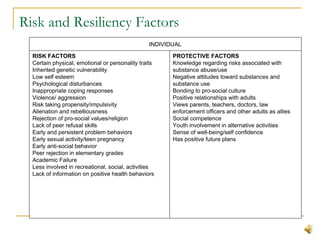
Risk and Resiliency Factors PROTECTIVE FACTORS   Knowledge regarding risks associated with substance abuse/use  Negative attitudes toward substances and substance use  Bonding to pro-social culture  Positive relationships with adults  Views parents, teachers, doctors, law enforcement officers and other adults as allies  Social competence  Youth involvement in alternative activities  Sense of well-being/self confidence  Has positive future plans  RISK FACTORS   Certain physical, emotional or personality traits  Inherited genetic vulnerability  Low self esteem  Psychological disturbances  Inappropriate coping responses  Violence/ aggression  Risk taking propensity/impulsivity  Alienation and rebelliousness  Rejection of pro-social values/religion  Lack of peer refusal skills  Early and persistent problem behaviors  Early sexual activity/teen pregnancy  Early anti-social behavior  Peer rejection in elementary grades  Academic Failure  Less involved in recreational, social, activities  Lack of information on positive health behaviors  INDIVIDUAL
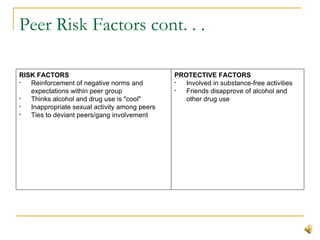
Peer Risk Factors cont. . . PROTECTIVE FACTORS   Involved in substance-free activities  Friends disapprove of alcohol and other drug use  RISK FACTORS   Reinforcement of negative norms and expectations within peer group  Thinks alcohol and drug use is "cool"  Inappropriate sexual activity among peers  Ties to deviant peers/gang involvement
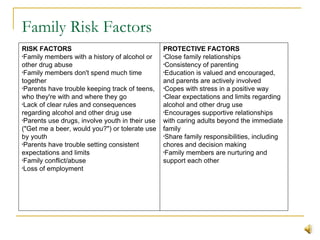
Family Risk Factors PROTECTIVE FACTORS   Close family relationships  Consistency of parenting  Education is valued and encouraged, and parents are actively involved  Copes with stress in a positive way  Clear expectations and limits regarding alcohol and other drug use  Encourages supportive relationships with caring adults beyond the immediate family  Share family responsibilities, including chores and decision making  Family members are nurturing and support each other  RISK FACTORS   Family members with a history of alcohol or other drug abuse  Family members don't spend much time together  Parents have trouble keeping track of teens, who they're with and where they go  Lack of clear rules and consequences regarding alcohol and other drug use  Parents use drugs, involve youth in their use ("Get me a beer, would you?") or tolerate use by youth  Parents have trouble setting consistent expectations and limits  Family conflict/abuse  Loss of employment
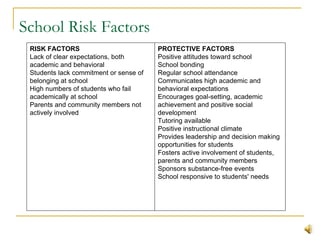
School Risk Factors PROTECTIVE FACTORS   Positive attitudes toward school  School bonding  Regular school attendance  Communicates high academic and behavioral expectations  Encourages goal-setting, academic achievement and positive social development  Tutoring available  Positive instructional climate  Provides leadership and decision making opportunities for students  Fosters active involvement of students, parents and community members  Sponsors substance-free events  School responsive to students' needs  RISK FACTORS   Lack of clear expectations, both academic and behavioral  Students lack commitment or sense of belonging at school  High numbers of students who fail academically at school  Parents and community members not actively involved
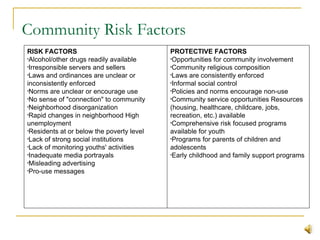
Community Risk Factors PROTECTIVE FACTORS   Opportunities for community involvement  Community religious composition  Laws are consistently enforced  Informal social control  Policies and norms encourage non-use  Community service opportunities Resources (housing, healthcare, childcare, jobs, recreation, etc.) available  Comprehensive risk focused programs available for youth Programs for parents of children and adolescents  Early childhood and family support programs  RISK FACTORS   Alcohol/other drugs readily available  Irresponsible servers and sellers  Laws and ordinances are unclear or inconsistently enforced  Norms are unclear or encourage use  No sense of "connection" to community  Neighborhood disorganization  Rapid changes in neighborhood High unemployment  Residents at or below the poverty level  Lack of strong social institutions  Lack of monitoring youths' activities  Inadequate media portrayals  Misleading advertising  Pro-use messages
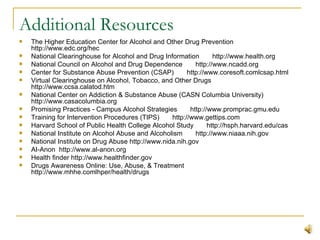
Additional Resources The Higher Education Center for Alcohol and Other Drug Prevention       http://www.edc.org/hec National Clearinghouse for Alcohol and Drug Information       http://www.health.org National Council on Alcohol and Drug Dependence       http://www.ncadd.org Center for Substance Abuse Prevention (CSAP)       http://www.coresoft.comlcsap.html Virtual Clearinghouse on Alcohol, Tobacco, and Other Drugs       http://www.ccsa.calatod.htm National Center on Addiction & Substance Abuse (CASN Columbia University) http://www.casacolumbia.org Promising Practices - Campus Alcohol Strategies       http://www.promprac.gmu.edu Training for Intervention Procedures (TIPS)       http://www.gettips.com Harvard School of Public Health College Alcohol Study       http://hsph.harvard.edu/cas National Institute on Alcohol Abuse and Alcoholism       http://www.niaaa.nih.gov National Institute on Drug Abuse http://www.nida.nih.gov AI-Anon  http://www.al-anon.org Health finder http://www.healthfinder.gov Drugs Awareness Online: Use, Abuse, & Treatment http://www.mhhe.comlhper/health/drugs
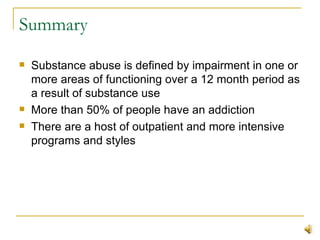
Summary Substance abuse is defined by impairment in one or more areas of functioning over a 12 month period as a result of substance use More than 50% of people have an addiction There are a host of outpatient and more intensive programs and styles

Substance Abuse Prevention

  • 1.
    Substance Use PreventionDr. Dawn-Elise Snipes
  • 2.
    Objectives To provideinformation about substance abuse prevention To assist students in understanding the risk and protective factors for substance abuse To provide resources for prevention
  • 3.
    Overview Substance usecan be thought of on a continuum from social/recreational use to abuse and dependence. Many factors affect whether substance use is a problem including whether it causes significant impairments in health, social, legal or occupational functioning No certain amount of substance use necessarily means there is a problem. It is important to consider the situation, the consequences and whether the person was in jeopardy of causing themselves physical harm by using.
  • 4.
    What is AddictionThree facets to the definition A person, substance, or activity Regularly used to escape from negative feeling states Continues to be used despite experiencing negative consequences. Note: Physiological dependence is NOT necessarily a part of addiction
  • 5.
    Prevention Prevention isA proactive process empowering individuals and systems to meet the challenges of life by creating and reinforcing conditions that promote healthy behaviors and prevent co-morbidity, relapse and disability. Goals fostering a climate in which alcohol is used legally and only when the risk of adverse consequences is minimal prescription and over-the-counter drugs and other abusable substances, e.g., aerosols, are used only for their intended purposes illegal drugs and tobacco are not used at all. (Source:http://preventionplatform.samhsa.gov/MacroHQ/Glossary2/viewgloss.cfm?action=terms&letter=P&gloss=all&sect_id=1&topic_id=99&CFID=336820&CFTOKEN=20068893)
  • 6.
    Definition of addictioncont… Another way to understand addiction is to apply the four Cs: Behavior that is motivated by emotions ranging along the Craving to Compulsion spectrum Continued use in spite of adverse Consequences, and Loss of Control.
  • 7.
    Levels of PreventionPrimary Goals are to prevent the problem from occurring in the first place Secondary Goals are to goals are to prevent the problem from getting worse Tertiary Goal are to prevent the problem from getting worse and prevent any other complications Information on Prevention Programs for Those Interested
  • 8.
    Risk and ResiliencyFactors PROTECTIVE FACTORS Knowledge regarding risks associated with substance abuse/use Negative attitudes toward substances and substance use Bonding to pro-social culture Positive relationships with adults Views parents, teachers, doctors, law enforcement officers and other adults as allies Social competence Youth involvement in alternative activities Sense of well-being/self confidence Has positive future plans RISK FACTORS Certain physical, emotional or personality traits Inherited genetic vulnerability Low self esteem Psychological disturbances Inappropriate coping responses Violence/ aggression Risk taking propensity/impulsivity Alienation and rebelliousness Rejection of pro-social values/religion Lack of peer refusal skills Early and persistent problem behaviors Early sexual activity/teen pregnancy Early anti-social behavior Peer rejection in elementary grades Academic Failure Less involved in recreational, social, activities Lack of information on positive health behaviors INDIVIDUAL
  • 9.
    Peer Risk Factorscont. . . PROTECTIVE FACTORS Involved in substance-free activities Friends disapprove of alcohol and other drug use RISK FACTORS Reinforcement of negative norms and expectations within peer group Thinks alcohol and drug use is "cool" Inappropriate sexual activity among peers Ties to deviant peers/gang involvement
  • 10.
    Family Risk FactorsPROTECTIVE FACTORS Close family relationships Consistency of parenting Education is valued and encouraged, and parents are actively involved Copes with stress in a positive way Clear expectations and limits regarding alcohol and other drug use Encourages supportive relationships with caring adults beyond the immediate family Share family responsibilities, including chores and decision making Family members are nurturing and support each other RISK FACTORS Family members with a history of alcohol or other drug abuse Family members don't spend much time together Parents have trouble keeping track of teens, who they're with and where they go Lack of clear rules and consequences regarding alcohol and other drug use Parents use drugs, involve youth in their use ("Get me a beer, would you?") or tolerate use by youth Parents have trouble setting consistent expectations and limits Family conflict/abuse Loss of employment
  • 11.
    School Risk FactorsPROTECTIVE FACTORS Positive attitudes toward school School bonding Regular school attendance Communicates high academic and behavioral expectations Encourages goal-setting, academic achievement and positive social development Tutoring available Positive instructional climate Provides leadership and decision making opportunities for students Fosters active involvement of students, parents and community members Sponsors substance-free events School responsive to students' needs RISK FACTORS Lack of clear expectations, both academic and behavioral Students lack commitment or sense of belonging at school High numbers of students who fail academically at school Parents and community members not actively involved
  • 12.
    Community Risk FactorsPROTECTIVE FACTORS Opportunities for community involvement Community religious composition Laws are consistently enforced Informal social control Policies and norms encourage non-use Community service opportunities Resources (housing, healthcare, childcare, jobs, recreation, etc.) available Comprehensive risk focused programs available for youth Programs for parents of children and adolescents Early childhood and family support programs RISK FACTORS Alcohol/other drugs readily available Irresponsible servers and sellers Laws and ordinances are unclear or inconsistently enforced Norms are unclear or encourage use No sense of "connection" to community Neighborhood disorganization Rapid changes in neighborhood High unemployment Residents at or below the poverty level Lack of strong social institutions Lack of monitoring youths' activities Inadequate media portrayals Misleading advertising Pro-use messages
  • 13.
    Additional Resources TheHigher Education Center for Alcohol and Other Drug Prevention       http://www.edc.org/hec National Clearinghouse for Alcohol and Drug Information       http://www.health.org National Council on Alcohol and Drug Dependence       http://www.ncadd.org Center for Substance Abuse Prevention (CSAP)       http://www.coresoft.comlcsap.html Virtual Clearinghouse on Alcohol, Tobacco, and Other Drugs       http://www.ccsa.calatod.htm National Center on Addiction & Substance Abuse (CASN Columbia University) http://www.casacolumbia.org Promising Practices - Campus Alcohol Strategies       http://www.promprac.gmu.edu Training for Intervention Procedures (TIPS)       http://www.gettips.com Harvard School of Public Health College Alcohol Study       http://hsph.harvard.edu/cas National Institute on Alcohol Abuse and Alcoholism       http://www.niaaa.nih.gov National Institute on Drug Abuse http://www.nida.nih.gov AI-Anon  http://www.al-anon.org Health finder http://www.healthfinder.gov Drugs Awareness Online: Use, Abuse, & Treatment http://www.mhhe.comlhper/health/drugs
  • 14.
    Summary Substance abuseis defined by impairment in one or more areas of functioning over a 12 month period as a result of substance use More than 50% of people have an addiction There are a host of outpatient and more intensive programs and styles