Subject verb
agreement
Literary Present
 When you write about writers or artists as they express themselves in their
work, use the present tense.
 The Basic Rule: You should use the past tense when discussing historical
events, and you should use the literary present when discussing fictional
events.
 When discussing events in a book or story, always use the present tense,
unless there is a shift in the time frame within the world of the text.
Subject verb agreement
 RULE 1 – A verb agrees with its subject in number.
 Singular subjects take singular verbs:
 The car stays in the garage.
 The flower smells good.
 RULE 2 – The number of the subject (singular or plural) is not changed
by words that come between the subject and the verb.
 One of the eggs is broken.
Practice!
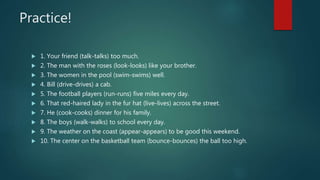
 1. Your friend (talk-talks) too much.
 2. The man with the roses (look-looks) like your brother.
 3. The women in the pool (swim-swims) well.
 4. Bill (drive-drives) a cab.
 5. The football players (run-runs) five miles every day.
 6. That red-haired lady in the fur hat (live-lives) across the street.
 7. He (cook-cooks) dinner for his family.
 8. The boys (walk-walks) to school every day.
 9. The weather on the coast (appear-appears) to be good this weekend.
 10. The center on the basketball team (bounce-bounces) the ball too high.
Subject verb agreement
 RULE 3 – Some subjects always take
a singular verb even though the
meaning may seem plural.
 These subjects always take singular
verbs:
Each, someone, either, anyone,
neither, nobody, one, somebody ,
no one, anybody, everyone ,
everybody
 Someone in the game was (not were)
hurt. Neither of the men is (not are)
working.
 RULE 4 – The following words may
be singular or plural, depending
upon their use in a sentence, some,
any, all, most.
 Most of the news is good. (singular)
 Most of the flowers were yellow.
(plural)
 All of the pizza was gone. (singular)
 All of the children were late. (plural)
Practice!
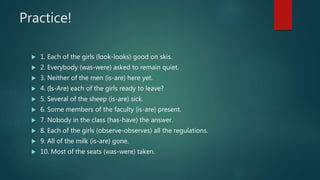
 1. Each of the girls (look-looks) good on skis.
 2. Everybody (was-were) asked to remain quiet.
 3. Neither of the men (is-are) here yet.
 4. (Is-Are) each of the girls ready to leave?
 5. Several of the sheep (is-are) sick.
 6. Some members of the faculty (is-are) present.
 7. Nobody in the class (has-have) the answer.
 8. Each of the girls (observe-observes) all the regulations.
 9. All of the milk (is-are) gone.
 10. Most of the seats (was-were) taken.
Subject verb agreement
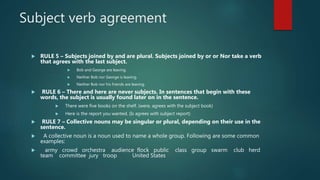
 RULE 5 – Subjects joined by and are plural. Subjects joined by or or Nor take a verb
that agrees with the last subject.
 Bob and George are leaving.
 Neither Bob nor George is leaving.
 Neither Bob nor his friends are leaving.
 RULE 6 – There and here are never subjects. In sentences that begin with these
words, the subject is usually found later on in the sentence.
 There were five books on the shelf. (were, agrees with the subject book)
 Here is the report you wanted. (Is agrees with subject report)
 RULE 7 – Collective nouns may be singular or plural, depending on their use in the
sentence.
 A collective noun is a noun used to name a whole group. Following are some common
examples:
 army crowd orchestra audience flock public class group swarm club herd
team committee jury troop United States
Practice!
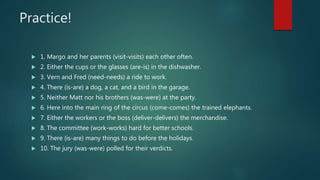
 1. Margo and her parents (visit-visits) each other often.
 2. Either the cups or the glasses (are-is) in the dishwasher.
 3. Vern and Fred (need-needs) a ride to work.
 4. There (is-are) a dog, a cat, and a bird in the garage.
 5. Neither Matt nor his brothers (was-were) at the party.
 6. Here into the main ring of the circus (come-comes) the trained elephants.
 7. Either the workers or the boss (deliver-delivers) the merchandise.
 8. The committee (work-works) hard for better schools.
 9. There (is-are) many things to do before the holidays.
 10. The jury (was-were) polled for their verdicts.
Now…
 Fix any subject verb agreement mistakes you made in your writing.
 Have another student take a look at your work and ask him or her to
proofread.

Subject-Verb-Agreement.pptx

  • 1.
  • 2.
    Literary Present  Whenyou write about writers or artists as they express themselves in their work, use the present tense.  The Basic Rule: You should use the past tense when discussing historical events, and you should use the literary present when discussing fictional events.  When discussing events in a book or story, always use the present tense, unless there is a shift in the time frame within the world of the text.
  • 3.
    Subject verb agreement RULE 1 – A verb agrees with its subject in number.  Singular subjects take singular verbs:  The car stays in the garage.  The flower smells good.  RULE 2 – The number of the subject (singular or plural) is not changed by words that come between the subject and the verb.  One of the eggs is broken.
  • 4.
    Practice!  1. Yourfriend (talk-talks) too much.  2. The man with the roses (look-looks) like your brother.  3. The women in the pool (swim-swims) well.  4. Bill (drive-drives) a cab.  5. The football players (run-runs) five miles every day.  6. That red-haired lady in the fur hat (live-lives) across the street.  7. He (cook-cooks) dinner for his family.  8. The boys (walk-walks) to school every day.  9. The weather on the coast (appear-appears) to be good this weekend.  10. The center on the basketball team (bounce-bounces) the ball too high.
  • 5.
    Subject verb agreement RULE 3 – Some subjects always take a singular verb even though the meaning may seem plural.  These subjects always take singular verbs: Each, someone, either, anyone, neither, nobody, one, somebody , no one, anybody, everyone , everybody  Someone in the game was (not were) hurt. Neither of the men is (not are) working.  RULE 4 – The following words may be singular or plural, depending upon their use in a sentence, some, any, all, most.  Most of the news is good. (singular)  Most of the flowers were yellow. (plural)  All of the pizza was gone. (singular)  All of the children were late. (plural)
  • 6.
    Practice!  1. Eachof the girls (look-looks) good on skis.  2. Everybody (was-were) asked to remain quiet.  3. Neither of the men (is-are) here yet.  4. (Is-Are) each of the girls ready to leave?  5. Several of the sheep (is-are) sick.  6. Some members of the faculty (is-are) present.  7. Nobody in the class (has-have) the answer.  8. Each of the girls (observe-observes) all the regulations.  9. All of the milk (is-are) gone.  10. Most of the seats (was-were) taken.
  • 7.
    Subject verb agreement RULE 5 – Subjects joined by and are plural. Subjects joined by or or Nor take a verb that agrees with the last subject.  Bob and George are leaving.  Neither Bob nor George is leaving.  Neither Bob nor his friends are leaving.  RULE 6 – There and here are never subjects. In sentences that begin with these words, the subject is usually found later on in the sentence.  There were five books on the shelf. (were, agrees with the subject book)  Here is the report you wanted. (Is agrees with subject report)  RULE 7 – Collective nouns may be singular or plural, depending on their use in the sentence.  A collective noun is a noun used to name a whole group. Following are some common examples:  army crowd orchestra audience flock public class group swarm club herd team committee jury troop United States
  • 8.
    Practice!  1. Margoand her parents (visit-visits) each other often.  2. Either the cups or the glasses (are-is) in the dishwasher.  3. Vern and Fred (need-needs) a ride to work.  4. There (is-are) a dog, a cat, and a bird in the garage.  5. Neither Matt nor his brothers (was-were) at the party.  6. Here into the main ring of the circus (come-comes) the trained elephants.  7. Either the workers or the boss (deliver-delivers) the merchandise.  8. The committee (work-works) hard for better schools.  9. There (is-are) many things to do before the holidays.  10. The jury (was-were) polled for their verdicts.
  • 9.
    Now…  Fix anysubject verb agreement mistakes you made in your writing.  Have another student take a look at your work and ask him or her to proofread.