Problems with Subject-
   Verb Agreement
 When Subjects and Verbs Don’t Match
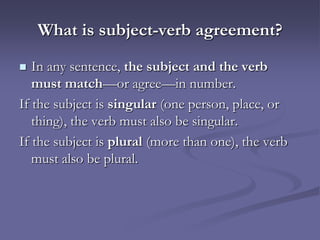
What is subject-verb agreement?
  In any sentence, the subject and the verb
   must match—or agree—in number.
If the subject is singular (one person, place, or
   thing), the verb must also be singular.
If the subject is plural (more than one), the verb
   must also be plural.
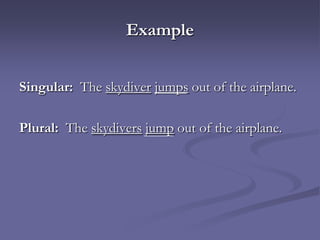
Example


Singular: The skydiver jumps out of the airplane.

Plural: The skydivers jump out of the airplane.
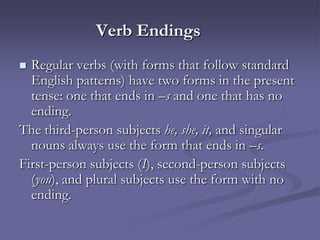
Verb Endings
 Regular verbs (with forms that follow standard
  English patterns) have two forms in the present
  tense: one that ends in –s and one that has no
  ending.
The third-person subjects he, she, it, and singular
  nouns always use the form that ends in –s.
First-person subjects (I), second-person subjects
  (you), and plural subjects use the form with no
  ending.
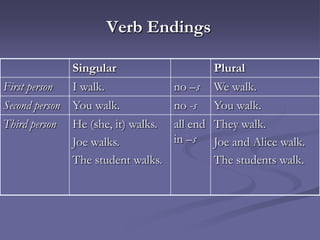
Verb Endings

                Singular                    Plural
First person    I walk.             no –s   We walk.
Second person   You walk.           no -s   You walk.
Third person    He (she, it) walks. all end They walk.
                Joe walks.          in –s Joe and Alice walk.
                The student walks.          The students walk.
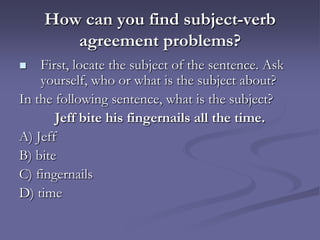
How can you find subject-verb
       agreement problems?
   First, locate the subject of the sentence. Ask
    yourself, who or what is the subject about?
In the following sentence, what is the subject?
       Jeff bite his fingernails all the time.
A) Jeff
B) bite
C) fingernails
D) time
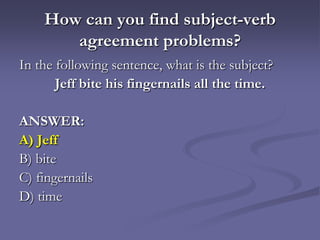
How can you find subject-verb
       agreement problems?
In the following sentence, what is the subject?
       Jeff bite his fingernails all the time.

ANSWER:
A) Jeff
B) bite
C) fingernails
D) time
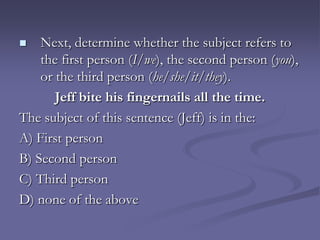
   Next, determine whether the subject refers to
    the first person (I/we), the second person (you),
    or the third person (he/she/it/they).
       Jeff bite his fingernails all the time.
The subject of this sentence (Jeff) is in the:
A) First person
B) Second person
C) Third person
D) none of the above
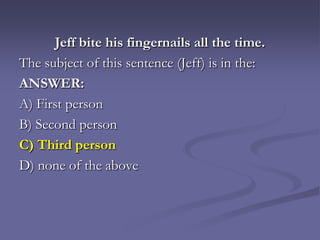
Jeff bite his fingernails all the time.
The subject of this sentence (Jeff) is in the:
ANSWER:
A) First person
B) Second person
C) Third person
D) none of the above
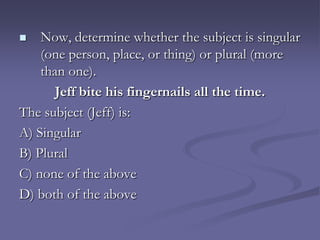
   Now, determine whether the subject is singular
    (one person, place, or thing) or plural (more
    than one).
      Jeff bite his fingernails all the time.
The subject (Jeff) is:
A) Singular
B) Plural
C) none of the above
D) both of the above
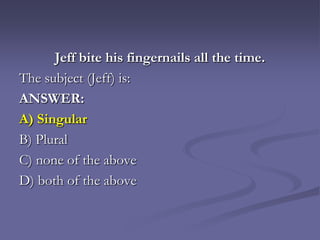
Jeff bite his fingernails all the time.
The subject (Jeff) is:
ANSWER:
A) Singular
B) Plural
C) none of the above
D) both of the above
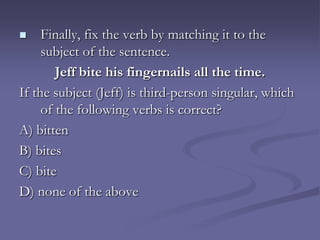
    Finally, fix the verb by matching it to the
     subject of the sentence.
        Jeff bite his fingernails all the time.
If the subject (Jeff) is third-person singular, which
     of the following verbs is correct?
A) bitten
B) bites
C) bite
D) none of the above
Jeff bite his fingernails all the time.
If the subject (Jeff) is third-person singular, which
     of the following verbs is correct?
ANSWER:
A) bitten
B) bites
C) bite
D) none of the above
Which verb would be correct in the
        following sentence?

I tells him not to bite his nails.

A) tells
B) tell
C) telled
D) none of the above
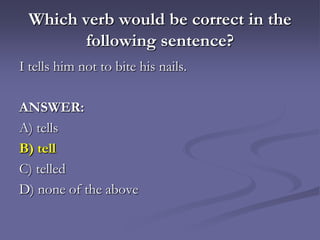
Which verb would be correct in the
        following sentence?
I tells him not to bite his nails.

ANSWER:
A) tells
B) tell
C) telled
D) none of the above
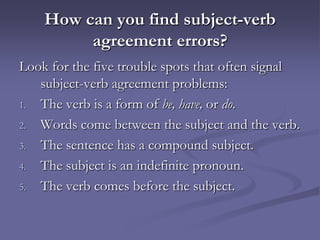
How can you find subject-verb
         agreement errors?
Look for the five trouble spots that often signal
   subject-verb agreement problems:
1. The verb is a form of be, have, or do.

2. Words come between the subject and the verb.

3. The sentence has a compound subject.

4. The subject is an indefinite pronoun.

5. The verb comes before the subject.
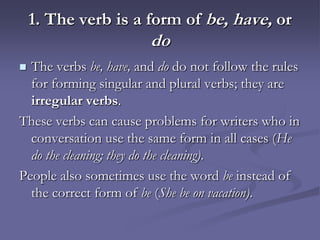
1. The verb is a form of be, have, or
                        do
 The verbs be, have, and do do not follow the rules
  for forming singular and plural verbs; they are
  irregular verbs.
These verbs can cause problems for writers who in
  conversation use the same form in all cases (He
  do the cleaning; they do the cleaning).
People also sometimes use the word be instead of
  the correct form of be (She be on vacation).
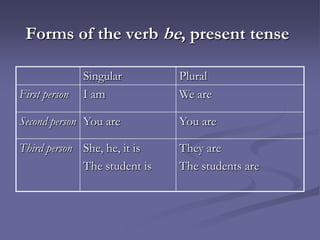
Forms of the verb be, present tense

               Singular       Plural
First person   I am           We are

Second person You are         You are

Third person She, he, it is   They are
             The student is   The students are
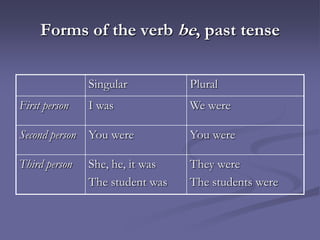
Forms of the verb be, past tense

                Singular          Plural
First person    I was             We were

Second person   You were          You were

Third person    She, he, it was   They were
                The student was   The students were
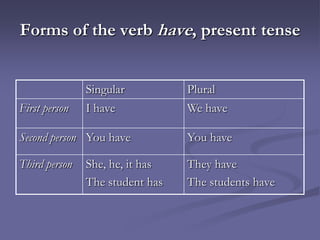
Forms of the verb have, present tense


               Singular          Plural
First person   I have            We have

Second person You have           You have

Third person   She, he, it has   They have
               The student has   The students have
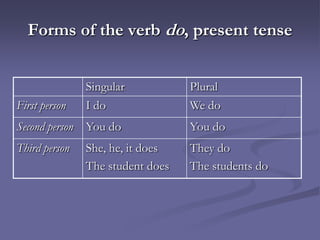
Forms of the verb do, present tense


                Singular           Plural
First person    I do               We do
Second person   You do             You do
Third person    She, he, it does   They do
                The student does   The students do
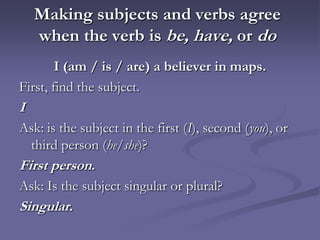
Making subjects and verbs agree
    when the verb is be, have, or do
        I (am / is / are) a believer in maps.
First, find the subject.
I
Ask: is the subject in the first (I), second (you), or
  third person (he/she)?
First person.
Ask: Is the subject singular or plural?
Singular.
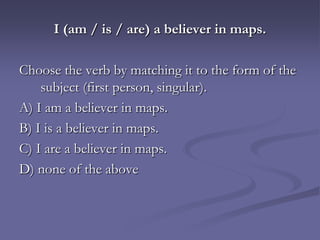
I (am / is / are) a believer in maps.

Choose the verb by matching it to the form of the
    subject (first person, singular).
A) I am a believer in maps.
B) I is a believer in maps.
C) I are a believer in maps.
D) none of the above
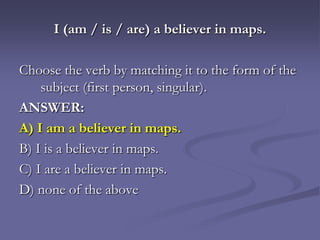
I (am / is / are) a believer in maps.

Choose the verb by matching it to the form of the
    subject (first person, singular).
ANSWER:
A) I am a believer in maps.
B) I is a believer in maps.
C) I are a believer in maps.
D) none of the above
Find and fix the subject-verb
           agreement problem
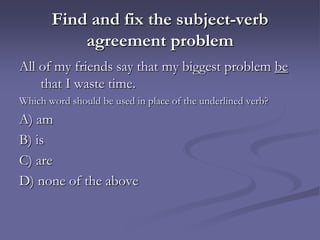
All of my friends say that my biggest problem be
    that I waste time.
Which word should be used in place of the underlined verb?
A) am
B) is
C) are
D) none of the above
Find and fix the subject-verb
           agreement problem
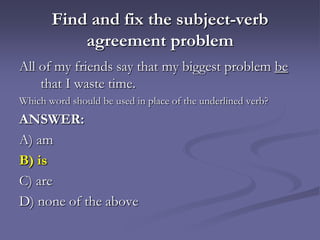
All of my friends say that my biggest problem be
    that I waste time.
Which word should be used in place of the underlined verb?
ANSWER:
A) am
B) is
C) are
D) none of the above
Find and fix the subject-verb
           agreement problem
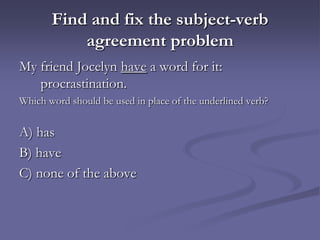
My friend Jocelyn have a word for it:
   procrastination.
Which word should be used in place of the underlined verb?


A) has
B) have
C) none of the above
Find and fix the subject-verb
           agreement problem
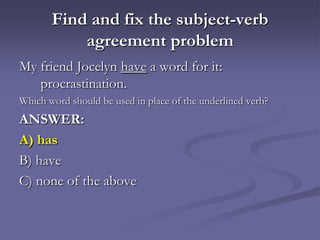
My friend Jocelyn have a word for it:
   procrastination.
Which word should be used in place of the underlined verb?
ANSWER:
A) has
B) have
C) none of the above
2. Words come between the subject
            and the verb
When the subject and verb aren’t right next to
 each other, it is more difficult to find them and
 to make sure they agree.
Most often, either a prepositional phrase or a
 dependent clause comes between the subject
 and the verb.
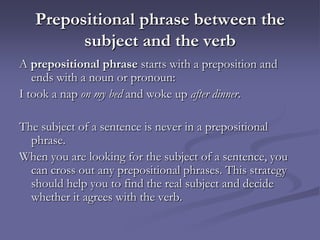
Prepositional phrase between the
         subject and the verb
A prepositional phrase starts with a preposition and
   ends with a noun or pronoun:
I took a nap on my bed and woke up after dinner.

The subject of a sentence is never in a prepositional
  phrase.
When you are looking for the subject of a sentence, you
  can cross out any prepositional phrases. This strategy
  should help you to find the real subject and decide
  whether it agrees with the verb.
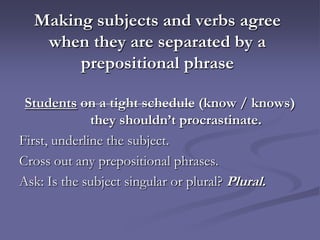
Making subjects and verbs agree
   when they are separated by a
       prepositional phrase

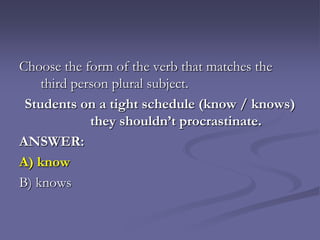
 Students on a tight schedule (know / knows)
              they shouldn’t procrastinate.
First, underline the subject.
Cross out any prepositional phrases.
Ask: Is the subject singular or plural? Plural.
Choose the form of the verb that matches the
    third person plural subject.
 Students on a tight schedule (know / knows)
             they shouldn’t procrastinate.
A) know
B) knows
Choose the form of the verb that matches the
    third person plural subject.
 Students on a tight schedule (know / knows)
             they shouldn’t procrastinate.
ANSWER:
A) know
B) knows
Dependent clause between the
        subject and the verb
A dependent clause has a subject and a verb, but
  it does not express a complete thought.
When a dependent clause comes between the
  subject and the verb, it usually starts with the
  word who, whose, whom, that, or which.
The subject of a sentence is never a dependent
  clause. When you are looking for the subject of
  a sentence, you can cross out any dependent
  clauses.
Making subjects and verbs agree
    when they are separated by a
         dependent clause
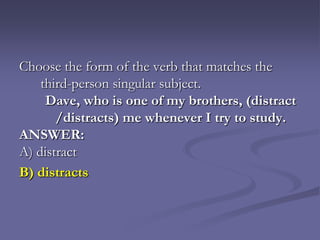
  Dave, who is one of my brothers, (distract
      /distracts) me whenever I try to study.

First, underline the subject.
Cross out any dependent clause.
Ask: Is the subject singular or plural? Singular.
Choose the form of the verb that matches the
   third-person singular subject.
  Dave, who is one of my brothers, (distract
      /distracts) me whenever I try to study.

A) distract
B) distracts
Choose the form of the verb that matches the
    third-person singular subject.
     Dave, who is one of my brothers, (distract
       /distracts) me whenever I try to study.
ANSWER:
A) distract
B) distracts
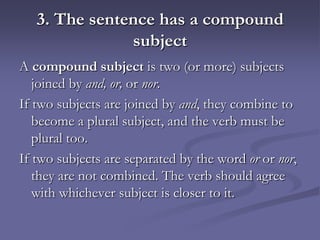
3. The sentence has a compound
               subject
A compound subject is two (or more) subjects
   joined by and, or, or nor.
If two subjects are joined by and, they combine to
   become a plural subject, and the verb must be
   plural too.
If two subjects are separated by the word or or nor,
   they are not combined. The verb should agree
   with whichever subject is closer to it.
Making subjects and verbs agree in a
 sentence with a compound subject
 Either Jocelyn or Dan (help / helps) me stay
    focused when I have a long paper to write.
First, underline the subjects.
Circle the word between the subjects.
Ask: Does that word join the subjects to make
  them plural or keep them separate? Keeps them
  separate.
Ask: Is the subject that is closer to the verb
 singular or plural? Singular.
Choose the verb form that agrees with the subject
    that is closer to the verb.
 Either Jocelyn or Dan (help / helps) me stay
     focused when I have a long paper to write.
A) help
B) helps
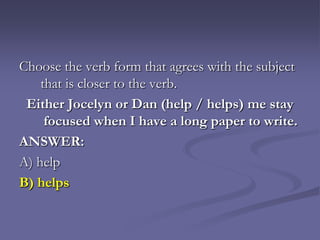
Choose the verb form that agrees with the subject
    that is closer to the verb.
 Either Jocelyn or Dan (help / helps) me stay
     focused when I have a long paper to write.
ANSWER:
A) help
B) helps
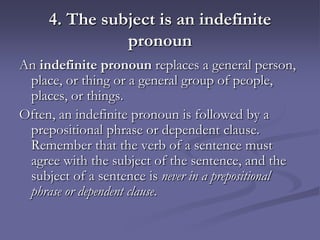
4. The subject is an indefinite
               pronoun
An indefinite pronoun replaces a general person,
 place, or thing or a general group of people,
 places, or things.
Often, an indefinite pronoun is followed by a
 prepositional phrase or dependent clause.
 Remember that the verb of a sentence must
 agree with the subject of the sentence, and the
 subject of a sentence is never in a prepositional
 phrase or dependent clause.
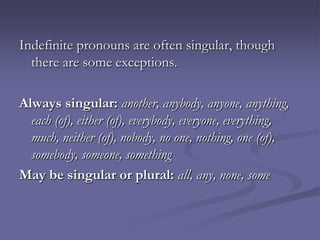
Indefinite pronouns are often singular, though
  there are some exceptions.

Always singular: another, anybody, anyone, anything,
  each (of), either (of), everybody, everyone, everything,
  much, neither (of), nobody, no one, nothing, one (of),
  somebody, someone, something
May be singular or plural: all, any, none, some
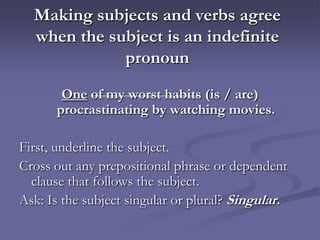
Making subjects and verbs agree
  when the subject is an indefinite
             pronoun
       One of my worst habits (is / are)
      procrastinating by watching movies.

First, underline the subject.
Cross out any prepositional phrase or dependent
  clause that follows the subject.
Ask: Is the subject singular or plural? Singular.
Choose the verb form that agrees with the subject.
      One of my worst habits (is / are)
      procrastinating by watching movies.

A) is
B) are
Choose the verb form that agrees with the subject.
       One of my worst habits (is / are)
       procrastinating by watching movies.
ANSWER:
A) is
B) are
5. The verb comes before the subject
In most sentences, the subject comes before the
  verb. Two kinds of sentences often reverse the
  usual subject-verb order: questions and
  sentences that begin with here or there.
In these two types of sentences, you need to check
  for errors in subject-verb agreement.
Questions
In questions, the verb or part of the verb comes
  before the subject.
To find the subject and verb, you can turn the
  question around as if you were going to answer
  it.

Where is the theater? / The theater is…
Are you leaving? / You are leaving.
Sentences that begin with here or
                     there
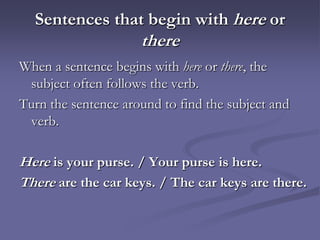
When a sentence begins with here or there, the
 subject often follows the verb.
Turn the sentence around to find the subject and
 verb.

Here is your purse. / Your purse is here.
There are the car keys. / The car keys are there.
Making subjects and verbs agree
   when the verb comes before the
              subject
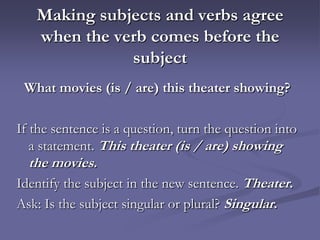
 What movies (is / are) this theater showing?

If the sentence is a question, turn the question into
   a statement. This theater (is / are) showing
   the movies.
Identify the subject in the new sentence. Theater.
Ask: Is the subject singular or plural? Singular.
Choose the form of the verb that matches the
   subject.
 What movies (is / are) this theater showing?
 This theater (is / are) showing the movies.

A) is
B) are
Choose the form of the verb that matches the
    subject.
 What movies (is / are) this theater showing?
  This theater (is / are) showing the movies.
ANSWER:
A) is
B) are
Making subjects and verbs agree
   when the verb comes before the
              subject
There (is / are) two good films at this theater.

If the sentence begins with here or there, turn it
   around: Two good films (is / are) at this
   theater.
Identify the subject in the new sentence. Films.
Ask: Is the subject singular or plural? Plural.
Choose the form of the verb that matches the
   subject.
There (is / are) two good films at this theater.
   Two good films (is / are) at this theater.

A) is
B) are
Choose the form of the verb that matches the
    subject.
There (is / are) two good films at this theater.
    Two good films (is / are) at this theater.
ANSWER:
A) is
B) are
LET’S PRACTICE!
CLICK HERE TO START

Subject verb agreement

  • 1.
    Problems with Subject- Verb Agreement When Subjects and Verbs Don’t Match
  • 2.
    What is subject-verbagreement?  In any sentence, the subject and the verb must match—or agree—in number. If the subject is singular (one person, place, or thing), the verb must also be singular. If the subject is plural (more than one), the verb must also be plural.
  • 3.
    Example Singular: The skydiverjumps out of the airplane. Plural: The skydivers jump out of the airplane.
  • 4.
    Verb Endings  Regularverbs (with forms that follow standard English patterns) have two forms in the present tense: one that ends in –s and one that has no ending. The third-person subjects he, she, it, and singular nouns always use the form that ends in –s. First-person subjects (I), second-person subjects (you), and plural subjects use the form with no ending.
  • 5.
    Verb Endings Singular Plural First person I walk. no –s We walk. Second person You walk. no -s You walk. Third person He (she, it) walks. all end They walk. Joe walks. in –s Joe and Alice walk. The student walks. The students walk.
  • 6.
    How can youfind subject-verb agreement problems?  First, locate the subject of the sentence. Ask yourself, who or what is the subject about? In the following sentence, what is the subject? Jeff bite his fingernails all the time. A) Jeff B) bite C) fingernails D) time
  • 7.
    How can youfind subject-verb agreement problems? In the following sentence, what is the subject? Jeff bite his fingernails all the time. ANSWER: A) Jeff B) bite C) fingernails D) time
  • 8.
    Next, determine whether the subject refers to the first person (I/we), the second person (you), or the third person (he/she/it/they). Jeff bite his fingernails all the time. The subject of this sentence (Jeff) is in the: A) First person B) Second person C) Third person D) none of the above
  • 9.
    Jeff bite hisfingernails all the time. The subject of this sentence (Jeff) is in the: ANSWER: A) First person B) Second person C) Third person D) none of the above
  • 10.
    Now, determine whether the subject is singular (one person, place, or thing) or plural (more than one). Jeff bite his fingernails all the time. The subject (Jeff) is: A) Singular B) Plural C) none of the above D) both of the above
  • 11.
    Jeff bite hisfingernails all the time. The subject (Jeff) is: ANSWER: A) Singular B) Plural C) none of the above D) both of the above
  • 12.
    Finally, fix the verb by matching it to the subject of the sentence. Jeff bite his fingernails all the time. If the subject (Jeff) is third-person singular, which of the following verbs is correct? A) bitten B) bites C) bite D) none of the above
  • 13.
    Jeff bite hisfingernails all the time. If the subject (Jeff) is third-person singular, which of the following verbs is correct? ANSWER: A) bitten B) bites C) bite D) none of the above
  • 14.
    Which verb wouldbe correct in the following sentence? I tells him not to bite his nails. A) tells B) tell C) telled D) none of the above
  • 15.
    Which verb wouldbe correct in the following sentence? I tells him not to bite his nails. ANSWER: A) tells B) tell C) telled D) none of the above
  • 16.
    How can youfind subject-verb agreement errors? Look for the five trouble spots that often signal subject-verb agreement problems: 1. The verb is a form of be, have, or do. 2. Words come between the subject and the verb. 3. The sentence has a compound subject. 4. The subject is an indefinite pronoun. 5. The verb comes before the subject.
  • 17.
    1. The verbis a form of be, have, or do  The verbs be, have, and do do not follow the rules for forming singular and plural verbs; they are irregular verbs. These verbs can cause problems for writers who in conversation use the same form in all cases (He do the cleaning; they do the cleaning). People also sometimes use the word be instead of the correct form of be (She be on vacation).
  • 18.
    Forms of theverb be, present tense Singular Plural First person I am We are Second person You are You are Third person She, he, it is They are The student is The students are
  • 19.
    Forms of theverb be, past tense Singular Plural First person I was We were Second person You were You were Third person She, he, it was They were The student was The students were
  • 20.
    Forms of theverb have, present tense Singular Plural First person I have We have Second person You have You have Third person She, he, it has They have The student has The students have
  • 21.
    Forms of theverb do, present tense Singular Plural First person I do We do Second person You do You do Third person She, he, it does They do The student does The students do
  • 22.
    Making subjects andverbs agree when the verb is be, have, or do I (am / is / are) a believer in maps. First, find the subject. I Ask: is the subject in the first (I), second (you), or third person (he/she)? First person. Ask: Is the subject singular or plural? Singular.
  • 23.
    I (am /is / are) a believer in maps. Choose the verb by matching it to the form of the subject (first person, singular). A) I am a believer in maps. B) I is a believer in maps. C) I are a believer in maps. D) none of the above
  • 24.
    I (am /is / are) a believer in maps. Choose the verb by matching it to the form of the subject (first person, singular). ANSWER: A) I am a believer in maps. B) I is a believer in maps. C) I are a believer in maps. D) none of the above
  • 25.
    Find and fixthe subject-verb agreement problem All of my friends say that my biggest problem be that I waste time. Which word should be used in place of the underlined verb? A) am B) is C) are D) none of the above
  • 26.
    Find and fixthe subject-verb agreement problem All of my friends say that my biggest problem be that I waste time. Which word should be used in place of the underlined verb? ANSWER: A) am B) is C) are D) none of the above
  • 27.
    Find and fixthe subject-verb agreement problem My friend Jocelyn have a word for it: procrastination. Which word should be used in place of the underlined verb? A) has B) have C) none of the above
  • 28.
    Find and fixthe subject-verb agreement problem My friend Jocelyn have a word for it: procrastination. Which word should be used in place of the underlined verb? ANSWER: A) has B) have C) none of the above
  • 29.
    2. Words comebetween the subject and the verb When the subject and verb aren’t right next to each other, it is more difficult to find them and to make sure they agree. Most often, either a prepositional phrase or a dependent clause comes between the subject and the verb.
  • 30.
    Prepositional phrase betweenthe subject and the verb A prepositional phrase starts with a preposition and ends with a noun or pronoun: I took a nap on my bed and woke up after dinner. The subject of a sentence is never in a prepositional phrase. When you are looking for the subject of a sentence, you can cross out any prepositional phrases. This strategy should help you to find the real subject and decide whether it agrees with the verb.
  • 31.
    Making subjects andverbs agree when they are separated by a prepositional phrase Students on a tight schedule (know / knows) they shouldn’t procrastinate. First, underline the subject. Cross out any prepositional phrases. Ask: Is the subject singular or plural? Plural.
  • 32.
    Choose the formof the verb that matches the third person plural subject. Students on a tight schedule (know / knows) they shouldn’t procrastinate. A) know B) knows
  • 33.
    Choose the formof the verb that matches the third person plural subject. Students on a tight schedule (know / knows) they shouldn’t procrastinate. ANSWER: A) know B) knows
  • 34.
    Dependent clause betweenthe subject and the verb A dependent clause has a subject and a verb, but it does not express a complete thought. When a dependent clause comes between the subject and the verb, it usually starts with the word who, whose, whom, that, or which. The subject of a sentence is never a dependent clause. When you are looking for the subject of a sentence, you can cross out any dependent clauses.
  • 35.
    Making subjects andverbs agree when they are separated by a dependent clause Dave, who is one of my brothers, (distract /distracts) me whenever I try to study. First, underline the subject. Cross out any dependent clause. Ask: Is the subject singular or plural? Singular.
  • 36.
    Choose the formof the verb that matches the third-person singular subject. Dave, who is one of my brothers, (distract /distracts) me whenever I try to study. A) distract B) distracts
  • 37.
    Choose the formof the verb that matches the third-person singular subject. Dave, who is one of my brothers, (distract /distracts) me whenever I try to study. ANSWER: A) distract B) distracts
  • 38.
    3. The sentencehas a compound subject A compound subject is two (or more) subjects joined by and, or, or nor. If two subjects are joined by and, they combine to become a plural subject, and the verb must be plural too. If two subjects are separated by the word or or nor, they are not combined. The verb should agree with whichever subject is closer to it.
  • 39.
    Making subjects andverbs agree in a sentence with a compound subject Either Jocelyn or Dan (help / helps) me stay focused when I have a long paper to write. First, underline the subjects. Circle the word between the subjects. Ask: Does that word join the subjects to make them plural or keep them separate? Keeps them separate. Ask: Is the subject that is closer to the verb singular or plural? Singular.
  • 40.
    Choose the verbform that agrees with the subject that is closer to the verb. Either Jocelyn or Dan (help / helps) me stay focused when I have a long paper to write. A) help B) helps
  • 41.
    Choose the verbform that agrees with the subject that is closer to the verb. Either Jocelyn or Dan (help / helps) me stay focused when I have a long paper to write. ANSWER: A) help B) helps
  • 42.
    4. The subjectis an indefinite pronoun An indefinite pronoun replaces a general person, place, or thing or a general group of people, places, or things. Often, an indefinite pronoun is followed by a prepositional phrase or dependent clause. Remember that the verb of a sentence must agree with the subject of the sentence, and the subject of a sentence is never in a prepositional phrase or dependent clause.
  • 43.
    Indefinite pronouns areoften singular, though there are some exceptions. Always singular: another, anybody, anyone, anything, each (of), either (of), everybody, everyone, everything, much, neither (of), nobody, no one, nothing, one (of), somebody, someone, something May be singular or plural: all, any, none, some
  • 44.
    Making subjects andverbs agree when the subject is an indefinite pronoun One of my worst habits (is / are) procrastinating by watching movies. First, underline the subject. Cross out any prepositional phrase or dependent clause that follows the subject. Ask: Is the subject singular or plural? Singular.
  • 45.
    Choose the verbform that agrees with the subject. One of my worst habits (is / are) procrastinating by watching movies. A) is B) are
  • 46.
    Choose the verbform that agrees with the subject. One of my worst habits (is / are) procrastinating by watching movies. ANSWER: A) is B) are
  • 47.
    5. The verbcomes before the subject In most sentences, the subject comes before the verb. Two kinds of sentences often reverse the usual subject-verb order: questions and sentences that begin with here or there. In these two types of sentences, you need to check for errors in subject-verb agreement.
  • 48.
    Questions In questions, theverb or part of the verb comes before the subject. To find the subject and verb, you can turn the question around as if you were going to answer it. Where is the theater? / The theater is… Are you leaving? / You are leaving.
  • 49.
    Sentences that beginwith here or there When a sentence begins with here or there, the subject often follows the verb. Turn the sentence around to find the subject and verb. Here is your purse. / Your purse is here. There are the car keys. / The car keys are there.
  • 50.
    Making subjects andverbs agree when the verb comes before the subject What movies (is / are) this theater showing? If the sentence is a question, turn the question into a statement. This theater (is / are) showing the movies. Identify the subject in the new sentence. Theater. Ask: Is the subject singular or plural? Singular.
  • 51.
    Choose the formof the verb that matches the subject. What movies (is / are) this theater showing? This theater (is / are) showing the movies. A) is B) are
  • 52.
    Choose the formof the verb that matches the subject. What movies (is / are) this theater showing? This theater (is / are) showing the movies. ANSWER: A) is B) are
  • 53.
    Making subjects andverbs agree when the verb comes before the subject There (is / are) two good films at this theater. If the sentence begins with here or there, turn it around: Two good films (is / are) at this theater. Identify the subject in the new sentence. Films. Ask: Is the subject singular or plural? Plural.
  • 54.
    Choose the formof the verb that matches the subject. There (is / are) two good films at this theater. Two good films (is / are) at this theater. A) is B) are
  • 55.
    Choose the formof the verb that matches the subject. There (is / are) two good films at this theater. Two good films (is / are) at this theater. ANSWER: A) is B) are
  • 56.