Table of content
Introduction about subject-verb agreement.
Introduce about the important rule of subject-
verb agreement.
 Give some exercises for practice of each part .
 Add more idea about how is different between
Neither/Either, Few/a few.
The last part we take 20 exercises relate to
subject-verb agreement for make you
understand.
*Introduction about subject-verb
agreement :
• What is Subject-verb agreement?
Subjects and verbs must AGREE with one
another in number (singular or plural). Thus, if
a subject is singular, its verb must also be
singular; if a subject is plural, its verb must also
be plural.
Example 1. What is the problem?
The problem is mathematic.
2. What are the problems? The problems are….
Singular subject
Singular verb
Plural subject Plural verb
Now, let’s try to learn some important
rules.
1. If the subject is singular (one person, one
thing), the verb must be singular.
Ex. A good student does his homework.*
• In the present tense a singular verb ends with an s.
 The dog(-s) chases(+s) the cat.
It chases the cat.
In the present tense a singular verb ends with an s.
Plural??
2. If the subject is plural (more than one person
or thing), the verb must be plural.
Ex. All good students listen to their teacher.*
 The professors tell us how to make a good
presentation.
*Notice that the verb do/does not have(end) an s!
Plural subject
have +S
Plural Verb NO -S
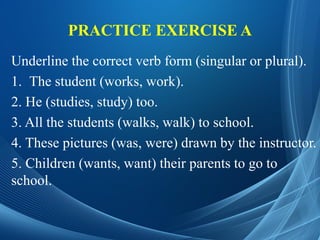
PRACTICE EXERCISE A
Underline the correct verb form (singular or plural).
1. The student (works, work).
2. He (studies, study) too.
3. All the students (walks, walk) to school.
4. These pictures (was, were) drawn by the instructor.
5. Children (wants, want) their parents to go to
school.
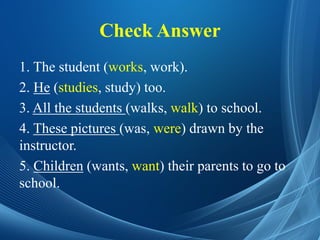
Check Answer
1. The student (works, work).
2. He (studies, study) too.
3. All the students (walks, walk) to school.
4. These pictures (was, were) drawn by the
instructor.
5. Children (wants, want) their parents to go to
school.
*Identify subject and verb
3. If words or phrases come between the subject
and the verb, first isolate the subject and then
decide on the correct verb form. Prepositional
phrases can be real trouble makers, so if you don’t
remember how to identify them, stop now and ask
for a learning packet.
Ex.1. The designs(with+s) on Indian pottery
(fascinates, fascinate)>(-s) me.
2. They design dress very fascinate me.
(The subject designs is plural; therefore, the verb
must be plural. The plural verb is fascinate.
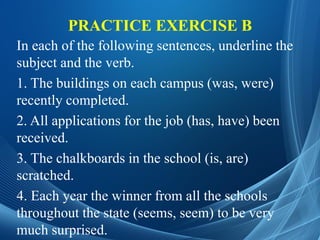
PRACTICE EXERCISE B
In each of the following sentences, underline the
subject and the verb.
1. The buildings on each campus (was, were)
recently completed.
2. All applications for the job (has, have) been
received.
3. The chalkboards in the school (is, are)
scratched.
4. Each year the winner from all the schools
throughout the state (seems, seem) to be very
much surprised.
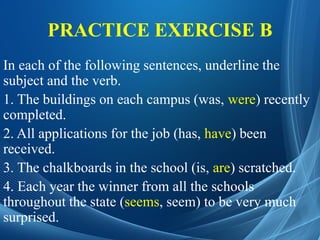
PRACTICE EXERCISE B
In each of the following sentences, underline the
subject and the verb.
1. The buildings on each campus (was, were) recently
completed.
2. All applications for the job (has, have) been
received.
3. The chalkboards in the school (is, are) scratched.
4. Each year the winner from all the schools
throughout the state (seems, seem) to be very much
surprised.
Always Singular
4. Some words that are often used as subjects are
always singular. Memorize them!!
(each, either, neither, no one, one, everyone,
anyone, someone, anybody, somebody,
everybody, nobody, everything.)
Ex. Everybody wants to make good grades.
Nobody knows about my life.
Everything makes me fall in love to her.
Always plural
Some words that are often used as subjects are
always plural. Memorize them!!
(Several, few, both, many, other)
Ex. Several of the staff understand the idea of an
attendance policy.
**A few vs few**
A few friends visited me. - Some friends visited
me.
Few friends visited me. - Hardly any friends
visited me.
Either Singular or plural
Some words may be either singular or plural,
depending on how they are used.
(some, any, all, most)
• Ex. Some of the fruit is rotten. (Some fruit is rotten.)
• Some of the apples are rotten. (Some apples are
rotten.)
• All of this apple is rotten. (The entire apple is
rotten.)
• All of these apples are rotten. (All apples are
rotten.)
PRACTICE EXERCISE C
Underline the correct form of the verb.
1. Some of the students (has, have) left the
building.
2. Each of her students ( is, are) special.
3. Several on the team (hits, hit) the ball really
hard.
4. Everything in the buildings (was, were)
destroyed.
5. Neither of the men (meets, meet) his class
every day.
Check Answer
1. Some of the students (has, have) left the
building.
2. Each of her students ( is, are) special.
3. Several on the team (hits, hit) the ball really
hard.
4. Everything in the buildings (was, were)
destroyed.
5. Neither of the men (meets, meet) his class
every day.
Compound Subject
5. If the sentence has compound subjects (more
than one subject) joined by and, the
verb is usually plural.
Ex. Vichet and John are twins.
The beginning of the story (and) the end of the story
were exciting.
Ex. CRUSH song and I DO song are my favorite
song for me.
Or / nor with compound subject
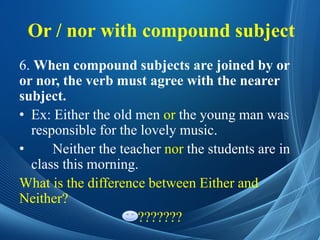
6. When compound subjects are joined by or
or nor, the verb must agree with the nearer
subject.
• Ex: Either the old men or the young man was
responsible for the lovely music.
• Neither the teacher nor the students are in
class this morning.
What is the difference between Either and
Neither?
???????
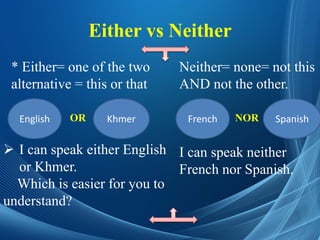
Either vs Neither
* Either= one of the two
alternative = this or that
 I can speak either English
or Khmer.
Which is easier for you to
understand?
Neither= none= not this
AND not the other.
I can speak neither
French nor Spanish.
English Khmer French SpanishOR NOR
PRACTICE EXERCISE D
Underline the correct form of the verb:
1. Neither science nor math (gives, give) me a
problem.
2. Either the cat or the dogs (greets, greet) me at the
door.
3. Neither the men who are listen as administrators
nor the woman who is also listed (has, have) been
appointed to the board.
4. Either my cousin or my uncle (was, were) on the
critical list.
5. Neither Ms. Jones nor a member of her staff (is,
are) going to attend the meeting.
Check Answer
Underline the correct form of the verb:
1. Neither science nor math (gives, give) me a
problem.
2. Either the cat or the dogs (greets, greet) me at the
door.
3. Neither the men who are listen as administrators nor
the woman who is also listed (has, have) been
appointed to the board.
4. Either my cousin or my uncle (was, were) on the
critical list.
5. Neither Ms. Jones nor a member of her staff (is, are)
going to attend the meeting.
Either There or Here
7. When a sentence begins with either there or
here, the subject comes behind the verb.
Ex. There is going to be just one student
representative on the board.
Here is making only one person.
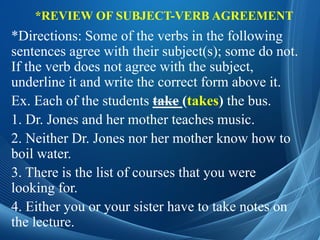
*REVIEW OF SUBJECT-VERB AGREEMENT
*Directions: Some of the verbs in the following
sentences agree with their subject(s); some do not.
If the verb does not agree with the subject,
underline it and write the correct form above it.
Ex. Each of the students take (takes) the bus.
1. Dr. Jones and her mother teaches music.
2. Neither Dr. Jones nor her mother know how to
boil water.
3. There is the list of courses that you were
looking for.
4. Either you or your sister have to take notes on
the lecture.
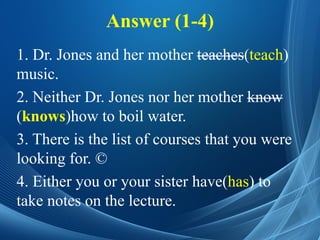
Answer (1-4)
1. Dr. Jones and her mother teaches(teach)
music.
2. Neither Dr. Jones nor her mother know
(knows)how to boil water.
3. There is the list of courses that you were
looking for. ©
4. Either you or your sister have(has) to
take notes on the lecture.
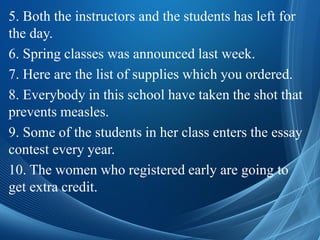
5. Both the instructors and the students has left for
the day.
6. Spring classes was announced last week.
7. Here are the list of supplies which you ordered.
8. Everybody in this school have taken the shot that
prevents measles.
9. Some of the students in her class enters the essay
contest every year.
10. The women who registered early are going to
get extra credit.
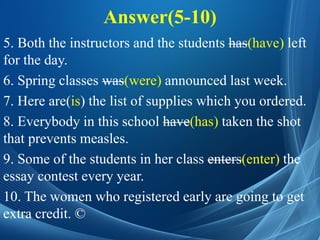
Answer(5-10)
5. Both the instructors and the students has(have) left
for the day.
6. Spring classes was(were) announced last week.
7. Here are(is) the list of supplies which you ordered.
8. Everybody in this school have(has) taken the shot
that prevents measles.
9. Some of the students in her class enters(enter) the
essay contest every year.
10. The women who registered early are going to get
extra credit. ©
11. Mr. and Mrs. Smith has been attending that
conference for many years.
12. The students and Dr. Lee prepares the bulletin each
month.
13. There goes one of the men who will conduct the
research.
14. Some of that paper are going to be presented at the
workshop.
15. Each of the children was promised a part in the
play.
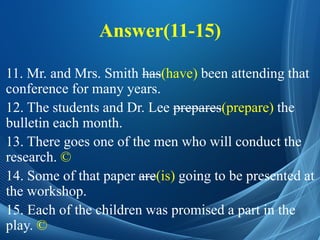
Answer(11-15)
11. Mr. and Mrs. Smith has(have) been attending that
conference for many years.
12. The students and Dr. Lee prepares(prepare) the
bulletin each month.
13. There goes one of the men who will conduct the
research. ©
14. Some of that paper are(is) going to be presented at
the workshop.
15. Each of the children was promised a part in the
play. ©
15. Each of the children was promised a part in the
play.
16. Neither of the women has been late to class this
semester.
17. The section of paper which I read most often
were missing.
18. Several of the faculty takes roll everyday.
19. Everything in this room fit with the decor of the
home.
20. All of the signs along the highway was removed.
• GET SUCCESS TO YOUR STUDY.
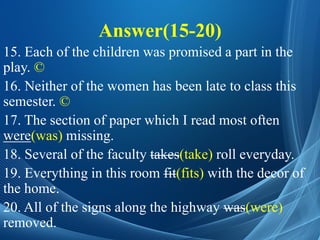
Answer(15-20)
15. Each of the children was promised a part in the
play. ©
16. Neither of the women has been late to class this
semester. ©
17. The section of paper which I read most often
were(was) missing.
18. Several of the faculty takes(take) roll everyday.
19. Everything in this room fit(fits) with the decor of
the home.
20. All of the signs along the highway was(were)
removed.
Reference
• SUBJECT/VERB AGREEMENT PS-16
Revised Summer 2012
• Practice #1 on Subject-Verb Agreement. Work
this practice and see your answers!
• Practice #2 on Subject-Verb Agreement. This
should help reinforce your understanding of
what subject-verb agreement actually means.
• Practice #3 on Subject-Verb Agreement. As you
progress through these exercises, you should
develop improved knowledge of this area of
grammar.
*Thank for your attention*

Slideshare ;subbject verb agreemet

  • 2.
    Table of content Introductionabout subject-verb agreement. Introduce about the important rule of subject- verb agreement.  Give some exercises for practice of each part .  Add more idea about how is different between Neither/Either, Few/a few. The last part we take 20 exercises relate to subject-verb agreement for make you understand.
  • 4.
    *Introduction about subject-verb agreement: • What is Subject-verb agreement? Subjects and verbs must AGREE with one another in number (singular or plural). Thus, if a subject is singular, its verb must also be singular; if a subject is plural, its verb must also be plural. Example 1. What is the problem? The problem is mathematic. 2. What are the problems? The problems are…. Singular subject Singular verb Plural subject Plural verb
  • 5.
    Now, let’s tryto learn some important rules. 1. If the subject is singular (one person, one thing), the verb must be singular. Ex. A good student does his homework.* • In the present tense a singular verb ends with an s.  The dog(-s) chases(+s) the cat. It chases the cat. In the present tense a singular verb ends with an s.
  • 6.
    Plural?? 2. If thesubject is plural (more than one person or thing), the verb must be plural. Ex. All good students listen to their teacher.*  The professors tell us how to make a good presentation. *Notice that the verb do/does not have(end) an s! Plural subject have +S Plural Verb NO -S
  • 7.
    PRACTICE EXERCISE A Underlinethe correct verb form (singular or plural). 1. The student (works, work). 2. He (studies, study) too. 3. All the students (walks, walk) to school. 4. These pictures (was, were) drawn by the instructor. 5. Children (wants, want) their parents to go to school.
  • 8.
    Check Answer 1. Thestudent (works, work). 2. He (studies, study) too. 3. All the students (walks, walk) to school. 4. These pictures (was, were) drawn by the instructor. 5. Children (wants, want) their parents to go to school.
  • 9.
    *Identify subject andverb 3. If words or phrases come between the subject and the verb, first isolate the subject and then decide on the correct verb form. Prepositional phrases can be real trouble makers, so if you don’t remember how to identify them, stop now and ask for a learning packet. Ex.1. The designs(with+s) on Indian pottery (fascinates, fascinate)>(-s) me. 2. They design dress very fascinate me. (The subject designs is plural; therefore, the verb must be plural. The plural verb is fascinate.
  • 10.
    PRACTICE EXERCISE B Ineach of the following sentences, underline the subject and the verb. 1. The buildings on each campus (was, were) recently completed. 2. All applications for the job (has, have) been received. 3. The chalkboards in the school (is, are) scratched. 4. Each year the winner from all the schools throughout the state (seems, seem) to be very much surprised.
  • 11.
    PRACTICE EXERCISE B Ineach of the following sentences, underline the subject and the verb. 1. The buildings on each campus (was, were) recently completed. 2. All applications for the job (has, have) been received. 3. The chalkboards in the school (is, are) scratched. 4. Each year the winner from all the schools throughout the state (seems, seem) to be very much surprised.
  • 12.
    Always Singular 4. Somewords that are often used as subjects are always singular. Memorize them!! (each, either, neither, no one, one, everyone, anyone, someone, anybody, somebody, everybody, nobody, everything.) Ex. Everybody wants to make good grades. Nobody knows about my life. Everything makes me fall in love to her.
  • 13.
    Always plural Some wordsthat are often used as subjects are always plural. Memorize them!! (Several, few, both, many, other) Ex. Several of the staff understand the idea of an attendance policy. **A few vs few** A few friends visited me. - Some friends visited me. Few friends visited me. - Hardly any friends visited me.
  • 14.
    Either Singular orplural Some words may be either singular or plural, depending on how they are used. (some, any, all, most) • Ex. Some of the fruit is rotten. (Some fruit is rotten.) • Some of the apples are rotten. (Some apples are rotten.) • All of this apple is rotten. (The entire apple is rotten.) • All of these apples are rotten. (All apples are rotten.)
  • 15.
    PRACTICE EXERCISE C Underlinethe correct form of the verb. 1. Some of the students (has, have) left the building. 2. Each of her students ( is, are) special. 3. Several on the team (hits, hit) the ball really hard. 4. Everything in the buildings (was, were) destroyed. 5. Neither of the men (meets, meet) his class every day.
  • 16.
    Check Answer 1. Someof the students (has, have) left the building. 2. Each of her students ( is, are) special. 3. Several on the team (hits, hit) the ball really hard. 4. Everything in the buildings (was, were) destroyed. 5. Neither of the men (meets, meet) his class every day.
  • 17.
    Compound Subject 5. Ifthe sentence has compound subjects (more than one subject) joined by and, the verb is usually plural. Ex. Vichet and John are twins. The beginning of the story (and) the end of the story were exciting. Ex. CRUSH song and I DO song are my favorite song for me.
  • 18.
    Or / norwith compound subject 6. When compound subjects are joined by or or nor, the verb must agree with the nearer subject. • Ex: Either the old men or the young man was responsible for the lovely music. • Neither the teacher nor the students are in class this morning. What is the difference between Either and Neither? ???????
  • 19.
    Either vs Neither *Either= one of the two alternative = this or that  I can speak either English or Khmer. Which is easier for you to understand? Neither= none= not this AND not the other. I can speak neither French nor Spanish. English Khmer French SpanishOR NOR
  • 20.
    PRACTICE EXERCISE D Underlinethe correct form of the verb: 1. Neither science nor math (gives, give) me a problem. 2. Either the cat or the dogs (greets, greet) me at the door. 3. Neither the men who are listen as administrators nor the woman who is also listed (has, have) been appointed to the board. 4. Either my cousin or my uncle (was, were) on the critical list. 5. Neither Ms. Jones nor a member of her staff (is, are) going to attend the meeting.
  • 21.
    Check Answer Underline thecorrect form of the verb: 1. Neither science nor math (gives, give) me a problem. 2. Either the cat or the dogs (greets, greet) me at the door. 3. Neither the men who are listen as administrators nor the woman who is also listed (has, have) been appointed to the board. 4. Either my cousin or my uncle (was, were) on the critical list. 5. Neither Ms. Jones nor a member of her staff (is, are) going to attend the meeting.
  • 22.
    Either There orHere 7. When a sentence begins with either there or here, the subject comes behind the verb. Ex. There is going to be just one student representative on the board. Here is making only one person.
  • 23.
    *REVIEW OF SUBJECT-VERBAGREEMENT *Directions: Some of the verbs in the following sentences agree with their subject(s); some do not. If the verb does not agree with the subject, underline it and write the correct form above it. Ex. Each of the students take (takes) the bus. 1. Dr. Jones and her mother teaches music. 2. Neither Dr. Jones nor her mother know how to boil water. 3. There is the list of courses that you were looking for. 4. Either you or your sister have to take notes on the lecture.
  • 24.
    Answer (1-4) 1. Dr.Jones and her mother teaches(teach) music. 2. Neither Dr. Jones nor her mother know (knows)how to boil water. 3. There is the list of courses that you were looking for. © 4. Either you or your sister have(has) to take notes on the lecture.
  • 25.
    5. Both theinstructors and the students has left for the day. 6. Spring classes was announced last week. 7. Here are the list of supplies which you ordered. 8. Everybody in this school have taken the shot that prevents measles. 9. Some of the students in her class enters the essay contest every year. 10. The women who registered early are going to get extra credit.
  • 26.
    Answer(5-10) 5. Both theinstructors and the students has(have) left for the day. 6. Spring classes was(were) announced last week. 7. Here are(is) the list of supplies which you ordered. 8. Everybody in this school have(has) taken the shot that prevents measles. 9. Some of the students in her class enters(enter) the essay contest every year. 10. The women who registered early are going to get extra credit. ©
  • 27.
    11. Mr. andMrs. Smith has been attending that conference for many years. 12. The students and Dr. Lee prepares the bulletin each month. 13. There goes one of the men who will conduct the research. 14. Some of that paper are going to be presented at the workshop. 15. Each of the children was promised a part in the play.
  • 28.
    Answer(11-15) 11. Mr. andMrs. Smith has(have) been attending that conference for many years. 12. The students and Dr. Lee prepares(prepare) the bulletin each month. 13. There goes one of the men who will conduct the research. © 14. Some of that paper are(is) going to be presented at the workshop. 15. Each of the children was promised a part in the play. ©
  • 29.
    15. Each ofthe children was promised a part in the play. 16. Neither of the women has been late to class this semester. 17. The section of paper which I read most often were missing. 18. Several of the faculty takes roll everyday. 19. Everything in this room fit with the decor of the home. 20. All of the signs along the highway was removed. • GET SUCCESS TO YOUR STUDY.
  • 30.
    Answer(15-20) 15. Each ofthe children was promised a part in the play. © 16. Neither of the women has been late to class this semester. © 17. The section of paper which I read most often were(was) missing. 18. Several of the faculty takes(take) roll everyday. 19. Everything in this room fit(fits) with the decor of the home. 20. All of the signs along the highway was(were) removed.
  • 31.
    Reference • SUBJECT/VERB AGREEMENTPS-16 Revised Summer 2012 • Practice #1 on Subject-Verb Agreement. Work this practice and see your answers! • Practice #2 on Subject-Verb Agreement. This should help reinforce your understanding of what subject-verb agreement actually means. • Practice #3 on Subject-Verb Agreement. As you progress through these exercises, you should develop improved knowledge of this area of grammar.
  • 32.
    *Thank for yourattention*