Past Simple
Active Voice / Passive Voice
We use the Past Simple Tense:
• to describe actions that started
in the past and were completed
at a specific time in the past.
We moved to a new house last year.
TIME EXPRESSIONS:
Yesterday, a week ago, last month, in
August, in 2010, before work, after
university, etc.
• for habitual or repeated actions
in the past (often with adverbs
of frequency).
We always went camping by the
lake in the summer.
• for completed actions that took
place one after the other in the
past.
Ann had breakfast, listened to the
news and went straight to work.
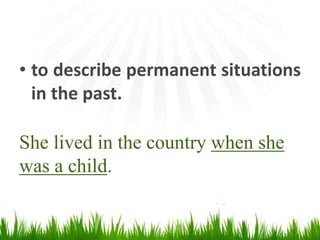
• to describe permanent situations
in the past.
She lived in the country when she
was a child.
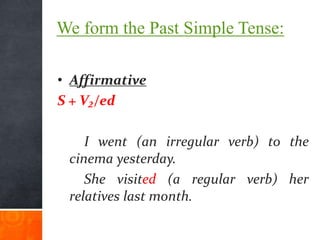
We form the Past Simple Tense:
• Affirmative
S + V₂/ed
I went (an irregular verb) to the
cinema yesterday.
She visited (a regular verb) her
relatives last month.
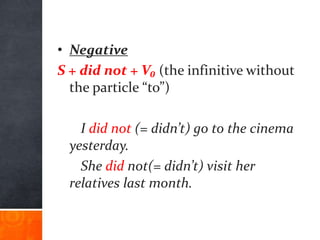
• Negative
S + did not + V₀ (the infinitive without
the particle “to”)
I did not (= didn’t) go to the cinema
yesterday.
She did not(= didn’t) visit her
relatives last month.
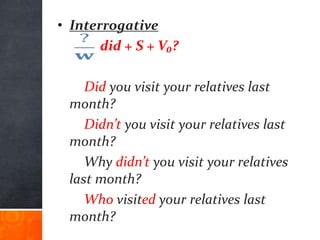
• Interrogative
did + S + V₀?
Did you visit your relatives last
month?
Didn’t you visit your relatives last
month?
Why didn’t you visit your relatives
last month?
Who visited your relatives last
month?
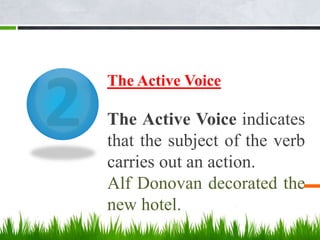
The Active Voice
The Active Voice indicates
that the subject of the verb
carries out an action.
Alf Donovan decorated the
new hotel.
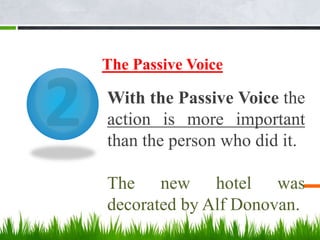
The Passive Voice
With the Passive Voice the
action is more important
than the person who did it.
The new hotel was
decorated by Alf Donovan.
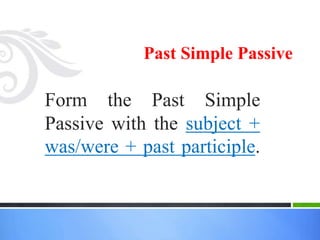
Past Simple Passive
Form the Past Simple
Passive with the subject +
was/were + past participle.
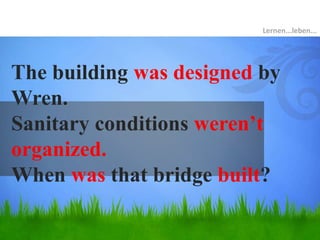
The building was designed by
Wren.
Sanitary conditions weren’t
organized.
When was that bridge built?
Lernen...leben...
Past simple active and passive voices

Past simple active and passive voices

  • 1.
    Past Simple Active Voice/ Passive Voice
  • 2.
    We use thePast Simple Tense: • to describe actions that started in the past and were completed at a specific time in the past. We moved to a new house last year.
  • 3.
    TIME EXPRESSIONS: Yesterday, aweek ago, last month, in August, in 2010, before work, after university, etc.
  • 4.
    • for habitualor repeated actions in the past (often with adverbs of frequency). We always went camping by the lake in the summer.
  • 5.
    • for completedactions that took place one after the other in the past. Ann had breakfast, listened to the news and went straight to work.
  • 6.
    • to describepermanent situations in the past. She lived in the country when she was a child.
  • 7.
    We form thePast Simple Tense: • Affirmative S + V₂/ed I went (an irregular verb) to the cinema yesterday. She visited (a regular verb) her relatives last month.
  • 8.
    • Negative S +did not + V₀ (the infinitive without the particle “to”) I did not (= didn’t) go to the cinema yesterday. She did not(= didn’t) visit her relatives last month.
  • 9.
    • Interrogative did +S + V₀? Did you visit your relatives last month? Didn’t you visit your relatives last month? Why didn’t you visit your relatives last month? Who visited your relatives last month?
  • 10.
    The Active Voice TheActive Voice indicates that the subject of the verb carries out an action. Alf Donovan decorated the new hotel.
  • 11.
    The Passive Voice Withthe Passive Voice the action is more important than the person who did it. The new hotel was decorated by Alf Donovan.
  • 12.
    Past Simple Passive Formthe Past Simple Passive with the subject + was/were + past participle.
  • 13.
    The building wasdesigned by Wren. Sanitary conditions weren’t organized. When was that bridge built? Lernen...leben...

Editor's Notes

  • #2 Эта презентация демонстрирует новые возможности PowerPoint. Ее рекомендуется просматривать в режиме показа слайдов. Эти слайды должны дать вам представление о том, какие эффектные презентации можно создать с помощью PowerPoint 2011. Для доступа к другим образцам шаблонов откройте меню "Файл", а затем щелкните "Создать из шаблона". В разделе "Шаблоны" щелкните "Презентации".