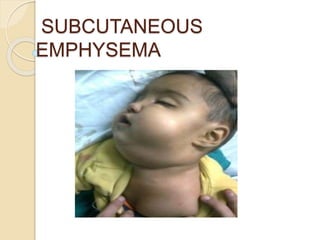
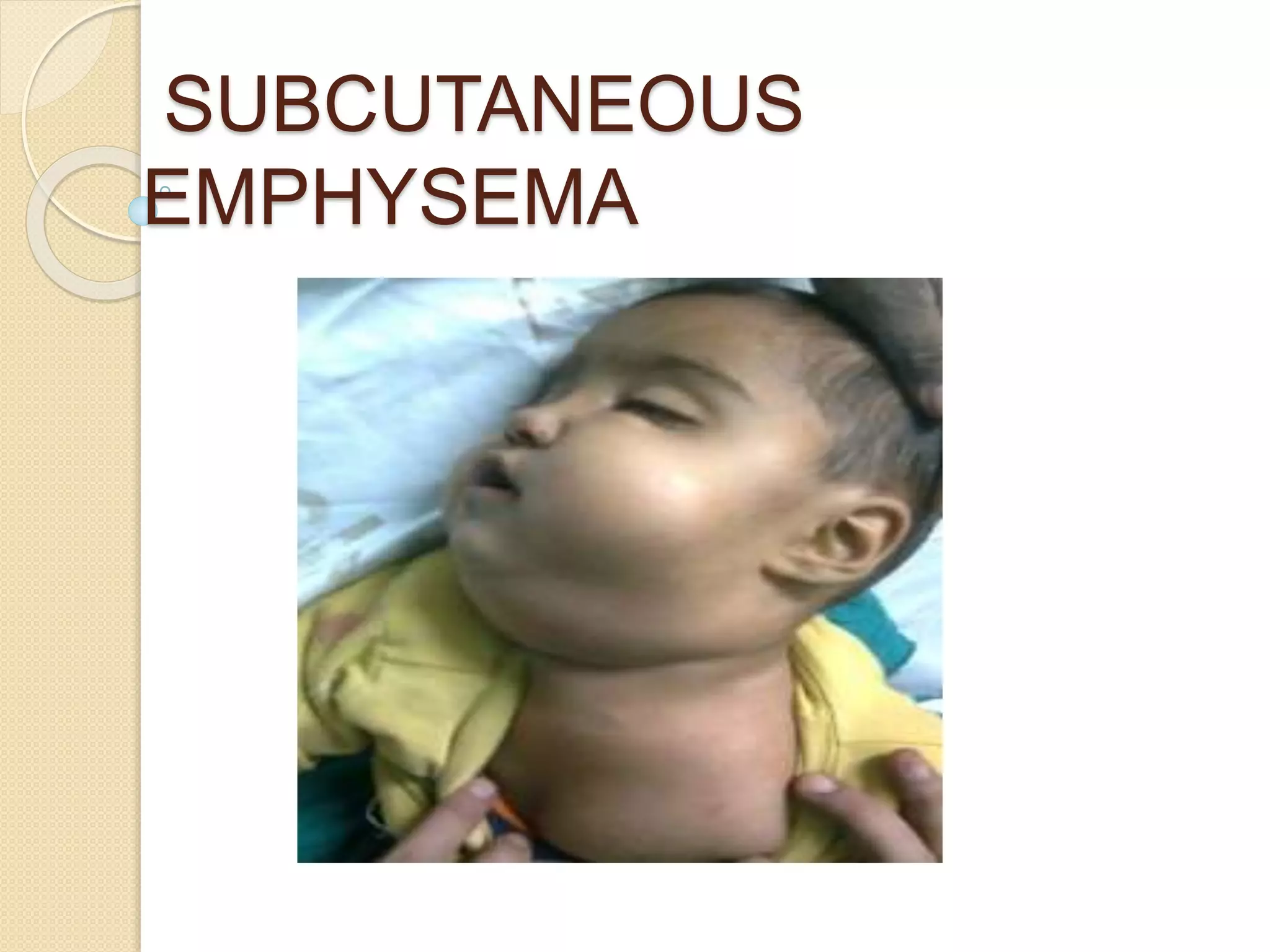
SUBCUTANEOUS
EMPHYSEMA
INTRODUCTION
 Emphysema - Greek word, ‘whick’ - ‘to
blow in.’
 Subcutaneous emphysema of the
head,neck, and thorax is caused by the
introduction of air into the fascial planes
of the connective tissue.
 Because of the looseness of the
connective tissue and its distensible
walls, air can accumulate in these
crevices and convert them into spaces of
considerable size.
 Periorbital emphysema is
subcutaneous emphysema that arises
when air is introduced into the
periorbital tissues.
 Subcutaneous emphysema arises
when air is forced, under pressure, into
the subcutaneous fascia leading to a
sudden
onset of soft tissue swelling
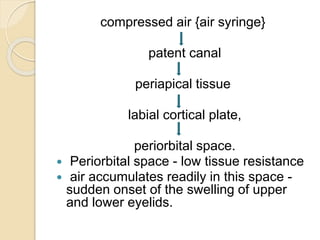
compressed air {air syringe}
patent canal
periapical tissue
labial cortical plate,
periorbital space.
 Periorbital space - low tissue resistance
 air accumulates readily in this space -
sudden onset of the swelling of upper
and lower eyelids.
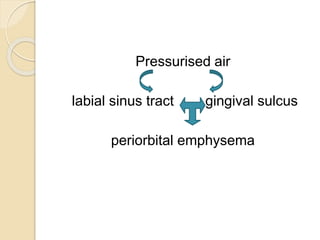
Pressurised air
labial sinus tract gingival sulcus
periorbital emphysema
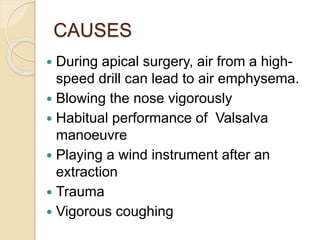
CAUSES
 During apical surgery, air from a high-
speed drill can lead to air emphysema.
 Blowing the nose vigorously
 Habitual performance of Valsalva
manoeuvre
 Playing a wind instrument after an
extraction
 Trauma
 Vigorous coughing
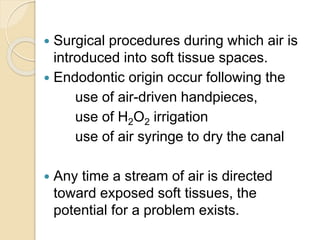
 Surgical procedures during which air is
introduced into soft tissue spaces.
 Endodontic origin occur following the
use of air-driven handpieces,
use of H2O2 irrigation
use of air syringe to dry the canal
 Any time a stream of air is directed
toward exposed soft tissues, the
potential for a problem exists.
Signs & symptoms
 Immediate
 Local soft skin-
coloured swelling
without redness
 Crepitus
 Local discomfort
 Subsequent
 Diffuse swelling
 Local erythema
 Pyrexia and Pain
 Hayduk et al. regard crepitus as
pathognomonic of tissue space emphysema
which allows one to quickly rule out
anaphylactic reaction.
 Dysphagia
 Dyspnea: Migration of air into the neck region
could cause respiratory difficulty, and
progression into the mediastinum could
cause death.
 Pain is a variable feature of
subcutaneous emphysema and
patients usually complain of
discomfort due to soft tissue
distension.
 Unlike irrigant extrusion reactions,
tissue space emphysema remains in
the subcutaneous connective tissue
and usually does not spread to the
deep anatomic spaces
 Alarming to the patient and clinician.
 Rarely,serious complications such as
pneumomediastinum and airway
compromise are seen.
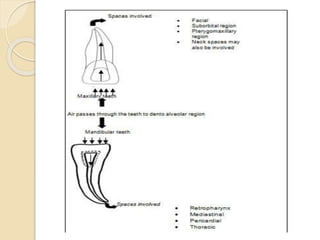
 On rare occasions trapped air can
spread along the fascial planes to the
periorbital,
mediastinal,parapharyngeal,
pericardial and thoracic spaces
causing serious and life threatening
complications.
 Its occurrence in conjunction with
a dental procedure was first reported
more
than a hundred years ago when Turnbull
extracted the premolar of a musician who
blew his bugle immediately after
extraction.
MANAGEMENT
 Usually a benign condition that
resolves over 3–10 days as the gas is
resorbed into the blood stream for
eventual excretion via the lungs
 Supportive management
 Most authors, however, recommend a
course of prophylactic antibiotics,
most commonly penicillin and
analgesics for 10 days to prevent
secondary infection from
dissemination of oral flora along the
emphysematous tract
 Cough suppressants may be
prescribed to prevent further air entry
into the fascial planes
 A follow-up appointment within 48
hours is imperative to monitor
resolution and signs of infection
 Severe cases, hospitalization may be
necessary for observation and follow-
up radiographs
 Administration of 100% oxygen via a
non breather mask can hasten the
resolution of emphysema because
oxygen, which replaces the air, is more
readily absorbed.
 Nitrous oxide sedation: the
administration of nitrous oxide should
be discontinued because the gas will
diffuse into the air spaces and increase
the volume of trapped air.
PREVENTION
 Avoiding the use of direct
compressed air to dry root canals.
 Using remote exhaust handpieces or
electric motor driven ones.
 Avoiding the use of hydrogen
peroxide as a root canal irrigant.
 Using sterile cotton pellets and
endodontic paper points to dry root
canals.
 In surgical procedures, once a flap is
reflected, apical access can be made
with the slowspeed or high-speed
handpieces that do not direct jets of
air into surgery sites
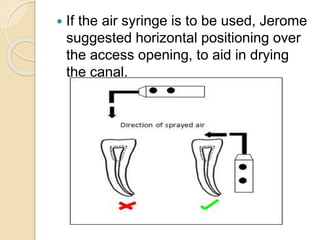
 If the air syringe is to be used, Jerome
suggested horizontal positioning over
the access opening, to aid in drying
the canal.
CONCLUSION
 Subcutaneous emphysema is a rare but
potentially serious complication of root
canal treatment.
 Characterised by sudden onset of soft
tissue swelling, associated with crepitus,
during or shortly after the procedure.
 Introduction of compressed air into
tissue spaces via patent canals, sinus
tracts, soft tissue lacerations, or gingival
sulcus is the underlying mechanism in
most cases.
 Therefore, blowing compressed air
into root canals should be avoided and
paper points should be used to dry
root canals.
 The majority of cases are managed
conservatively and patients should be
advised as to the nature of
emphysema
REFERENCES
 A. Al-Qudah, F. Amin and Y. Hassona.
Periorbital emphysema during
endodontic retreatment of an upper
central incisor:a case report:British
Dental Journal nov 9 2013; 215(9)
 Dr. Abdul Hameed.Periorbital
emphysema unexpected
complication;Your Guide on the path
of Dentistry.
 Rakesh K. Yadav ,Anil Chandra ,A. P.
Tikku, K. K.Wadhwani,Promila verma;
Air emphysema - an in office
emergency: A case report.
 Lora Mishra, Swarnav Patnaik,
Sangram Patro, Nitai Debnath,
Satyaranjan Mishra. Iatrogenic
Subcutaneous Emphysema of
Endodontic Origin – Case Report with
Literature Review. Journal of Clinical
and Diagnostic Research. 2014 Jan,
8(1): 279-281
 Manon Paquette. Subcutaneous
Emphysema; Clinical Images in Oral
Medicine and Maxillofacial Radiology

Subcutaneous emphysema

  • 1.
  • 2.
    INTRODUCTION  Emphysema -Greek word, ‘whick’ - ‘to blow in.’  Subcutaneous emphysema of the head,neck, and thorax is caused by the introduction of air into the fascial planes of the connective tissue.  Because of the looseness of the connective tissue and its distensible walls, air can accumulate in these crevices and convert them into spaces of considerable size.
  • 3.
     Periorbital emphysemais subcutaneous emphysema that arises when air is introduced into the periorbital tissues.  Subcutaneous emphysema arises when air is forced, under pressure, into the subcutaneous fascia leading to a sudden onset of soft tissue swelling
  • 4.
    compressed air {airsyringe} patent canal periapical tissue labial cortical plate, periorbital space.  Periorbital space - low tissue resistance  air accumulates readily in this space - sudden onset of the swelling of upper and lower eyelids.
  • 5.
    Pressurised air labial sinustract gingival sulcus periorbital emphysema
  • 6.
    CAUSES  During apicalsurgery, air from a high- speed drill can lead to air emphysema.  Blowing the nose vigorously  Habitual performance of Valsalva manoeuvre  Playing a wind instrument after an extraction  Trauma  Vigorous coughing
  • 7.
     Surgical proceduresduring which air is introduced into soft tissue spaces.  Endodontic origin occur following the use of air-driven handpieces, use of H2O2 irrigation use of air syringe to dry the canal  Any time a stream of air is directed toward exposed soft tissues, the potential for a problem exists.
  • 8.
    Signs & symptoms Immediate  Local soft skin- coloured swelling without redness  Crepitus  Local discomfort  Subsequent  Diffuse swelling  Local erythema  Pyrexia and Pain
  • 9.
     Hayduk etal. regard crepitus as pathognomonic of tissue space emphysema which allows one to quickly rule out anaphylactic reaction.  Dysphagia  Dyspnea: Migration of air into the neck region could cause respiratory difficulty, and progression into the mediastinum could cause death.
  • 10.
     Pain isa variable feature of subcutaneous emphysema and patients usually complain of discomfort due to soft tissue distension.  Unlike irrigant extrusion reactions, tissue space emphysema remains in the subcutaneous connective tissue and usually does not spread to the deep anatomic spaces
  • 12.
     Alarming tothe patient and clinician.  Rarely,serious complications such as pneumomediastinum and airway compromise are seen.  On rare occasions trapped air can spread along the fascial planes to the periorbital, mediastinal,parapharyngeal, pericardial and thoracic spaces causing serious and life threatening complications.
  • 13.
     Its occurrencein conjunction with a dental procedure was first reported more than a hundred years ago when Turnbull extracted the premolar of a musician who blew his bugle immediately after extraction.
  • 14.
    MANAGEMENT  Usually abenign condition that resolves over 3–10 days as the gas is resorbed into the blood stream for eventual excretion via the lungs  Supportive management
  • 15.
     Most authors,however, recommend a course of prophylactic antibiotics, most commonly penicillin and analgesics for 10 days to prevent secondary infection from dissemination of oral flora along the emphysematous tract  Cough suppressants may be prescribed to prevent further air entry into the fascial planes
  • 16.
     A follow-upappointment within 48 hours is imperative to monitor resolution and signs of infection  Severe cases, hospitalization may be necessary for observation and follow- up radiographs
  • 17.
     Administration of100% oxygen via a non breather mask can hasten the resolution of emphysema because oxygen, which replaces the air, is more readily absorbed.  Nitrous oxide sedation: the administration of nitrous oxide should be discontinued because the gas will diffuse into the air spaces and increase the volume of trapped air.
  • 18.
    PREVENTION  Avoiding theuse of direct compressed air to dry root canals.  Using remote exhaust handpieces or electric motor driven ones.  Avoiding the use of hydrogen peroxide as a root canal irrigant.
  • 19.
     Using sterilecotton pellets and endodontic paper points to dry root canals.  In surgical procedures, once a flap is reflected, apical access can be made with the slowspeed or high-speed handpieces that do not direct jets of air into surgery sites
  • 20.
     If theair syringe is to be used, Jerome suggested horizontal positioning over the access opening, to aid in drying the canal.
  • 21.
    CONCLUSION  Subcutaneous emphysemais a rare but potentially serious complication of root canal treatment.  Characterised by sudden onset of soft tissue swelling, associated with crepitus, during or shortly after the procedure.  Introduction of compressed air into tissue spaces via patent canals, sinus tracts, soft tissue lacerations, or gingival sulcus is the underlying mechanism in most cases.
  • 22.
     Therefore, blowingcompressed air into root canals should be avoided and paper points should be used to dry root canals.  The majority of cases are managed conservatively and patients should be advised as to the nature of emphysema
  • 23.
    REFERENCES  A. Al-Qudah,F. Amin and Y. Hassona. Periorbital emphysema during endodontic retreatment of an upper central incisor:a case report:British Dental Journal nov 9 2013; 215(9)  Dr. Abdul Hameed.Periorbital emphysema unexpected complication;Your Guide on the path of Dentistry.
  • 24.
     Rakesh K.Yadav ,Anil Chandra ,A. P. Tikku, K. K.Wadhwani,Promila verma; Air emphysema - an in office emergency: A case report.  Lora Mishra, Swarnav Patnaik, Sangram Patro, Nitai Debnath, Satyaranjan Mishra. Iatrogenic Subcutaneous Emphysema of Endodontic Origin – Case Report with Literature Review. Journal of Clinical and Diagnostic Research. 2014 Jan, 8(1): 279-281
  • 25.
     Manon Paquette.Subcutaneous Emphysema; Clinical Images in Oral Medicine and Maxillofacial Radiology