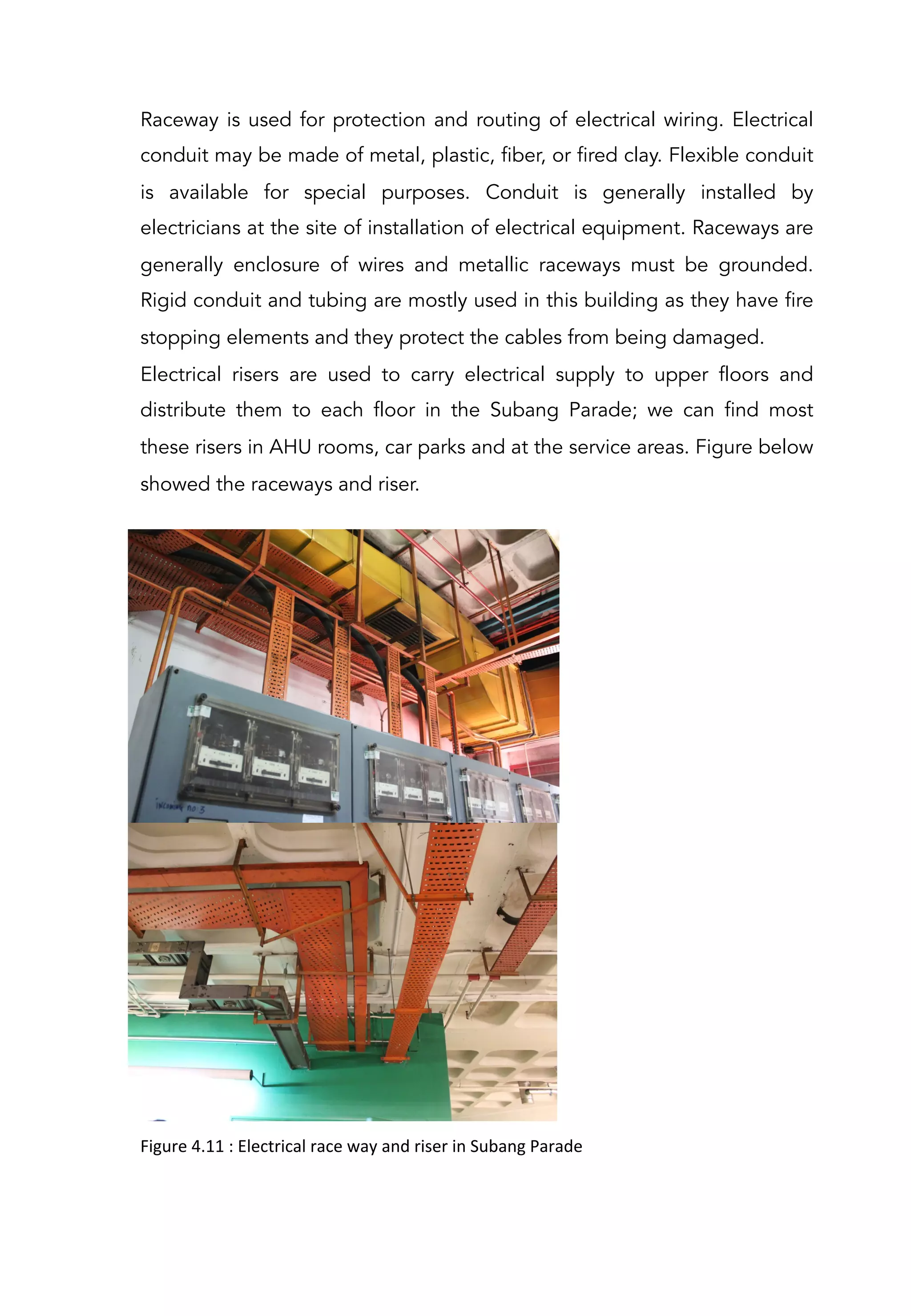
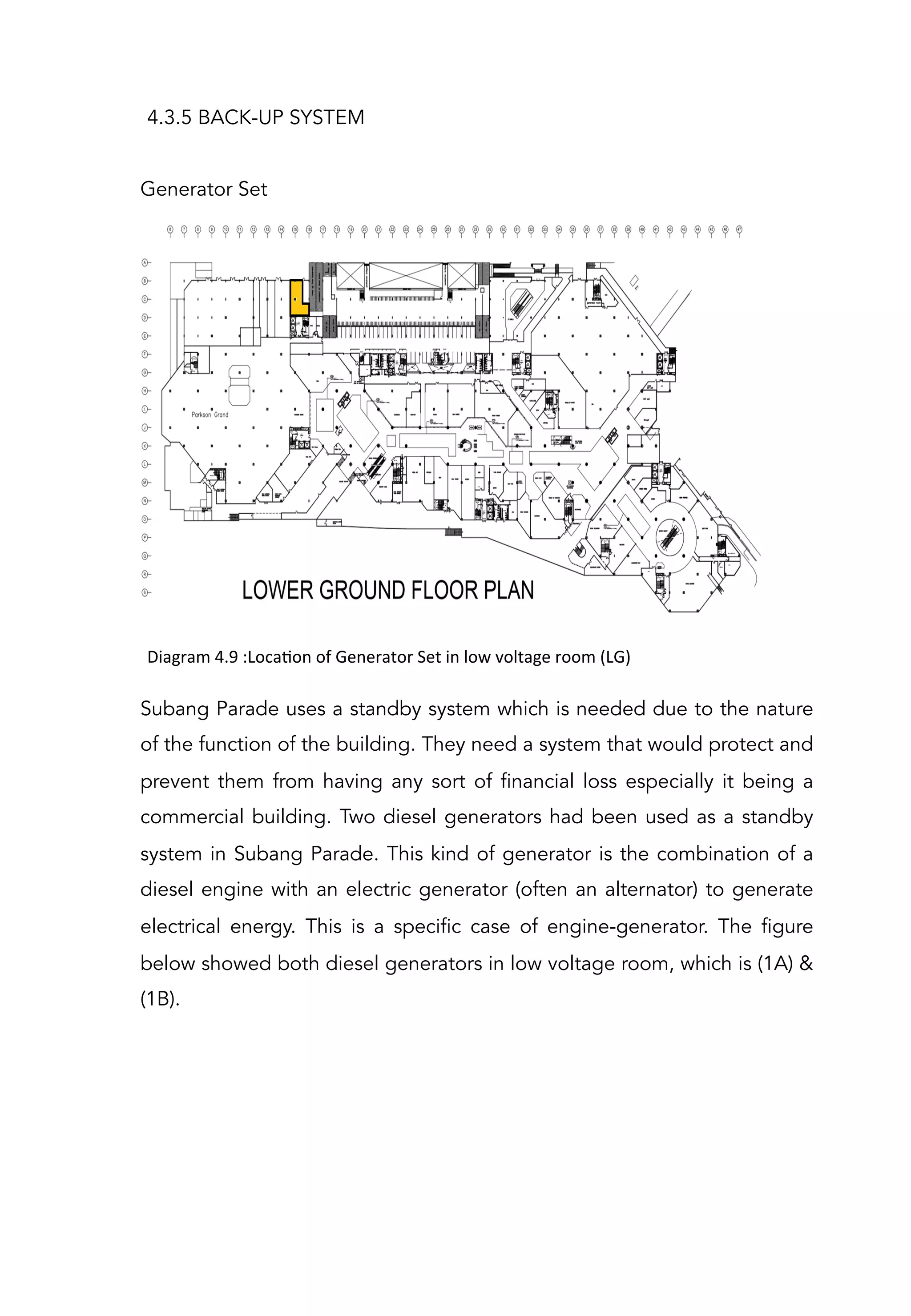
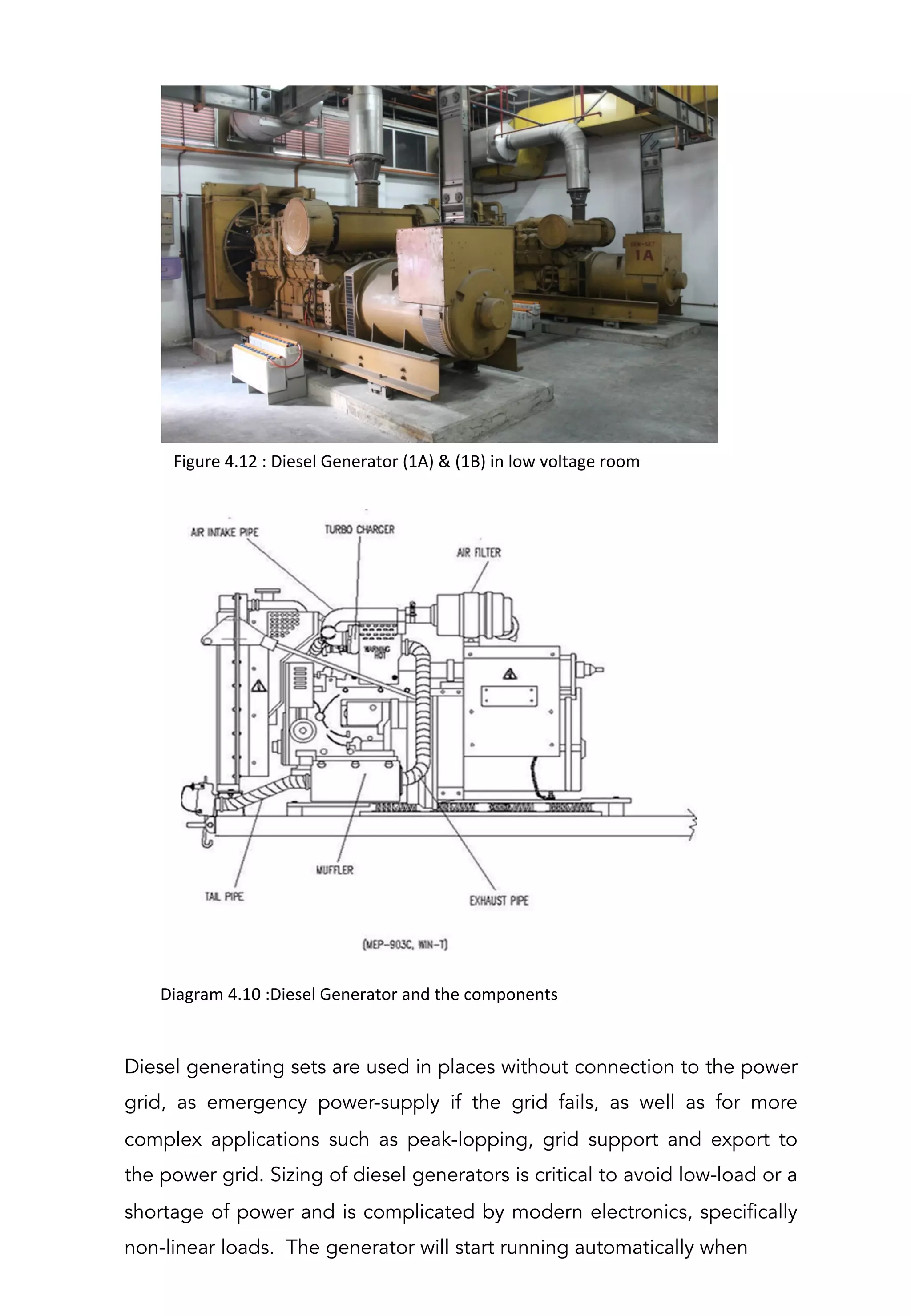
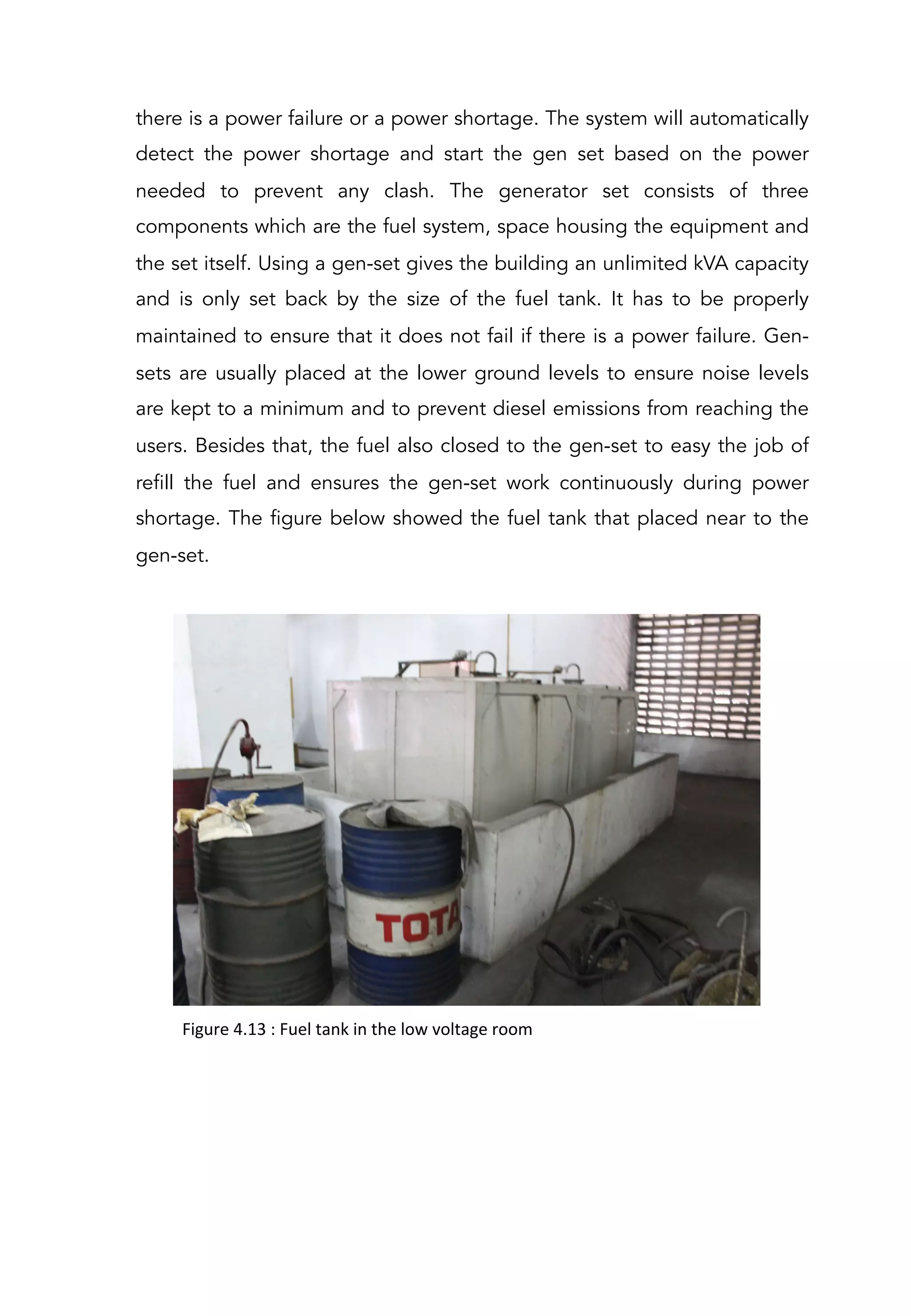
RESEARCH REPORT ON BUILDING SERVICES of
SUBANG PARADE,
Subang Jaya, Selangor, Malaysia.


  Tutor: MR SANJAY
 
 
0302966
0303127
0303646
0316922
0302970
0303128
LEE YIANG SIANG
LING TECK ONG
POH WEI KEAT
ALEX CHUNG KA SENG
LEE CHEE SIONG
ZERROX TAN AIK KAH
Table of Contents
 
1.0 Introduction
1.1 Abstract
1.2 Acknowledgement
2.0 Air Conditioning System
2.1 Introduction
2.2 Literature Review
2.2.1 Central Plant System
2.2.2 Cooling System
2.2.3 Air-Handling Units (AHU)
2.2.4 Fan Coil Units (FCU)
2.3 Case Study
2.3.1 Introduction
2.3.2 Cooling Tower
2.3.3 Chilled Water System
2.3.4 Air-Handling Units (AHU Room)
2.3.5 Fan Coil Units (FCU)
2.3.6 Diffusers
2.3.7 Duct System
2.3.8 Pipe System
2.4 Analysis
2.5 Conclusion
3.0 Fire Safety System
3.1 Literature Review
3.2 Aim
3.2.1 Education
3.2.2 Passive Fire Protection
3.2.3 Active Fire Protection
3.3 Active Fire Protection
3.3.1 Smoke Detector
3.3.2 Fire Control Room
3.3.3 Manual Pull Station
3.3.4 Fireman Intercom Station
3.3.5 Fire Alarm
3.3.6 Manual Call Point
3.3.7 Non-Water Based System
3.3.8 Classification and Use
3.3.9 Automatic Sprinkler System
3.3.10 Typical Deluge System
3.3.11 Water Based System
3.3.12 Fire Pump Room
3.4 Passive Fire Protection System
3.4.1 Emergency Exit Signage
3.4.2 Fire Escape Door
3.4.3 Door Closer-
3.4.4 Fire Escape Staircase
3.4.5 Railings
3.5 Conclusion
4.0 Electrical System
4.1 Intoduction
4.2 Literature Review
4.2.1 Power Transmission
  4.2.2 Devices
4.3 Case Study
  4.3.1 Electrical Distribution System
  4.3.2 High Voltage, Transformer
Room & Low Voltage Room
  4.3.3 High Tension Switch Gear
  4.3.4 Raceway, Conductor Electrical
Riser
  4.3.5 Back Up System
4.4 Analysis
4.5 Conclusion
5.0 Water Supply System
5.1 Introduction
5.2 Literature Review
5.3 Case Study
  5.3.1 Water Storage
  5.3.2 Water Supply
  5.3.3 Fire-Flow Requirements
  5.3.4 Pump Systems
  5.3.5 Cold Water Systems
  5.3.6 Piping-
  5.3.7 Maintenance
5.4 Analysis
5.5 Conclusion
6.0 Wastewater Disposal System
6.1 Introduction
6.2 Literature Review
6.3.1 Sanitary Appliances
6.3.2 Traps
6.3.3 Sump
6.3.4 Stack
6.3.5 Septic Tank
6.3.6 Manholes
6.3.7 Drainage
6.3.8 Insulation
6.4 Analysis
6.5 Conclusion
7.0 Mechanical Transportation System
7.1 Introduction
7.2 Literature Review
7.3 Elevators
  7.3.1 Case Study
  7.3.2 Geared Traction Elevator
  7.3.3 Plunger Hydraulic Elevator
  7.3.4 Elevator Car Control
  7.3.5 Requirements of Elevators
  7.3.6 Special Considerations
7.4Escalators
7.4.1 Case Study
  7.4.2 Escalator Arrangement
  7.4.3 Location
  7.4.4 Size, Speed, Capacity and Rise
  7.4.5 Components
  7.4.6 Safety Features
  7.4.7 Fire Protection
  7.5 Conclusion
8.0 References 
 
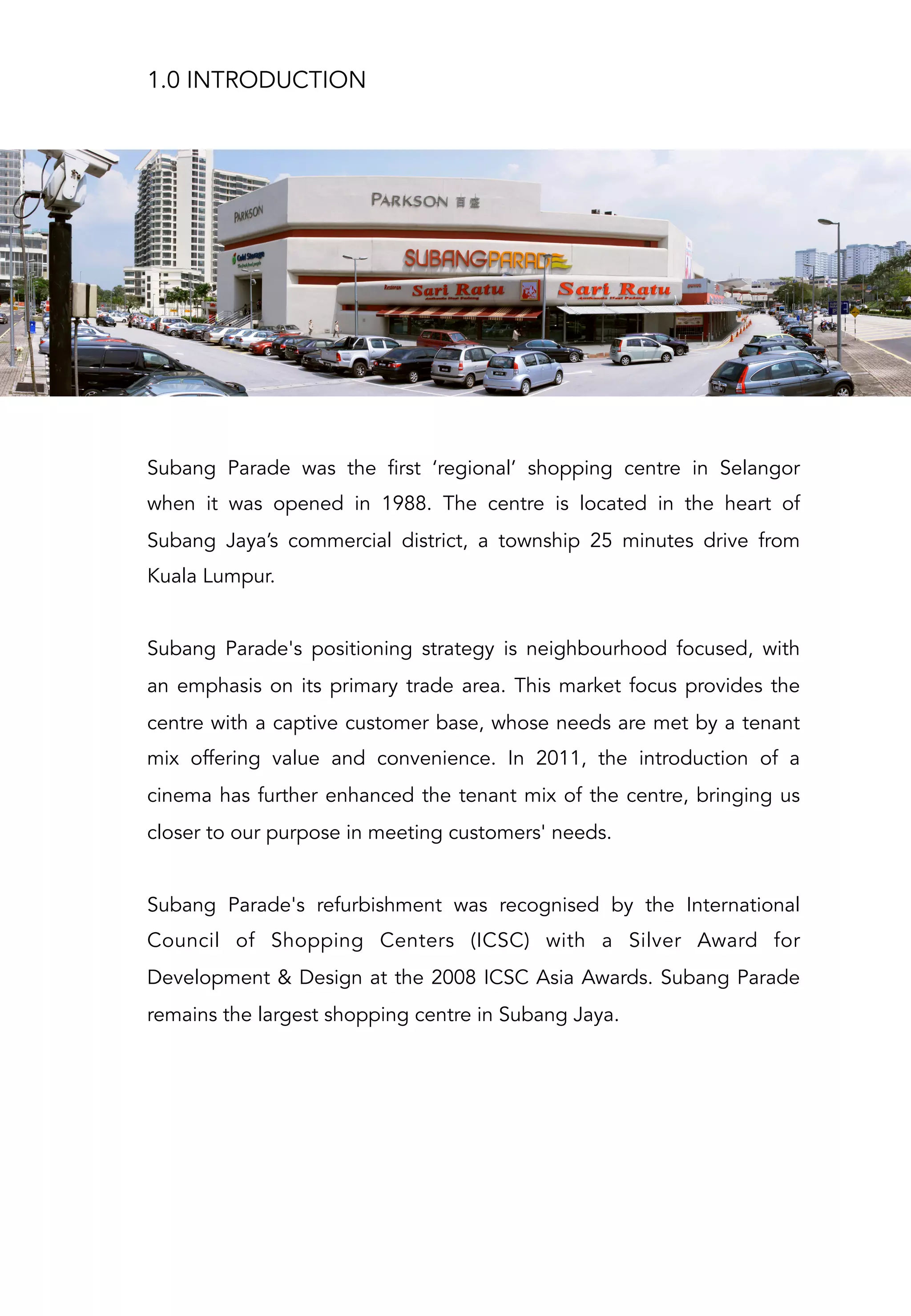
Subang Parade was the first ‘regional’ shopping centre in Selangor
when it was opened in 1988. The centre is located in the heart of
Subang Jaya’s commercial district, a township 25 minutes drive from
Kuala Lumpur.
Subang Parade's positioning strategy is neighbourhood focused, with
an emphasis on its primary trade area. This market focus provides the
centre with a captive customer base, whose needs are met by a tenant
mix offering value and convenience. In 2011, the introduction of a
cinema has further enhanced the tenant mix of the centre, bringing us
closer to our purpose in meeting customers' needs.
Subang Parade's refurbishment was recognised by the International
Council of Shopping Centers (ICSC) with a Silver Award for
Development & Design at the 2008 ICSC Asia Awards. Subang Parade
remains the largest shopping centre in Subang Jaya.
1.0 INTRODUCTION
1.1 ABSTRACT
The research report will be looking into the workings of the services system
in the Subang Parade such as the Air conditioning and ventilation systems,
Fire safety systems, Electricity supply system, Water supply system and the
Sewerage system. The report will aim at introducing the fundamentals of all
the mentioned systems as well as an analysis of the system and the
advantages and disadvantages that have been analyzed and synthesized to
our own understanding and also based on the regulations of buildings and
its services such as Uniform Building By Law and also Malaysian Standards.
Requirements and adherence will also be analyzed based on each services
respected controlling arm.
1.2 ACKNOWLEDGEMENT
We would like to extend our gratitude to each individual that has helped
and assisted us to complete this research report which without your
involvement, this report would be insufficient and unsatisfactory. A special
thanks we would like to give to Mr. Sanjay for guiding us through each
tutorial and providing us with an aim to accomplish.
We would also like to thank the staffs at Subang Parade, especially Mr.
Rahman for welcoming and giving us an insight into the services system
incorporated into the building and also for being patient and understanding
of us during our visit there.
2.0 AIR-CONDITIONING SYSTEM
2.1 INTRODUCTION
This research paper discuss about the Thermal Control of our chosen
case study building, Subang Parade Mall through this research, we can learn
about the air-conditioning system of the building chosen and have a well and
deep-understanding to it.
The thermal comfort can be easily achieved once this system had been
introduced. Besides, it helps to redraw in the natural air from outside and
expel the state air to create better ventilation as well as the air circulation
within the building. It is also able to control the temperature and the air purity
within the building.
In Subang Parade Mall, there is only a mechanical system in a building
that provides fresh air. It removes unwanted air from the building. Air-
conditioning system in this mall where all the components within the system
will be explained in detail. The components of the air-conditioning will be
studied based on the following sequence:
•  Cooling tower
•  Chilled water system
•  Air-handling unit (AHU)
•  Fan coil unit (FCU)
•  Supply air diffusers
•  Return air grilles
•  Ductwork
•  Piping system
In accordance with rules and standards are also being investigate. Rules
and standards have been set by various bodies to ensure that quality air is
provided via the air-conditioning system. The standards used to examine here
is MS1525.
2.2 LITERATURE REVIEW
Air-conditioning system is important to improve indoor air quality of a building.
air-condition accomplishes four functions at the same time; they are to control air-
temperature, control air humidity, air-circulation and air quality. There are many different
types of air-conditioning found in the industry and they are usually classified according to
how the condenser is being cooled. They are the air-cooled condenser, which uses air to
cool the condenser; the water-cooled condenser, which uses water to cool the condenser;
the direct expansion, which uses evaporator to cool the air directly.  
2.2.1 Central Plant System
Central plant system has one central source of conditioned air that is
distributed in a network of ductwork. Thus, it is usually used in large buildings as the
equipment is bulky. The room air-conditioning units are self-contained package, which are
usually positioned in every room to provide cool air. Most air-conditioning system these
days in Malaysia uses water-cooled system, which uses cooling tower.  
2.2.2 Cooling System
All air-systems transfer cool-air from a central plant through the duct system as
mentioned above, which then distributes the air specific diffusers and into the individual
rooms of the building. Water-cooled system uses chiller plant to produce water that is
pumped into fan coil units found in AHU rooms. Heat rejected from room to water is then
pumped back into chiller unit where it is rejected by a condenser (water directed from
cooling tower). Water is then chilled again and pumped back to the rooms.
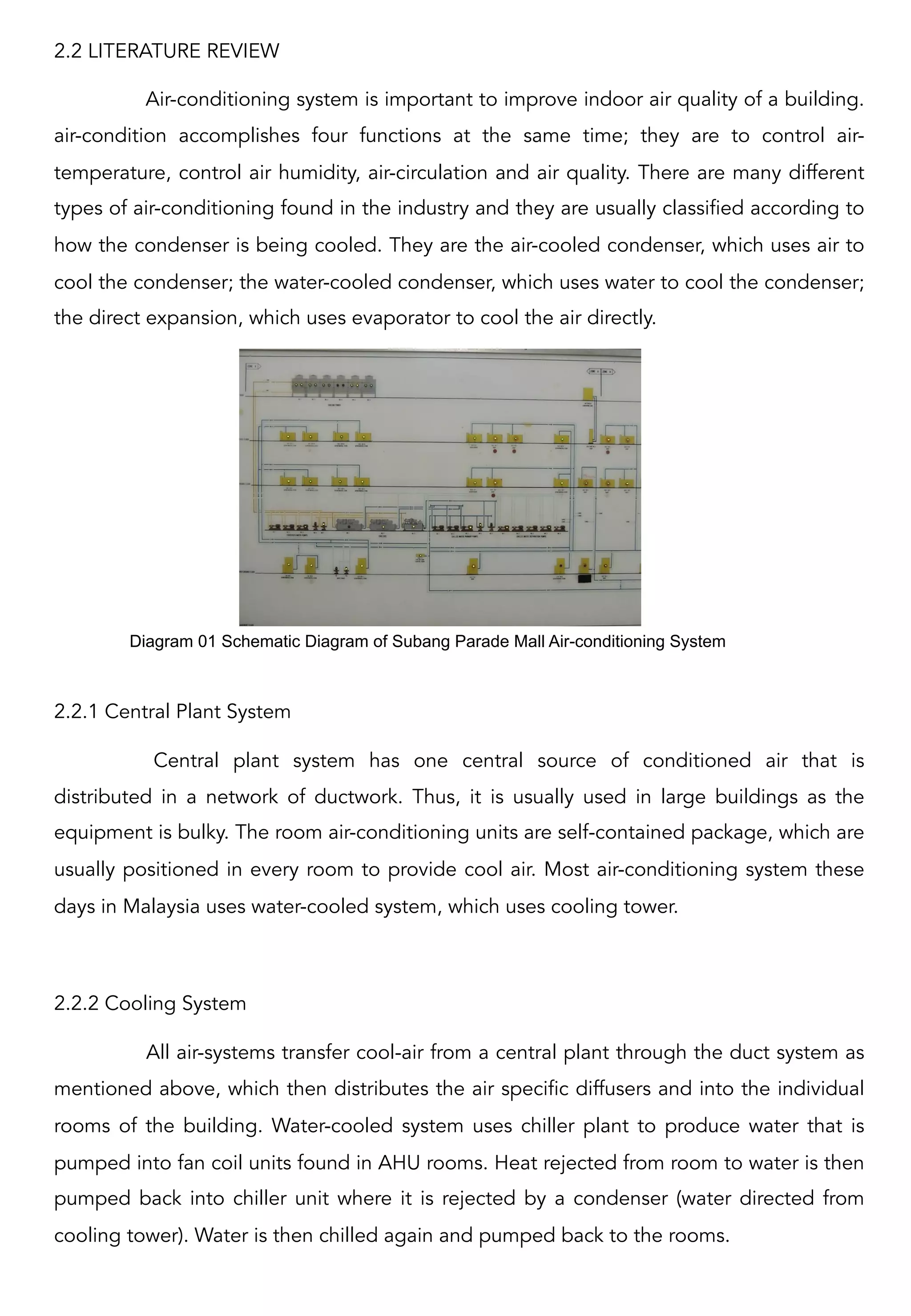
Diagram 01 Schematic Diagram of Subang Parade Mall Air-conditioning System	
  
There is another type of cooling system called the direct expansion
system (DX system) that generally operates split or multi-split systems.
This system is usually used in smaller buildings or residential areas. The
refrigerant carries rejected room heats though a dry coil and fan. Then,
the refrigerant is compressed into liquid again by the compressor and
the cycle repeats. A DX system is a system in which the refrigerant
expands directly inside a coil to effect the cooling of the air.
2.2.2.1 ALL-AIR SYSTEM
All air-systems transfer cool-air from a central plant through
the duct system which then distributes the air specific diffusers and
into the individual rooms of the building. It normally comprises the
cheapest equipment cost, but is not necessarily easy or cheap.
 
2.2.2.2 ALL-WATER SYSTEM
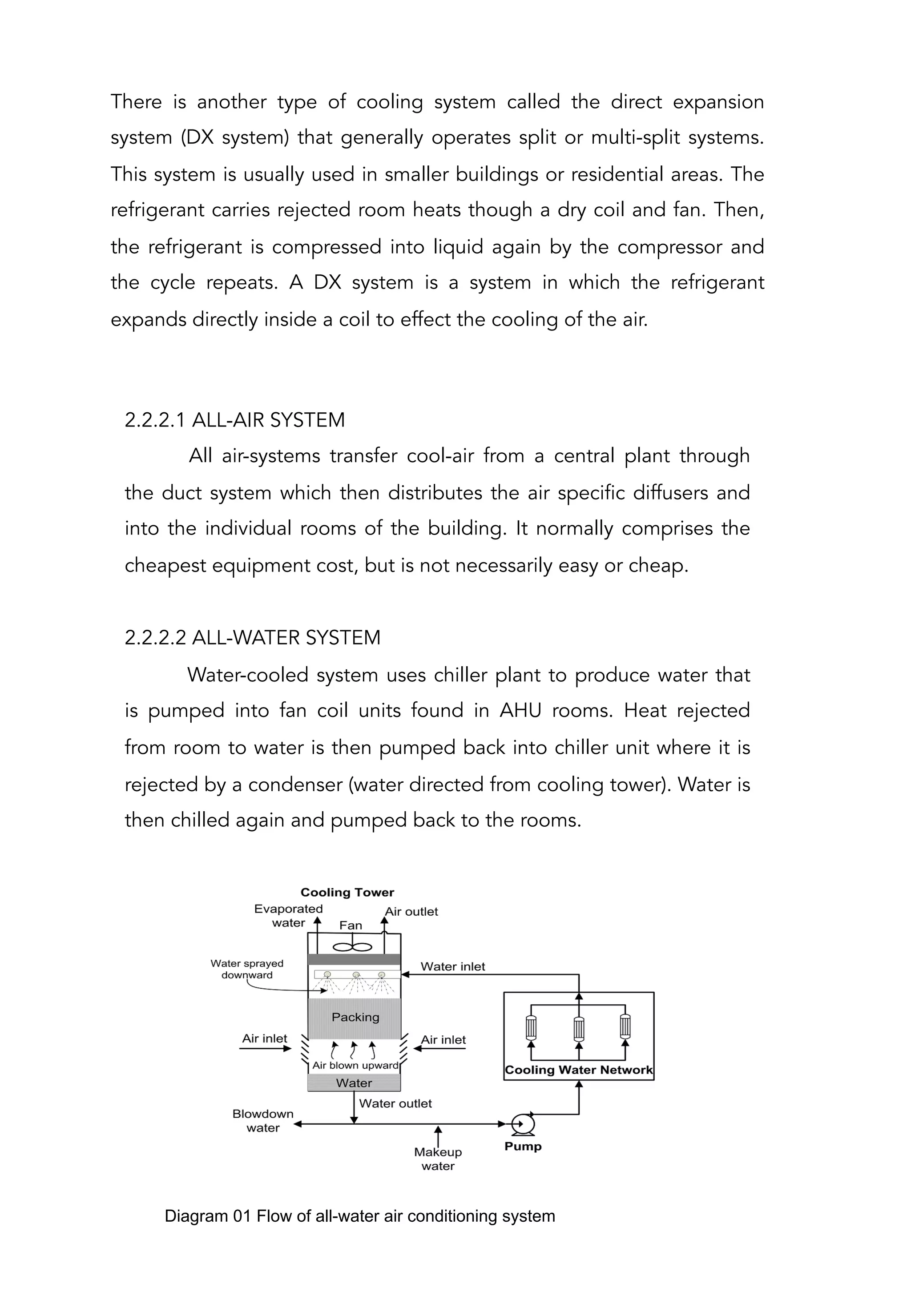
Water-cooled system uses chiller plant to produce water that
is pumped into fan coil units found in AHU rooms. Heat rejected
from room to water is then pumped back into chiller unit where it is
rejected by a condenser (water directed from cooling tower). Water is
then chilled again and pumped back to the rooms.
Diagram 01 Flow of all-water air conditioning system	
  
2.2.2.3 DIRECT EXPANSION SYSTEM (DX SYSTEM)
The DX system generally operates split or multi-split systems. This system is
usually used in smaller buildings or residential areas. The refrigerant carries rejected room
heats though a dry coil and fan. Then, the refrigerant is compressed into liquid again by
the compressor and the cycle repeats. A DX system is a system in which the refrigerant
expands directly inside a coil to effect the cooling of the air.
 
2.2.3 AIR-HANDLING UNITS (AHU)
All basic air-handling units have an AHU. The AHU functions to supply constant
airflow, draw air in from outside, filter any pollutants, control temperature, and deliver
fresh air into the distribution system. AHU is made up of a number of components. There
is an electrically driven fan to push the air through the distribution system; another fan is
used to extract air from the return ductwork. Then, a filter is used to remove solid
pollutant. A cooling coil, found in the AHU, uses cool water that circulates from the chiller
plant, cools the air before distributing it to the diffusers.
2.2.4 FAN COIL UNITS (FCU)
Fan coil units are also found in the air-conditioning system, it acts similar to an
induction system. The difference is that the fan coil unit replaces the induction unit. The
fan coil consists of finned-tube coil and a fan section. The fan section circulates air
continuously though the coils. The coils are constantly supplied with cool water.
2.3 CASE STUDY
2.3.1 INTRODUCTION
The Subang Parade Mall is a huge shopping mall located at
Subang area; due to the building size, it utilizes a general central air-
conditioning system. This system is very appropriate for big buildings as it is
efficient in providing high cooling loads, which needs to be cooled at all
times (Eg. Shopping malls, hospitals). This system works by distributing cool
air to all areas via a duct system, then to a complex plan of diffusers form
specific AHU rooms found in a building. The desired temperature of building
can be controlled in the AHU rooms. If one specific AHU unit fails to work,
the whole designated area for that particular AHU would fail as well. The
quantity of AHU in each floors are suggested by the built up area and the
users as well. In this case of the Subang Parade Mall, 6 AHU are found in
each floors.
Instead of an air-cooled system or direct expansion system
explained under literature review, the Subang Parade Mall uses the Central
Air-conditioning system. The main components of Central Air-conditioning
system are cooling tower, chiller units, AHU, duct system and diffusers.
Chiller unit is a device used to remove heat from liquid through the
absorption refrigerant cycle. The condenser used in this particular case of
Subang Parade Mall is called the Water Cooled Condenser. Cooling tower
located at the rooftop functions to cool the water pumped by the condenser.
Condenser transfers the heat inside chiller plant to water. The water will then
be cooled and the cycle will be repeated.
CENTRAL AIR-CONDITIONING SYSTEM
2.3.2 COOLING TOWER
Cooling towers are devices that extract heat out to the atmosphere from the
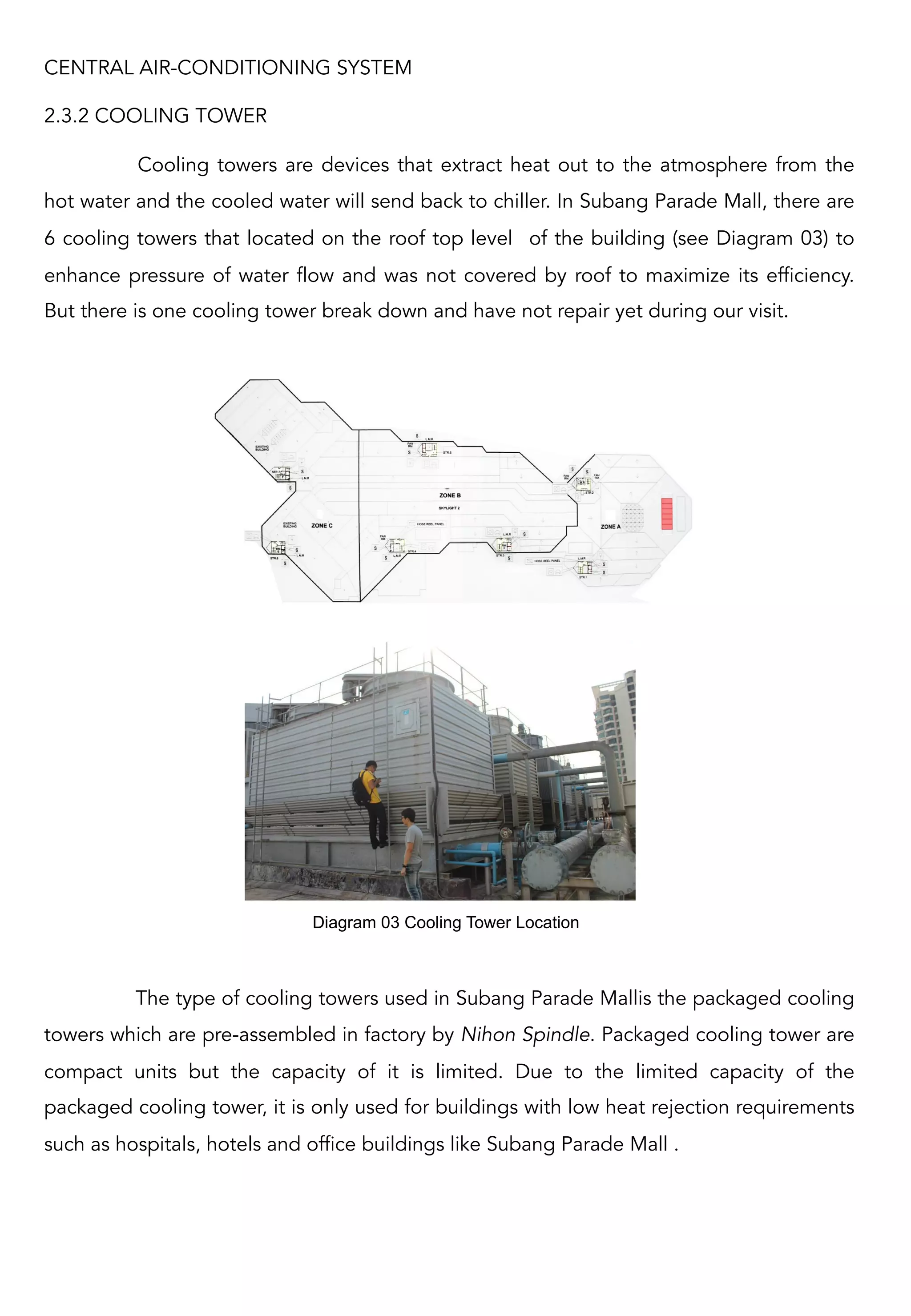
hot water and the cooled water will send back to chiller. In Subang Parade Mall, there are
6 cooling towers that located on the roof top level of the building (see Diagram 03) to
enhance pressure of water flow and was not covered by roof to maximize its efficiency.
But there is one cooling tower break down and have not repair yet during our visit.
The type of cooling towers used in Subang Parade Mallis the packaged cooling
towers which are pre-assembled in factory by Nihon Spindle. Packaged cooling tower are
compact units but the capacity of it is limited. Due to the limited capacity of the
packaged cooling tower, it is only used for buildings with low heat rejection requirements
such as hospitals, hotels and office buildings like Subang Parade Mall .
Diagram 03 Cooling Tower Location 	
  
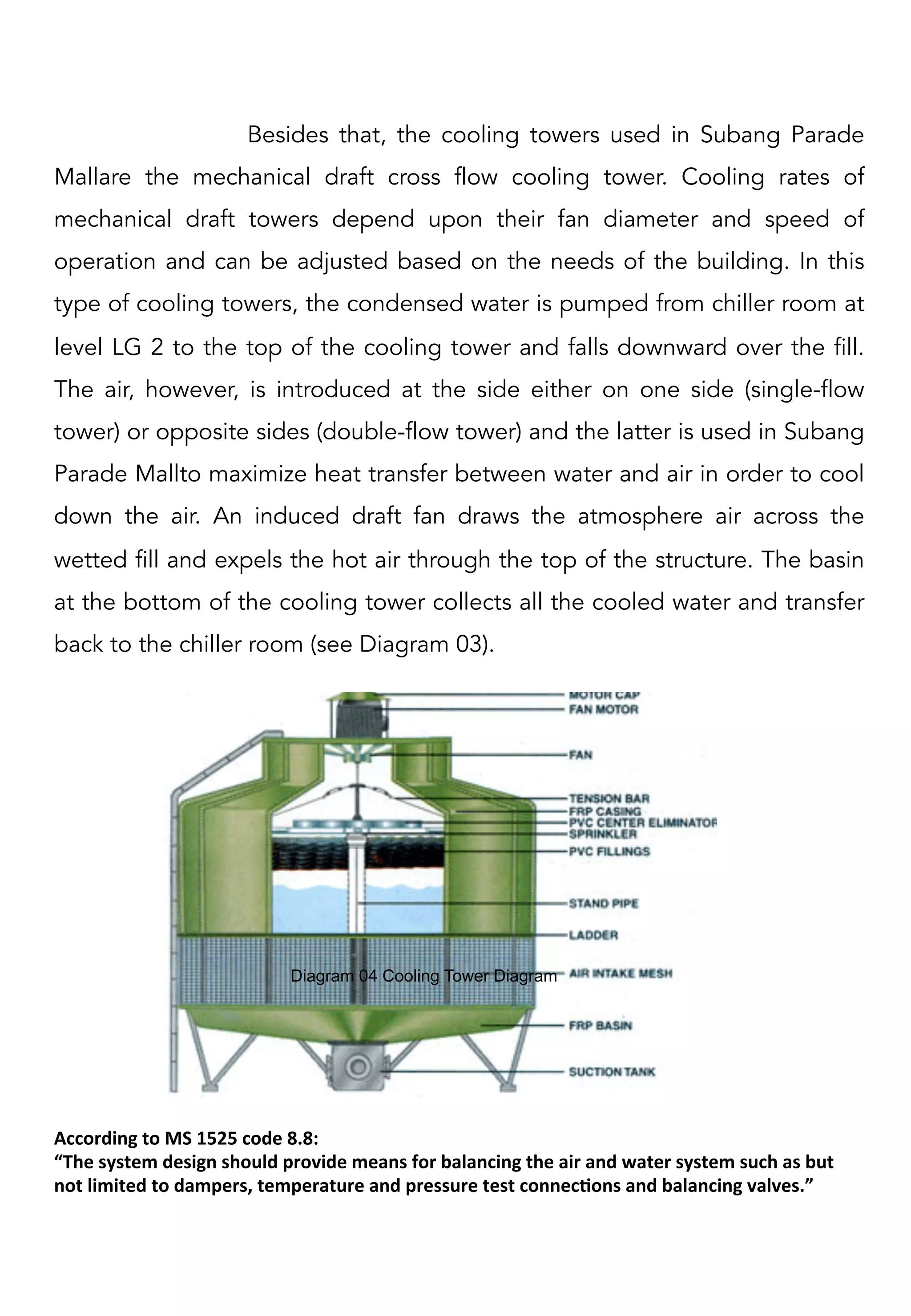
Besides that, the cooling towers used in Subang Parade
Mallare the mechanical draft cross flow cooling tower. Cooling rates of
mechanical draft towers depend upon their fan diameter and speed of
operation and can be adjusted based on the needs of the building. In this
type of cooling towers, the condensed water is pumped from chiller room at
level LG 2 to the top of the cooling tower and falls downward over the fill.
The air, however, is introduced at the side either on one side (single-flow
tower) or opposite sides (double-flow tower) and the latter is used in Subang
Parade Mallto maximize heat transfer between water and air in order to cool
down the air. An induced draft fan draws the atmosphere air across the
wetted fill and expels the hot air through the top of the structure. The basin
at the bottom of the cooling tower collects all the cooled water and transfer
back to the chiller room (see Diagram 03).
Diagram 04 Cooling Tower Diagram	
  
According	
  to	
  MS	
  1525	
  code	
  8.8:	
  	
  
“The	
  system	
  design	
  should	
  provide	
  means	
  for	
  balancing	
  the	
  air	
  and	
  water	
  system	
  such	
  as	
  but	
  
not	
  limited	
  to	
  dampers,	
  temperature	
  and	
  pressure	
  test	
  connecCons	
  and	
  balancing	
  valves.”	
  	
  
2.3.3 Chilled Water System
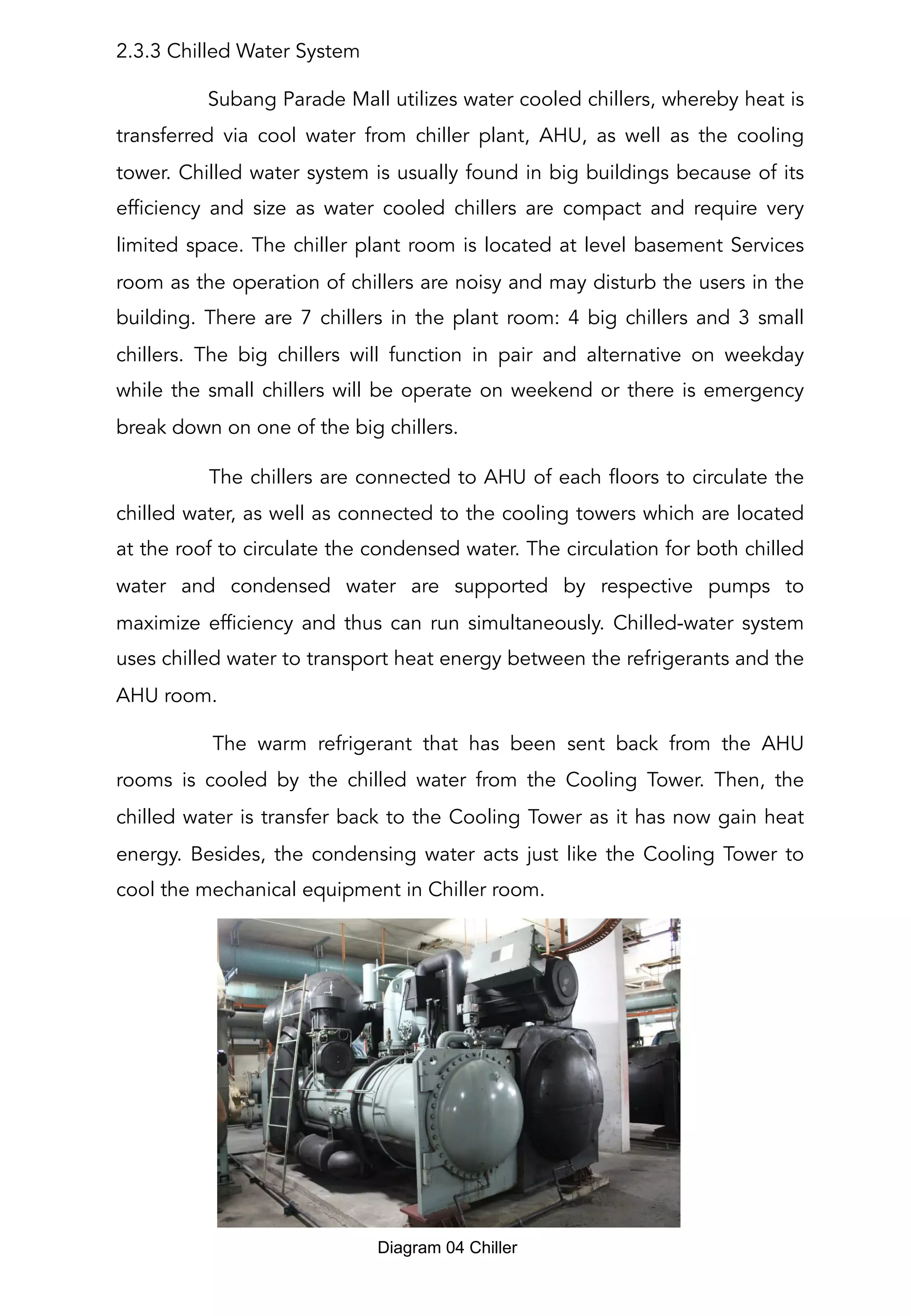
Subang Parade Mall utilizes water cooled chillers, whereby heat is
transferred via cool water from chiller plant, AHU, as well as the cooling
tower. Chilled water system is usually found in big buildings because of its
efficiency and size as water cooled chillers are compact and require very
limited space. The chiller plant room is located at level basement Services
room as the operation of chillers are noisy and may disturb the users in the
building. There are 7 chillers in the plant room: 4 big chillers and 3 small
chillers. The big chillers will function in pair and alternative on weekday
while the small chillers will be operate on weekend or there is emergency
break down on one of the big chillers.
The chillers are connected to AHU of each floors to circulate the
chilled water, as well as connected to the cooling towers which are located
at the roof to circulate the condensed water. The circulation for both chilled
water and condensed water are supported by respective pumps to
maximize efficiency and thus can run simultaneously. Chilled-water system
uses chilled water to transport heat energy between the refrigerants and the
AHU room.
The warm refrigerant that has been sent back from the AHU
rooms is cooled by the chilled water from the Cooling Tower. Then, the
chilled water is transfer back to the Cooling Tower as it has now gain heat
energy. Besides, the condensing water acts just like the Cooling Tower to
cool the mechanical equipment in Chiller room.
Diagram 04 Chiller	
  
According to MS 1525 code 8.11.1:
“Chiller water pumps circulating chilled water through the piping system
external to the package, and cooling tower pumps and fans circulating water
or air through the condenser and cooling tower are not to be included in the
consideration of the COP for the component”
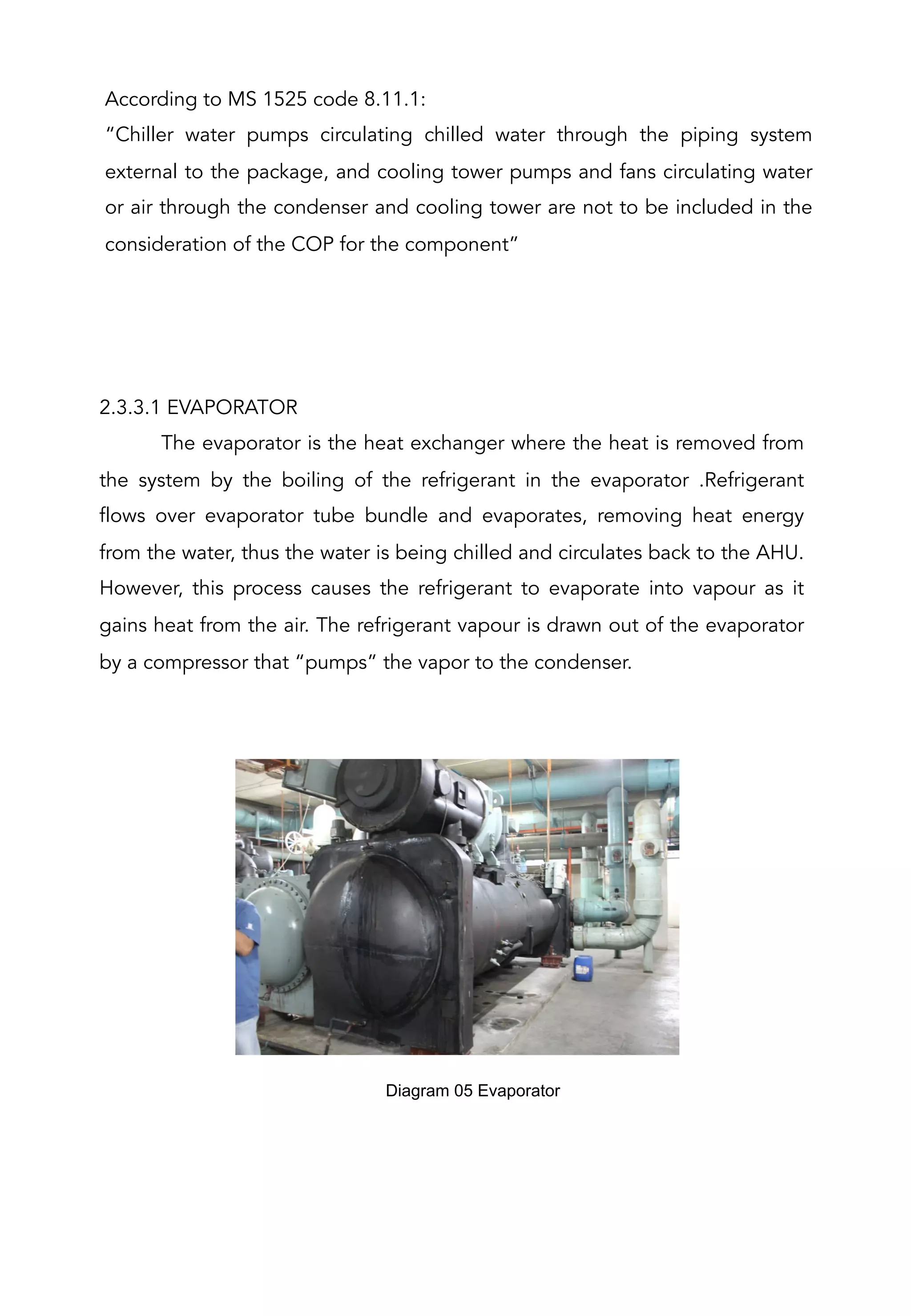
2.3.3.1 EVAPORATOR
The evaporator is the heat exchanger where the heat is removed from
the system by the boiling of the refrigerant in the evaporator .Refrigerant
flows over evaporator tube bundle and evaporates, removing heat energy
from the water, thus the water is being chilled and circulates back to the AHU.
However, this process causes the refrigerant to evaporate into vapour as it
gains heat from the air. The refrigerant vapour is drawn out of the evaporator
by a compressor that “pumps” the vapor to the condenser.
Diagram 05 Evaporator	
  
2.3.3.2 COMPRESSOR
The refrigerant vapour will then be drawn into the compressor. The compressor
is needed to converse this low pressure and low temperature gaseous refrigearant into
high pressure, high-temperature gas. Then the vapour will be compressed by increasing
the pressure and the temperature of the vapour to a level that is required which is
typically 98°F and then flows into the condenser.
2.3.3.3 CONDENSER
The condenser is also the heat exchanger where the refrigerant gas condenses,
giving up its heat to the atmosphere(refer to Diagram 2.3.4). The cold water that cooled
in cooling towers is transferred to condenser to absorb heat from the hot refrigerant gas.
This caused the hot gas in the condenser to be condensed and turned back into liquid
form and being transferred to the evaporator. Meanwhile, the heat transferred the cold
water becomes hot water and is circulated back to the cooling tower to be cooled.
Diagram 06 Condenser	
  
2.3.3.4 REFRIGERANT
The type of refrigerant used in the chiller is known as R-22 or HCFC-22 or
Chlorodifluoromethane as it is less damaging compared to other refrigerants
such as CFC and R-11. R-22 is widely used in refrigerant systems either in
residential or commercial.
 
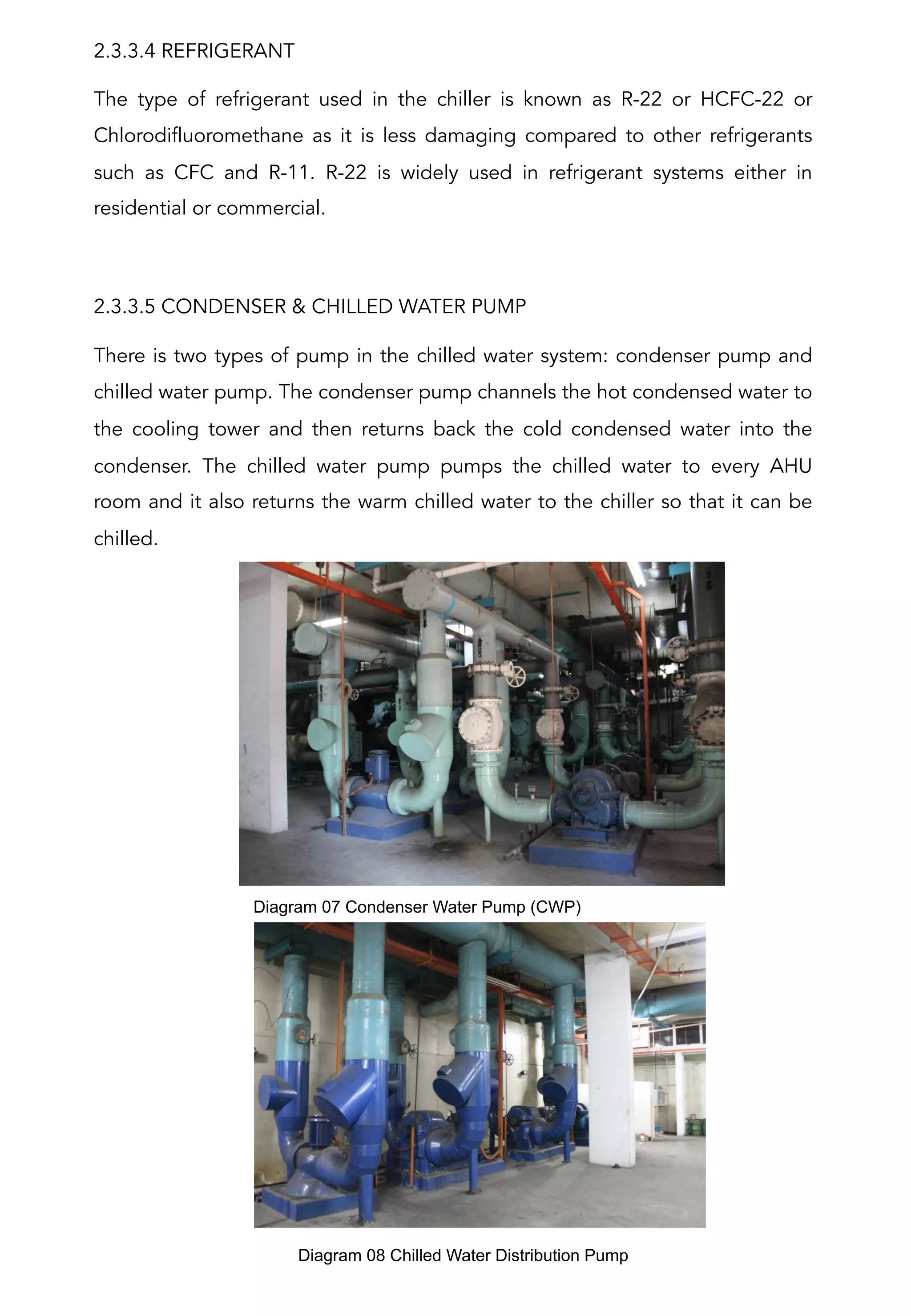
2.3.3.5 CONDENSER & CHILLED WATER PUMP
There is two types of pump in the chilled water system: condenser pump and
chilled water pump. The condenser pump channels the hot condensed water to
the cooling tower and then returns back the cold condensed water into the
condenser. The chilled water pump pumps the chilled water to every AHU
room and it also returns the warm chilled water to the chiller so that it can be
chilled.
Diagram 07 Condenser Water Pump (CWP)	
  
Diagram 08 Chilled Water Distribution Pump	
  
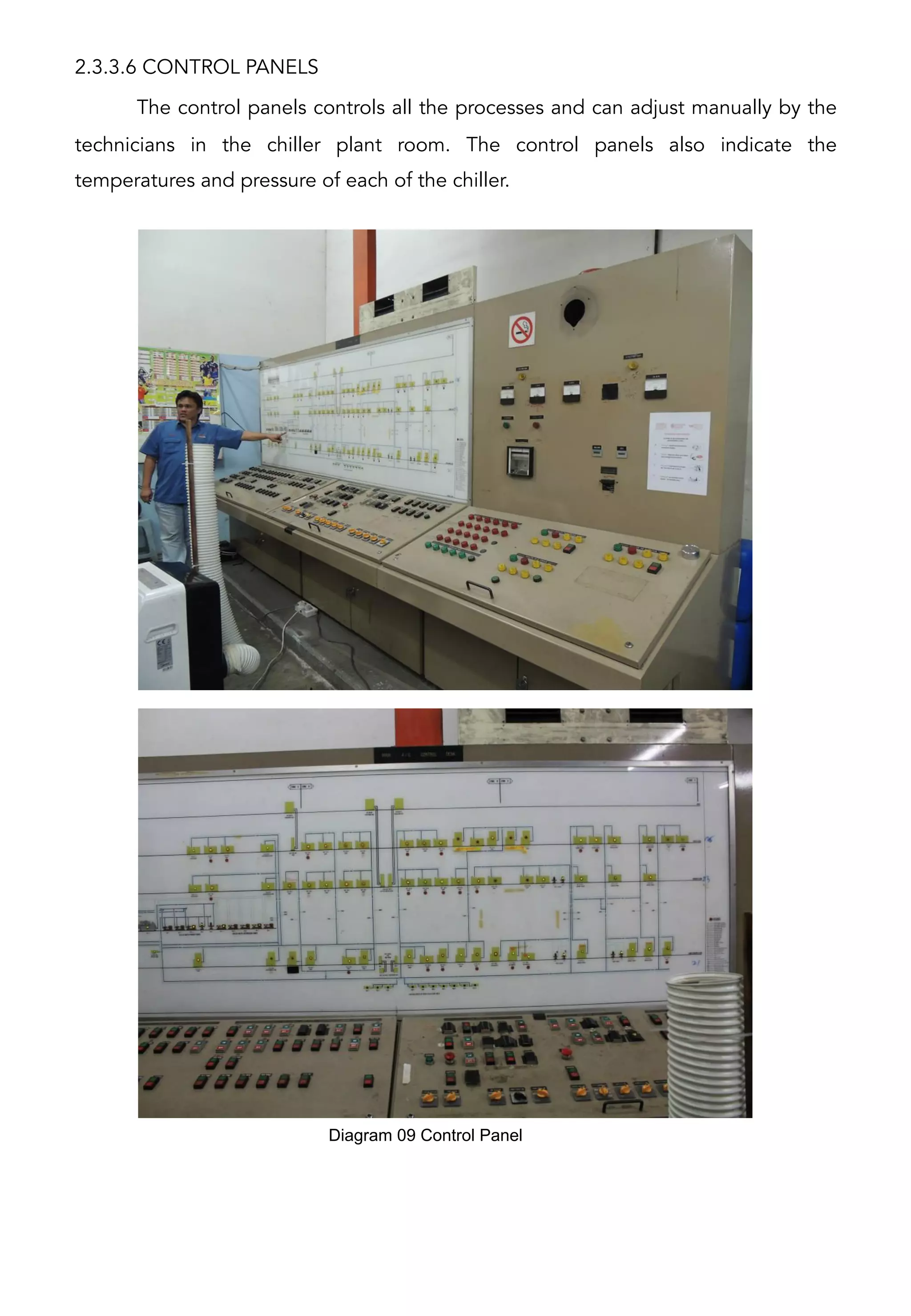
2.3.3.6 CONTROL PANELS
The control panels controls all the processes and can adjust manually by the
technicians in the chiller plant room. The control panels also indicate the
temperatures and pressure of each of the chiller.
Diagram 09 Control Panel	
  
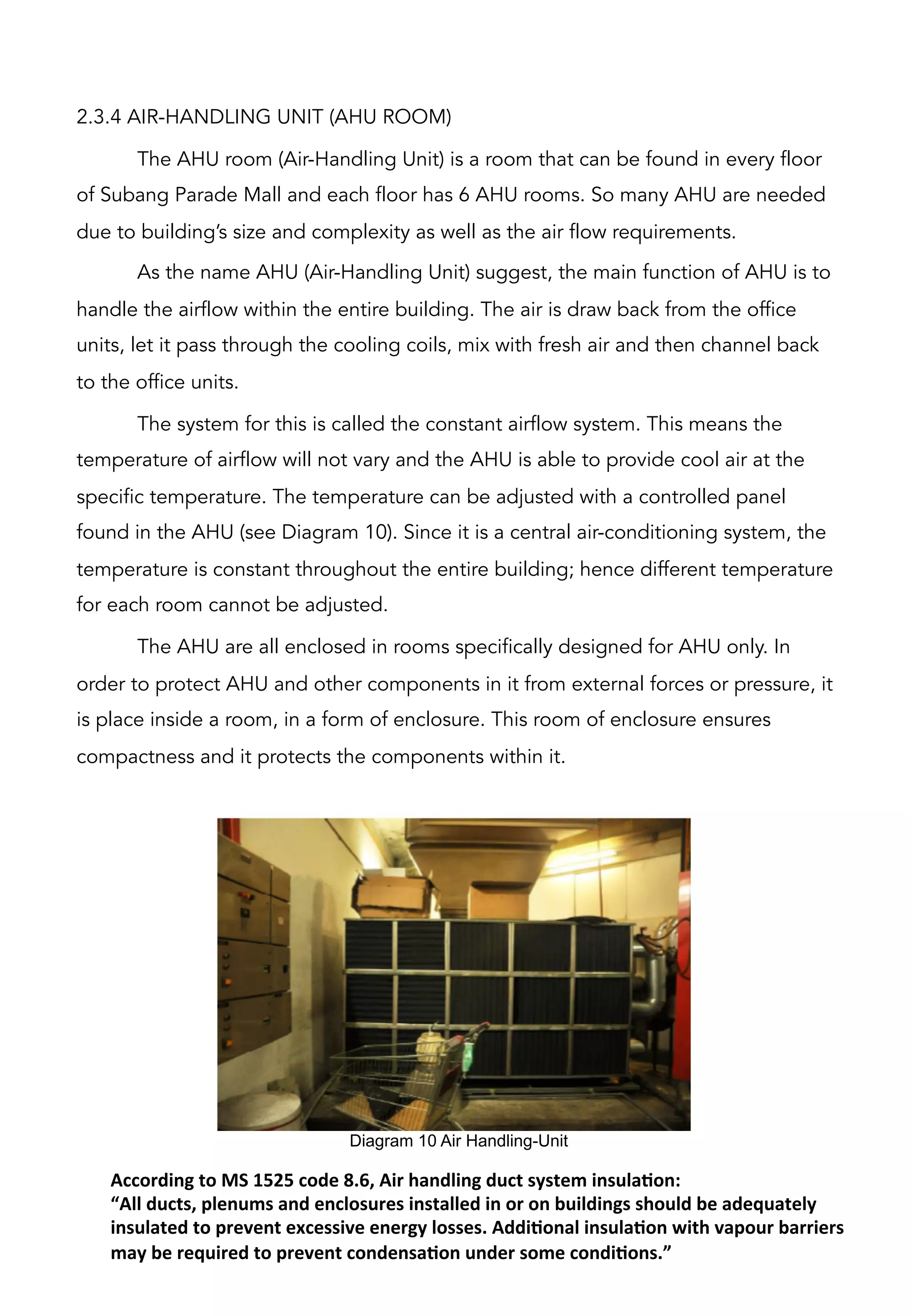
2.3.4 AIR-HANDLING UNIT (AHU ROOM)
The AHU room (Air-Handling Unit) is a room that can be found in every floor
of Subang Parade Mall and each floor has 6 AHU rooms. So many AHU are needed
due to building’s size and complexity as well as the air flow requirements.
As the name AHU (Air-Handling Unit) suggest, the main function of AHU is to
handle the airflow within the entire building. The air is draw back from the office
units, let it pass through the cooling coils, mix with fresh air and then channel back
to the office units.
The system for this is called the constant airflow system. This means the
temperature of airflow will not vary and the AHU is able to provide cool air at the
specific temperature. The temperature can be adjusted with a controlled panel
found in the AHU (see Diagram 10). Since it is a central air-conditioning system, the
temperature is constant throughout the entire building; hence different temperature
for each room cannot be adjusted.
The AHU are all enclosed in rooms specifically designed for AHU only. In
order to protect AHU and other components in it from external forces or pressure, it
is place inside a room, in a form of enclosure. This room of enclosure ensures
compactness and it protects the components within it.
Diagram 10 Air Handling-Unit	
  
According	
  to	
  MS	
  1525	
  code	
  8.6,	
  Air	
  handling	
  duct	
  system	
  insulaCon:	
  	
  
“All	
  ducts,	
  plenums	
  and	
  enclosures	
  installed	
  in	
  or	
  on	
  buildings	
  should	
  be	
  adequately	
  
insulated	
  to	
  prevent	
  excessive	
  energy	
  losses.	
  AddiConal	
  insulaCon	
  with	
  vapour	
  barriers	
  
may	
  be	
  required	
  to	
  prevent	
  condensaCon	
  under	
  some	
  condiCons.”	
  	
  
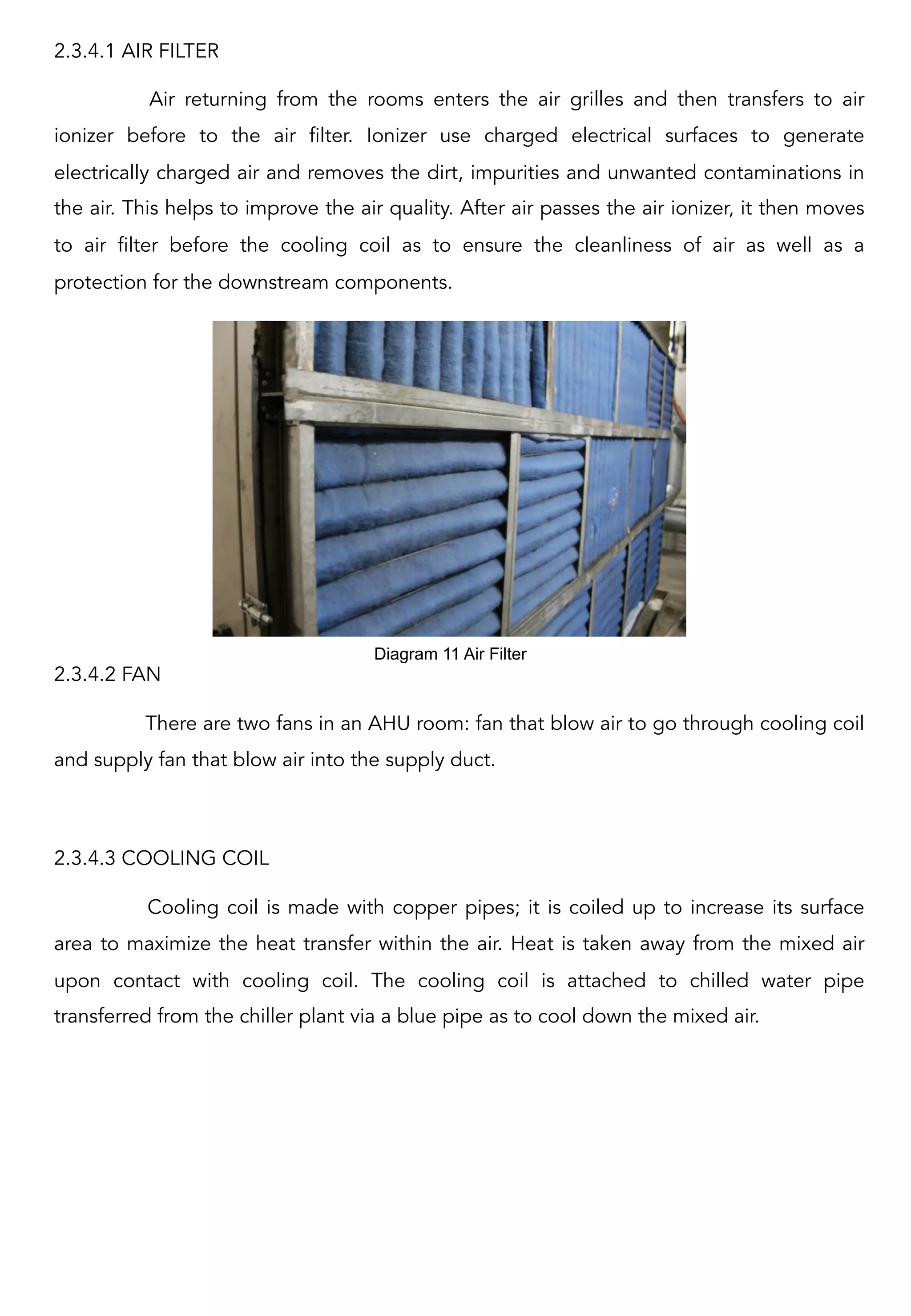
2.3.4.1 AIR FILTER
Air returning from the rooms enters the air grilles and then transfers to air
ionizer before to the air filter. Ionizer  use charged electrical surfaces to generate
electrically charged air and removes the dirt, impurities and unwanted contaminations in
the air. This helps to improve the air quality. After air passes the air ionizer, it then moves
to air filter before the cooling coil as to ensure the cleanliness of air as well as a
protection for the downstream components.
2.3.4.2 FAN
There are two fans in an AHU room: fan that blow air to go through cooling coil
and supply fan that blow air into the supply duct.
2.3.4.3 COOLING COIL
Cooling coil is made with copper pipes; it is coiled up to increase its surface
area to maximize the heat transfer within the air. Heat is taken away from the mixed air
upon contact with cooling coil. The cooling coil is attached to chilled water pipe
transferred from the chiller plant via a blue pipe as to cool down the mixed air.
Diagram 11 Air Filter	
  
2.3.4.4 Mixing Box
This is where the cool air is mixed with the fresh air. The damper controls by
manipulate the ratio of fresh air and recycled air while exhausting part of the
recycled air. When the air sensor detects more than 500pm carbon dioxide in the
return air from office unit, the system will be activate automatic and intake the fresh
air from the roof and surroundings of the building so that the air in the building can
be refresh.
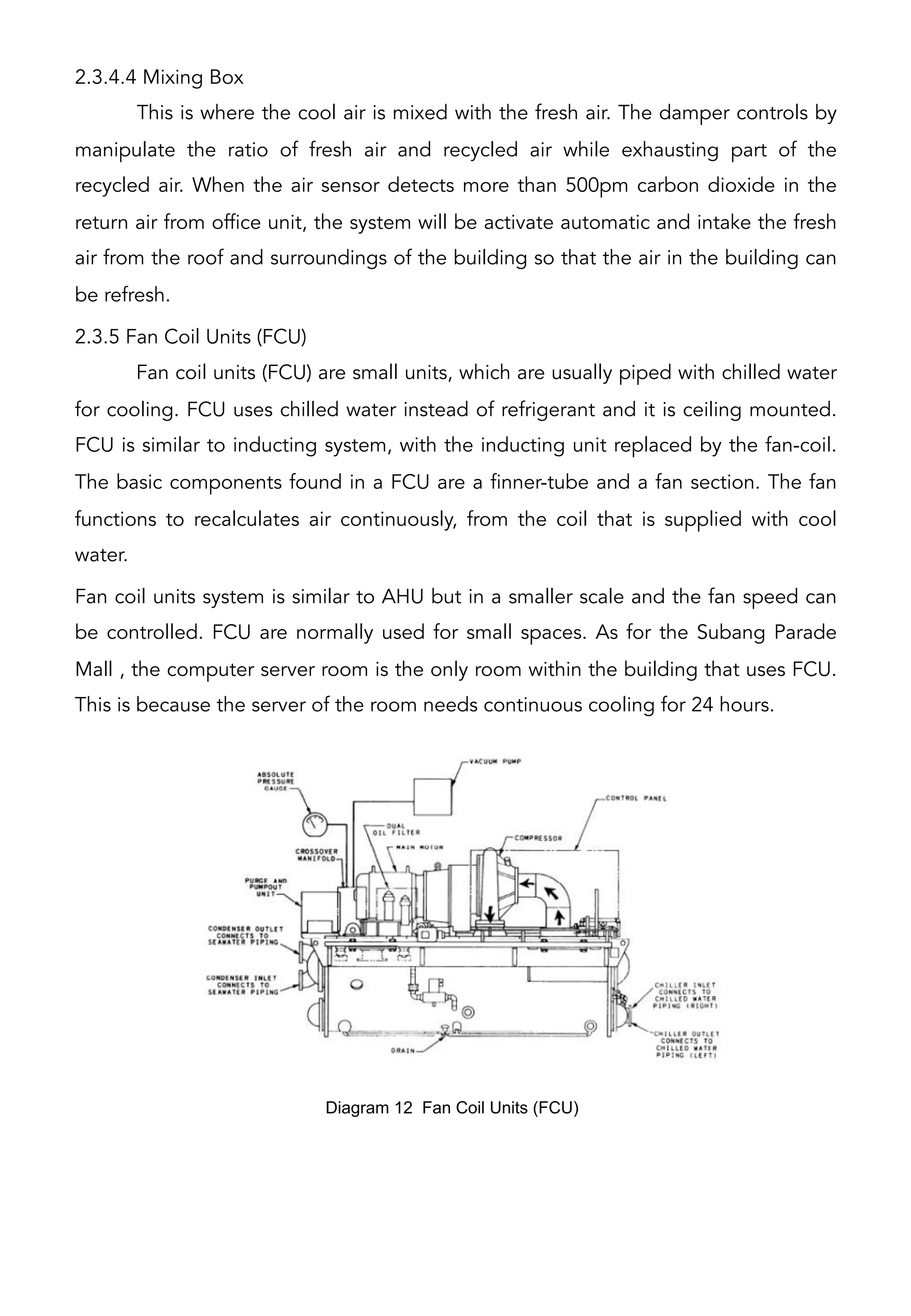
2.3.5 Fan Coil Units (FCU)
Fan coil units (FCU) are small units, which are usually piped with chilled water
for cooling. FCU uses chilled water instead of refrigerant and it is ceiling mounted.
FCU is similar to inducting system, with the inducting unit replaced by the fan-coil.
The basic components found in a FCU are a finner-tube and a fan section. The fan
functions to recalculates air continuously, from the coil that is supplied with cool
water.
Fan coil units system is similar to AHU but in a smaller scale and the fan speed can
be controlled. FCU are normally used for small spaces. As for the Subang Parade
Mall , the computer server room is the only room within the building that uses FCU.
This is because the server of the room needs continuous cooling for 24 hours.
Diagram 12 Fan Coil Units (FCU)	
  
2.3.6 DIFFUSERS
2.3.6.1 SUPPLY AIR DIFFUSERS
Diffusers are designed to distribute equal amount of air into the
rooms of Subang Parade Mall . Diffusers do not require any generation of
power and it improves the efficiency of the entire air-conditioning system
by dividing the distribution of air form AHU rooms. Diffusers give the
users a comfortable environment constantly by removing any areas with
heat and providing uniform distribution of heat.
At the Subang Parade Mall , there are 2 main types of diffusers
being applied which are directional square diffuser and linear slot diffuser.
Most of the diffusers are found on the floor of offices and some are
mounted on ceiling in public-use spaces like corridor, cafeteria and etc.
The size of both type diffusers for this case is same throughout, however
the number of diffusers on each floor depends on the area that needs to
be covered with air-conditions. The air diffusers work by capturing the air
from fan at the AHU and splitting air into smaller streams forcefully. Tiny
streams will allow air to flow smoothly and evenly throughout the room.
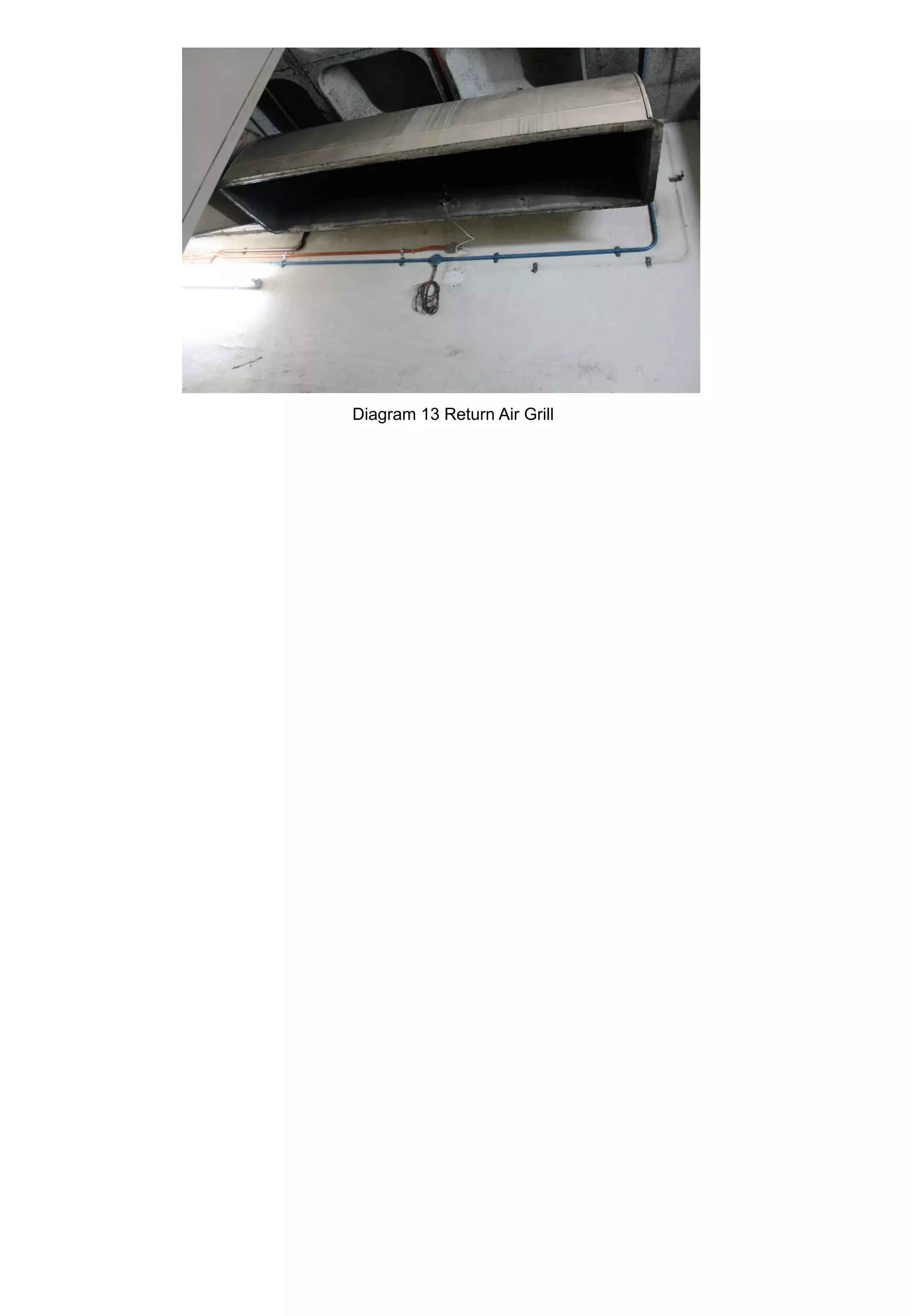
2.3.6.2 RETURN AIR GRILLES
Return Air Grille functions to carry the air back to the specific
area in AHU room. The return air grille is covered with grillwork to cover
up the duct behind it. It is also to avoid big objects from entering the duct
and damaging the AHU. A filter can also be found behind the grille to
trap pollutant, which can reduce the maintenance level. Unlike the
diffusers, the return air grilles are placed at the ceilings of Subang Parade
Mall.
It works just like a pump; a fan behind the grille sucks out warm
air from the space as well. The return air grilles are larger than the
diffusers, but lesser in numbers. As one can see in Diagram 13, the
number of return air grilles are much more lesser than the supply air
diffusers.
Diagram 13 Return Air Grill	
  
2.3.7 DUCT SYSTEM
Duct system functions to carry cooled air from AHU into the rooms of the
building via a diffuser. The duct used for this building is made of galvanized steel because
this material has good insulation qualities. This is to make sure the air remains cool while
it is being transferred into the diffuser. A blower or fan is also installed within the duct to
help circulate movement of air.
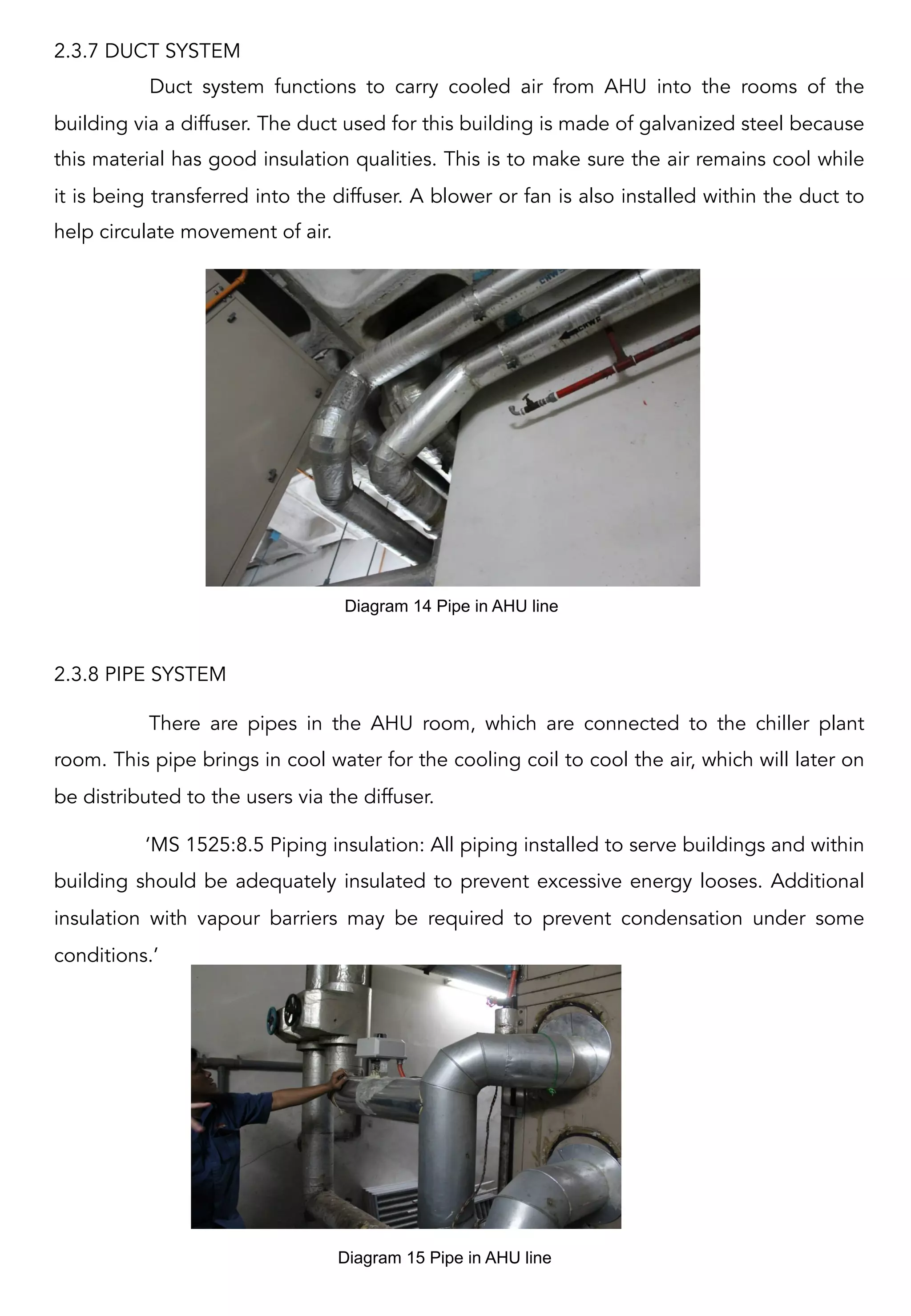
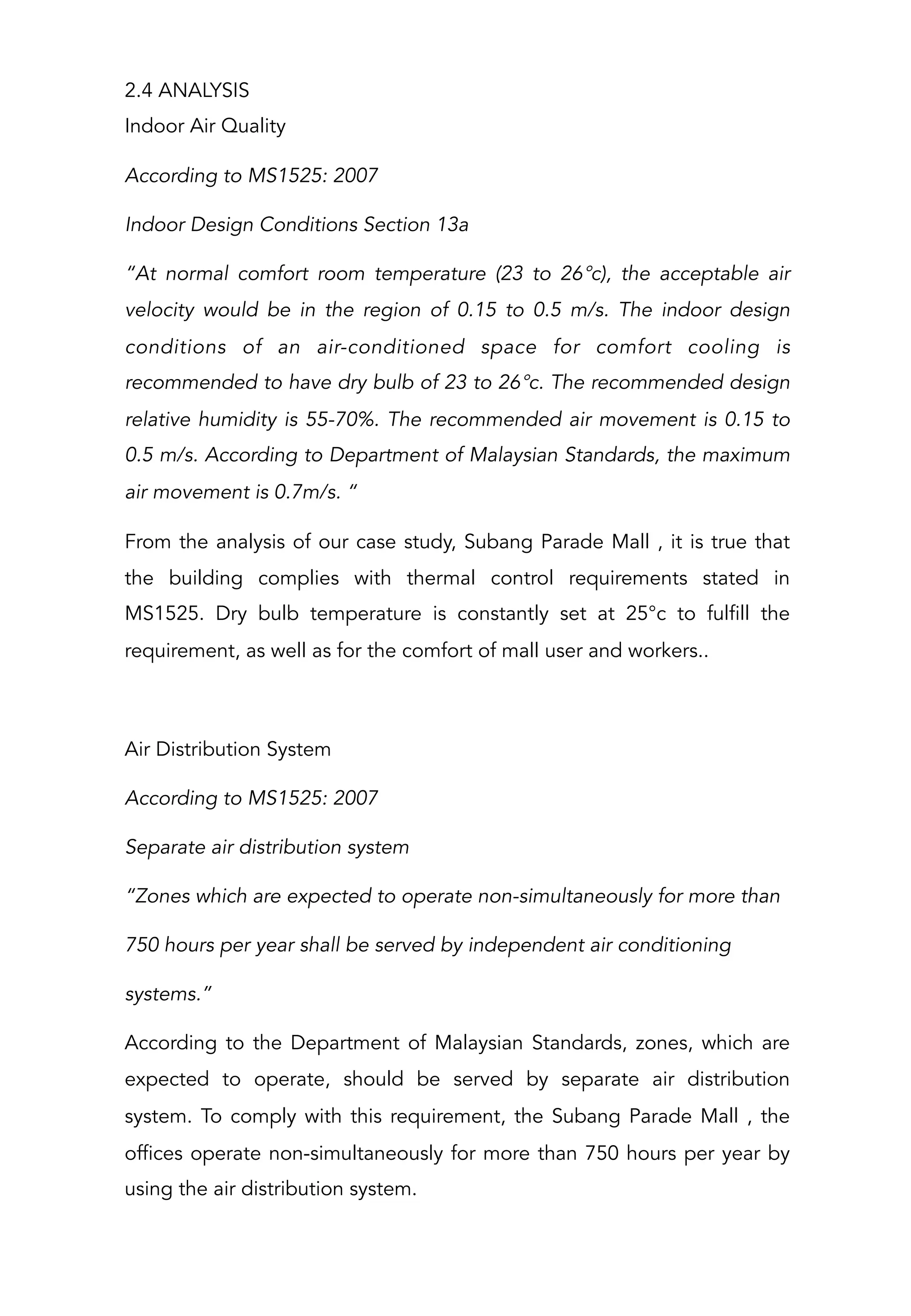
2.3.8 PIPE SYSTEM
There are pipes in the AHU room, which are connected to the chiller plant
room. This pipe brings in cool water for the cooling coil to cool the air, which will later on
be distributed to the users via the diffuser.
‘MS 1525:8.5 Piping insulation: All piping installed to serve buildings and within
building should be adequately insulated to prevent excessive energy looses. Additional
insulation with vapour barriers may be required to prevent condensation under some
conditions.’
Diagram 15 Pipe in AHU line 	
  
Diagram 14 Pipe in AHU line 	
  
2.4 ANALYSIS
Indoor Air Quality
According to MS1525: 2007
Indoor Design Conditions Section 13a
“At normal comfort room temperature (23 to 26°c), the acceptable air
velocity would be in the region of 0.15 to 0.5 m/s. The indoor design
conditions of an air-conditioned space for comfort cooling is
recommended to have dry bulb of 23 to 26°c. The recommended design
relative humidity is 55-70%. The recommended air movement is 0.15 to
0.5 m/s. According to Department of Malaysian Standards, the maximum
air movement is 0.7m/s. “
From the analysis of our case study, Subang Parade Mall , it is true that
the building complies with thermal control requirements stated in
MS1525. Dry bulb temperature is constantly set at 25°c to fulfill the
requirement, as well as for the comfort of mall user and workers..
 
Air Distribution System
According to MS1525: 2007
Separate air distribution system
“Zones which are expected to operate non-simultaneously for more than
750 hours per year shall be served by independent air conditioning
systems.”
According to the Department of Malaysian Standards, zones, which are
expected to operate, should be served by separate air distribution
system. To comply with this requirement, the Subang Parade Mall , the
offices operate non-simultaneously for more than 750 hours per year by
using the air distribution system.
 
 
ACCORDING TO MS1525: 2007
Off-hour Control
“ACMV system should be equipped with automatic controls capable
of  accomplishing a reduction of energy use for example through
equipment shutdown during periods of non-use or alternative use of the
spaces served by the system.”
The Subang Parade Mall only schedules to open during office hours.
The ACMV system turn off automatically shut down after office hours to
prevent waste of energy.
 
Temperature control.
“Each system should be provided with at least one thermostat
for the regulation of temperature. Each thermostat should be capable
of being set by adjustment or selection of sensors over a minimum
range of between 22°C to 27°C.”
The Subang Parade Mall has a thermostat at the top floor to measure
temperature of building. Hence the temperature is always at a average
of 23°C.
2.5 CONCLUSION
In conclusion, using a centralized air-conditioning system is best
appropriate for the Subang Parade Mall, because of this large scale of
commercial shopping space. The components of the air-conditioning
system such as AHU, Chiller plant and cooling tower were placed at
appropriate levels. This helps the system to run smoothly and save
great amount of energy at the same time. 
The building complies with the by-law in terms of air-
distribution, off-hour control and temperature-control. This has
contributed to the comfort and efficiency the air conditioning system
within the building.  Subang Parade Mall with this centralized air-
conditioning system can maintain by certain thermal comfort
temperature and generate with energy efficiency achieve the best
ventilation solution for this large scale mall.
3.0 ACTIVE AND PASSIVE FIRE PROTECTION.
3.1 LITERATURE REVIEW
Fire is defined as the results of the chemical reaction called combustion. In
which substances combine chemically with oxygen from the air and
typically give out bright light, heat, and smoke. The basic factors of a fire
triangle are fuel, heat and oxygen, together with the chemical reaction
between one another. Fire is a visible, tangible side effect of matter
changing form. It starts in three main ways, by accidents due to the misuse
of appliances, dropping a cigarette or match on a sofa or mattress, the
deliberate ignition or arson by certain people within the space and lastly,
the failure of equipment including electrical malfunctions and overheating
in certain rooms. The temperatures achieved in fires are usually beyond
the ability of building cooling systems t o control. Thus, special water
system is fixed in the form of sprinklers to deprive fire of high
temperatures. Another design responses are to install fire suppression
system to cover the fuel, or displace oxygen, O2 with carbon dioxide,
CO2 that inhibits the chemical action to flame itself.
 
 
3.2 AIM
 
The rudiment aim of passive and active fire protection systems is to
prevent the spread of fire and smoke from one space to another space of
building, allowed dweller to escape safely without the any fire menace. It
enable to reduce and control the building damage as well from fire hazard
even neighbor building and reduce the risk of emergency system collapse.
 
-Education
-Passive fire protection
-Active fire protection
 
3.2.1 EDUCATION
 
Education is important for operator in mastering skills in term of emergency
precautions of that building. The function of active and passive fire protection
system in fire hazard, the blind angle of this system and also the weak point
and strong point of the covered area are those important study has to include
in teaching objective.
The dweller and owner have right to understand all the safety security system
code on plan works when fire hazard and fire escape plan should be provide.
 
3.2.2 PASSIVE FIRE PROTECTION
Passive Fire protection (PFP) is one of the components of structural fire
protection, which provide existing fire safety to the building and do not rely
on the operation of any form of mechanical device. It is to maintain the
rudiment requirements of building fire separation, structural stability, building
compartmentation and safety escape. For instance, passive systems in the
form of fire rated doors, barrier, ceilings and structural fire protection. Passive
fire protection system provided an alternative way to slow down the fire
spread when incident happen by make use of fire protection tools on site.
Passive design are always designed with the building which included the fire
water, fire walls, escape route, emergency access and opening protection.
Passive fire protection is only effective for short duration exposure about 1-2
hours.
3.2.3 ACTIVE FIRE PROTECTION
 
Active fire protection system widely used in the process industries for
protection in the form of suppression, extinguishers, sprinkler, alarm and
extract ventilation. There are always on alert and first to act in case of fire.
The overall aim of active system is to extinguish the fire by:
 
•  Detecting the fire early and evacuate the building.
•  Alerting emergency services at an early stage of the fire.
•  Control the movement of smoke and fire.
•  Suppress and/or starve the fire of oxygen and fuel. (NAFFCO, 2004)
 
This system includes automatic, or manual operation systems such as, water-
based system, non-water based system, fire alarm systems, fireman intercom
system and smoke control system. These systems are crucial in protecting
properties and the lives of the occupants. Active fire protection system
includes the action of retarding the progress of fire spread, putting out the
fire, or being notified of fire happenings and smoke conditions. The most
popular type of automatic sprinkler system under water-based system is by
using water to put out or slow down the progress of a fire. Some other
examples of the water-based system are hydrant system, hose reel system
and wet riser system. Some examples of non-water based active fire
protection systems that can help to extinguish a fire are CO2 automatic
sprinkler system, foam and chemical system. These systems are most likely
being used in places where water is not advisable against firefighting, such as
transformer room in certain shopping malls where it contained such high
voltage of electrical devices. Alternatively, manual active fire protection that
requires human operation such as the use of fire extinguishers, this is only
advisable during an occurrence of a small fire. Besides that, active fire
protection also includes the fire alarm system and smoke control system.
These are vitally important to protect life and to ensure a quick fire
department response. Generally, smoke control systems consist of smoke
detecting devices being placed throughout a building that detect the
smoke and heat from a fire. These detectors are extremely sensitive and
can notify the occupants of a building of danger with plenty of time to get
out of the building and call for help, meanwhile notify the fire department
automatically, which is very useful especially during night times when the
buildings are not under guarded.
 
ACTIVE FIRE PROTECTION
Active fire protection system is a system widely used in the process
industries for protection. There are always on alert and first to act in case of
fire. The overall aim of active system is to extinguish the fire by:
•  Detecting the fire early and evacuate the building.
•  Alerting emergency services at an early stage of the fire.
•  Control the movement of smoke and fire.
•  Suppress and/or starve the fire of oxygen and fuel. (NAFFCO, 2004)
 
3.3 ACTIVE FIRE PROTECTION
3.3.1 SMOKE DETECTOR
Smoke detector is a typically as an indicator of fire and is one of the
important safety tools to detect smoke and heat while fire in the building.
Smoke detectors usually powered by a central fire alarm system, which is
powered with a battery backup. When heat sensation reaches the fixed
temperature it will send a signal to master plan while the surroundings
temperature reaches 47°C. For the installation of smoke detector, it has a
laser sensor inside, while the smokes flew in and lower down the detection
of laser. It will be activated and sent signal to master panel.
 
Analysis
Under UBBL 1984 section153: Smoke detectors for lift lobbies.
• All lift lobbies shall be provided with smoke detectors.
• Lift not opening into a smoke lobby shall not use door.
• Reopening devices controlled by light beam or photo detectors unless
incorporated with a force close features which after thirty second of any
unless incorporated with a force close feature which are thirty seconds of
any interruption of the beam causes the door to close within a preset-time.
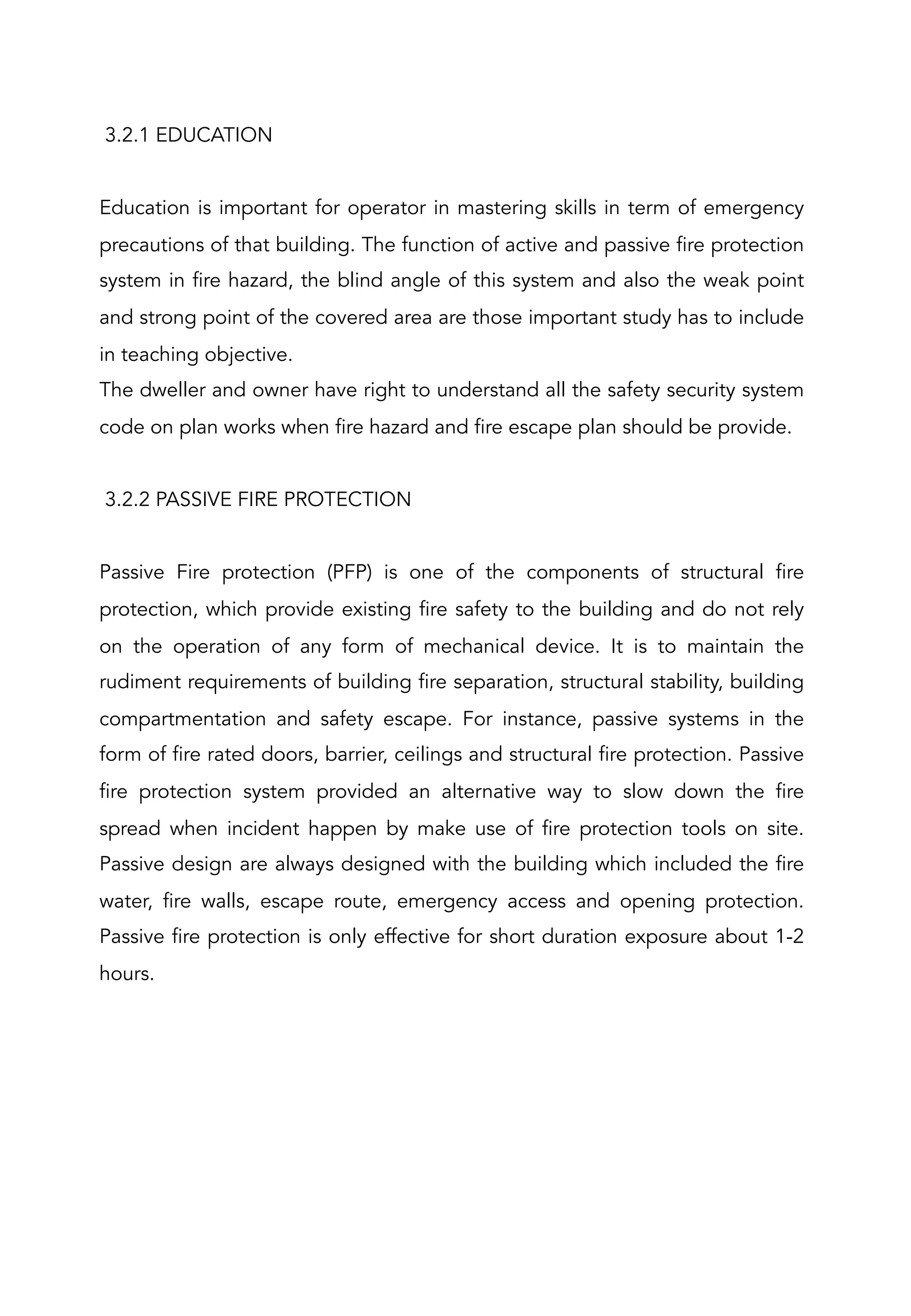
There are two types of smoke detector commonly found in the market
that are photoelectric smoke detector and ionization smoke detector.
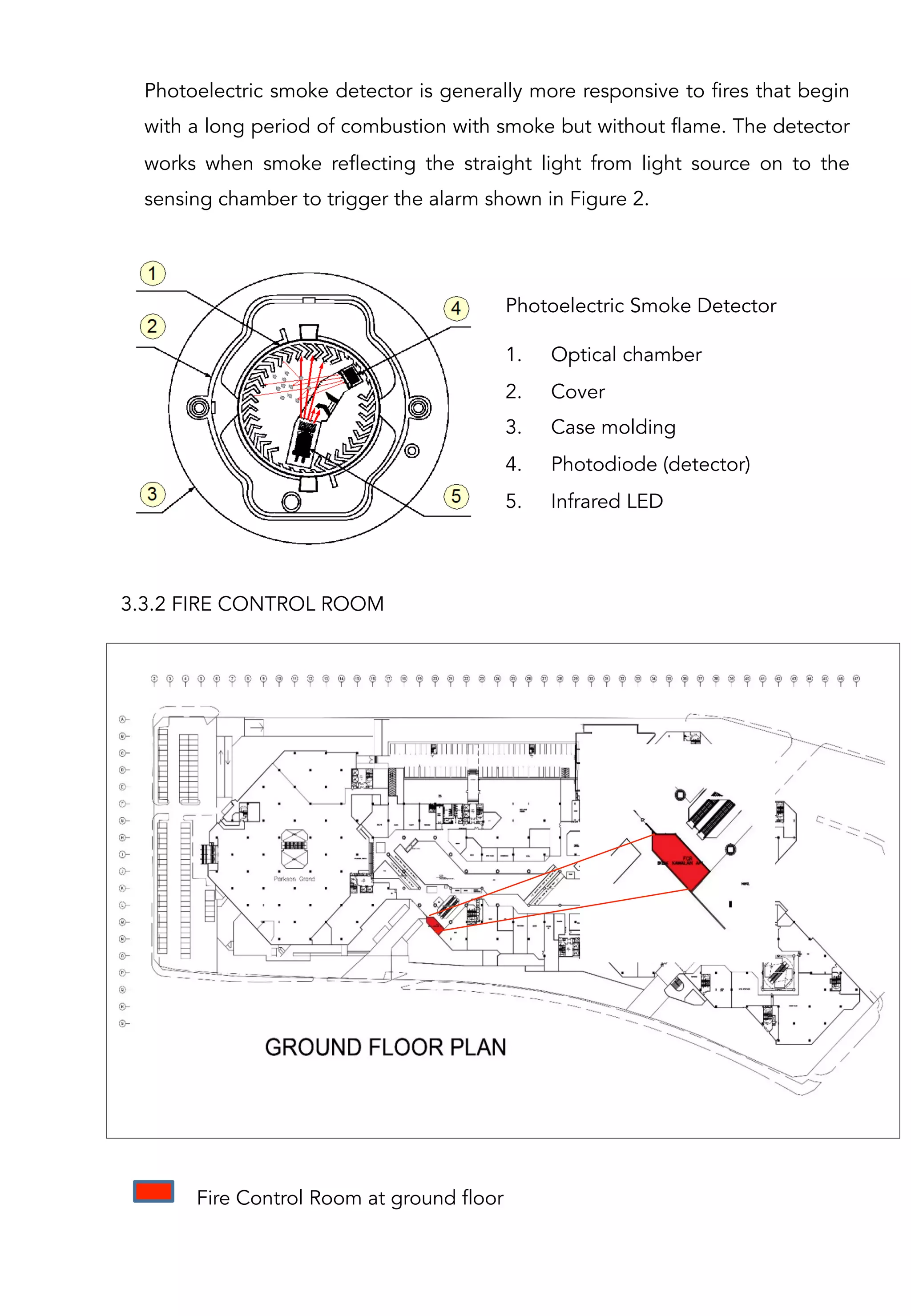
Figure above shown the photoelectric smoke detector used in
Subang Parade.
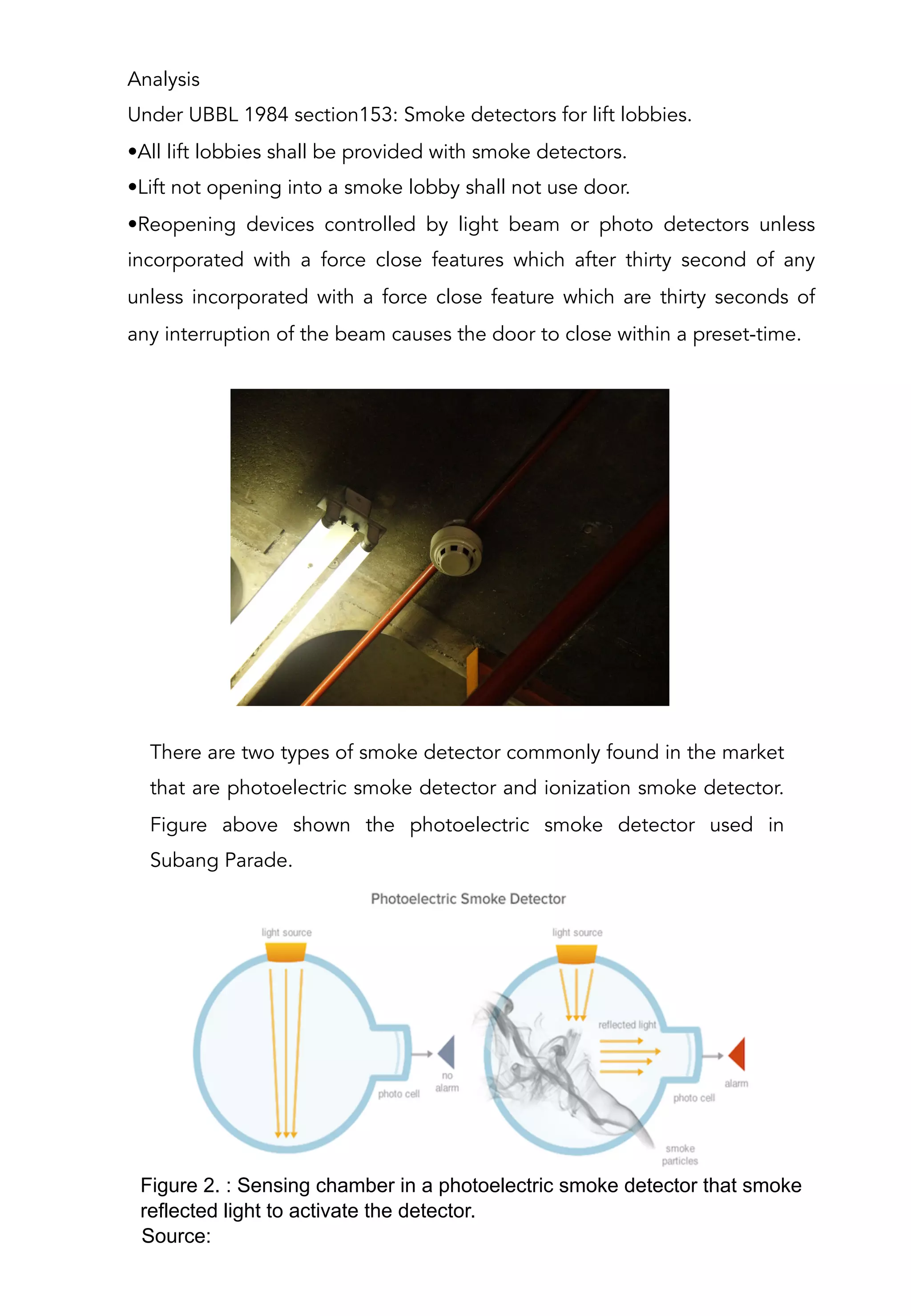
Figure 2. : Sensing chamber in a photoelectric smoke detector that smoke
reflected light to activate the detector.
Source:
Photoelectric smoke detector is generally more responsive to fires that begin
with a long period of combustion with smoke but without flame. The detector
works when smoke reflecting the straight light from light source on to the
sensing chamber to trigger the alarm shown in Figure 2.
Photoelectric Smoke Detector
1.  Optical chamber
2.  Cover
3.  Case molding
4.  Photodiode (detector)
5.  Infrared LED
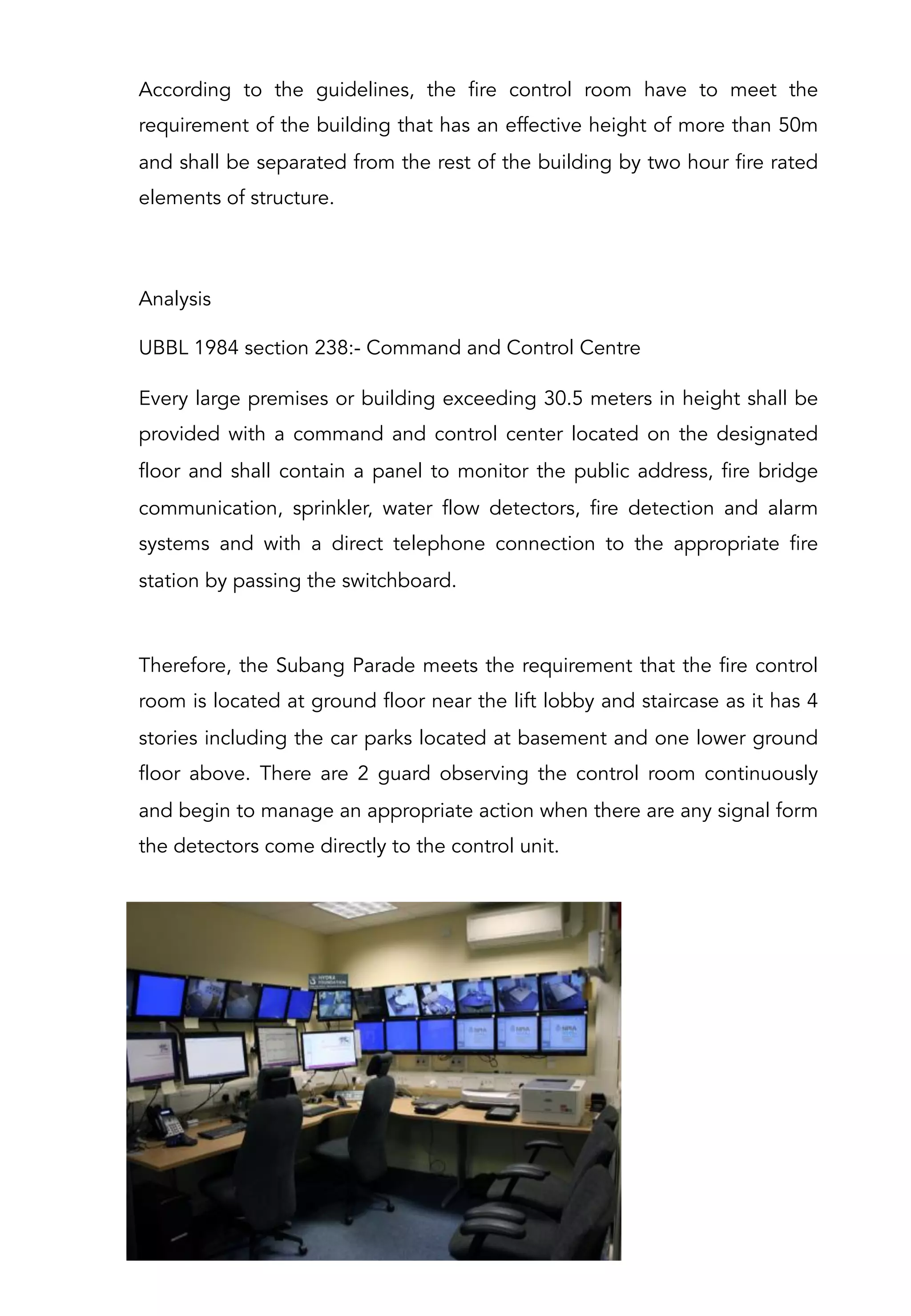
3.3.2 FIRE CONTROL ROOM
Fire Control Room at ground floor
According to the guidelines, the fire control room have to meet the
requirement of the building that has an effective height of more than 50m
and shall be separated from the rest of the building by two hour fire rated
elements of structure.
 
Analysis
UBBL 1984 section 238:- Command and Control Centre
Every large premises or building exceeding 30.5 meters in height shall be
provided with a command and control center located on the designated
floor and shall contain a panel to monitor the public address, fire bridge
communication, sprinkler, water flow detectors, fire detection and alarm
systems and with a direct telephone connection to the appropriate fire
station by passing the switchboard.
Therefore, the Subang Parade meets the requirement that the fire control
room is located at ground floor near the lift lobby and staircase as it has 4
stories including the car parks located at basement and one lower ground
floor above. There are 2 guard observing the control room continuously
and begin to manage an appropriate action when there are any signal form
the detectors come directly to the control unit.
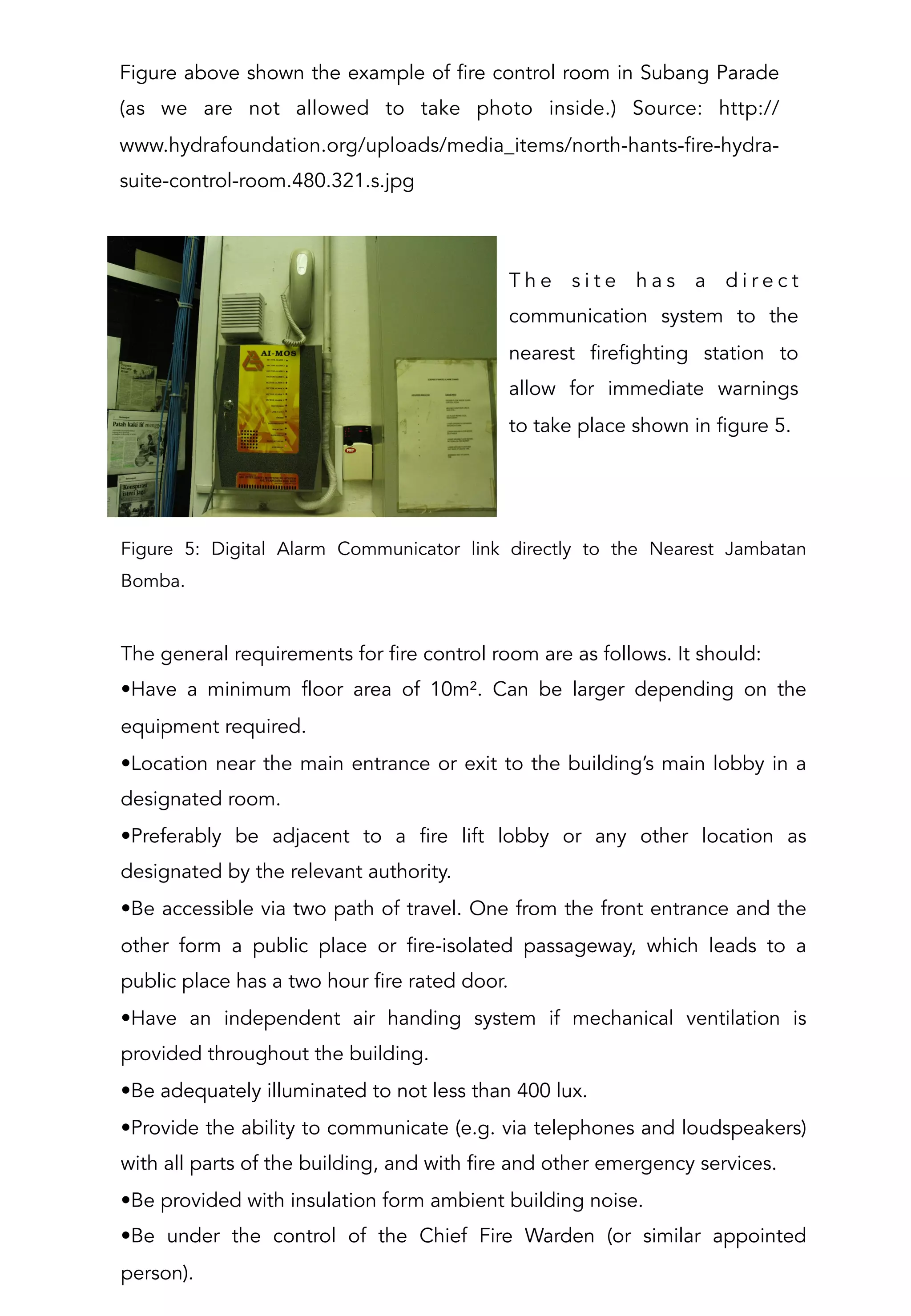
Figure above shown the example of fire control room in Subang Parade
(as we are not allowed to take photo inside.) Source: http://
www.hydrafoundation.org/uploads/media_items/north-hants-fire-hydra-
suite-control-room.480.321.s.jpg
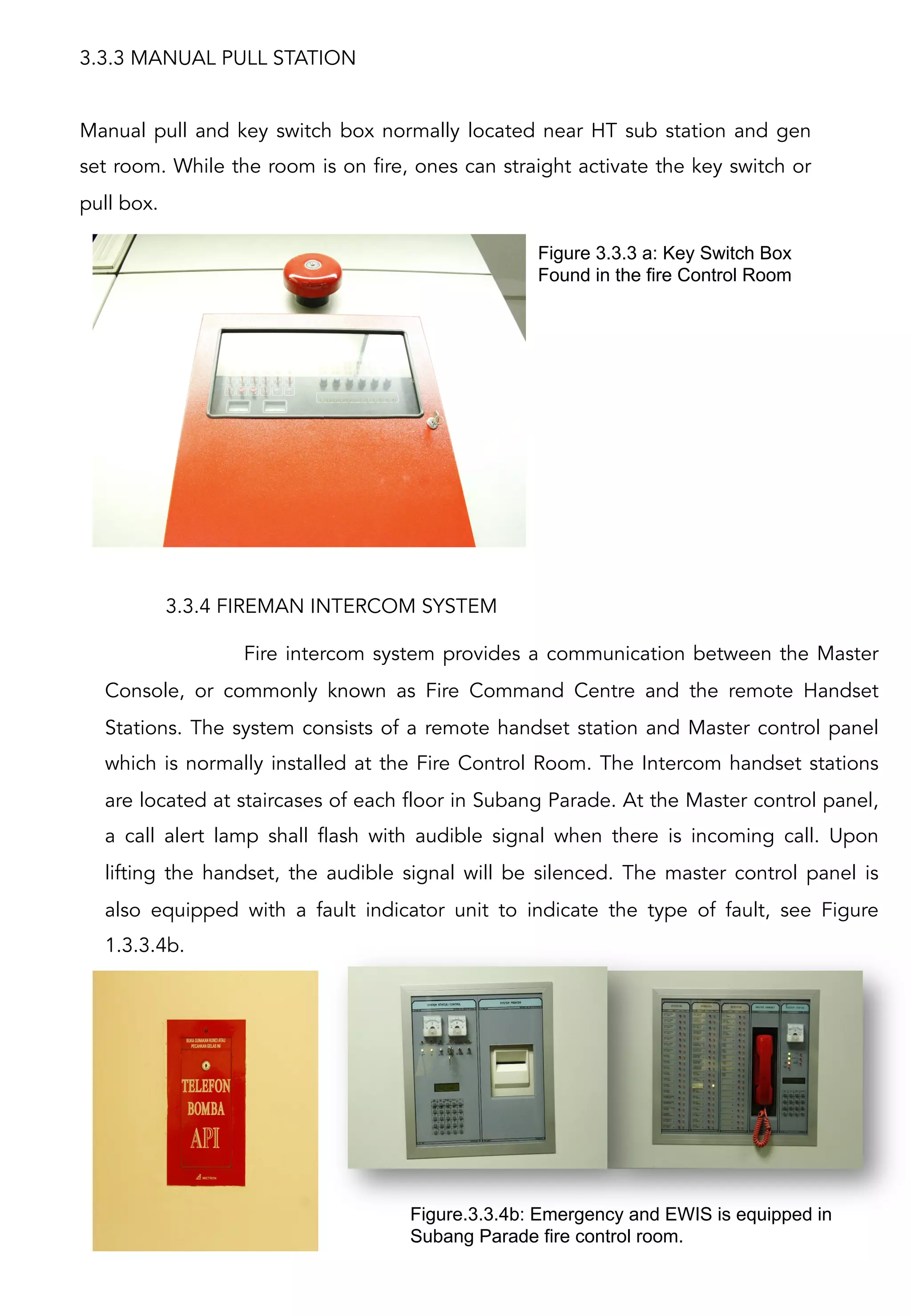
T h e s i t e h a s a d i r e c t
communication system to the
nearest firefighting station to
allow for immediate warnings
to take place shown in figure 5.
Figure 5: Digital Alarm Communicator link directly to the Nearest Jambatan
Bomba.
The general requirements for fire control room are as follows. It should:
• Have a minimum floor area of 10m². Can be larger depending on the
equipment required.
• Location near the main entrance or exit to the building’s main lobby in a
designated room.
• Preferably be adjacent to a fire lift lobby or any other location as
designated by the relevant authority.
• Be accessible via two path of travel. One from the front entrance and the
other form a public place or fire-isolated passageway, which leads to a
public place has a two hour fire rated door.
• Have an independent air handing system if mechanical ventilation is
provided throughout the building.
• Be adequately illuminated to not less than 400 lux.
• Provide the ability to communicate (e.g. via telephones and loudspeakers)
with all parts of the building, and with fire and other emergency services.
• Be provided with insulation form ambient building noise.
• Be under the control of the Chief Fire Warden (or similar appointed
person).
3.3.3 MANUAL PULL STATION
Manual pull and key switch box normally located near HT sub station and gen
set room. While the room is on fire, ones can straight activate the key switch or
pull box.
Figure 3.3.3 a: Key Switch Box
Found in the fire Control Room	
  
3.3.4 FIREMAN INTERCOM SYSTEM
Fire intercom system provides a communication between the Master
Console, or commonly known as Fire Command Centre and the remote Handset
Stations. The system consists of a remote handset station and Master control panel
which is normally installed at the Fire Control Room. The Intercom handset stations
are located at staircases of each floor in Subang Parade. At the Master control panel,
a call alert lamp shall flash with audible signal when there is incoming call. Upon
lifting the handset, the audible signal will be silenced. The master control panel is
also equipped with a fault indicator unit to indicate the type of fault, see Figure
1.3.3.4b.
Figure.3.3.4b: Emergency and EWIS is equipped in
Subang Parade fire control room.
Figure above shown a telephone
connected directly to the external
exchange.
3.3.5 FIRE ALARM
There are two types of fire alarm mechanisms that need to be installed in the
building to notify people in the building that there may be a fire and need to be
evacuated. The two types of mechanisms for fire alarm are the fire emergency
light and fire alarm bell.
According to UBBL 1984, Section 237:
1)  Fire alarms shall be provided in accordance with the Tenth Schedule to these
by-laws.
2)  All premises and building with gross floor area excluding car park and storage
area exceeding 9290 square meters or exceeding 30.5m in height shall be
3)  provided with a two-stage alarm system with evacuation (continuous signal) to
be given immediately in the affected section of the premises while an alert
4)  (intermittent signal) be given adjoining section.
5)  Provision shall be made for the general evacuation of the premises by action
of a master control.
According to UBBL 1984, Section 155:
1. The fire mode of operation shall be initiated by a signal from the fire alarm
panel which may be activated automatically by one of the alarm devices in the
building or manually.
2. If mains power is available all lifts shall return in sequence directly
to the designated floor, commencing with the fire lifts, without
answering any car or
landing calls, overriding the emergency stop button inside the car,
but not any other emergency or safety devices, and park with doors
open.
3. The fire lifts shall then be available for use by the fire brigade on
operation of the fireman’s switch.
4. Under this mode of operation, the fire lift shall only operate in
response to car calls but not to landing calls in a mode of operation
in accordance with
by-law154.
5. In the event of mains power failure, all lift shall return in sequence
directly to the designated floor and operate under emergency power
as described under
paragraphs 2 and 4.
According to UBBL 1984, Section 255:
1. Every building shall be provided with means of detecting and
extinguishing fire and with fire alarms together with illuminated exit
signs in accordance with the
requirements as specified in the Tenth Schedule to these by-laws.
The fire alarm mechanisms also apply to the Subang Parade that has
982,000 square feet. In order to make the Subang Parade to be more
effective way of fire safety, a fire alarm system is set up to alert the
occupants thought noise, light or both at the same time. As mentioned,
there are two types od fire alarm mechanisms sued to install that are fire
emergency light and fire alarm bell.
The figure above shown the fire emergency light, control panel box, alarm box and
emergency break glass had been installed in front of transformer room.
Emergency light is to alert people in building through light and sound. This
mechanism is effective for people whom are deaf or poor hearing that could not
be able to hear the fire alarm bell instead they might notice the fire emergency
light in order for them to evacuate. The light in green showed normal situation as
for the red light showed fire in order for people to evacuate. The emergency light
usually installed in a common area for immediate and effective way for people to
evacuate or to escape.
3.3.6 ALARM BELL
Alarm bell also named as alarm sounder shown in figure below.
Functionally in manual or automatic as well as by breaking down the glass
of manual call point. If a smoker detector detects smoke or heat or
someone operates a manual call point, then alarm bell will operate to
alert other in the building that there may be a fire and to evacuate. It may
also incorporate remote signaling equipment, which would alert the fire
brigade via Subang Parade.
Diagram: Fire Alarm Bell Found in Lift Lobby
3.3.6 MANUAL CALL POINT
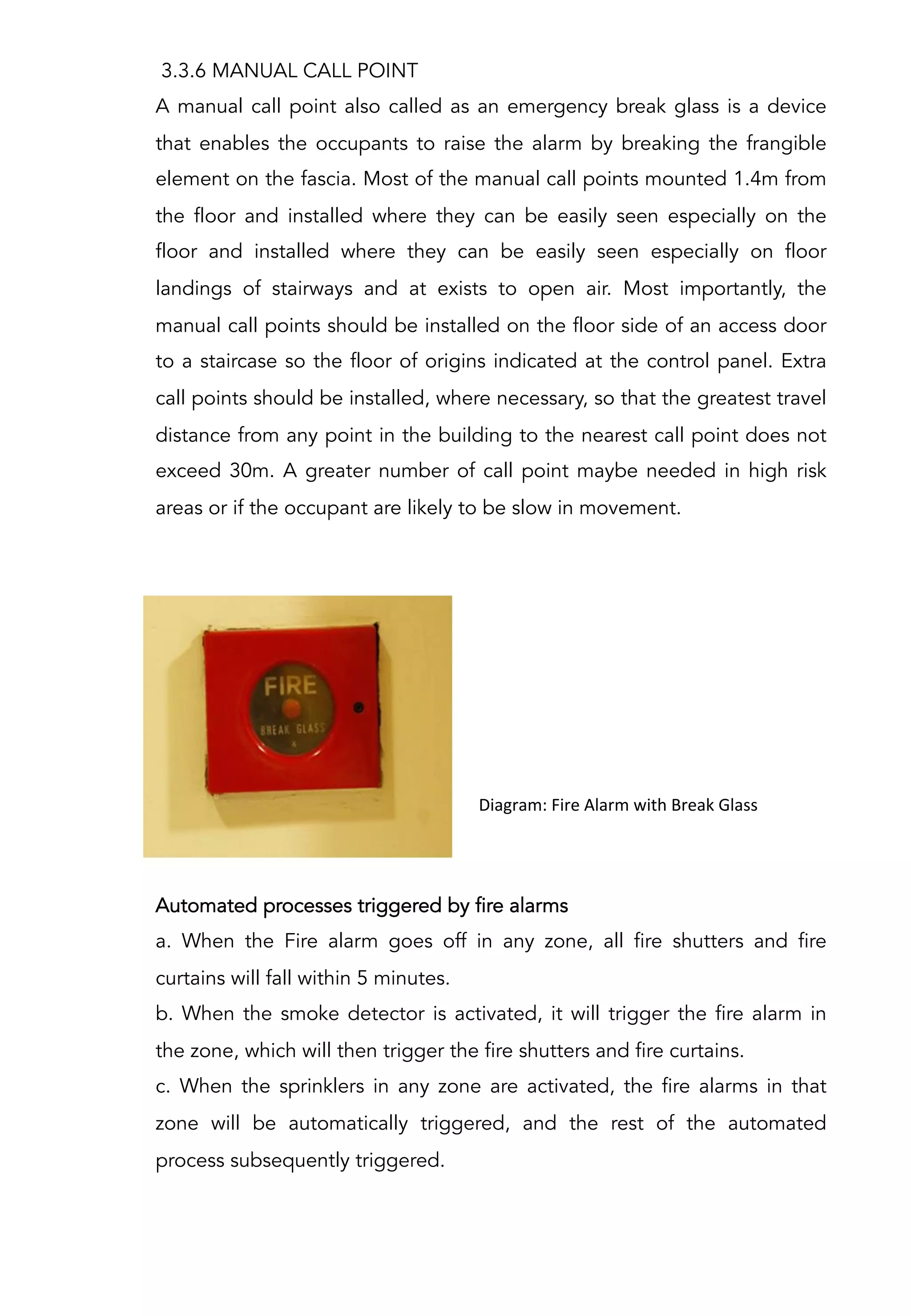
A manual call point also called as an emergency break glass is a device
that enables the occupants to raise the alarm by breaking the frangible
element on the fascia. Most of the manual call points mounted 1.4m from
the floor and installed where they can be easily seen especially on the
floor and installed where they can be easily seen especially on floor
landings of stairways and at exists to open air. Most importantly, the
manual call points should be installed on the floor side of an access door
to a staircase so the floor of origins indicated at the control panel. Extra
call points should be installed, where necessary, so that the greatest travel
distance from any point in the building to the nearest call point does not
exceed 30m. A greater number of call point maybe needed in high risk
areas or if the occupant are likely to be slow in movement.


  Diagram:	
  Fire	
  Alarm	
  with	
  Break	
  Glass	


Automated processes triggered by fire alarms
a. When the Fire alarm goes off in any zone, all fire shutters and fire
curtains will fall within 5 minutes.
b. When the smoke detector is activated, it will trigger the fire alarm in
the zone, which will then trigger the fire shutters and fire curtains.
c. When the sprinklers in any zone are activated, the fire alarms in that
zone will be automatically triggered, and the rest of the automated
process subsequently triggered.
3.3.7	
  Non-­‐Water	
  Based	
  System	
  
Carbon	
  Dioxide	
  System	
  
	
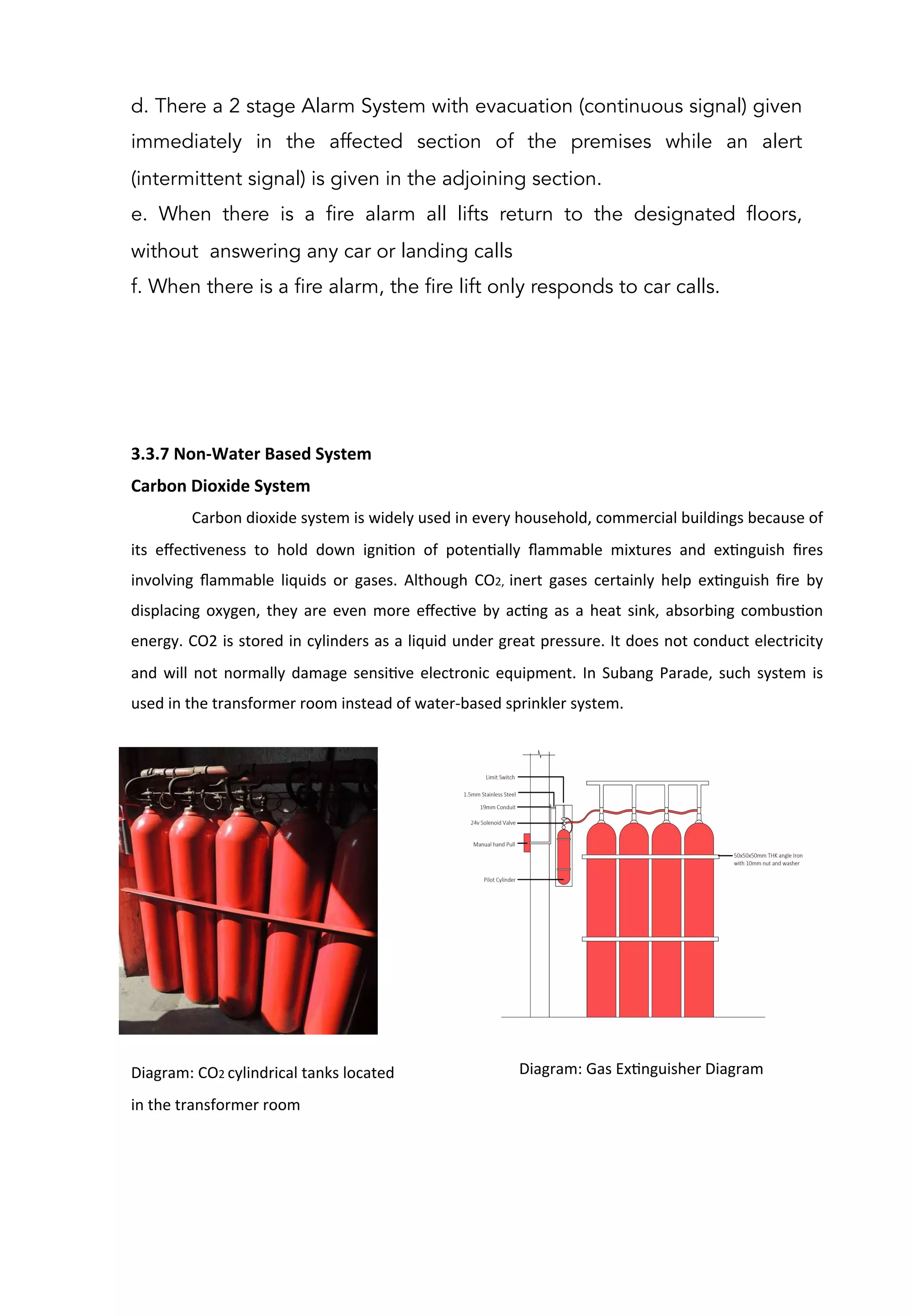
  Carbon	
  dioxide	
  system	
  is	
  widely	
  used	
  in	
  every	
  household,	
  commercial	
  buildings	
  because	
  of	
  
its	
   effecAveness	
   to	
   hold	
   down	
   igniAon	
   of	
   potenAally	
   flammable	
   mixtures	
   and	
   exAnguish	
   fires	
  
involving	
   flammable	
   liquids	
   or	
   gases.	
   Although	
   CO2,	
   inert	
   gases	
   certainly	
   help	
   exAnguish	
   fire	
   by	
  
displacing	
  oxygen,	
  they	
  are	
  even	
  more	
  effecAve	
  by	
  acAng	
  as	
  a	
  heat	
  sink,	
  absorbing	
  combusAon	
  
energy.	
  CO2	
  is	
  stored	
  in	
  cylinders	
  as	
  a	
  liquid	
  under	
  great	
  pressure.	
  It	
  does	
  not	
  conduct	
  electricity	
  
and	
  will	
  not	
  normally	
  damage	
  sensiAve	
  electronic	
  equipment.	
  In	
  Subang	
  Parade,	
  such	
  system	
  is	
  
used	
  in	
  the	
  transformer	
  room	
  instead	
  of	
  water-­‐based	
  sprinkler	
  system.	


Diagram:	
  CO2	
  cylindrical	
  tanks	
  located	
  	
  
in	
  the	
  transformer	
  room	


  Diagram:	
  Gas	
  ExAnguisher	
  Diagram	


d. There a 2 stage Alarm System with evacuation (continuous signal) given
immediately in the affected section of the premises while an alert
(intermittent signal) is given in the adjoining section.
e. When there is a fire alarm all lifts return to the designated floors,
without answering any car or landing calls
f. When there is a fire alarm, the fire lift only responds to car calls.
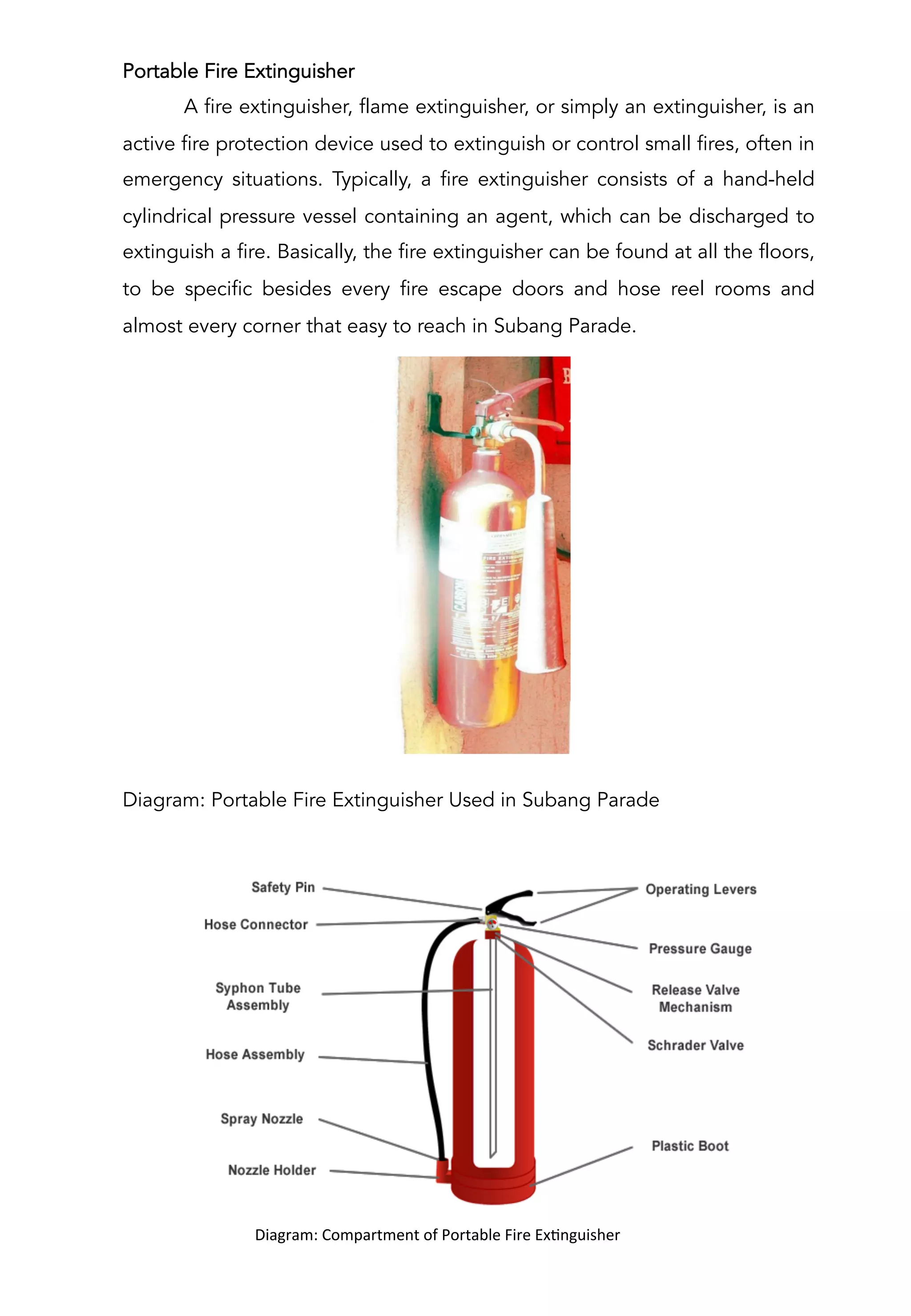
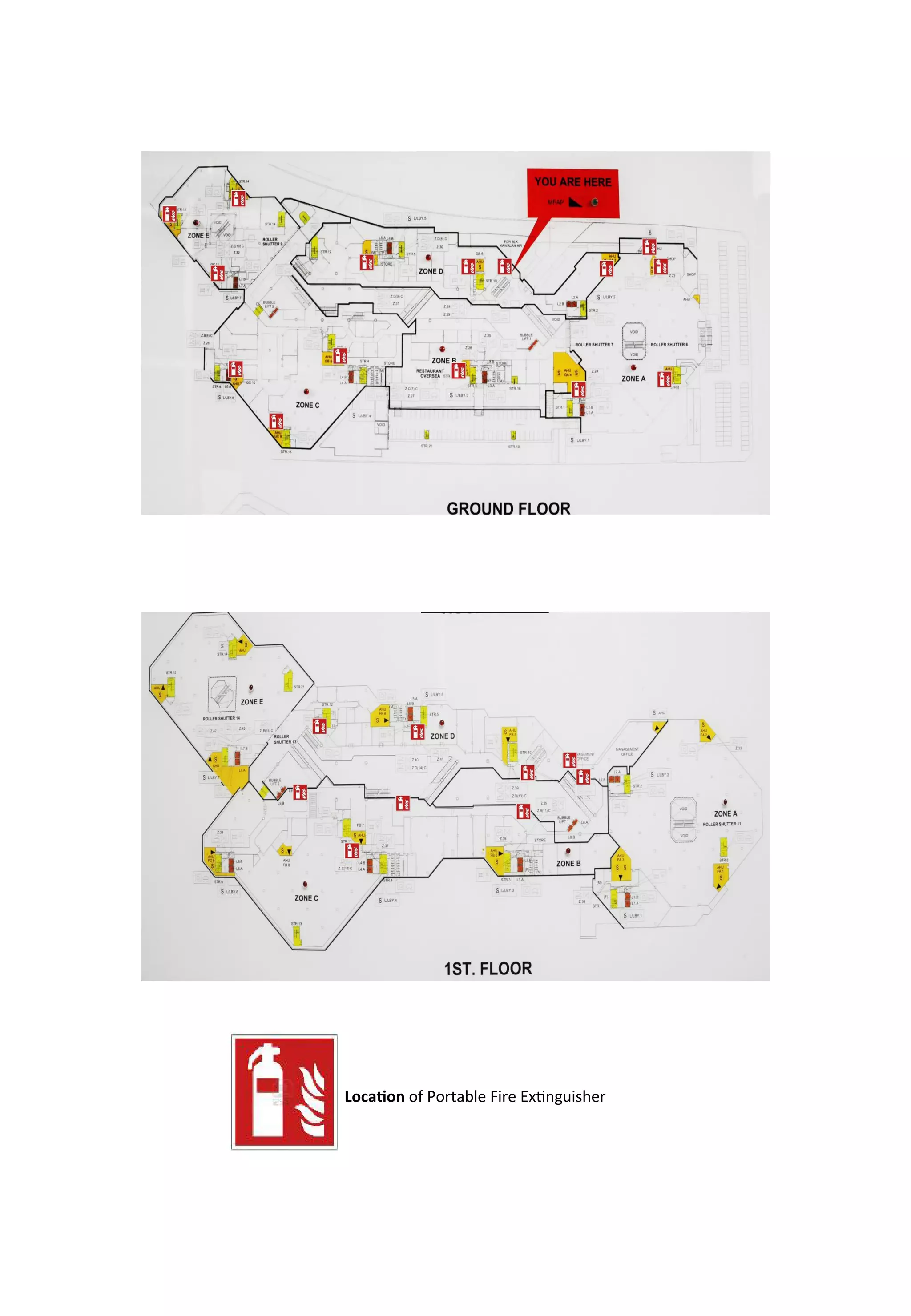
Portable Fire Extinguisher
A fire extinguisher, flame extinguisher, or simply an extinguisher, is an
active fire protection device used to extinguish or control small fires, often in
emergency situations. Typically, a fire extinguisher consists of a hand-held
cylindrical pressure vessel containing an agent, which can be discharged to
extinguish a fire. Basically, the fire extinguisher can be found at all the floors,
to be specific besides every fire escape doors and hose reel rooms and
almost every corner that easy to reach in Subang Parade.
Diagram: Portable Fire Extinguisher Used in Subang Parade


  Diagram:	
  Compartment	
  of	
  Portable	
  Fire	
  ExAnguisher	


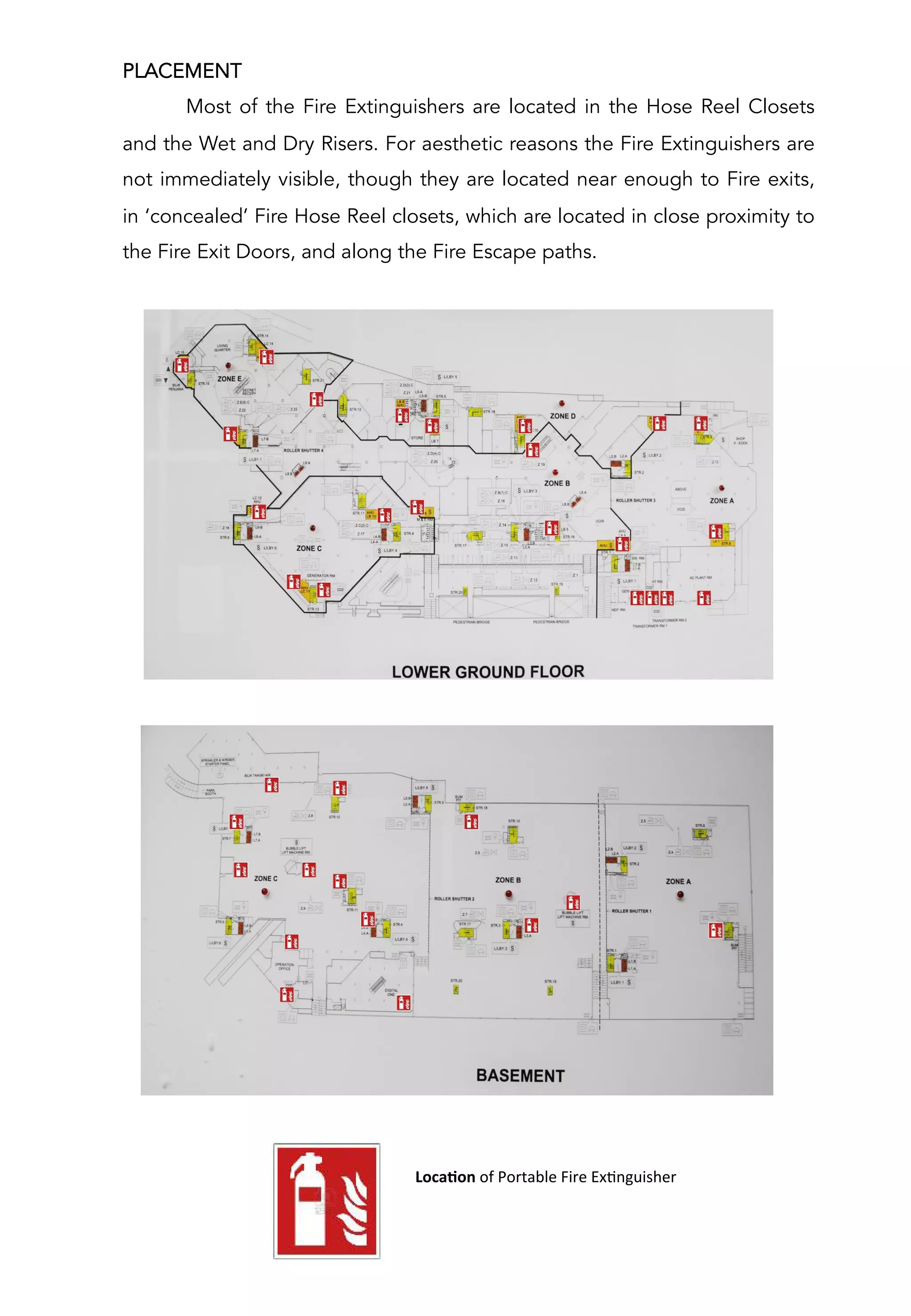
PLACEMENT
Most of the Fire Extinguishers are located in the Hose Reel Closets
and the Wet and Dry Risers. For aesthetic reasons the Fire Extinguishers are
not immediately visible, though they are located near enough to Fire exits,
in ‘concealed’ Fire Hose Reel closets, which are located in close proximity to
the Fire Exit Doors, and along the Fire Escape paths.


  LocaCon	
  of	
  Portable	
  Fire	
  ExAnguisher	


  LocaCon	
  of	
  Portable	
  Fire	
  ExAnguisher	


According to UBBL Law 1984, Section 227:
Portable Fire Extinguisher shall be provided in accordance with relevant
codes of practice and shall be sited in prominent position on exit routes to
be visible from all direction and similar extinguishers in a building shall be of
the same method of operation.
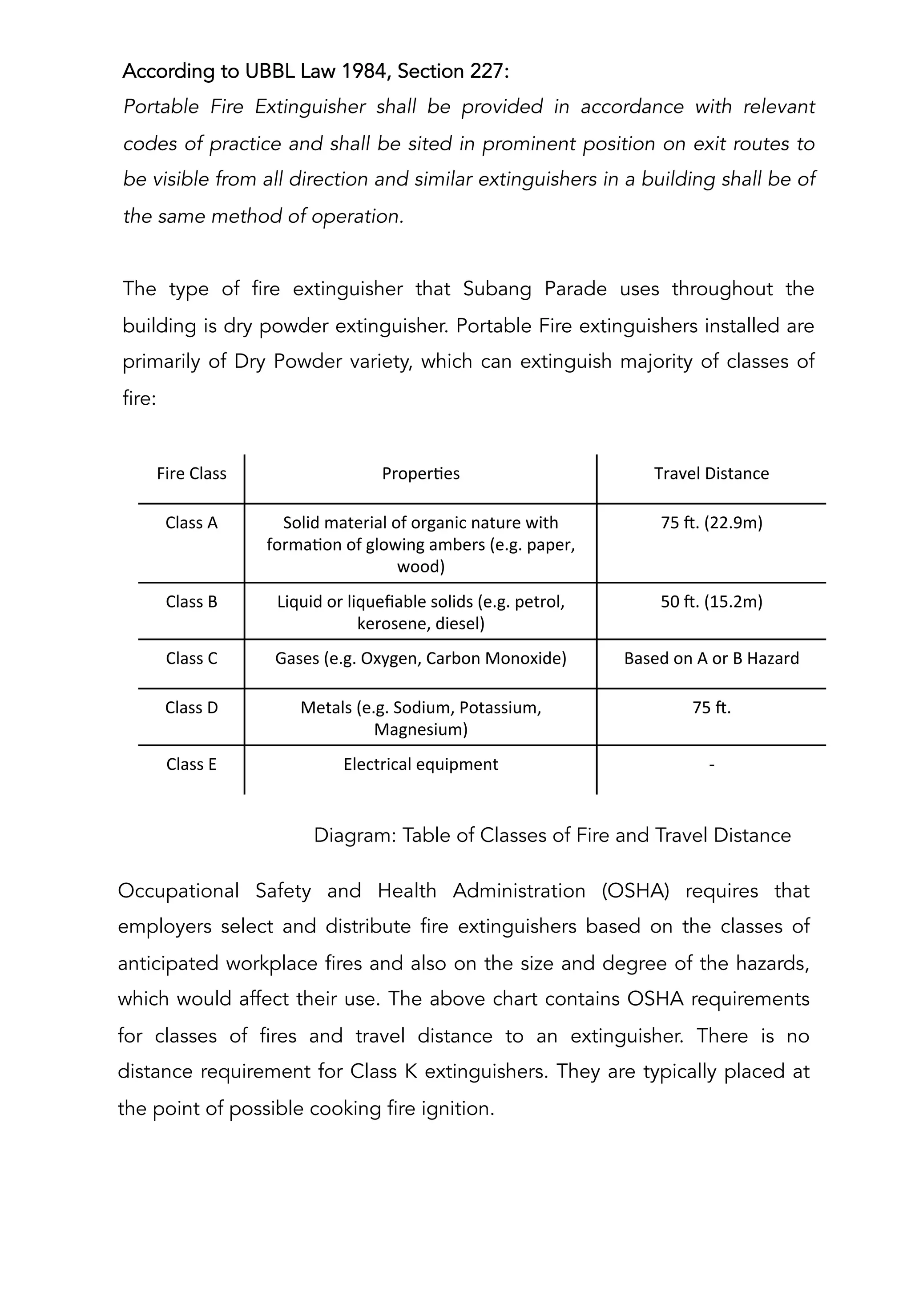
The type of fire extinguisher that Subang Parade uses throughout the
building is dry powder extinguisher. Portable Fire extinguishers installed are
primarily of Dry Powder variety, which can extinguish majority of classes of
fire:
Diagram: Table of Classes of Fire and Travel Distance
Fire	
  Class	
  	
   ProperAes	
   Travel	
  Distance	
  
Class	
  A	
   Solid	
  material	
  of	
  organic	
  nature	
  with	
  
formaAon	
  of	
  glowing	
  ambers	
  (e.g.	
  paper,	
  
wood)	
  
75	
  S.	
  (22.9m)	
  
Class	
  B	
   Liquid	
  or	
  liquefiable	
  solids	
  (e.g.	
  petrol,	
  
kerosene,	
  diesel)	
  
50	
  S.	
  (15.2m)	
  
Class	
  C	
   Gases	
  (e.g.	
  Oxygen,	
  Carbon	
  Monoxide)	
   Based	
  on	
  A	
  or	
  B	
  Hazard	
  
Class	
  D	
   Metals	
  (e.g.	
  Sodium,	
  Potassium,	
  
Magnesium)	
  
75	
  S.	
  	
  
Class	
  E	
   Electrical	
  equipment	
   -­‐	
  
Occupational Safety and Health Administration (OSHA) requires that
employers select and distribute fire extinguishers based on the classes of
anticipated workplace fires and also on the size and degree of the hazards,
which would affect their use. The above chart contains OSHA requirements
for classes of fires and travel distance to an extinguisher. There is no
distance requirement for Class K extinguishers. They are typically placed at
the point of possible cooking fire ignition.
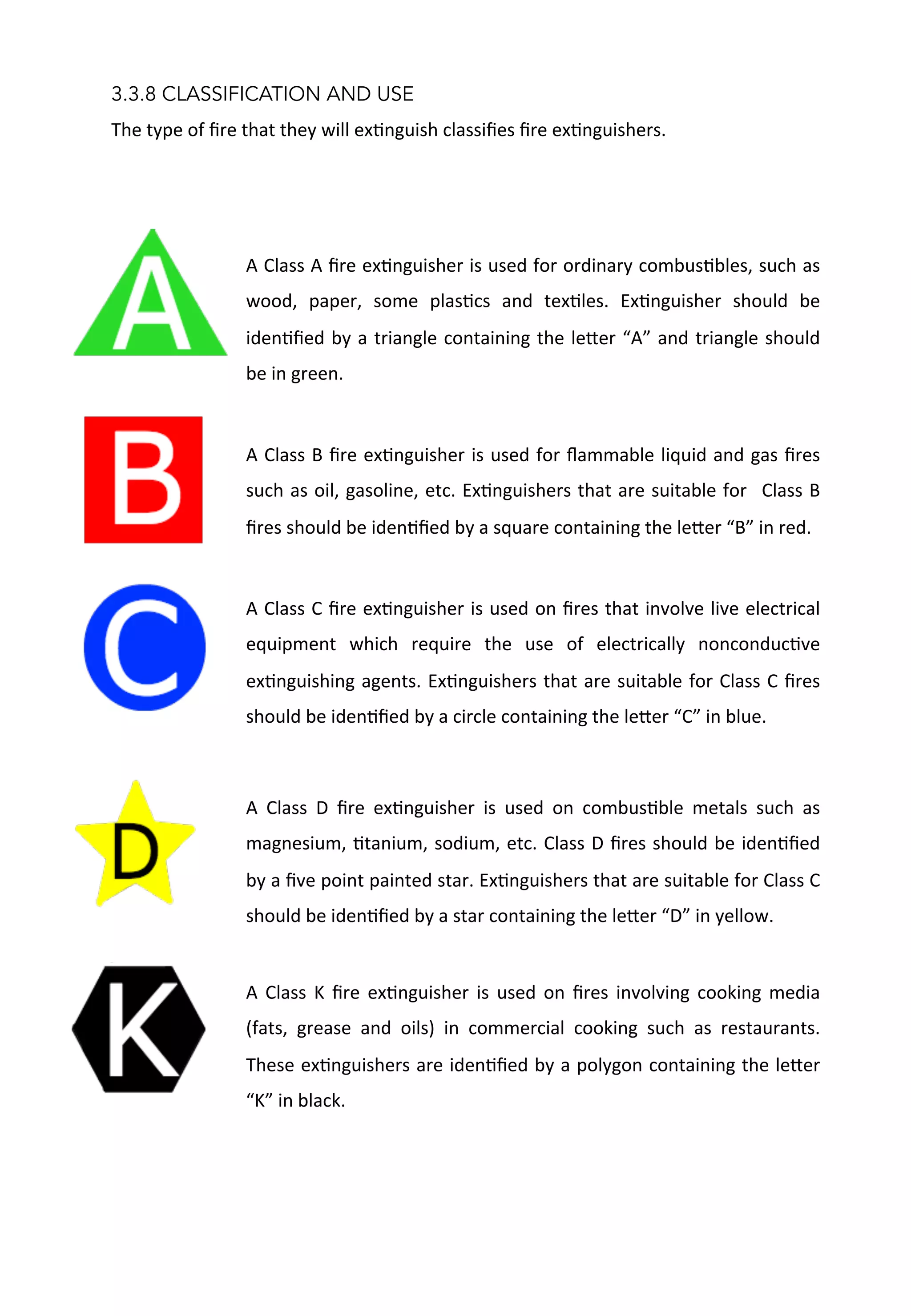
A	
  Class	
  B	
  fire	
  exAnguisher	
  is	
  used	
  for	
  flammable	
  liquid	
  and	
  gas	
  fires	
  
such	
  as	
  oil,	
  gasoline,	
  etc.	
  ExAnguishers	
  that	
  are	
  suitable	
  for	
   	
  Class	
  B	
  
fires	
  should	
  be	
  idenAfied	
  by	
  a	
  square	
  containing	
  the	
  le[er	
  “B”	
  in	
  red.	
  
A	
  Class	
  C	
  fire	
  exAnguisher	
  is	
  used	
  on	
  fires	
  that	
  involve	
  live	
  electrical	
  
equipment	
   which	
   require	
   the	
   use	
   of	
   electrically	
   nonconducAve	
  
exAnguishing	
  agents.	
  ExAnguishers	
  that	
  are	
  suitable	
  for	
  Class	
  C	
  fires	
  
should	
  be	
  idenAfied	
  by	
  a	
  circle	
  containing	
  the	
  le[er	
  “C”	
  in	
  blue.	
  
A	
   Class	
   D	
   fire	
   exAnguisher	
   is	
   used	
   on	
   combusAble	
   metals	
   such	
   as	
  
magnesium,	
  Atanium,	
  sodium,	
  etc.	
  Class	
  D	
  fires	
  should	
  be	
  idenAfied	
  
by	
  a	
  five	
  point	
  painted	
  star.	
  ExAnguishers	
  that	
  are	
  suitable	
  for	
  Class	
  C	
  
should	
  be	
  idenAfied	
  by	
  a	
  star	
  containing	
  the	
  le[er	
  “D”	
  in	
  yellow.	
  
A	
   Class	
   K	
   fire	
   exAnguisher	
   is	
   used	
   on	
   fires	
   involving	
   cooking	
   media	
  
(fats,	
   grease	
   and	
   oils)	
   in	
   commercial	
   cooking	
   such	
   as	
   restaurants.	
  
These	
  exAnguishers	
  are	
  idenAfied	
  by	
  a	
  polygon	
  containing	
  the	
  le[er	
  
“K”	
  in	
  black.	
  
3.3.8 CLASSIFICATION AND USE
The	
  type	
  of	
  fire	
  that	
  they	
  will	
  exAnguish	
  classifies	
  fire	
  exAnguishers.	


A	
  Class	
  A	
  fire	
  exAnguisher	
  is	
  used	
  for	
  ordinary	
  combusAbles,	
  such	
  as	
  
wood,	
   paper,	
   some	
   plasAcs	
   and	
   texAles.	
   ExAnguisher	
   should	
   be	
  
idenAfied	
  by	
  a	
  triangle	
  containing	
  the	
  le[er	
  “A”	
  and	
  triangle	
  should	
  
be	
  in	
  green.	
  
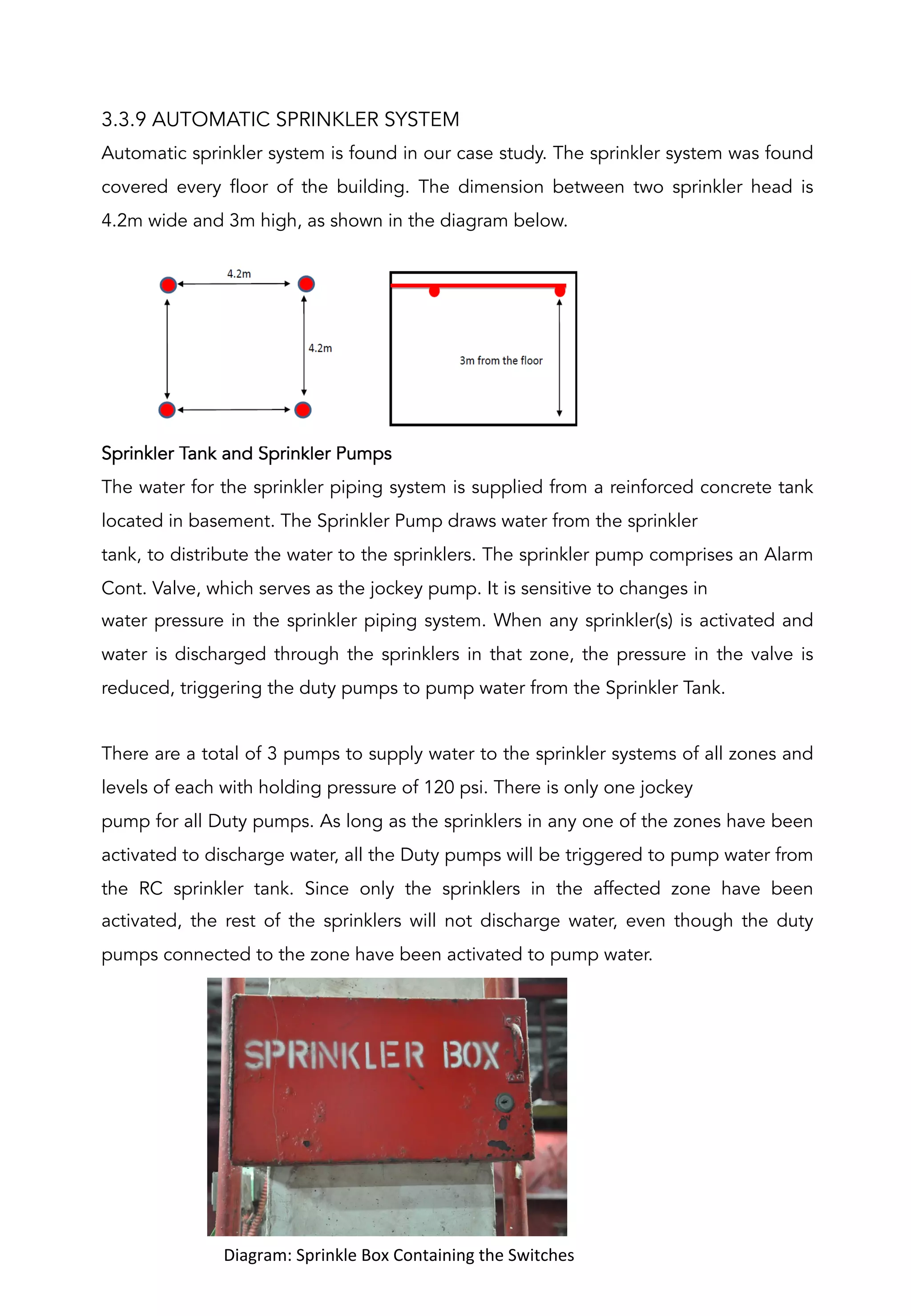
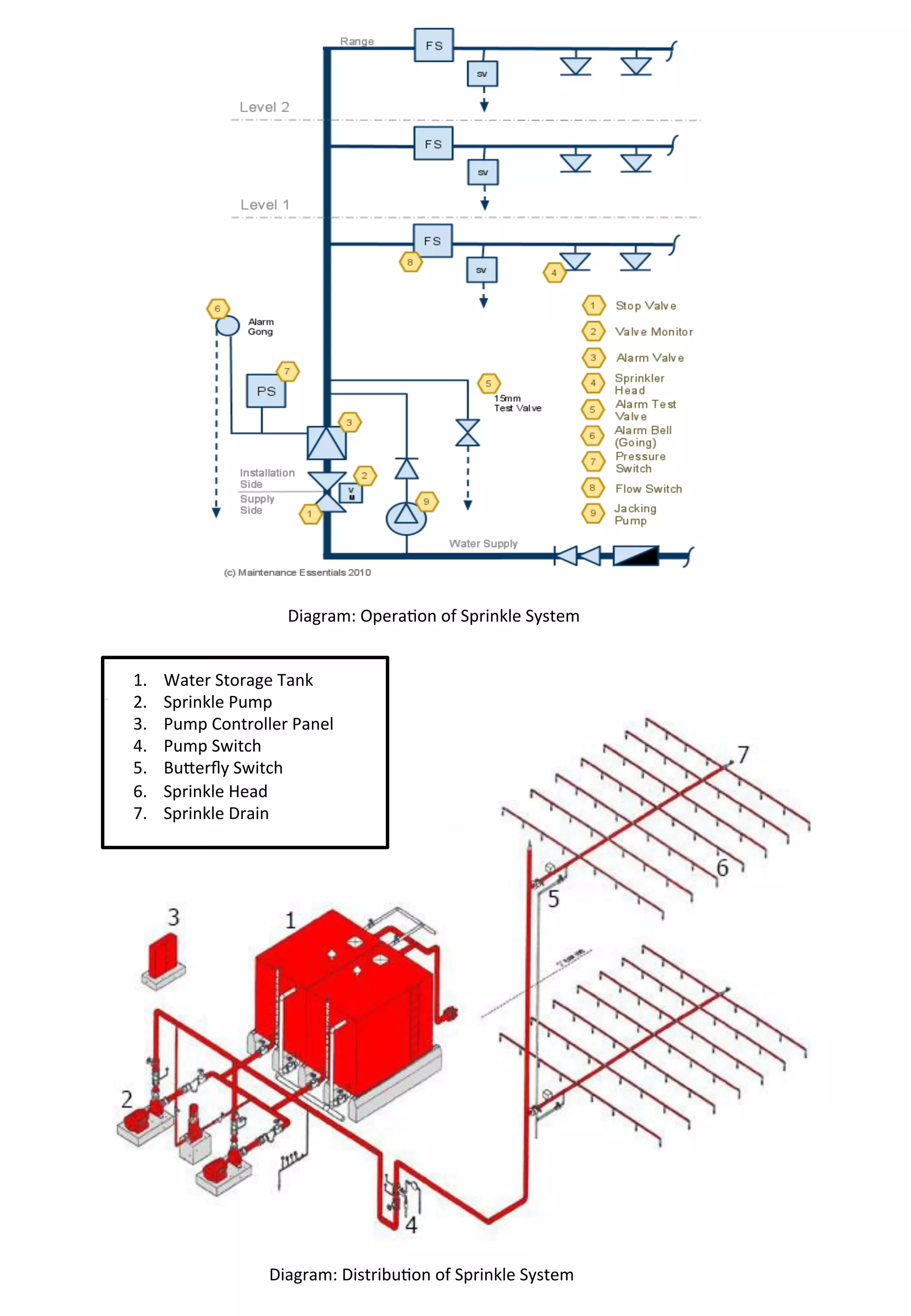
3.3.9 AUTOMATIC SPRINKLER SYSTEM
Automatic sprinkler system is found in our case study. The sprinkler system was found
covered every floor of the building. The dimension between two sprinkler head is
4.2m wide and 3m high, as shown in the diagram below.
Sprinkler Tank and Sprinkler Pumps
The water for the sprinkler piping system is supplied from a reinforced concrete tank
located in basement. The Sprinkler Pump draws water from the sprinkler
tank, to distribute the water to the sprinklers. The sprinkler pump comprises an Alarm
Cont. Valve, which serves as the jockey pump. It is sensitive to changes in
water pressure in the sprinkler piping system. When any sprinkler(s) is activated and
water is discharged through the sprinklers in that zone, the pressure in the valve is
reduced, triggering the duty pumps to pump water from the Sprinkler Tank.
There are a total of 3 pumps to supply water to the sprinkler systems of all zones and
levels of each with holding pressure of 120 psi. There is only one jockey
pump for all Duty pumps. As long as the sprinklers in any one of the zones have been
activated to discharge water, all the Duty pumps will be triggered to pump water from
the RC sprinkler tank. Since only the sprinklers in the affected zone have been
activated, the rest of the sprinklers will not discharge water, even though the duty
pumps connected to the zone have been activated to pump water.


  Diagram:	
  Sprinkle	
  Box	
  Containing	
  the	
  Switches	


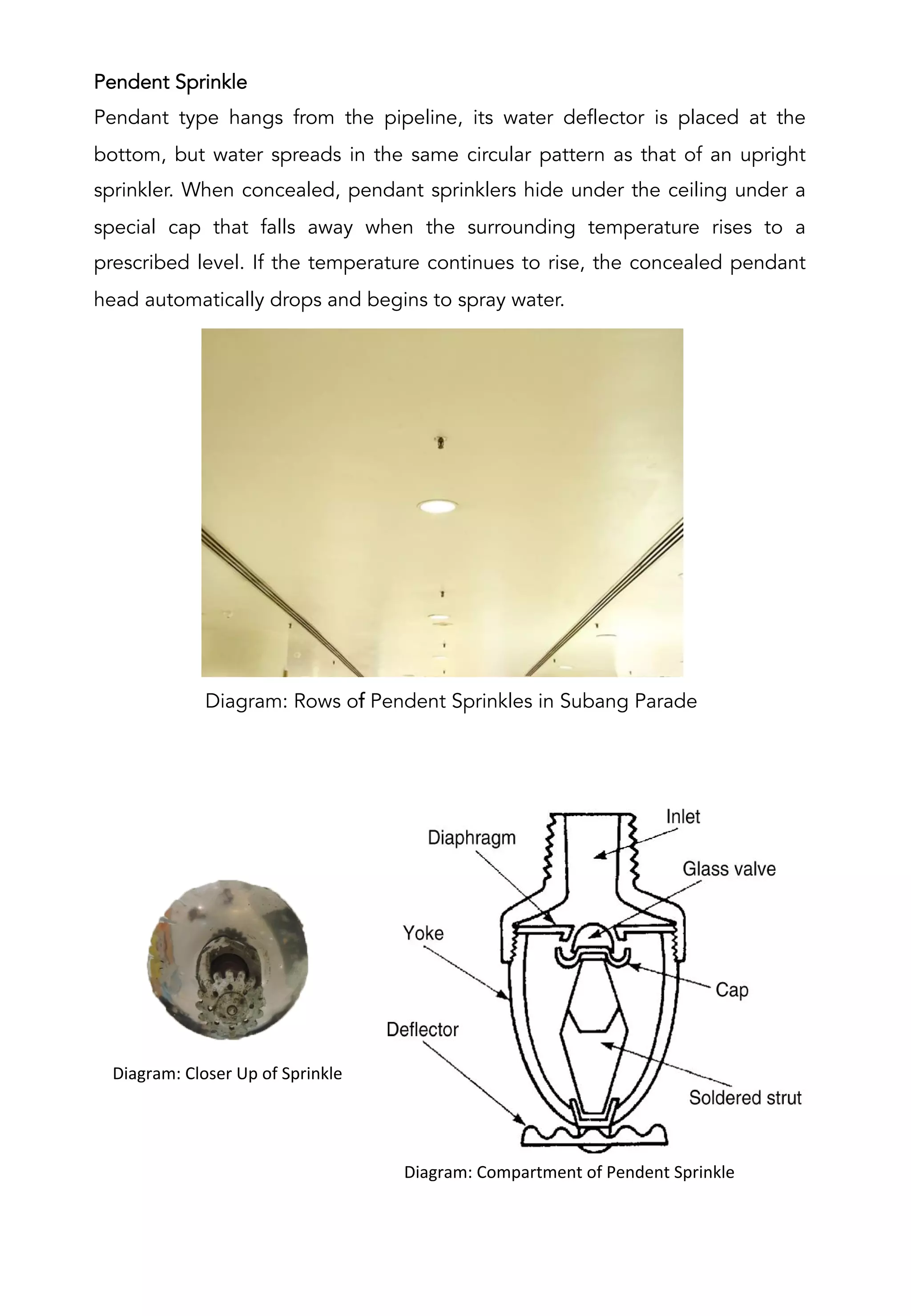
Pendent Sprinkle
Pendant type hangs from the pipeline, its water deflector is placed at the
bottom, but water spreads in the same circular pattern as that of an upright
sprinkler. When concealed, pendant sprinklers hide under the ceiling under a
special cap that falls away when the surrounding temperature rises to a
prescribed level. If the temperature continues to rise, the concealed pendant
head automatically drops and begins to spray water.
Diagram: Rows of Pendent Sprinkles in Subang Parade


  Diagram:	
  Compartment	
  of	
  Pendent	
  Sprinkle	


  Diagram:	
  Closer	
  Up	
  of	
  Sprinkle	


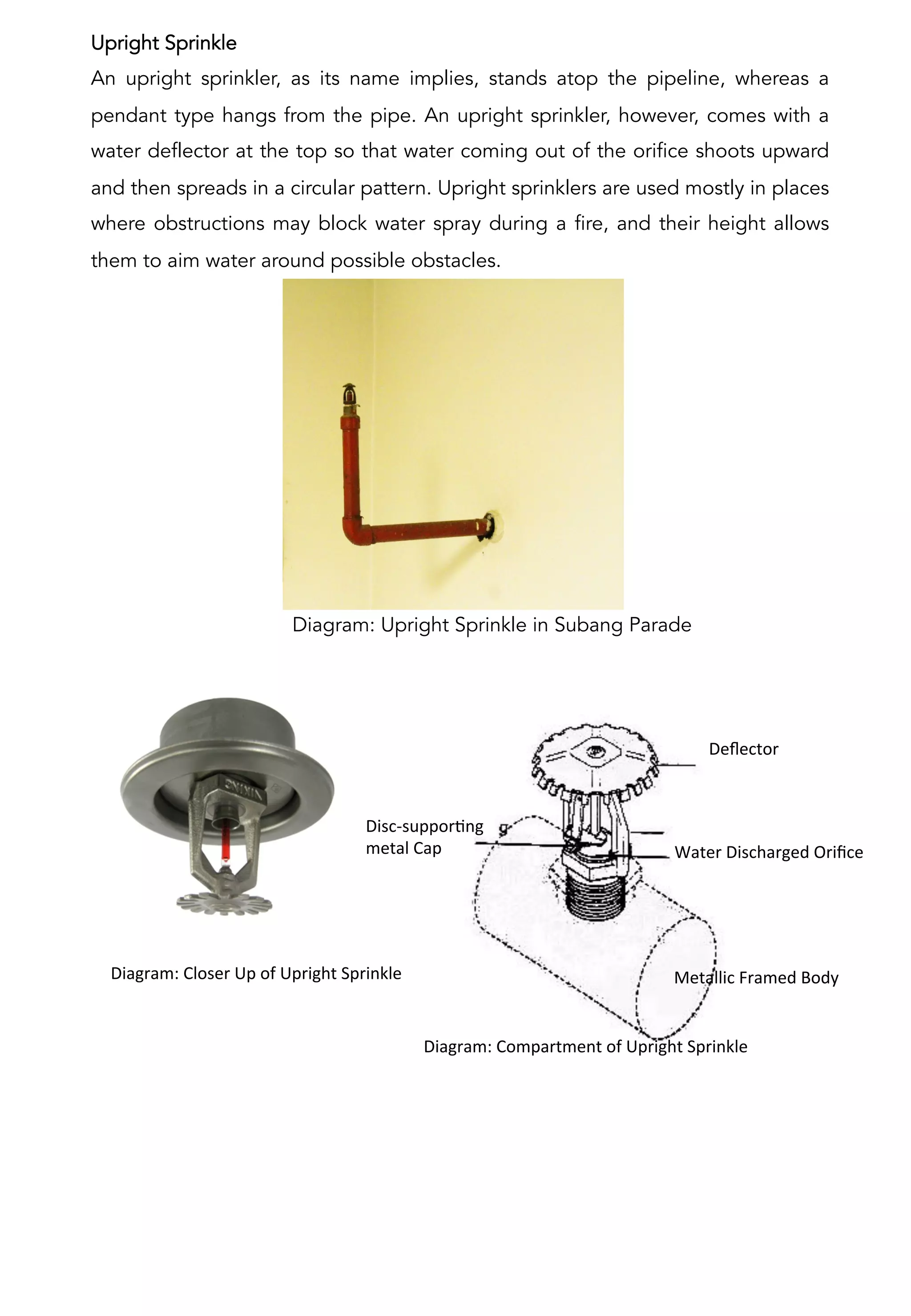
Upright Sprinkle
An upright sprinkler, as its name implies, stands atop the pipeline, whereas a
pendant type hangs from the pipe. An upright sprinkler, however, comes with a
water deflector at the top so that water coming out of the orifice shoots upward
and then spreads in a circular pattern. Upright sprinklers are used mostly in places
where obstructions may block water spray during a fire, and their height allows
them to aim water around possible obstacles.
Diagram: Upright Sprinkle in Subang Parade
Disc-­‐supporAng	
  	
  
metal	
  Cap	
  
Deflector	
  
Metallic	
  Framed	
  Body	
  	
  
Water	
  Discharged	
  Orifice	


  Diagram:	
  Compartment	
  of	
  Upright	
  Sprinkle	


  Diagram:	
  Closer	
  Up	
  of	
  Upright	
  Sprinkle	


  Diagram:	
  DistribuAon	
  of	
  Sprinkle	
  System	


1.  Water	
  Storage	
  Tank	
  
2.  Sprinkle	
  Pump	
  
3.  Pump	
  Controller	
  Panel	
  
4.  Pump	
  Switch	
  
5.  Bu[erfly	
  Switch	
  
6.  Sprinkle	
  Head	
  
7.  Sprinkle	
  Drain	


  Diagram:	
  OperaAon	
  of	
  Sprinkle	
  System	


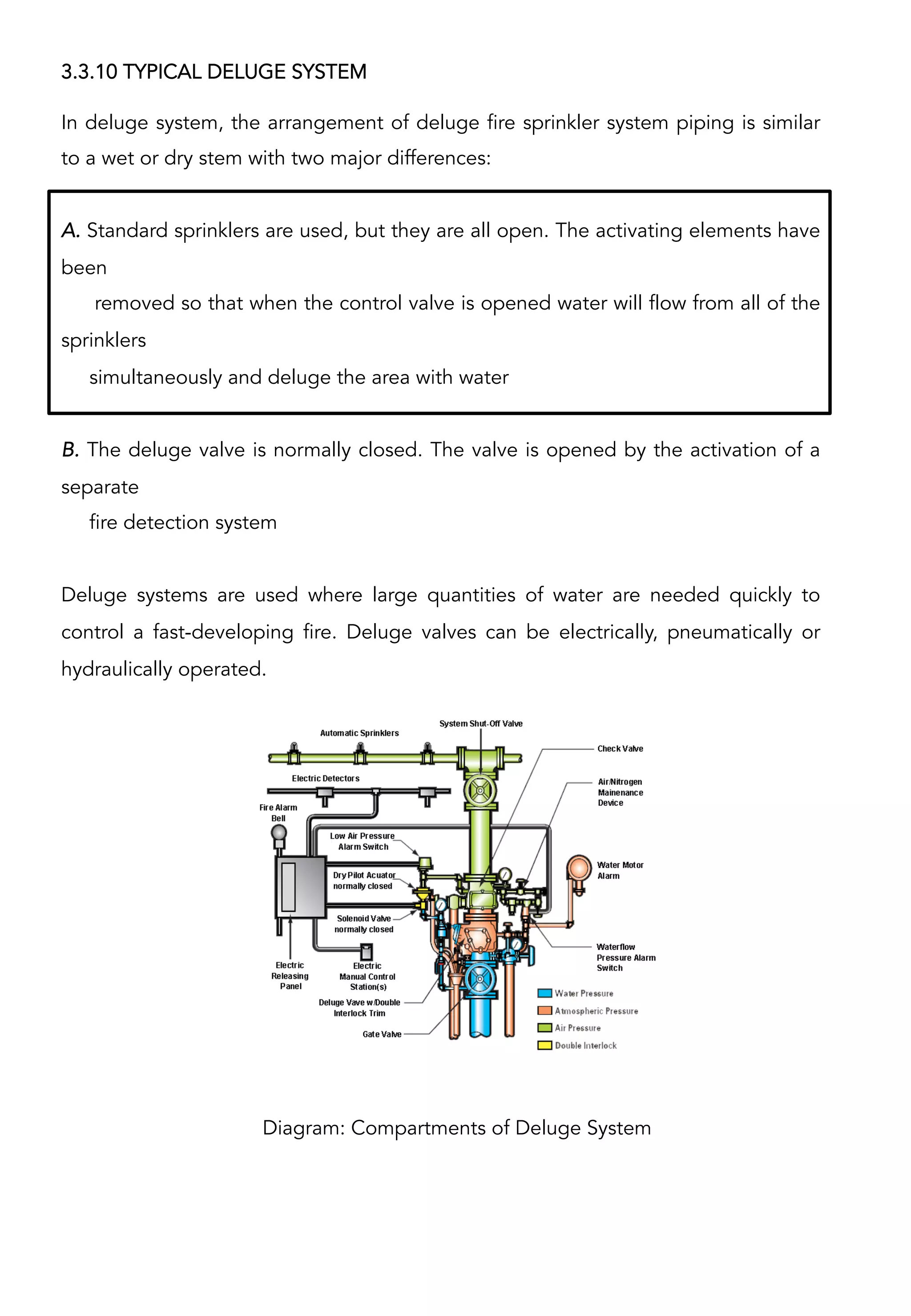
3.3.10 TYPICAL DELUGE SYSTEM
Diagram: Compartments of Deluge System
In deluge system, the arrangement of deluge fire sprinkler system piping is similar
to a wet or dry stem with two major differences:
A. Standard sprinklers are used, but they are all open. The activating elements have
been
removed so that when the control valve is opened water will flow from all of the
sprinklers
simultaneously and deluge the area with water
B. The deluge valve is normally closed. The valve is opened by the activation of a
separate
fire detection system
Deluge systems are used where large quantities of water are needed quickly to
control a fast-developing fire. Deluge valves can be electrically, pneumatically or
hydraulically operated.
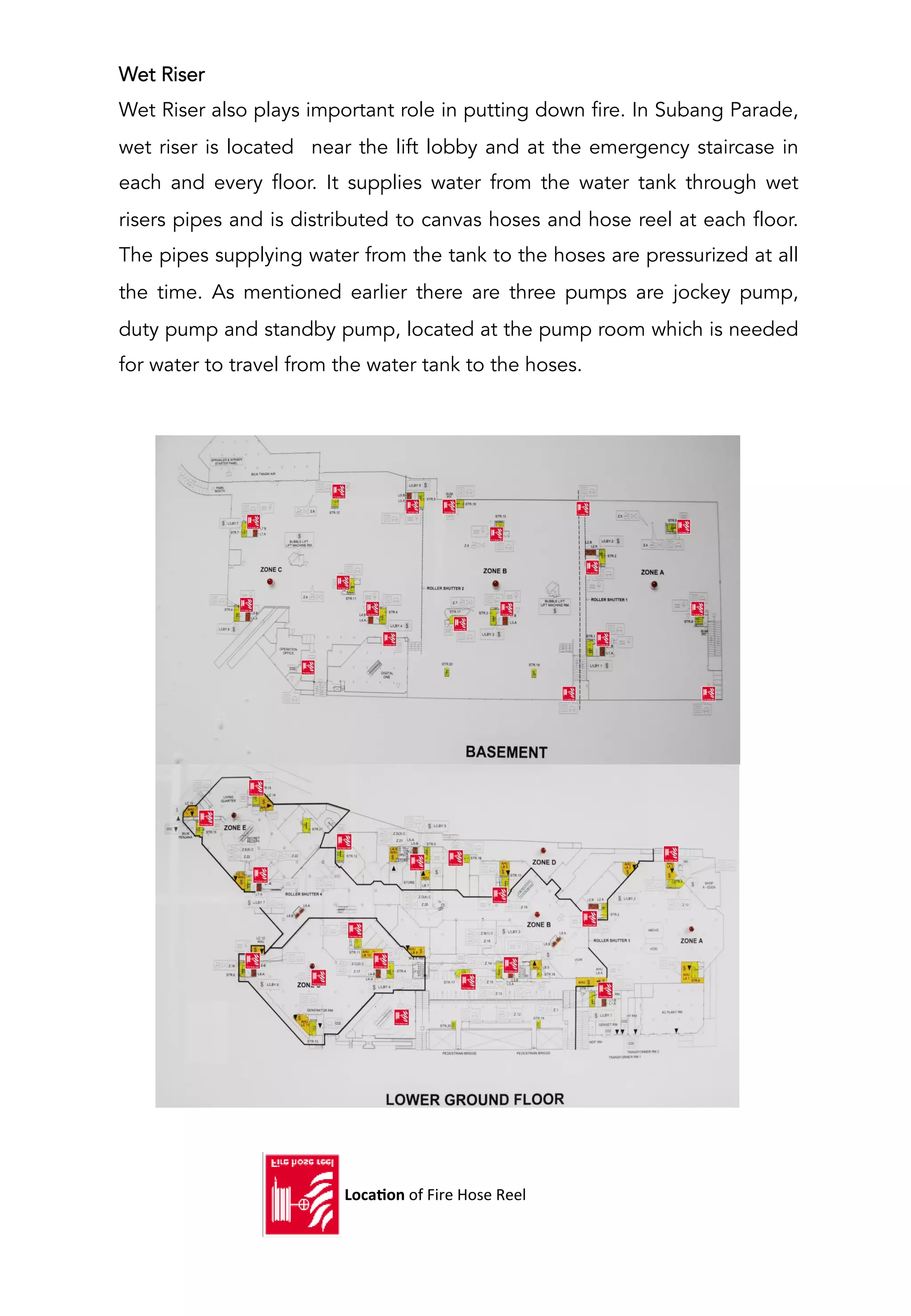
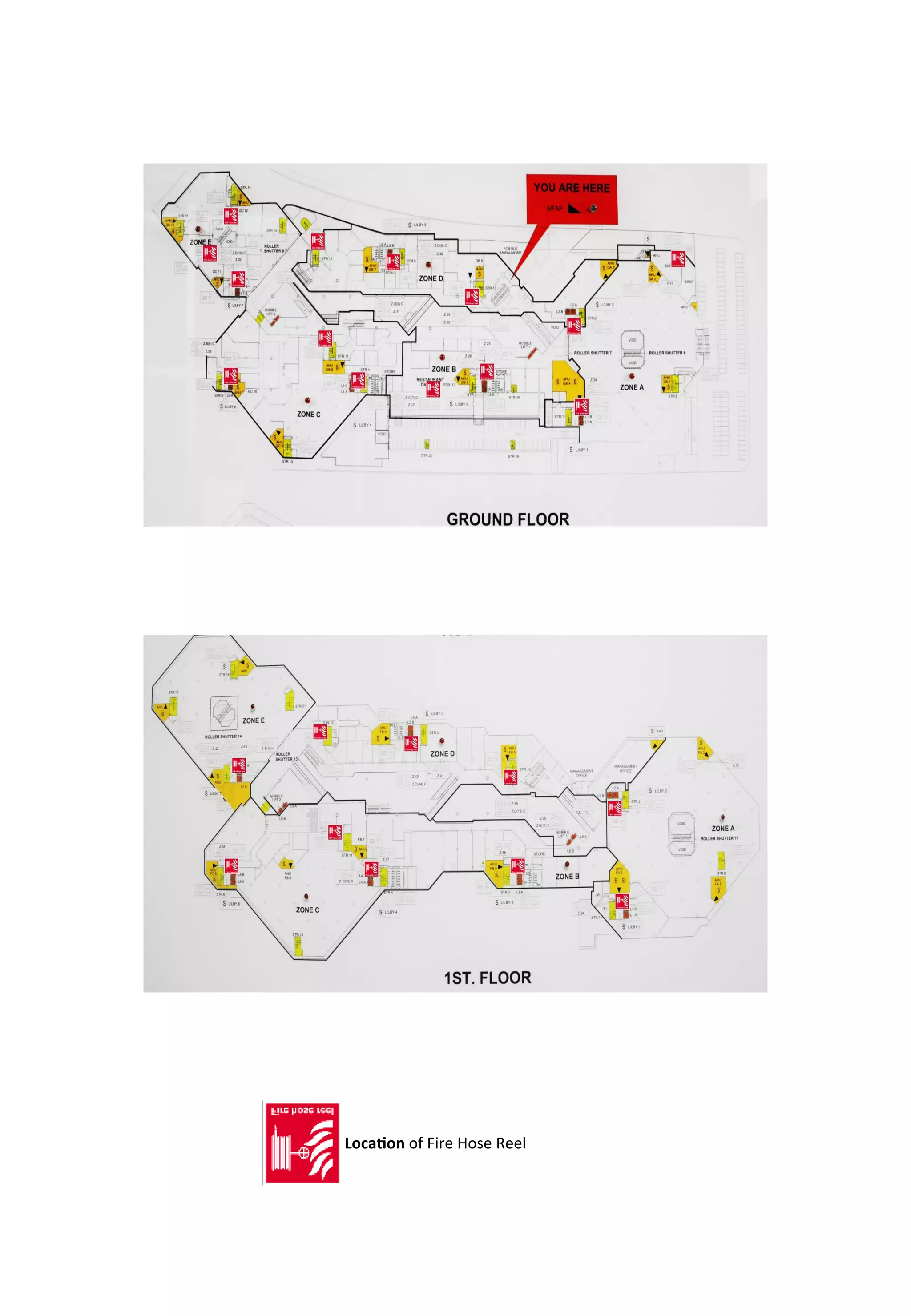
Wet Riser
Wet Riser also plays important role in putting down fire. In Subang Parade,
wet riser is located near the lift lobby and at the emergency staircase in
each and every floor. It supplies water from the water tank through wet
risers pipes and is distributed to canvas hoses and hose reel at each floor.
The pipes supplying water from the tank to the hoses are pressurized at all
the time. As mentioned earlier there are three pumps are jockey pump,
duty pump and standby pump, located at the pump room which is needed
for water to travel from the water tank to the hoses.


  LocaCon	
  of	
  Fire	
  Hose	
  Reel	


  LocaCon	
  of	
  Fire	
  Hose	
  Reel	
  
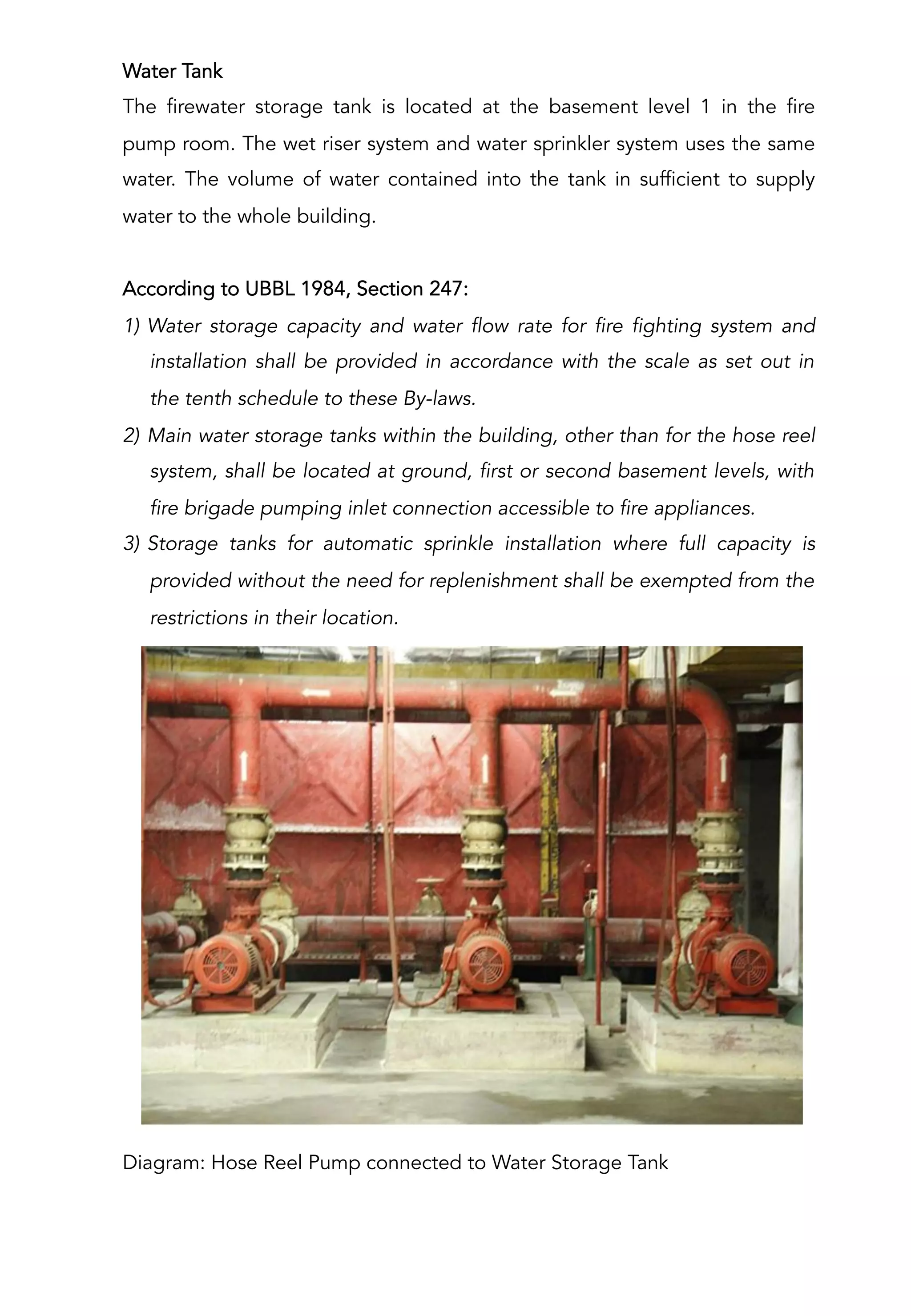
Water Tank
The firewater storage tank is located at the basement level 1 in the fire
pump room. The wet riser system and water sprinkler system uses the same
water. The volume of water contained into the tank in sufficient to supply
water to the whole building.
According to UBBL 1984, Section 247:
1)  Water storage capacity and water flow rate for fire fighting system and
installation shall be provided in accordance with the scale as set out in
the tenth schedule to these By-laws.
2)  Main water storage tanks within the building, other than for the hose reel
system, shall be located at ground, first or second basement levels, with
fire brigade pumping inlet connection accessible to fire appliances.
3)  Storage tanks for automatic sprinkle installation where full capacity is
provided without the need for replenishment shall be exempted from the
restrictions in their location.
Diagram: Hose Reel Pump connected to Water Storage Tank
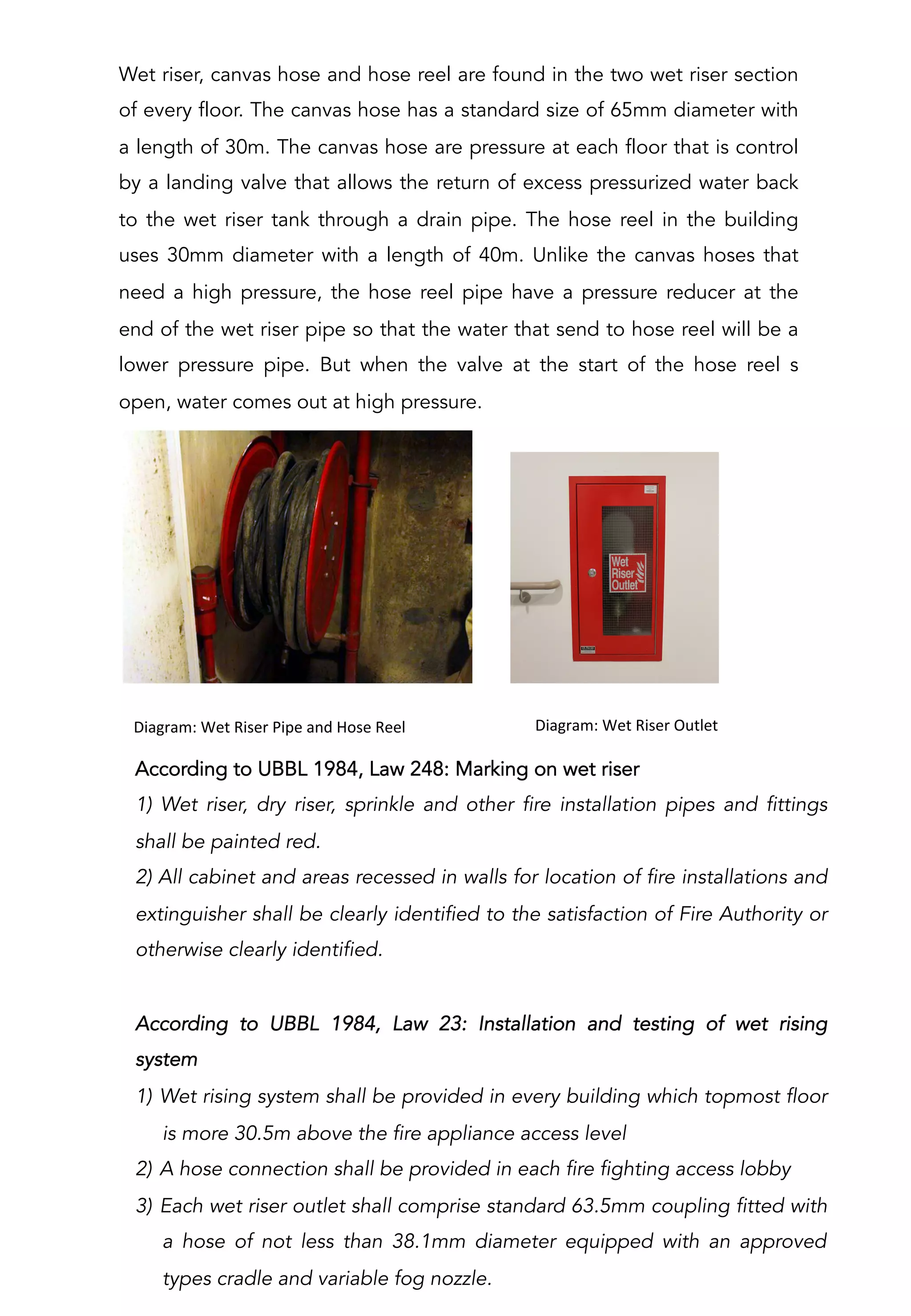
Wet riser, canvas hose and hose reel are found in the two wet riser section
of every floor. The canvas hose has a standard size of 65mm diameter with
a length of 30m. The canvas hose are pressure at each floor that is control
by a landing valve that allows the return of excess pressurized water back
to the wet riser tank through a drain pipe. The hose reel in the building
uses 30mm diameter with a length of 40m. Unlike the canvas hoses that
need a high pressure, the hose reel pipe have a pressure reducer at the
end of the wet riser pipe so that the water that send to hose reel will be a
lower pressure pipe. But when the valve at the start of the hose reel s
open, water comes out at high pressure.


  Diagram:	
  Wet	
  Riser	
  Pipe	
  and	
  Hose	
  Reel 	


  Diagram:	
  Wet	
  Riser	
  Outlet 	
  	
  
According to UBBL 1984, Law 248: Marking on wet riser
1) Wet riser, dry riser, sprinkle and other fire installation pipes and fittings
shall be painted red.
2) All cabinet and areas recessed in walls for location of fire installations and
extinguisher shall be clearly identified to the satisfaction of Fire Authority or
otherwise clearly identified.
According to UBBL 1984, Law 23: Installation and testing of wet rising
system
1)  Wet rising system shall be provided in every building which topmost floor
is more 30.5m above the fire appliance access level
2)  A hose connection shall be provided in each fire fighting access lobby
3)  Each wet riser outlet shall comprise standard 63.5mm coupling fitted with
a hose of not less than 38.1mm diameter equipped with an approved
types cradle and variable fog nozzle.
3.3.11 WATER BASED SYSTEM
External Fire Hydrant
Water Hydrant fire-fighting system consists of hydrants connected to same
pipeline; the other end of the pipeline is attached to the pumps and water
supply tank of the fire fighting room. The fire fighting hydrant line is close
loop pipe system to maintain the pressure in the water hydrant fire fighting
system. The networks of pipes are located underground. The hydrants are
used in case of emergency when there is need for more water. Firemen will
connect their equipment to the outlets of the hydrant, forcing water into the
system.
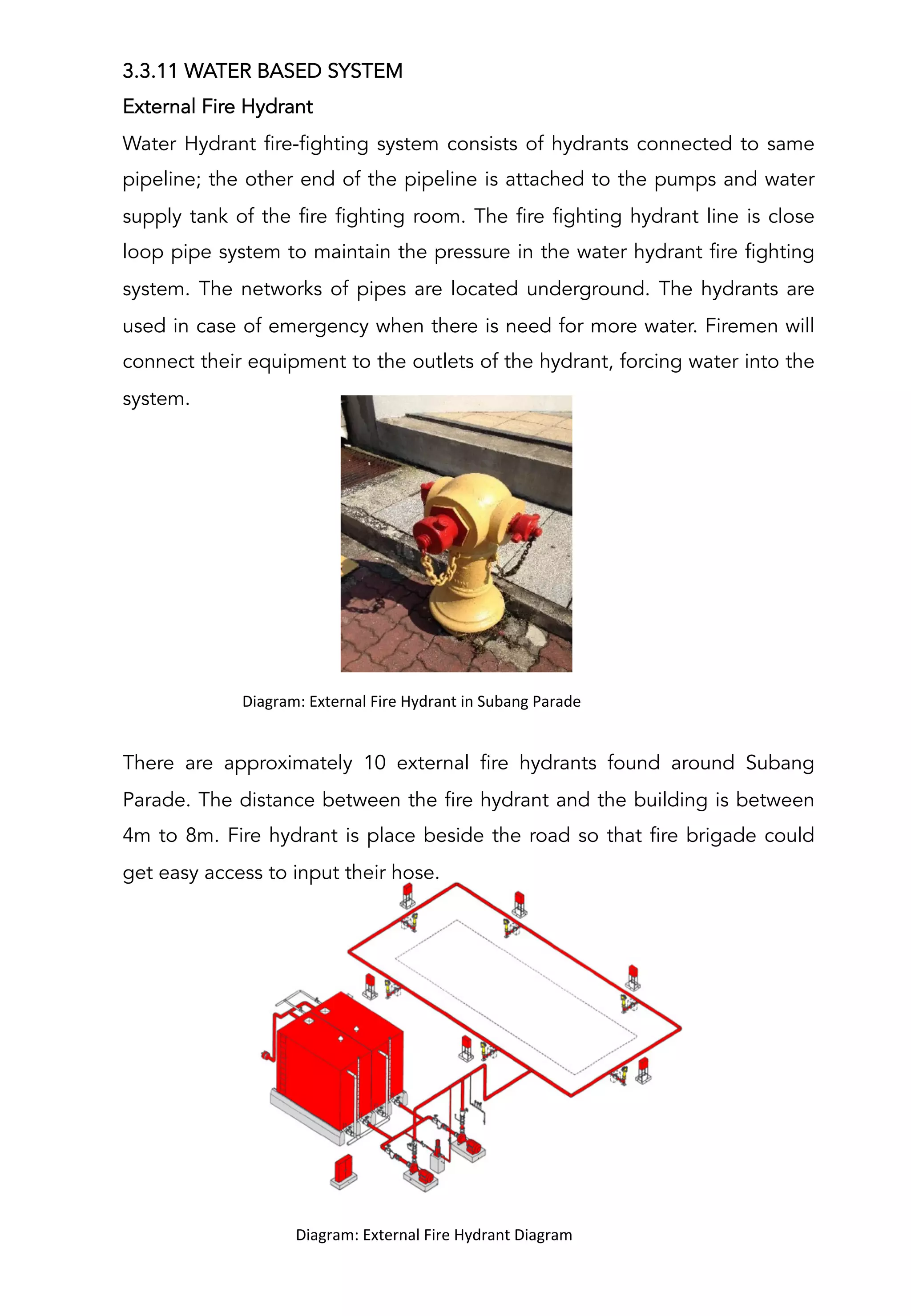
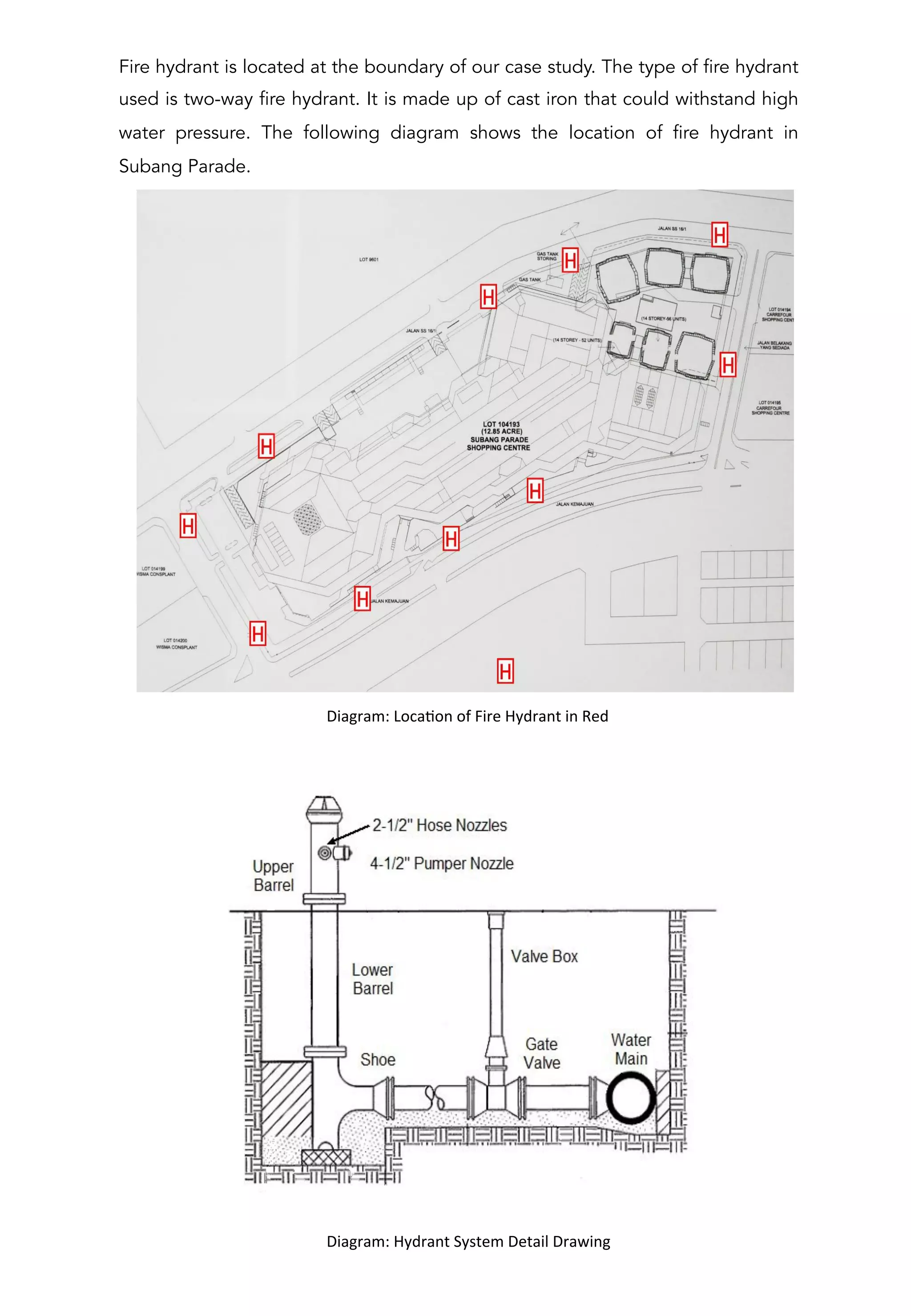
There are approximately 10 external fire hydrants found around Subang
Parade. The distance between the fire hydrant and the building is between
4m to 8m. Fire hydrant is place beside the road so that fire brigade could
get easy access to input their hose.


  Diagram:	
  External	
  Fire	
  Hydrant	
  Diagram	


  Diagram:	
  External	
  Fire	
  Hydrant	
  in	
  Subang	
  Parade	


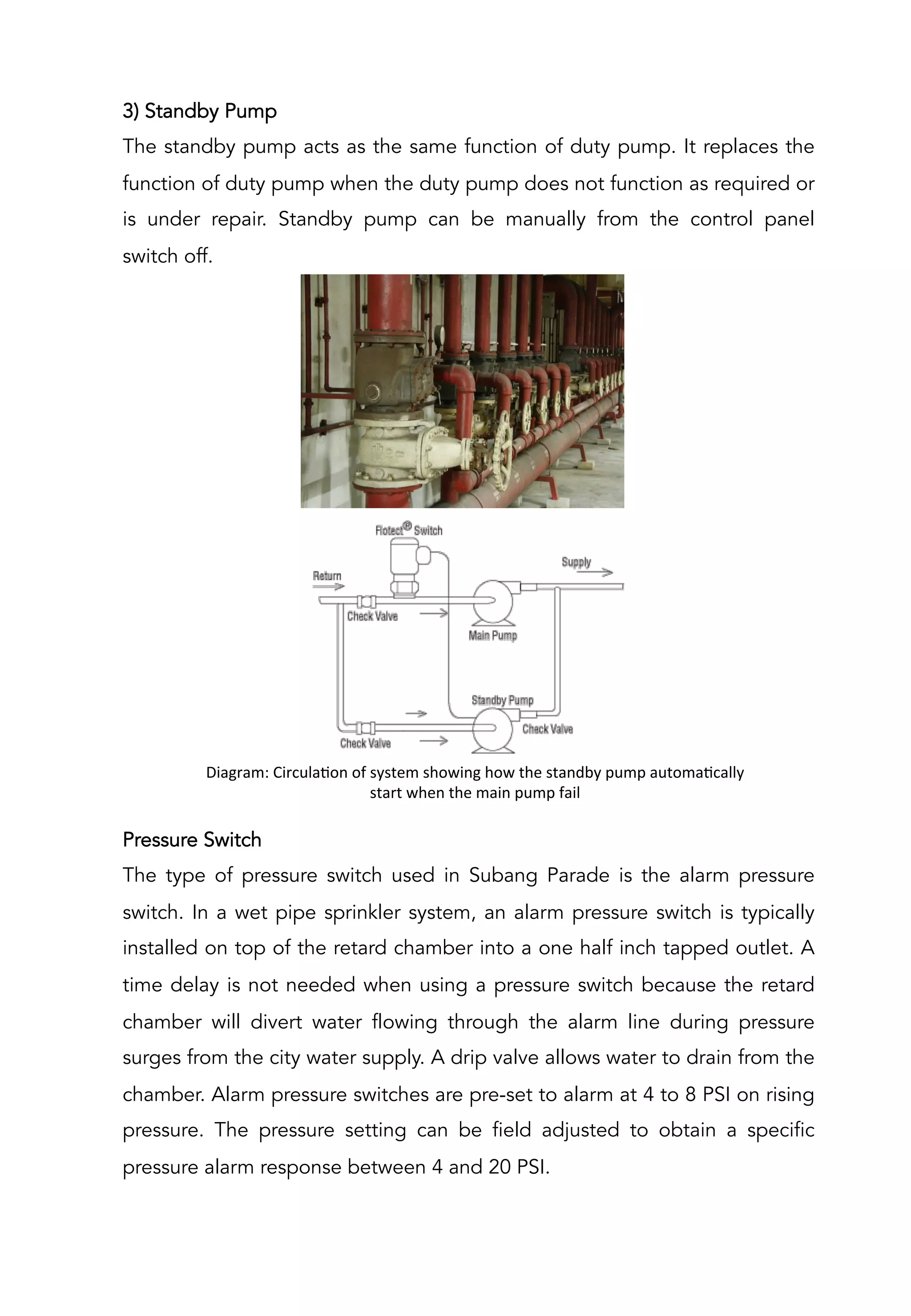
  Diagram:	
  LocaAon	
  of	
  Fire	
  Hydrant	
  in	
  Red	


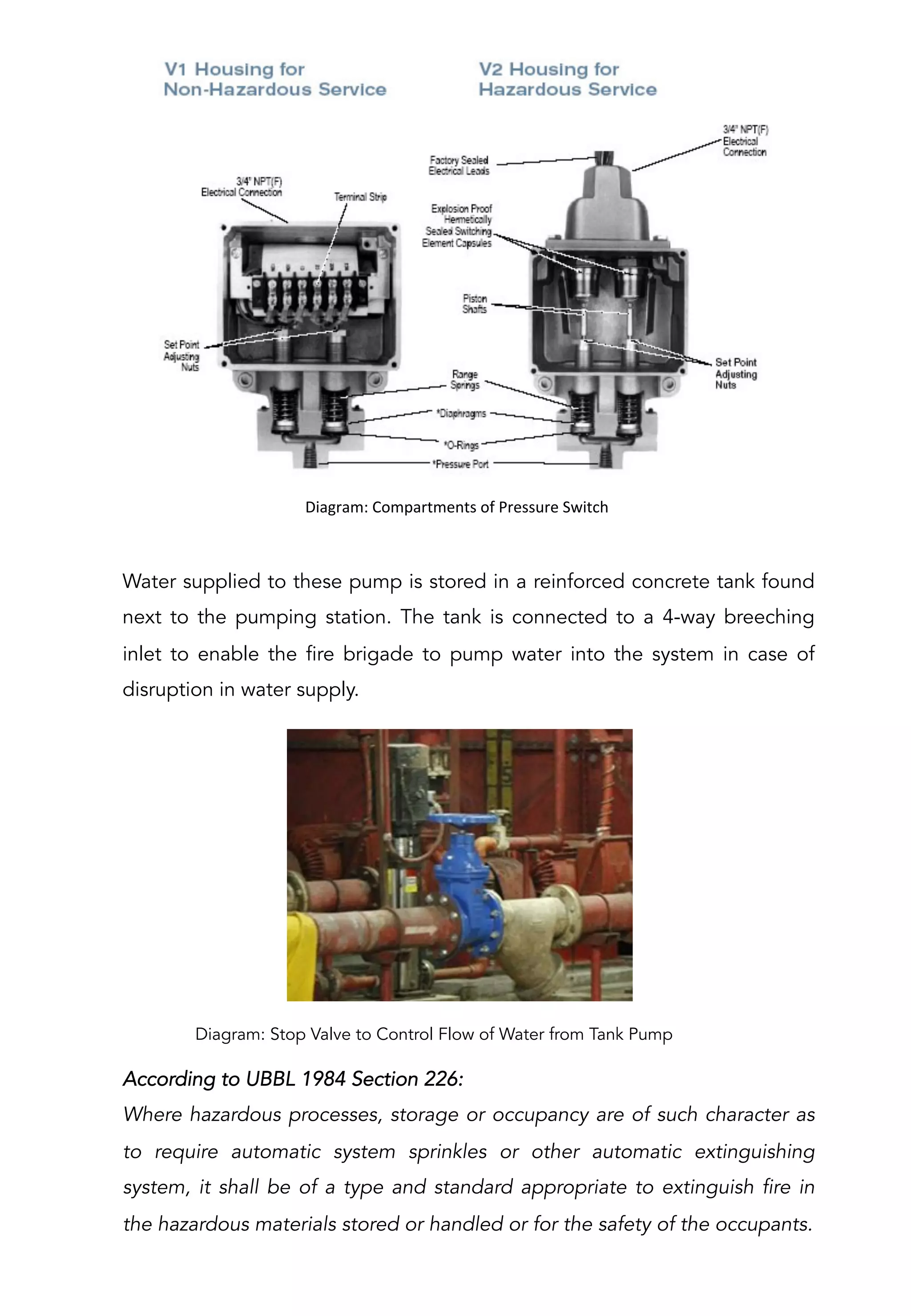
  Diagram:	
  Hydrant	
  System	
  Detail	
  Drawing	
  
Fire hydrant is located at the boundary of our case study. The type of fire hydrant
used is two-way fire hydrant. It is made up of cast iron that could withstand high
water pressure. The following diagram shows the location of fire hydrant in
Subang Parade.
3) Standby Pump
The standby pump acts as the same function of duty pump. It replaces the
function of duty pump when the duty pump does not function as required or
is under repair. Standby pump can be manually from the control panel
switch off.
Pressure Switch
The type of pressure switch used in Subang Parade is the alarm pressure
switch. In a wet pipe sprinkler system, an alarm pressure switch is typically
installed on top of the retard chamber into a one half inch tapped outlet. A
time delay is not needed when using a pressure switch because the retard
chamber will divert water flowing through the alarm line during pressure
surges from the city water supply. A drip valve allows water to drain from the
chamber. Alarm pressure switches are pre-set to alarm at 4 to 8 PSI on rising
pressure. The pressure setting can be field adjusted to obtain a specific
pressure alarm response between 4 and 20 PSI.
Diagram:	
  CirculaAon	
  of	
  system	
  showing	
  how	
  the	
  standby	
  pump	
  automaAcally	
  
start	
  when	
  the	
  main	
  pump	
  fail	


According to UBBL 1984 Section 226:
Where hazardous processes, storage or occupancy are of such character as
to require automatic system sprinkles or other automatic extinguishing
system, it shall be of a type and standard appropriate to extinguish fire in
the hazardous materials stored or handled or for the safety of the occupants.
Water supplied to these pump is stored in a reinforced concrete tank found
next to the pumping station. The tank is connected to a 4-way breeching
inlet to enable the fire brigade to pump water into the system in case of
disruption in water supply.
Diagram: Stop Valve to Control Flow of Water from Tank Pump
Diagram:	
  Compartments	
  of	
  Pressure	
  Switch	
  
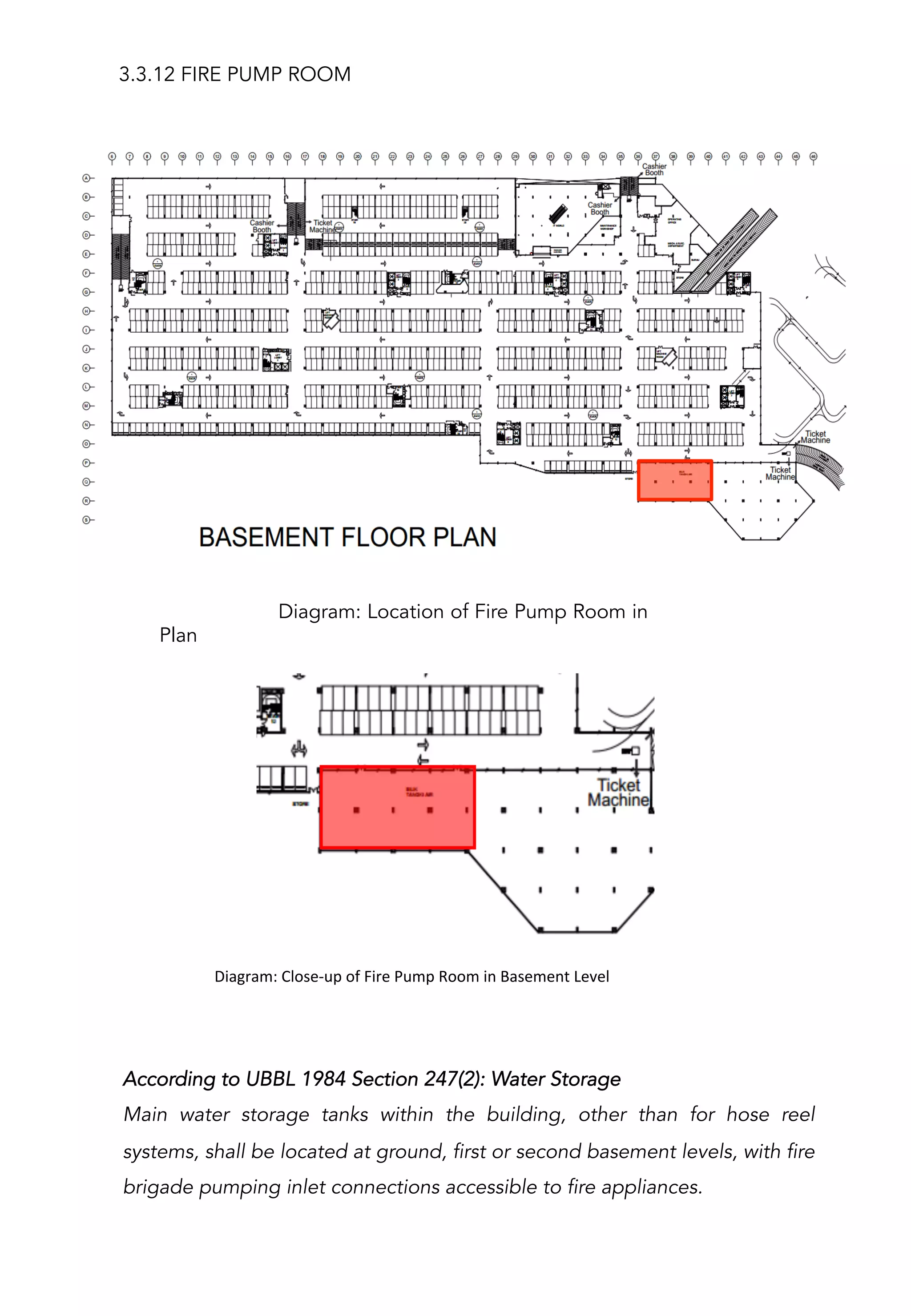
3.3.12 FIRE PUMP ROOM
Diagram: Location of Fire Pump Room in
Plan


  Diagram:	
  Close-­‐up	
  of	
  Fire	
  Pump	
  Room	
  in	
  Basement	
  Level	


According to UBBL 1984 Section 247(2): Water Storage
Main water storage tanks within the building, other than for hose reel
systems, shall be located at ground, first or second basement levels, with fire
brigade pumping inlet connections accessible to fire appliances.
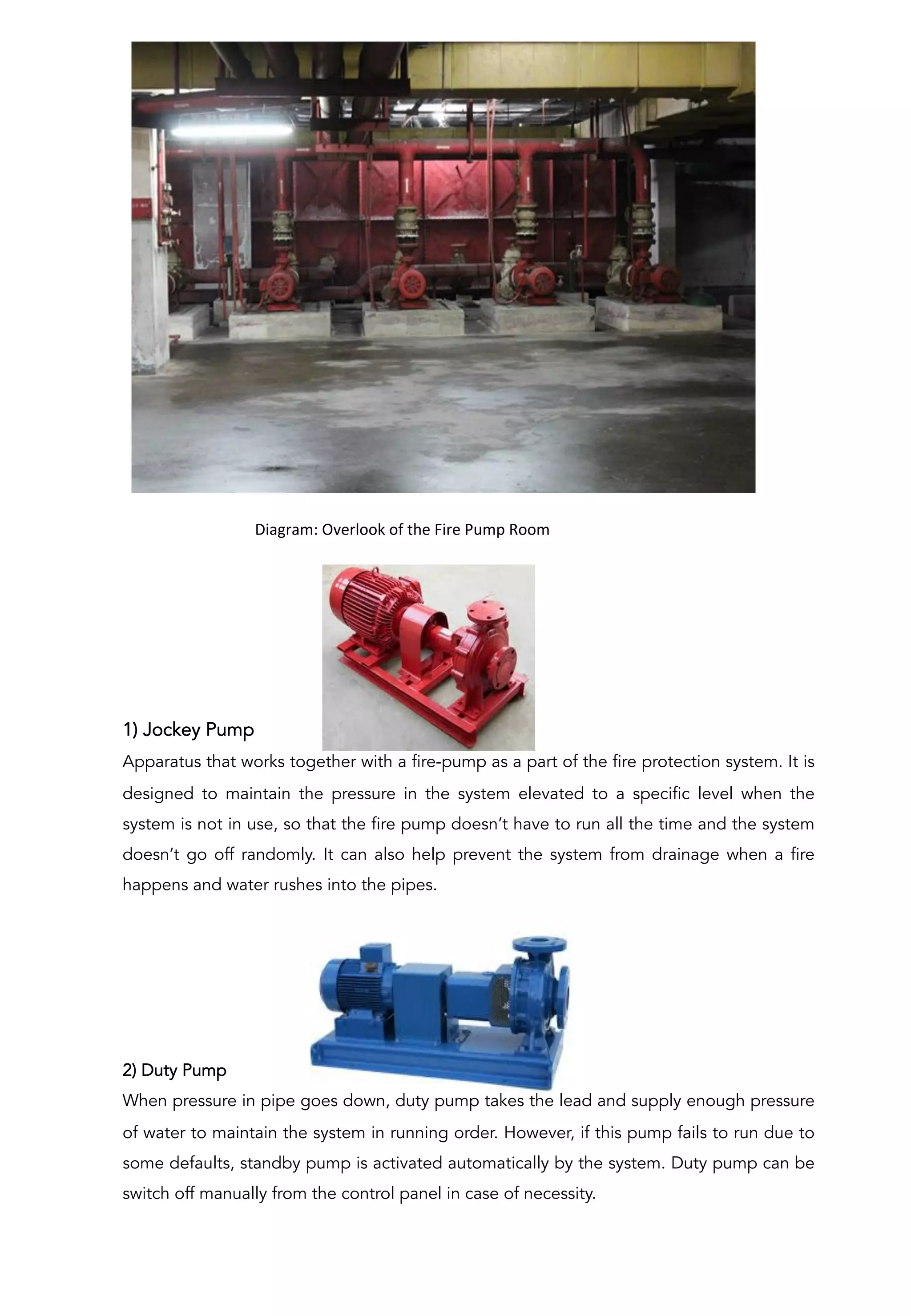
1) Jockey Pump
Apparatus that works together with a fire-pump as a part of the fire protection system. It is
designed to maintain the pressure in the system elevated to a specific level when the
system is not in use, so that the fire pump doesn’t have to run all the time and the system
doesn’t go off randomly. It can also help prevent the system from drainage when a fire
happens and water rushes into the pipes.
2) Duty Pump
When pressure in pipe goes down, duty pump takes the lead and supply enough pressure
of water to maintain the system in running order. However, if this pump fails to run due to
some defaults, standby pump is activated automatically by the system. Duty pump can be
switch off manually from the control panel in case of necessity.


  Diagram:	
  Overlook	
  of	
  the	
  Fire	
  Pump	
  Room	


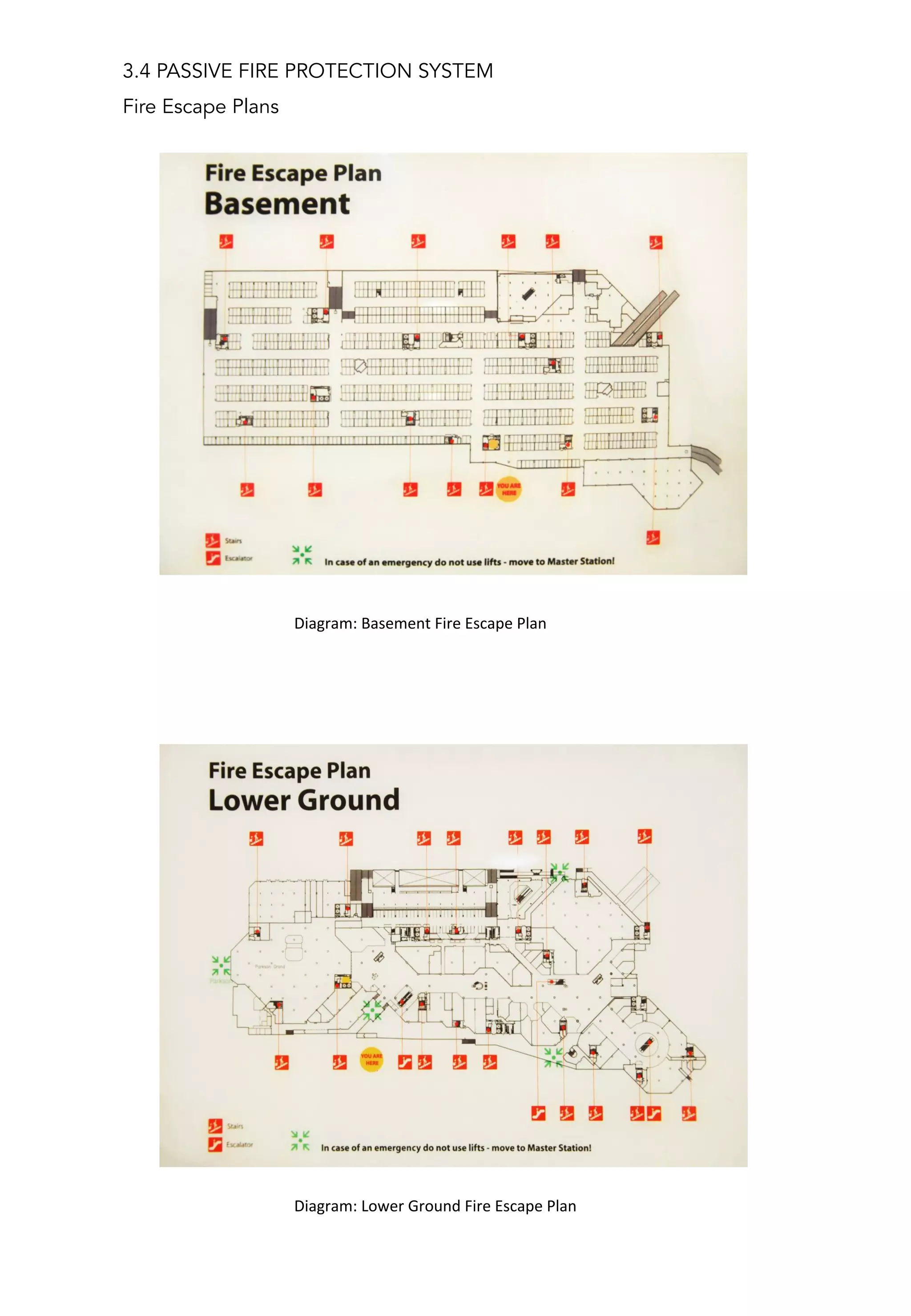
3.4 PASSIVE FIRE PROTECTION SYSTEM
Fire Escape Plans


  Diagram:	
  Basement	
  Fire	
  Escape	
  Plan	


  Diagram:	
  Lower	
  Ground	
  Fire	
  Escape	
  Plan	


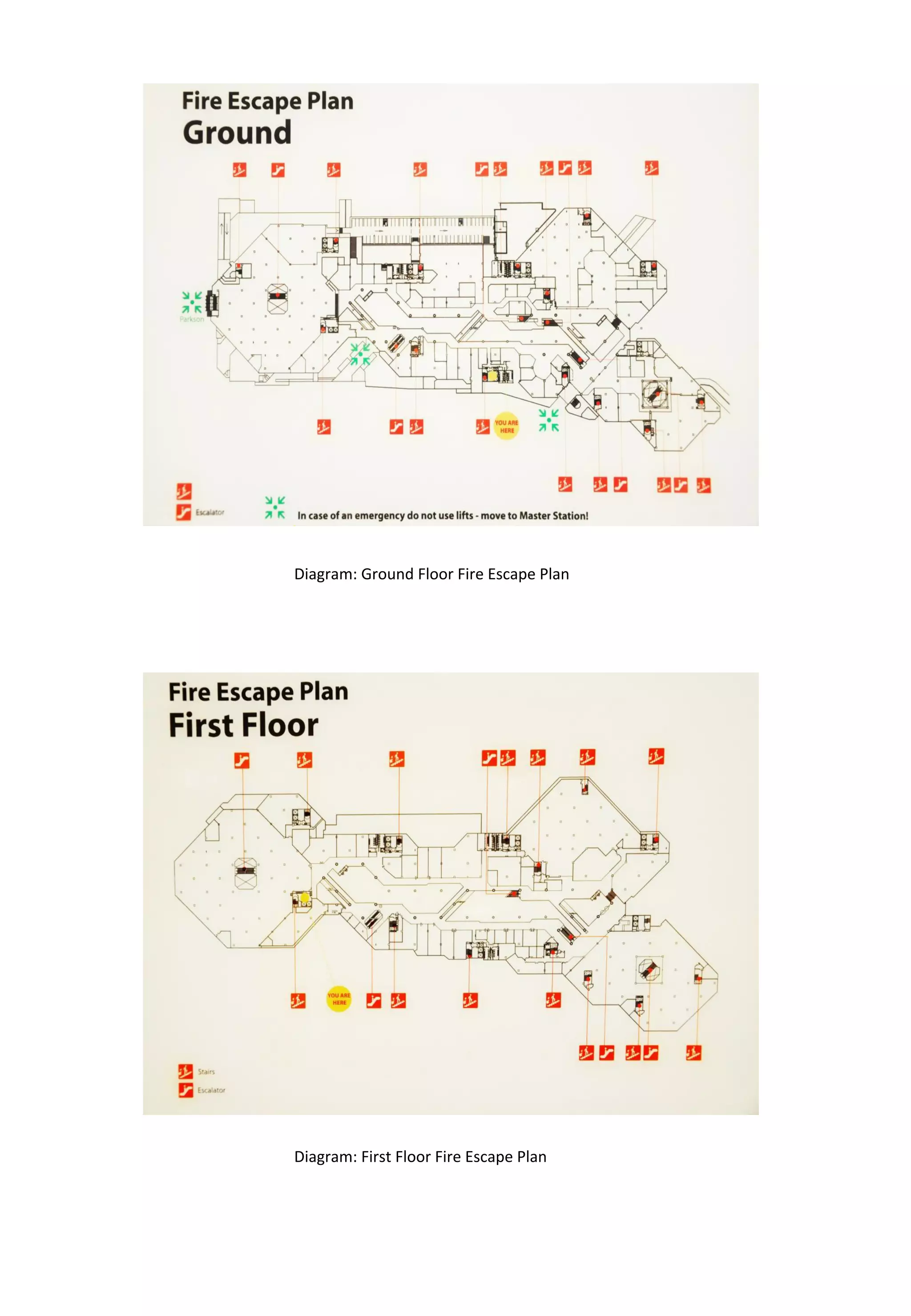
  Diagram:	
  Ground	
  Floor	
  Fire	
  Escape	
  Plan	


  Diagram:	
  First	
  Floor	
  Fire	
  Escape	
  Plan	
  
Fire escape provide a method of escape in the fire to allow the occupant to
evacuate from the building to a safer area outside of the building, which also
mean assembly area. There are routes and exits that were designed
specifically in Subang Parade in case of fire.
Escape route is a designed safe pathway to occupants, from an area of the
building to a place such as fireproof staircase, where the occupants will be
safe and capable of escaping from the fire or smoke as a fire protected area
or a fire fighting access lobby.
According to UBBL 1984: Enclosing Means of Escape in Certain Building.
1)  Every staircase provided under these By-laws in a building where the
highest floor is more than 1200mm above the ground level, or in any
place of assembly, or in any school when such staircase is to used as an
alternative means of escape shall be enclosed throughout its length with
fire resisting materials
2)  Any necessary openings, except openings in external walls which shall not
for the purpose of this by-law include wall to air wells, in the length of
such staircase shall be provided with self-closing doors constructed of fire
resisting materials.
3.4.1 EMERGENCY EXIT SIGNAGE


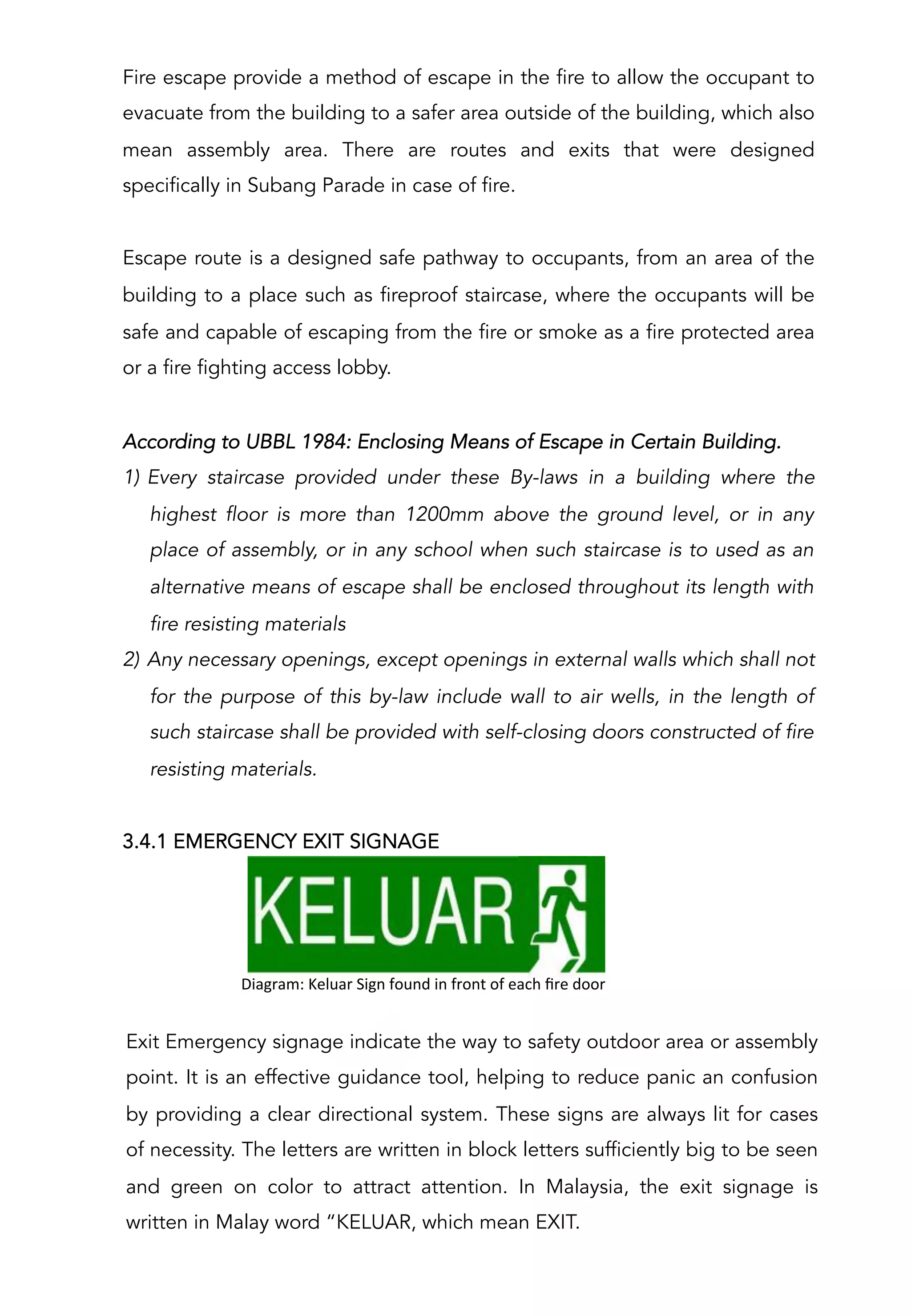
  Diagram:	
  Keluar	
  Sign	
  found	
  in	
  front	
  of	
  each	
  fire	
  door	
  
Exit Emergency signage indicate the way to safety outdoor area or assembly
point. It is an effective guidance tool, helping to reduce panic an confusion
by providing a clear directional system. These signs are always lit for cases
of necessity. The letters are written in block letters sufficiently big to be seen
and green on color to attract attention. In Malaysia, the exit signage is
written in Malay word “KELUAR, which mean EXIT.
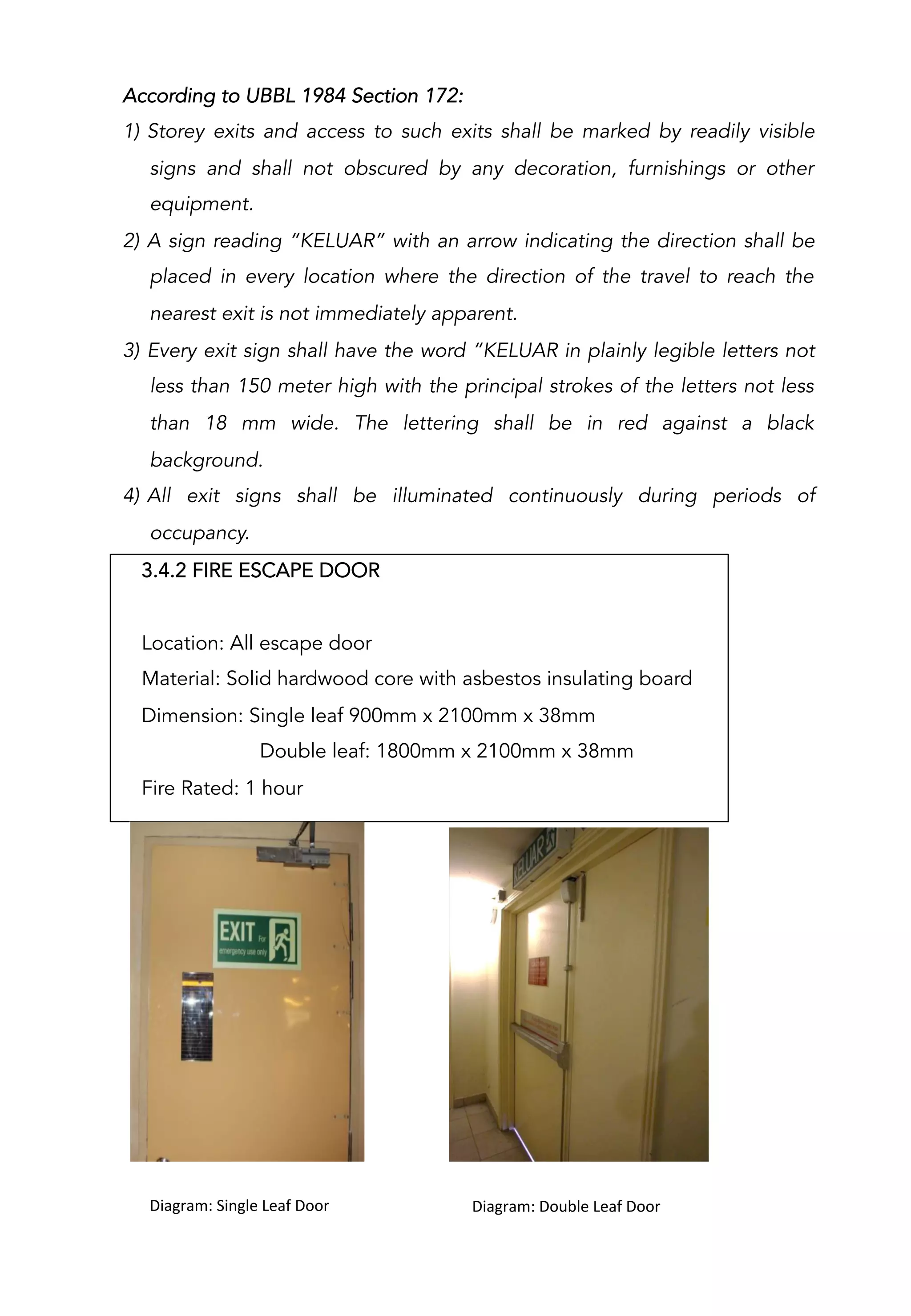
3.4.2 FIRE ESCAPE DOOR
Location: All escape door
Material: Solid hardwood core with asbestos insulating board
Dimension: Single leaf 900mm x 2100mm x 38mm
Double leaf: 1800mm x 2100mm x 38mm
Fire Rated: 1 hour


  Diagram:	
  Double	
  Leaf	
  Door	


  Diagram:	
  Single	
  Leaf	
  Door	
  
According to UBBL 1984 Section 172:
1)  Storey exits and access to such exits shall be marked by readily visible
signs and shall not obscured by any decoration, furnishings or other
equipment.
2)  A sign reading “KELUAR” with an arrow indicating the direction shall be
placed in every location where the direction of the travel to reach the
nearest exit is not immediately apparent.
3)  Every exit sign shall have the word “KELUAR in plainly legible letters not
less than 150 meter high with the principal strokes of the letters not less
than 18 mm wide. The lettering shall be in red against a black
background.
4)  All exit signs shall be illuminated continuously during periods of
occupancy.
According to UBBL 1984 Section 162:
Fire doors including frames shall be constructed to a specification which can
be shown to meet the requirements for the relevant FRP when tested in
accordance with section 3 of BS 476: 1951.
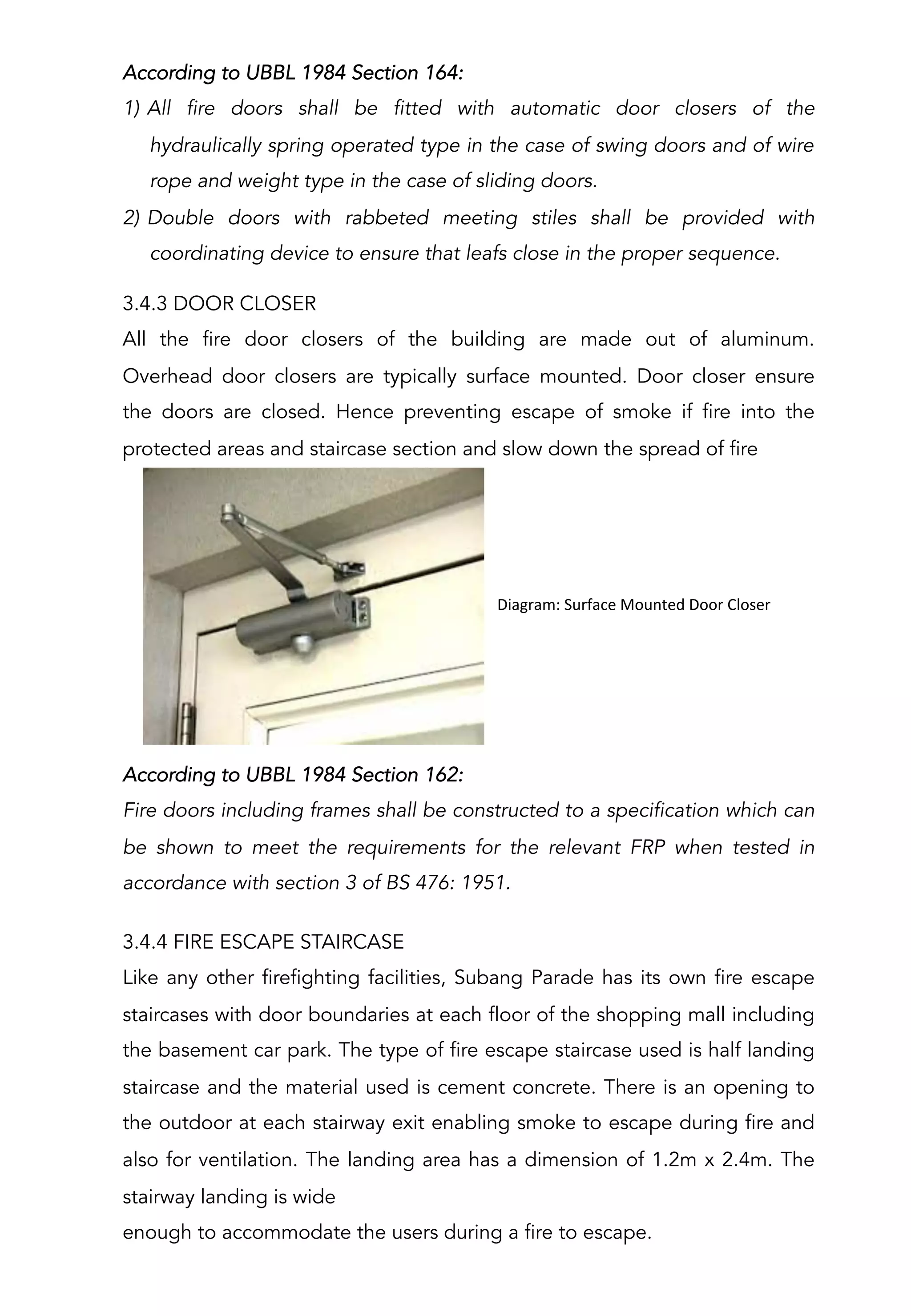
3.4.3 DOOR CLOSER
All the fire door closers of the building are made out of aluminum.
Overhead door closers are typically surface mounted. Door closer ensure
the doors are closed. Hence preventing escape of smoke if fire into the
protected areas and staircase section and slow down the spread of fire
	
  	
  Diagram:	
  Surface	
  Mounted	
  Door	
  Closer	
  
According to UBBL 1984 Section 164:
1)  All fire doors shall be fitted with automatic door closers of the
hydraulically spring operated type in the case of swing doors and of wire
rope and weight type in the case of sliding doors.
2)  Double doors with rabbeted meeting stiles shall be provided with
coordinating device to ensure that leafs close in the proper sequence.
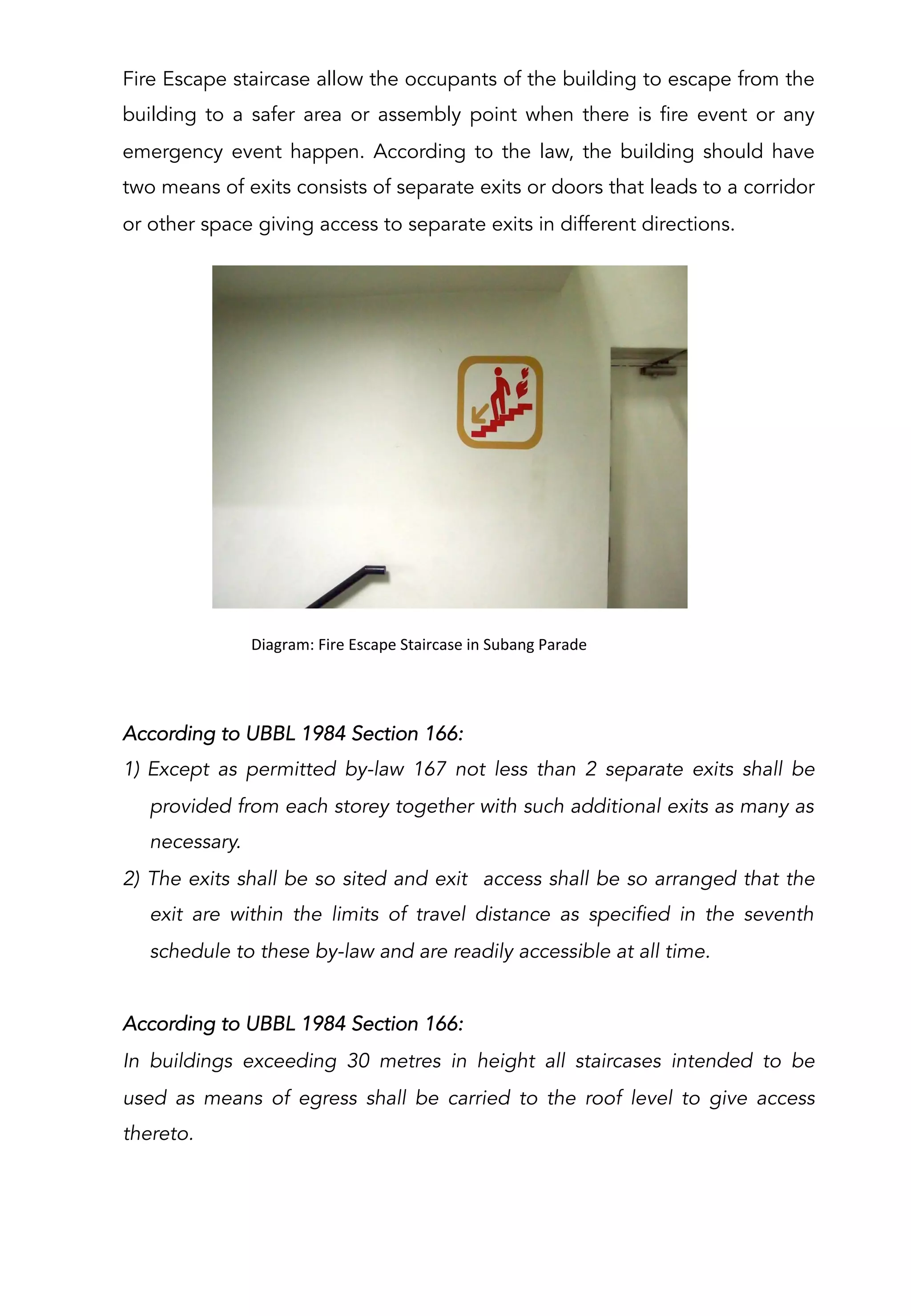
3.4.4 FIRE ESCAPE STAIRCASE
Like any other firefighting facilities, Subang Parade has its own fire escape
staircases with door boundaries at each floor of the shopping mall including
the basement car park. The type of fire escape staircase used is half landing
staircase and the material used is cement concrete. There is an opening to
the outdoor at each stairway exit enabling smoke to escape during fire and
also for ventilation. The landing area has a dimension of 1.2m x 2.4m. The
stairway landing is wide
enough to accommodate the users during a fire to escape.
Fire Escape staircase allow the occupants of the building to escape from the
building to a safer area or assembly point when there is fire event or any
emergency event happen. According to the law, the building should have
two means of exits consists of separate exits or doors that leads to a corridor
or other space giving access to separate exits in different directions.
	
  	
  Diagram:	
  Fire	
  Escape	
  Staircase	
  in	
  Subang	
  Parade	
  
According to UBBL 1984 Section 166:
1)  Except as permitted by-law 167 not less than 2 separate exits shall be
provided from each storey together with such additional exits as many as
necessary.
2)  The exits shall be so sited and exit access shall be so arranged that the
exit are within the limits of travel distance as specified in the seventh
schedule to these by-law and are readily accessible at all time.
According to UBBL 1984 Section 166:
In buildings exceeding 30 metres in height all staircases intended to be
used as means of egress shall be carried to the roof level to give access
thereto.
one floor discharging into it calculated in accordance with provisions in the
Seventh schedule to these By-laws.
3. The required width of a staircase shall be the clear width between walls
but handrails may be permitted to encroach on this width to a maximum of
75 mm.
4. The required width of a staircase shall be maintained throughout its
length including at landings.
5. Doors giving access to staircases shall be so positioned that their swing
shall at no point encroach on the required width of the staircase or landing.
According to UBBL 1984 Section 229(4):
A fire fighting staircase shall be provided to give direct access to each fire
fighting access lobby and shall be directly accessible from outside the
building at the fire appliances access level.
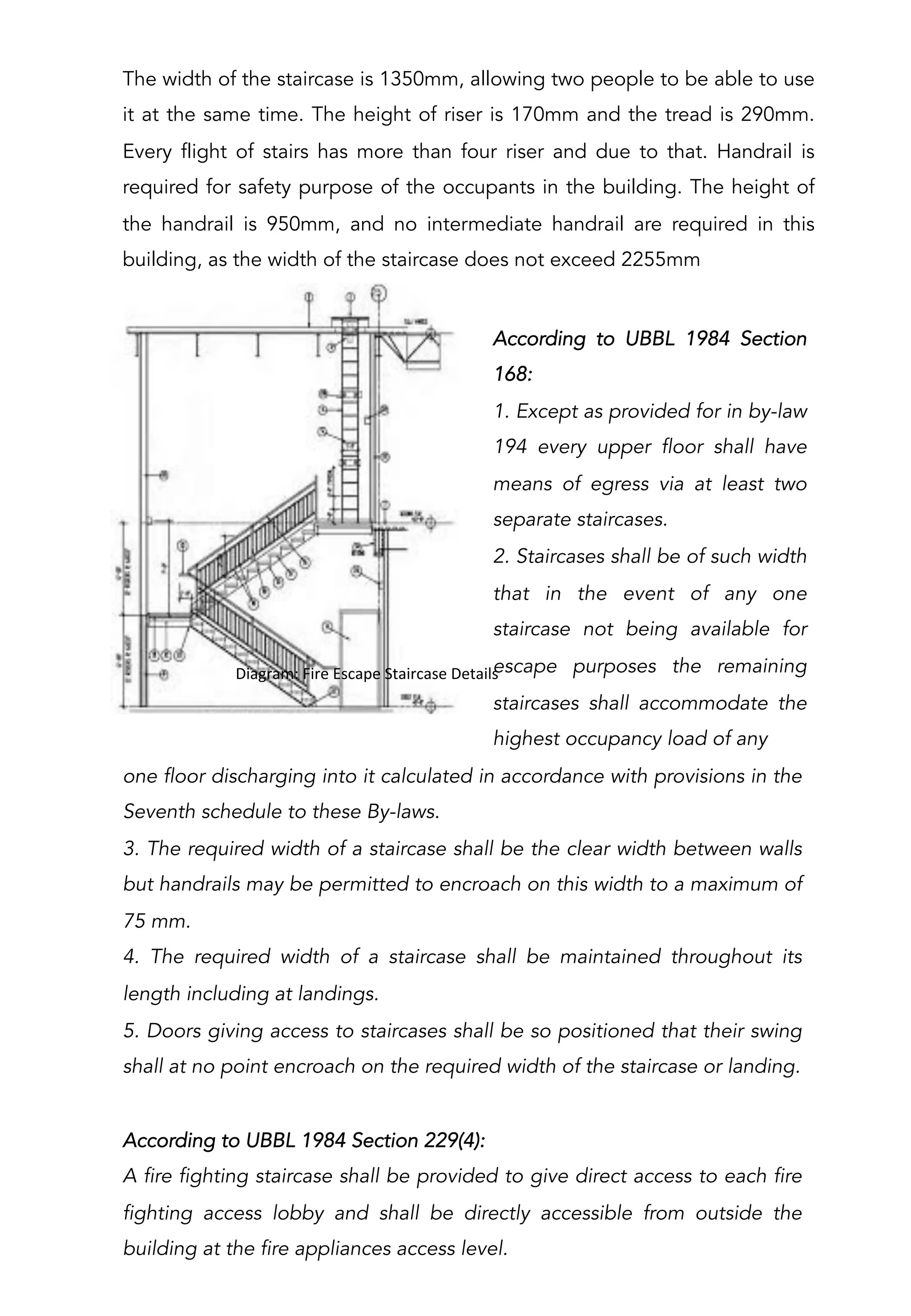
The width of the staircase is 1350mm, allowing two people to be able to use
it at the same time. The height of riser is 170mm and the tread is 290mm.
Every flight of stairs has more than four riser and due to that. Handrail is
required for safety purpose of the occupants in the building. The height of
the handrail is 950mm, and no intermediate handrail are required in this
building, as the width of the staircase does not exceed 2255mm
	
  	
  Diagram:	
  Fire	
  Escape	
  Staircase	
  Details	
  
According to UBBL 1984 Section
168:
1. Except as provided for in by-law
194 every upper floor shall have
means of egress via at least two
separate staircases.
2. Staircases shall be of such width
that in the event of any one
staircase not being available for
escape purposes the remaining
staircases shall accommodate the
highest occupancy load of any
3.4.5 Railings
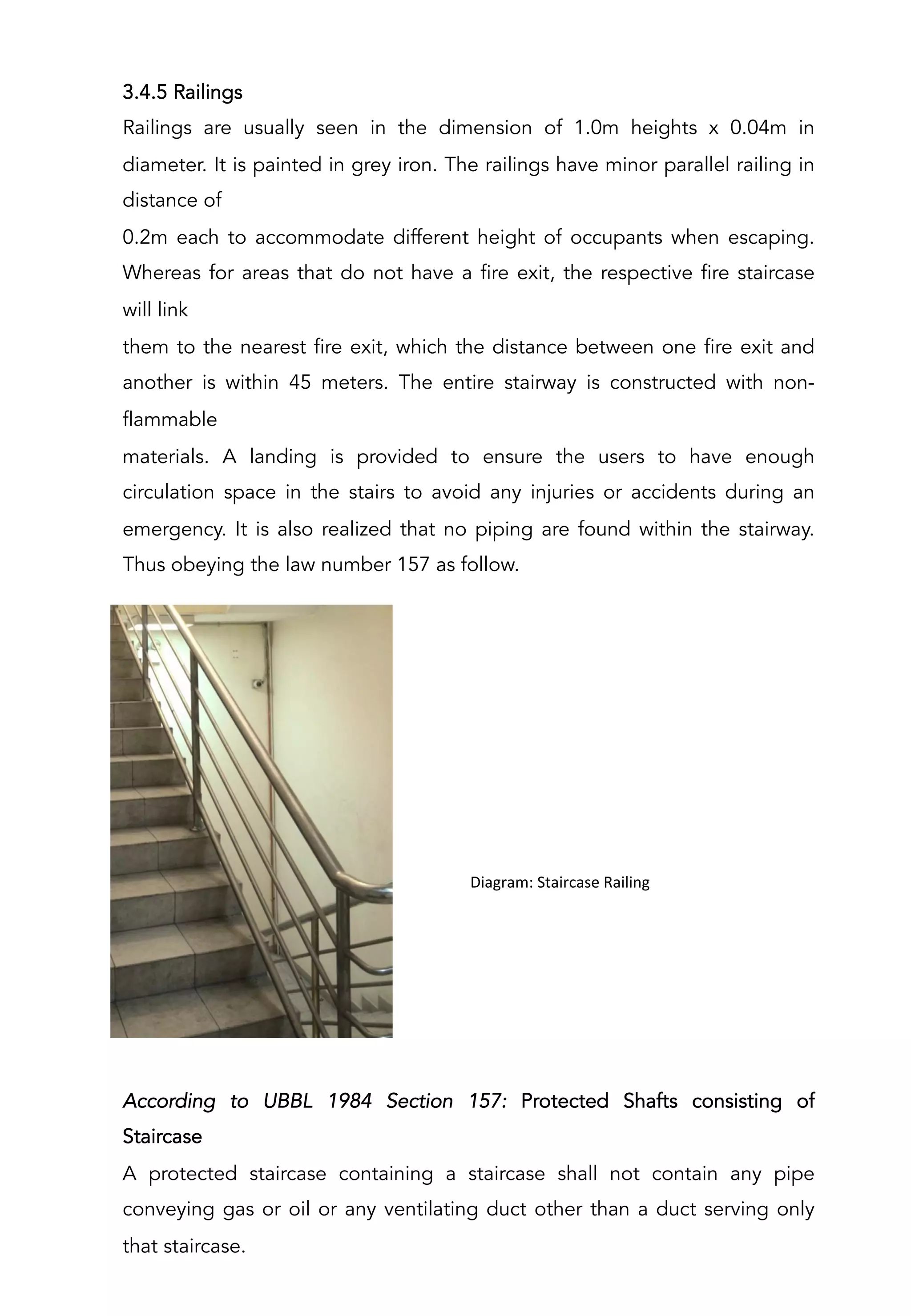
Railings are usually seen in the dimension of 1.0m heights x 0.04m in
diameter. It is painted in grey iron. The railings have minor parallel railing in
distance of
0.2m each to accommodate different height of occupants when escaping.
Whereas for areas that do not have a fire exit, the respective fire staircase
will link
them to the nearest fire exit, which the distance between one fire exit and
another is within 45 meters. The entire stairway is constructed with non-
flammable
materials. A landing is provided to ensure the users to have enough
circulation space in the stairs to avoid any injuries or accidents during an
emergency. It is also realized that no piping are found within the stairway.
Thus obeying the law number 157 as follow.
	
  	
  Diagram:	
  Staircase	
  Railing	
  
According to UBBL 1984 Section 157: Protected Shafts consisting of
Staircase
A protected staircase containing a staircase shall not contain any pipe
conveying gas or oil or any ventilating duct other than a duct serving only
that staircase.
In Conclusion, both active and passive fire protection system plays an
important role in protecting the building against an eventual fire
breakdown. Along with its functional aspect, the passive systems also
attribute in aesthetic features. As far as active fire protection system is
concerned, it contribute to its fair share in the protection of the
building. But nowadays, more technologically advanced system for the
detectors are available. There are more responsive and more efficient.
3.5 CONCLUSION
4.0 ELECTRICAL SYSTEM
Tenaga National Berhad (TNB) who is the largest company electricity
utility company in Malaysia, and also Southeast Asia are in charge of
generation, transmission, distribution and sale of electricity throughout
Peninsula Malaysia and Sabah. They are also in charge of repairs, testing,
maintenance of all equipment, construction of power plants and
manufacturing of high voltage gears to ensure continuous transmission
and distribution of electricity. According to Norayhunt (2008), Malaysia has
a mix variety of energy resources such as oil, natural gas, coal and
renewable energies such as hydro powered electricity, biomass and solar.
However, about 75% of the energy used comes from natural gas which in
our opinion is not sustainable. The reason for this is that Malaysia has the
cheapest and most fossil fuel in the region. We as architects should
encourage the construction of more renewable sources.
Electricity is the most prevalent form of energy in a modern building. It
not only supplies electric outlets and electric lighting, but also provides
the motive power for HVAC equipment, traction power for elevators and
material transport, and power for all signals and communications
equipment. An electric power failure can paralyze a facility. A properly
designed facility can quickly return to partial operation by virtue of
emergency equipment that can furnish part of the facility’s electricity
needs for a limited time.
Electricity is form of energy that occurs naturally only in unusable forms
such as lighting and other static discharges or in natural galvanic cells
(which cause corrosion). The primary problem in the utilization of
electricity energy is that, unlike fuels or even heat, it cannot be readily
stored and therefore must be generated and utilized in the same instant.
This requires an entirely different concept of utilization than, for example,
a heating system with its fuel source, burner, piping, and associated
equipment.
4.1 INTRODUCTION
4.2 LITERATURE REVIEW
4.2.1 POWER TRANSMISSION
Figure	
  4.1	
  :	
  Generally	
  explanaAon	
  on	
  how	
  
power	
  is	
  transmi[ed	
  to	
  buildings	
  	
  
Subang Parade is the
first shopping center in
Subang Jaya, Selangor,
Malaysia. It is located
near Wisma Consplant
(formerly Wisma Tractors
until 1995) and Empire
Subang in SS16. Its
anchor tenant is the
Parkson Department
store. They require
continuous flow of
e l e c t r i c i t y w i t h o u t
breakdowns to ensure
that the department is
forever running during
the working hours. Without it, the entire financial and regulation of securities
will go haywire. Electricity in this building is mostly used for air conditioning,
lighting, elevators, escalators, appliances, etc. Electricity from the power
station is stepped up from the power plant to keep loss of electricity to a
minimum due to resistance of the material transmitting electricity, usually
copper. As shown in the figure, before the distribution stations, it is further
stepped down to either 275kv or 132kv and when it reaches the substation,
it is stepped down to 33kv. The local substations would further reduce the
electricity from 33kv to 11kv, which the Subang Parade uses. In the Subang
Parade, the transformer further steps it down to the usable voltages.
4.2.2 Devices
Several devices used in the distribution of electricity throughout a
building. A meter is used to receive electricity through a residual current
device. A meter helps take measurements of usage and normally takes
measurements in kilowatt per hour. In the case of the SCC, a commercial
electric meter is used instead of a watt hour meter. Main switch,
commonly known as the circuit breaker allows electricity to pass through,
and will break the circuit if overloaded or short circuit. Distribution board
allows for the division of cable to receive current and to distribute it
through a branch circuit.
A branch circuit is typically used instead of a feeder circuit because it is
generally safer. It has a reserve capacity to ensure that the circuit does
short circuit. There are 3 types of outlets used which are single, multiple
and general multiple circuits. Single normally used for heavy usage
appliances, multiple for small devices and general multiple for things like
lighting.
Safety devices such as circuit breakers and fuses are used to prevent
incidents like fire or wreckage of devices from happening due to over
usage. A circuit breaker is an automatically operated electrical switch
designed to protect an electrical circuit from damage caused by overload
or short circuit. Its basic function is to detect a fault condition and
interrupt current flow. Unlike a fuse, which operates once and then must
be replaced, a circuit breaker can be reset (either manually or
automatically) to resume normal operation. Circuit breakers are made in
varying sizes, from small devices that protect an individual household
appliance up to large switchgear designed to protect high voltage circuits
feeding an entire city.
4.3 CASE STUDY
The transmission voltage networks in Malaysia are 500kV, 275kV, 132kV
and the distribution voltages are 33kV, 11kV and 400/230V. The latter is
usually used for residential and the rest for industrial use. In the case of
the Subang Parade, it gets its electricity directly by the TNB Substation.
4.3.1 ELECTRICAL DISTRIBUTION SYSTEM
Outdoor Distribution
Figure	
  4.2	
  :	
  Diagram	
  shows	
  how	
  the	
  power	
  is	
  transmi[ed	
  to	
  the	
  Subang	
  Parade	
  	
  
The	
  following	
  diagram	
  shows	
  the	
  TNB	
  switching	
  room,	
  gen-­‐set	
  room,	
  and	
  the	
  rest	
  
which	
  includes	
  the	
  high	
  and	
  low	
  voltage	
  area	
  and	
  transformers.	
  	
  
Indoor Distribution
Figure	
  4.3	
  :	
  Diagram	
  shows	
  how	
  the	
  power	
  being	
  transformed	
  to	
  low	
  voltage	
  	
  
Figure	
  4.4	
  :	
  Diagram	
  shows	
  the	
  locaAon	
  of	
  TNB	
  switching	
  room	
  in	
  yellow	
  (LG).	
  	
  
According to TNB, the function of a SSU / Main Switching Station is to
supply a dedicated amount bulk consumer of 32kV, 22kV and 11kV. As for
the Subang Parade’s case, we are getting 11kV. The SSU provides a bulk
capacity injection from the Main Distribution substation to the load center
for distribution. The SSU is normally divided into 3 parts which is the SSU
Switchgear Room, the control room and the battery room. As for the
Subang Parade’s case, there is only a switchgear room.
Main Switching Station (SSU)
Switchgear is the combination of electrical disconnects switches, fuses or
circuit breakers used to control, protect and isolate electrical equipment.
Switchgears are used both to de-energize equipment to allow work to be
done and to clear faults downstream. This type of equipment is directly
linked to the reliability of the electricity supply. As required by TNB, this
room has medium voltage vacuum circuit breaker, vacuum circuit breakers
have rated current up to 6,300 A, and higher for generator circuit
breakers. These breakers interrupt the current by creating and
extinguishing the arc in a vacuum container - aka "bottle". Long life
SSU Switchgear Room
bellows are designed to travel the 6 to 10 mm the contacts must part.
These are generally applied for voltages up to about 40,500 V, which
corresponds roughly to the medium-voltage range of power systems. This
room has no column and cross beam to avoid hindrance. It must have well
ventilation within this room as well.
Legend:
1.  High Voltage / Low Voltage Room
2.  Switch Gear
3.  3 Phase Transformer (11kV to 415V)
4.  Label indicating transformation of voltage
5.  Distribution Panel
6.  Sub Switch boards in various places of Subang Parade
Diagram	
  4.5	
  :	
  Diagram	
  illustraAng	
  transformaAon	
  of	
  high	
  voltage	
  to	
  low	
  voltage	
  	
  
The above diagram illustrates how electricity from the Power station
reaches into the Subang Parade. Before the power station, it reaches the
TNB metering kiosk. After the meter, it reaches the TNB Power Station
(SSU). After that it goes to the Vacuum Circuit Breaker, known also as the
main switch which helps to protect the three phase transformer when it is
overloaded by disconnection the power which is at 11kV in the
transformer room beside it. The transformer further steps down the
voltage to 415kV before transferring it to the Low Voltage area located at
another room. The transformer room is beside the Low Voltage Room.
They are all located close to each other to further increase efficiency and
to prevent energy loss. Air Circuits are installed to prevent leakage of
current for transformer, which could zap a person to death if leaked. After
the transformer, it reaches the distribution panel (switchboard) which it
furthers distributes to the rest of the Subang Parade through the riser.
4.3.2 HIGH VOLTAGE, TRANSFORMER ROOM & LOW VOLTAGE ROOM.
Diagram	
  4.6	
  :	
  LocaAon	
  of	
  high	
  voltage	
  room	
  (BLUE),	
  transformer	
  room	
  (GREEN)	
  and	
  
low	
  voltage	
  room	
  (RED)	
  (LG	
  Plan)	
  
Diagram	
  4.7	
  :	
  Plan	
  view	
  of	
  the	
  High	
  voltage	
  room,	
  Transformer	
  Room	
  	
  
4.3.3 HIGH TENSION SWITCH GEAR
Main metal-clad switchgear for commercial, industrial, and public
buildings, as well as Subang Parade is almost invariably located in a Lower
Ground and encapsulated in a separated well-ventilated electrical
switchgear room. These switch gears regulate the flow of electricity within
the electrical system. Switch gear provides protection against overload of
current, short circuit current and insulation failure. It is an insulating barrier
between open contacts which is clearly visible and also a fail-proof
mechanical indicator. The many functions of the switch gear includes
functional switching, emergency switching, emergency stopping and also
stopping of entire mechanism for maintenance. Emergency switching is
used when there is a failure in power, the switch gear would run on the
backup generators providing the power needed. Smaller sub distribution
switchboards require no special room. A wire screen enclosure to prevent
tampering or vandalism plus a large “DANGER-HIGH VOLTAGE” sign are
usually adequate. The diagram below showed the sign “DANGER’’ which
outside the High Voltage Room. From the diagram below, sufficient of
exits, hallways, or hatches for the installation and removal of all equipment
had provided as well. Specification for switchgear should state the
maximum overall dimensions of sections that will be transported and
installed in a piece.
Figure	
  4.1	
  :	
  ‘’DANGER’’	
  sign	
  placed	
  outside	
  the	
  room	


Figure	
  4.2	
  :	
  Sufficient	
  exits	
  and	
  hallways	
  is	
  provided	
  for	
  installaAon	
  and	
  removal	
  of	
  all	
  
equipment	
  	
  
Step-Down Transformer
The unique objective of the transformer is to step down high voltage
current from 11kV to 415V through the machinery shown in the Figure
below. There are total 5 transformers in the transformer room at Subang
Parade.
a) b)
c) e)d)
Electricity flows from the TNB substation passing through the switchgear
which is (a), and reaches the 5 transformers (b) to step down the voltage
from 11kV to 415V. It later splits and goes through the ACMV and the
switchboard for distribution to the users, lighting, AHU and etc. (c) helps
to absorb water vapors or oil to reduce the humidity inside the
transformer (d) is a system to check the temperatures of the transformers.
In case of an emergency, the technician would be notified. (e) Transformer
room is a CO² system room which will release carbon dioxide if there was
a fire.
A transformer is an electrical device that transfers energy between two or
more circuits through electromagnetic induction. It changes or transforms
alternating current (ac) of one voltage to alternating current of another
voltage. Transformers used in building work consist essentially of an iron
core on which are wound at least two coils: a primary winding and
secondary winding. A voltage impressed on the primary winding induces
(through the iron core) a voltage in the secondary winding in proportion to
the ratio of turns in the two coils. Thus, a step-down transformer has a
larger number of turns in its primary winding than in its secondary
winding. In theory, transformers are reversible, although in practice they
are rarely used that way. Transformers cannot be used on dc. Transformers
are available in single-phase or three phase construction. In the case in
Subang Parade, Three phase transformer have been used.
Figure	
  4.3	
  :	
  Photos	
  of	
  devices	
  in	
  Transformer	
  Room	
  
Figure	
  4.4	
  :	
  Photos	
  of	
  Three	
  Phase	
  Transformer	
  USED	
  IN	
  Subang	
  Parade	
  	
  
Heat is generated by the passage of current through the transformer coils
due to the winding cable resistance. The heat is transferred to the unit’s
cooling medium, where it is radiated or otherwise disposed of. The unit’s
cooling medium is a property of major importance. Transformers are either
dry (air cooled) or liquid-filled. The choice depends upon the required
electrical characteristics, the proposed physical location of the
transformer, and costs. For the case in Subang Parade, Oil-insulated
Transformer had been used. These present a fire hazard when installed
indoors because flammable oil can spread from a tank leak or rupture. To
prevent this, most oil-filled transformers must be installed in a fire-resistant
vault, the construction of which involves substantial cost. Advantages
offsetting this cost, low losses, long life, excellent electrical characteristics,
low noise level, and high overload capacity.
When an indoor transformer installation is indicated, special consideration
must be given to the transformer’s heat-generating properties. The room
must be well-ventilated. Besides that, indoor transformer installation is
more suitable to install in fire-resistant room. In Subang Parade, the
transformer room had a CO² fire protection system for safety. Carbon
dioxide is used as an extinguishing agent in this fire protection system.
Every time before enter the transformer room, the technician have to see
the sign on the door whether the condition inside the room is suitable for
man to go in. If the sign is green that mean is safe and red sign mean
danger. The figure below showed the sign on the door.
Figure	
  4.5	
  :	
  Photos	
  of	
  CO²	
  Cylindrical	
  Tank	
  in	
  Transformer	
  Room	
  	
  
Figure	
  4.6	
  :	
  Photos	
  of	
  safety	
  sign	
  on	
  the	
  door	
  of	
  the	
  Transformer	
  Room	
  	
  
Vacuum Circuit Breaker (VCB) and Air Circuit Breaker (ACB)
A circuit breaker is an electromechanical device that performs the same
protective function as a fuse and also acts as a switch. It is a device which
is able to open and close a circuit in a quick time. Both these breakers
have the same function which is to cut off power and to isolate if there is a
fault to prevent outbreaks. Circuit breakers are made in varying sizes, from
small devices that protect an individual household appliance up to large
switchgear designed to protect high voltage circuits feeding an entire city.
Vacuum breakers interrupt the current by creating and extinguishing the
arc in a vacuum container while air circuit breakers use configurable trips
thresholds and delays to trip the circuit when it overflows. Air circuit
breakers usually come in draw-out enclosures for easy access and
maintenance. Vacuum circuit breakers usually have a longer life than air
circuit breakers. Photo below showed the vacuum circuit breaker used in
Subang Parade.
Figure	
  4.7	
  :	
  Photos	
  of	
  Vacuum	
  Circuit	
  Breaker	
  	
  
Main Switch Board / Distribution Panel
The main switchboard is a large assembly of panels which contains
switches which allow electricity to be redirected. It is to divide the main
current into smaller currents for further distribution control of current. With
this board, one can control the electrical supply of the entire network from
just one area. The role of a switchboard is to allow the division of the
current supplied to the switchboard into smaller currents for further
distribution and to provide switching, current protection and (possibly)
metering for those various currents. In general, switchboards may
distribute power to transformers, panel boards, control equipment, and,
ultimately, to individual system loads. Distribution panel is a component of
an electricity supply system which divides an electrical power feed into
subsidiary circuits, while providing a protective fuse or circuit breaker for
each circuit, in a common enclosure. Normally, a main switch, and in
recent boards, one or more residual-current devices (RCD) or residual
current breakers with overcurrent protection (RCBO), are also
incorporated.
Figure	
  4.8	
  :	
  Main	
  switchboard	
  in	
  low	
  voltage	
  area	
  	
  
Sub-Switch Board
The sub-switch board has the same functionality of the main switch board
which is to connect and disconnect the electric supply from the main
switchboard. There are many sub switch boards such as the AHU room,
fire pump room, A/C Room and etc.
Diagram	
  4.8	
  :Diagram	
  of	
  distribuAon	
  panel.	
  
Diagram	
  4.9	
  :Plan	
  view	
  of	
  sub	
  switch	
  board,	
  (Red=AHU),	
  (Green=A/C),	
  
(Blue=Elevator)	
  	
  
Figure	
  4.9	
  :	
  Sub	
  Switchboard	
  in	
  AHU	
  Room	
  
Figure	
  4.10	
  :	
  Sub	
  Switchboard	
  in	
  Fire	
  Pump	
  Room	
  
4.3.4 RACEWAY, CONDUCTOR ELECTRICAL RISER
Conductors could be round wires, rectangular cross section or stands that
are usually made out of metals either copper or aluminum. Electrical
conductors are means by which current is conducted through the electrical
system, corresponding to the piping of a hydraulic system. Current is
carried through these wires which are covered with the raceway.
Conductors are wrapped with insulators to prevent them from causing
electric shock. Insulators are called raceway.
Raceway is used for protection and routing of electrical wiring. Electrical
conduit may be made of metal, plastic, fiber, or fired clay. Flexible conduit
is available for special purposes. Conduit is generally installed by
electricians at the site of installation of electrical equipment. Raceways are
generally enclosure of wires and metallic raceways must be grounded.
Rigid conduit and tubing are mostly used in this building as they have fire
stopping elements and they protect the cables from being damaged.
Electrical risers are used to carry electrical supply to upper floors and
distribute them to each floor in the Subang Parade; we can find most
these risers in AHU rooms, car parks and at the service areas. Figure below
showed the raceways and riser.
Figure	
  4.11	
  :	
  Electrical	
  race	
  way	
  and	
  riser	
  in	
  Subang	
  Parade	
  
4.3.5 BACK-UP SYSTEM
Generator Set
Diagram	
  4.9	
  :LocaAon	
  of	
  Generator	
  Set	
  in	
  low	
  voltage	
  room	
  (LG)	
  	
  
Subang Parade uses a standby system which is needed due to the nature
of the function of the building. They need a system that would protect and
prevent them from having any sort of financial loss especially it being a
commercial building. Two diesel generators had been used as a standby
system in Subang Parade. This kind of generator is the combination of a
diesel engine with an electric generator (often an alternator) to generate
electrical energy. This is a specific case of engine-generator. The figure
below showed both diesel generators in low voltage room, which is (1A) &
(1B).
Figure	
  4.12	
  :	
  Diesel	
  Generator	
  (1A)	
  &	
  (1B)	
  in	
  low	
  voltage	
  room	
  
Diagram	
  4.10	
  :Diesel	
  Generator	
  and	
  the	
  components	
  
Diesel generating sets are used in places without connection to the power
grid, as emergency power-supply if the grid fails, as well as for more
complex applications such as peak-lopping, grid support and export to
the power grid. Sizing of diesel generators is critical to avoid low-load or a
shortage of power and is complicated by modern electronics, specifically
non-linear loads. The generator will start running automatically when
there is a power failure or a power shortage. The system will automatically
detect the power shortage and start the gen set based on the power
needed to prevent any clash. The generator set consists of three
components which are the fuel system, space housing the equipment and
the set itself. Using a gen-set gives the building an unlimited kVA capacity
and is only set back by the size of the fuel tank. It has to be properly
maintained to ensure that it does not fail if there is a power failure. Gen-
sets are usually placed at the lower ground levels to ensure noise levels
are kept to a minimum and to prevent diesel emissions from reaching the
users. Besides that, the fuel also closed to the gen-set to easy the job of
refill the fuel and ensures the gen-set work continuously during power
shortage. The figure below showed the fuel tank that placed near to the
gen-set.
Figure	
  4.13	
  :	
  Fuel	
  tank	
  in	
  the	
  low	
  voltage	
  room	
  
4.4 ANALYSIS
Transformer
A transformer is device that changes or transformers alternating current
(ac) of one voltage to alternating current of another voltage. A varying
current in the transformer's primary winding creates a varying magnetic
flux in the core and a varying magnetic field impinging on the secondary
winding.
Under MS1525; 7: Electric power and distribution
 
This clause applies to the energy efficiency requirements of electric
motors, transformers and distribution systems of buildings except those
required for emergency purposes.
All electrical power distribution equipment should be selected for their
energy efficiency and to minimize cost of ownership. Cost of ownership
includes the capital cost and the cost of energy over the equipment life
time.
Supply system voltage has significant impact on losses. Hence, the supply
voltage should be maintained as close as possible to the design/optimum
voltage of the equipment installed.
 
Subang Parade has a gen set that has its own transformers to step down
its current just for it. The figure below show the transformer own by gen-
set. It is not necessary for a gen set to have its own transformer as they
cost relatively expensive. The gen set system should be connected to the
other two transformers that are still able to handle the load of the gen
sets. One less transformer means one less equipment to maintain and
handle.
The transformers, switchboards and gen sets are all located very near to
each other to lower down the cost of consumption of electricity. The
designers put in thought on how to minimize space area and also to
cleverly design a room which is properly organized.
Figure	
  4.14	
  :	
  Gen-­‐set	
  own	
  transformer	
  	
  
Generator Set
The generator sets provide adequate power and supply for the entire
building to run under emergencies such as fire and also as a standby
system where it is always ready to power the building. The generator will
start running automatically when there is a power failure or a power
shortage. The system will automatically detect the power shortage and
start the gen set based on the power needed to prevent any clash. The
generator set consists of three components which are the fuel system,
space housing the equipment and the set itself.
Under UBBL Section 253(1):
Emergency power system shall be provided to supply illumination and
power automatically in the event of failure of the normal supply or in the
event of accident to elements of the system supplying power and
illumination essential for safety to life and property.
The Subang Parade provides all the above statement. Diesel generator is
used as a standby system to provide sufficient power when break down
occur. Besides that, sufficient fuel provided as well beside the generator to
make sure the generator can work properly for a long time during power
shortage.
4.5 CONCLUSION
Going through the Subang Parade and looking at how the electrical
system works is very amazing. Most of the systems are well thought of and
all systems have been working ever since the day it was built. These
systems amazed me because every single part of them works together as
one to carry out function. Maintenance is carried out regularly to ensure
that all systems work well throughout the year. Most of the equipment
used is of top class as they even have a notification system via SMS to
inform the person in charge of problems in the system. The maintenance
becomes easier to handle. From here, I really learnt a lot of knowledge
about electrical system and others services.
As mentioned above, it would be better if the generator shared the
transformer from the switchboard instead of having its own because one
less transformer means one less equipment to maintain and handle. This
would greatly cut down the cost of maintenance. Besides that, the fuel
should be provided or standby sufficiently to make sure the generator can
work continuously during power shortage.
Otherwise, all is good and the systems there work great as well.
5.0 WATER SUPPLY SYSTEM
This chapter is about the basic and general study regarding water
services available in the case study chosen which is the Subang Parade.
The information mentioned is associated with the case study upon how
the water supply is available and being distributed throughout the
entire building.
The water services study covered also include the water supply system,
water distribution system and also water supply piping. The water
supply will also be analyzed to give a more concrete understanding
about the water services.
5.1 INTRODUCTION
5.2 LITERATURE REVIEW
The water supply is essentially important to maintain the health of the
community, sustainability of the industry, business and agriculturally.
Without sufficient water supply, our present society would not have
evolved and our lives today wouldn’t be recognizable. With
technologies evolving, and the amount of pollution increasing, we
depend on treated water to avoid threats. Knowing that the volume of
water consumed by our community each day, enormous infrastructures
were required.
 
In Malaysia there are a number of private water companies that
together supplies to millions of consumers with millions of litres of
water. SYABAS is one of the private companies that currently supplies
treated water to over 7 million consumers in Selangor, Kuala Lumpur
and Putra Jaya.
 
 The core business in SYABAS would be related to the water supplied to
consumers, which has been processed and treated before distribution.
Rain falls and river flows will be pumped to the water treatment plant
and from there, raw water is treated by going through the process of
aeraton, coagulation, flocculation, sedimentation, filtration, disinfection
and conditioning. The treated water that is already safe for drinking will
then be pumped to the balancing reservoirs before being distributed to
service reservoirs. From here, then water is supplied to its consumers.
Water supply and services in Malaysia is under the concurrent
jurisdiction of the Federal Government and State Governments. In order
to increase the country’s water services quality particularly protecting
consumers’ rights, two legislative frameworks, namely the National
Water Service Industry (NSW) Act (2006) (Act 655) and the National
Water Services Commission (SPAN) Act (2006) (Act 65) were introduced.
 
With a well-regulated water services in place, this will help to promote
efficiency and long-term sustainability of the water industry to benefit
the consumers, investors as well as the operators. Consumers in
Malaysia enjoy a 24-hour water supply and water is reliable and safe in
terms of quantity and quality. It is treated according to international
standards for drinking water set out by the World Health Organization
(WHO). All domestic, commercial and industrial users are metered.
Water tariff are vary from state to state.
5.2.1 WATER SUPPLY BY LAW
In Subang Parade, water is used as domestic purpose, for flushing
toilets, is used in air conditioning system and for sprinkler system to
project water to the fire when there’s a fire incident happening.
5.3 CASE STUDY
Due to differences in culture, climate and economic wealth, water
demand varies significantly between countries (Smith and Ali, 2006).
The demand for water also varies over the 24-hour period.
 
Therefore, storage capacity required for the building can be determined
from hours of supply, pressure in mains and fire storage requirements.
 
In Subang Parade, storage compartments are divided into two:
Underground Storage: Necessary to collect water from the city mains
during hours of water supply if the pressure is not enough to reach the
point of supply.
Overhead Storage: mandatory for flushing toilets.
 
5.3.1 WATER STORAGE
Area in red indicate the location of the water service area which is at the
basement floor, near the entrance of the carpark.
Figure	
  5.1	
  :	
  LocaAon	
  of	
  water	
  service	
  area.	
  	
  
To store water, water storage are to be installed and there are a few
requirements linking to installation and protection of water storage
tanks:
 
•  Tanks are installed on bases above ground level, platforms where the
tank is being located at is designed to bear the weight of the tank
when it is filled to maximum capacity, without unnecessary alteration
taking place.
•  Metal tank are to be installed with a membrane of non-corrosive
insulating material between the support and the underside of the
tank.
•  Tanks must be supported in a certain manner, so that no load is
transmitted to any of the attached pipes.
•  Tanks are located somewhere accessible for inspection, repairs,
maintenance and replacement.
•  Tanks must be provided with a cover, designed to prevent the entry
of dust, roof water, surface water, groundwater, birds, animals or
insects.
•  Insulation from heat and cold should also be specified.
•  Tanks storing potable water should not be located directly beneath
any sanitary plumbing or any other pipes conveying non-potable
water.
Figure	
  5.2	
  :	
  Water	
  storage	
  
tank	
  located	
  at	
  basement	
  
floor.	
  
Horizontal concrete beam lying on the floor slab are used as supporting
the water storage tanks and to make space for pipe system under the
tank.
Figure	
  5.3	
  :	
  
Horizontal	
  
concrete	
  beam	
  
Horizontal	
  
concrete	
  beam	
  
Figure	
  5.4	
  :	
  SucAon	
  tank	
  and	
  main	
  supply	
  
pipe.	
  
Placement of the water tank.
There are three main water
tanks available at the Lower
ground of Subang Parade,
which is the R.C. suction
tank, R.C sprinkler tank and
R.C. wet riser tank. The R.C.
suction tank stores water
that will be used to pump up
to the domestic water tank,
located at the roof, if
needed. The R.C. suction
tank is used to store water
from SYABAS distributed to
the domestic tank. In case of
situations when the main
water supply
Figure	
  5.5	
  :	
  R.C	
  sprinkler	
  and	
  R.C	
  wet	
  riser	
  
tank.	
  
is turned off, the suction tank should act as a back up to provide
necessary water needed for the building. Water is already stored in the
R.C. suction tank, but when the pressure is low, the water will then be
pumped up to the main domestic water tank located at the roof top.	
  
The R.C. sprinkler tank and R.C. wet riser tank stores in water supply
from the red colored water bulk meter, which is directly from SYABAS.
Figure	
  5.5	
  :	
  Water	
  supply	
  and	
  R.C	
  sprinkler	
  piping.	
  
Water	
  supply	
  pipe	
  
R.C	
  sprinkler	
  pipe	
  
Pipe with blue indication is the pipe which transport water to selected
area from the water storage tank, whereas the R.C sprinkler pipe is
indicate in red.
UBBL
247
(2) Main water storage tanks
within the building. Other
than for hose reel systems,
shall be located at ground,
first or second basement
levels, with fire brigade
pumping inlet connections
accessible to fire appliances.
UBBL
247
(3) Storage tanks for automatic
sprinkler installations where full
capacity is provided without
need for replenishment shall be
exempted from the restrictions in
their location.
SYABAS comes directly from the water main, underground and then being
distributed to the water bulk meter which is located outside near the car
parking area.
 
 
Source of water supply for
Subang Parade comes directly
from SYABAS, which generally
stands for “Syarikat Bekalan
Air Selangor Sdn. Bhd.” It is a
company where it’s in charge
of water distribution in
Selangor. Water supply from
5.3.2 WATER SUPPLY
!
Figure	
  5.6	
  :	
  Syabas	
  logo	
  
5.3.3 FIRE-FLOW REQUIREMENTS
The system must be capable of
supplying the fire flow specified
plus any other demand that cannot
be reduced during the fire period at
the required residual pressure and
for the required duration. The
requirements of each system must
be analyzed to determine whether
the capacity of the system is fixed
UBBL
247
(1) Water storage capacity and
water flow rate for fire fighting
systems and installations shall be
provided in accordance with the
scale as set out in the Tenth
Schedule to these By-Laws.
by the domestic requirements, by the fire demands, or by a combination of
both. Where fire-flow demands are relatively high, or required for long
duration, and population and/or industrial use is relatively low, the total
required capacity will be determined by the prevailing fire demand. In
some exceptional cases, this may warrant consideration of a special water
system for fire purposes, separate, in part or in whole, from the domestic
system. However, such separate systems will be appropriate only under
exceptional circumstances and, in general, are to be avoided.
5.3.4 PUMP SYSTEMS
Pump Selection.
The type of pump selected depends upon many factors, including the
yield of the rate of a well, the daily flow (and maximum instantaneous
flow rate) needed by the users, the size of the storage or pressure tank
used, and the total operating pressure tank used, and the total
operating pressure against which the pump works (including the height
to which water must be raised within the well). First cost, maintenance,
and reliability are also factors, as is the energy used by the pump. In
cold climates, a pump and water supply system must be protected
from freezing.
Of these factors, the two critical selection determinants are the flow
rate ( volume per minute or per hour to be delivered ) and the total
pressure (or head). The flow rate depends upon the number of fixtures
to be served. The total pressure includes the suction lift, static head,
and friction loss plus the pressure head.
In Subang Parade, hydro
pneumatic system is used. The
hydro pneumatic system
consists of a pressure vessel
and a pressure pump. The
pressure vessel contains water
with a pressurized air space to
provide the pressure for theFigure	
  5.7	
  :	
  Hydro	
  pneumaAc	
  system	
  
system. With water demand, water flows from the vessel, increasing the air
space as well as decreasing air pressure. This lower pressure signals the
pump to start. The pump meets the demand with the excess volume backing
up in the pressure vessel. This decreases the air space and increases the
pressure once again. When the upper level is reached, the pump shuts off.
The newer pressure vessels have a neoprene bladder to separate the air
space from the water.
Diagram	
  5.1	
  :	
  Hydro	
  pneumaAc	
  tank	
  system	
  
Water supply system in which water is pumped from the supply system into a
pressure tank for storage. Air in the tank is compressed by the water entering
the tank. As the pressure in the tank increases, the pressure in the water
distribution system also increases, since it is fed from the tank.
5.3.5 COLD WATER SYSTEMS
The water supply comes from
the R.C Suction (figure 5.4)
tank located at the basement
floor of the building and is
pumped up to the main water
domestic tanks for storage.
From the domestic tanks,
located on the rooftop, the
cold water is distributed
throughout the basement via
domestic water pumps. The
building has 3 floors to
distribute water to, and since
the domestic pump is located
above all the floors, gravity is
used to distribute the water to
the lower floor levels.
 
Figure	
  5.7	
  :	
  DomesAc	
  water	
  
pump	
  
Figure	
  5.8	
  :	
  DomesAc	
  water	
  tank	
  
(retrieved	
  from	
  internet	
  source.	
  
Domestic water
pump is used to
pump the water
to the domestic
water tank
located at the
roof top.
Domestic
water tank
located at the
rooftop of
Subang
Parade.
Diagram	
  5.2	
  :	
  GravitaAonal	
  System	
  
5.3.6 PIPING
Water distribution piping varies according to their usage and functionality in
supplying water to their designated areas. Each pipe sizes and material
correspond to their respective distribution outlets in order to provide the
necessary pressure for the usage of the users. Below are tables indicating the
different types of piping and their respective material and sizes.
 
Type Material Size
Cold water rise (from suction tank to
roof tank)
Mild steel cement lining pipe
(MSCL)
100
Cold water rise (from pump room to
2nd floor)
Stainless steel pipe 50
Cold water distribution (lower
ground to roof)
ABS PN 15 50
Cold water distribution (lower
ground to first floor public toilet and
common areas)
ABS PN 15 100
Table	
  5.1	
  :	
  Pipe	
  size	
  
Referring to the Uniform Building By-Laws (UBBL), there are no regulations or
code that states the needs in providing water services in accordance to the
by-laws. In accordance to this matter, the hotel water services are based on
the regulations set by the engineers and are in accordance to the drawing
given. Below are the quotations excerpts from the engineers drawing.
 
•  All levels are in m and dimension are in mm unless otherwise stated
Figure	
  5.8	
  :	
  Water	
  piping	
   Figure	
  5.8	
  :	
  Water	
  piping	
  
5.3.7 MAINTENANCE
Maintenance is very important to prevent water supply failure. Usually due to
leakage, data center will have the toilets to stand-alone for almost all the
floors. Maintenance in Security Commission Building is done once every
month.
 
•  All pressure pipes and fittings shall be ABS PN 12 standard unless
otherwise stated
•  All non-pressure pipes and fittings shall be UPVC class “D” BS 3505
standard unless otherwise stated
•  All pressure pipes passing through RC structural shall be c/w puddle collar
•  All pipe pressure tests shall be 50 psi
5.4 ANALYSIS
Cold water supply system used in Subang Parade is main water supply where
they use water tanks to store in water from the water main (suction tank to
domestic tank) and distributes the water throughout the entire building. The
benefit of using this system is that the water tanks reserves the water supply,
in case of shortage from the water main. Moreover, water tanks are sufficient
enough in this building to provide water supply and as preparaton when
shortage coming.
 
In this system, water pumps are needed to push up the pressure when the
water supply from the main is low. In Subang Parade, domestic water tank is
placed on top of the roof which had save up a lot of cost on installing water
pumper as the water is distributed by using the gravitational force. Besides,
the installation of water tank is a success which had fulfill the requirements of
the UBBL by-law.
 
5.5 CONCLUSION
Based on the study and research conducted in this chapter, it can be said
that the cold water distribution system is suitable for Subang Parade as it has
3 floors to distribute water to, therefore using the cistern water distribution
system is good enough because everything focuses on gravitational forces to
pull the water down.
Two water tanks with one acts as daily water supply and another as a back up
water in case there is a water shortage happening. Also due to the number
of people occupying the building, its safer to have several water tanks to
provide the necessary water supply to the occupants of the building.
Amount of water pump is controlled so that costs are reduced and energy is
saved.
Based on the study of water services in Subang Parade, the kinds of services
provided are already efficient and suitable for the building. What can be
recommended is that the building should have a rainwater collection tank for
sanitary services which would reduce even more usage of water from the
water mains.
 
6.0 SEWERAGE AND SANITARY SYSTEM
6.1 INTRODUCTION
Sewage which also called wastewater is any liquid that has been adversely affected
in quality by anthropogenic influence. All of these come from two sources which are
human wastes and household wastes like urinals, stables, latrines, discharge of rain.
They are disposed safely and efficiently through a defined system of their each
individual system or through a combination of systems. The systems usually consist
of sanitary appliances, pipes, service areas, and treatment area which are always
concealed behind walls or partitions or located in service rooms away from human
sight or disturbance aside from the appliances. Wastewater can encompass a wide
range of potential contaminants and concentration such as feces and urine, garbage,
minerals and also wastes from industries that are hazardous and anaerobic. The
disposal system should be applied into the design of buildings to ensure that the
liquid waste are treated properly so that the users will not be affected by improper
disposal. In this chapter, sewage and sanitary systems as well as drainage system in
Subang Parade are examined. The existing facilities, service capacities and
limitations of each type of system are discussed.
Figure 6.1.1: Flow of the Sanitary Sewerage System Figure 6.1.2: Flow of dirty waste into river
6.2 LITERATURE REVIEW
Sewage is produced everyday in our life. Sewage and sanitary system plays important
role to reduce the accumulation of sewage. There are many strategies to dispose of
waste water but first it has to be understood that waste water is any water that has
been adversely affected by anthropogenic influence (Burton, 2003). In relation to the
research, sewerage system can be define as the network of collecting & conveying
sewage by water carriage system through underground pipes. After understanding
the definition and works of the water waste subset, the system of each subset will then
be introduced and informed in general.
The main focus we looked at in this chapter is the sanitary appliances, traps, stacks,
septic tank and follow by public sewer for sewerage system. Sanitary appliances is a
fixture connected to the sewer pipe which allows a person to put in sewage or liquids
into the sewage system. Water is used to flush the sewage into the sewer pipe.
The second subset of wastewater that will be looked at is the drainage system.
Drainage system is a system of piping within private or public premises that conveys
sewage, rainwater or any other liquid waste to an approved point of disposal. The
drainage system normally involves starting from the sanitary appliances to waste or
soil pipe, then to the main sewer pipe for sewer treatment and lastly back to the river.
Sanitary appliances are fitted with water taps or flushing devices which provide water
to help force the solid or semi-solid waste into the sewer. Traps are used to prevent
large waste product from enter the pipe and also to prevent back flow of the water.
Figure 6.2.1: Sewerage System
Sewer is the underground conduits or drains. It is used for carrying the sewage. The
most common types of sewer are the sanitary sewer, storm sewer and combined
sewer. Sanitary sewer is a underground carriage system that used for transporting
sewage from house and commercial buildings. Sanitary sewers serving industrial areas
also carry industrial sewage. Sanitary sewage is collected with the help of sanitary
sewer line. The sanitary sewer is attached to main sewer and runs directly to the
sewage treatment area.
A storm sewer collects storm water with the help of gutter & catch basin. Gutter allow
the storm water to drain from the street directly into the storm sewer. Combined
sewer is a type of sewer system that collects sanitary sewage and storm water run off
in a single pipe system. It can cause serious water pollution problems due to
combined sewer overflows. It usually caused by large variations in flow between dry
and wet weather.
Figure 6.2.3: Variation Between Dry and Wet Weather
Figure 6.2.2: Types of Sewer
Sewage treatment and sewage passage is usually the responsibility of the
authorities but only starts at the boundary of the private building with the exception
of the septic system which is on site. The system within the building and within the
boundary is under the responsibility of the property owner, which of course is
subjected to rules and regulations of its components.
Figure	
  6.2.4	
  	
  Single	
  Stack	
  (Combined	
  System)	
  
Waste	
  Water	
  Engineering,	
  2003	
  
Figure	
  6.2.5	
  	
  Double	
  stacked	
  (Separate	
  System)	
  
Waste	
  Water	
  Engineering,	
  2003	


6.3 CASE STUDY
Subang Parade building has 4 floors: basement, lower ground, ground and first floor.
The building consist of few features of sewerage system which are collection,
conveyance, treatment and disposal. Location of wash closets on each are similar
because a direct stack shared all through the levels is more cost efficient and space
efficient. The waste from the wash closets from every floor is collected and conveyed
through the system of pipe line: soil pipe, vent pipe and waste pipe. The sewage is
treated by removing contaminants from sewage and discharge to the nearest manhole
then flow into the drainage. The figure below shows the overall sewerage system of
Subang Parade:
6.3.1 SANITARY APPLIANCES
Sanitary appliances that are used in the toilets includes water closet and also
wash basins. Wastewater that are produced here will be discharged into the
waste and soil pipes which will flow down the stack to the main discharge
outlet. Floor traps which are located on the floor will also connect to these
stacks. All the discharge points and traps require a trap seal to prevent foul
gases from exiting through the inlet.
6.3.1.1 WATER CLOSET
Water closet is an enclosed room or compartment containing a toilet bowl fitted
with a mechanism for flushing. It is a simple yet ingenious invention that used to
carry away waste and prevent sewer gasses from entering the house. Several
different types of mechanisms are used to accomplish a toilet’s basic operation.
Most flush valves are 2 1/2 inches in diameter, although some of the newer
models can be as large as 4 inches, as is the ball-shaped part of the flapper The
flapper hinges onto the vertical overflow pipe that’s next to the valve, and a
small chain connects the flapper to the trip lever. As the tank of a conventional
toilet empties, a float ball drops, activating the ballcock which releases water
into the tank. The water is delivered to the ballcock through a supply tube that’s
connected to a valve at the wall or floor. When turned clockwise, this valve shuts
off the flow of water to the tank. To prevent overflow and flooding, the top of
the overflow tube is open and acts as a drain if the tank’s water level rises too
Figure	
  6.3.1:	
  Plan	
  showing	
  the	
  sewerage	
  system	
  
Figure	
  6.3.1.1a:	
  Water	
  Closet	
  in	
  Subang	
  Parade	
  
Analysis
According to UBBL 1984, Section 43:
In all buildings, the size of the latrines, water-closets and bathrooms shall be
(a) In the case of latrines or water-closets with pedestal-type closet fittings, not
less than 1.5 metres by 0.75 metre.
6.3.1.2 BASINS
A sink is a bowl shaped plumbing fixture used for washing hands, for dish
washing, cleaning purposes. Sink generally have taps which also called faucets
that supply hot and cold water and may include a spray feature to be used for
faster rinsing. They also include a drain to remove used water and it may include
a strainer or shut off device and an overflow-prevention device. Soap dispenser
could also be added to the sink.
Figure	
  6.3.1.1b:	
  Compartments	
  of	
  Water	
  Closet	
  
Figure	
  6.3.1.1c:	
  Dimension	
  of	
  latrine	
  comply	
  to	
  minimum	
  dimension	
  stated	
  by	
  the	
  UBBL.	


When a sink becomes stopped-up or clogged, a person will often resort to use
a chemical drain cleaner or a plunger, though most professional plumbers will
choose to remove clog with a drain auger or often called plumber’s snake.
From about 1820 to 1900 the dry sink evolved by adding a wooden cabinet with
a trough built on the top and lined with zinc or lead. This is where the bowls or
buckets for water were held into. Stainless steel is commonly used in kitchens
and commercial applications because it represents a good trade-off between
cost, usability, durability, and ease of cleaning. Most stainless steel sinks are
made by drawing a sheet of stainless steel over a die. Stainless steel sinks will
not be damaged by hot or cold objects and resist damage from impacts. One
disadvantage of stainless steel is that, being made of thin metal, they tend to be
noisier than most other sink materials, although better sinks apply a heavy
coating of vibration-damping material to the underside of the sink.
Solid ceramic sinks shown in Figure 6.3.1.2a have many of the same
characteristics as enamel over cast iron, but without the risk of surface damage
leading to corrosion. Soapstone sinks were once common, but today tend to
be used only in very-high-end applications or applications that must resist
caustic chemicals that would damage more-conventional sinks. Wood sinks are
from the early days of sinks and baths were made from natural teak with no
additional finishing. Teak is chosen because of its natural waterproofing
properties Teak also has natural antiseptic properties, which is a bonus for its
use in baths and sinks. Glass sinks, a current trend in bathroom design is the
handmade glass sink which has become fashionable for wealthy homeowners.
Stone sinks have been used for ages. Some of the more popular stones used
are: marble, travertine, onyx, granite, and soap stone on high end sinks.
Figure	
  6.3.1.2a:	
  Solid	
  Cermaic	
  Sink	
  used	
  in	
  Subang	
  Parade	


Figure	
  6.3.1.2b:	
  Compartments	
  
of	
  Water	
  Basin	
  
6.3.2 TRAPS
6.3.2.1 WATER SEAL
The function of water seal is to prevent the entry of waste water gases and pest
into the building, water seals traps are fitted just after the sanitary appliances,
traps some flushing water, create a water seal in the waste water pipe. It’s
normally made of steel, cast iron, plastic or brass, vitreous china or porcelain.
For toilet bowl and urinal, traps are cast together with the sanitary appliance.
 
6.3.2.1.1 BOTTLE TRAPS
The bottle trap is an essential element of the basins plumbing that keeps the
bathroom hygienic and clean. When we use the basin, the used water goes
through the basin waste, into the drainage pipe and then into the sewer. Lot of
other waste and dirt is accumulated in this sewer and naturally the accumulation
causes a lot of harmful gases. These gases need an outlet and that, they get
through our drainage pipes, through the wastes and back into our bathrooms.
The bottle trap is a kind of a deep vessel which has a bigger diameter than the
plumbing pipe as shown in Figure 6.3.2.1.1. The plumbing pipe that comes from
the basin goes straight into the bottle trap.
When more water gushes in the water inside the bottle trap goes into the drain
and fills with the new water that comes from the waste. Thus the trap always
remains filled with a certain amount of water and the pipe from the basin remains
immersed into this water
inside the bottle trap.
Figure	
  6.3.2.1.1:	
  Diagram	
  showing	
  how	
  the	
  water	
  from	
  basin	
  flows	
  to	
  bo[le	
  trap	
  prevenAng	
  dirt	
  
Now when the sewer gases re enter the system through the outlet pipes they
reach the bottle trap, but here they find their way sealed with the water that is
collected in the trap. Due to the basin pipe immersed in water it remains closed
and doesn’t allow the return waste and gases to enter it and pave their way
upwards into and out of the basin right into the bathroom.
6.3.2.1.2 “S” TRAPS
In plumbing, a trap is an S or J-shaped pipe located below or within a plumbing
fixture. An S-shaped trap is also known as the S-bend invented by Alexander
Cummings in 1775 but became known as the U-bend following the introduction
of the U-shaped trap by Thomas Crapper in 1880. The new U-bend could not
jam, so, unlike the S-bend, it did not need an overflow. The bend is used to
prevent sewer gases from entering buildings. In refinery applications, it also
prevents hydrocarbons and other dangerous gases from escaping outside
through drains. The most common of these traps in houses is referred to as a P-
trap. It is the addition of a 90 degree fitting on the outlet side of a U-bend,
thereby creating a P-like shape. It can also be referred to as a sink trap due to the
fact it is installed under most house sinks. Because of its shape, the trap retains a
small amount of water after the fixture's use. This water in the trap creates a seal
that prevents sewer gas from passing from the drain pipes back into the
occupied space of the building. Traps also tend to collect hair, sand, and other
debris and limit the ultimate size of objects that will pass on into the rest of the
plumbing, thereby catching over-sized objects. For all of these reasons, most
traps can either be disassembled for cleaning or they provide some sort of
cleanout feature.
Figure	
  6.3.2.1.2a:	
  Compartments	
  and	
  details	
  of	
  the	
  sanitary	
  appliances	
  	
  	
   Figure	
  6.3.2.1.2b:	
  S-­‐trap	
  
6.3.2.1.3 INTERCEPTOR TRAPS
To prevent blockages, devices called interceptors are installed just after the
sanitary appliance or at the waste water inlet to trap solid object or substances
from entering the rest of the waste water pipe. They include gratings at the
waste water inlet to trap hair or solids and interceptor traps grease and food
remains.
Biomatic Grease Interceptor shown in Figure 6.3.2.1.3a is specially designed to
intercept both the FOG (fat, grease and oil) and the starch residue and solid
waste which are usually produced at kitchens. The Sediment trap compartment
will filter and trap solid waste Food and allow greasy water to continue to enter
into grease interceptor compartment. It is used together with a dosing unit which
doses the trapped waste with an enzyme which produce certain reactions such as
fat splitting, protein and carbohydrate decomposition before discharging it into
the waste pipe.
Figure	
  6.3.2.1.3b	
  	
  Frosco	
  AutomaAc	
  Dosing	
  Unit	
  Interceptor	


Figure	
  6.3.2.1.3a.	
  Frosco	
  BiomaAc	
  Grease	
  Interceptor	


6.3.2.1.4 GULLY TRAP
A gully trap is a basin in the ground with a water seal to prevent foul odours from
the sewer reaching the surface. Waste water from kitchen and bathroom is piped
to a gully trap before emptying into the sewer. Gully traps are buried in the
ground with the tops or surround raised above ground level to prevent ground
water entering into the sewer.
Gully traps receive discharge from wastewater fixtures. One gully trap may
receive discharge pipes from several outlets. Each residential building must have
at least one gully trap. If a drainage system becomes blocked, the gully trap
provides the point where sewage can overflow outside the building, instead of
building up inside the pipe and overflowing inside the building. Gully traps must
have an overflow rim at least 150 mm below the overflow level of the lowest
fixture served by the system, located within the legal boundary of the land on
which the building stands, to prevent surface water from entering the trap, be
constructed so the grate will lift to allow surcharge, have at least one discharge
pipe feeding into it to maintain the water seal. A floor waste gully acts as a floor
drain as well as receiving the discharge from wastewater fixtures. It may only
receive discharge pipes from wastewater fixtures that are located in the same
room. It may also be used as a shower outlet but cannot receive solid waste, for
example, from a WC pan. The advantage of using a floor waste gully is that it
reduces the number of connections required to the drain and the length of pipe.
They may be used in buildings where overflowing water could enter another
property.
Figure	
  6.3.2.1.4a.	
  Gully	
  Trap	


Figure	
  6.3.2.1.4b.	
  Detail	
  Diagram	
  of	
  Gully	
  Trap	


6.3.2.1.5 GRATINGS
A grating is any regularly spaced collection of essentially identical, parallel,
elongated elements. Gratings usually consist of a single set of elongated
elements, but can consist of two sets, in which case the second set is usually
perpendicular to the first (Figure 6.3.2.1.5b). When the two sets are
perpendicular, this is also known as a grid or a mesh. All sanitary appliances
outlet holes except for WCs and bidets to the waste water pipes are fitted with a
grate or perforated cover. A grating covering a drain can be a collection of iron
bars (the identical, elongated elements) held together (to ensure the bars are
parallel and regularly spaced) by a lighter iron frame. Gratings over drains and air
vents are used as filters, to block movement of large particles and to allow
movement of small particles such as water or air.
6.3.3 SUMP
A sump is a low space that collects wastewater which is usually located at the
basement. The wastewater is then pumped to an outlet using a sump pump
which is mostly submersible. The sump is the compartment for the storm water
sewer which located in the basement level.
The waste and soil stack pipes from basement to first floor are 150Ø UPVC pipes,
stack pipes from basement to the sump are 100Ø UPVC pipes while the outlet
from the sewage sump to the manhole are 100Ø C.I pipes which is used to
withstand the pressure caused by the pump.
Figure	
  6.3.2.1.5a.	
  Metal	
  GraAngs	


Figure	
  6.3.2.1.5b.	
  Detail	
  of	
  GraAngs	
  
6.3.3.1 Sump Pump
A sump pump is a pump used to remove water that has accumulated in a water
collecting sump basin, commonly found in the basement of homes. The water
may enter via the perimeter drains of a basement waterproofing system,
funneling into the basin or because of rain or natural ground water, if the
basement is below the water table level.
Sump pumps are used where basement flooding happens regularly and to
remedy dampness where the water table is above the foundation of a home.
Sump pumps send water away from a house to any place where it is no longer
problematic, such as a municipal storm drain or a dry well.
The sump pumps are located inside the sump chamber and are submersible
pumps, each sump contains 2nos of pumps which are used to pump the
wastewater to the ground floor outlet. The pump have a flow capacity of 7.5
litres/sec and is controlled by a level regulator to prevent overflow and
underflow.
Figure	
  6.3.3a.	
  Equipments	
  of	
  Sump	
  System	


Figure	
  6.3.3b.	
  Compartment	
  of	
  Sump	
  System	


6.3.4 STACK
6.3.4.1 WASTE PIPE
The system of pipes that carries water and waste to a sewer line or septic tank is call
the drain-waste-vent (DWV) system. As the name implies, it has three components:
Drain lines collect water from sinks, showers, and tubs; waste lines carry waste from
toilets; and vent lines exhaust sewer gases and allow wastes to flow freely. All drain
and waste lines slope slightly downward from the fixture toward the sewer or septic
system. Water and wastes are carried by gravity.
The pipes are large in diameter—typically 1 1/4 inches to 4 inches—to minimize the
possibility of blockages. The main soil stack for toilets is normally a 4-inch pipe;
showers usually have a 2-inch pipe. Sinks, lavatories, bathtubs, and laundry tubs
may be served by 1 1/4- to 2-inch pipes. Though some old homes may have pipes
made of lead, most drain piping is ABS plastic, cast iron, or copper. Some vent
pipes are galvanized iron. To operate properly and safely, each drain must be
served by a vent line that carries sewer gases out through the roof. Several vents
may be connected together and joined to one larger soil stack as long as there is no
drain above the connection point. Or vents may pass through the roof on their own.
Wherever vent pipes penetrate the roof, special flashing protects against roof leaks.
(For a closer view of vent flashing, see How Roof Flashing Works.)
All waste pipes should have cleanouts at easily accessible locations. A cleanout is
simply a Y-shaped fitting in the line that is capped off. If a blockage occurs in the
drainpipe, a cleanout offers a convenient place for a plumber to snake out the line.
To prevent sewer gases and odours from entering the house, drains are protected
by traps. A trap is a curved section of drainpipe that fills up with water, providing a
seal. Drains that penetrate a wall have a P trap; those that go through the floor have
an S trap. The water held by the trap is replaced each time the fixture is used.
Figure	
  6.3.4.1a.	
  Waste	
  piping	
  in	
  exterior	
  of	
  building	


Figure	
  6.3.4.1b.	
  Waste	
  Pipe	
  Diagram	


All waste pipes should have cleanouts at easily accessible locations. A cleanout is
simply a Y-shaped fitting in the line that is capped off. If a blockage occurs in the
drainpipe, a cleanout offers a convenient place for a plumber to snake out the line.
To prevent sewer gases and odours from entering the house, drains are protected
by traps. A trap is a curved section of drainpipe that fills up with water, providing a
seal. Drains that penetrate a wall have a P trap; those that go through the floor have
an S trap. The water held by the trap is replaced each time the fixture is used.
This is the best and most improved system of plumbing. Two sets of vertical pipes,
one for excreta (night soil) as soil pipe and another for sullage as waste pipe. The
soil pipes as well as waste pipes are separately ventilated, by providing, separate
vent pipe or anti-siphon age pipe. This system has four vertical pipes. The
ventilation is usually achieved by providing a fresh air inlet connected to the lower-
most manhole or inspection chamber. Fresh air from the atmosphere will enter
through this inlet into the manhole, and finally goes out at top through the vent
pipe. The air along with foul gases will finally escape out from the cowl provided at
the top. A flap valve is provided at the inlet of fresh air into the inspection chamber,
to avoid the escape of foul gases in the street or courtyard.
Figure	
  6.3.4.1c.	
  Plumbing 	
  
6.3.5 SEPTIC TANK
A septic tank generally consists of a tank (or sometimes more than one tank) of
between 1,000 and 2,000 gallons (4000 and 7500 litres) connected to an inlet
wastewater pipe at one end and a septic drain field at the other. In general,
these pipe connections are made via a T pipe, which allows liquid to enter and
exit without disturbing any crust on the surface. Today, the design of the tank
usually incorporates two chambers (each equipped with a manhole cover), which
are separated by means of a dividing wall that has openings located about
midway between the floor and roof of the tank.
Waste water enters the first chamber of the tank, allowing solids to settle and
scum to float. The settled solids are anaerobically digested, reducing the volume
of solids. The liquid component flows through the dividing wall into the second
chamber, where further settlement takes place, with the excess liquid then
draining in a relatively clear condition from the outlet into the leach field, also
referred to as a drain field or seepage field, depending upon locality. A
percolation test is required to establish the porosity of the local soil conditions
for the drain field design. The remaining impurities are trapped and eliminated
in the soil, with the excess water eliminated through percolation into the soil
(eventually returning to the groundwater), through evaporation, and by uptake
through the root system of plants and eventual transpiration. A piping network,
often laid in a stone-filled trench (see weeping tile), distributes the wastewater
throughout the field with multiple drainage holes in the network. The size of the
leach field is proportional to the volume of wastewater and inversely
proportional to the porosity of the drainage field. The entire septic system can
operate by gravity alone or, where topographic considerations require, with
inclusion of a lift pump. Certain septic tank designs include siphons or other
methods of increasing the volume and velocity of outflow to the drainage field.
Figure	
  6.3.5a.	
  SepAc	
  Tank	
   Figure	
  6.3.5b.	
  Details	
  of	
  SepAc	
  Tank	
  
6.3.6 MANHOLES
Manholes or maintenance holes are underground chambers which are dug into
the ground to ensure that sewer lines and other utilities such as electrical cables
are able to be checked for damage and maintenance. Sewer lines run across
manholes, and if they are damaged, manholes are access points to get to the
damaged pipe. Manhole openings are protected by a manhole cover (also
known as a "biscuit"), a flat plug designed to prevent accidental or unauthorized
access to the manhole. Those plugs are traditionally made of metal, but may be
constructed from precast concrete, glass reinforced plastic or other composite
material (especially in Europe, or where cover theft is of concern).
Manholes are usually outfitted with metal, polypropylene, or fiberglass steps
installed in the inner side of the wall to allow easy descent into the utility space.
Because of legislation restricting acceptable manual handling weights, Europe
has seen a move toward lighter weight composite manhole cover materials,
which also have the benefits of greater slip resistance and electrical insulating
properties. The access openings are usually circular in shape to prevent
accidental fall of the cover into the hole.
Manholes are generally found in urban areas, in streets and occasionally under
sidewalks. In rural and undeveloped areas, services such as telephone and
electricity are usually carried on utility poles or even pylons rather than
underground.
Figure	
  6.3.6a.	
  Manhole	
   Figure	
  6.3.6b.	
  Manhole	
  detail	
  
6.3.7 DRAINAGE
The drainage system is an essential part of living in a city or urban area, as it
reduces flood damage by carrying water away. When it rains, some water
naturally seeps into the ground. The rest makes its way through drainage
systems, into rivers and creeks and eventually into the bays, or directly to the
bays through storm water beach outlets.
In areas with houses, shops and roads we need to create alternative ways for this
water to drain away. Large amounts of water can build up quickly during heavy
rain and storms, and without adequate drainage this flows towards low-lying
land, causing flooding, and damage and safety risks.
For this reason, we work with local councils to provide a drainage system that
safely carries storm water away from built-up areas and into rivers and creeks.
Analysis
According to UBBL 1984, Section 115:
Roof coverings and drainage. All roofs of buildings shall be so constructed as to
drain effectually to suitable and sufficient channels, gutters, chutes or troughs
which shall be provided in accordance with the requirements of these By-laws for
receiving and conveying all water which may fall on and from the roof.
Figure	
  6.3.7a.	
  Drainage	
   Figure	
  6.3.7b.	
  Detail	
  of	
  Drainage	
  
1. Storm water runs off Subang Parade’s properties and their roofs through house
gutters and downpipes, and into residential drains
2. Residential drains connect to streets and roads or council drains
3. Council drains connect to regional drains
4. Regional drains direct water into the nearest river or creek or directly to the bay
5.  Rivers and creeks eventually empty into Port Phillip Bay or Western Port
Entering storm water drains is dangerous and illegal, and it could cost lead to
death.
Conditions inside a drain can become very hazardous without warning. For
example:
• Water levels can rise even on a dry, sunny day
• Rainwater can arrive suddenly, having fallen many kilometres away
• Slow moving flows can quickly become raging torrents
• Areas with poisonous gases and low oxygen can be deadly
• Drains may contain steep, hidden slopes, making it easy to slip and difficult for
others to
hear you call for help
We can’t cover up all storm water drains and grilles as this would restrict water
flows and cause a build-up of litter and debris, leading to flooding. Warning signs
are placed at entrances to drains around Subang Parade.
Figure	
  6.3.8	
  Armaflex	
  insulaAon	
  on	
  wastewater	
  pipes	


According to MS 1525:2007 8.5 Piping Insulation
All piping installed to serve buildings and within buildings should be adequately
insulated to prevent excessive energy losses. Additional insulation with vapour
barriers may be required to prevent condensation under some conditions.
As mentioned above, the standard is adhered in the implementation of the pipes through
lower temperature areas of the building.
6.3.8 INSULATION
Certain wastewater pipes in the building are insulated with Armaflex insulation which
is a polyethylene product. The wastewater pipes that insulated are located within
rooms that has a lower temperature such as the AHU room and also the M&E room
which is air conditioned. The reason for the insulation of these pipes in low
temperature rooms is because of condensation control, where pipes operate at
below-ambient temperatures, the potential exists for water vapor to condense on
the pipe surface. Moisture is known to contribute towards many different types of
corrosion, so preventing the formation of condensation on pipework is usually
considered important. Pipe insulation can prevent condensation forming, as the
surface temperature of the insulation will vary from the surface temperature of the
pipe. Condensation will not occur, provided that the insulation surface is above the
dew point temperature of the air; and the insulation incorporates some form of
water vapor barrier or retarder that prevents water vapor from passing through the
insulation to form on the pipe surface.
6.4 ANALYSIS
In Subang Parade, liquid waste are being release in sanitary appliances and being flush
into the vertical waste pipe also called as stacks. From Stacks in then travel to the
septic tank in the basement of the building and through a soil pipe, wastewater is
being pumped into the public sewer line. Wastewater is then travel along the public
sewer line to a wastewater treatment plant nearby for treatment before clean water
being send to the nearby water sources.
However, grease interceptor trap are use only at ground level of the building where
restaurant is located. Grease or fat from wastewater can cause pipes to block as they
solidify on the inner wall of the pipe. A grease interceptor trap consists of a tank which
holds water in a sufficient amount to cause the washing up water to stagnate and cool.
Thus allows the grease to float to the water surface and maybe solidify and thrown
away while the normal liquid being sent out through an outlet pipe. It usually also
fitted with a wire basket to trap solid waste which enter the tank with the wastewater.
Most of the sewage pipes and vents, including the storm drains and sewer are hidden
and cannot be seen. Most sewage pipes run across above ceiling panels, and behind
walls. Therefore, this is a good thing for the aesthetics of the building interior and
exterior. Even the pipes beneath washroom sinks are hidden by a concrete surface.
The smell and odour around the building is kept fresh, as every plumbing fixture and
sewage inlet such as water closets and floor traps are connected to a stack vent, and
every stack vent has a vent pipe till the roof to allow the smell of the sewage to escape
the building, rather than trapping it inside the building. So, the hygiene is maintained
quite well.
6.5 CONCLUSION
As in conclusion, Subang Parade is a very efficient design in terms of sanitation and
drainage. It has all the basic requirements of sanitation services and storm water
systems, which is executed at affordable costs. The sanitation systems in the building
are functional, efficient, and aesthetically acceptable. The wastewater system for
Subang Parade is well planned and it complies with standards and requirement of
regulatory bodies in Malaysia. The availability of wastewater treatment plant nearby is
an advantage for the building as it allows wastewater to be discharge into the public
sewer line, which reduces the cost as well as the maintenance cost for a septic tank or
a treatment system in the building itself.
7.0 MECHANICAL TRANSPORTATION SYSTEM
7.1 INTRODUCTION
In the 21th generation, there’re multi-storeys of profitable building which used of
mechanical transportation to transport their goods and users to different level of floor
of the building. Mechanical transportation is playing an important role in building
construction of a building.
According to Malaysia Uniform Building By-Laws 1984, clause 124.
A lift shall be provided for non-residential building which exceeds 4 storeys above/
below main entrance.
•  Necessary in building less than 4 storeys if access for senior or disabled is enforced
•  Minimum walking distance to lift shall not exceed 45 m.
•  Lift should be positioned in the central area of the building to minimize horizontal
travel distance
The other UBBL clause that hold an important role is UBBL clause 153, a smoke
detector to be provided at the elevator’s lobby. Besides that, elevator lobby should
be broad enough to grant traffic access in two directions.
7.2 LITERATURE REVIEW
The two types of elevators are geared traction elevator and hydraulic elevator.
Traction elevator can be separated into two different categories. One is geared and
the other one is gearless. Nonetheless, the selection of elevators is not only based on
the choices of the classes and motors, it is also based on the performance and
effectiveness of the elevator set up on site. The performance and effectiveness of an
elevator set up is achieved by calculating the round trip time (RTT). This is an ordinary
period of time for one lift car to circulate, assimilating statistical data for the time lost
due to stops. It is measured from the time the lift doors begin to open at the main
7.3 ELEVATOR
7.3.1 CASE STUDY
Being a typical shopping mall, Subang Parade has integrated with mechanical
transportation system to transport its customer as well as the stocks.
The Elevator System used by Subang Parade consists of:
•  Geared Traction Elevator
•  Plunger Hydraulic Elevator
Besides elevators, there are two
type of Escalators being used such as:
•  Crisscross Escalators
•  Parallel Escalators.
fatal to the time they reopen when the car completes its cycle. The complete
process is a summation of a number of simple calculations relating the
elevator’s function through its cycle.
On the other hand, escalators are moving stairs that designed to provide
efficient vertical conveyance of people. It transports the users adequately,
instantaneously, safely as well as continuously with consistent speed.
Figure	
  4.3.1a	
  shows	
  the	
  allocaAon	
  of	
  the	
  locaAon	
  of	
  the	
  elevators	
  and	
  escalators	
  
7.3.2 GEARED TRACTION ELEVATORS
Geared Traction Elevators typically work at speeds greater than 500 feet per minute
(2.54 meters per second). In a gearless traction machine, woven steel cables called
hoisting ropes are secured to the top of the elevator car and wrapped around the
drive sheave in special grooves. The other ends of the cables are secured to a
counterweight that moves up and down in the hoistway on its own guide rails. The
linked weight of the elevator car and the counterweight presses the cables into the
drive sheave grooves, providing the necessary traction as the sheave turns. Besides
that, geared traction elevators was selected to be the Elevator System of Subang
Parade, a 4 storeys building.
7.3.2.1 PRINCIPAL COMPONENTS
The car, cables, elevator machine, control equipment, counterweights, hoistway, rails,
penthouse, and pit are the principal parts of a traction elevator installation.
An illustration of the functions and orientation of geared traction elevator is shown in
Figure 4.3.2.1a.
Figure 4.3.2.1a Components of a
Geared Traction Elevator set up with
one solid state control and motor
drive.
Source from http://asianlift.in/
gallery/traction/2.jpg.
Car
The car is the only element which the normal passenger is familiar. Some of a
building’s prestige depends upon proper design of the elevator car. Essentially,
the car is a cage of some fire-resistant material supported on a structural frame, to
the top member of which the lifting cables are locked. By means of guide shoes
on the side members, the car is guided in its vertical travel in the shaft. The car is
equipped with safety doors, operating-control equipment (Figure 4.3.2.1b), floor-
level indicators Figure 4.3.2.1c), illumination, emergency exits, and ventilation. It
is designed for long life, low maintenance and soft operation.
Figure	
  4.3.2.1c	
  Floor	
  level	
  indicators	
  
Figure	
  4.3.2.1b	
  OperaAng-­‐Control	
  Equipment	
  	
  
Cables
Cables (ropes) are made of groups of steel wires uniquely designed to withstand
the weight of the car and its live load. The cables are associated to the crosshead
(top beam of the elevator). Four to eight cables, depending on car speed and
capacity, are positioned in parallel. Although multiple of ropes are used primarily
to surge the traction area on the drive sheaves, they also surge the elevator safety
factor, as each rope is normally capable of supporting the entire load. The
minimum factor of safety varies from 7.6 to 12.0 for passenger elevators. The
cables from the top of the car pass over the motor-driven cylindrical sheave at the
traction machine (grooved for the cables) and the downward to the
counterweight.
Geared Traction Machines
A geared traction machine (Figure 4.3.2.1d) has a worm and gear interposed
between the driving motor and the hoisting sheave. The driving motor can
therefore be smaller, economical, high speed unit rather than the large, low speed
unit required by a gearless installations. Geared machines are used for car speeds
of up to 450fpm (2.3 m/s) and a maximum rise of about 300 ft (90 m). With an
appropriate drive and control system, a geared traction machine can give almost
the same high-quality, accurate, smooth ride as is available from a gearless
installation.
Figure	
  4.3.2.1d	
  Geared	
  TracAon	
  Machine	
  
Counterweight
The counterweight is made up of cut steel plates stacked in a frame attached to
the opposite ends of the cables to which the car is locked. It is guided in its travel
up and down the shaft by two guide rails typically seted up on the back wall of
the shaft. Its weight equals that of the empty car plus 40% of the rated live load.
It serves several purposes:
1. To provide adequate traction at the sheave for car lifting
2. To reduce the size of the traction machine
3. To reduce power demand and energy cost
Shaft
The shaft or hoist-way is the vertical passageway for the car and the
counterweights. On its side walls are the car guide rails and certain mechanical
and electrical auxiliaries of the control apparatus. At the bottom of the shaft are
the car and counterweight buffer. At the top is the structural platform on which
the elevator machine rests. The elevator machine room (which occupy one or two
levels) is usually directly above the shaft. It contains the traction machine and the
solid-state control that supplies energy to the elevator machine and control
equipment are designed for quiet, vibration-free operation.
7.3.2.2 ARRANGEMENT OF ELEVATOR MACHINES, SHEAVES AND CABLES
Subang Parade used single wrap 2:! Roping for their arrangement of elevator
machines, sheaves and cables. The mechanical leverage of the 2:1 roping is that
it permits the use of high-speed, low power (lower cost) traction machine.
7.3.2.3 SAFETY DEVICE
Every systems has its own safety device. For elevator system, there is a main
brake mounted directly on the shaft of the elevator machine. The main brake
works in such a way during emergency/accident the elevator is the first slowed by
dynamic braking of the motor, and the brake then operates to clamp the brake
drum, thus holding the car still at the floor.
A dual safety system is designed to block an elevator car automatically before its
speed becomes excessive is normally used. The device acts first is a centrifugal
governor or an electronic speed sensor that cuts off the power to the traction
motor and sets the brake in the event of a limited over speed. This usually blocks
the car. Should the speed still rise , the governor actuates two safety rail clamps,
which are mounted at the bottom of the car, one on either side. They clamp the
guide rails by wedging action, bringing the car to a smooth stop.
Oil or spring buffers are usually positioned in the elevator pit. Their aspiration is
not to block a falling car but to bring it to a somewhat cushioned stop if it over
travels the lower terminal. If a car over travels, travel sensors de-energize the
traction motor and set the main brake.
7.3.3 OBSERVATION ELEVATOR (PLUNGER HYDRAULIC ELEVATOR)
For the sake of aesthetic, there is a plunger hydraulic elevator positioned in the
heart of Subang Parade. The absence of the overhead machine room,
penthouse and traction equipment with camouflaged guide rails project above
the car generate an impression of freestanding observatory elevator. All
hydraulic elevators today consume oil and collect their motive power from a
sealed oil-piping circuit powered by an oil pump. The systems runs the same
way as a hydraulic automobile jack. Oil from a reservoir is pumped under the
plunger, by that lifting it and the car. The pump is stopped during downward
motion, the car being lowered by gravity and restrained by the action of bypass
valves, which also restraint the positioning of the car during upward motion.
Besides that, there are advantages of hydraulic elevators. Advantages of
Hydraulic elevator:
•  The elevator load is carried by the ground and not by the structure. In
contrast, traction units place a large structural load on the penthouse and
machine room floors and on overhead steel as well.
•  The hoistway is smaller due to the absence of a counterweight and its guide
rails.
•  Cars can be lowered manually by the operation of oil valves. This is particular
useful and important in the event of control equipment failure or power
outage.
7.3.4 ELEVATOR CAR CONTROL
The movement of an elevator car and all of its parts is restrained by three different
systems that associate and interact to provide a unified control system. The
same goes with the elevator system in Subang Parade. The three systems are:
1.  Drive Control System
2.  Operational Control System
3.  Supervisory System
7.3.4.1 DRIVE CONTROL SYSTEM
Drive Control System, also recognized as motion control system determines the
car’s acceleration, velocity, braking, levelling and regenerative braking plus all
aspect
of door motion. Elevator car acceleration and deceleration are accomplished by
restraining the speed of the motor that drives the traction elevator machine.
This speed control can be accomplished in a number of ways. In this case, Subang
Parade used Variable Voltage DC Motor Control or recognized as Ward Leonard
System as their motor speed control’s drive.
7.3.4.1.1 WARD LEONARD SYSTEM
Before the evolution of electronic motor control, the only practical way of
obtaining the precise motor speed control necessary for smooth step less elevator
was to provide a variable DC voltage to a DC traction motor. This variable DC
voltage was obtained from an auxiliary m-g set comprising an AC motor and a DC
generator. It is a classic high quality elevator drive arrangement and is found in the
vast majority of better quality geared and gearless set up built before
1990. The disadvantages of this system are:
• Low capability
• Expensive machines
• High Noise levels
7.3.4.2 OPERATING CONTROL SYSTEM
Elevator Operating Control System determines when and where
physical motion of a car and its doors should appear. This system
deals with the operation of the car doors and the integration of car
buttons, lanterns and passenger-operated devices into the overall
control and indicating system. Generally, the motion of a car is
regulated by the action of three principal items of equipment, the car
controller, the motion controls and the system supervisory
equipment. The function of a car controller is to provide information
on the car’s exact location, panel calls and hall calls. This information
is fed into the supervisory system and the motion control equipment,
which in turn act to initiate all the procedures necessary to answer all
calls via the individual car controller panels. The car controller panel
also supplies the necessary signals to car and hall lanterns that
indicate the car position and direction of travel.
7.3.4.3 SUPERVISORY SYSTEM
Supervisory system controls a bank of elevators as a group and
dictates which car answer which call. There are several group of
system supervisory equipment.
Subang Parade used selective collective system in this case.
7.3.4.3.1 SELECTIVE COLLECTIVE OPERATION
This group of collective operation is “selective” in that it is organized to collect
all waiting “up” calls on the trip up and all “down” calls on the trip down. The
control system stores all calls until they are answered, and automatically
reverses the direction of travel at the highest and lowest call. When all the calls
have been cleared, the car remain at the floor of its last stop awaiting the next
call. Any hall button call will set the car in operation. For places where service
requirement are neutral, a group control scheme for up to three cars (for
Subang Parade, it is two car) automatically assigns each hall call to the car best
situated to answer it, prevents more than one car from answering a call, allows
one car to be detached for freight duty and automatically parks cars at ground
floor when they are not required. The major disadvantages of the selective
collective control is its inherent and strong tendency toward bunching of cars
can result in long waiting periods. This characteristic is particularly annoying
with groups of three cars due to certain situation which a passengers arrived at
a landing find that all three cars have just passed, going in the same direction.
For this reason, operation of more than two cars with this system is not
recommended. That is why Subang Parade had only two cars operating with
system at once.
7.3.4.4 LOBBY ELEVATOR PANEL
Lobby elevator control today has become one or more computer monitor
screens positioned at a lobby desk or in the building maintenance office. The
lobby elevator panel in Subang Parade is based in its surveillance office. The
information displayed on the screen includes car locations, movement
direction, waiting corridor calls and any special status data. The control
functions available at the computer terminal permit intervention to establish
special types of operation including:
7.3.5 REQUIREMENTS OF ELEVATORS
7.3.5.1 ELEVATOR DOORS
The choice of a car and shaft door affects the speed and quality of elevator
service considerably. Doors for passenger elevators are power operated and are
synchronized with the levelling controls so that the doors are fully opened by the
time a car comes to a complete stop at a landing. For safety reasons, the
kinetic energy of an automatic door is limited to 9.5Nm and its closing pressure
to 13.6kg. To provide the fastest closing within this limitation, a center-opening
door is used. A clear opening of 1.52m is used in Subang Parade to reduce the
passenger transfer time and avoid discomfort and also in the meantime allows
simultaneous loading and unloading without undue passenger contact. The
choice of door design for Subang Parade in this case is Two Speed, center-
opening
1.52m department store door (Figure 4.3.5.1a) for freight, passenger and non-
automatic service.
• Car movement without operating the usual audible and visual signals
(inconspicuous riser)
• One or more cars removed from supervisory control and operated manually
(attendant or independent service)
• Cars selected for night or weekend service while the other cars are shut
down
• Cars assigned to a particular floor on a fixed or priority basis call (convention
feature or priority)
• Switching off power between cars in the event of emergency
• Two way communication with each car and other selected locations.
7.3.5.2 SHAFTS AND LOBBIES
The elevator lobby on each floor is the focal point from which corridors
radiate for access to all rooms, stairways, service rooms, and so forth. The
lobbies in Subang Parade are placed above each other. Lobbies in Subang
Parade provide adequate area for the peak-load gathering of passengers to
ensure rapid and comfortable service to all. The number of people
contributing to the period of peak load (15 to 20 minute peak) determines the
required lobby area on the floor. Not less than 0.5𝑚2 of floor space per
person should be provided at peak periods for waiting passengers at a given
elevator or bank of elevators. The hallways leading to such lobbies should
also provide at least 0.5𝑚2 per person, approaching the lobby. Under self-
adjusting relax conditions, density is about 0.65𝑚2 per person. During peak
periods crowding occurs, however, reducing this to 0.3 to 0.4𝑚2 per person.
An acceptable compromise is 0.5𝑚2 per person. In this case Subang Parade
had done more than that in providing a comfort experience for its customers.
The main lower terminal of elevators banks is generally on the street floor
level. The upper terminal is usually the top floor of the building.
Lift shaft in Subang Parade incorporate the following features:
• Water tightness
• Means of drainage
Figure 4.3.5.1a Two speed,
center-opening 1.52m door
7.3.5.3 EMERGENCY POWER
According to Malaysia Standard EN 81-1:2012, sub clause 8.16.5 There
shall be an emergency supply which is capable of feeding at least the
forced ventilation for 2hours in case of interruption of the normal supply.
This forced ventilation shall come in automatically upon failure of the
normal power supply. According to Malaysia Standard EN 81-1:2012, sub
clause 8.17.4 There shall be an automatically rechargeable emergency
supply, which is capable of feeding at least a 1W lamp for 2hours in case of
an interruption of the normal lighting supply.
On breakdown of power in Subang Parade, the car brake is set immediately
upon power outage and the car remains motionless. The emergency brakes
are activated by a continuous rope passing over a pulley in the pit and an
over speed governor pulley in the motor room. The governor locks in
response to flyweight inertia from the centrifugal force generated by excess
speed, thus jerking the rope in the process.
While for the observatory elevator, the hydraulic cars can be lowered by
operation of a manual valve. This is particularly bad for cars in blind shafts –
that is, express shafts with no shaft way doors. In such cases, escape from
the cars via a hatchway is not practical because when emergency power is
not available, the undesirable option of breaking through the shaft way
walls is to holy recourse. The generator in Subang Parade is sized to
support one elevator motor at a time, with manual or automatic switching
organized between unit controllers. Thus, each car in turn can be brought
to a landing and from that time forward a single car maintained in service.
• Plumb, vertical sides
• Smooth painted finish
• Ventilation void for emission of smoke
• Permanent inspection lights
• Have no other services except those necessary for operation of the lift.
7.3.6 SPECIAL CONSIDERATIONS
7.3.6.1 FIRE SAFETY
According to Malaysia Uniform Building By-Laws, clause 151
Where openings to lift shafts are not connected to protected lobbies, such lift
shafts shall be provided with vents of not less than 0.09 square metre per lift
located at the top of the shaft. Where the vent does not discharge directly to the
open air the lift shafts shall be vented to the exterior through a duct of the
required FRP as for the lift shafts.
According to Malaysia Uniform Building By-Laws, clause 152
1. Every opening in a lift shaft or lift entrance shall not open into a protected
lobby unless other suitable means of protection to the opening to the satisfaction
of the local authority is provided. These requirements shall not apply to open
type industrial and other special buildings as may be approved by the D.G.F.S.
2. Landing doors shall have a FRP of not less than half the FRP of the hoist-way
structure with a minimum FRP of half hour.
3. No glass shall be used for in landing doors except for vision in which case any
vision panel shall or be glazed with wired safety glass, and shall not be more than
0.0161 square metre and the total area of one of more vision panels in any
landing door shall be not more than 0.0156 square metre.
4. Each clear panel opening shall reject a sphere 150mm in diameter.
5. Provision shall be made for the opening of all landing doors by means of an
emergency key irrespective of the position of the lift car.
7.4 ESCALATORS
7.4.1 CASE STUDY
Escalators, also referred as the moving stairway or an electric stairway is a modern
successors deliver passengers comfortably, rapidly, safely and continuously at
constant speed and usually with no delay at the boarding level. The escalator is
always in motion, inviting passengers to ride an open, airy, observation-type
conveyance that can never trap them due to equipment or power failure. An
escalator also has a decorative/ design function, and its open, observation
characteristic is frequently used to expose the rider to specific visual panoramas.
Subang Parade too incorporate such a system in their mechanical transportation
system.
7.4.2 ESCALATOR ARRANGEMENT
7.4.2.1 PARALLEL STACKED ARRANGEMENT
The principal advantage of the parallel arrangement is its impressive appearance.
The stacked arrangement must be used with caution due to the inconvenience to
the rider of an enforced long walk-around to continue the trip. In Subang Parade,
the stacked parallel arrangement , with forced walk-around is unpleasant, as many
people are there to flip through and window-shop rather than to purchase and
leave. Escalators between two contiguous levels do not present the continued
trip problem and therefore are frequently used in the parallel arrangement.
The consideration of division of rider traffic between elevators and escalators in a
store is important. The general philosophy of store owners is to make escalators
the primary means of vertical transportation for the obvious reason of
merchandise exposure.
7.4.2.2 CRISSCROSS ARRANGEMENT
This crisscross arrangement is rapid, pleasant and very economical of space
because the stairs nest into each other. It can be used for as many as five floors
without excessive annoyance to the rider.
7.4.3 Location
Escalators are constantly moving and are generally part of a horizontal and vertical
trip, they must be place directly in the main line of traffic. Escalators must
therefore be place in the area served, often with a dominating presence. This
allows potential riders to immediately locate the escalators, recognize the
individual escalator’s destination and move easily towards the escalators.
To avoid traffic movement disorientation, Subang Parade provides:
1.  A well-marked escalator with plentiful traffic capacity.
2. Assembling space at the intermediate landings so that commuter’s strain can be
relieved.
3. A slight setback for the next escalator so that the necessary 180 degree turn can
readily be negotiated. At the exit terminus, an escalator is discharged into an
open area with no turns or choice of direction. The landing space beyond the
escalator newels is a minimum of 2.4m for 0.81m units and 3m for 1.22m units for
a standard 0.5-m/s speed. The parallel arrangement, being less efficient and more
costly, has a compensating virtue a very impressive appearance that strongly draws
people to it.
7.4.2.2 CRISSCROSS ARRANGEMENT
This crisscross arrangement is rapid, pleasant and very economical of space
because the stairs nest into each other. It can be used for as many as five floors
without excessive annoyance to the rider.
7.4.4 SIZE, SPEED, CAPACITY AND RISE
Escalators are built according to manufacturers’ and industry standards and are
therefore available in standard designs.
All escalators in the United States are equipped at an angle of 30 degree from the
horizontal, with a minimum vertical clearance of 2.1m for escalator passengers.
The 30 degree aptitude means that the rise is equal to 57% of the unit’s projected
floor area for its portion. To meet Americans with Disabilities Act (ADA)
qualification, elongated newels with at least two horizontal treads before the
landing plate are needed. Today the industry has standardized the linear speed
and thus, Subang Parade’s escalators are running on a single speed of 0.5m/s.
Safety code (ANSI/ASME 17.1) defines the width of an escalator as the width of
the stair tread (in inches). The measurement of width designation is now named
size. The standard size and width of Subang Parade’s escalators are 1.22 m (size)
and 1.02m (width).
A 1.02m tread can certainly carry 2 persons, psychologically circumstances, plus
physical ones such as bulky clothing, packages, purses, and briefcases. As a
result, on a 1.02m wide tread, one person uses each step in a diagonal
arrangement. Nevertheless in reality, maximum capacity is approached only
during peak-loads periods in transportation terminals.
In escalator design all the motive power is transferred at one point; that is, the
drive motor drives the main chain, top sprocket, step chain and pulls up the steps
lead to the entire assembly to move. This settlement is suitable for neutral rises
up to approximately 7.6m; beyond that, the design becomes increasingly
inefficient. In Subang Parade, the ascent of the escalator is approximately 7m.
7.4.5 COMPONENTS
Figure	
  4.4.5a	
  shows	
  an	
  illustraAon	
  of	
  the	
  major	
  components	
  of	
  an	
  escalator.	


Source	
  from	
  h[p://www.mitsubishielectric.com/elevator/overview/e_m_walks/images/img_e_s_equ00_1.gif	
  
7.4.6 SAFETY FEATURES
Protection of passengers during normal operation is secured by a number of
safety features associated with moving stairways.
-  Handrails and steps travel at exactly the same speed to assure steadiness and
equity and to aid stepping on or off the comb plates.
-  The steps are broad and steady, and designed to avoid slipping.
-  Step design and step levelling with the comb plates at each landing avoid
tripping upon entering or leaving the escalator. This is accomplished with 2 or 3
horizontal steps at either end of the escalator.
-  The balustrade is designed to avoid catching of passengers’ clothing or
packages. Close clearances provide safety near the comb plates and step
treads.
-  Adequate illumination is provided at all landings, at the comb plates and
completely down all stairways. Some escalator designs provide built-in lighting,
-  An automatic service brake will bring the stairway to a smooth stop if:
• The drive chain or the step chain is damaged or abnormally stretched
• A foreign object is jammed into the handrail inlet, between the skirt guard and
step, or between steps, causing them to separate
• A power failure arises
• The emergency stop button is operated (one is located at either end of
escalator)
• Any of the fire safety system devices operates
• A tread sags, rises or breaks
• A drive motor malfunction occurs
In case of over-speed or under-speed, an automatic governor shuts down the
escalator, prevents reversal of direction (up or down), and operates the service
brake.
If the escalator is stopped by operation of a safety device, passengers can walk
the steps as they would on any stationary stairway.
7.4.7 FIRE PROTECTION
Four approach of implements protection in case of nearby escalators are
available: The rolling shutter, the smoke guard, the spray nozzle curtain and the
sprinkler vent. Subang Parade used rolling shutter and also spray nozzle curtain.
7.4.7.1 ROLLER SHUTTER
Roller shutter (Figure 4.4.7.1a) is drive by temperature and smoke detectors
which will automatically actuate the motor-driven shutters. The estimated fire rate
4 hours. The control panel is normally based beside the roller shutter and is
usually manual.
Figure	
  4.4.7.1a	
  Roller	
  Shu[er	
  
7.4.7.2	
  SPRAY	
  NOZZLE	
  CURTAIN	


Spray	
   nozzle	
   curtain	
   of	
   water	
   is	
   very	
   similar	
   to	
   the	
   smoke	
   guard	
   protecAon.	
   A	
   closely	
  
spaced,	
  high	
  velocity	
  water	
  nozzles	
  form	
  a	
  compact	
  water	
  curtain	
  to	
  prevent	
  smoke	
  and	
  
flames	
  from	
  rising	
  through	
  the	
  well	
  ways.	
  AutomaAc	
  thermal	
  smoke	
  or	
  relays	
  open	
  all	
  
nozzles	
  at	
  the	
  same	
  Ame.	


7.5	
  CONCLUSION	


As	
  the	
  conclusion,	
  the	
  mechanical	
  transportaAon	
  system	
  in	
  Subang	
  Parade	
  is	
  applicable	
  
for	
   the	
   funcAon	
   of	
   the	
   building	
   as	
   a	
   shopping	
   centre.	
   It	
   is	
   designed	
   and	
   projected	
  
accordingly	
  to	
  provide	
  an	
  opAmum	
  experience	
  for	
  its	
  customers.	
  
Figure	
  4.4.7.1b	
  Major	
  components	
  of	
  roller	
  shu[er	


Source	
  from	
  h[p://i01.i.aliimg.com/img/pb/247/124/535/535124247_121.jpg	
  
7.0 REFERENCES
AIR CONDITIONING. (n.d.). Building Services Engineering lecture notes. Retrieved
September 20, 2011,
Chiller Plant Design. (2002). Minnesota: McQuay Air Conditioning.
HVAC: sentrifugal chillers. (2004). Platts, a division of The McGraw-Hill Companies, Inc.
Water Cooled Chiller System. (n.d.). World Aircond Engineering (M) Sdn Bhd. Retrieved
September 26, 2011, from http://www.worldaircond.com/water-cooled-chiller-system.html
 
Tchobanoglous, G., Burton, F.L., and Stensel, H.D. (2003). Wastewater Engineering
(Treatment Disposal Reuse) / Metcalf & Eddy, Inc. (4th ed.). McGraw-Hill Book Company
 
Stanley W. Trimble (2007) Encyclopedia of Water Science, CRC Press
 
 
Isle of Wight Council. (2011). Means of Escape. [online]. Available at:
http://www.iow.gov.uk/living_here/planning/Building_Control/General_Advice/
meansofe.asp [Accessed 10th October 2012].
 
Sparks Electrical Wholesaler. (2012). Aico Heat Alarms. [online]. Available at:
http://www.fire-detect.co.uk/aico-heat-alarms.html
 
Severino and Son Inc. (2012). About Granite and Marble. [online]. Available at:
http://www.stonecountertop.com/index.php/natural-stone-quartz/about-granite-and-
marble [Accessed 10th October 2012].
 
Wikipedia. (2012). Smoke Detectors. [online]. Available at:
http://en.wikipedia.org/wiki/Smoke_detector [Accessed 10th October 2012].
 
 
Basic Design Guidelines for Mechanical Engineering Systems: A BASIC DESIGN
GUIDELINE FOR MECHANICAL ENGINEERING SYSTEMS COULD BE CATEGORISED
INTO FIVE (5) SECTIONS SUCH AS;. (n.d.). Basic Design Guidelines for Mechanical
Engineering Systems. Retrieved October 21, 2012, from http://leonim.blogspot.com/
2011/02/basic-design-guideline-for-mechanical.html
 
Electrical Installations: Electrical rooms design. (n.d.). Electrical Installations. Retrieved
October 21, 2012, from http://electricalinstallationblog.blogspot.com/2009/12/electrical-
rooms-design.html
 
Powering The Nation | Tenaga Nasional Berhad. (n.d.). Powering The Nation | Tenaga
Nasional Berhad. Retrieved October 21, 2012, from http://www.tnb.com.my
 
ROTARY UPS. (n.d.). UPS | Uninterruptible Power Supply Comparative Informant .
Retrieved October 21, 2012, from http://www.upsci.com/UPS-rotary.htm
 
Stein, B., Reynolds, J., & McGuinness, W. J. (1992). Mechanical and electrical equipment
for buildings (8th ed.). New York: J. Wiley & Sons.
 
http://www.agc.gov.my/Akta/Vol.%2012/Act%20581.pdf
 
http://www.watertankfactory.com.au/Tank-Installation-Guide.php
 
http://www.h2obazaar.com/company/watersparks/products_152/2/view_more/278
 
http://www.syabas.com.my
 
www.armacell.com
 
www.froscoweb.com
 
http://www.arca53.dsl.pipex.com/index_files/ac1.htm
http://electricalinstallationblog.blogspot.com/2009/12/electrical-rooms-design.html
 
http://www.upsci.com/UPS-rotary.htm
 
http://www.tnb.com.my/application/uploads/uploaded/Substation_design_booklet.pdf
 
http://leonim.blogspot.com/2011/02/basic-design-guideline-for-mechanical.html
 
http://www.tnb.com.my/application/uploads/uploaded/ESAHv3.pdf
 
http://www.uniten.edu.my/newhome/uploaded/coe/arsepe/2007/lecture/week%201/
UNITEN%20ARSEPE%2007%20L13%20Regulatory%20issues%20Ir%20Azhar.pdf

Subang parade b.service

  • 1.
            RESEARCH REPORT ONBUILDING SERVICES of SUBANG PARADE, Subang Jaya, Selangor, Malaysia.         Tutor: MR SANJAY     0302966 0303127 0303646 0316922 0302970 0303128 LEE YIANG SIANG LING TECK ONG POH WEI KEAT ALEX CHUNG KA SENG LEE CHEE SIONG ZERROX TAN AIK KAH
  • 2.
    Table of Contents   1.0Introduction 1.1 Abstract 1.2 Acknowledgement 2.0 Air Conditioning System 2.1 Introduction 2.2 Literature Review 2.2.1 Central Plant System 2.2.2 Cooling System 2.2.3 Air-Handling Units (AHU) 2.2.4 Fan Coil Units (FCU) 2.3 Case Study 2.3.1 Introduction 2.3.2 Cooling Tower 2.3.3 Chilled Water System 2.3.4 Air-Handling Units (AHU Room) 2.3.5 Fan Coil Units (FCU) 2.3.6 Diffusers 2.3.7 Duct System 2.3.8 Pipe System 2.4 Analysis 2.5 Conclusion 3.0 Fire Safety System 3.1 Literature Review 3.2 Aim 3.2.1 Education 3.2.2 Passive Fire Protection 3.2.3 Active Fire Protection 3.3 Active Fire Protection 3.3.1 Smoke Detector 3.3.2 Fire Control Room 3.3.3 Manual Pull Station 3.3.4 Fireman Intercom Station 3.3.5 Fire Alarm 3.3.6 Manual Call Point 3.3.7 Non-Water Based System 3.3.8 Classification and Use 3.3.9 Automatic Sprinkler System 3.3.10 Typical Deluge System 3.3.11 Water Based System 3.3.12 Fire Pump Room 3.4 Passive Fire Protection System 3.4.1 Emergency Exit Signage 3.4.2 Fire Escape Door 3.4.3 Door Closer- 3.4.4 Fire Escape Staircase 3.4.5 Railings 3.5 Conclusion 4.0 Electrical System 4.1 Intoduction 4.2 Literature Review 4.2.1 Power Transmission   4.2.2 Devices 4.3 Case Study   4.3.1 Electrical Distribution System   4.3.2 High Voltage, Transformer Room & Low Voltage Room   4.3.3 High Tension Switch Gear   4.3.4 Raceway, Conductor Electrical Riser   4.3.5 Back Up System 4.4 Analysis 4.5 Conclusion 5.0 Water Supply System 5.1 Introduction 5.2 Literature Review 5.3 Case Study   5.3.1 Water Storage   5.3.2 Water Supply   5.3.3 Fire-Flow Requirements   5.3.4 Pump Systems   5.3.5 Cold Water Systems   5.3.6 Piping-   5.3.7 Maintenance 5.4 Analysis 5.5 Conclusion 6.0 Wastewater Disposal System 6.1 Introduction 6.2 Literature Review 6.3.1 Sanitary Appliances 6.3.2 Traps 6.3.3 Sump 6.3.4 Stack 6.3.5 Septic Tank 6.3.6 Manholes 6.3.7 Drainage
  • 3.
    6.3.8 Insulation 6.4 Analysis 6.5Conclusion 7.0 Mechanical Transportation System 7.1 Introduction 7.2 Literature Review 7.3 Elevators   7.3.1 Case Study   7.3.2 Geared Traction Elevator   7.3.3 Plunger Hydraulic Elevator   7.3.4 Elevator Car Control   7.3.5 Requirements of Elevators   7.3.6 Special Considerations 7.4Escalators 7.4.1 Case Study   7.4.2 Escalator Arrangement   7.4.3 Location   7.4.4 Size, Speed, Capacity and Rise   7.4.5 Components   7.4.6 Safety Features   7.4.7 Fire Protection   7.5 Conclusion 8.0 References   
  • 4.
    Subang Parade wasthe first ‘regional’ shopping centre in Selangor when it was opened in 1988. The centre is located in the heart of Subang Jaya’s commercial district, a township 25 minutes drive from Kuala Lumpur. Subang Parade's positioning strategy is neighbourhood focused, with an emphasis on its primary trade area. This market focus provides the centre with a captive customer base, whose needs are met by a tenant mix offering value and convenience. In 2011, the introduction of a cinema has further enhanced the tenant mix of the centre, bringing us closer to our purpose in meeting customers' needs. Subang Parade's refurbishment was recognised by the International Council of Shopping Centers (ICSC) with a Silver Award for Development & Design at the 2008 ICSC Asia Awards. Subang Parade remains the largest shopping centre in Subang Jaya. 1.0 INTRODUCTION
  • 5.
    1.1 ABSTRACT The researchreport will be looking into the workings of the services system in the Subang Parade such as the Air conditioning and ventilation systems, Fire safety systems, Electricity supply system, Water supply system and the Sewerage system. The report will aim at introducing the fundamentals of all the mentioned systems as well as an analysis of the system and the advantages and disadvantages that have been analyzed and synthesized to our own understanding and also based on the regulations of buildings and its services such as Uniform Building By Law and also Malaysian Standards. Requirements and adherence will also be analyzed based on each services respected controlling arm. 1.2 ACKNOWLEDGEMENT We would like to extend our gratitude to each individual that has helped and assisted us to complete this research report which without your involvement, this report would be insufficient and unsatisfactory. A special thanks we would like to give to Mr. Sanjay for guiding us through each tutorial and providing us with an aim to accomplish. We would also like to thank the staffs at Subang Parade, especially Mr. Rahman for welcoming and giving us an insight into the services system incorporated into the building and also for being patient and understanding of us during our visit there.
  • 6.
    2.0 AIR-CONDITIONING SYSTEM 2.1INTRODUCTION This research paper discuss about the Thermal Control of our chosen case study building, Subang Parade Mall through this research, we can learn about the air-conditioning system of the building chosen and have a well and deep-understanding to it. The thermal comfort can be easily achieved once this system had been introduced. Besides, it helps to redraw in the natural air from outside and expel the state air to create better ventilation as well as the air circulation within the building. It is also able to control the temperature and the air purity within the building. In Subang Parade Mall, there is only a mechanical system in a building that provides fresh air. It removes unwanted air from the building. Air- conditioning system in this mall where all the components within the system will be explained in detail. The components of the air-conditioning will be studied based on the following sequence: •  Cooling tower •  Chilled water system •  Air-handling unit (AHU) •  Fan coil unit (FCU) •  Supply air diffusers •  Return air grilles •  Ductwork •  Piping system In accordance with rules and standards are also being investigate. Rules and standards have been set by various bodies to ensure that quality air is provided via the air-conditioning system. The standards used to examine here is MS1525.
  • 7.
    2.2 LITERATURE REVIEW Air-conditioningsystem is important to improve indoor air quality of a building. air-condition accomplishes four functions at the same time; they are to control air- temperature, control air humidity, air-circulation and air quality. There are many different types of air-conditioning found in the industry and they are usually classified according to how the condenser is being cooled. They are the air-cooled condenser, which uses air to cool the condenser; the water-cooled condenser, which uses water to cool the condenser; the direct expansion, which uses evaporator to cool the air directly.   2.2.1 Central Plant System Central plant system has one central source of conditioned air that is distributed in a network of ductwork. Thus, it is usually used in large buildings as the equipment is bulky. The room air-conditioning units are self-contained package, which are usually positioned in every room to provide cool air. Most air-conditioning system these days in Malaysia uses water-cooled system, which uses cooling tower.   2.2.2 Cooling System All air-systems transfer cool-air from a central plant through the duct system as mentioned above, which then distributes the air specific diffusers and into the individual rooms of the building. Water-cooled system uses chiller plant to produce water that is pumped into fan coil units found in AHU rooms. Heat rejected from room to water is then pumped back into chiller unit where it is rejected by a condenser (water directed from cooling tower). Water is then chilled again and pumped back to the rooms. Diagram 01 Schematic Diagram of Subang Parade Mall Air-conditioning System  
  • 8.
    There is anothertype of cooling system called the direct expansion system (DX system) that generally operates split or multi-split systems. This system is usually used in smaller buildings or residential areas. The refrigerant carries rejected room heats though a dry coil and fan. Then, the refrigerant is compressed into liquid again by the compressor and the cycle repeats. A DX system is a system in which the refrigerant expands directly inside a coil to effect the cooling of the air. 2.2.2.1 ALL-AIR SYSTEM All air-systems transfer cool-air from a central plant through the duct system which then distributes the air specific diffusers and into the individual rooms of the building. It normally comprises the cheapest equipment cost, but is not necessarily easy or cheap.   2.2.2.2 ALL-WATER SYSTEM Water-cooled system uses chiller plant to produce water that is pumped into fan coil units found in AHU rooms. Heat rejected from room to water is then pumped back into chiller unit where it is rejected by a condenser (water directed from cooling tower). Water is then chilled again and pumped back to the rooms. Diagram 01 Flow of all-water air conditioning system  
  • 9.
    2.2.2.3 DIRECT EXPANSIONSYSTEM (DX SYSTEM) The DX system generally operates split or multi-split systems. This system is usually used in smaller buildings or residential areas. The refrigerant carries rejected room heats though a dry coil and fan. Then, the refrigerant is compressed into liquid again by the compressor and the cycle repeats. A DX system is a system in which the refrigerant expands directly inside a coil to effect the cooling of the air.   2.2.3 AIR-HANDLING UNITS (AHU) All basic air-handling units have an AHU. The AHU functions to supply constant airflow, draw air in from outside, filter any pollutants, control temperature, and deliver fresh air into the distribution system. AHU is made up of a number of components. There is an electrically driven fan to push the air through the distribution system; another fan is used to extract air from the return ductwork. Then, a filter is used to remove solid pollutant. A cooling coil, found in the AHU, uses cool water that circulates from the chiller plant, cools the air before distributing it to the diffusers. 2.2.4 FAN COIL UNITS (FCU) Fan coil units are also found in the air-conditioning system, it acts similar to an induction system. The difference is that the fan coil unit replaces the induction unit. The fan coil consists of finned-tube coil and a fan section. The fan section circulates air continuously though the coils. The coils are constantly supplied with cool water.
  • 10.
    2.3 CASE STUDY 2.3.1INTRODUCTION The Subang Parade Mall is a huge shopping mall located at Subang area; due to the building size, it utilizes a general central air- conditioning system. This system is very appropriate for big buildings as it is efficient in providing high cooling loads, which needs to be cooled at all times (Eg. Shopping malls, hospitals). This system works by distributing cool air to all areas via a duct system, then to a complex plan of diffusers form specific AHU rooms found in a building. The desired temperature of building can be controlled in the AHU rooms. If one specific AHU unit fails to work, the whole designated area for that particular AHU would fail as well. The quantity of AHU in each floors are suggested by the built up area and the users as well. In this case of the Subang Parade Mall, 6 AHU are found in each floors. Instead of an air-cooled system or direct expansion system explained under literature review, the Subang Parade Mall uses the Central Air-conditioning system. The main components of Central Air-conditioning system are cooling tower, chiller units, AHU, duct system and diffusers. Chiller unit is a device used to remove heat from liquid through the absorption refrigerant cycle. The condenser used in this particular case of Subang Parade Mall is called the Water Cooled Condenser. Cooling tower located at the rooftop functions to cool the water pumped by the condenser. Condenser transfers the heat inside chiller plant to water. The water will then be cooled and the cycle will be repeated.
  • 11.
    CENTRAL AIR-CONDITIONING SYSTEM 2.3.2COOLING TOWER Cooling towers are devices that extract heat out to the atmosphere from the hot water and the cooled water will send back to chiller. In Subang Parade Mall, there are 6 cooling towers that located on the roof top level of the building (see Diagram 03) to enhance pressure of water flow and was not covered by roof to maximize its efficiency. But there is one cooling tower break down and have not repair yet during our visit. The type of cooling towers used in Subang Parade Mallis the packaged cooling towers which are pre-assembled in factory by Nihon Spindle. Packaged cooling tower are compact units but the capacity of it is limited. Due to the limited capacity of the packaged cooling tower, it is only used for buildings with low heat rejection requirements such as hospitals, hotels and office buildings like Subang Parade Mall . Diagram 03 Cooling Tower Location  
  • 12.
    Besides that, thecooling towers used in Subang Parade Mallare the mechanical draft cross flow cooling tower. Cooling rates of mechanical draft towers depend upon their fan diameter and speed of operation and can be adjusted based on the needs of the building. In this type of cooling towers, the condensed water is pumped from chiller room at level LG 2 to the top of the cooling tower and falls downward over the fill. The air, however, is introduced at the side either on one side (single-flow tower) or opposite sides (double-flow tower) and the latter is used in Subang Parade Mallto maximize heat transfer between water and air in order to cool down the air. An induced draft fan draws the atmosphere air across the wetted fill and expels the hot air through the top of the structure. The basin at the bottom of the cooling tower collects all the cooled water and transfer back to the chiller room (see Diagram 03). Diagram 04 Cooling Tower Diagram   According  to  MS  1525  code  8.8:     “The  system  design  should  provide  means  for  balancing  the  air  and  water  system  such  as  but   not  limited  to  dampers,  temperature  and  pressure  test  connecCons  and  balancing  valves.”    
  • 13.
    2.3.3 Chilled WaterSystem Subang Parade Mall utilizes water cooled chillers, whereby heat is transferred via cool water from chiller plant, AHU, as well as the cooling tower. Chilled water system is usually found in big buildings because of its efficiency and size as water cooled chillers are compact and require very limited space. The chiller plant room is located at level basement Services room as the operation of chillers are noisy and may disturb the users in the building. There are 7 chillers in the plant room: 4 big chillers and 3 small chillers. The big chillers will function in pair and alternative on weekday while the small chillers will be operate on weekend or there is emergency break down on one of the big chillers. The chillers are connected to AHU of each floors to circulate the chilled water, as well as connected to the cooling towers which are located at the roof to circulate the condensed water. The circulation for both chilled water and condensed water are supported by respective pumps to maximize efficiency and thus can run simultaneously. Chilled-water system uses chilled water to transport heat energy between the refrigerants and the AHU room. The warm refrigerant that has been sent back from the AHU rooms is cooled by the chilled water from the Cooling Tower. Then, the chilled water is transfer back to the Cooling Tower as it has now gain heat energy. Besides, the condensing water acts just like the Cooling Tower to cool the mechanical equipment in Chiller room. Diagram 04 Chiller  
  • 14.
    According to MS1525 code 8.11.1: “Chiller water pumps circulating chilled water through the piping system external to the package, and cooling tower pumps and fans circulating water or air through the condenser and cooling tower are not to be included in the consideration of the COP for the component” 2.3.3.1 EVAPORATOR The evaporator is the heat exchanger where the heat is removed from the system by the boiling of the refrigerant in the evaporator .Refrigerant flows over evaporator tube bundle and evaporates, removing heat energy from the water, thus the water is being chilled and circulates back to the AHU. However, this process causes the refrigerant to evaporate into vapour as it gains heat from the air. The refrigerant vapour is drawn out of the evaporator by a compressor that “pumps” the vapor to the condenser. Diagram 05 Evaporator  
  • 15.
    2.3.3.2 COMPRESSOR The refrigerantvapour will then be drawn into the compressor. The compressor is needed to converse this low pressure and low temperature gaseous refrigearant into high pressure, high-temperature gas. Then the vapour will be compressed by increasing the pressure and the temperature of the vapour to a level that is required which is typically 98°F and then flows into the condenser. 2.3.3.3 CONDENSER The condenser is also the heat exchanger where the refrigerant gas condenses, giving up its heat to the atmosphere(refer to Diagram 2.3.4). The cold water that cooled in cooling towers is transferred to condenser to absorb heat from the hot refrigerant gas. This caused the hot gas in the condenser to be condensed and turned back into liquid form and being transferred to the evaporator. Meanwhile, the heat transferred the cold water becomes hot water and is circulated back to the cooling tower to be cooled. Diagram 06 Condenser  
  • 16.
    2.3.3.4 REFRIGERANT The typeof refrigerant used in the chiller is known as R-22 or HCFC-22 or Chlorodifluoromethane as it is less damaging compared to other refrigerants such as CFC and R-11. R-22 is widely used in refrigerant systems either in residential or commercial.   2.3.3.5 CONDENSER & CHILLED WATER PUMP There is two types of pump in the chilled water system: condenser pump and chilled water pump. The condenser pump channels the hot condensed water to the cooling tower and then returns back the cold condensed water into the condenser. The chilled water pump pumps the chilled water to every AHU room and it also returns the warm chilled water to the chiller so that it can be chilled. Diagram 07 Condenser Water Pump (CWP)   Diagram 08 Chilled Water Distribution Pump  
  • 17.
    2.3.3.6 CONTROL PANELS Thecontrol panels controls all the processes and can adjust manually by the technicians in the chiller plant room. The control panels also indicate the temperatures and pressure of each of the chiller. Diagram 09 Control Panel  
  • 18.
    2.3.4 AIR-HANDLING UNIT(AHU ROOM) The AHU room (Air-Handling Unit) is a room that can be found in every floor of Subang Parade Mall and each floor has 6 AHU rooms. So many AHU are needed due to building’s size and complexity as well as the air flow requirements. As the name AHU (Air-Handling Unit) suggest, the main function of AHU is to handle the airflow within the entire building. The air is draw back from the office units, let it pass through the cooling coils, mix with fresh air and then channel back to the office units. The system for this is called the constant airflow system. This means the temperature of airflow will not vary and the AHU is able to provide cool air at the specific temperature. The temperature can be adjusted with a controlled panel found in the AHU (see Diagram 10). Since it is a central air-conditioning system, the temperature is constant throughout the entire building; hence different temperature for each room cannot be adjusted. The AHU are all enclosed in rooms specifically designed for AHU only. In order to protect AHU and other components in it from external forces or pressure, it is place inside a room, in a form of enclosure. This room of enclosure ensures compactness and it protects the components within it. Diagram 10 Air Handling-Unit   According  to  MS  1525  code  8.6,  Air  handling  duct  system  insulaCon:     “All  ducts,  plenums  and  enclosures  installed  in  or  on  buildings  should  be  adequately   insulated  to  prevent  excessive  energy  losses.  AddiConal  insulaCon  with  vapour  barriers   may  be  required  to  prevent  condensaCon  under  some  condiCons.”    
  • 19.
    2.3.4.1 AIR FILTER Airreturning from the rooms enters the air grilles and then transfers to air ionizer before to the air filter. Ionizer  use charged electrical surfaces to generate electrically charged air and removes the dirt, impurities and unwanted contaminations in the air. This helps to improve the air quality. After air passes the air ionizer, it then moves to air filter before the cooling coil as to ensure the cleanliness of air as well as a protection for the downstream components. 2.3.4.2 FAN There are two fans in an AHU room: fan that blow air to go through cooling coil and supply fan that blow air into the supply duct. 2.3.4.3 COOLING COIL Cooling coil is made with copper pipes; it is coiled up to increase its surface area to maximize the heat transfer within the air. Heat is taken away from the mixed air upon contact with cooling coil. The cooling coil is attached to chilled water pipe transferred from the chiller plant via a blue pipe as to cool down the mixed air. Diagram 11 Air Filter  
  • 20.
    2.3.4.4 Mixing Box Thisis where the cool air is mixed with the fresh air. The damper controls by manipulate the ratio of fresh air and recycled air while exhausting part of the recycled air. When the air sensor detects more than 500pm carbon dioxide in the return air from office unit, the system will be activate automatic and intake the fresh air from the roof and surroundings of the building so that the air in the building can be refresh. 2.3.5 Fan Coil Units (FCU) Fan coil units (FCU) are small units, which are usually piped with chilled water for cooling. FCU uses chilled water instead of refrigerant and it is ceiling mounted. FCU is similar to inducting system, with the inducting unit replaced by the fan-coil. The basic components found in a FCU are a finner-tube and a fan section. The fan functions to recalculates air continuously, from the coil that is supplied with cool water. Fan coil units system is similar to AHU but in a smaller scale and the fan speed can be controlled. FCU are normally used for small spaces. As for the Subang Parade Mall , the computer server room is the only room within the building that uses FCU. This is because the server of the room needs continuous cooling for 24 hours. Diagram 12 Fan Coil Units (FCU)  
  • 21.
    2.3.6 DIFFUSERS 2.3.6.1 SUPPLYAIR DIFFUSERS Diffusers are designed to distribute equal amount of air into the rooms of Subang Parade Mall . Diffusers do not require any generation of power and it improves the efficiency of the entire air-conditioning system by dividing the distribution of air form AHU rooms. Diffusers give the users a comfortable environment constantly by removing any areas with heat and providing uniform distribution of heat. At the Subang Parade Mall , there are 2 main types of diffusers being applied which are directional square diffuser and linear slot diffuser. Most of the diffusers are found on the floor of offices and some are mounted on ceiling in public-use spaces like corridor, cafeteria and etc. The size of both type diffusers for this case is same throughout, however the number of diffusers on each floor depends on the area that needs to be covered with air-conditions. The air diffusers work by capturing the air from fan at the AHU and splitting air into smaller streams forcefully. Tiny streams will allow air to flow smoothly and evenly throughout the room. 2.3.6.2 RETURN AIR GRILLES Return Air Grille functions to carry the air back to the specific area in AHU room. The return air grille is covered with grillwork to cover up the duct behind it. It is also to avoid big objects from entering the duct and damaging the AHU. A filter can also be found behind the grille to trap pollutant, which can reduce the maintenance level. Unlike the diffusers, the return air grilles are placed at the ceilings of Subang Parade Mall. It works just like a pump; a fan behind the grille sucks out warm air from the space as well. The return air grilles are larger than the diffusers, but lesser in numbers. As one can see in Diagram 13, the number of return air grilles are much more lesser than the supply air diffusers.
  • 22.
    Diagram 13 ReturnAir Grill  
  • 23.
    2.3.7 DUCT SYSTEM Ductsystem functions to carry cooled air from AHU into the rooms of the building via a diffuser. The duct used for this building is made of galvanized steel because this material has good insulation qualities. This is to make sure the air remains cool while it is being transferred into the diffuser. A blower or fan is also installed within the duct to help circulate movement of air. 2.3.8 PIPE SYSTEM There are pipes in the AHU room, which are connected to the chiller plant room. This pipe brings in cool water for the cooling coil to cool the air, which will later on be distributed to the users via the diffuser. ‘MS 1525:8.5 Piping insulation: All piping installed to serve buildings and within building should be adequately insulated to prevent excessive energy looses. Additional insulation with vapour barriers may be required to prevent condensation under some conditions.’ Diagram 15 Pipe in AHU line   Diagram 14 Pipe in AHU line  
  • 24.
    2.4 ANALYSIS Indoor AirQuality According to MS1525: 2007 Indoor Design Conditions Section 13a “At normal comfort room temperature (23 to 26°c), the acceptable air velocity would be in the region of 0.15 to 0.5 m/s. The indoor design conditions of an air-conditioned space for comfort cooling is recommended to have dry bulb of 23 to 26°c. The recommended design relative humidity is 55-70%. The recommended air movement is 0.15 to 0.5 m/s. According to Department of Malaysian Standards, the maximum air movement is 0.7m/s. “ From the analysis of our case study, Subang Parade Mall , it is true that the building complies with thermal control requirements stated in MS1525. Dry bulb temperature is constantly set at 25°c to fulfill the requirement, as well as for the comfort of mall user and workers..   Air Distribution System According to MS1525: 2007 Separate air distribution system “Zones which are expected to operate non-simultaneously for more than 750 hours per year shall be served by independent air conditioning systems.” According to the Department of Malaysian Standards, zones, which are expected to operate, should be served by separate air distribution system. To comply with this requirement, the Subang Parade Mall , the offices operate non-simultaneously for more than 750 hours per year by using the air distribution system.    
  • 25.
    ACCORDING TO MS1525:2007 Off-hour Control “ACMV system should be equipped with automatic controls capable of  accomplishing a reduction of energy use for example through equipment shutdown during periods of non-use or alternative use of the spaces served by the system.” The Subang Parade Mall only schedules to open during office hours. The ACMV system turn off automatically shut down after office hours to prevent waste of energy.   Temperature control. “Each system should be provided with at least one thermostat for the regulation of temperature. Each thermostat should be capable of being set by adjustment or selection of sensors over a minimum range of between 22°C to 27°C.” The Subang Parade Mall has a thermostat at the top floor to measure temperature of building. Hence the temperature is always at a average of 23°C.
  • 26.
    2.5 CONCLUSION In conclusion,using a centralized air-conditioning system is best appropriate for the Subang Parade Mall, because of this large scale of commercial shopping space. The components of the air-conditioning system such as AHU, Chiller plant and cooling tower were placed at appropriate levels. This helps the system to run smoothly and save great amount of energy at the same time.  The building complies with the by-law in terms of air- distribution, off-hour control and temperature-control. This has contributed to the comfort and efficiency the air conditioning system within the building.  Subang Parade Mall with this centralized air- conditioning system can maintain by certain thermal comfort temperature and generate with energy efficiency achieve the best ventilation solution for this large scale mall.
  • 27.
    3.0 ACTIVE ANDPASSIVE FIRE PROTECTION. 3.1 LITERATURE REVIEW Fire is defined as the results of the chemical reaction called combustion. In which substances combine chemically with oxygen from the air and typically give out bright light, heat, and smoke. The basic factors of a fire triangle are fuel, heat and oxygen, together with the chemical reaction between one another. Fire is a visible, tangible side effect of matter changing form. It starts in three main ways, by accidents due to the misuse of appliances, dropping a cigarette or match on a sofa or mattress, the deliberate ignition or arson by certain people within the space and lastly, the failure of equipment including electrical malfunctions and overheating in certain rooms. The temperatures achieved in fires are usually beyond the ability of building cooling systems t o control. Thus, special water system is fixed in the form of sprinklers to deprive fire of high temperatures. Another design responses are to install fire suppression system to cover the fuel, or displace oxygen, O2 with carbon dioxide, CO2 that inhibits the chemical action to flame itself.     3.2 AIM   The rudiment aim of passive and active fire protection systems is to prevent the spread of fire and smoke from one space to another space of building, allowed dweller to escape safely without the any fire menace. It enable to reduce and control the building damage as well from fire hazard even neighbor building and reduce the risk of emergency system collapse.   -Education -Passive fire protection -Active fire protection  
  • 28.
    3.2.1 EDUCATION   Education isimportant for operator in mastering skills in term of emergency precautions of that building. The function of active and passive fire protection system in fire hazard, the blind angle of this system and also the weak point and strong point of the covered area are those important study has to include in teaching objective. The dweller and owner have right to understand all the safety security system code on plan works when fire hazard and fire escape plan should be provide.   3.2.2 PASSIVE FIRE PROTECTION Passive Fire protection (PFP) is one of the components of structural fire protection, which provide existing fire safety to the building and do not rely on the operation of any form of mechanical device. It is to maintain the rudiment requirements of building fire separation, structural stability, building compartmentation and safety escape. For instance, passive systems in the form of fire rated doors, barrier, ceilings and structural fire protection. Passive fire protection system provided an alternative way to slow down the fire spread when incident happen by make use of fire protection tools on site. Passive design are always designed with the building which included the fire water, fire walls, escape route, emergency access and opening protection. Passive fire protection is only effective for short duration exposure about 1-2 hours.
  • 29.
    3.2.3 ACTIVE FIREPROTECTION   Active fire protection system widely used in the process industries for protection in the form of suppression, extinguishers, sprinkler, alarm and extract ventilation. There are always on alert and first to act in case of fire. The overall aim of active system is to extinguish the fire by:   •  Detecting the fire early and evacuate the building. •  Alerting emergency services at an early stage of the fire. •  Control the movement of smoke and fire. •  Suppress and/or starve the fire of oxygen and fuel. (NAFFCO, 2004)   This system includes automatic, or manual operation systems such as, water- based system, non-water based system, fire alarm systems, fireman intercom system and smoke control system. These systems are crucial in protecting properties and the lives of the occupants. Active fire protection system includes the action of retarding the progress of fire spread, putting out the fire, or being notified of fire happenings and smoke conditions. The most popular type of automatic sprinkler system under water-based system is by using water to put out or slow down the progress of a fire. Some other examples of the water-based system are hydrant system, hose reel system and wet riser system. Some examples of non-water based active fire protection systems that can help to extinguish a fire are CO2 automatic sprinkler system, foam and chemical system. These systems are most likely being used in places where water is not advisable against firefighting, such as transformer room in certain shopping malls where it contained such high voltage of electrical devices. Alternatively, manual active fire protection that requires human operation such as the use of fire extinguishers, this is only advisable during an occurrence of a small fire. Besides that, active fire protection also includes the fire alarm system and smoke control system. These are vitally important to protect life and to ensure a quick fire department response. Generally, smoke control systems consist of smoke
  • 30.
    detecting devices beingplaced throughout a building that detect the smoke and heat from a fire. These detectors are extremely sensitive and can notify the occupants of a building of danger with plenty of time to get out of the building and call for help, meanwhile notify the fire department automatically, which is very useful especially during night times when the buildings are not under guarded.   ACTIVE FIRE PROTECTION Active fire protection system is a system widely used in the process industries for protection. There are always on alert and first to act in case of fire. The overall aim of active system is to extinguish the fire by: •  Detecting the fire early and evacuate the building. •  Alerting emergency services at an early stage of the fire. •  Control the movement of smoke and fire. •  Suppress and/or starve the fire of oxygen and fuel. (NAFFCO, 2004)   3.3 ACTIVE FIRE PROTECTION 3.3.1 SMOKE DETECTOR Smoke detector is a typically as an indicator of fire and is one of the important safety tools to detect smoke and heat while fire in the building. Smoke detectors usually powered by a central fire alarm system, which is powered with a battery backup. When heat sensation reaches the fixed temperature it will send a signal to master plan while the surroundings temperature reaches 47°C. For the installation of smoke detector, it has a laser sensor inside, while the smokes flew in and lower down the detection of laser. It will be activated and sent signal to master panel.  
  • 31.
    Analysis Under UBBL 1984section153: Smoke detectors for lift lobbies. • All lift lobbies shall be provided with smoke detectors. • Lift not opening into a smoke lobby shall not use door. • Reopening devices controlled by light beam or photo detectors unless incorporated with a force close features which after thirty second of any unless incorporated with a force close feature which are thirty seconds of any interruption of the beam causes the door to close within a preset-time. There are two types of smoke detector commonly found in the market that are photoelectric smoke detector and ionization smoke detector. Figure above shown the photoelectric smoke detector used in Subang Parade. Figure 2. : Sensing chamber in a photoelectric smoke detector that smoke reflected light to activate the detector. Source:
  • 32.
    Photoelectric smoke detectoris generally more responsive to fires that begin with a long period of combustion with smoke but without flame. The detector works when smoke reflecting the straight light from light source on to the sensing chamber to trigger the alarm shown in Figure 2. Photoelectric Smoke Detector 1.  Optical chamber 2.  Cover 3.  Case molding 4.  Photodiode (detector) 5.  Infrared LED 3.3.2 FIRE CONTROL ROOM Fire Control Room at ground floor
  • 33.
    According to theguidelines, the fire control room have to meet the requirement of the building that has an effective height of more than 50m and shall be separated from the rest of the building by two hour fire rated elements of structure.   Analysis UBBL 1984 section 238:- Command and Control Centre Every large premises or building exceeding 30.5 meters in height shall be provided with a command and control center located on the designated floor and shall contain a panel to monitor the public address, fire bridge communication, sprinkler, water flow detectors, fire detection and alarm systems and with a direct telephone connection to the appropriate fire station by passing the switchboard. Therefore, the Subang Parade meets the requirement that the fire control room is located at ground floor near the lift lobby and staircase as it has 4 stories including the car parks located at basement and one lower ground floor above. There are 2 guard observing the control room continuously and begin to manage an appropriate action when there are any signal form the detectors come directly to the control unit.
  • 34.
    Figure above shownthe example of fire control room in Subang Parade (as we are not allowed to take photo inside.) Source: http:// www.hydrafoundation.org/uploads/media_items/north-hants-fire-hydra- suite-control-room.480.321.s.jpg T h e s i t e h a s a d i r e c t communication system to the nearest firefighting station to allow for immediate warnings to take place shown in figure 5. Figure 5: Digital Alarm Communicator link directly to the Nearest Jambatan Bomba. The general requirements for fire control room are as follows. It should: • Have a minimum floor area of 10m². Can be larger depending on the equipment required. • Location near the main entrance or exit to the building’s main lobby in a designated room. • Preferably be adjacent to a fire lift lobby or any other location as designated by the relevant authority. • Be accessible via two path of travel. One from the front entrance and the other form a public place or fire-isolated passageway, which leads to a public place has a two hour fire rated door. • Have an independent air handing system if mechanical ventilation is provided throughout the building. • Be adequately illuminated to not less than 400 lux. • Provide the ability to communicate (e.g. via telephones and loudspeakers) with all parts of the building, and with fire and other emergency services. • Be provided with insulation form ambient building noise. • Be under the control of the Chief Fire Warden (or similar appointed person).
  • 35.
    3.3.3 MANUAL PULLSTATION Manual pull and key switch box normally located near HT sub station and gen set room. While the room is on fire, ones can straight activate the key switch or pull box. Figure 3.3.3 a: Key Switch Box Found in the fire Control Room   3.3.4 FIREMAN INTERCOM SYSTEM Fire intercom system provides a communication between the Master Console, or commonly known as Fire Command Centre and the remote Handset Stations. The system consists of a remote handset station and Master control panel which is normally installed at the Fire Control Room. The Intercom handset stations are located at staircases of each floor in Subang Parade. At the Master control panel, a call alert lamp shall flash with audible signal when there is incoming call. Upon lifting the handset, the audible signal will be silenced. The master control panel is also equipped with a fault indicator unit to indicate the type of fault, see Figure 1.3.3.4b. Figure.3.3.4b: Emergency and EWIS is equipped in Subang Parade fire control room.
  • 36.
    Figure above showna telephone connected directly to the external exchange. 3.3.5 FIRE ALARM There are two types of fire alarm mechanisms that need to be installed in the building to notify people in the building that there may be a fire and need to be evacuated. The two types of mechanisms for fire alarm are the fire emergency light and fire alarm bell. According to UBBL 1984, Section 237: 1)  Fire alarms shall be provided in accordance with the Tenth Schedule to these by-laws. 2)  All premises and building with gross floor area excluding car park and storage area exceeding 9290 square meters or exceeding 30.5m in height shall be 3)  provided with a two-stage alarm system with evacuation (continuous signal) to be given immediately in the affected section of the premises while an alert 4)  (intermittent signal) be given adjoining section. 5)  Provision shall be made for the general evacuation of the premises by action of a master control. According to UBBL 1984, Section 155: 1. The fire mode of operation shall be initiated by a signal from the fire alarm panel which may be activated automatically by one of the alarm devices in the building or manually.
  • 37.
    2. If mainspower is available all lifts shall return in sequence directly to the designated floor, commencing with the fire lifts, without answering any car or landing calls, overriding the emergency stop button inside the car, but not any other emergency or safety devices, and park with doors open. 3. The fire lifts shall then be available for use by the fire brigade on operation of the fireman’s switch. 4. Under this mode of operation, the fire lift shall only operate in response to car calls but not to landing calls in a mode of operation in accordance with by-law154. 5. In the event of mains power failure, all lift shall return in sequence directly to the designated floor and operate under emergency power as described under paragraphs 2 and 4. According to UBBL 1984, Section 255: 1. Every building shall be provided with means of detecting and extinguishing fire and with fire alarms together with illuminated exit signs in accordance with the requirements as specified in the Tenth Schedule to these by-laws.
  • 38.
    The fire alarmmechanisms also apply to the Subang Parade that has 982,000 square feet. In order to make the Subang Parade to be more effective way of fire safety, a fire alarm system is set up to alert the occupants thought noise, light or both at the same time. As mentioned, there are two types od fire alarm mechanisms sued to install that are fire emergency light and fire alarm bell. The figure above shown the fire emergency light, control panel box, alarm box and emergency break glass had been installed in front of transformer room. Emergency light is to alert people in building through light and sound. This mechanism is effective for people whom are deaf or poor hearing that could not be able to hear the fire alarm bell instead they might notice the fire emergency light in order for them to evacuate. The light in green showed normal situation as for the red light showed fire in order for people to evacuate. The emergency light usually installed in a common area for immediate and effective way for people to evacuate or to escape.
  • 39.
    3.3.6 ALARM BELL Alarmbell also named as alarm sounder shown in figure below. Functionally in manual or automatic as well as by breaking down the glass of manual call point. If a smoker detector detects smoke or heat or someone operates a manual call point, then alarm bell will operate to alert other in the building that there may be a fire and to evacuate. It may also incorporate remote signaling equipment, which would alert the fire brigade via Subang Parade. Diagram: Fire Alarm Bell Found in Lift Lobby Diagram: Fire Alarm Bell Found in Lift Lobby
  • 40.
    3.3.6 MANUAL CALLPOINT A manual call point also called as an emergency break glass is a device that enables the occupants to raise the alarm by breaking the frangible element on the fascia. Most of the manual call points mounted 1.4m from the floor and installed where they can be easily seen especially on the floor and installed where they can be easily seen especially on floor landings of stairways and at exists to open air. Most importantly, the manual call points should be installed on the floor side of an access door to a staircase so the floor of origins indicated at the control panel. Extra call points should be installed, where necessary, so that the greatest travel distance from any point in the building to the nearest call point does not exceed 30m. A greater number of call point maybe needed in high risk areas or if the occupant are likely to be slow in movement.                    Diagram:  Fire  Alarm  with  Break  Glass     Automated processes triggered by fire alarms a. When the Fire alarm goes off in any zone, all fire shutters and fire curtains will fall within 5 minutes. b. When the smoke detector is activated, it will trigger the fire alarm in the zone, which will then trigger the fire shutters and fire curtains. c. When the sprinklers in any zone are activated, the fire alarms in that zone will be automatically triggered, and the rest of the automated process subsequently triggered.
  • 41.
    3.3.7  Non-­‐Water  Based  System   Carbon  Dioxide  System    Carbon  dioxide  system  is  widely  used  in  every  household,  commercial  buildings  because  of   its   effecAveness   to   hold   down   igniAon   of   potenAally   flammable   mixtures   and   exAnguish   fires   involving   flammable   liquids   or   gases.   Although   CO2,   inert   gases   certainly   help   exAnguish   fire   by   displacing  oxygen,  they  are  even  more  effecAve  by  acAng  as  a  heat  sink,  absorbing  combusAon   energy.  CO2  is  stored  in  cylinders  as  a  liquid  under  great  pressure.  It  does  not  conduct  electricity   and  will  not  normally  damage  sensiAve  electronic  equipment.  In  Subang  Parade,  such  system  is   used  in  the  transformer  room  instead  of  water-­‐based  sprinkler  system.                         Diagram:  CO2  cylindrical  tanks  located     in  the  transformer  room                      Diagram:  Gas  ExAnguisher  Diagram     d. There a 2 stage Alarm System with evacuation (continuous signal) given immediately in the affected section of the premises while an alert (intermittent signal) is given in the adjoining section. e. When there is a fire alarm all lifts return to the designated floors, without answering any car or landing calls f. When there is a fire alarm, the fire lift only responds to car calls.
  • 42.
    Portable Fire Extinguisher Afire extinguisher, flame extinguisher, or simply an extinguisher, is an active fire protection device used to extinguish or control small fires, often in emergency situations. Typically, a fire extinguisher consists of a hand-held cylindrical pressure vessel containing an agent, which can be discharged to extinguish a fire. Basically, the fire extinguisher can be found at all the floors, to be specific besides every fire escape doors and hose reel rooms and almost every corner that easy to reach in Subang Parade. Diagram: Portable Fire Extinguisher Used in Subang Parade                    Diagram:  Compartment  of  Portable  Fire  ExAnguisher    
  • 43.
    PLACEMENT Most of theFire Extinguishers are located in the Hose Reel Closets and the Wet and Dry Risers. For aesthetic reasons the Fire Extinguishers are not immediately visible, though they are located near enough to Fire exits, in ‘concealed’ Fire Hose Reel closets, which are located in close proximity to the Fire Exit Doors, and along the Fire Escape paths.                        LocaCon  of  Portable  Fire  ExAnguisher    
  • 44.
                           LocaCon  of  Portable  Fire  ExAnguisher    
  • 45.
    According to UBBLLaw 1984, Section 227: Portable Fire Extinguisher shall be provided in accordance with relevant codes of practice and shall be sited in prominent position on exit routes to be visible from all direction and similar extinguishers in a building shall be of the same method of operation. The type of fire extinguisher that Subang Parade uses throughout the building is dry powder extinguisher. Portable Fire extinguishers installed are primarily of Dry Powder variety, which can extinguish majority of classes of fire: Diagram: Table of Classes of Fire and Travel Distance Fire  Class     ProperAes   Travel  Distance   Class  A   Solid  material  of  organic  nature  with   formaAon  of  glowing  ambers  (e.g.  paper,   wood)   75  S.  (22.9m)   Class  B   Liquid  or  liquefiable  solids  (e.g.  petrol,   kerosene,  diesel)   50  S.  (15.2m)   Class  C   Gases  (e.g.  Oxygen,  Carbon  Monoxide)   Based  on  A  or  B  Hazard   Class  D   Metals  (e.g.  Sodium,  Potassium,   Magnesium)   75  S.     Class  E   Electrical  equipment   -­‐   Occupational Safety and Health Administration (OSHA) requires that employers select and distribute fire extinguishers based on the classes of anticipated workplace fires and also on the size and degree of the hazards, which would affect their use. The above chart contains OSHA requirements for classes of fires and travel distance to an extinguisher. There is no distance requirement for Class K extinguishers. They are typically placed at the point of possible cooking fire ignition.
  • 46.
    A  Class  B  fire  exAnguisher  is  used  for  flammable  liquid  and  gas  fires   such  as  oil,  gasoline,  etc.  ExAnguishers  that  are  suitable  for    Class  B   fires  should  be  idenAfied  by  a  square  containing  the  le[er  “B”  in  red.   A  Class  C  fire  exAnguisher  is  used  on  fires  that  involve  live  electrical   equipment   which   require   the   use   of   electrically   nonconducAve   exAnguishing  agents.  ExAnguishers  that  are  suitable  for  Class  C  fires   should  be  idenAfied  by  a  circle  containing  the  le[er  “C”  in  blue.   A   Class   D   fire   exAnguisher   is   used   on   combusAble   metals   such   as   magnesium,  Atanium,  sodium,  etc.  Class  D  fires  should  be  idenAfied   by  a  five  point  painted  star.  ExAnguishers  that  are  suitable  for  Class  C   should  be  idenAfied  by  a  star  containing  the  le[er  “D”  in  yellow.   A   Class   K   fire   exAnguisher   is   used   on   fires   involving   cooking   media   (fats,   grease   and   oils)   in   commercial   cooking   such   as   restaurants.   These  exAnguishers  are  idenAfied  by  a  polygon  containing  the  le[er   “K”  in  black.   3.3.8 CLASSIFICATION AND USE The  type  of  fire  that  they  will  exAnguish  classifies  fire  exAnguishers.       A  Class  A  fire  exAnguisher  is  used  for  ordinary  combusAbles,  such  as   wood,   paper,   some   plasAcs   and   texAles.   ExAnguisher   should   be   idenAfied  by  a  triangle  containing  the  le[er  “A”  and  triangle  should   be  in  green.  
  • 47.
    3.3.9 AUTOMATIC SPRINKLERSYSTEM Automatic sprinkler system is found in our case study. The sprinkler system was found covered every floor of the building. The dimension between two sprinkler head is 4.2m wide and 3m high, as shown in the diagram below. Sprinkler Tank and Sprinkler Pumps The water for the sprinkler piping system is supplied from a reinforced concrete tank located in basement. The Sprinkler Pump draws water from the sprinkler tank, to distribute the water to the sprinklers. The sprinkler pump comprises an Alarm Cont. Valve, which serves as the jockey pump. It is sensitive to changes in water pressure in the sprinkler piping system. When any sprinkler(s) is activated and water is discharged through the sprinklers in that zone, the pressure in the valve is reduced, triggering the duty pumps to pump water from the Sprinkler Tank. There are a total of 3 pumps to supply water to the sprinkler systems of all zones and levels of each with holding pressure of 120 psi. There is only one jockey pump for all Duty pumps. As long as the sprinklers in any one of the zones have been activated to discharge water, all the Duty pumps will be triggered to pump water from the RC sprinkler tank. Since only the sprinklers in the affected zone have been activated, the rest of the sprinklers will not discharge water, even though the duty pumps connected to the zone have been activated to pump water.                    Diagram:  Sprinkle  Box  Containing  the  Switches    
  • 48.
    Pendent Sprinkle Pendant typehangs from the pipeline, its water deflector is placed at the bottom, but water spreads in the same circular pattern as that of an upright sprinkler. When concealed, pendant sprinklers hide under the ceiling under a special cap that falls away when the surrounding temperature rises to a prescribed level. If the temperature continues to rise, the concealed pendant head automatically drops and begins to spray water. Diagram: Rows of Pendent Sprinkles in Subang Parade                    Diagram:  Compartment  of  Pendent  Sprinkle                        Diagram:  Closer  Up  of  Sprinkle    
  • 49.
    Upright Sprinkle An uprightsprinkler, as its name implies, stands atop the pipeline, whereas a pendant type hangs from the pipe. An upright sprinkler, however, comes with a water deflector at the top so that water coming out of the orifice shoots upward and then spreads in a circular pattern. Upright sprinklers are used mostly in places where obstructions may block water spray during a fire, and their height allows them to aim water around possible obstacles. Diagram: Upright Sprinkle in Subang Parade Disc-­‐supporAng     metal  Cap   Deflector   Metallic  Framed  Body     Water  Discharged  Orifice                      Diagram:  Compartment  of  Upright  Sprinkle                        Diagram:  Closer  Up  of  Upright  Sprinkle    
  • 50.
                       Diagram:  DistribuAon  of  Sprinkle  System     1.  Water  Storage  Tank   2.  Sprinkle  Pump   3.  Pump  Controller  Panel   4.  Pump  Switch   5.  Bu[erfly  Switch   6.  Sprinkle  Head   7.  Sprinkle  Drain                      Diagram:  OperaAon  of  Sprinkle  System    
  • 51.
    3.3.10 TYPICAL DELUGESYSTEM Diagram: Compartments of Deluge System In deluge system, the arrangement of deluge fire sprinkler system piping is similar to a wet or dry stem with two major differences: A. Standard sprinklers are used, but they are all open. The activating elements have been removed so that when the control valve is opened water will flow from all of the sprinklers simultaneously and deluge the area with water B. The deluge valve is normally closed. The valve is opened by the activation of a separate fire detection system Deluge systems are used where large quantities of water are needed quickly to control a fast-developing fire. Deluge valves can be electrically, pneumatically or hydraulically operated.
  • 52.
    Wet Riser Wet Riseralso plays important role in putting down fire. In Subang Parade, wet riser is located near the lift lobby and at the emergency staircase in each and every floor. It supplies water from the water tank through wet risers pipes and is distributed to canvas hoses and hose reel at each floor. The pipes supplying water from the tank to the hoses are pressurized at all the time. As mentioned earlier there are three pumps are jockey pump, duty pump and standby pump, located at the pump room which is needed for water to travel from the water tank to the hoses.                        LocaCon  of  Fire  Hose  Reel  
  • 53.
                           LocaCon  of  Fire  Hose  Reel  
  • 54.
    Water Tank The firewaterstorage tank is located at the basement level 1 in the fire pump room. The wet riser system and water sprinkler system uses the same water. The volume of water contained into the tank in sufficient to supply water to the whole building. According to UBBL 1984, Section 247: 1)  Water storage capacity and water flow rate for fire fighting system and installation shall be provided in accordance with the scale as set out in the tenth schedule to these By-laws. 2)  Main water storage tanks within the building, other than for the hose reel system, shall be located at ground, first or second basement levels, with fire brigade pumping inlet connection accessible to fire appliances. 3)  Storage tanks for automatic sprinkle installation where full capacity is provided without the need for replenishment shall be exempted from the restrictions in their location. Diagram: Hose Reel Pump connected to Water Storage Tank
  • 55.
    Wet riser, canvashose and hose reel are found in the two wet riser section of every floor. The canvas hose has a standard size of 65mm diameter with a length of 30m. The canvas hose are pressure at each floor that is control by a landing valve that allows the return of excess pressurized water back to the wet riser tank through a drain pipe. The hose reel in the building uses 30mm diameter with a length of 40m. Unlike the canvas hoses that need a high pressure, the hose reel pipe have a pressure reducer at the end of the wet riser pipe so that the water that send to hose reel will be a lower pressure pipe. But when the valve at the start of the hose reel s open, water comes out at high pressure.                                          Diagram:  Wet  Riser  Pipe  and  Hose  Reel                                                Diagram:  Wet  Riser  Outlet     According to UBBL 1984, Law 248: Marking on wet riser 1) Wet riser, dry riser, sprinkle and other fire installation pipes and fittings shall be painted red. 2) All cabinet and areas recessed in walls for location of fire installations and extinguisher shall be clearly identified to the satisfaction of Fire Authority or otherwise clearly identified. According to UBBL 1984, Law 23: Installation and testing of wet rising system 1)  Wet rising system shall be provided in every building which topmost floor is more 30.5m above the fire appliance access level 2)  A hose connection shall be provided in each fire fighting access lobby 3)  Each wet riser outlet shall comprise standard 63.5mm coupling fitted with a hose of not less than 38.1mm diameter equipped with an approved types cradle and variable fog nozzle.
  • 56.
    3.3.11 WATER BASEDSYSTEM External Fire Hydrant Water Hydrant fire-fighting system consists of hydrants connected to same pipeline; the other end of the pipeline is attached to the pumps and water supply tank of the fire fighting room. The fire fighting hydrant line is close loop pipe system to maintain the pressure in the water hydrant fire fighting system. The networks of pipes are located underground. The hydrants are used in case of emergency when there is need for more water. Firemen will connect their equipment to the outlets of the hydrant, forcing water into the system. There are approximately 10 external fire hydrants found around Subang Parade. The distance between the fire hydrant and the building is between 4m to 8m. Fire hydrant is place beside the road so that fire brigade could get easy access to input their hose.                    Diagram:  External  Fire  Hydrant  Diagram                        Diagram:  External  Fire  Hydrant  in  Subang  Parade    
  • 57.
                                                                                                 Diagram:  LocaAon  of  Fire  Hydrant  in  Red                                                                                                Diagram:  Hydrant  System  Detail  Drawing   Fire hydrant is located at the boundary of our case study. The type of fire hydrant used is two-way fire hydrant. It is made up of cast iron that could withstand high water pressure. The following diagram shows the location of fire hydrant in Subang Parade.
  • 58.
    3) Standby Pump Thestandby pump acts as the same function of duty pump. It replaces the function of duty pump when the duty pump does not function as required or is under repair. Standby pump can be manually from the control panel switch off. Pressure Switch The type of pressure switch used in Subang Parade is the alarm pressure switch. In a wet pipe sprinkler system, an alarm pressure switch is typically installed on top of the retard chamber into a one half inch tapped outlet. A time delay is not needed when using a pressure switch because the retard chamber will divert water flowing through the alarm line during pressure surges from the city water supply. A drip valve allows water to drain from the chamber. Alarm pressure switches are pre-set to alarm at 4 to 8 PSI on rising pressure. The pressure setting can be field adjusted to obtain a specific pressure alarm response between 4 and 20 PSI. Diagram:  CirculaAon  of  system  showing  how  the  standby  pump  automaAcally   start  when  the  main  pump  fail    
  • 59.
    According to UBBL1984 Section 226: Where hazardous processes, storage or occupancy are of such character as to require automatic system sprinkles or other automatic extinguishing system, it shall be of a type and standard appropriate to extinguish fire in the hazardous materials stored or handled or for the safety of the occupants. Water supplied to these pump is stored in a reinforced concrete tank found next to the pumping station. The tank is connected to a 4-way breeching inlet to enable the fire brigade to pump water into the system in case of disruption in water supply. Diagram: Stop Valve to Control Flow of Water from Tank Pump Diagram:  Compartments  of  Pressure  Switch  
  • 60.
    3.3.12 FIRE PUMPROOM Diagram: Location of Fire Pump Room in Plan                    Diagram:  Close-­‐up  of  Fire  Pump  Room  in  Basement  Level     According to UBBL 1984 Section 247(2): Water Storage Main water storage tanks within the building, other than for hose reel systems, shall be located at ground, first or second basement levels, with fire brigade pumping inlet connections accessible to fire appliances.
  • 61.
    1) Jockey Pump Apparatusthat works together with a fire-pump as a part of the fire protection system. It is designed to maintain the pressure in the system elevated to a specific level when the system is not in use, so that the fire pump doesn’t have to run all the time and the system doesn’t go off randomly. It can also help prevent the system from drainage when a fire happens and water rushes into the pipes. 2) Duty Pump When pressure in pipe goes down, duty pump takes the lead and supply enough pressure of water to maintain the system in running order. However, if this pump fails to run due to some defaults, standby pump is activated automatically by the system. Duty pump can be switch off manually from the control panel in case of necessity.                    Diagram:  Overlook  of  the  Fire  Pump  Room    
  • 62.
    3.4 PASSIVE FIREPROTECTION SYSTEM Fire Escape Plans                    Diagram:  Basement  Fire  Escape  Plan                        Diagram:  Lower  Ground  Fire  Escape  Plan  
  • 63.
                       Diagram:  Ground  Floor  Fire  Escape  Plan                        Diagram:  First  Floor  Fire  Escape  Plan  
  • 64.
    Fire escape providea method of escape in the fire to allow the occupant to evacuate from the building to a safer area outside of the building, which also mean assembly area. There are routes and exits that were designed specifically in Subang Parade in case of fire. Escape route is a designed safe pathway to occupants, from an area of the building to a place such as fireproof staircase, where the occupants will be safe and capable of escaping from the fire or smoke as a fire protected area or a fire fighting access lobby. According to UBBL 1984: Enclosing Means of Escape in Certain Building. 1)  Every staircase provided under these By-laws in a building where the highest floor is more than 1200mm above the ground level, or in any place of assembly, or in any school when such staircase is to used as an alternative means of escape shall be enclosed throughout its length with fire resisting materials 2)  Any necessary openings, except openings in external walls which shall not for the purpose of this by-law include wall to air wells, in the length of such staircase shall be provided with self-closing doors constructed of fire resisting materials. 3.4.1 EMERGENCY EXIT SIGNAGE                    Diagram:  Keluar  Sign  found  in  front  of  each  fire  door   Exit Emergency signage indicate the way to safety outdoor area or assembly point. It is an effective guidance tool, helping to reduce panic an confusion by providing a clear directional system. These signs are always lit for cases of necessity. The letters are written in block letters sufficiently big to be seen and green on color to attract attention. In Malaysia, the exit signage is written in Malay word “KELUAR, which mean EXIT.
  • 65.
    3.4.2 FIRE ESCAPEDOOR Location: All escape door Material: Solid hardwood core with asbestos insulating board Dimension: Single leaf 900mm x 2100mm x 38mm Double leaf: 1800mm x 2100mm x 38mm Fire Rated: 1 hour                    Diagram:  Double  Leaf  Door                      Diagram:  Single  Leaf  Door   According to UBBL 1984 Section 172: 1)  Storey exits and access to such exits shall be marked by readily visible signs and shall not obscured by any decoration, furnishings or other equipment. 2)  A sign reading “KELUAR” with an arrow indicating the direction shall be placed in every location where the direction of the travel to reach the nearest exit is not immediately apparent. 3)  Every exit sign shall have the word “KELUAR in plainly legible letters not less than 150 meter high with the principal strokes of the letters not less than 18 mm wide. The lettering shall be in red against a black background. 4)  All exit signs shall be illuminated continuously during periods of occupancy.
  • 66.
    According to UBBL1984 Section 162: Fire doors including frames shall be constructed to a specification which can be shown to meet the requirements for the relevant FRP when tested in accordance with section 3 of BS 476: 1951. 3.4.3 DOOR CLOSER All the fire door closers of the building are made out of aluminum. Overhead door closers are typically surface mounted. Door closer ensure the doors are closed. Hence preventing escape of smoke if fire into the protected areas and staircase section and slow down the spread of fire    Diagram:  Surface  Mounted  Door  Closer   According to UBBL 1984 Section 164: 1)  All fire doors shall be fitted with automatic door closers of the hydraulically spring operated type in the case of swing doors and of wire rope and weight type in the case of sliding doors. 2)  Double doors with rabbeted meeting stiles shall be provided with coordinating device to ensure that leafs close in the proper sequence. 3.4.4 FIRE ESCAPE STAIRCASE Like any other firefighting facilities, Subang Parade has its own fire escape staircases with door boundaries at each floor of the shopping mall including the basement car park. The type of fire escape staircase used is half landing staircase and the material used is cement concrete. There is an opening to the outdoor at each stairway exit enabling smoke to escape during fire and also for ventilation. The landing area has a dimension of 1.2m x 2.4m. The stairway landing is wide enough to accommodate the users during a fire to escape.
  • 67.
    Fire Escape staircaseallow the occupants of the building to escape from the building to a safer area or assembly point when there is fire event or any emergency event happen. According to the law, the building should have two means of exits consists of separate exits or doors that leads to a corridor or other space giving access to separate exits in different directions.    Diagram:  Fire  Escape  Staircase  in  Subang  Parade   According to UBBL 1984 Section 166: 1)  Except as permitted by-law 167 not less than 2 separate exits shall be provided from each storey together with such additional exits as many as necessary. 2)  The exits shall be so sited and exit access shall be so arranged that the exit are within the limits of travel distance as specified in the seventh schedule to these by-law and are readily accessible at all time. According to UBBL 1984 Section 166: In buildings exceeding 30 metres in height all staircases intended to be used as means of egress shall be carried to the roof level to give access thereto.
  • 68.
    one floor discharginginto it calculated in accordance with provisions in the Seventh schedule to these By-laws. 3. The required width of a staircase shall be the clear width between walls but handrails may be permitted to encroach on this width to a maximum of 75 mm. 4. The required width of a staircase shall be maintained throughout its length including at landings. 5. Doors giving access to staircases shall be so positioned that their swing shall at no point encroach on the required width of the staircase or landing. According to UBBL 1984 Section 229(4): A fire fighting staircase shall be provided to give direct access to each fire fighting access lobby and shall be directly accessible from outside the building at the fire appliances access level. The width of the staircase is 1350mm, allowing two people to be able to use it at the same time. The height of riser is 170mm and the tread is 290mm. Every flight of stairs has more than four riser and due to that. Handrail is required for safety purpose of the occupants in the building. The height of the handrail is 950mm, and no intermediate handrail are required in this building, as the width of the staircase does not exceed 2255mm    Diagram:  Fire  Escape  Staircase  Details   According to UBBL 1984 Section 168: 1. Except as provided for in by-law 194 every upper floor shall have means of egress via at least two separate staircases. 2. Staircases shall be of such width that in the event of any one staircase not being available for escape purposes the remaining staircases shall accommodate the highest occupancy load of any
  • 69.
    3.4.5 Railings Railings areusually seen in the dimension of 1.0m heights x 0.04m in diameter. It is painted in grey iron. The railings have minor parallel railing in distance of 0.2m each to accommodate different height of occupants when escaping. Whereas for areas that do not have a fire exit, the respective fire staircase will link them to the nearest fire exit, which the distance between one fire exit and another is within 45 meters. The entire stairway is constructed with non- flammable materials. A landing is provided to ensure the users to have enough circulation space in the stairs to avoid any injuries or accidents during an emergency. It is also realized that no piping are found within the stairway. Thus obeying the law number 157 as follow.    Diagram:  Staircase  Railing   According to UBBL 1984 Section 157: Protected Shafts consisting of Staircase A protected staircase containing a staircase shall not contain any pipe conveying gas or oil or any ventilating duct other than a duct serving only that staircase.
  • 70.
    In Conclusion, bothactive and passive fire protection system plays an important role in protecting the building against an eventual fire breakdown. Along with its functional aspect, the passive systems also attribute in aesthetic features. As far as active fire protection system is concerned, it contribute to its fair share in the protection of the building. But nowadays, more technologically advanced system for the detectors are available. There are more responsive and more efficient. 3.5 CONCLUSION
  • 71.
    4.0 ELECTRICAL SYSTEM TenagaNational Berhad (TNB) who is the largest company electricity utility company in Malaysia, and also Southeast Asia are in charge of generation, transmission, distribution and sale of electricity throughout Peninsula Malaysia and Sabah. They are also in charge of repairs, testing, maintenance of all equipment, construction of power plants and manufacturing of high voltage gears to ensure continuous transmission and distribution of electricity. According to Norayhunt (2008), Malaysia has a mix variety of energy resources such as oil, natural gas, coal and renewable energies such as hydro powered electricity, biomass and solar. However, about 75% of the energy used comes from natural gas which in our opinion is not sustainable. The reason for this is that Malaysia has the cheapest and most fossil fuel in the region. We as architects should encourage the construction of more renewable sources. Electricity is the most prevalent form of energy in a modern building. It not only supplies electric outlets and electric lighting, but also provides the motive power for HVAC equipment, traction power for elevators and material transport, and power for all signals and communications equipment. An electric power failure can paralyze a facility. A properly designed facility can quickly return to partial operation by virtue of emergency equipment that can furnish part of the facility’s electricity needs for a limited time. Electricity is form of energy that occurs naturally only in unusable forms such as lighting and other static discharges or in natural galvanic cells (which cause corrosion). The primary problem in the utilization of electricity energy is that, unlike fuels or even heat, it cannot be readily stored and therefore must be generated and utilized in the same instant. This requires an entirely different concept of utilization than, for example, a heating system with its fuel source, burner, piping, and associated equipment. 4.1 INTRODUCTION
  • 72.
    4.2 LITERATURE REVIEW 4.2.1POWER TRANSMISSION Figure  4.1  :  Generally  explanaAon  on  how   power  is  transmi[ed  to  buildings     Subang Parade is the first shopping center in Subang Jaya, Selangor, Malaysia. It is located near Wisma Consplant (formerly Wisma Tractors until 1995) and Empire Subang in SS16. Its anchor tenant is the Parkson Department store. They require continuous flow of e l e c t r i c i t y w i t h o u t breakdowns to ensure that the department is forever running during the working hours. Without it, the entire financial and regulation of securities will go haywire. Electricity in this building is mostly used for air conditioning, lighting, elevators, escalators, appliances, etc. Electricity from the power station is stepped up from the power plant to keep loss of electricity to a minimum due to resistance of the material transmitting electricity, usually copper. As shown in the figure, before the distribution stations, it is further stepped down to either 275kv or 132kv and when it reaches the substation, it is stepped down to 33kv. The local substations would further reduce the electricity from 33kv to 11kv, which the Subang Parade uses. In the Subang Parade, the transformer further steps it down to the usable voltages.
  • 73.
    4.2.2 Devices Several devicesused in the distribution of electricity throughout a building. A meter is used to receive electricity through a residual current device. A meter helps take measurements of usage and normally takes measurements in kilowatt per hour. In the case of the SCC, a commercial electric meter is used instead of a watt hour meter. Main switch, commonly known as the circuit breaker allows electricity to pass through, and will break the circuit if overloaded or short circuit. Distribution board allows for the division of cable to receive current and to distribute it through a branch circuit. A branch circuit is typically used instead of a feeder circuit because it is generally safer. It has a reserve capacity to ensure that the circuit does short circuit. There are 3 types of outlets used which are single, multiple and general multiple circuits. Single normally used for heavy usage appliances, multiple for small devices and general multiple for things like lighting. Safety devices such as circuit breakers and fuses are used to prevent incidents like fire or wreckage of devices from happening due to over usage. A circuit breaker is an automatically operated electrical switch designed to protect an electrical circuit from damage caused by overload or short circuit. Its basic function is to detect a fault condition and interrupt current flow. Unlike a fuse, which operates once and then must be replaced, a circuit breaker can be reset (either manually or automatically) to resume normal operation. Circuit breakers are made in varying sizes, from small devices that protect an individual household appliance up to large switchgear designed to protect high voltage circuits feeding an entire city.
  • 74.
    4.3 CASE STUDY Thetransmission voltage networks in Malaysia are 500kV, 275kV, 132kV and the distribution voltages are 33kV, 11kV and 400/230V. The latter is usually used for residential and the rest for industrial use. In the case of the Subang Parade, it gets its electricity directly by the TNB Substation. 4.3.1 ELECTRICAL DISTRIBUTION SYSTEM Outdoor Distribution Figure  4.2  :  Diagram  shows  how  the  power  is  transmi[ed  to  the  Subang  Parade     The  following  diagram  shows  the  TNB  switching  room,  gen-­‐set  room,  and  the  rest   which  includes  the  high  and  low  voltage  area  and  transformers.     Indoor Distribution Figure  4.3  :  Diagram  shows  how  the  power  being  transformed  to  low  voltage    
  • 75.
    Figure  4.4  :  Diagram  shows  the  locaAon  of  TNB  switching  room  in  yellow  (LG).     According to TNB, the function of a SSU / Main Switching Station is to supply a dedicated amount bulk consumer of 32kV, 22kV and 11kV. As for the Subang Parade’s case, we are getting 11kV. The SSU provides a bulk capacity injection from the Main Distribution substation to the load center for distribution. The SSU is normally divided into 3 parts which is the SSU Switchgear Room, the control room and the battery room. As for the Subang Parade’s case, there is only a switchgear room. Main Switching Station (SSU) Switchgear is the combination of electrical disconnects switches, fuses or circuit breakers used to control, protect and isolate electrical equipment. Switchgears are used both to de-energize equipment to allow work to be done and to clear faults downstream. This type of equipment is directly linked to the reliability of the electricity supply. As required by TNB, this room has medium voltage vacuum circuit breaker, vacuum circuit breakers have rated current up to 6,300 A, and higher for generator circuit breakers. These breakers interrupt the current by creating and extinguishing the arc in a vacuum container - aka "bottle". Long life SSU Switchgear Room
  • 76.
    bellows are designedto travel the 6 to 10 mm the contacts must part. These are generally applied for voltages up to about 40,500 V, which corresponds roughly to the medium-voltage range of power systems. This room has no column and cross beam to avoid hindrance. It must have well ventilation within this room as well. Legend: 1.  High Voltage / Low Voltage Room 2.  Switch Gear 3.  3 Phase Transformer (11kV to 415V) 4.  Label indicating transformation of voltage 5.  Distribution Panel 6.  Sub Switch boards in various places of Subang Parade
  • 77.
    Diagram  4.5  :  Diagram  illustraAng  transformaAon  of  high  voltage  to  low  voltage     The above diagram illustrates how electricity from the Power station reaches into the Subang Parade. Before the power station, it reaches the TNB metering kiosk. After the meter, it reaches the TNB Power Station (SSU). After that it goes to the Vacuum Circuit Breaker, known also as the main switch which helps to protect the three phase transformer when it is overloaded by disconnection the power which is at 11kV in the transformer room beside it. The transformer further steps down the voltage to 415kV before transferring it to the Low Voltage area located at another room. The transformer room is beside the Low Voltage Room. They are all located close to each other to further increase efficiency and to prevent energy loss. Air Circuits are installed to prevent leakage of current for transformer, which could zap a person to death if leaked. After the transformer, it reaches the distribution panel (switchboard) which it furthers distributes to the rest of the Subang Parade through the riser.
  • 78.
    4.3.2 HIGH VOLTAGE,TRANSFORMER ROOM & LOW VOLTAGE ROOM. Diagram  4.6  :  LocaAon  of  high  voltage  room  (BLUE),  transformer  room  (GREEN)  and   low  voltage  room  (RED)  (LG  Plan)   Diagram  4.7  :  Plan  view  of  the  High  voltage  room,  Transformer  Room    
  • 79.
    4.3.3 HIGH TENSIONSWITCH GEAR Main metal-clad switchgear for commercial, industrial, and public buildings, as well as Subang Parade is almost invariably located in a Lower Ground and encapsulated in a separated well-ventilated electrical switchgear room. These switch gears regulate the flow of electricity within the electrical system. Switch gear provides protection against overload of current, short circuit current and insulation failure. It is an insulating barrier between open contacts which is clearly visible and also a fail-proof mechanical indicator. The many functions of the switch gear includes functional switching, emergency switching, emergency stopping and also stopping of entire mechanism for maintenance. Emergency switching is used when there is a failure in power, the switch gear would run on the backup generators providing the power needed. Smaller sub distribution switchboards require no special room. A wire screen enclosure to prevent tampering or vandalism plus a large “DANGER-HIGH VOLTAGE” sign are usually adequate. The diagram below showed the sign “DANGER’’ which outside the High Voltage Room. From the diagram below, sufficient of exits, hallways, or hatches for the installation and removal of all equipment had provided as well. Specification for switchgear should state the maximum overall dimensions of sections that will be transported and installed in a piece. Figure  4.1  :  ‘’DANGER’’  sign  placed  outside  the  room    
  • 80.
    Figure  4.2  :  Sufficient  exits  and  hallways  is  provided  for  installaAon  and  removal  of  all   equipment     Step-Down Transformer The unique objective of the transformer is to step down high voltage current from 11kV to 415V through the machinery shown in the Figure below. There are total 5 transformers in the transformer room at Subang Parade. a) b)
  • 81.
    c) e)d) Electricity flowsfrom the TNB substation passing through the switchgear which is (a), and reaches the 5 transformers (b) to step down the voltage from 11kV to 415V. It later splits and goes through the ACMV and the switchboard for distribution to the users, lighting, AHU and etc. (c) helps to absorb water vapors or oil to reduce the humidity inside the transformer (d) is a system to check the temperatures of the transformers. In case of an emergency, the technician would be notified. (e) Transformer room is a CO² system room which will release carbon dioxide if there was a fire. A transformer is an electrical device that transfers energy between two or more circuits through electromagnetic induction. It changes or transforms alternating current (ac) of one voltage to alternating current of another voltage. Transformers used in building work consist essentially of an iron core on which are wound at least two coils: a primary winding and secondary winding. A voltage impressed on the primary winding induces (through the iron core) a voltage in the secondary winding in proportion to the ratio of turns in the two coils. Thus, a step-down transformer has a larger number of turns in its primary winding than in its secondary winding. In theory, transformers are reversible, although in practice they are rarely used that way. Transformers cannot be used on dc. Transformers are available in single-phase or three phase construction. In the case in Subang Parade, Three phase transformer have been used. Figure  4.3  :  Photos  of  devices  in  Transformer  Room  
  • 82.
    Figure  4.4  :  Photos  of  Three  Phase  Transformer  USED  IN  Subang  Parade     Heat is generated by the passage of current through the transformer coils due to the winding cable resistance. The heat is transferred to the unit’s cooling medium, where it is radiated or otherwise disposed of. The unit’s cooling medium is a property of major importance. Transformers are either dry (air cooled) or liquid-filled. The choice depends upon the required electrical characteristics, the proposed physical location of the transformer, and costs. For the case in Subang Parade, Oil-insulated Transformer had been used. These present a fire hazard when installed indoors because flammable oil can spread from a tank leak or rupture. To prevent this, most oil-filled transformers must be installed in a fire-resistant vault, the construction of which involves substantial cost. Advantages offsetting this cost, low losses, long life, excellent electrical characteristics, low noise level, and high overload capacity. When an indoor transformer installation is indicated, special consideration must be given to the transformer’s heat-generating properties. The room must be well-ventilated. Besides that, indoor transformer installation is more suitable to install in fire-resistant room. In Subang Parade, the transformer room had a CO² fire protection system for safety. Carbon
  • 83.
    dioxide is usedas an extinguishing agent in this fire protection system. Every time before enter the transformer room, the technician have to see the sign on the door whether the condition inside the room is suitable for man to go in. If the sign is green that mean is safe and red sign mean danger. The figure below showed the sign on the door. Figure  4.5  :  Photos  of  CO²  Cylindrical  Tank  in  Transformer  Room     Figure  4.6  :  Photos  of  safety  sign  on  the  door  of  the  Transformer  Room    
  • 84.
    Vacuum Circuit Breaker(VCB) and Air Circuit Breaker (ACB) A circuit breaker is an electromechanical device that performs the same protective function as a fuse and also acts as a switch. It is a device which is able to open and close a circuit in a quick time. Both these breakers have the same function which is to cut off power and to isolate if there is a fault to prevent outbreaks. Circuit breakers are made in varying sizes, from small devices that protect an individual household appliance up to large switchgear designed to protect high voltage circuits feeding an entire city. Vacuum breakers interrupt the current by creating and extinguishing the arc in a vacuum container while air circuit breakers use configurable trips thresholds and delays to trip the circuit when it overflows. Air circuit breakers usually come in draw-out enclosures for easy access and maintenance. Vacuum circuit breakers usually have a longer life than air circuit breakers. Photo below showed the vacuum circuit breaker used in Subang Parade. Figure  4.7  :  Photos  of  Vacuum  Circuit  Breaker    
  • 85.
    Main Switch Board/ Distribution Panel The main switchboard is a large assembly of panels which contains switches which allow electricity to be redirected. It is to divide the main current into smaller currents for further distribution control of current. With this board, one can control the electrical supply of the entire network from just one area. The role of a switchboard is to allow the division of the current supplied to the switchboard into smaller currents for further distribution and to provide switching, current protection and (possibly) metering for those various currents. In general, switchboards may distribute power to transformers, panel boards, control equipment, and, ultimately, to individual system loads. Distribution panel is a component of an electricity supply system which divides an electrical power feed into subsidiary circuits, while providing a protective fuse or circuit breaker for each circuit, in a common enclosure. Normally, a main switch, and in recent boards, one or more residual-current devices (RCD) or residual current breakers with overcurrent protection (RCBO), are also incorporated. Figure  4.8  :  Main  switchboard  in  low  voltage  area    
  • 86.
    Sub-Switch Board The sub-switchboard has the same functionality of the main switch board which is to connect and disconnect the electric supply from the main switchboard. There are many sub switch boards such as the AHU room, fire pump room, A/C Room and etc. Diagram  4.8  :Diagram  of  distribuAon  panel.   Diagram  4.9  :Plan  view  of  sub  switch  board,  (Red=AHU),  (Green=A/C),   (Blue=Elevator)    
  • 87.
    Figure  4.9  :  Sub  Switchboard  in  AHU  Room   Figure  4.10  :  Sub  Switchboard  in  Fire  Pump  Room   4.3.4 RACEWAY, CONDUCTOR ELECTRICAL RISER Conductors could be round wires, rectangular cross section or stands that are usually made out of metals either copper or aluminum. Electrical conductors are means by which current is conducted through the electrical system, corresponding to the piping of a hydraulic system. Current is carried through these wires which are covered with the raceway. Conductors are wrapped with insulators to prevent them from causing electric shock. Insulators are called raceway.
  • 88.
    Raceway is usedfor protection and routing of electrical wiring. Electrical conduit may be made of metal, plastic, fiber, or fired clay. Flexible conduit is available for special purposes. Conduit is generally installed by electricians at the site of installation of electrical equipment. Raceways are generally enclosure of wires and metallic raceways must be grounded. Rigid conduit and tubing are mostly used in this building as they have fire stopping elements and they protect the cables from being damaged. Electrical risers are used to carry electrical supply to upper floors and distribute them to each floor in the Subang Parade; we can find most these risers in AHU rooms, car parks and at the service areas. Figure below showed the raceways and riser. Figure  4.11  :  Electrical  race  way  and  riser  in  Subang  Parade  
  • 89.
    4.3.5 BACK-UP SYSTEM GeneratorSet Diagram  4.9  :LocaAon  of  Generator  Set  in  low  voltage  room  (LG)     Subang Parade uses a standby system which is needed due to the nature of the function of the building. They need a system that would protect and prevent them from having any sort of financial loss especially it being a commercial building. Two diesel generators had been used as a standby system in Subang Parade. This kind of generator is the combination of a diesel engine with an electric generator (often an alternator) to generate electrical energy. This is a specific case of engine-generator. The figure below showed both diesel generators in low voltage room, which is (1A) & (1B).
  • 90.
    Figure  4.12  :  Diesel  Generator  (1A)  &  (1B)  in  low  voltage  room   Diagram  4.10  :Diesel  Generator  and  the  components   Diesel generating sets are used in places without connection to the power grid, as emergency power-supply if the grid fails, as well as for more complex applications such as peak-lopping, grid support and export to the power grid. Sizing of diesel generators is critical to avoid low-load or a shortage of power and is complicated by modern electronics, specifically non-linear loads. The generator will start running automatically when
  • 91.
    there is apower failure or a power shortage. The system will automatically detect the power shortage and start the gen set based on the power needed to prevent any clash. The generator set consists of three components which are the fuel system, space housing the equipment and the set itself. Using a gen-set gives the building an unlimited kVA capacity and is only set back by the size of the fuel tank. It has to be properly maintained to ensure that it does not fail if there is a power failure. Gen- sets are usually placed at the lower ground levels to ensure noise levels are kept to a minimum and to prevent diesel emissions from reaching the users. Besides that, the fuel also closed to the gen-set to easy the job of refill the fuel and ensures the gen-set work continuously during power shortage. The figure below showed the fuel tank that placed near to the gen-set. Figure  4.13  :  Fuel  tank  in  the  low  voltage  room  
  • 92.
    4.4 ANALYSIS Transformer A transformeris device that changes or transformers alternating current (ac) of one voltage to alternating current of another voltage. A varying current in the transformer's primary winding creates a varying magnetic flux in the core and a varying magnetic field impinging on the secondary winding. Under MS1525; 7: Electric power and distribution   This clause applies to the energy efficiency requirements of electric motors, transformers and distribution systems of buildings except those required for emergency purposes. All electrical power distribution equipment should be selected for their energy efficiency and to minimize cost of ownership. Cost of ownership includes the capital cost and the cost of energy over the equipment life time. Supply system voltage has significant impact on losses. Hence, the supply voltage should be maintained as close as possible to the design/optimum voltage of the equipment installed.   Subang Parade has a gen set that has its own transformers to step down its current just for it. The figure below show the transformer own by gen- set. It is not necessary for a gen set to have its own transformer as they cost relatively expensive. The gen set system should be connected to the other two transformers that are still able to handle the load of the gen sets. One less transformer means one less equipment to maintain and handle.
  • 93.
    The transformers, switchboardsand gen sets are all located very near to each other to lower down the cost of consumption of electricity. The designers put in thought on how to minimize space area and also to cleverly design a room which is properly organized. Figure  4.14  :  Gen-­‐set  own  transformer     Generator Set The generator sets provide adequate power and supply for the entire building to run under emergencies such as fire and also as a standby system where it is always ready to power the building. The generator will start running automatically when there is a power failure or a power shortage. The system will automatically detect the power shortage and start the gen set based on the power needed to prevent any clash. The generator set consists of three components which are the fuel system, space housing the equipment and the set itself. Under UBBL Section 253(1): Emergency power system shall be provided to supply illumination and power automatically in the event of failure of the normal supply or in the event of accident to elements of the system supplying power and illumination essential for safety to life and property.
  • 94.
    The Subang Paradeprovides all the above statement. Diesel generator is used as a standby system to provide sufficient power when break down occur. Besides that, sufficient fuel provided as well beside the generator to make sure the generator can work properly for a long time during power shortage. 4.5 CONCLUSION Going through the Subang Parade and looking at how the electrical system works is very amazing. Most of the systems are well thought of and all systems have been working ever since the day it was built. These systems amazed me because every single part of them works together as one to carry out function. Maintenance is carried out regularly to ensure that all systems work well throughout the year. Most of the equipment used is of top class as they even have a notification system via SMS to inform the person in charge of problems in the system. The maintenance becomes easier to handle. From here, I really learnt a lot of knowledge about electrical system and others services. As mentioned above, it would be better if the generator shared the transformer from the switchboard instead of having its own because one less transformer means one less equipment to maintain and handle. This would greatly cut down the cost of maintenance. Besides that, the fuel should be provided or standby sufficiently to make sure the generator can work continuously during power shortage. Otherwise, all is good and the systems there work great as well.
  • 95.
    5.0 WATER SUPPLYSYSTEM This chapter is about the basic and general study regarding water services available in the case study chosen which is the Subang Parade. The information mentioned is associated with the case study upon how the water supply is available and being distributed throughout the entire building. The water services study covered also include the water supply system, water distribution system and also water supply piping. The water supply will also be analyzed to give a more concrete understanding about the water services. 5.1 INTRODUCTION 5.2 LITERATURE REVIEW The water supply is essentially important to maintain the health of the community, sustainability of the industry, business and agriculturally. Without sufficient water supply, our present society would not have evolved and our lives today wouldn’t be recognizable. With technologies evolving, and the amount of pollution increasing, we depend on treated water to avoid threats. Knowing that the volume of water consumed by our community each day, enormous infrastructures were required.   In Malaysia there are a number of private water companies that together supplies to millions of consumers with millions of litres of water. SYABAS is one of the private companies that currently supplies treated water to over 7 million consumers in Selangor, Kuala Lumpur and Putra Jaya.  
  • 96.
     The core businessin SYABAS would be related to the water supplied to consumers, which has been processed and treated before distribution. Rain falls and river flows will be pumped to the water treatment plant and from there, raw water is treated by going through the process of aeraton, coagulation, flocculation, sedimentation, filtration, disinfection and conditioning. The treated water that is already safe for drinking will then be pumped to the balancing reservoirs before being distributed to service reservoirs. From here, then water is supplied to its consumers. Water supply and services in Malaysia is under the concurrent jurisdiction of the Federal Government and State Governments. In order to increase the country’s water services quality particularly protecting consumers’ rights, two legislative frameworks, namely the National Water Service Industry (NSW) Act (2006) (Act 655) and the National Water Services Commission (SPAN) Act (2006) (Act 65) were introduced.   With a well-regulated water services in place, this will help to promote efficiency and long-term sustainability of the water industry to benefit the consumers, investors as well as the operators. Consumers in Malaysia enjoy a 24-hour water supply and water is reliable and safe in terms of quantity and quality. It is treated according to international standards for drinking water set out by the World Health Organization (WHO). All domestic, commercial and industrial users are metered. Water tariff are vary from state to state. 5.2.1 WATER SUPPLY BY LAW
  • 97.
    In Subang Parade,water is used as domestic purpose, for flushing toilets, is used in air conditioning system and for sprinkler system to project water to the fire when there’s a fire incident happening. 5.3 CASE STUDY Due to differences in culture, climate and economic wealth, water demand varies significantly between countries (Smith and Ali, 2006). The demand for water also varies over the 24-hour period.   Therefore, storage capacity required for the building can be determined from hours of supply, pressure in mains and fire storage requirements.   In Subang Parade, storage compartments are divided into two: Underground Storage: Necessary to collect water from the city mains during hours of water supply if the pressure is not enough to reach the point of supply. Overhead Storage: mandatory for flushing toilets.   5.3.1 WATER STORAGE Area in red indicate the location of the water service area which is at the basement floor, near the entrance of the carpark. Figure  5.1  :  LocaAon  of  water  service  area.    
  • 98.
    To store water,water storage are to be installed and there are a few requirements linking to installation and protection of water storage tanks:   •  Tanks are installed on bases above ground level, platforms where the tank is being located at is designed to bear the weight of the tank when it is filled to maximum capacity, without unnecessary alteration taking place. •  Metal tank are to be installed with a membrane of non-corrosive insulating material between the support and the underside of the tank. •  Tanks must be supported in a certain manner, so that no load is transmitted to any of the attached pipes. •  Tanks are located somewhere accessible for inspection, repairs, maintenance and replacement. •  Tanks must be provided with a cover, designed to prevent the entry of dust, roof water, surface water, groundwater, birds, animals or insects. •  Insulation from heat and cold should also be specified. •  Tanks storing potable water should not be located directly beneath any sanitary plumbing or any other pipes conveying non-potable water. Figure  5.2  :  Water  storage   tank  located  at  basement   floor.  
  • 99.
    Horizontal concrete beamlying on the floor slab are used as supporting the water storage tanks and to make space for pipe system under the tank. Figure  5.3  :   Horizontal   concrete  beam   Horizontal   concrete  beam   Figure  5.4  :  SucAon  tank  and  main  supply   pipe.   Placement of the water tank. There are three main water tanks available at the Lower ground of Subang Parade, which is the R.C. suction tank, R.C sprinkler tank and R.C. wet riser tank. The R.C. suction tank stores water that will be used to pump up to the domestic water tank, located at the roof, if needed. The R.C. suction tank is used to store water from SYABAS distributed to the domestic tank. In case of situations when the main water supply Figure  5.5  :  R.C  sprinkler  and  R.C  wet  riser   tank.  
  • 100.
    is turned off,the suction tank should act as a back up to provide necessary water needed for the building. Water is already stored in the R.C. suction tank, but when the pressure is low, the water will then be pumped up to the main domestic water tank located at the roof top.   The R.C. sprinkler tank and R.C. wet riser tank stores in water supply from the red colored water bulk meter, which is directly from SYABAS. Figure  5.5  :  Water  supply  and  R.C  sprinkler  piping.   Water  supply  pipe   R.C  sprinkler  pipe   Pipe with blue indication is the pipe which transport water to selected area from the water storage tank, whereas the R.C sprinkler pipe is indicate in red. UBBL 247 (2) Main water storage tanks within the building. Other than for hose reel systems, shall be located at ground, first or second basement levels, with fire brigade pumping inlet connections accessible to fire appliances. UBBL 247 (3) Storage tanks for automatic sprinkler installations where full capacity is provided without need for replenishment shall be exempted from the restrictions in their location.
  • 101.
    SYABAS comes directlyfrom the water main, underground and then being distributed to the water bulk meter which is located outside near the car parking area.     Source of water supply for Subang Parade comes directly from SYABAS, which generally stands for “Syarikat Bekalan Air Selangor Sdn. Bhd.” It is a company where it’s in charge of water distribution in Selangor. Water supply from 5.3.2 WATER SUPPLY ! Figure  5.6  :  Syabas  logo   5.3.3 FIRE-FLOW REQUIREMENTS The system must be capable of supplying the fire flow specified plus any other demand that cannot be reduced during the fire period at the required residual pressure and for the required duration. The requirements of each system must be analyzed to determine whether the capacity of the system is fixed UBBL 247 (1) Water storage capacity and water flow rate for fire fighting systems and installations shall be provided in accordance with the scale as set out in the Tenth Schedule to these By-Laws. by the domestic requirements, by the fire demands, or by a combination of both. Where fire-flow demands are relatively high, or required for long duration, and population and/or industrial use is relatively low, the total required capacity will be determined by the prevailing fire demand. In some exceptional cases, this may warrant consideration of a special water system for fire purposes, separate, in part or in whole, from the domestic system. However, such separate systems will be appropriate only under exceptional circumstances and, in general, are to be avoided.
  • 102.
    5.3.4 PUMP SYSTEMS PumpSelection. The type of pump selected depends upon many factors, including the yield of the rate of a well, the daily flow (and maximum instantaneous flow rate) needed by the users, the size of the storage or pressure tank used, and the total operating pressure tank used, and the total operating pressure against which the pump works (including the height to which water must be raised within the well). First cost, maintenance, and reliability are also factors, as is the energy used by the pump. In cold climates, a pump and water supply system must be protected from freezing. Of these factors, the two critical selection determinants are the flow rate ( volume per minute or per hour to be delivered ) and the total pressure (or head). The flow rate depends upon the number of fixtures to be served. The total pressure includes the suction lift, static head, and friction loss plus the pressure head. In Subang Parade, hydro pneumatic system is used. The hydro pneumatic system consists of a pressure vessel and a pressure pump. The pressure vessel contains water with a pressurized air space to provide the pressure for theFigure  5.7  :  Hydro  pneumaAc  system  
  • 103.
    system. With waterdemand, water flows from the vessel, increasing the air space as well as decreasing air pressure. This lower pressure signals the pump to start. The pump meets the demand with the excess volume backing up in the pressure vessel. This decreases the air space and increases the pressure once again. When the upper level is reached, the pump shuts off. The newer pressure vessels have a neoprene bladder to separate the air space from the water. Diagram  5.1  :  Hydro  pneumaAc  tank  system   Water supply system in which water is pumped from the supply system into a pressure tank for storage. Air in the tank is compressed by the water entering the tank. As the pressure in the tank increases, the pressure in the water distribution system also increases, since it is fed from the tank.
  • 104.
    5.3.5 COLD WATERSYSTEMS The water supply comes from the R.C Suction (figure 5.4) tank located at the basement floor of the building and is pumped up to the main water domestic tanks for storage. From the domestic tanks, located on the rooftop, the cold water is distributed throughout the basement via domestic water pumps. The building has 3 floors to distribute water to, and since the domestic pump is located above all the floors, gravity is used to distribute the water to the lower floor levels.   Figure  5.7  :  DomesAc  water   pump   Figure  5.8  :  DomesAc  water  tank   (retrieved  from  internet  source.   Domestic water pump is used to pump the water to the domestic water tank located at the roof top. Domestic water tank located at the rooftop of Subang Parade. Diagram  5.2  :  GravitaAonal  System  
  • 105.
    5.3.6 PIPING Water distributionpiping varies according to their usage and functionality in supplying water to their designated areas. Each pipe sizes and material correspond to their respective distribution outlets in order to provide the necessary pressure for the usage of the users. Below are tables indicating the different types of piping and their respective material and sizes.   Type Material Size Cold water rise (from suction tank to roof tank) Mild steel cement lining pipe (MSCL) 100 Cold water rise (from pump room to 2nd floor) Stainless steel pipe 50 Cold water distribution (lower ground to roof) ABS PN 15 50 Cold water distribution (lower ground to first floor public toilet and common areas) ABS PN 15 100 Table  5.1  :  Pipe  size   Referring to the Uniform Building By-Laws (UBBL), there are no regulations or code that states the needs in providing water services in accordance to the by-laws. In accordance to this matter, the hotel water services are based on the regulations set by the engineers and are in accordance to the drawing given. Below are the quotations excerpts from the engineers drawing.   •  All levels are in m and dimension are in mm unless otherwise stated Figure  5.8  :  Water  piping   Figure  5.8  :  Water  piping  
  • 106.
    5.3.7 MAINTENANCE Maintenance isvery important to prevent water supply failure. Usually due to leakage, data center will have the toilets to stand-alone for almost all the floors. Maintenance in Security Commission Building is done once every month.   •  All pressure pipes and fittings shall be ABS PN 12 standard unless otherwise stated •  All non-pressure pipes and fittings shall be UPVC class “D” BS 3505 standard unless otherwise stated •  All pressure pipes passing through RC structural shall be c/w puddle collar •  All pipe pressure tests shall be 50 psi 5.4 ANALYSIS Cold water supply system used in Subang Parade is main water supply where they use water tanks to store in water from the water main (suction tank to domestic tank) and distributes the water throughout the entire building. The benefit of using this system is that the water tanks reserves the water supply, in case of shortage from the water main. Moreover, water tanks are sufficient enough in this building to provide water supply and as preparaton when shortage coming.   In this system, water pumps are needed to push up the pressure when the water supply from the main is low. In Subang Parade, domestic water tank is placed on top of the roof which had save up a lot of cost on installing water pumper as the water is distributed by using the gravitational force. Besides, the installation of water tank is a success which had fulfill the requirements of the UBBL by-law.  
  • 107.
    5.5 CONCLUSION Based onthe study and research conducted in this chapter, it can be said that the cold water distribution system is suitable for Subang Parade as it has 3 floors to distribute water to, therefore using the cistern water distribution system is good enough because everything focuses on gravitational forces to pull the water down. Two water tanks with one acts as daily water supply and another as a back up water in case there is a water shortage happening. Also due to the number of people occupying the building, its safer to have several water tanks to provide the necessary water supply to the occupants of the building. Amount of water pump is controlled so that costs are reduced and energy is saved. Based on the study of water services in Subang Parade, the kinds of services provided are already efficient and suitable for the building. What can be recommended is that the building should have a rainwater collection tank for sanitary services which would reduce even more usage of water from the water mains.  
  • 108.
    6.0 SEWERAGE ANDSANITARY SYSTEM 6.1 INTRODUCTION Sewage which also called wastewater is any liquid that has been adversely affected in quality by anthropogenic influence. All of these come from two sources which are human wastes and household wastes like urinals, stables, latrines, discharge of rain. They are disposed safely and efficiently through a defined system of their each individual system or through a combination of systems. The systems usually consist of sanitary appliances, pipes, service areas, and treatment area which are always concealed behind walls or partitions or located in service rooms away from human sight or disturbance aside from the appliances. Wastewater can encompass a wide range of potential contaminants and concentration such as feces and urine, garbage, minerals and also wastes from industries that are hazardous and anaerobic. The disposal system should be applied into the design of buildings to ensure that the liquid waste are treated properly so that the users will not be affected by improper disposal. In this chapter, sewage and sanitary systems as well as drainage system in Subang Parade are examined. The existing facilities, service capacities and limitations of each type of system are discussed. Figure 6.1.1: Flow of the Sanitary Sewerage System Figure 6.1.2: Flow of dirty waste into river
  • 109.
    6.2 LITERATURE REVIEW Sewageis produced everyday in our life. Sewage and sanitary system plays important role to reduce the accumulation of sewage. There are many strategies to dispose of waste water but first it has to be understood that waste water is any water that has been adversely affected by anthropogenic influence (Burton, 2003). In relation to the research, sewerage system can be define as the network of collecting & conveying sewage by water carriage system through underground pipes. After understanding the definition and works of the water waste subset, the system of each subset will then be introduced and informed in general. The main focus we looked at in this chapter is the sanitary appliances, traps, stacks, septic tank and follow by public sewer for sewerage system. Sanitary appliances is a fixture connected to the sewer pipe which allows a person to put in sewage or liquids into the sewage system. Water is used to flush the sewage into the sewer pipe. The second subset of wastewater that will be looked at is the drainage system. Drainage system is a system of piping within private or public premises that conveys sewage, rainwater or any other liquid waste to an approved point of disposal. The drainage system normally involves starting from the sanitary appliances to waste or soil pipe, then to the main sewer pipe for sewer treatment and lastly back to the river. Sanitary appliances are fitted with water taps or flushing devices which provide water to help force the solid or semi-solid waste into the sewer. Traps are used to prevent large waste product from enter the pipe and also to prevent back flow of the water. Figure 6.2.1: Sewerage System
  • 110.
    Sewer is theunderground conduits or drains. It is used for carrying the sewage. The most common types of sewer are the sanitary sewer, storm sewer and combined sewer. Sanitary sewer is a underground carriage system that used for transporting sewage from house and commercial buildings. Sanitary sewers serving industrial areas also carry industrial sewage. Sanitary sewage is collected with the help of sanitary sewer line. The sanitary sewer is attached to main sewer and runs directly to the sewage treatment area. A storm sewer collects storm water with the help of gutter & catch basin. Gutter allow the storm water to drain from the street directly into the storm sewer. Combined sewer is a type of sewer system that collects sanitary sewage and storm water run off in a single pipe system. It can cause serious water pollution problems due to combined sewer overflows. It usually caused by large variations in flow between dry and wet weather. Figure 6.2.3: Variation Between Dry and Wet Weather Figure 6.2.2: Types of Sewer
  • 111.
    Sewage treatment andsewage passage is usually the responsibility of the authorities but only starts at the boundary of the private building with the exception of the septic system which is on site. The system within the building and within the boundary is under the responsibility of the property owner, which of course is subjected to rules and regulations of its components. Figure  6.2.4    Single  Stack  (Combined  System)   Waste  Water  Engineering,  2003   Figure  6.2.5    Double  stacked  (Separate  System)   Waste  Water  Engineering,  2003       6.3 CASE STUDY Subang Parade building has 4 floors: basement, lower ground, ground and first floor. The building consist of few features of sewerage system which are collection, conveyance, treatment and disposal. Location of wash closets on each are similar because a direct stack shared all through the levels is more cost efficient and space efficient. The waste from the wash closets from every floor is collected and conveyed through the system of pipe line: soil pipe, vent pipe and waste pipe. The sewage is treated by removing contaminants from sewage and discharge to the nearest manhole then flow into the drainage. The figure below shows the overall sewerage system of Subang Parade:
  • 112.
    6.3.1 SANITARY APPLIANCES Sanitaryappliances that are used in the toilets includes water closet and also wash basins. Wastewater that are produced here will be discharged into the waste and soil pipes which will flow down the stack to the main discharge outlet. Floor traps which are located on the floor will also connect to these stacks. All the discharge points and traps require a trap seal to prevent foul gases from exiting through the inlet. 6.3.1.1 WATER CLOSET Water closet is an enclosed room or compartment containing a toilet bowl fitted with a mechanism for flushing. It is a simple yet ingenious invention that used to carry away waste and prevent sewer gasses from entering the house. Several different types of mechanisms are used to accomplish a toilet’s basic operation. Most flush valves are 2 1/2 inches in diameter, although some of the newer models can be as large as 4 inches, as is the ball-shaped part of the flapper The flapper hinges onto the vertical overflow pipe that’s next to the valve, and a small chain connects the flapper to the trip lever. As the tank of a conventional toilet empties, a float ball drops, activating the ballcock which releases water into the tank. The water is delivered to the ballcock through a supply tube that’s connected to a valve at the wall or floor. When turned clockwise, this valve shuts off the flow of water to the tank. To prevent overflow and flooding, the top of the overflow tube is open and acts as a drain if the tank’s water level rises too Figure  6.3.1:  Plan  showing  the  sewerage  system  
  • 113.
    Figure  6.3.1.1a:  Water  Closet  in  Subang  Parade   Analysis According to UBBL 1984, Section 43: In all buildings, the size of the latrines, water-closets and bathrooms shall be (a) In the case of latrines or water-closets with pedestal-type closet fittings, not less than 1.5 metres by 0.75 metre. 6.3.1.2 BASINS A sink is a bowl shaped plumbing fixture used for washing hands, for dish washing, cleaning purposes. Sink generally have taps which also called faucets that supply hot and cold water and may include a spray feature to be used for faster rinsing. They also include a drain to remove used water and it may include a strainer or shut off device and an overflow-prevention device. Soap dispenser could also be added to the sink. Figure  6.3.1.1b:  Compartments  of  Water  Closet   Figure  6.3.1.1c:  Dimension  of  latrine  comply  to  minimum  dimension  stated  by  the  UBBL.    
  • 114.
    When a sinkbecomes stopped-up or clogged, a person will often resort to use a chemical drain cleaner or a plunger, though most professional plumbers will choose to remove clog with a drain auger or often called plumber’s snake. From about 1820 to 1900 the dry sink evolved by adding a wooden cabinet with a trough built on the top and lined with zinc or lead. This is where the bowls or buckets for water were held into. Stainless steel is commonly used in kitchens and commercial applications because it represents a good trade-off between cost, usability, durability, and ease of cleaning. Most stainless steel sinks are made by drawing a sheet of stainless steel over a die. Stainless steel sinks will not be damaged by hot or cold objects and resist damage from impacts. One disadvantage of stainless steel is that, being made of thin metal, they tend to be noisier than most other sink materials, although better sinks apply a heavy coating of vibration-damping material to the underside of the sink. Solid ceramic sinks shown in Figure 6.3.1.2a have many of the same characteristics as enamel over cast iron, but without the risk of surface damage leading to corrosion. Soapstone sinks were once common, but today tend to be used only in very-high-end applications or applications that must resist caustic chemicals that would damage more-conventional sinks. Wood sinks are from the early days of sinks and baths were made from natural teak with no additional finishing. Teak is chosen because of its natural waterproofing properties Teak also has natural antiseptic properties, which is a bonus for its use in baths and sinks. Glass sinks, a current trend in bathroom design is the handmade glass sink which has become fashionable for wealthy homeowners. Stone sinks have been used for ages. Some of the more popular stones used are: marble, travertine, onyx, granite, and soap stone on high end sinks. Figure  6.3.1.2a:  Solid  Cermaic  Sink  used  in  Subang  Parade     Figure  6.3.1.2b:  Compartments   of  Water  Basin  
  • 115.
    6.3.2 TRAPS 6.3.2.1 WATERSEAL The function of water seal is to prevent the entry of waste water gases and pest into the building, water seals traps are fitted just after the sanitary appliances, traps some flushing water, create a water seal in the waste water pipe. It’s normally made of steel, cast iron, plastic or brass, vitreous china or porcelain. For toilet bowl and urinal, traps are cast together with the sanitary appliance.   6.3.2.1.1 BOTTLE TRAPS The bottle trap is an essential element of the basins plumbing that keeps the bathroom hygienic and clean. When we use the basin, the used water goes through the basin waste, into the drainage pipe and then into the sewer. Lot of other waste and dirt is accumulated in this sewer and naturally the accumulation causes a lot of harmful gases. These gases need an outlet and that, they get through our drainage pipes, through the wastes and back into our bathrooms. The bottle trap is a kind of a deep vessel which has a bigger diameter than the plumbing pipe as shown in Figure 6.3.2.1.1. The plumbing pipe that comes from the basin goes straight into the bottle trap. When more water gushes in the water inside the bottle trap goes into the drain and fills with the new water that comes from the waste. Thus the trap always remains filled with a certain amount of water and the pipe from the basin remains immersed into this water inside the bottle trap. Figure  6.3.2.1.1:  Diagram  showing  how  the  water  from  basin  flows  to  bo[le  trap  prevenAng  dirt  
  • 116.
    Now when thesewer gases re enter the system through the outlet pipes they reach the bottle trap, but here they find their way sealed with the water that is collected in the trap. Due to the basin pipe immersed in water it remains closed and doesn’t allow the return waste and gases to enter it and pave their way upwards into and out of the basin right into the bathroom. 6.3.2.1.2 “S” TRAPS In plumbing, a trap is an S or J-shaped pipe located below or within a plumbing fixture. An S-shaped trap is also known as the S-bend invented by Alexander Cummings in 1775 but became known as the U-bend following the introduction of the U-shaped trap by Thomas Crapper in 1880. The new U-bend could not jam, so, unlike the S-bend, it did not need an overflow. The bend is used to prevent sewer gases from entering buildings. In refinery applications, it also prevents hydrocarbons and other dangerous gases from escaping outside through drains. The most common of these traps in houses is referred to as a P- trap. It is the addition of a 90 degree fitting on the outlet side of a U-bend, thereby creating a P-like shape. It can also be referred to as a sink trap due to the fact it is installed under most house sinks. Because of its shape, the trap retains a small amount of water after the fixture's use. This water in the trap creates a seal that prevents sewer gas from passing from the drain pipes back into the occupied space of the building. Traps also tend to collect hair, sand, and other debris and limit the ultimate size of objects that will pass on into the rest of the plumbing, thereby catching over-sized objects. For all of these reasons, most traps can either be disassembled for cleaning or they provide some sort of cleanout feature. Figure  6.3.2.1.2a:  Compartments  and  details  of  the  sanitary  appliances       Figure  6.3.2.1.2b:  S-­‐trap  
  • 117.
    6.3.2.1.3 INTERCEPTOR TRAPS Toprevent blockages, devices called interceptors are installed just after the sanitary appliance or at the waste water inlet to trap solid object or substances from entering the rest of the waste water pipe. They include gratings at the waste water inlet to trap hair or solids and interceptor traps grease and food remains. Biomatic Grease Interceptor shown in Figure 6.3.2.1.3a is specially designed to intercept both the FOG (fat, grease and oil) and the starch residue and solid waste which are usually produced at kitchens. The Sediment trap compartment will filter and trap solid waste Food and allow greasy water to continue to enter into grease interceptor compartment. It is used together with a dosing unit which doses the trapped waste with an enzyme which produce certain reactions such as fat splitting, protein and carbohydrate decomposition before discharging it into the waste pipe. Figure  6.3.2.1.3b    Frosco  AutomaAc  Dosing  Unit  Interceptor     Figure  6.3.2.1.3a.  Frosco  BiomaAc  Grease  Interceptor    
  • 118.
    6.3.2.1.4 GULLY TRAP Agully trap is a basin in the ground with a water seal to prevent foul odours from the sewer reaching the surface. Waste water from kitchen and bathroom is piped to a gully trap before emptying into the sewer. Gully traps are buried in the ground with the tops or surround raised above ground level to prevent ground water entering into the sewer. Gully traps receive discharge from wastewater fixtures. One gully trap may receive discharge pipes from several outlets. Each residential building must have at least one gully trap. If a drainage system becomes blocked, the gully trap provides the point where sewage can overflow outside the building, instead of building up inside the pipe and overflowing inside the building. Gully traps must have an overflow rim at least 150 mm below the overflow level of the lowest fixture served by the system, located within the legal boundary of the land on which the building stands, to prevent surface water from entering the trap, be constructed so the grate will lift to allow surcharge, have at least one discharge pipe feeding into it to maintain the water seal. A floor waste gully acts as a floor drain as well as receiving the discharge from wastewater fixtures. It may only receive discharge pipes from wastewater fixtures that are located in the same room. It may also be used as a shower outlet but cannot receive solid waste, for example, from a WC pan. The advantage of using a floor waste gully is that it reduces the number of connections required to the drain and the length of pipe. They may be used in buildings where overflowing water could enter another property. Figure  6.3.2.1.4a.  Gully  Trap     Figure  6.3.2.1.4b.  Detail  Diagram  of  Gully  Trap    
  • 119.
    6.3.2.1.5 GRATINGS A gratingis any regularly spaced collection of essentially identical, parallel, elongated elements. Gratings usually consist of a single set of elongated elements, but can consist of two sets, in which case the second set is usually perpendicular to the first (Figure 6.3.2.1.5b). When the two sets are perpendicular, this is also known as a grid or a mesh. All sanitary appliances outlet holes except for WCs and bidets to the waste water pipes are fitted with a grate or perforated cover. A grating covering a drain can be a collection of iron bars (the identical, elongated elements) held together (to ensure the bars are parallel and regularly spaced) by a lighter iron frame. Gratings over drains and air vents are used as filters, to block movement of large particles and to allow movement of small particles such as water or air. 6.3.3 SUMP A sump is a low space that collects wastewater which is usually located at the basement. The wastewater is then pumped to an outlet using a sump pump which is mostly submersible. The sump is the compartment for the storm water sewer which located in the basement level. The waste and soil stack pipes from basement to first floor are 150Ø UPVC pipes, stack pipes from basement to the sump are 100Ø UPVC pipes while the outlet from the sewage sump to the manhole are 100Ø C.I pipes which is used to withstand the pressure caused by the pump. Figure  6.3.2.1.5a.  Metal  GraAngs     Figure  6.3.2.1.5b.  Detail  of  GraAngs  
  • 120.
    6.3.3.1 Sump Pump Asump pump is a pump used to remove water that has accumulated in a water collecting sump basin, commonly found in the basement of homes. The water may enter via the perimeter drains of a basement waterproofing system, funneling into the basin or because of rain or natural ground water, if the basement is below the water table level. Sump pumps are used where basement flooding happens regularly and to remedy dampness where the water table is above the foundation of a home. Sump pumps send water away from a house to any place where it is no longer problematic, such as a municipal storm drain or a dry well. The sump pumps are located inside the sump chamber and are submersible pumps, each sump contains 2nos of pumps which are used to pump the wastewater to the ground floor outlet. The pump have a flow capacity of 7.5 litres/sec and is controlled by a level regulator to prevent overflow and underflow. Figure  6.3.3a.  Equipments  of  Sump  System     Figure  6.3.3b.  Compartment  of  Sump  System    
  • 121.
    6.3.4 STACK 6.3.4.1 WASTEPIPE The system of pipes that carries water and waste to a sewer line or septic tank is call the drain-waste-vent (DWV) system. As the name implies, it has three components: Drain lines collect water from sinks, showers, and tubs; waste lines carry waste from toilets; and vent lines exhaust sewer gases and allow wastes to flow freely. All drain and waste lines slope slightly downward from the fixture toward the sewer or septic system. Water and wastes are carried by gravity. The pipes are large in diameter—typically 1 1/4 inches to 4 inches—to minimize the possibility of blockages. The main soil stack for toilets is normally a 4-inch pipe; showers usually have a 2-inch pipe. Sinks, lavatories, bathtubs, and laundry tubs may be served by 1 1/4- to 2-inch pipes. Though some old homes may have pipes made of lead, most drain piping is ABS plastic, cast iron, or copper. Some vent pipes are galvanized iron. To operate properly and safely, each drain must be served by a vent line that carries sewer gases out through the roof. Several vents may be connected together and joined to one larger soil stack as long as there is no drain above the connection point. Or vents may pass through the roof on their own. Wherever vent pipes penetrate the roof, special flashing protects against roof leaks. (For a closer view of vent flashing, see How Roof Flashing Works.) All waste pipes should have cleanouts at easily accessible locations. A cleanout is simply a Y-shaped fitting in the line that is capped off. If a blockage occurs in the drainpipe, a cleanout offers a convenient place for a plumber to snake out the line. To prevent sewer gases and odours from entering the house, drains are protected by traps. A trap is a curved section of drainpipe that fills up with water, providing a seal. Drains that penetrate a wall have a P trap; those that go through the floor have an S trap. The water held by the trap is replaced each time the fixture is used. Figure  6.3.4.1a.  Waste  piping  in  exterior  of  building     Figure  6.3.4.1b.  Waste  Pipe  Diagram    
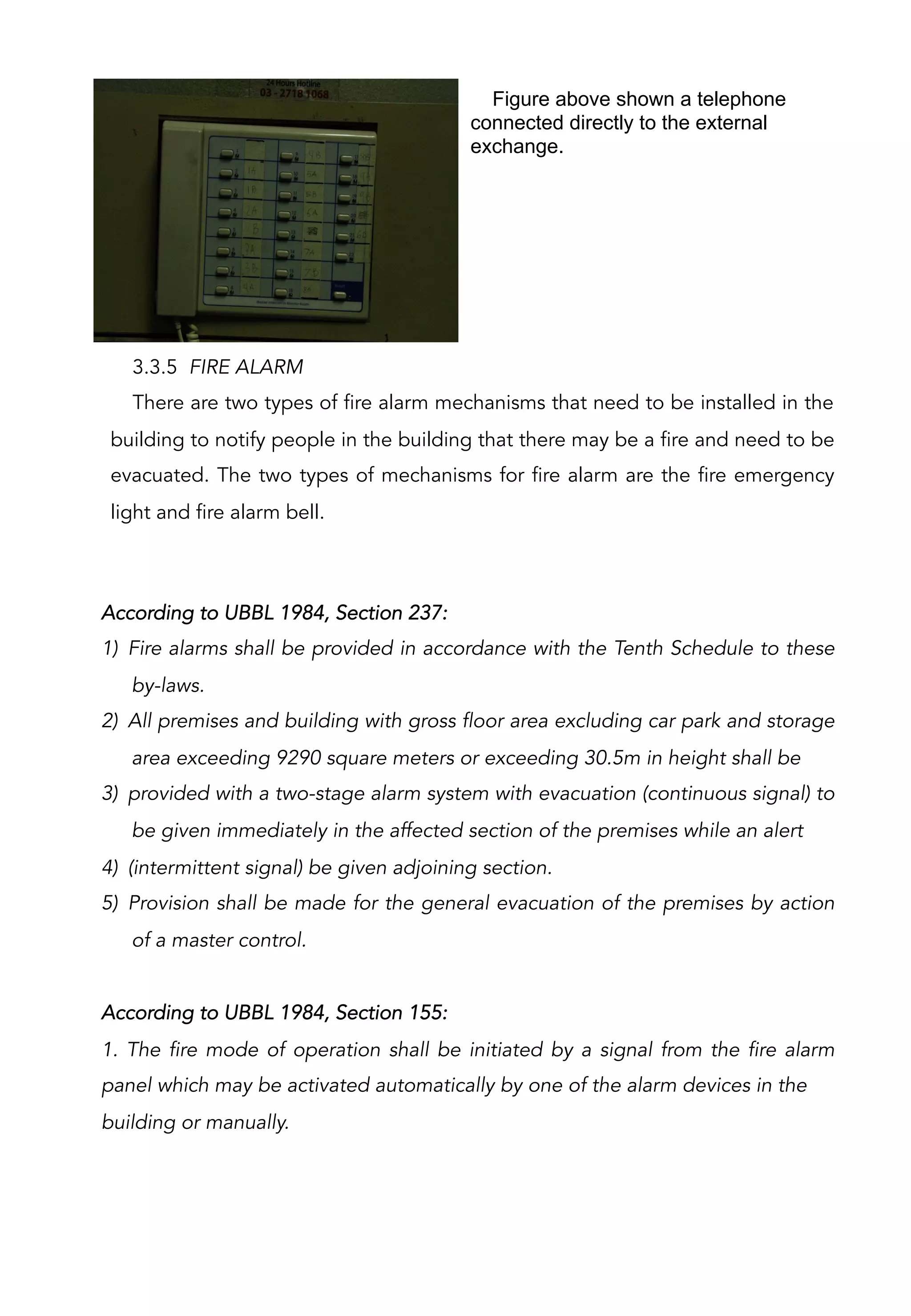
  • 122.
    All waste pipesshould have cleanouts at easily accessible locations. A cleanout is simply a Y-shaped fitting in the line that is capped off. If a blockage occurs in the drainpipe, a cleanout offers a convenient place for a plumber to snake out the line. To prevent sewer gases and odours from entering the house, drains are protected by traps. A trap is a curved section of drainpipe that fills up with water, providing a seal. Drains that penetrate a wall have a P trap; those that go through the floor have an S trap. The water held by the trap is replaced each time the fixture is used. This is the best and most improved system of plumbing. Two sets of vertical pipes, one for excreta (night soil) as soil pipe and another for sullage as waste pipe. The soil pipes as well as waste pipes are separately ventilated, by providing, separate vent pipe or anti-siphon age pipe. This system has four vertical pipes. The ventilation is usually achieved by providing a fresh air inlet connected to the lower- most manhole or inspection chamber. Fresh air from the atmosphere will enter through this inlet into the manhole, and finally goes out at top through the vent pipe. The air along with foul gases will finally escape out from the cowl provided at the top. A flap valve is provided at the inlet of fresh air into the inspection chamber, to avoid the escape of foul gases in the street or courtyard. Figure  6.3.4.1c.  Plumbing  
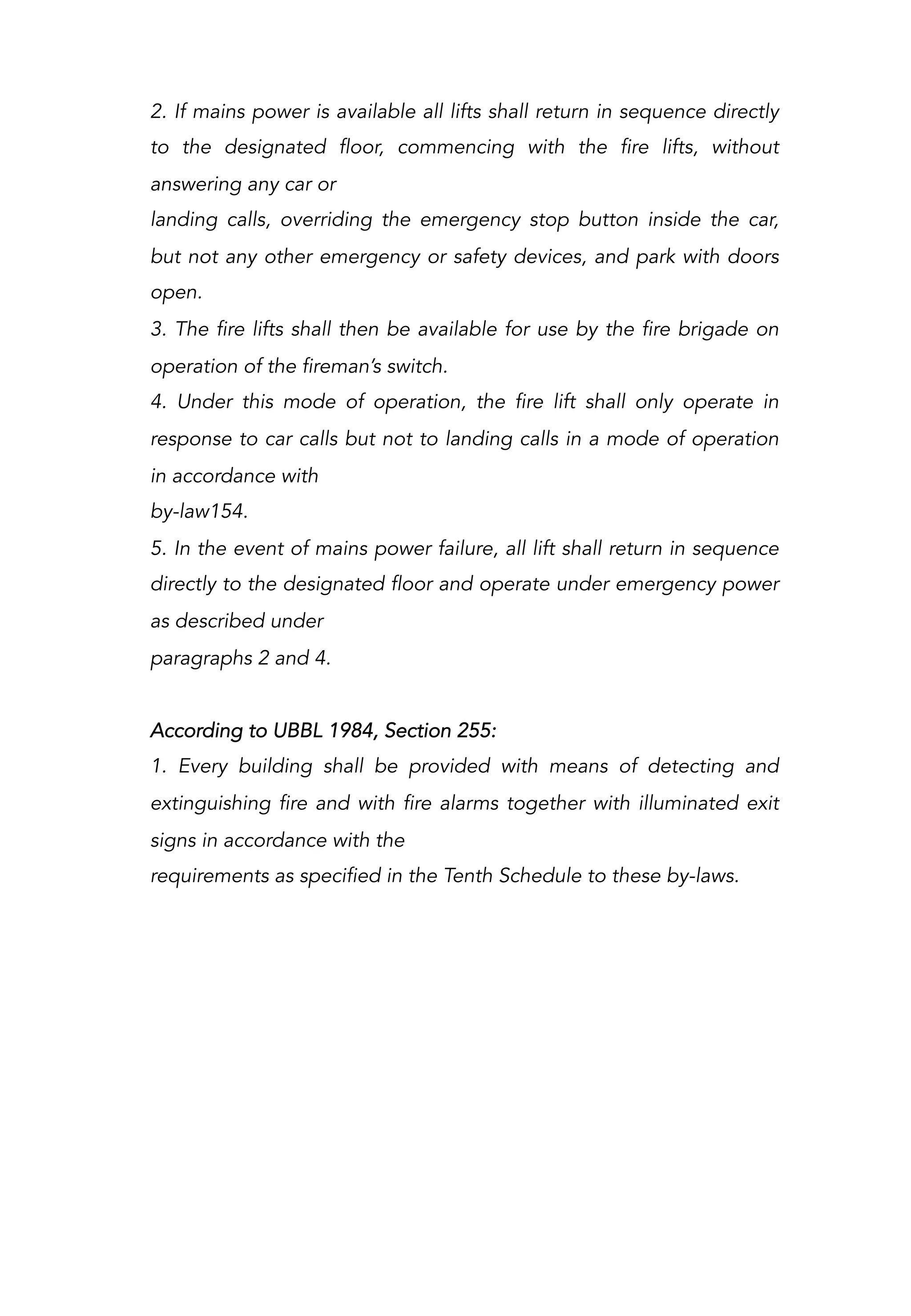
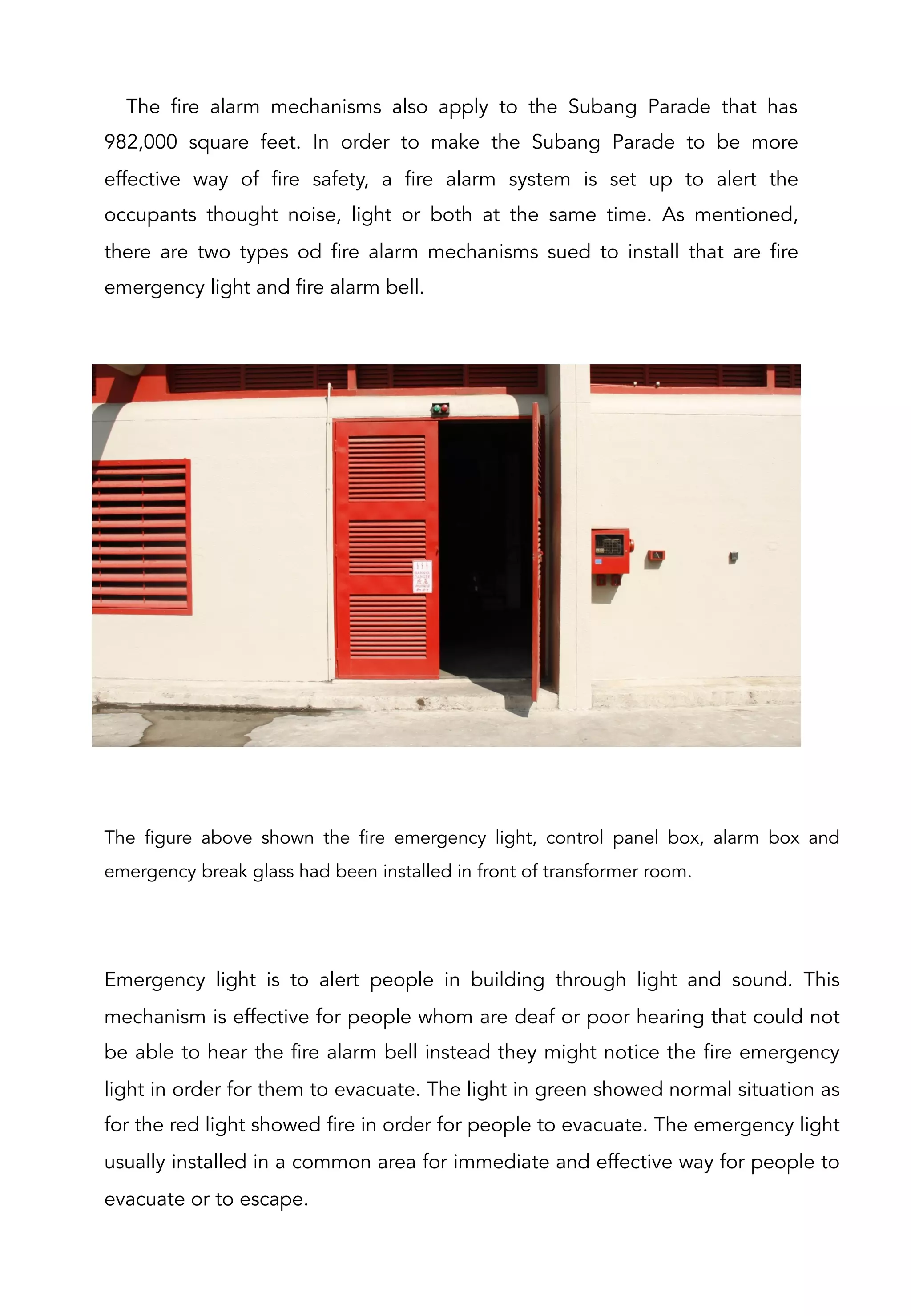
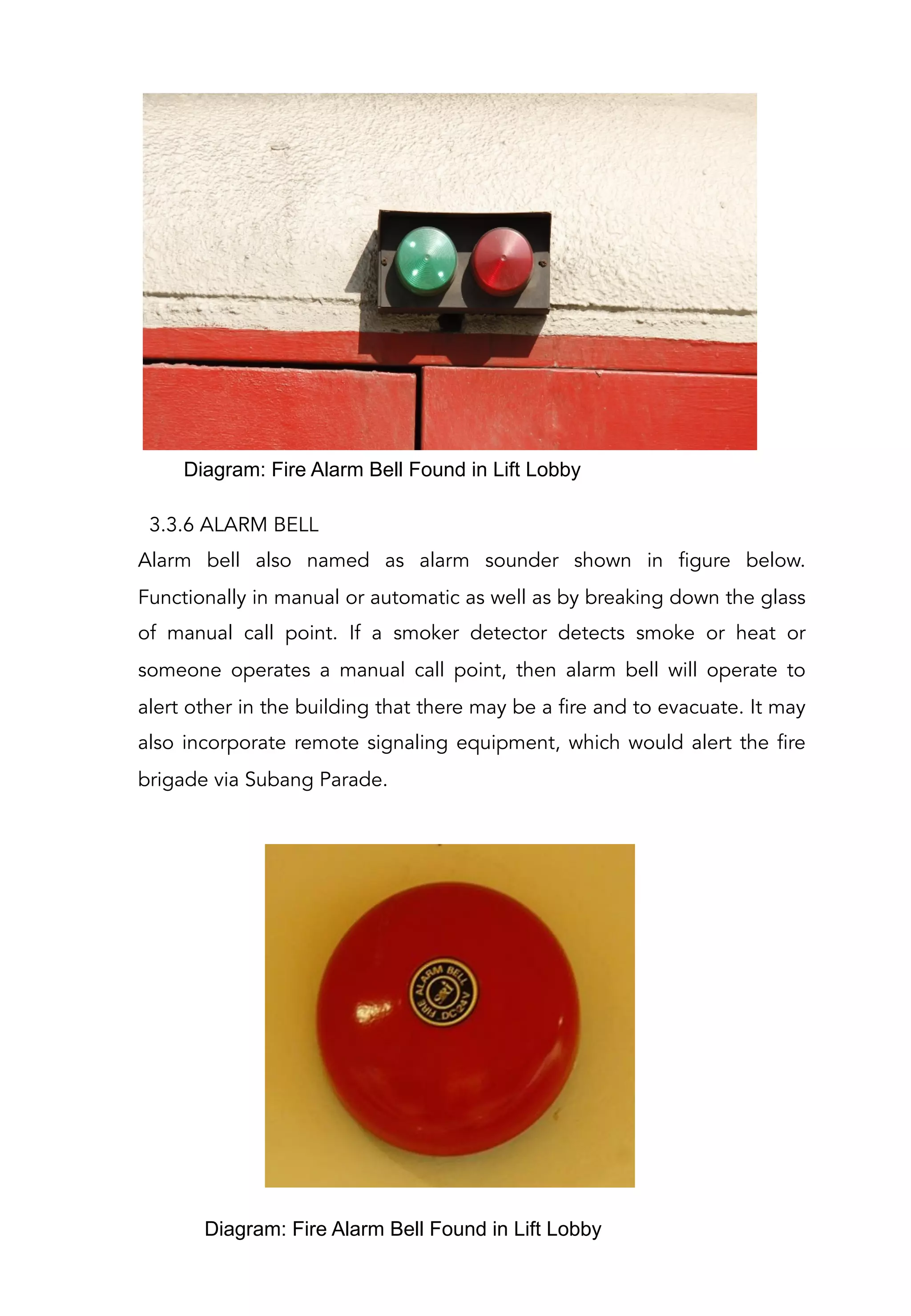
  • 123.
    6.3.5 SEPTIC TANK Aseptic tank generally consists of a tank (or sometimes more than one tank) of between 1,000 and 2,000 gallons (4000 and 7500 litres) connected to an inlet wastewater pipe at one end and a septic drain field at the other. In general, these pipe connections are made via a T pipe, which allows liquid to enter and exit without disturbing any crust on the surface. Today, the design of the tank usually incorporates two chambers (each equipped with a manhole cover), which are separated by means of a dividing wall that has openings located about midway between the floor and roof of the tank. Waste water enters the first chamber of the tank, allowing solids to settle and scum to float. The settled solids are anaerobically digested, reducing the volume of solids. The liquid component flows through the dividing wall into the second chamber, where further settlement takes place, with the excess liquid then draining in a relatively clear condition from the outlet into the leach field, also referred to as a drain field or seepage field, depending upon locality. A percolation test is required to establish the porosity of the local soil conditions for the drain field design. The remaining impurities are trapped and eliminated in the soil, with the excess water eliminated through percolation into the soil (eventually returning to the groundwater), through evaporation, and by uptake through the root system of plants and eventual transpiration. A piping network, often laid in a stone-filled trench (see weeping tile), distributes the wastewater throughout the field with multiple drainage holes in the network. The size of the leach field is proportional to the volume of wastewater and inversely proportional to the porosity of the drainage field. The entire septic system can operate by gravity alone or, where topographic considerations require, with inclusion of a lift pump. Certain septic tank designs include siphons or other methods of increasing the volume and velocity of outflow to the drainage field. Figure  6.3.5a.  SepAc  Tank   Figure  6.3.5b.  Details  of  SepAc  Tank  
  • 124.
    6.3.6 MANHOLES Manholes ormaintenance holes are underground chambers which are dug into the ground to ensure that sewer lines and other utilities such as electrical cables are able to be checked for damage and maintenance. Sewer lines run across manholes, and if they are damaged, manholes are access points to get to the damaged pipe. Manhole openings are protected by a manhole cover (also known as a "biscuit"), a flat plug designed to prevent accidental or unauthorized access to the manhole. Those plugs are traditionally made of metal, but may be constructed from precast concrete, glass reinforced plastic or other composite material (especially in Europe, or where cover theft is of concern). Manholes are usually outfitted with metal, polypropylene, or fiberglass steps installed in the inner side of the wall to allow easy descent into the utility space. Because of legislation restricting acceptable manual handling weights, Europe has seen a move toward lighter weight composite manhole cover materials, which also have the benefits of greater slip resistance and electrical insulating properties. The access openings are usually circular in shape to prevent accidental fall of the cover into the hole. Manholes are generally found in urban areas, in streets and occasionally under sidewalks. In rural and undeveloped areas, services such as telephone and electricity are usually carried on utility poles or even pylons rather than underground. Figure  6.3.6a.  Manhole   Figure  6.3.6b.  Manhole  detail  
  • 125.
    6.3.7 DRAINAGE The drainagesystem is an essential part of living in a city or urban area, as it reduces flood damage by carrying water away. When it rains, some water naturally seeps into the ground. The rest makes its way through drainage systems, into rivers and creeks and eventually into the bays, or directly to the bays through storm water beach outlets. In areas with houses, shops and roads we need to create alternative ways for this water to drain away. Large amounts of water can build up quickly during heavy rain and storms, and without adequate drainage this flows towards low-lying land, causing flooding, and damage and safety risks. For this reason, we work with local councils to provide a drainage system that safely carries storm water away from built-up areas and into rivers and creeks. Analysis According to UBBL 1984, Section 115: Roof coverings and drainage. All roofs of buildings shall be so constructed as to drain effectually to suitable and sufficient channels, gutters, chutes or troughs which shall be provided in accordance with the requirements of these By-laws for receiving and conveying all water which may fall on and from the roof. Figure  6.3.7a.  Drainage   Figure  6.3.7b.  Detail  of  Drainage  
  • 126.
    1. Storm waterruns off Subang Parade’s properties and their roofs through house gutters and downpipes, and into residential drains 2. Residential drains connect to streets and roads or council drains 3. Council drains connect to regional drains 4. Regional drains direct water into the nearest river or creek or directly to the bay 5.  Rivers and creeks eventually empty into Port Phillip Bay or Western Port Entering storm water drains is dangerous and illegal, and it could cost lead to death. Conditions inside a drain can become very hazardous without warning. For example: • Water levels can rise even on a dry, sunny day • Rainwater can arrive suddenly, having fallen many kilometres away • Slow moving flows can quickly become raging torrents • Areas with poisonous gases and low oxygen can be deadly • Drains may contain steep, hidden slopes, making it easy to slip and difficult for others to hear you call for help We can’t cover up all storm water drains and grilles as this would restrict water flows and cause a build-up of litter and debris, leading to flooding. Warning signs are placed at entrances to drains around Subang Parade.
  • 127.
    Figure  6.3.8  Armaflex  insulaAon  on  wastewater  pipes       According to MS 1525:2007 8.5 Piping Insulation All piping installed to serve buildings and within buildings should be adequately insulated to prevent excessive energy losses. Additional insulation with vapour barriers may be required to prevent condensation under some conditions. As mentioned above, the standard is adhered in the implementation of the pipes through lower temperature areas of the building. 6.3.8 INSULATION Certain wastewater pipes in the building are insulated with Armaflex insulation which is a polyethylene product. The wastewater pipes that insulated are located within rooms that has a lower temperature such as the AHU room and also the M&E room which is air conditioned. The reason for the insulation of these pipes in low temperature rooms is because of condensation control, where pipes operate at below-ambient temperatures, the potential exists for water vapor to condense on the pipe surface. Moisture is known to contribute towards many different types of corrosion, so preventing the formation of condensation on pipework is usually considered important. Pipe insulation can prevent condensation forming, as the surface temperature of the insulation will vary from the surface temperature of the pipe. Condensation will not occur, provided that the insulation surface is above the dew point temperature of the air; and the insulation incorporates some form of water vapor barrier or retarder that prevents water vapor from passing through the insulation to form on the pipe surface.
  • 128.
    6.4 ANALYSIS In SubangParade, liquid waste are being release in sanitary appliances and being flush into the vertical waste pipe also called as stacks. From Stacks in then travel to the septic tank in the basement of the building and through a soil pipe, wastewater is being pumped into the public sewer line. Wastewater is then travel along the public sewer line to a wastewater treatment plant nearby for treatment before clean water being send to the nearby water sources. However, grease interceptor trap are use only at ground level of the building where restaurant is located. Grease or fat from wastewater can cause pipes to block as they solidify on the inner wall of the pipe. A grease interceptor trap consists of a tank which holds water in a sufficient amount to cause the washing up water to stagnate and cool. Thus allows the grease to float to the water surface and maybe solidify and thrown away while the normal liquid being sent out through an outlet pipe. It usually also fitted with a wire basket to trap solid waste which enter the tank with the wastewater. Most of the sewage pipes and vents, including the storm drains and sewer are hidden and cannot be seen. Most sewage pipes run across above ceiling panels, and behind walls. Therefore, this is a good thing for the aesthetics of the building interior and exterior. Even the pipes beneath washroom sinks are hidden by a concrete surface. The smell and odour around the building is kept fresh, as every plumbing fixture and sewage inlet such as water closets and floor traps are connected to a stack vent, and every stack vent has a vent pipe till the roof to allow the smell of the sewage to escape the building, rather than trapping it inside the building. So, the hygiene is maintained quite well.
  • 129.
    6.5 CONCLUSION As inconclusion, Subang Parade is a very efficient design in terms of sanitation and drainage. It has all the basic requirements of sanitation services and storm water systems, which is executed at affordable costs. The sanitation systems in the building are functional, efficient, and aesthetically acceptable. The wastewater system for Subang Parade is well planned and it complies with standards and requirement of regulatory bodies in Malaysia. The availability of wastewater treatment plant nearby is an advantage for the building as it allows wastewater to be discharge into the public sewer line, which reduces the cost as well as the maintenance cost for a septic tank or a treatment system in the building itself.
  • 130.
    7.0 MECHANICAL TRANSPORTATIONSYSTEM 7.1 INTRODUCTION In the 21th generation, there’re multi-storeys of profitable building which used of mechanical transportation to transport their goods and users to different level of floor of the building. Mechanical transportation is playing an important role in building construction of a building. According to Malaysia Uniform Building By-Laws 1984, clause 124. A lift shall be provided for non-residential building which exceeds 4 storeys above/ below main entrance. •  Necessary in building less than 4 storeys if access for senior or disabled is enforced •  Minimum walking distance to lift shall not exceed 45 m. •  Lift should be positioned in the central area of the building to minimize horizontal travel distance The other UBBL clause that hold an important role is UBBL clause 153, a smoke detector to be provided at the elevator’s lobby. Besides that, elevator lobby should be broad enough to grant traffic access in two directions. 7.2 LITERATURE REVIEW The two types of elevators are geared traction elevator and hydraulic elevator. Traction elevator can be separated into two different categories. One is geared and the other one is gearless. Nonetheless, the selection of elevators is not only based on the choices of the classes and motors, it is also based on the performance and effectiveness of the elevator set up on site. The performance and effectiveness of an elevator set up is achieved by calculating the round trip time (RTT). This is an ordinary period of time for one lift car to circulate, assimilating statistical data for the time lost due to stops. It is measured from the time the lift doors begin to open at the main
  • 131.
    7.3 ELEVATOR 7.3.1 CASESTUDY Being a typical shopping mall, Subang Parade has integrated with mechanical transportation system to transport its customer as well as the stocks. The Elevator System used by Subang Parade consists of: •  Geared Traction Elevator •  Plunger Hydraulic Elevator Besides elevators, there are two type of Escalators being used such as: •  Crisscross Escalators •  Parallel Escalators. fatal to the time they reopen when the car completes its cycle. The complete process is a summation of a number of simple calculations relating the elevator’s function through its cycle. On the other hand, escalators are moving stairs that designed to provide efficient vertical conveyance of people. It transports the users adequately, instantaneously, safely as well as continuously with consistent speed.
  • 133.
    Figure  4.3.1a  shows  the  allocaAon  of  the  locaAon  of  the  elevators  and  escalators  
  • 134.
    7.3.2 GEARED TRACTIONELEVATORS Geared Traction Elevators typically work at speeds greater than 500 feet per minute (2.54 meters per second). In a gearless traction machine, woven steel cables called hoisting ropes are secured to the top of the elevator car and wrapped around the drive sheave in special grooves. The other ends of the cables are secured to a counterweight that moves up and down in the hoistway on its own guide rails. The linked weight of the elevator car and the counterweight presses the cables into the drive sheave grooves, providing the necessary traction as the sheave turns. Besides that, geared traction elevators was selected to be the Elevator System of Subang Parade, a 4 storeys building. 7.3.2.1 PRINCIPAL COMPONENTS The car, cables, elevator machine, control equipment, counterweights, hoistway, rails, penthouse, and pit are the principal parts of a traction elevator installation. An illustration of the functions and orientation of geared traction elevator is shown in Figure 4.3.2.1a. Figure 4.3.2.1a Components of a Geared Traction Elevator set up with one solid state control and motor drive. Source from http://asianlift.in/ gallery/traction/2.jpg.
  • 135.
    Car The car isthe only element which the normal passenger is familiar. Some of a building’s prestige depends upon proper design of the elevator car. Essentially, the car is a cage of some fire-resistant material supported on a structural frame, to the top member of which the lifting cables are locked. By means of guide shoes on the side members, the car is guided in its vertical travel in the shaft. The car is equipped with safety doors, operating-control equipment (Figure 4.3.2.1b), floor- level indicators Figure 4.3.2.1c), illumination, emergency exits, and ventilation. It is designed for long life, low maintenance and soft operation. Figure  4.3.2.1c  Floor  level  indicators   Figure  4.3.2.1b  OperaAng-­‐Control  Equipment    
  • 136.
    Cables Cables (ropes) aremade of groups of steel wires uniquely designed to withstand the weight of the car and its live load. The cables are associated to the crosshead (top beam of the elevator). Four to eight cables, depending on car speed and capacity, are positioned in parallel. Although multiple of ropes are used primarily to surge the traction area on the drive sheaves, they also surge the elevator safety factor, as each rope is normally capable of supporting the entire load. The minimum factor of safety varies from 7.6 to 12.0 for passenger elevators. The cables from the top of the car pass over the motor-driven cylindrical sheave at the traction machine (grooved for the cables) and the downward to the counterweight. Geared Traction Machines A geared traction machine (Figure 4.3.2.1d) has a worm and gear interposed between the driving motor and the hoisting sheave. The driving motor can therefore be smaller, economical, high speed unit rather than the large, low speed unit required by a gearless installations. Geared machines are used for car speeds of up to 450fpm (2.3 m/s) and a maximum rise of about 300 ft (90 m). With an appropriate drive and control system, a geared traction machine can give almost the same high-quality, accurate, smooth ride as is available from a gearless installation. Figure  4.3.2.1d  Geared  TracAon  Machine  
  • 137.
    Counterweight The counterweight ismade up of cut steel plates stacked in a frame attached to the opposite ends of the cables to which the car is locked. It is guided in its travel up and down the shaft by two guide rails typically seted up on the back wall of the shaft. Its weight equals that of the empty car plus 40% of the rated live load. It serves several purposes: 1. To provide adequate traction at the sheave for car lifting 2. To reduce the size of the traction machine 3. To reduce power demand and energy cost Shaft The shaft or hoist-way is the vertical passageway for the car and the counterweights. On its side walls are the car guide rails and certain mechanical and electrical auxiliaries of the control apparatus. At the bottom of the shaft are the car and counterweight buffer. At the top is the structural platform on which the elevator machine rests. The elevator machine room (which occupy one or two levels) is usually directly above the shaft. It contains the traction machine and the solid-state control that supplies energy to the elevator machine and control equipment are designed for quiet, vibration-free operation.
  • 138.
    7.3.2.2 ARRANGEMENT OFELEVATOR MACHINES, SHEAVES AND CABLES Subang Parade used single wrap 2:! Roping for their arrangement of elevator machines, sheaves and cables. The mechanical leverage of the 2:1 roping is that it permits the use of high-speed, low power (lower cost) traction machine. 7.3.2.3 SAFETY DEVICE Every systems has its own safety device. For elevator system, there is a main brake mounted directly on the shaft of the elevator machine. The main brake works in such a way during emergency/accident the elevator is the first slowed by dynamic braking of the motor, and the brake then operates to clamp the brake drum, thus holding the car still at the floor. A dual safety system is designed to block an elevator car automatically before its speed becomes excessive is normally used. The device acts first is a centrifugal governor or an electronic speed sensor that cuts off the power to the traction motor and sets the brake in the event of a limited over speed. This usually blocks the car. Should the speed still rise , the governor actuates two safety rail clamps, which are mounted at the bottom of the car, one on either side. They clamp the guide rails by wedging action, bringing the car to a smooth stop. Oil or spring buffers are usually positioned in the elevator pit. Their aspiration is not to block a falling car but to bring it to a somewhat cushioned stop if it over travels the lower terminal. If a car over travels, travel sensors de-energize the traction motor and set the main brake.
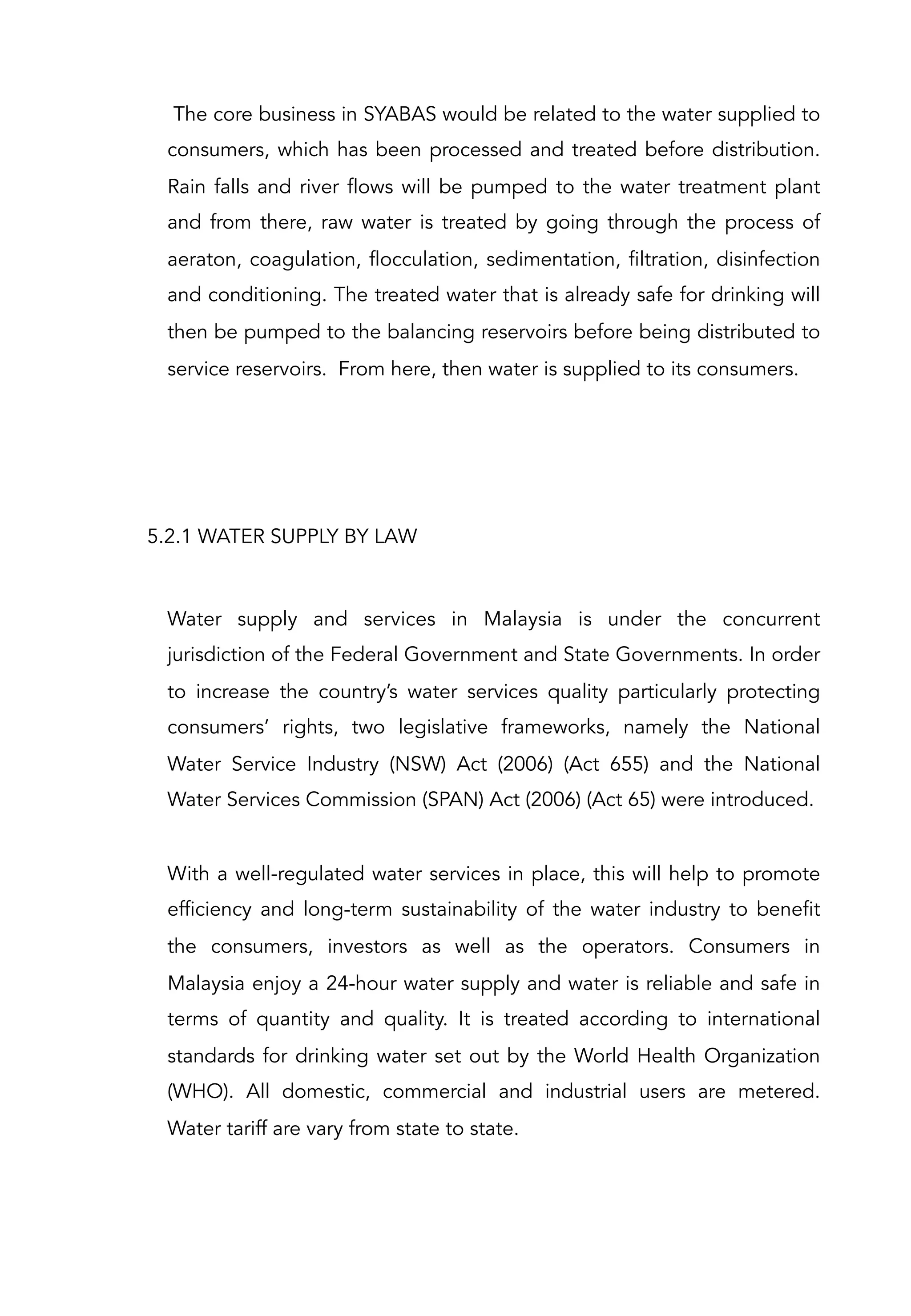
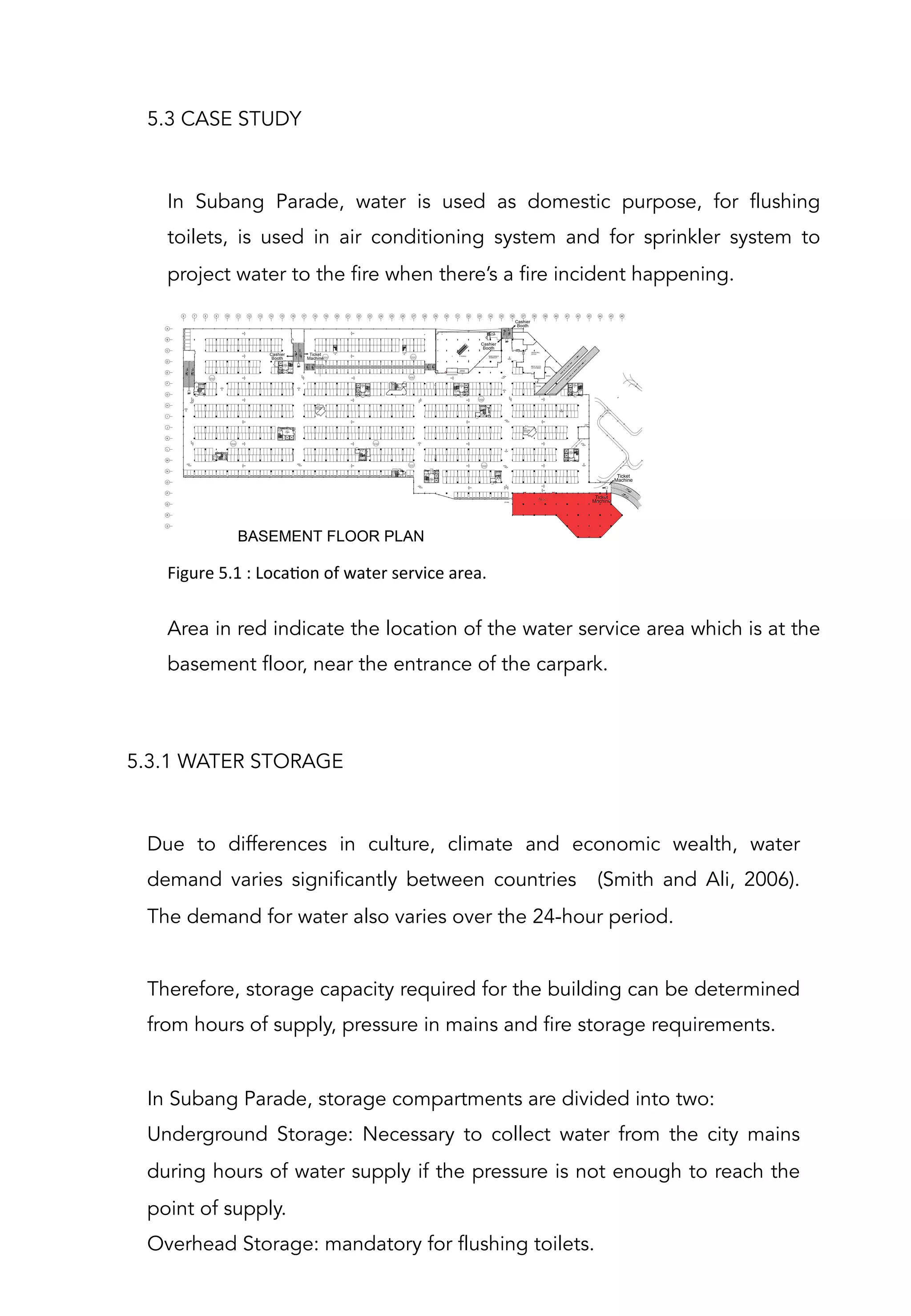
  • 139.
    7.3.3 OBSERVATION ELEVATOR(PLUNGER HYDRAULIC ELEVATOR) For the sake of aesthetic, there is a plunger hydraulic elevator positioned in the heart of Subang Parade. The absence of the overhead machine room, penthouse and traction equipment with camouflaged guide rails project above the car generate an impression of freestanding observatory elevator. All hydraulic elevators today consume oil and collect their motive power from a sealed oil-piping circuit powered by an oil pump. The systems runs the same way as a hydraulic automobile jack. Oil from a reservoir is pumped under the plunger, by that lifting it and the car. The pump is stopped during downward motion, the car being lowered by gravity and restrained by the action of bypass valves, which also restraint the positioning of the car during upward motion. Besides that, there are advantages of hydraulic elevators. Advantages of Hydraulic elevator: •  The elevator load is carried by the ground and not by the structure. In contrast, traction units place a large structural load on the penthouse and machine room floors and on overhead steel as well. •  The hoistway is smaller due to the absence of a counterweight and its guide rails. •  Cars can be lowered manually by the operation of oil valves. This is particular useful and important in the event of control equipment failure or power outage.
  • 140.
    7.3.4 ELEVATOR CARCONTROL The movement of an elevator car and all of its parts is restrained by three different systems that associate and interact to provide a unified control system. The same goes with the elevator system in Subang Parade. The three systems are: 1.  Drive Control System 2.  Operational Control System 3.  Supervisory System 7.3.4.1 DRIVE CONTROL SYSTEM Drive Control System, also recognized as motion control system determines the car’s acceleration, velocity, braking, levelling and regenerative braking plus all aspect of door motion. Elevator car acceleration and deceleration are accomplished by restraining the speed of the motor that drives the traction elevator machine. This speed control can be accomplished in a number of ways. In this case, Subang Parade used Variable Voltage DC Motor Control or recognized as Ward Leonard System as their motor speed control’s drive. 7.3.4.1.1 WARD LEONARD SYSTEM Before the evolution of electronic motor control, the only practical way of obtaining the precise motor speed control necessary for smooth step less elevator was to provide a variable DC voltage to a DC traction motor. This variable DC voltage was obtained from an auxiliary m-g set comprising an AC motor and a DC generator. It is a classic high quality elevator drive arrangement and is found in the vast majority of better quality geared and gearless set up built before 1990. The disadvantages of this system are: • Low capability • Expensive machines • High Noise levels
  • 141.
    7.3.4.2 OPERATING CONTROLSYSTEM Elevator Operating Control System determines when and where physical motion of a car and its doors should appear. This system deals with the operation of the car doors and the integration of car buttons, lanterns and passenger-operated devices into the overall control and indicating system. Generally, the motion of a car is regulated by the action of three principal items of equipment, the car controller, the motion controls and the system supervisory equipment. The function of a car controller is to provide information on the car’s exact location, panel calls and hall calls. This information is fed into the supervisory system and the motion control equipment, which in turn act to initiate all the procedures necessary to answer all calls via the individual car controller panels. The car controller panel also supplies the necessary signals to car and hall lanterns that indicate the car position and direction of travel. 7.3.4.3 SUPERVISORY SYSTEM Supervisory system controls a bank of elevators as a group and dictates which car answer which call. There are several group of system supervisory equipment. Subang Parade used selective collective system in this case.
  • 142.
    7.3.4.3.1 SELECTIVE COLLECTIVEOPERATION This group of collective operation is “selective” in that it is organized to collect all waiting “up” calls on the trip up and all “down” calls on the trip down. The control system stores all calls until they are answered, and automatically reverses the direction of travel at the highest and lowest call. When all the calls have been cleared, the car remain at the floor of its last stop awaiting the next call. Any hall button call will set the car in operation. For places where service requirement are neutral, a group control scheme for up to three cars (for Subang Parade, it is two car) automatically assigns each hall call to the car best situated to answer it, prevents more than one car from answering a call, allows one car to be detached for freight duty and automatically parks cars at ground floor when they are not required. The major disadvantages of the selective collective control is its inherent and strong tendency toward bunching of cars can result in long waiting periods. This characteristic is particularly annoying with groups of three cars due to certain situation which a passengers arrived at a landing find that all three cars have just passed, going in the same direction. For this reason, operation of more than two cars with this system is not recommended. That is why Subang Parade had only two cars operating with system at once. 7.3.4.4 LOBBY ELEVATOR PANEL Lobby elevator control today has become one or more computer monitor screens positioned at a lobby desk or in the building maintenance office. The lobby elevator panel in Subang Parade is based in its surveillance office. The information displayed on the screen includes car locations, movement direction, waiting corridor calls and any special status data. The control functions available at the computer terminal permit intervention to establish special types of operation including:
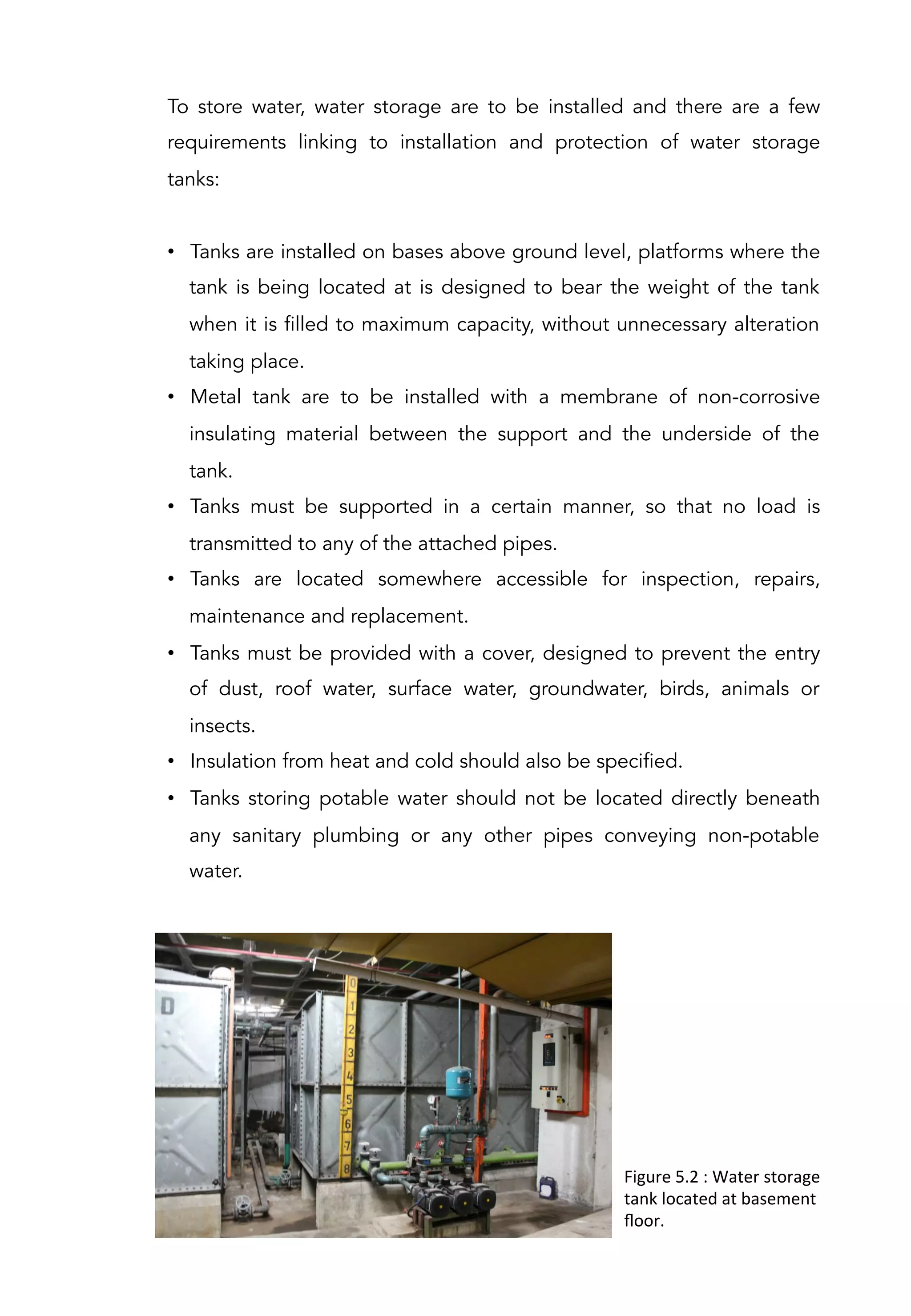
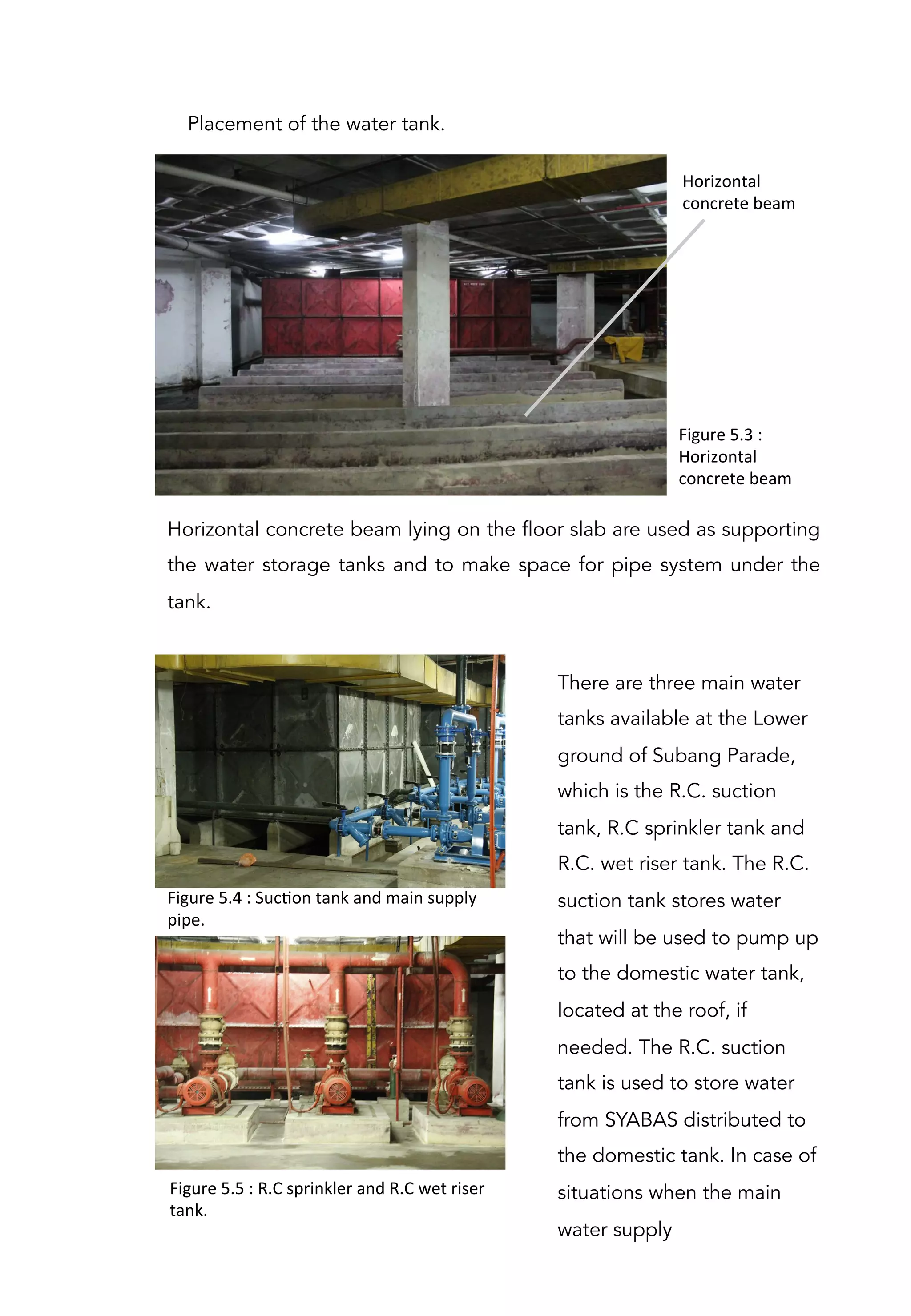
  • 143.
    7.3.5 REQUIREMENTS OFELEVATORS 7.3.5.1 ELEVATOR DOORS The choice of a car and shaft door affects the speed and quality of elevator service considerably. Doors for passenger elevators are power operated and are synchronized with the levelling controls so that the doors are fully opened by the time a car comes to a complete stop at a landing. For safety reasons, the kinetic energy of an automatic door is limited to 9.5Nm and its closing pressure to 13.6kg. To provide the fastest closing within this limitation, a center-opening door is used. A clear opening of 1.52m is used in Subang Parade to reduce the passenger transfer time and avoid discomfort and also in the meantime allows simultaneous loading and unloading without undue passenger contact. The choice of door design for Subang Parade in this case is Two Speed, center- opening 1.52m department store door (Figure 4.3.5.1a) for freight, passenger and non- automatic service. • Car movement without operating the usual audible and visual signals (inconspicuous riser) • One or more cars removed from supervisory control and operated manually (attendant or independent service) • Cars selected for night or weekend service while the other cars are shut down • Cars assigned to a particular floor on a fixed or priority basis call (convention feature or priority) • Switching off power between cars in the event of emergency • Two way communication with each car and other selected locations.
  • 144.
    7.3.5.2 SHAFTS ANDLOBBIES The elevator lobby on each floor is the focal point from which corridors radiate for access to all rooms, stairways, service rooms, and so forth. The lobbies in Subang Parade are placed above each other. Lobbies in Subang Parade provide adequate area for the peak-load gathering of passengers to ensure rapid and comfortable service to all. The number of people contributing to the period of peak load (15 to 20 minute peak) determines the required lobby area on the floor. Not less than 0.5𝑚2 of floor space per person should be provided at peak periods for waiting passengers at a given elevator or bank of elevators. The hallways leading to such lobbies should also provide at least 0.5𝑚2 per person, approaching the lobby. Under self- adjusting relax conditions, density is about 0.65𝑚2 per person. During peak periods crowding occurs, however, reducing this to 0.3 to 0.4𝑚2 per person. An acceptable compromise is 0.5𝑚2 per person. In this case Subang Parade had done more than that in providing a comfort experience for its customers. The main lower terminal of elevators banks is generally on the street floor level. The upper terminal is usually the top floor of the building. Lift shaft in Subang Parade incorporate the following features: • Water tightness • Means of drainage Figure 4.3.5.1a Two speed, center-opening 1.52m door
  • 145.
    7.3.5.3 EMERGENCY POWER Accordingto Malaysia Standard EN 81-1:2012, sub clause 8.16.5 There shall be an emergency supply which is capable of feeding at least the forced ventilation for 2hours in case of interruption of the normal supply. This forced ventilation shall come in automatically upon failure of the normal power supply. According to Malaysia Standard EN 81-1:2012, sub clause 8.17.4 There shall be an automatically rechargeable emergency supply, which is capable of feeding at least a 1W lamp for 2hours in case of an interruption of the normal lighting supply. On breakdown of power in Subang Parade, the car brake is set immediately upon power outage and the car remains motionless. The emergency brakes are activated by a continuous rope passing over a pulley in the pit and an over speed governor pulley in the motor room. The governor locks in response to flyweight inertia from the centrifugal force generated by excess speed, thus jerking the rope in the process. While for the observatory elevator, the hydraulic cars can be lowered by operation of a manual valve. This is particularly bad for cars in blind shafts – that is, express shafts with no shaft way doors. In such cases, escape from the cars via a hatchway is not practical because when emergency power is not available, the undesirable option of breaking through the shaft way walls is to holy recourse. The generator in Subang Parade is sized to support one elevator motor at a time, with manual or automatic switching organized between unit controllers. Thus, each car in turn can be brought to a landing and from that time forward a single car maintained in service. • Plumb, vertical sides • Smooth painted finish • Ventilation void for emission of smoke • Permanent inspection lights • Have no other services except those necessary for operation of the lift.
  • 146.
    7.3.6 SPECIAL CONSIDERATIONS 7.3.6.1FIRE SAFETY According to Malaysia Uniform Building By-Laws, clause 151 Where openings to lift shafts are not connected to protected lobbies, such lift shafts shall be provided with vents of not less than 0.09 square metre per lift located at the top of the shaft. Where the vent does not discharge directly to the open air the lift shafts shall be vented to the exterior through a duct of the required FRP as for the lift shafts. According to Malaysia Uniform Building By-Laws, clause 152 1. Every opening in a lift shaft or lift entrance shall not open into a protected lobby unless other suitable means of protection to the opening to the satisfaction of the local authority is provided. These requirements shall not apply to open type industrial and other special buildings as may be approved by the D.G.F.S. 2. Landing doors shall have a FRP of not less than half the FRP of the hoist-way structure with a minimum FRP of half hour. 3. No glass shall be used for in landing doors except for vision in which case any vision panel shall or be glazed with wired safety glass, and shall not be more than 0.0161 square metre and the total area of one of more vision panels in any landing door shall be not more than 0.0156 square metre. 4. Each clear panel opening shall reject a sphere 150mm in diameter. 5. Provision shall be made for the opening of all landing doors by means of an emergency key irrespective of the position of the lift car.
  • 147.
    7.4 ESCALATORS 7.4.1 CASESTUDY Escalators, also referred as the moving stairway or an electric stairway is a modern successors deliver passengers comfortably, rapidly, safely and continuously at constant speed and usually with no delay at the boarding level. The escalator is always in motion, inviting passengers to ride an open, airy, observation-type conveyance that can never trap them due to equipment or power failure. An escalator also has a decorative/ design function, and its open, observation characteristic is frequently used to expose the rider to specific visual panoramas. Subang Parade too incorporate such a system in their mechanical transportation system. 7.4.2 ESCALATOR ARRANGEMENT 7.4.2.1 PARALLEL STACKED ARRANGEMENT The principal advantage of the parallel arrangement is its impressive appearance. The stacked arrangement must be used with caution due to the inconvenience to the rider of an enforced long walk-around to continue the trip. In Subang Parade, the stacked parallel arrangement , with forced walk-around is unpleasant, as many people are there to flip through and window-shop rather than to purchase and leave. Escalators between two contiguous levels do not present the continued trip problem and therefore are frequently used in the parallel arrangement. The consideration of division of rider traffic between elevators and escalators in a store is important. The general philosophy of store owners is to make escalators the primary means of vertical transportation for the obvious reason of merchandise exposure.
  • 148.
    7.4.2.2 CRISSCROSS ARRANGEMENT Thiscrisscross arrangement is rapid, pleasant and very economical of space because the stairs nest into each other. It can be used for as many as five floors without excessive annoyance to the rider. 7.4.3 Location Escalators are constantly moving and are generally part of a horizontal and vertical trip, they must be place directly in the main line of traffic. Escalators must therefore be place in the area served, often with a dominating presence. This allows potential riders to immediately locate the escalators, recognize the individual escalator’s destination and move easily towards the escalators. To avoid traffic movement disorientation, Subang Parade provides: 1.  A well-marked escalator with plentiful traffic capacity. 2. Assembling space at the intermediate landings so that commuter’s strain can be relieved. 3. A slight setback for the next escalator so that the necessary 180 degree turn can readily be negotiated. At the exit terminus, an escalator is discharged into an open area with no turns or choice of direction. The landing space beyond the escalator newels is a minimum of 2.4m for 0.81m units and 3m for 1.22m units for a standard 0.5-m/s speed. The parallel arrangement, being less efficient and more costly, has a compensating virtue a very impressive appearance that strongly draws people to it. 7.4.2.2 CRISSCROSS ARRANGEMENT This crisscross arrangement is rapid, pleasant and very economical of space because the stairs nest into each other. It can be used for as many as five floors without excessive annoyance to the rider.
  • 149.
    7.4.4 SIZE, SPEED,CAPACITY AND RISE Escalators are built according to manufacturers’ and industry standards and are therefore available in standard designs. All escalators in the United States are equipped at an angle of 30 degree from the horizontal, with a minimum vertical clearance of 2.1m for escalator passengers. The 30 degree aptitude means that the rise is equal to 57% of the unit’s projected floor area for its portion. To meet Americans with Disabilities Act (ADA) qualification, elongated newels with at least two horizontal treads before the landing plate are needed. Today the industry has standardized the linear speed and thus, Subang Parade’s escalators are running on a single speed of 0.5m/s. Safety code (ANSI/ASME 17.1) defines the width of an escalator as the width of the stair tread (in inches). The measurement of width designation is now named size. The standard size and width of Subang Parade’s escalators are 1.22 m (size) and 1.02m (width). A 1.02m tread can certainly carry 2 persons, psychologically circumstances, plus physical ones such as bulky clothing, packages, purses, and briefcases. As a result, on a 1.02m wide tread, one person uses each step in a diagonal arrangement. Nevertheless in reality, maximum capacity is approached only during peak-loads periods in transportation terminals. In escalator design all the motive power is transferred at one point; that is, the drive motor drives the main chain, top sprocket, step chain and pulls up the steps lead to the entire assembly to move. This settlement is suitable for neutral rises up to approximately 7.6m; beyond that, the design becomes increasingly inefficient. In Subang Parade, the ascent of the escalator is approximately 7m.
  • 150.
    7.4.5 COMPONENTS Figure  4.4.5a  shows  an  illustraAon  of  the  major  components  of  an  escalator.     Source  from  h[p://www.mitsubishielectric.com/elevator/overview/e_m_walks/images/img_e_s_equ00_1.gif  
  • 151.
    7.4.6 SAFETY FEATURES Protectionof passengers during normal operation is secured by a number of safety features associated with moving stairways. -  Handrails and steps travel at exactly the same speed to assure steadiness and equity and to aid stepping on or off the comb plates. -  The steps are broad and steady, and designed to avoid slipping. -  Step design and step levelling with the comb plates at each landing avoid tripping upon entering or leaving the escalator. This is accomplished with 2 or 3 horizontal steps at either end of the escalator. -  The balustrade is designed to avoid catching of passengers’ clothing or packages. Close clearances provide safety near the comb plates and step treads. -  Adequate illumination is provided at all landings, at the comb plates and completely down all stairways. Some escalator designs provide built-in lighting, -  An automatic service brake will bring the stairway to a smooth stop if: • The drive chain or the step chain is damaged or abnormally stretched • A foreign object is jammed into the handrail inlet, between the skirt guard and step, or between steps, causing them to separate • A power failure arises • The emergency stop button is operated (one is located at either end of escalator) • Any of the fire safety system devices operates • A tread sags, rises or breaks • A drive motor malfunction occurs In case of over-speed or under-speed, an automatic governor shuts down the escalator, prevents reversal of direction (up or down), and operates the service brake. If the escalator is stopped by operation of a safety device, passengers can walk the steps as they would on any stationary stairway.
  • 152.
    7.4.7 FIRE PROTECTION Fourapproach of implements protection in case of nearby escalators are available: The rolling shutter, the smoke guard, the spray nozzle curtain and the sprinkler vent. Subang Parade used rolling shutter and also spray nozzle curtain. 7.4.7.1 ROLLER SHUTTER Roller shutter (Figure 4.4.7.1a) is drive by temperature and smoke detectors which will automatically actuate the motor-driven shutters. The estimated fire rate 4 hours. The control panel is normally based beside the roller shutter and is usually manual. Figure  4.4.7.1a  Roller  Shu[er  
  • 153.
    7.4.7.2  SPRAY  NOZZLE  CURTAIN     Spray   nozzle   curtain   of   water   is   very   similar   to   the   smoke   guard   protecAon.   A   closely   spaced,  high  velocity  water  nozzles  form  a  compact  water  curtain  to  prevent  smoke  and   flames  from  rising  through  the  well  ways.  AutomaAc  thermal  smoke  or  relays  open  all   nozzles  at  the  same  Ame.     7.5  CONCLUSION     As  the  conclusion,  the  mechanical  transportaAon  system  in  Subang  Parade  is  applicable   for   the   funcAon   of   the   building   as   a   shopping   centre.   It   is   designed   and   projected   accordingly  to  provide  an  opAmum  experience  for  its  customers.   Figure  4.4.7.1b  Major  components  of  roller  shu[er       Source  from  h[p://i01.i.aliimg.com/img/pb/247/124/535/535124247_121.jpg  
  • 154.
    7.0 REFERENCES AIR CONDITIONING.(n.d.). Building Services Engineering lecture notes. Retrieved September 20, 2011, Chiller Plant Design. (2002). Minnesota: McQuay Air Conditioning. HVAC: sentrifugal chillers. (2004). Platts, a division of The McGraw-Hill Companies, Inc. Water Cooled Chiller System. (n.d.). World Aircond Engineering (M) Sdn Bhd. Retrieved September 26, 2011, from http://www.worldaircond.com/water-cooled-chiller-system.html   Tchobanoglous, G., Burton, F.L., and Stensel, H.D. (2003). Wastewater Engineering (Treatment Disposal Reuse) / Metcalf & Eddy, Inc. (4th ed.). McGraw-Hill Book Company   Stanley W. Trimble (2007) Encyclopedia of Water Science, CRC Press     Isle of Wight Council. (2011). Means of Escape. [online]. Available at: http://www.iow.gov.uk/living_here/planning/Building_Control/General_Advice/ meansofe.asp [Accessed 10th October 2012].   Sparks Electrical Wholesaler. (2012). Aico Heat Alarms. [online]. Available at: http://www.fire-detect.co.uk/aico-heat-alarms.html   Severino and Son Inc. (2012). About Granite and Marble. [online]. Available at: http://www.stonecountertop.com/index.php/natural-stone-quartz/about-granite-and- marble [Accessed 10th October 2012].   Wikipedia. (2012). Smoke Detectors. [online]. Available at: http://en.wikipedia.org/wiki/Smoke_detector [Accessed 10th October 2012].     Basic Design Guidelines for Mechanical Engineering Systems: A BASIC DESIGN GUIDELINE FOR MECHANICAL ENGINEERING SYSTEMS COULD BE CATEGORISED INTO FIVE (5) SECTIONS SUCH AS;. (n.d.). Basic Design Guidelines for Mechanical Engineering Systems. Retrieved October 21, 2012, from http://leonim.blogspot.com/ 2011/02/basic-design-guideline-for-mechanical.html   Electrical Installations: Electrical rooms design. (n.d.). Electrical Installations. Retrieved October 21, 2012, from http://electricalinstallationblog.blogspot.com/2009/12/electrical- rooms-design.html   Powering The Nation | Tenaga Nasional Berhad. (n.d.). Powering The Nation | Tenaga Nasional Berhad. Retrieved October 21, 2012, from http://www.tnb.com.my   ROTARY UPS. (n.d.). UPS | Uninterruptible Power Supply Comparative Informant . Retrieved October 21, 2012, from http://www.upsci.com/UPS-rotary.htm   Stein, B., Reynolds, J., & McGuinness, W. J. (1992). Mechanical and electrical equipment for buildings (8th ed.). New York: J. Wiley & Sons.   http://www.agc.gov.my/Akta/Vol.%2012/Act%20581.pdf  
  • 155.