DOJO IMPLEMENTATION THROUGH
PRACTICAL TRAINING AND
CONTINUOUS IMPROVEMENT
TETRAHEDRON MANUACTURING SERV ICES PVT LTD.
https://www.tetrahedron.in/dojo-training-center/
dojo@tetrahedron.in 8984189814
TABLE OF
CONTENT
DOJO Overview
Chapter 1: The Evolution of DOJO Lean Manufacturing
Chapter 2:Understanding the DOJO Training Method
Chapter 3: Creating a Culture of Continuous
Improvement with DOJO
Chapter 4:Level of Skill Mapping in DOJO Centre
Chapter 5:Senses of Human Being
Chapter 6:Activity vs Senses in DOJO
Chapter 7:12 Types of DOJOS
Chapter 8: Adapting DOJO Training for Industry4.0
Chapter 9: DOJO Skill in Total Productive Maintenance (TPM)
Chapter 10: DOJO Skill in World-Class
Manufacturing (WCM)
Chapter 11:Planning and Implementing DOJO
Training
02
https://www.tetrahedron.in/dojo-training-center/
dojo@tetrahedron.in
8984189814
DOJO OVERVIEW
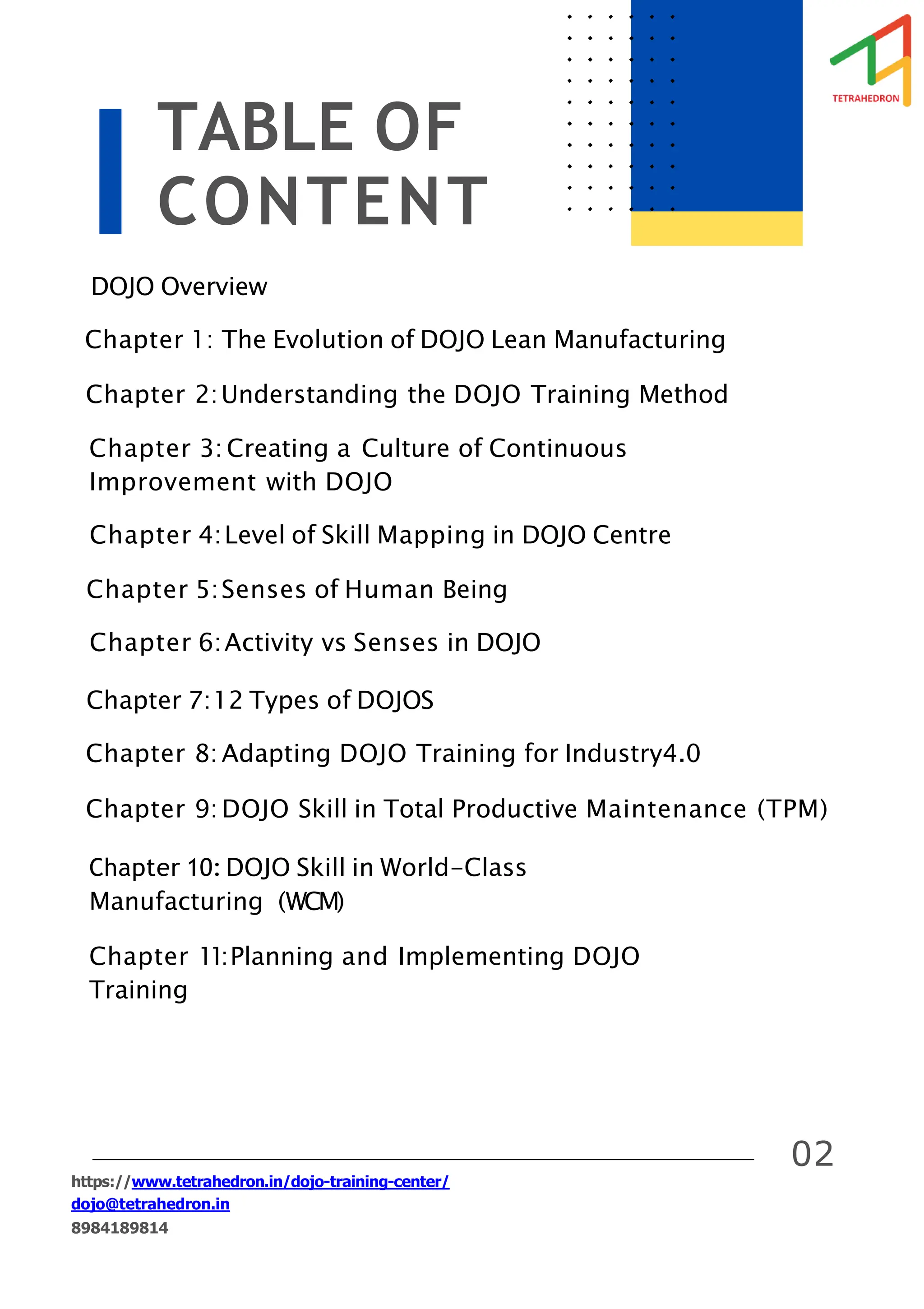
A Dojo center is known for manufacturing companies
where newly hired team members can get professional
training and acclimate to take on their responsibility
effectively to work on the manufacturing shop floors. To
complete a particular task in a dojo center, he or she is
trained again and again with the help of replica
models/stimulators and mock-ups until they become
perfect at their task. Actual Shopfloor environment with
all the simulator & actual training environment for newly
hired workers who give confidence to the new operators
and give time-to-time guidance to correct them. After
taking training from the Dojo Training Center, a worker
feels more comfortable and confident on the shop floor
and performs his work better.
DOJO
The term 'Dojo' originates from Japan
and refers to a room or hall where
JUDO is practiced, while in Hindi it is
known as Akhada. It combines the
words 'do' meaning 'the way' or 'the
pursuit' and 'jo' meaning 'a place',
thus representing a 'place of the
pursuit'.
Initially, Dojo represented a room in a
religious temple, but it later came to
symbolize training rooms for martial
arts.
https://www.tetrahedron.in/dojo-training-center/
dojo@tetrahedron.in
8984189814
Derived from the Japanese term for a
martial arts training hall, a DOJO in a
professional setting represents a space
dedicated to intentional and focused
learning. It is a flexible concept that
adapts to the unique requirements of
different industries rather than being
limited to one.
Overall, the training facility plays a vital
role in ensuring a smooth transition for
new employees into their roles. It
provides them with the necessary
knowledge, skills, and confidence to
perform their jobs effectively, ultimately
contributing to the success of the
organization.
04
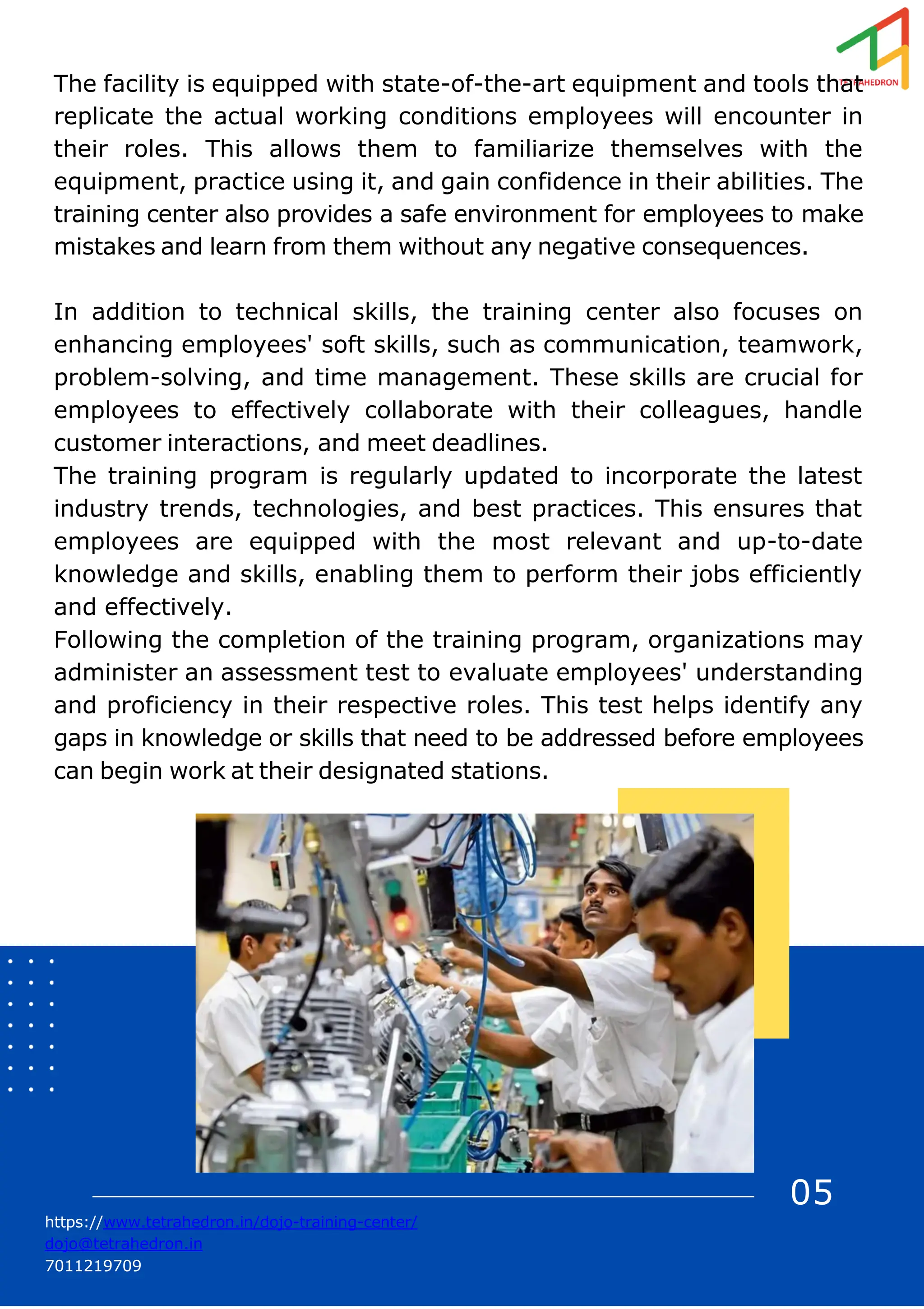
The facility is equipped with state-of-the-art equipment and tools that
replicate the actual working conditions employees will encounter in
their roles. This allows them to familiarize themselves with the
equipment, practice using it, and gain confidence in their abilities. The
training center also provides a safe environment for employees to make
mistakes and learn from them without any negative consequences.
In addition to technical skills, the training center also focuses on
enhancing employees' soft skills, such as communication, teamwork,
problem-solving, and time management. These skills are crucial for
employees to effectively collaborate with their colleagues, handle
customer interactions, and meet deadlines.
The training program is regularly updated to incorporate the latest
industry trends, technologies, and best practices. This ensures that
employees are equipped with the most relevant and up-to-date
knowledge and skills, enabling them to perform their jobs efficiently
and effectively.
Following the completion of the training program, organizations may
administer an assessment test to evaluate employees' understanding
and proficiency in their respective roles. This test helps identify any
gaps in knowledge or skills that need to be addressed before employees
can begin work at their designated stations.
05
https://www.tetrahedron.in/dojo-training-center/
dojo@tetrahedron.in
7011219709
06
https://www.tetrahedron.in/dojo-training-center/
dojo@tetrahedron.in
8984189814
CHAPTER 1:INTRODUCTION: THE EVOLUTION
OF DOJO LEA N M ANUFA C TURING
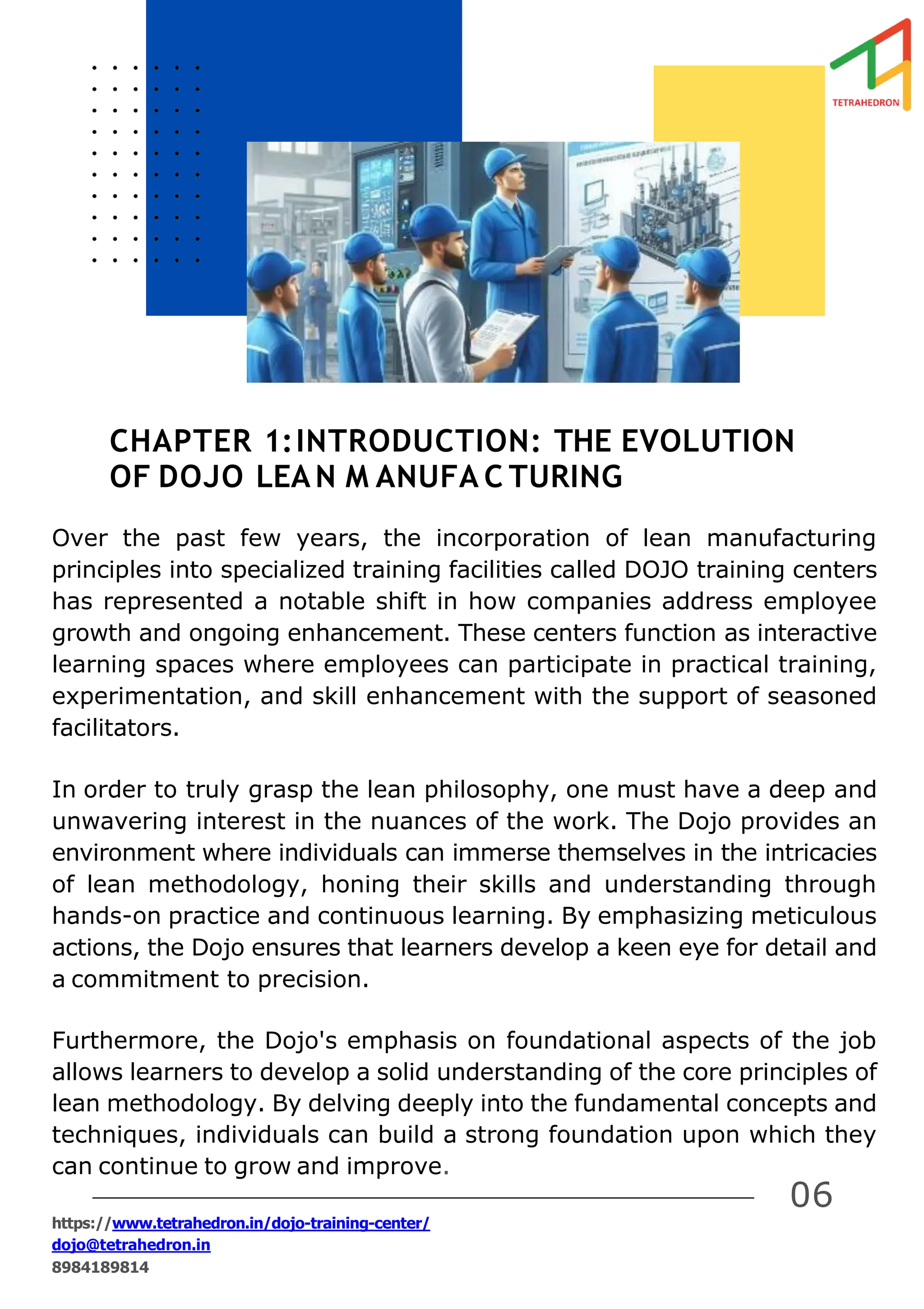
Over the past few years, the incorporation of lean manufacturing
principles into specialized training facilities called DOJO training centers
has represented a notable shift in how companies address employee
growth and ongoing enhancement. These centers function as interactive
learning spaces where employees can participate in practical training,
experimentation, and skill enhancement with the support of seasoned
facilitators.
In order to truly grasp the lean philosophy, one must have a deep and
unwavering interest in the nuances of the work. The Dojo provides an
environment where individuals can immerse themselves in the intricacies
of lean methodology, honing their skills and understanding through
hands-on practice and continuous learning. By emphasizing meticulous
actions, the Dojo ensures that learners develop a keen eye for detail and
a commitment to precision.
Furthermore, the Dojo's emphasis on foundational aspects of the job
allows learners to develop a solid understanding of the core principles of
lean methodology. By delving deeply into the fundamental concepts and
techniques, individuals can build a strong foundation upon which they
can continue to grow and improve.
07
https://www.tetrahedron.in/dojo-training-center/
dojo@tetrahedron.in
8984189814
Dojo provides a supportive and collaborative environment where
teachers can guide learners through the intricacies of lean
methodology, ensuring that they develop a comprehensive
understanding of the principles and their practical application.
In conclusion, the Dojo's commitment to precise actions and focus on
details aligns perfectly with the core principles of lean methodology. By
emphasizing continuous improvement through daily incremental
changes.
DOJO training center provides several key advantages for organizations
seeking to embrace lean manufacturing principles:
1. Participants at the DOJO training center can
experience and apply lean techniques in a secure setting.
gain practical
2.DOJO training sessions encourage collaboration and knowledge
sharing among employees from various departments and levels.
3.The DOJO training center promotes a culture of continuous
improvement, empowering employees to identify and resolve
inefficiencies and contribute to the organization's achievements.
4.Through standardized training programs and materials, the DOJO
training center guarantees consistent and effective education in lean
manufacturing across the organization.
08
https://www.tetrahedron.in/dojo-training-center/
dojo@tetrahedron.in
8984189814
CHAPTER 2: UNDERSTANDING THE DOJO TRAINING
METHOD
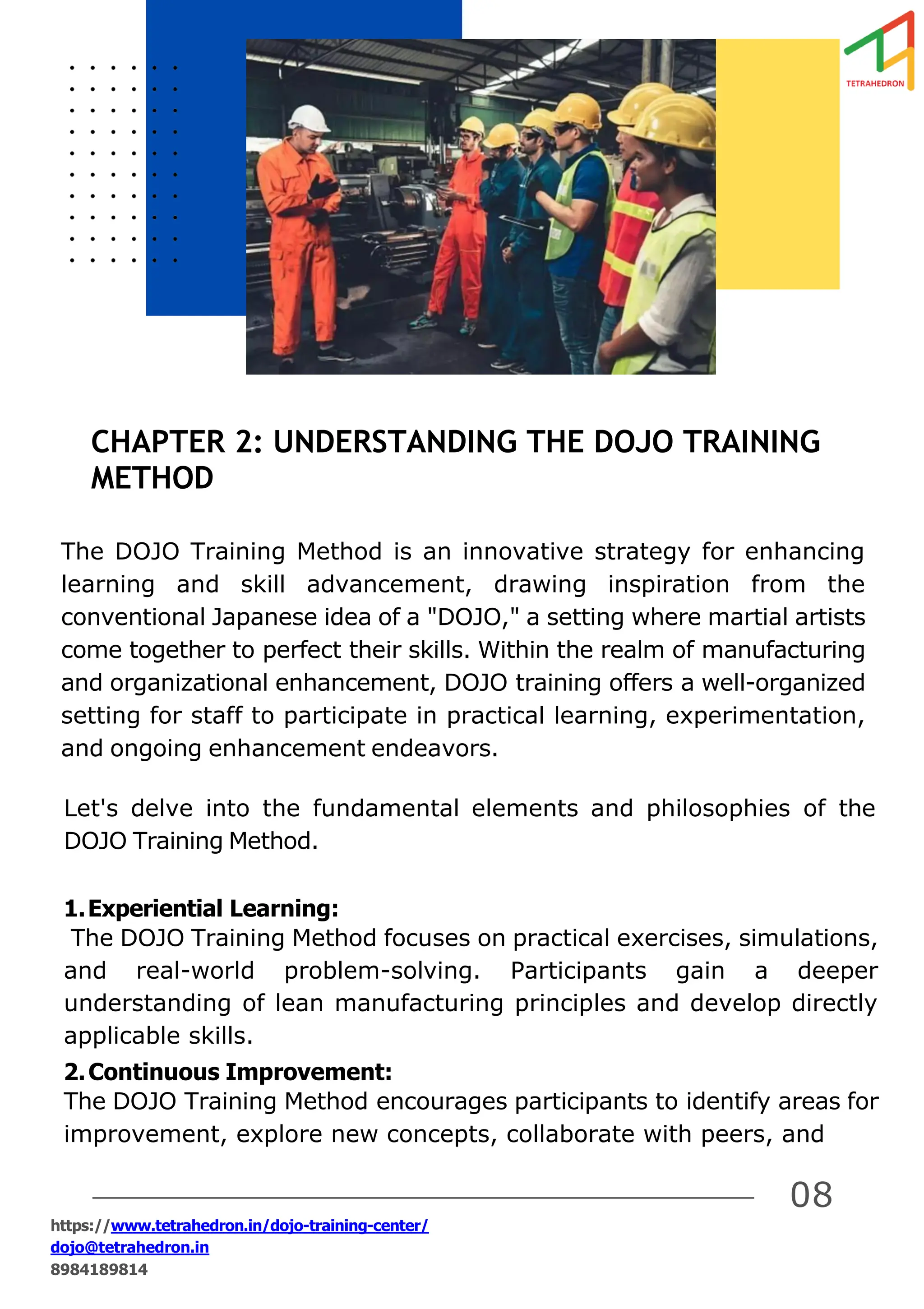
The DOJO Training Method is an innovative strategy for enhancing
learning and skill advancement, drawing inspiration from the
conventional Japanese idea of a "DOJO," a setting where martial artists
come together to perfect their skills. Within the realm of manufacturing
and organizational enhancement, DOJO training offers a well-organized
setting for staff to participate in practical learning, experimentation,
and ongoing enhancement endeavors.
Let's delve into the fundamental elements and philosophies of the
DOJO Training Method.
1.Experiential Learning:
The DOJO Training Method focuses on practical exercises, simulations,
and real-world problem-solving. Participants gain a deeper
understanding of lean manufacturing principles and develop directly
applicable skills.
2.Continuous Improvement:
The DOJO Training Method encourages participants to identify areas for
improvement, explore new concepts, collaborate with peers, and
09
https://www.tetrahedron.in/dojo-training-center/
dojo@tetrahedron.in
8984189814
achieve gradual but significant enhancements in productivity, quality,
and efficiency.
3. Cross-Functional Collaboration:
DOJO training encourages cross-departmental collaboration, knowledge
sharing, diverse perspectives, and barrier removal. Participants gain
insights into organizational challenges and identify enhancement
opportunities.
4. Feedback and Reflection:
DOJO training involves constructive feedback, self-assessment, and
learning from both successes and failures. Participants recognize
strengths, identify areas for improvement, and apply insights to future
endeavors.
5. Standardization and Reproducibility:
DOJO training encourages creativity and experimentation while
emphasizing the importance of standardization and reproducibility.
Consistent training materials, processes, and outcomes ensure
effectiveness across sessions.
6. Practical Application:
DOJO training bridges theory and practice, empowering participants to
apply lean principles and problem-solving methods to real-life
challenges.
7.Continuous Learning Culture:
DOJO training fosters continuous learning, skill acquisition, creativity,
collaboration, and individual responsibility for professional growth.
10
https://www.tetrahedron.in/dojo-training-center/
dojo@tetrahedron.in
8984189814
CHAPTER 3: CREATING A CULTURE OF
CONTINUOUSIMPROVEMENT WITH DOJO
Establishing a culture of continuous improvement is essential for
achieving organizational excellence, and DOJO training centers are
instrumental in this effort. These centers provide a dedicated space for
employees to engage in immersive learning, collaborative problem-
solving, and skill development. Learn how organizations can leverage
DOJO training centers to lay the groundwork for a culture of continuous
improvement.
1.Leadership Commitment:
Creating a culture of continuous improvement starts with committed
leadership. Leaders must champion its importance, allocate resources
for DOJO training, and actively participate in training sessions. By
leading by example, they set the standard for the entire organization and
inspire employees to embrace continuous improvement.
2. Clear Communication:
Effective communication is vital for creating a culture of continuous
improvement. Organizations must clearly convey DOJO training
objectives and expectations to employees. Transparency and open
channels encourage idea-sharing, feedback, and active participation.
Regular progress updates sustain momentum and engagement
11
https://www.tetrahedron.in/dojo-training-center/
dojo@tetrahedron.in
8984189814
3.Recognition and Rewards:
Recognizing and motivating employees for
continuous improvement boosts positive
their contributions to
work behaviors and
engagement. Businesses can praise employees who excel in DOJO
training sessions through verbal recognition, peer appreciation, and
tangible rewards like bonuses.
4.Integration with Daily Operations:
Integrate DOJO training principles into daily operations. Employees
should actively apply acquired knowledge and skills. DOJO centers
serve as hubs for ongoing learning and collaborative sessions
5. Measurement and Feedback:
Assessing DOJO training programs and setting KPIs to track their impact
on productivity, quality, and employee satisfaction is essential. Surveys,
focus groups, and performance evaluations allow employees to share
feedback and suggest improvements
dojo@tetrahedron.in
8984189814
CHAPTER 4: LEVEL OF SKILL MAPPING IN
DOJO CENTRE
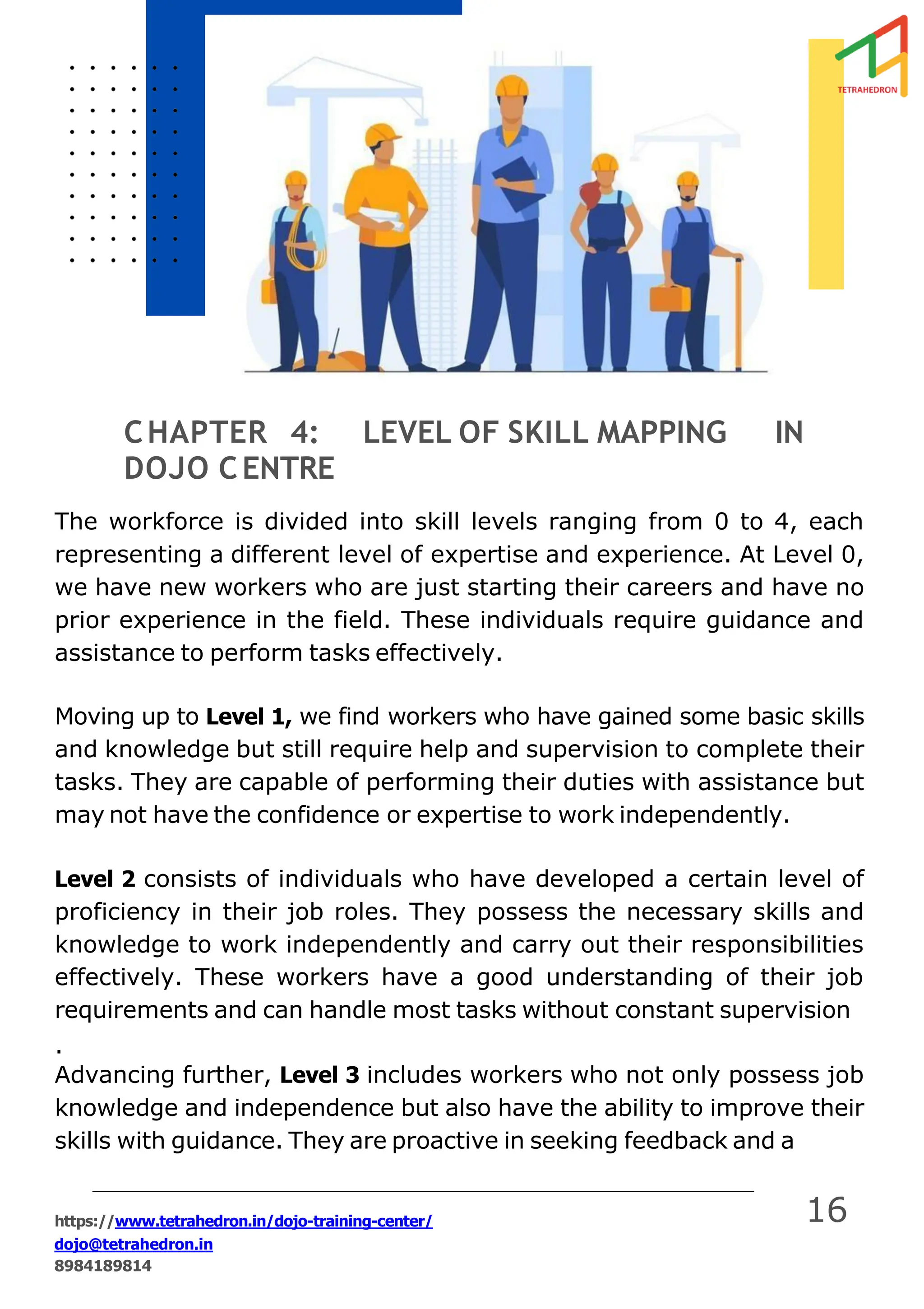
The workforce is divided into skill levels ranging from 0 to 4, each
representing a different level of expertise and experience. At Level 0,
we have new workers who are just starting their careers and have no
prior experience in the field. These individuals require guidance and
assistance to perform tasks effectively.
Moving up to Level 1, we find workers who have gained some basic skills
and knowledge but still require help and supervision to complete their
tasks. They are capable of performing their duties with assistance but
may not have the confidence or expertise to work independently.
Level 2 consists of individuals who have developed a certain level of
proficiency in their job roles. They possess the necessary skills and
knowledge to work independently and carry out their responsibilities
effectively. These workers have a good understanding of their job
requirements and can handle most tasks without constant supervision
.
Advancing further, Level 3 includes workers who not only possess job
knowledge and independence but also have the ability to improve their
skills with guidance. They are proactive in seeking feedback and a
https://www.tetrahedron.in/dojo-training-center/ 16
https://www.tetrahedron.in/dojo-training-center/
dojo@tetrahedron.in
8984189814
Finally, at Level 4, we have workers who have reached the pinnacle
of their field. These individuals have extensive knowledge and
experience, allowing them to not only excel in their own roles but also
train and mentor others. They are recognized as experts in their field
and are often sought after for their insights and guidance.
By dividing the workforce into these skill levels, organizations can better
understand the capabilities and potential of their employees. This
division allows for targeted training and development programs to help
individuals progress from one level to the next, ensuring a skilled and
competent workforce.
17
CHAPTER 5: SENSES OF HUM AN BEING
5 SENSES
Meaning
In the context of workplace training,a dojo
serves as a dedicated learning center where
workers can hone their skills and knowledge.
Just like learning to ride a bike or drive a car,
mastering tasks in the workplace requires
practice, guidance, and repetition. The dojo
provides a structured environment for
employees to receive trainingtailored to their
specific roles and responsibilities
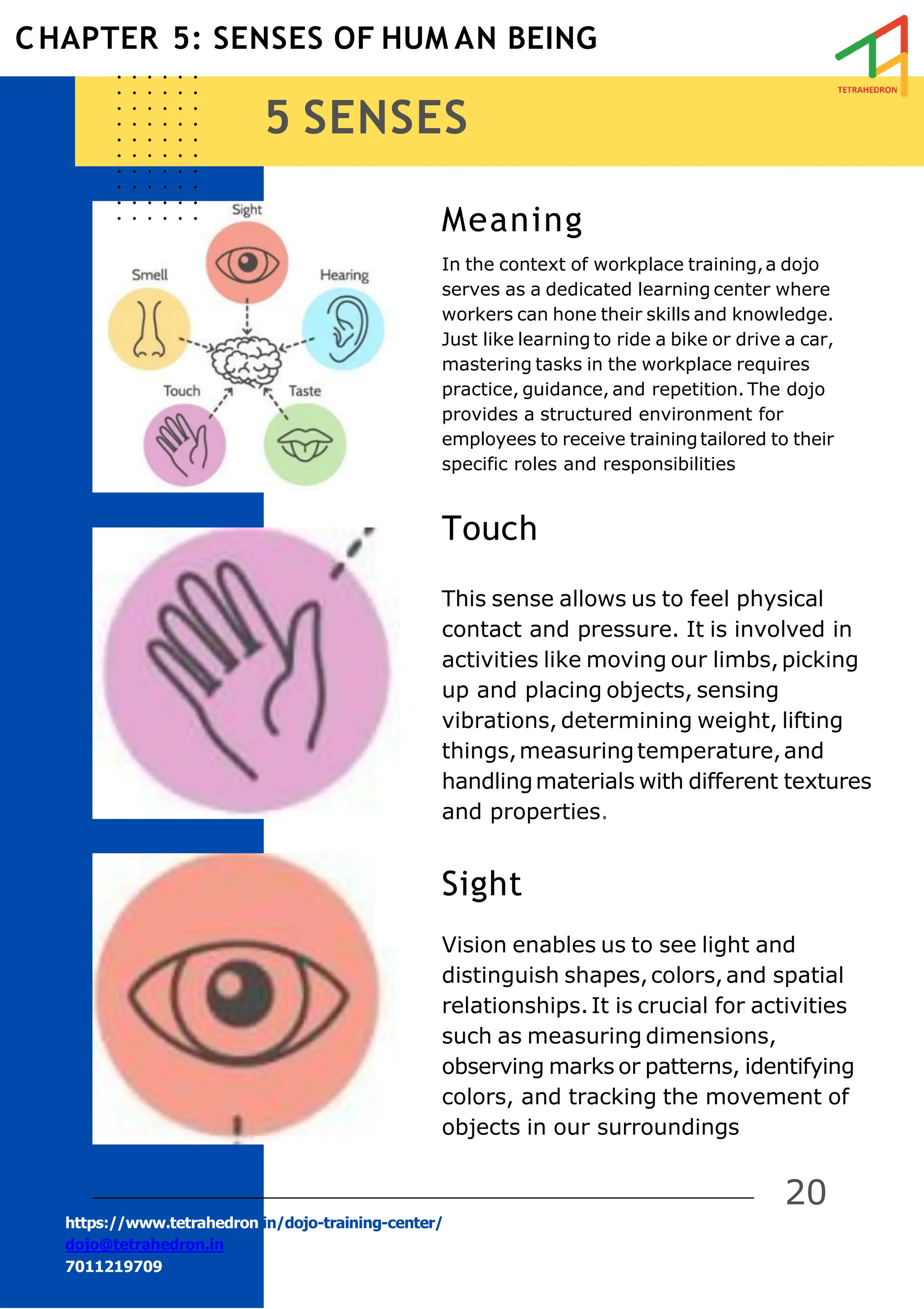
Touch
This sense allows us to feel physical
contact and pressure. It is involved in
activities like moving our limbs,picking
up and placing objects, sensing
vibrations, determining weight, lifting
things,measuringtemperature,and
handlingmaterials with different textures
and properties.
Sight
Vision enables us to see light and
distinguish shapes,colors,and spatial
relationships.It is crucial for activities
such as measuring dimensions,
observing marks or patterns, identifying
colors, and tracking the movement of
objects in our surroundings
20
https://www.tetrahedron in/dojo-training-center/
dojo@tetrahedron.in
7011219709
5 SENSES
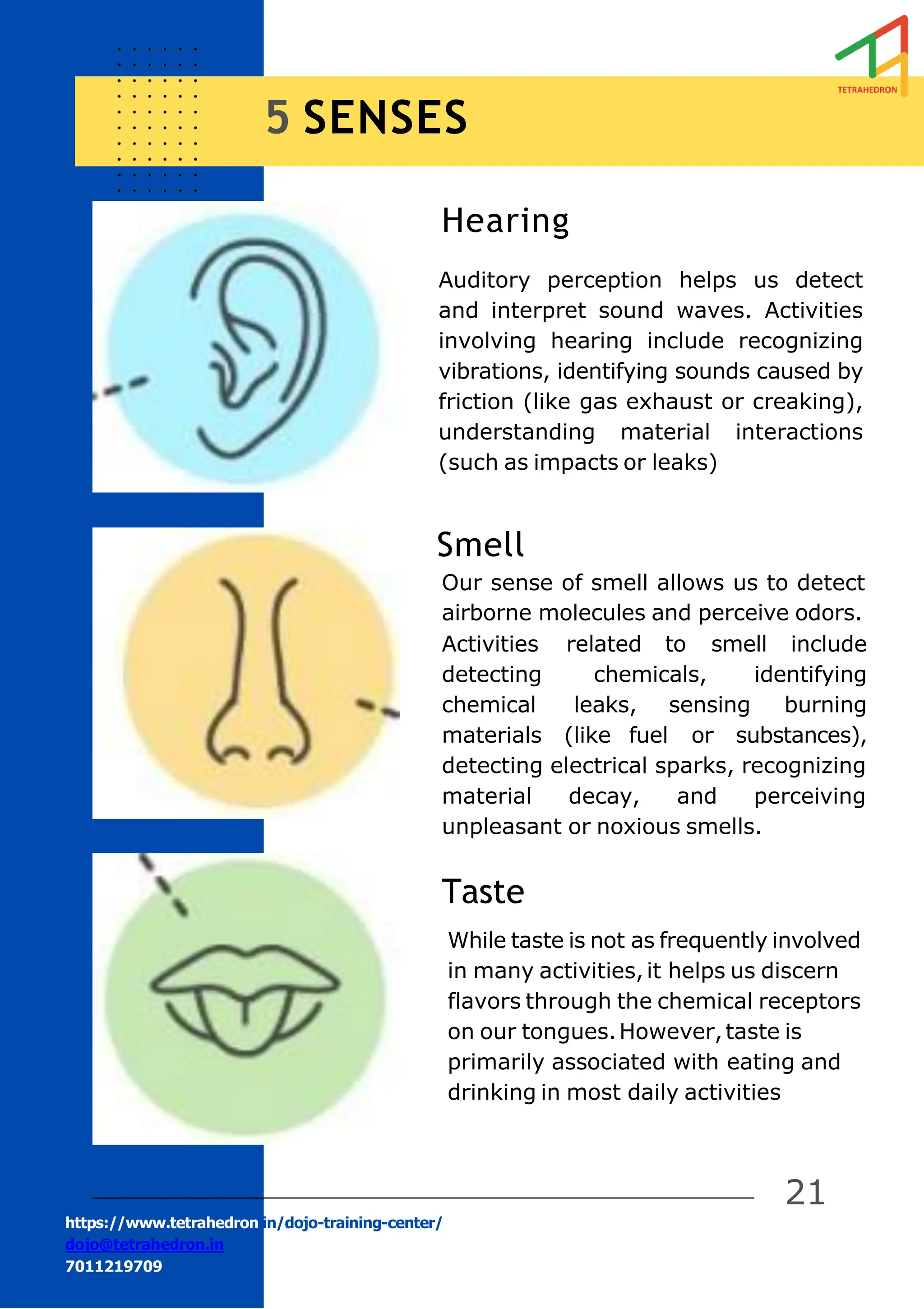
Hearing
Auditory perception helps us detect
and interpret sound waves. Activities
involving hearing include recognizing
vibrations, identifying sounds caused by
friction (like gas exhaust or creaking),
understanding material interactions
(such as impacts or leaks)
Smell
Our sense of smell allows us to detect
airborne molecules and perceive odors.
Activities
detecting
chemical
materials
related to smell include
chemicals, identifying
leaks, sensing burning
(like fuel or substances),
detecting electrical sparks, recognizing
material decay, and perceiving
unpleasant or noxious smells.
Taste
While taste is not as frequently involved
in many activities,it helps us discern
flavors through the chemical receptors
on our tongues.However,taste is
primarily associated with eating and
drinking in most daily activities
21
https://www.tetrahedron in/dojo-training-center/
dojo@tetrahedron.in
7011219709
CHAPTER 6: AC TIVITY VS SENSES IN DOJO
Below is an example illustrating what a dojo is and how it helps
individuals in their learning process:
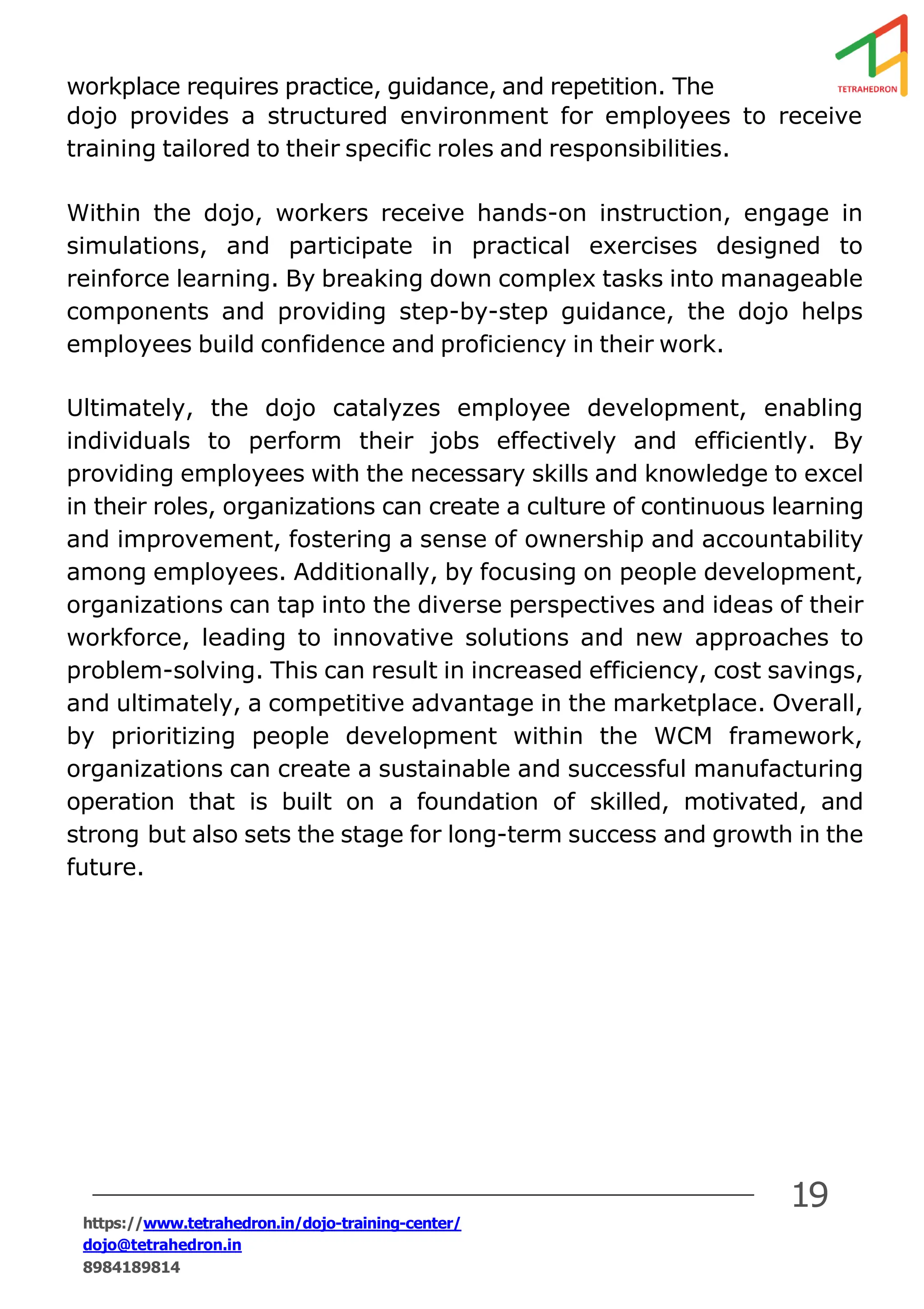
Imagine you're learning how to ride a bicycle for the first time. At the
beginning, it feels daunting and unfamiliar. You're constantly focusing on
balancing, pedaling, and steering, all while feeling a bit scared of falling
over. However, with practice and perseverance, you start to adapt. Your
senses become attuned to the movements and sensations of riding.
Eventually, you find yourself pedaling effortlessly, confidently
navigating turns, and even riding with one hand.
Similarly, consider the experience of learning to drive a car. Initially,
there's a lot to remember – from operating the gears and brakes to
coordinating the steering wheel. But as you gain experience, these
actions become second nature. You no longer need to consciously think
about every step; instead, your muscle memory and instincts take over.
In the context of workplace training, a dojo serves as a dedicated
learning center where workers can hone their skills and knowledge. Just
like learning to ride a bike or drive a car, mastering tasks in the
18
https://www.tetrahedron.in/dojo-training-center/
dojo@tetrahedron.in
8984189814
19
https://www.tetrahedron.in/dojo-training-center/
dojo@tetrahedron.in
8984189814
workplace requires practice, guidance, and repetition. The
dojo provides a structured environment for employees to receive
training tailored to their specific roles and responsibilities.
Within the dojo, workers receive hands-on instruction, engage in
simulations, and participate in practical exercises designed to
reinforce learning. By breaking down complex tasks into manageable
components and providing step-by-step guidance, the dojo helps
employees build confidence and proficiency in their work.
Ultimately, the dojo catalyzes employee development, enabling
individuals to perform their jobs effectively and efficiently. By
providing employees with the necessary skills and knowledge to excel
in their roles, organizations can create a culture of continuous learning
and improvement, fostering a sense of ownership and accountability
among employees. Additionally, by focusing on people development,
organizations can tap into the diverse perspectives and ideas of their
workforce, leading to innovative solutions and new approaches to
problem-solving. This can result in increased efficiency, cost savings,
and ultimately, a competitive advantage in the marketplace. Overall,
by prioritizing people development within the WCM framework,
organizations can create a sustainable and successful manufacturing
operation that is built on a foundation of skilled, motivated, and
strong but also sets the stage for long-term success and growth in the
future.
22
https://www.tetrahedron.in/dojo-training-center/
dojo@tetrahedron.in
8984189814
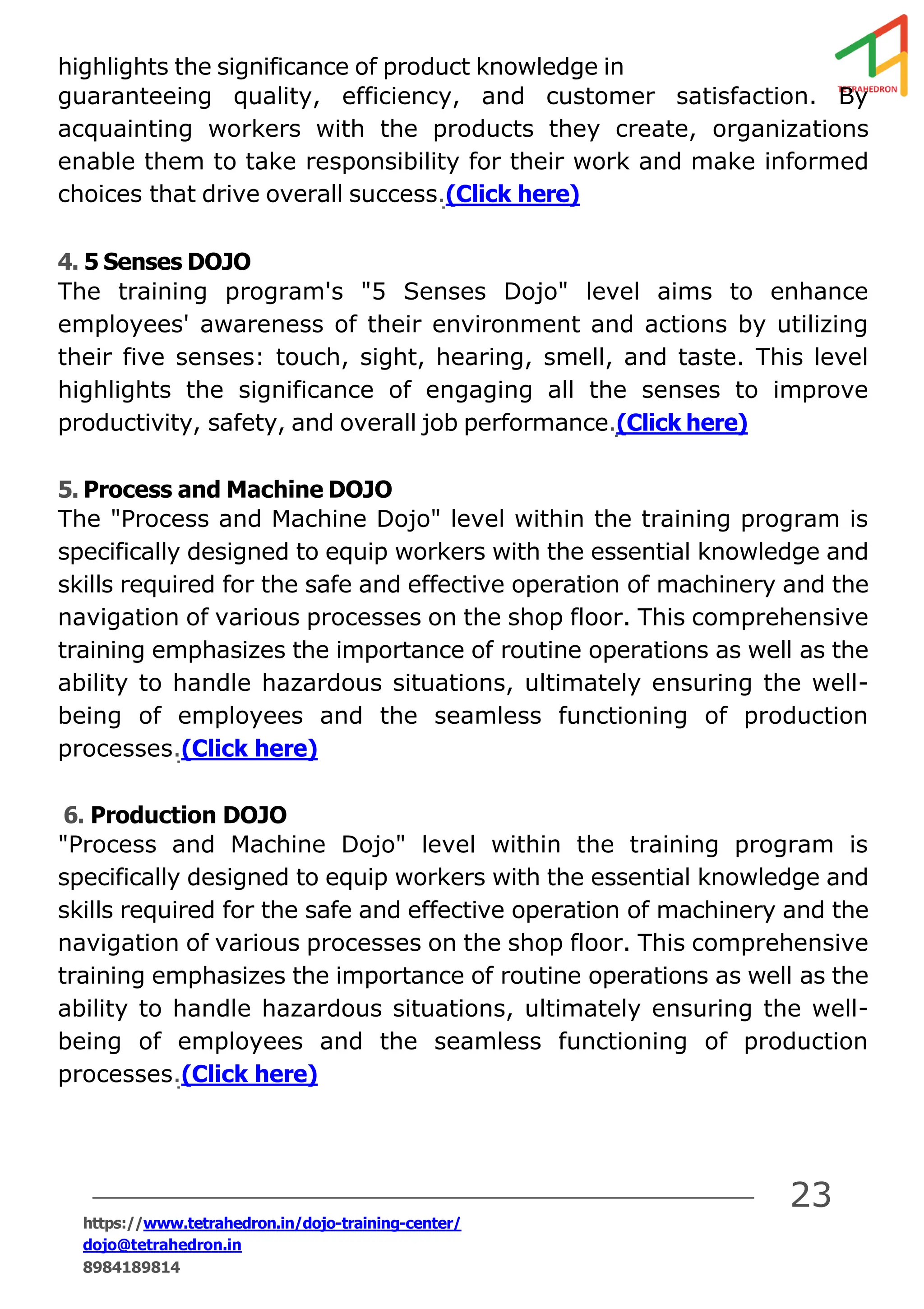
CHAPTER 7: 12 TYPES OF DOJO
1. Know my company
One of the key aspects emphasized during this stage is instilling a sense
of pride in the employees toward their organization. By providing them
with a comprehensive understanding of the company's history, values,
mission, and achievements, employees are encouraged to develop a
deep appreciation for the organization they are a part of. This pride
serves as a motivational factor, driving employees to perform their best
and contribute to the overall success of the company. To know more
about the List of Equipment. (Click here)
2. Safety DOJO
The training program's "Safety Dojo" level underscores the critical
significance of safety across all production areas. It fosters a safety-
first culture and provides employees with the expertise, abilities, and
attitude needed to recognize and manage risks efficiently. Various
training sessions within the Safety Dojo target distinct safety issues to
guarantee thorough adherence to safety protocols. To know more
about the List of Equipment’s. (Click here)
3. Product DOJO
The training program's "Product Dojo" level aims to improve employees'
comprehension of the products they manufacture or handle. This level
23
https://www.tetrahedron.in/dojo-training-center/
dojo@tetrahedron.in
8984189814
highlights the significance of product knowledge in
guaranteeing quality, efficiency, and customer satisfaction. By
acquainting workers with the products they create, organizations
enable them to take responsibility for their work and make informed
choices that drive overall success.(Click here)
4. 5 Senses DOJO
The training program's "5 Senses Dojo" level aims to enhance
employees' awareness of their environment and actions by utilizing
their five senses: touch, sight, hearing, smell, and taste. This level
highlights the significance of engaging all the senses to improve
productivity, safety, and overall job performance.(Click here)
5. Process and Machine DOJO
The "Process and Machine Dojo" level within the training program is
specifically designed to equip workers with the essential knowledge and
skills required for the safe and effective operation of machinery and the
navigation of various processes on the shop floor. This comprehensive
training emphasizes the importance of routine operations as well as the
ability to handle hazardous situations, ultimately ensuring the well-
being of employees and the seamless functioning of production
processes.(Click here)
6. Production DOJO
"Process and Machine Dojo" level within the training program is
specifically designed to equip workers with the essential knowledge and
skills required for the safe and effective operation of machinery and the
navigation of various processes on the shop floor. This comprehensive
training emphasizes the importance of routine operations as well as the
ability to handle hazardous situations, ultimately ensuring the well-
being of employees and the seamless functioning of production
processes.(Click here)
24
https://www.tetrahedron.in/dojo-training-center/
dojo@tetrahedron.in
8984189814
7.Quality DOJO
The training program's "Quality Dojo" level aims to cultivate a culture of
excellence in quality among employees. Through this training, workers
are equipped with the necessary knowledge, skills, and mindset to
produce high-quality products while minimizing waste and maximizing
productivity.(Click here)
8. Maintenance DOJO
The "Maintenance Dojo" training module aims to provide workers with
the necessary knowledge and skills for Maintaining manufactured
products effectively. It includes preventive maintenance,
troubleshooting techniques, and routine inspections to uphold product
quality.(Click here)
9. Ergonomic DOJO
The "Ergonomic Dojo" level in a training program aims to improve
employees' understanding of body posture and ergonomics, leading to
increased productivity and a decrease in workplace injuries. This
training provides employees with the necessary knowledge and skills to
maintain correct posture, optimize body mechanics, and minimize
physical strain during work tasks.(Click here)
10. Innovation DOJO
The "Innovation Dojo" level within the training program is specifically
crafted to nurture a culture of creativity, problem-solving, and
continuous improvement within the workforce. Through this training,
employees are empowered to leverage their cognitive abilities to foster
innovation and elevate the company's competitive edge.(Click here)
11.On Job Training
In the dynamic realm of manufacturing, where hands-on expertise
reigns supreme, on-the-job training within the confines of a "dojo"
offers a transformative learning experience. Unlike traditional
25
https://www.tetrahedron.in/dojo-training-center/
dojo@tetrahedron.in
8984189814
classroom settings, these dojos immerse participants directly into the
heart of operations, providing a holistic education that blends theory
with practical application. On job training within a manufacturing dojo is
more than just a learning experience; it's a journey of discovery, growth,
and empowerment. Through hands-on immersion, guided mentorship,
and relentless pursuit of excellence, participants emerge not only as
skilled professionals but as torchbearers of innovation, poised to shape
the future of manufacturing.(Click here)
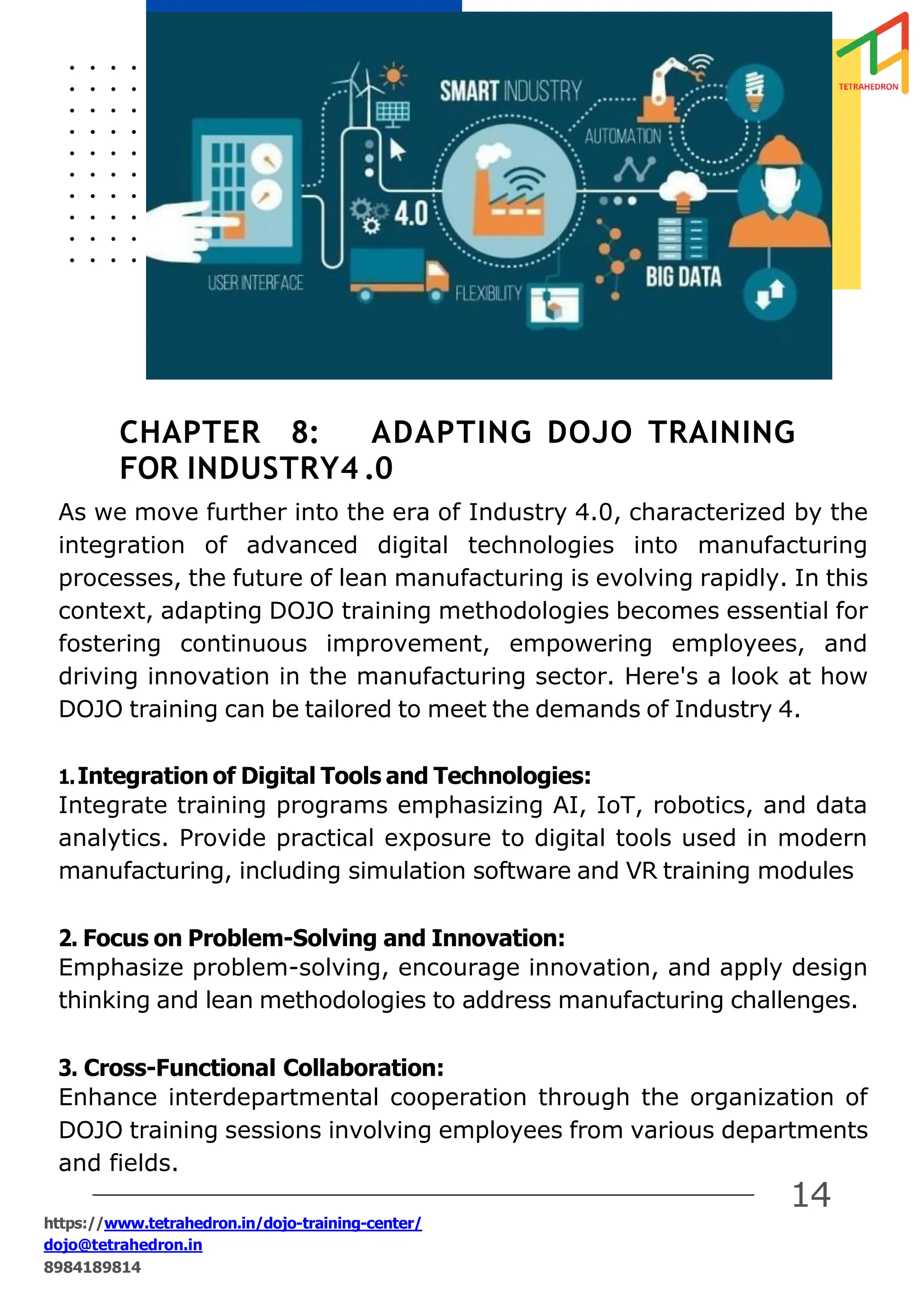
12.Certification
Upon completion of the rigorous training program within our esteemed
dojo, participants are awarded a Certificate of Achievement. This
certificate serves as a tangible recognition of their dedication, hard
work, and mastery of essential skills in their respective fields. It signifies
not only the culmination of their training journey but also their
readiness to apply their newfound knowledge and expertise in real-
world manufacturing settings. With this certificate, participants join a
prestigious community of skilled professionals, poised to make
meaningful contributions to the industry and drive innovation forward.
(Click here)
14
https://www.tetrahedron.in/dojo-training-center/
dojo@tetrahedron.in
8984189814
CHAPTER 8: ADAPTING DOJO TRAINING
FOR INDUSTRY4 .0
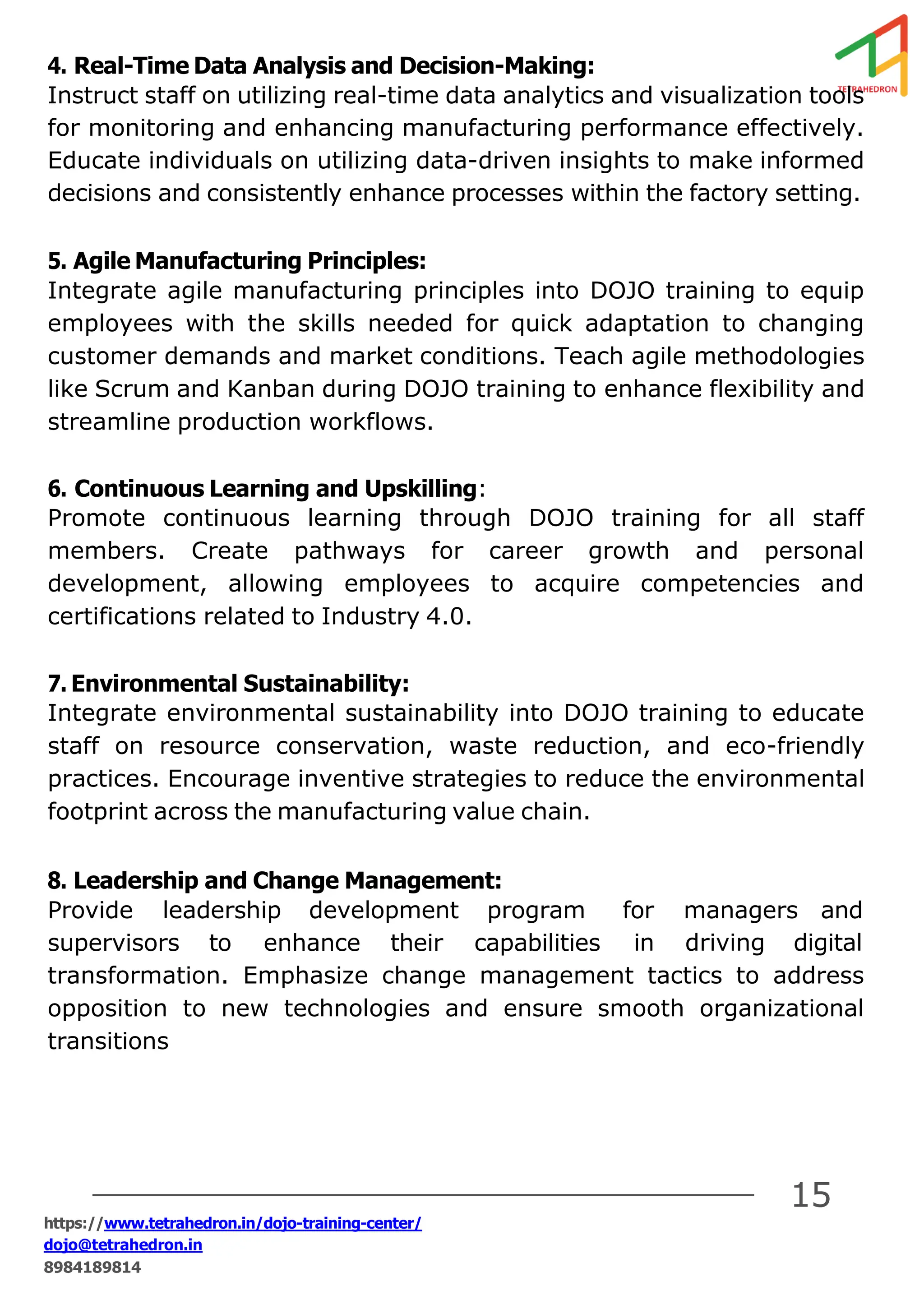
As we move further into the era of Industry 4.0, characterized by the
integration of advanced digital technologies into manufacturing
processes, the future of lean manufacturing is evolving rapidly. In this
context, adapting DOJO training methodologies becomes essential for
fostering continuous improvement, empowering employees, and
driving innovation in the manufacturing sector. Here's a look at how
DOJO training can be tailored to meet the demands of Industry 4.
1.Integration of Digital Tools and Technologies:
Integrate training programs emphasizing AI, IoT, robotics, and data
analytics. Provide practical exposure to digital tools used in modern
manufacturing, including simulation software and VR training modules
2. Focus on Problem-Solving and Innovation:
Emphasize problem-solving, encourage innovation, and apply design
thinking and lean methodologies to address manufacturing challenges.
3. Cross-Functional Collaboration:
Enhance interdepartmental cooperation through the organization of
DOJO training sessions involving employees from various departments
and fields.
15
https://www.tetrahedron.in/dojo-training-center/
dojo@tetrahedron.in
8984189814
4. Real-Time Data Analysis and Decision-Making:
Instruct staff on utilizing real-time data analytics and visualization tools
for monitoring and enhancing manufacturing performance effectively.
Educate individuals on utilizing data-driven insights to make informed
decisions and consistently enhance processes within the factory setting.
5. Agile Manufacturing Principles:
Integrate agile manufacturing principles into DOJO training to equip
employees with the skills needed for quick adaptation to changing
customer demands and market conditions. Teach agile methodologies
like Scrum and Kanban during DOJO training to enhance flexibility and
streamline production workflows.
6. Continuous Learning and Upskilling:
Promote continuous learning through DOJO training for all staff
members. Create pathways for career growth and personal
development, allowing employees to acquire competencies and
certifications related to Industry 4.0.
7. Environmental Sustainability:
Integrate environmental sustainability into DOJO training to educate
staff on resource conservation, waste reduction, and eco-friendly
practices. Encourage inventive strategies to reduce the environmental
footprint across the manufacturing value chain.
8. Leadership and Change Management:
Provide leadership development program
supervisors to enhance their capabilities
for managers and
in driving digital
transformation. Emphasize change management tactics to address
opposition to new technologies and ensure smooth organizational
transitions
26
https://www.tetrahedron.in/dojo-training-center/
dojo@tetrahedron.in
8984189814
CHAPTER 9: DOJO SKILL IN TOTAL
PRODUC TIVE MAINTENANCE E (TPM )
By incorporating TPM into their operations, companies can create a
culture of continuous improvement and employee engagement. The
Education & Training component of TPM focuses on developing the
skills and knowledge of employees to effectively maintain and operate
equipment, leading to reduced downtime and increased overall
equipment effectiveness.
The "Dojo Skill" approach involves providing hands-on training and
practical experience to employees in a dedicated learning environment.
This approach allows employees to learn and practice new skills in a
controlled setting, ensuring that they are fully prepared to apply their
knowledge on the production floor.
Empowering employees through education and training not only
improves their technical abilities but also fosters a sense of ownership
and responsibility for the equipment they work with. This leads to
increased equipment dependability, reduced breakdowns, and
27
https://www.tetrahedron.in/dojo-training-center/
dojo@tetrahedron.in
8984189814
ultimately, higher productivity levels.
Overall, the integration of TPM with a strong focus on Education &
Training can transform a company's operations by creating a more
efficient, reliable, and productive work environment. It
invests in the long-term success and sustainability
organization.
is one
of the
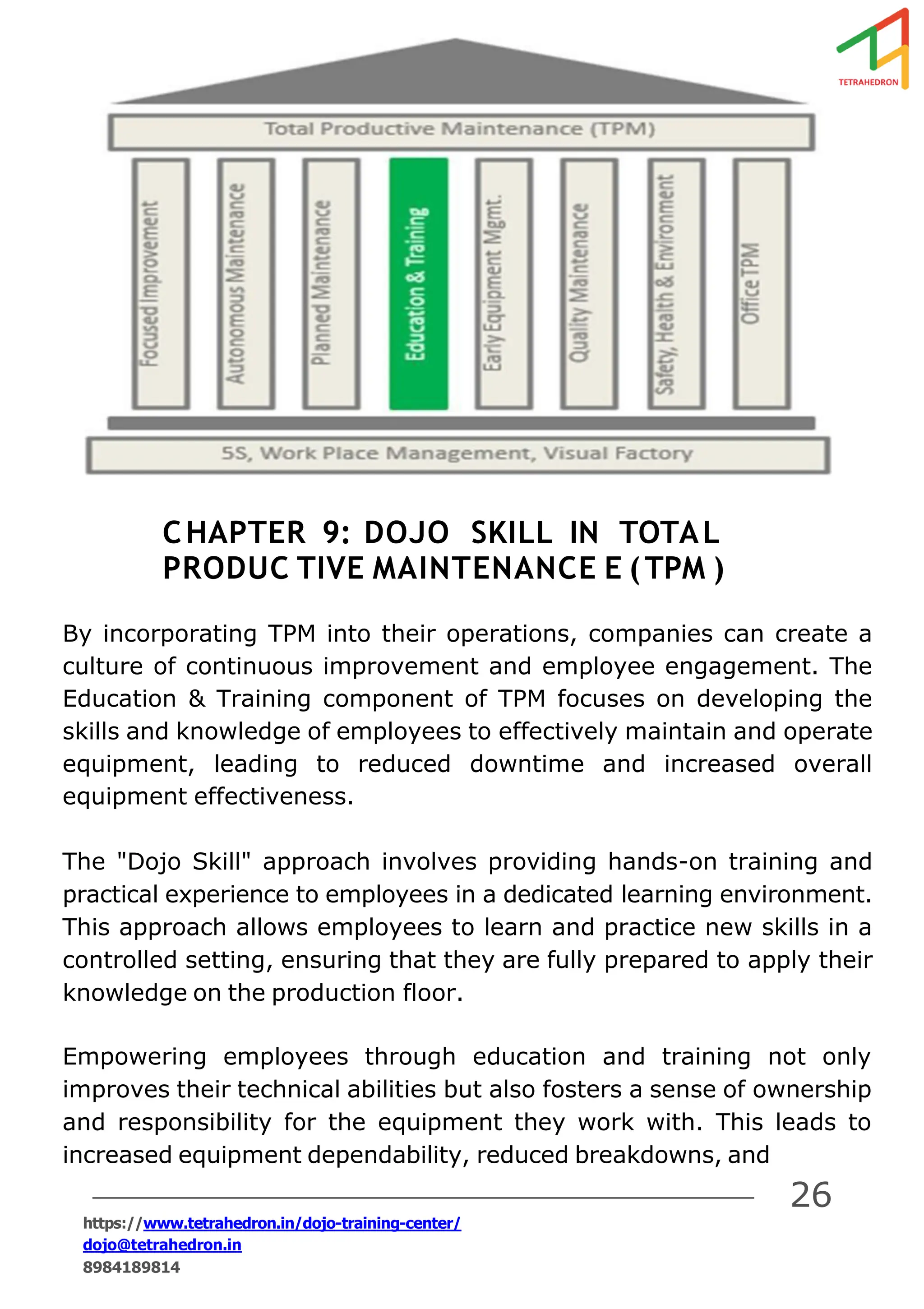
1.Focused improvement
2.Autonomous Maintenance
3. Planned Maintenance
4. Education & Training
5. Early Equipment management
6. Quality Maintenance
7.Safety, health & environment
8. Office TPM
In summary, Education & Training serves as a foundational pillar of
Total Productive Maintenance (TPM), empowering workers with the
knowledge, skills, and capabilities needed to drive continuous
improvement, enhance equipment reliability, and optimize
productivity throughout the organization. By investing in education
and training initiatives that focus on TPM principles and practices,
companies can cultivate a culture of excellence, innovation, and
continuous improvement that drives sustainable growth and success.
28
https://www.tetrahedron.in/dojo-training-center/
dojo@tetrahedron.in
8984189814
CHAPTER10: DOJO SKILLIN WORLD CLASS
MANUFACTURING ( WCM)
Within the framework of World Class Manufacturing (WCM), the
expertise of "DOJO" is essential for enhancing employee engagement,
communication, measurement, standardization, and documentation,
with a specific emphasis on People Development.
DOJO, which refers to a training facility or a place of learning in
Japanese, plays a crucial role in implementing and sustaining the
principles of WCM. In the context of WCM, DOJO serves as a dedicated
space where employees can receive comprehensive training and
development opportunities to enhance their skills and knowledge.
One of the key aspects of DOJO within the WCM framework is employee
engagement. By providing a dedicated space for training and
development, DOJO encourages employees to actively participate in
learning activities, fostering a sense of ownership and commitment
towards their personal growth and the organization's success. This
engagement is crucial for creating a culture of continuous improvement
29
https://www.tetrahedron.in/dojo-training-center/
dojo@tetrahedron.in
8984189814
and innovation within the company.
Furthermore, DOJO facilitates effective communication within the
organization. It serves as a platform for employees to exchange ideas,
share best practices, and collaborate on problem-solving initiatives.
Through interactive training sessions and workshops, employees can
develop their communication skills, enabling them to effectively convey
their thoughts and ideas to their colleagues and superiors.
Measurement is another critical aspect of DOJO within the WCM
framework. By providing a structured training environment, DOJO
allows organizations to measure the progress and effectiveness of their
training programs. This measurement helps identify areas of
improvement and enables organizations to make data-driven decisions
to enhance their training initiatives.
Standardization and documentation are also emphasized within DOJO.
By establishing standardized training processes and procedures, DOJO
ensures consistency in the delivery of training programs. This
standardization helps organizations maintain quality and efficiency in
their training efforts. Additionally, DOJO encourages the
documentation of training materials and best practices, creating a
knowledge repository that can be accessed by employees at any time.
Lastly, DOJO places a specific emphasis on People Development within
the WCM framework. It recognizes that investing in the development of
employees is crucial for their growth and the overall success of the
organization. Through a variety of training programs, workshops, and
mentoring opportunities, DOJO helps employees enhance their skills,
knowledge, and capabilities, enabling them to contribute effectively to
the organization's goals.
In conclusion, within the framework of World Class Manufacturing
(WCM), the expertise of DOJO is essential for enhancing employee
30
https://www.tetrahedron.in/dojo-training-center/
dojo@tetrahedron.in
8984189814
engagement, communication, measurement, standardization, and
documentation, with a specific emphasis on People Development. By
providing a dedicated space for training and development, DOJO
enables organizations to create a culture of continuous improvement,
and foster effective.
Here's how People Development integrates with WCM and supports
the overarching objectives:
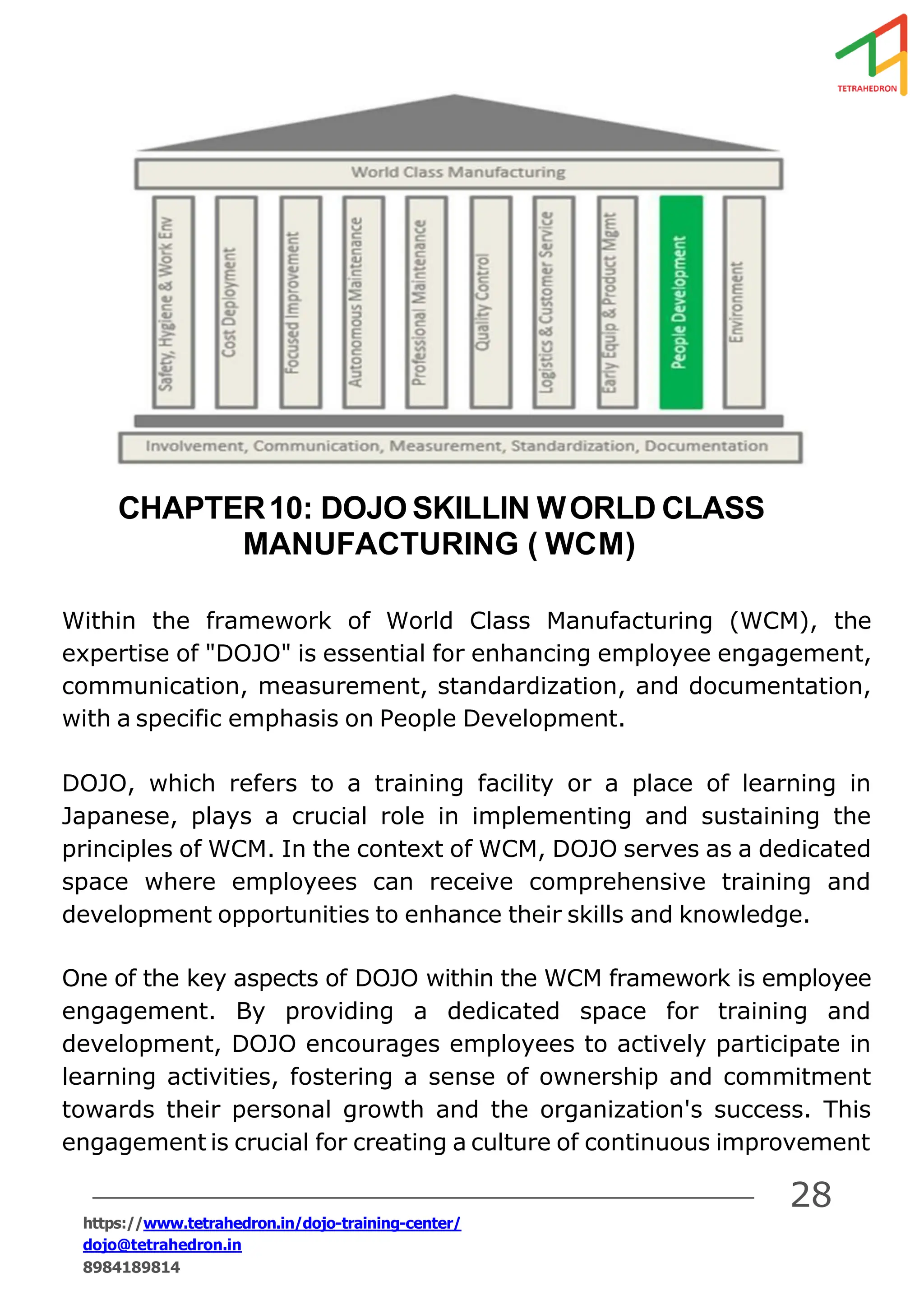
1.Safety, hygiene &work Env
2.Cost Deployment
3.Focused improvement
4.Autonomous Maintenance
5.Professional Maintenance
Fostering employee pride through understanding the company’s
history, values, mission, and achievements motivates high
performance and contributes to overall success.
Additionally, by focusing on people development, organizations can
tap into the diverse perspectives and ideas of their workforce, leading
to innovative solutions and new approaches to problem-solving. This
can result in increased efficiency, cost savings, and ultimately, a
competitive advantage in the marketplace.
Overall, by prioritizing people development within the WCM
framework, organizations can create a sustainable and successful
manufacturing operation that is built on a foundation of skilled.
12
https://www.tetrahedron.in/dojo-training-center/
dojo@tetrahedron.in
8984189814
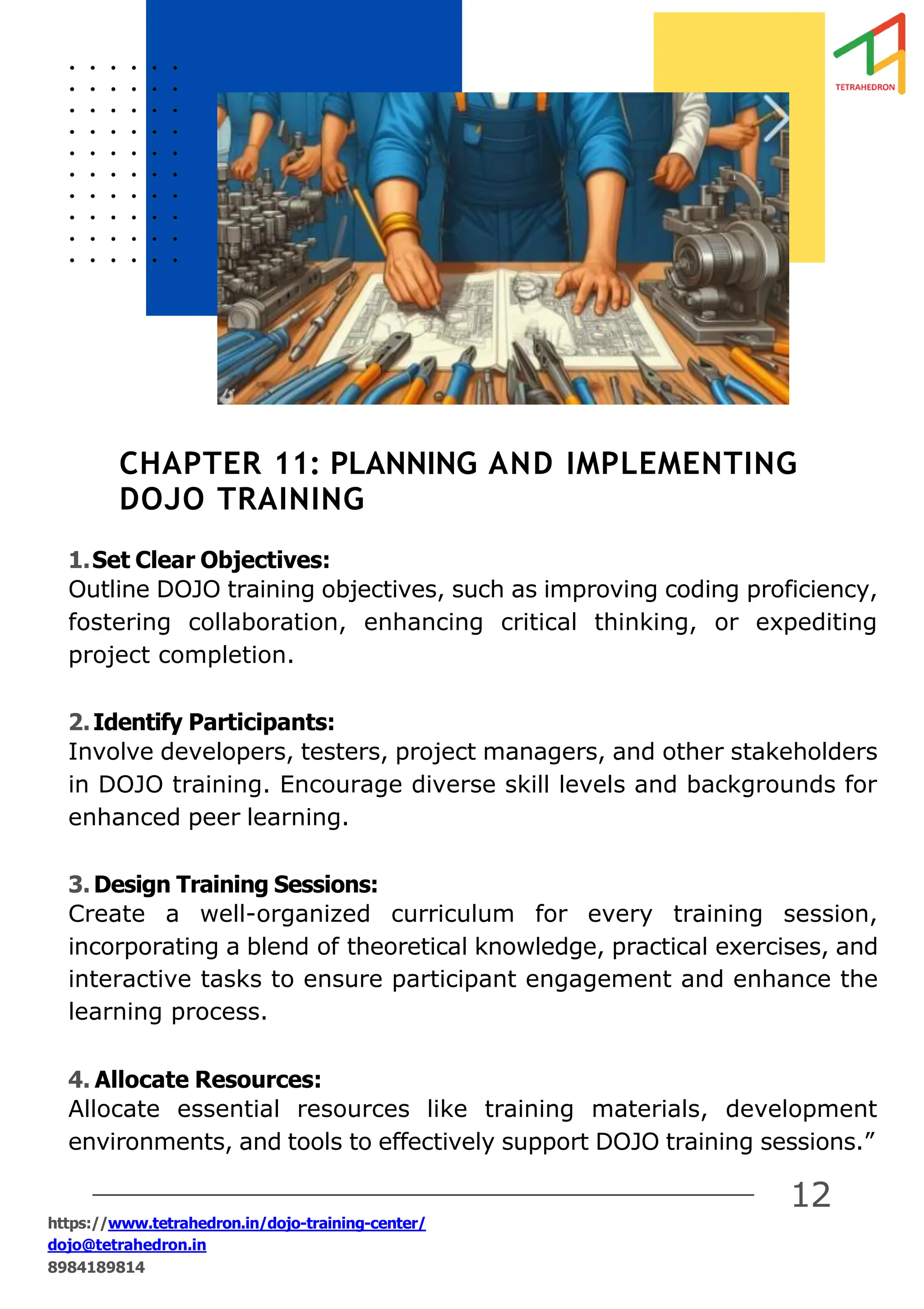
CHAPTER 11: PLANNING AND IMPLEMENTING
DOJO TRAINING
1.Set Clear Objectives:
Outline DOJO training objectives, such as improving coding proficiency,
fostering collaboration, enhancing critical thinking, or expediting
project completion.
2.Identify Participants:
Involve developers, testers, project managers, and other stakeholders
in DOJO training. Encourage diverse skill levels and backgrounds for
enhanced peer learning.
3. Design Training Sessions:
Create a well-organized curriculum for every training session,
incorporating a blend of theoretical knowledge, practical exercises, and
interactive tasks to ensure participant engagement and enhance the
learning process.
4. Allocate Resources:
Allocate essential resources like training materials, development
environments, and tools to effectively support DOJO training sessions.”
13
https://www.tetrahedron.in/dojo-training-center/
dojo@tetrahedron.in
8984189814
remember to foster a culture of continuous improvement by
integrating DOJO principles into daily operations.
5. Schedule Sessions:
Plan DOJO training sessions strategically, considering participant
availability and avoiding critical project phases for maximum
engagement.” Remember to foster a culture of continuous improvement
by integrating DOJO principles into daily operations.
6. Monitor Progress:
Consistently monitor the progress of participants and the impact of the
training sessions. Obtain feedback from both participants and
facilitators to identify opportunities for improvement and implement
necessary changes.
7.Measure Results:
Examine the impact of DOJO training on participants' skills, productivity,
and overall team performance. Success can be measured through
metrics such as code quality improvements, time-to-market reductions,
and employee satisfaction levels.
8. Continuous Improvement:
Enhance the training program by incorporating feedback and insights
gained from past sessions. Regularly revise the syllabus, introduce fresh
subjects, and improve teaching methods to maintain its efficacy over
time.
8984189814
https://www.tetrahedron.in/dojo-training-center/
dojo@tetrahedron.in
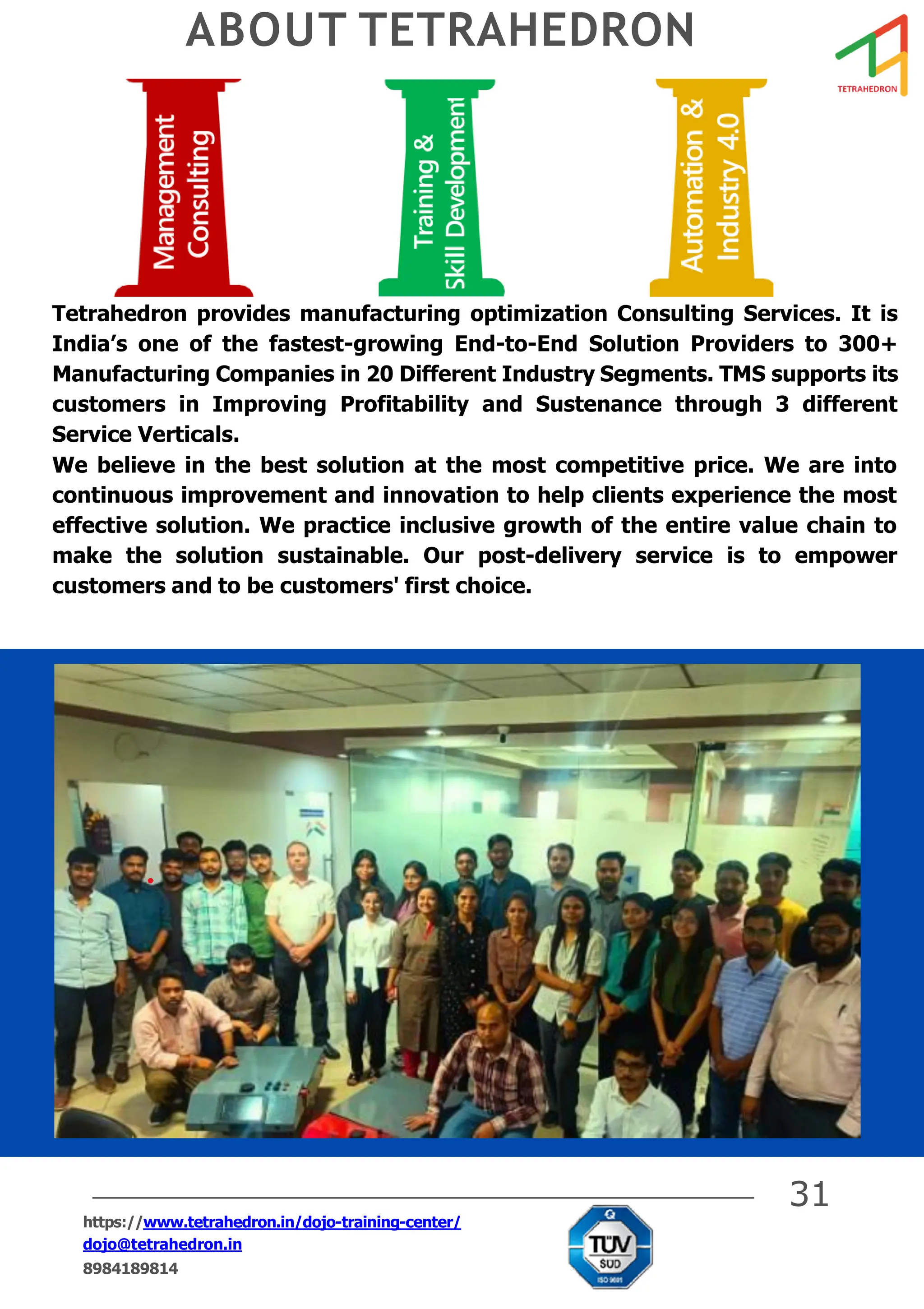
ABOUT TETRAHEDRON
Tetrahedron provides manufacturing optimization Consulting Services. It is
India’s one of the fastest-growing End-to-End Solution Providers to 300+
Manufacturing Companies in 20 Different Industry Segments. TMS supports its
customers in Improving Profitability and Sustenance through 3 different
Service Verticals.
We believe in the best solution at the most competitive price. We are into
continuous improvement and innovation to help clients experience the most
effective solution. We practice inclusive growth of the entire value chain to
make the solution sustainable. Our post-delivery service is to empower
customers and to be customers' first choice.
31
To Inquire & understand more about DOJO Center Setup,
visit our website
www.tetrahedron.in/dojo-training-center/
Call or WhatsApp: 8984189814
Mail: dojo@tetrahedron.in
THANK YOU
TETRAHEDRON
MANUFACTURING
SERVICESPRIVATE
LIMITED

DOJO Training Center - Empowering Workforce Excellence

  • 1.
    DOJO IMPLEMENTATION THROUGH PRACTICALTRAINING AND CONTINUOUS IMPROVEMENT TETRAHEDRON MANUACTURING SERV ICES PVT LTD. https://www.tetrahedron.in/dojo-training-center/ dojo@tetrahedron.in 8984189814
  • 2.
    TABLE OF CONTENT DOJO Overview Chapter1: The Evolution of DOJO Lean Manufacturing Chapter 2:Understanding the DOJO Training Method Chapter 3: Creating a Culture of Continuous Improvement with DOJO Chapter 4:Level of Skill Mapping in DOJO Centre Chapter 5:Senses of Human Being Chapter 6:Activity vs Senses in DOJO Chapter 7:12 Types of DOJOS Chapter 8: Adapting DOJO Training for Industry4.0 Chapter 9: DOJO Skill in Total Productive Maintenance (TPM) Chapter 10: DOJO Skill in World-Class Manufacturing (WCM) Chapter 11:Planning and Implementing DOJO Training 02 https://www.tetrahedron.in/dojo-training-center/ dojo@tetrahedron.in 8984189814
  • 3.
    DOJO OVERVIEW A Dojocenter is known for manufacturing companies where newly hired team members can get professional training and acclimate to take on their responsibility effectively to work on the manufacturing shop floors. To complete a particular task in a dojo center, he or she is trained again and again with the help of replica models/stimulators and mock-ups until they become perfect at their task. Actual Shopfloor environment with all the simulator & actual training environment for newly hired workers who give confidence to the new operators and give time-to-time guidance to correct them. After taking training from the Dojo Training Center, a worker feels more comfortable and confident on the shop floor and performs his work better.
  • 4.
    DOJO The term 'Dojo'originates from Japan and refers to a room or hall where JUDO is practiced, while in Hindi it is known as Akhada. It combines the words 'do' meaning 'the way' or 'the pursuit' and 'jo' meaning 'a place', thus representing a 'place of the pursuit'. Initially, Dojo represented a room in a religious temple, but it later came to symbolize training rooms for martial arts. https://www.tetrahedron.in/dojo-training-center/ dojo@tetrahedron.in 8984189814 Derived from the Japanese term for a martial arts training hall, a DOJO in a professional setting represents a space dedicated to intentional and focused learning. It is a flexible concept that adapts to the unique requirements of different industries rather than being limited to one. Overall, the training facility plays a vital role in ensuring a smooth transition for new employees into their roles. It provides them with the necessary knowledge, skills, and confidence to perform their jobs effectively, ultimately contributing to the success of the organization. 04
  • 5.
    The facility isequipped with state-of-the-art equipment and tools that replicate the actual working conditions employees will encounter in their roles. This allows them to familiarize themselves with the equipment, practice using it, and gain confidence in their abilities. The training center also provides a safe environment for employees to make mistakes and learn from them without any negative consequences. In addition to technical skills, the training center also focuses on enhancing employees' soft skills, such as communication, teamwork, problem-solving, and time management. These skills are crucial for employees to effectively collaborate with their colleagues, handle customer interactions, and meet deadlines. The training program is regularly updated to incorporate the latest industry trends, technologies, and best practices. This ensures that employees are equipped with the most relevant and up-to-date knowledge and skills, enabling them to perform their jobs efficiently and effectively. Following the completion of the training program, organizations may administer an assessment test to evaluate employees' understanding and proficiency in their respective roles. This test helps identify any gaps in knowledge or skills that need to be addressed before employees can begin work at their designated stations. 05 https://www.tetrahedron.in/dojo-training-center/ dojo@tetrahedron.in 7011219709
  • 6.
    06 https://www.tetrahedron.in/dojo-training-center/ dojo@tetrahedron.in 8984189814 CHAPTER 1:INTRODUCTION: THEEVOLUTION OF DOJO LEA N M ANUFA C TURING Over the past few years, the incorporation of lean manufacturing principles into specialized training facilities called DOJO training centers has represented a notable shift in how companies address employee growth and ongoing enhancement. These centers function as interactive learning spaces where employees can participate in practical training, experimentation, and skill enhancement with the support of seasoned facilitators. In order to truly grasp the lean philosophy, one must have a deep and unwavering interest in the nuances of the work. The Dojo provides an environment where individuals can immerse themselves in the intricacies of lean methodology, honing their skills and understanding through hands-on practice and continuous learning. By emphasizing meticulous actions, the Dojo ensures that learners develop a keen eye for detail and a commitment to precision. Furthermore, the Dojo's emphasis on foundational aspects of the job allows learners to develop a solid understanding of the core principles of lean methodology. By delving deeply into the fundamental concepts and techniques, individuals can build a strong foundation upon which they can continue to grow and improve.
  • 7.
    07 https://www.tetrahedron.in/dojo-training-center/ dojo@tetrahedron.in 8984189814 Dojo provides asupportive and collaborative environment where teachers can guide learners through the intricacies of lean methodology, ensuring that they develop a comprehensive understanding of the principles and their practical application. In conclusion, the Dojo's commitment to precise actions and focus on details aligns perfectly with the core principles of lean methodology. By emphasizing continuous improvement through daily incremental changes. DOJO training center provides several key advantages for organizations seeking to embrace lean manufacturing principles: 1. Participants at the DOJO training center can experience and apply lean techniques in a secure setting. gain practical 2.DOJO training sessions encourage collaboration and knowledge sharing among employees from various departments and levels. 3.The DOJO training center promotes a culture of continuous improvement, empowering employees to identify and resolve inefficiencies and contribute to the organization's achievements. 4.Through standardized training programs and materials, the DOJO training center guarantees consistent and effective education in lean manufacturing across the organization.
  • 8.
    08 https://www.tetrahedron.in/dojo-training-center/ dojo@tetrahedron.in 8984189814 CHAPTER 2: UNDERSTANDINGTHE DOJO TRAINING METHOD The DOJO Training Method is an innovative strategy for enhancing learning and skill advancement, drawing inspiration from the conventional Japanese idea of a "DOJO," a setting where martial artists come together to perfect their skills. Within the realm of manufacturing and organizational enhancement, DOJO training offers a well-organized setting for staff to participate in practical learning, experimentation, and ongoing enhancement endeavors. Let's delve into the fundamental elements and philosophies of the DOJO Training Method. 1.Experiential Learning: The DOJO Training Method focuses on practical exercises, simulations, and real-world problem-solving. Participants gain a deeper understanding of lean manufacturing principles and develop directly applicable skills. 2.Continuous Improvement: The DOJO Training Method encourages participants to identify areas for improvement, explore new concepts, collaborate with peers, and
  • 9.
    09 https://www.tetrahedron.in/dojo-training-center/ dojo@tetrahedron.in 8984189814 achieve gradual butsignificant enhancements in productivity, quality, and efficiency. 3. Cross-Functional Collaboration: DOJO training encourages cross-departmental collaboration, knowledge sharing, diverse perspectives, and barrier removal. Participants gain insights into organizational challenges and identify enhancement opportunities. 4. Feedback and Reflection: DOJO training involves constructive feedback, self-assessment, and learning from both successes and failures. Participants recognize strengths, identify areas for improvement, and apply insights to future endeavors. 5. Standardization and Reproducibility: DOJO training encourages creativity and experimentation while emphasizing the importance of standardization and reproducibility. Consistent training materials, processes, and outcomes ensure effectiveness across sessions. 6. Practical Application: DOJO training bridges theory and practice, empowering participants to apply lean principles and problem-solving methods to real-life challenges. 7.Continuous Learning Culture: DOJO training fosters continuous learning, skill acquisition, creativity, collaboration, and individual responsibility for professional growth.
  • 10.
    10 https://www.tetrahedron.in/dojo-training-center/ dojo@tetrahedron.in 8984189814 CHAPTER 3: CREATINGA CULTURE OF CONTINUOUSIMPROVEMENT WITH DOJO Establishing a culture of continuous improvement is essential for achieving organizational excellence, and DOJO training centers are instrumental in this effort. These centers provide a dedicated space for employees to engage in immersive learning, collaborative problem- solving, and skill development. Learn how organizations can leverage DOJO training centers to lay the groundwork for a culture of continuous improvement. 1.Leadership Commitment: Creating a culture of continuous improvement starts with committed leadership. Leaders must champion its importance, allocate resources for DOJO training, and actively participate in training sessions. By leading by example, they set the standard for the entire organization and inspire employees to embrace continuous improvement. 2. Clear Communication: Effective communication is vital for creating a culture of continuous improvement. Organizations must clearly convey DOJO training objectives and expectations to employees. Transparency and open channels encourage idea-sharing, feedback, and active participation. Regular progress updates sustain momentum and engagement
  • 11.
    11 https://www.tetrahedron.in/dojo-training-center/ dojo@tetrahedron.in 8984189814 3.Recognition and Rewards: Recognizingand motivating employees for continuous improvement boosts positive their contributions to work behaviors and engagement. Businesses can praise employees who excel in DOJO training sessions through verbal recognition, peer appreciation, and tangible rewards like bonuses. 4.Integration with Daily Operations: Integrate DOJO training principles into daily operations. Employees should actively apply acquired knowledge and skills. DOJO centers serve as hubs for ongoing learning and collaborative sessions 5. Measurement and Feedback: Assessing DOJO training programs and setting KPIs to track their impact on productivity, quality, and employee satisfaction is essential. Surveys, focus groups, and performance evaluations allow employees to share feedback and suggest improvements
  • 12.
    dojo@tetrahedron.in 8984189814 CHAPTER 4: LEVELOF SKILL MAPPING IN DOJO CENTRE The workforce is divided into skill levels ranging from 0 to 4, each representing a different level of expertise and experience. At Level 0, we have new workers who are just starting their careers and have no prior experience in the field. These individuals require guidance and assistance to perform tasks effectively. Moving up to Level 1, we find workers who have gained some basic skills and knowledge but still require help and supervision to complete their tasks. They are capable of performing their duties with assistance but may not have the confidence or expertise to work independently. Level 2 consists of individuals who have developed a certain level of proficiency in their job roles. They possess the necessary skills and knowledge to work independently and carry out their responsibilities effectively. These workers have a good understanding of their job requirements and can handle most tasks without constant supervision . Advancing further, Level 3 includes workers who not only possess job knowledge and independence but also have the ability to improve their skills with guidance. They are proactive in seeking feedback and a https://www.tetrahedron.in/dojo-training-center/ 16
  • 13.
    https://www.tetrahedron.in/dojo-training-center/ dojo@tetrahedron.in 8984189814 Finally, at Level4, we have workers who have reached the pinnacle of their field. These individuals have extensive knowledge and experience, allowing them to not only excel in their own roles but also train and mentor others. They are recognized as experts in their field and are often sought after for their insights and guidance. By dividing the workforce into these skill levels, organizations can better understand the capabilities and potential of their employees. This division allows for targeted training and development programs to help individuals progress from one level to the next, ensuring a skilled and competent workforce. 17
  • 14.
    CHAPTER 5: SENSESOF HUM AN BEING 5 SENSES Meaning In the context of workplace training,a dojo serves as a dedicated learning center where workers can hone their skills and knowledge. Just like learning to ride a bike or drive a car, mastering tasks in the workplace requires practice, guidance, and repetition. The dojo provides a structured environment for employees to receive trainingtailored to their specific roles and responsibilities Touch This sense allows us to feel physical contact and pressure. It is involved in activities like moving our limbs,picking up and placing objects, sensing vibrations, determining weight, lifting things,measuringtemperature,and handlingmaterials with different textures and properties. Sight Vision enables us to see light and distinguish shapes,colors,and spatial relationships.It is crucial for activities such as measuring dimensions, observing marks or patterns, identifying colors, and tracking the movement of objects in our surroundings 20 https://www.tetrahedron in/dojo-training-center/ dojo@tetrahedron.in 7011219709
  • 15.
    5 SENSES Hearing Auditory perceptionhelps us detect and interpret sound waves. Activities involving hearing include recognizing vibrations, identifying sounds caused by friction (like gas exhaust or creaking), understanding material interactions (such as impacts or leaks) Smell Our sense of smell allows us to detect airborne molecules and perceive odors. Activities detecting chemical materials related to smell include chemicals, identifying leaks, sensing burning (like fuel or substances), detecting electrical sparks, recognizing material decay, and perceiving unpleasant or noxious smells. Taste While taste is not as frequently involved in many activities,it helps us discern flavors through the chemical receptors on our tongues.However,taste is primarily associated with eating and drinking in most daily activities 21 https://www.tetrahedron in/dojo-training-center/ dojo@tetrahedron.in 7011219709
  • 16.
    CHAPTER 6: ACTIVITY VS SENSES IN DOJO Below is an example illustrating what a dojo is and how it helps individuals in their learning process: Imagine you're learning how to ride a bicycle for the first time. At the beginning, it feels daunting and unfamiliar. You're constantly focusing on balancing, pedaling, and steering, all while feeling a bit scared of falling over. However, with practice and perseverance, you start to adapt. Your senses become attuned to the movements and sensations of riding. Eventually, you find yourself pedaling effortlessly, confidently navigating turns, and even riding with one hand. Similarly, consider the experience of learning to drive a car. Initially, there's a lot to remember – from operating the gears and brakes to coordinating the steering wheel. But as you gain experience, these actions become second nature. You no longer need to consciously think about every step; instead, your muscle memory and instincts take over. In the context of workplace training, a dojo serves as a dedicated learning center where workers can hone their skills and knowledge. Just like learning to ride a bike or drive a car, mastering tasks in the 18 https://www.tetrahedron.in/dojo-training-center/ dojo@tetrahedron.in 8984189814
  • 17.
    19 https://www.tetrahedron.in/dojo-training-center/ dojo@tetrahedron.in 8984189814 workplace requires practice,guidance, and repetition. The dojo provides a structured environment for employees to receive training tailored to their specific roles and responsibilities. Within the dojo, workers receive hands-on instruction, engage in simulations, and participate in practical exercises designed to reinforce learning. By breaking down complex tasks into manageable components and providing step-by-step guidance, the dojo helps employees build confidence and proficiency in their work. Ultimately, the dojo catalyzes employee development, enabling individuals to perform their jobs effectively and efficiently. By providing employees with the necessary skills and knowledge to excel in their roles, organizations can create a culture of continuous learning and improvement, fostering a sense of ownership and accountability among employees. Additionally, by focusing on people development, organizations can tap into the diverse perspectives and ideas of their workforce, leading to innovative solutions and new approaches to problem-solving. This can result in increased efficiency, cost savings, and ultimately, a competitive advantage in the marketplace. Overall, by prioritizing people development within the WCM framework, organizations can create a sustainable and successful manufacturing operation that is built on a foundation of skilled, motivated, and strong but also sets the stage for long-term success and growth in the future.
  • 18.
    22 https://www.tetrahedron.in/dojo-training-center/ dojo@tetrahedron.in 8984189814 CHAPTER 7: 12TYPES OF DOJO 1. Know my company One of the key aspects emphasized during this stage is instilling a sense of pride in the employees toward their organization. By providing them with a comprehensive understanding of the company's history, values, mission, and achievements, employees are encouraged to develop a deep appreciation for the organization they are a part of. This pride serves as a motivational factor, driving employees to perform their best and contribute to the overall success of the company. To know more about the List of Equipment. (Click here) 2. Safety DOJO The training program's "Safety Dojo" level underscores the critical significance of safety across all production areas. It fosters a safety- first culture and provides employees with the expertise, abilities, and attitude needed to recognize and manage risks efficiently. Various training sessions within the Safety Dojo target distinct safety issues to guarantee thorough adherence to safety protocols. To know more about the List of Equipment’s. (Click here) 3. Product DOJO The training program's "Product Dojo" level aims to improve employees' comprehension of the products they manufacture or handle. This level
  • 19.
    23 https://www.tetrahedron.in/dojo-training-center/ dojo@tetrahedron.in 8984189814 highlights the significanceof product knowledge in guaranteeing quality, efficiency, and customer satisfaction. By acquainting workers with the products they create, organizations enable them to take responsibility for their work and make informed choices that drive overall success.(Click here) 4. 5 Senses DOJO The training program's "5 Senses Dojo" level aims to enhance employees' awareness of their environment and actions by utilizing their five senses: touch, sight, hearing, smell, and taste. This level highlights the significance of engaging all the senses to improve productivity, safety, and overall job performance.(Click here) 5. Process and Machine DOJO The "Process and Machine Dojo" level within the training program is specifically designed to equip workers with the essential knowledge and skills required for the safe and effective operation of machinery and the navigation of various processes on the shop floor. This comprehensive training emphasizes the importance of routine operations as well as the ability to handle hazardous situations, ultimately ensuring the well- being of employees and the seamless functioning of production processes.(Click here) 6. Production DOJO "Process and Machine Dojo" level within the training program is specifically designed to equip workers with the essential knowledge and skills required for the safe and effective operation of machinery and the navigation of various processes on the shop floor. This comprehensive training emphasizes the importance of routine operations as well as the ability to handle hazardous situations, ultimately ensuring the well- being of employees and the seamless functioning of production processes.(Click here)
  • 20.
    24 https://www.tetrahedron.in/dojo-training-center/ dojo@tetrahedron.in 8984189814 7.Quality DOJO The trainingprogram's "Quality Dojo" level aims to cultivate a culture of excellence in quality among employees. Through this training, workers are equipped with the necessary knowledge, skills, and mindset to produce high-quality products while minimizing waste and maximizing productivity.(Click here) 8. Maintenance DOJO The "Maintenance Dojo" training module aims to provide workers with the necessary knowledge and skills for Maintaining manufactured products effectively. It includes preventive maintenance, troubleshooting techniques, and routine inspections to uphold product quality.(Click here) 9. Ergonomic DOJO The "Ergonomic Dojo" level in a training program aims to improve employees' understanding of body posture and ergonomics, leading to increased productivity and a decrease in workplace injuries. This training provides employees with the necessary knowledge and skills to maintain correct posture, optimize body mechanics, and minimize physical strain during work tasks.(Click here) 10. Innovation DOJO The "Innovation Dojo" level within the training program is specifically crafted to nurture a culture of creativity, problem-solving, and continuous improvement within the workforce. Through this training, employees are empowered to leverage their cognitive abilities to foster innovation and elevate the company's competitive edge.(Click here) 11.On Job Training In the dynamic realm of manufacturing, where hands-on expertise reigns supreme, on-the-job training within the confines of a "dojo" offers a transformative learning experience. Unlike traditional
  • 21.
    25 https://www.tetrahedron.in/dojo-training-center/ dojo@tetrahedron.in 8984189814 classroom settings, thesedojos immerse participants directly into the heart of operations, providing a holistic education that blends theory with practical application. On job training within a manufacturing dojo is more than just a learning experience; it's a journey of discovery, growth, and empowerment. Through hands-on immersion, guided mentorship, and relentless pursuit of excellence, participants emerge not only as skilled professionals but as torchbearers of innovation, poised to shape the future of manufacturing.(Click here) 12.Certification Upon completion of the rigorous training program within our esteemed dojo, participants are awarded a Certificate of Achievement. This certificate serves as a tangible recognition of their dedication, hard work, and mastery of essential skills in their respective fields. It signifies not only the culmination of their training journey but also their readiness to apply their newfound knowledge and expertise in real- world manufacturing settings. With this certificate, participants join a prestigious community of skilled professionals, poised to make meaningful contributions to the industry and drive innovation forward. (Click here)
  • 22.
    14 https://www.tetrahedron.in/dojo-training-center/ dojo@tetrahedron.in 8984189814 CHAPTER 8: ADAPTINGDOJO TRAINING FOR INDUSTRY4 .0 As we move further into the era of Industry 4.0, characterized by the integration of advanced digital technologies into manufacturing processes, the future of lean manufacturing is evolving rapidly. In this context, adapting DOJO training methodologies becomes essential for fostering continuous improvement, empowering employees, and driving innovation in the manufacturing sector. Here's a look at how DOJO training can be tailored to meet the demands of Industry 4. 1.Integration of Digital Tools and Technologies: Integrate training programs emphasizing AI, IoT, robotics, and data analytics. Provide practical exposure to digital tools used in modern manufacturing, including simulation software and VR training modules 2. Focus on Problem-Solving and Innovation: Emphasize problem-solving, encourage innovation, and apply design thinking and lean methodologies to address manufacturing challenges. 3. Cross-Functional Collaboration: Enhance interdepartmental cooperation through the organization of DOJO training sessions involving employees from various departments and fields.
  • 23.
    15 https://www.tetrahedron.in/dojo-training-center/ dojo@tetrahedron.in 8984189814 4. Real-Time DataAnalysis and Decision-Making: Instruct staff on utilizing real-time data analytics and visualization tools for monitoring and enhancing manufacturing performance effectively. Educate individuals on utilizing data-driven insights to make informed decisions and consistently enhance processes within the factory setting. 5. Agile Manufacturing Principles: Integrate agile manufacturing principles into DOJO training to equip employees with the skills needed for quick adaptation to changing customer demands and market conditions. Teach agile methodologies like Scrum and Kanban during DOJO training to enhance flexibility and streamline production workflows. 6. Continuous Learning and Upskilling: Promote continuous learning through DOJO training for all staff members. Create pathways for career growth and personal development, allowing employees to acquire competencies and certifications related to Industry 4.0. 7. Environmental Sustainability: Integrate environmental sustainability into DOJO training to educate staff on resource conservation, waste reduction, and eco-friendly practices. Encourage inventive strategies to reduce the environmental footprint across the manufacturing value chain. 8. Leadership and Change Management: Provide leadership development program supervisors to enhance their capabilities for managers and in driving digital transformation. Emphasize change management tactics to address opposition to new technologies and ensure smooth organizational transitions
  • 24.
    26 https://www.tetrahedron.in/dojo-training-center/ dojo@tetrahedron.in 8984189814 CHAPTER 9: DOJOSKILL IN TOTAL PRODUC TIVE MAINTENANCE E (TPM ) By incorporating TPM into their operations, companies can create a culture of continuous improvement and employee engagement. The Education & Training component of TPM focuses on developing the skills and knowledge of employees to effectively maintain and operate equipment, leading to reduced downtime and increased overall equipment effectiveness. The "Dojo Skill" approach involves providing hands-on training and practical experience to employees in a dedicated learning environment. This approach allows employees to learn and practice new skills in a controlled setting, ensuring that they are fully prepared to apply their knowledge on the production floor. Empowering employees through education and training not only improves their technical abilities but also fosters a sense of ownership and responsibility for the equipment they work with. This leads to increased equipment dependability, reduced breakdowns, and
  • 25.
    27 https://www.tetrahedron.in/dojo-training-center/ dojo@tetrahedron.in 8984189814 ultimately, higher productivitylevels. Overall, the integration of TPM with a strong focus on Education & Training can transform a company's operations by creating a more efficient, reliable, and productive work environment. It invests in the long-term success and sustainability organization. is one of the 1.Focused improvement 2.Autonomous Maintenance 3. Planned Maintenance 4. Education & Training 5. Early Equipment management 6. Quality Maintenance 7.Safety, health & environment 8. Office TPM In summary, Education & Training serves as a foundational pillar of Total Productive Maintenance (TPM), empowering workers with the knowledge, skills, and capabilities needed to drive continuous improvement, enhance equipment reliability, and optimize productivity throughout the organization. By investing in education and training initiatives that focus on TPM principles and practices, companies can cultivate a culture of excellence, innovation, and continuous improvement that drives sustainable growth and success.
  • 26.
    28 https://www.tetrahedron.in/dojo-training-center/ dojo@tetrahedron.in 8984189814 CHAPTER10: DOJO SKILLINWORLD CLASS MANUFACTURING ( WCM) Within the framework of World Class Manufacturing (WCM), the expertise of "DOJO" is essential for enhancing employee engagement, communication, measurement, standardization, and documentation, with a specific emphasis on People Development. DOJO, which refers to a training facility or a place of learning in Japanese, plays a crucial role in implementing and sustaining the principles of WCM. In the context of WCM, DOJO serves as a dedicated space where employees can receive comprehensive training and development opportunities to enhance their skills and knowledge. One of the key aspects of DOJO within the WCM framework is employee engagement. By providing a dedicated space for training and development, DOJO encourages employees to actively participate in learning activities, fostering a sense of ownership and commitment towards their personal growth and the organization's success. This engagement is crucial for creating a culture of continuous improvement

  • 27.
    29 https://www.tetrahedron.in/dojo-training-center/ dojo@tetrahedron.in 8984189814 and innovation withinthe company. Furthermore, DOJO facilitates effective communication within the organization. It serves as a platform for employees to exchange ideas, share best practices, and collaborate on problem-solving initiatives. Through interactive training sessions and workshops, employees can develop their communication skills, enabling them to effectively convey their thoughts and ideas to their colleagues and superiors. Measurement is another critical aspect of DOJO within the WCM framework. By providing a structured training environment, DOJO allows organizations to measure the progress and effectiveness of their training programs. This measurement helps identify areas of improvement and enables organizations to make data-driven decisions to enhance their training initiatives. Standardization and documentation are also emphasized within DOJO. By establishing standardized training processes and procedures, DOJO ensures consistency in the delivery of training programs. This standardization helps organizations maintain quality and efficiency in their training efforts. Additionally, DOJO encourages the documentation of training materials and best practices, creating a knowledge repository that can be accessed by employees at any time. Lastly, DOJO places a specific emphasis on People Development within the WCM framework. It recognizes that investing in the development of employees is crucial for their growth and the overall success of the organization. Through a variety of training programs, workshops, and mentoring opportunities, DOJO helps employees enhance their skills, knowledge, and capabilities, enabling them to contribute effectively to the organization's goals. In conclusion, within the framework of World Class Manufacturing (WCM), the expertise of DOJO is essential for enhancing employee
  • 28.
    30 https://www.tetrahedron.in/dojo-training-center/ dojo@tetrahedron.in 8984189814 engagement, communication, measurement,standardization, and documentation, with a specific emphasis on People Development. By providing a dedicated space for training and development, DOJO enables organizations to create a culture of continuous improvement, and foster effective. Here's how People Development integrates with WCM and supports the overarching objectives: 1.Safety, hygiene &work Env 2.Cost Deployment 3.Focused improvement 4.Autonomous Maintenance 5.Professional Maintenance Fostering employee pride through understanding the company’s history, values, mission, and achievements motivates high performance and contributes to overall success. Additionally, by focusing on people development, organizations can tap into the diverse perspectives and ideas of their workforce, leading to innovative solutions and new approaches to problem-solving. This can result in increased efficiency, cost savings, and ultimately, a competitive advantage in the marketplace. Overall, by prioritizing people development within the WCM framework, organizations can create a sustainable and successful manufacturing operation that is built on a foundation of skilled.
  • 29.
    12 https://www.tetrahedron.in/dojo-training-center/ dojo@tetrahedron.in 8984189814 CHAPTER 11: PLANNINGAND IMPLEMENTING DOJO TRAINING 1.Set Clear Objectives: Outline DOJO training objectives, such as improving coding proficiency, fostering collaboration, enhancing critical thinking, or expediting project completion. 2.Identify Participants: Involve developers, testers, project managers, and other stakeholders in DOJO training. Encourage diverse skill levels and backgrounds for enhanced peer learning. 3. Design Training Sessions: Create a well-organized curriculum for every training session, incorporating a blend of theoretical knowledge, practical exercises, and interactive tasks to ensure participant engagement and enhance the learning process. 4. Allocate Resources: Allocate essential resources like training materials, development environments, and tools to effectively support DOJO training sessions.”
  • 30.
    13 https://www.tetrahedron.in/dojo-training-center/ dojo@tetrahedron.in 8984189814 remember to fostera culture of continuous improvement by integrating DOJO principles into daily operations. 5. Schedule Sessions: Plan DOJO training sessions strategically, considering participant availability and avoiding critical project phases for maximum engagement.” Remember to foster a culture of continuous improvement by integrating DOJO principles into daily operations. 6. Monitor Progress: Consistently monitor the progress of participants and the impact of the training sessions. Obtain feedback from both participants and facilitators to identify opportunities for improvement and implement necessary changes. 7.Measure Results: Examine the impact of DOJO training on participants' skills, productivity, and overall team performance. Success can be measured through metrics such as code quality improvements, time-to-market reductions, and employee satisfaction levels. 8. Continuous Improvement: Enhance the training program by incorporating feedback and insights gained from past sessions. Regularly revise the syllabus, introduce fresh subjects, and improve teaching methods to maintain its efficacy over time.
  • 31.
    8984189814 https://www.tetrahedron.in/dojo-training-center/ dojo@tetrahedron.in ABOUT TETRAHEDRON Tetrahedron providesmanufacturing optimization Consulting Services. It is India’s one of the fastest-growing End-to-End Solution Providers to 300+ Manufacturing Companies in 20 Different Industry Segments. TMS supports its customers in Improving Profitability and Sustenance through 3 different Service Verticals. We believe in the best solution at the most competitive price. We are into continuous improvement and innovation to help clients experience the most effective solution. We practice inclusive growth of the entire value chain to make the solution sustainable. Our post-delivery service is to empower customers and to be customers' first choice. 31
  • 32.
    To Inquire &understand more about DOJO Center Setup, visit our website www.tetrahedron.in/dojo-training-center/ Call or WhatsApp: 8984189814 Mail: dojo@tetrahedron.in THANK YOU TETRAHEDRON MANUFACTURING SERVICESPRIVATE LIMITED