A L L A , D E S I R E E FA E A .
STUDENTS WITH
HEARING IMPAIRMENT
INCIDENCE AND PREVALENCE
• In the Philippines, the conservative estimate that 2% of the
population has hearing impairment and the number may
increase if children below school age and persons who lose
hearing sensitivity due to old age are included.
• In the united states at lease 1 in every 22 newly born infants
has some degree of hearing impairment. At least in 1000
infants have a severe or profound hearing impairment. In its
latest report, the U.S Department of Education claimed that
children with hearing impairment constitute 1.3% of pupils
provided with education service and 11% of total age
population.
ETIOLOGY OF HEARING IMPAIRMENT
Hearing impairment are attributed to genetic and heredity
factors, infections, environment and other traumatic factors.
Some hearing impairment have unknown causes.
• Genetic and heredity types of deafness occur in one out of
one thousand live births. Causes are heredity and
chromosomal abnormalities.
• Infections such as maternal rubella, cytomegalovirus,
hepatitis B virus, syphilis, mumps, and otitis media may occur
during pregnancy or after birth.
• Adventitious hearing loss can be attributed to
environmental factors such as excessive and constant
exposure to very loud noises.
COMMON DISORDER ASSOCIATED
WITH HEARING LOSS
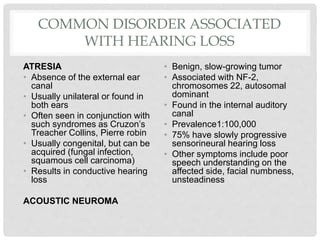
ATRESIA
• Absence of the external ear
canal
• Usually unilateral or found in
both ears
• Often seen in conjunction with
such syndromes as Cruzon’s
Treacher Collins, Pierre robin
• Usually congenital, but can be
acquired (fungal infection,
squamous cell carcinoma)
• Results in conductive hearing
loss
ACOUSTIC NEUROMA
• Benign, slow-growing tumor
• Associated with NF-2,
chromosomes 22, autosomal
dominant
• Found in the internal auditory
canal
• Prevalence1:100,000
• 75% have slowly progressive
sensorineural hearing loss
• Other symptoms include poor
speech understanding on the
affected side, facial numbness,
unsteadiness
COMMON DISORDER ASSOCIATED
WITH HEARING LOSS
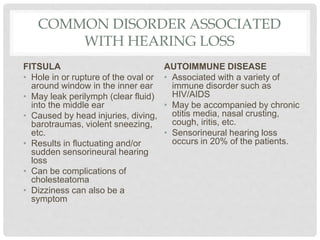
FITSULA
• Hole in or rupture of the oval or
around window in the inner ear
• May leak perilymph (clear fluid)
into the middle ear
• Caused by head injuries, diving,
barotraumas, violent sneezing,
etc.
• Results in fluctuating and/or
sudden sensorineural hearing
loss
• Can be complications of
cholesteatoma
• Dizziness can also be a
symptom
AUTOIMMUNE DISEASE
• Associated with a variety of
immune disorder such as
HIV/AIDS
• May be accompanied by chronic
otitis media, nasal crusting,
cough, iritis, etc.
• Sensorineural hearing loss
occurs in 20% of the patients.
COMMON DISORDER ASSOCIATED
WITH HEARING LOSS
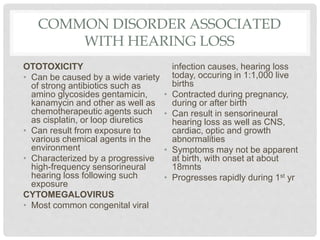
OTOTOXICITY
• Can be caused by a wide variety
of strong antibiotics such as
amino glycosides gentamicin,
kanamycin and other as well as
chemotherapeutic agents such
as cisplatin, or loop diuretics
• Can result from exposure to
various chemical agents in the
environment
• Characterized by a progressive
high-frequency sensorineural
hearing loss following such
exposure
CYTOMEGALOVIRUS
• Most common congenital viral
infection causes, hearing loss
today, occuring in 1:1,000 live
births
• Contracted during pregnancy,
during or after birth
• Can result in sensorineural
hearing loss as well as CNS,
cardiac, optic and growth
abnormalities
• Symptoms may not be apparent
at birth, with onset at about
18mnts
• Progresses rapidly during 1st yr
COMMON DISORDER ASSOCIATED
WITH HEARING LOSS
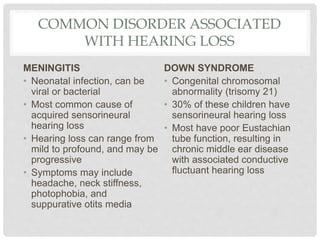
MENINGITIS
• Neonatal infection, can be
viral or bacterial
• Most common cause of
acquired sensorineural
hearing loss
• Hearing loss can range from
mild to profound, and may be
progressive
• Symptoms may include
headache, neck stiffness,
photophobia, and
suppurative otits media
DOWN SYNDROME
• Congenital chromosomal
abnormality (trisomy 21)
• 30% of these children have
sensorineural hearing loss
• Most have poor Eustachian
tube function, resulting in
chronic middle ear disease
with associated conductive
fluctuant hearing loss
COMMON DISORDER ASSOCIATED
WITH HEARING LOSS
CHOLEASTEATOMA
• Can be acquired or congenital
• A benign growth of slow-growing skin tissue in the middle ear
• Usually caused by recurring otitis media and negative middle
ear pressure
• Associated hearing loss is usually conductive, but may be
sensorineural depending on the location of growth
• Symptoms may include ear drainage, fullness, dizziness,
facial weakness and recurring middle ear infections
COMMON DISORDER ASSOCIATED
WITH HEARING LOSS
CRUZON’S SYNDROME
• Congenital abnormality of external
and middle ear
• Inherited autosomal dominant
disorder
• “Frog face” appearance
• One-third of these children have
bilateral conductive hearing loss
• Pinnas may be low set and
rotated, with atresia
• Often may be middle ear
deformities
WAARDENBURG SYNDROME
• Autosomal hereditary dominant
disorder
• 20% have white forelock, 99%
have increased distance between
the eyes, 45%have irises of
different colors
• Depigmintation of the skin and
eyebrows that meet over the
bridge of the nose are is a
common feature of this syndrome
• 50% have mild to severe
sensorineural hearing lose, which
can be unilateral or bilateral that
is progressive
COMMON DISORDER ASSOCIATED
WITH HEARING LOSS
USHER SYNDROME
• Autosomal recessive disorder
• Occur in 6-12% of congenitally
deaf children, and 3 in 100,000
of the general population
• Involves retinitis pigmentosa
and progressive moderate to
serve sensorineural hearing loss
• Can vary greatly in age of onset,
severity and progression
TEACHER COLLINS
SYNDROME
• Autosomal dominant cogenital
abnormality of the external and
middle ear
• Facial anomalies such as
depressed cheekbones,
malformed pinna, receding chin,
large fishlike mouth, and dental
abnormalities
• Poorly developed middle ear
space with ossicles frequently
absent or deformed
• Can be associated with
conductive and/or sensorineural
hearing loss.
COMMON DISORDER ASSOCIATED
WITH HEARING LOSS
PENDRED’S SYNDROME
• Congenital abnormalities of the inner ear
• Recessive endocrine-metabolic disorder occurring in 1 of
100,000 newborns
• Associated with profound sensorineural hearing loss,
which may develop during the first 10 years of life
• Also associated with thyroid defect, resulting in a goiter
during the second or third decade of life
• 40% have vestibular problems
• Often seen with a Mondini-life cochlear abnormality
COMMON DISORDER ASSOCIATED
WITH HEARING LOSS
LYME DISEASE
• Acquired disorder
• Cause by tick-borne spirochete
• Leading cause of facial paralysis
in children
• Symptoms include rash,
headache, hearing loss, stiff
neck, arthralgia, and fatigue
• Hearing loss usually improves
with antibiotic therapy
TURNER SYNDROME
• Aberrative of sex chromosomes,
X chromosome is absent
• Associated with abnormalities of
the external and middle ear,
including low set ears, auricle
defect, middle ear abnormalities,
and a Mondinilike cochlea
• Can result in conductive and/or
sensorineural hearing loss
COMMON DISORDER ASSOCIATED
WITH HEARING LOSS
PIERRE ROBBIN SYNDROME
• Autosomal dominant inheritance
• Congenital abnormality of external and middle ear
• Cleft palate and glossoptosis
• Low set cupped ears, facial nerve abnormalities
• Conductive hearing loss
CHARACTERISTIC OF PERSONS WITH
HEARING IMPAIRMENT
Individuals with hearing impairment compose a wide
diverse group of persons. Since the major effect of
deafness is in language development, concomitant issues
occur on intellectual and social development, speech and
language development that are closely connected to
educational concerns.
Deafness is describe as an invisible handicapping
condition because there are only few physical and
observable manifestation to indicate its presence such as
the absence of the outer ear, closed earn canal and fluid
discharge from the ear.
SOME OF THE OBSERVABLE BEHAVIORAL AND
LEARNING CHARACTERISTICS OF A CHILD WITH
HEARING IMPAIRMENT ARE AS FOLLOWS:
• Cups hand behind the ear, cock ear/tilts head at an angle to catch sounds
• Has strained or black facial expression with listening or talked to
• Pays attention to vibration and vibrating objects
• Moves closer to speak, watches face especially the mouth and the lips of
the speaker when talked to
• Less responsive to noise, voice, music and other sources of sounds
• Uses more natural gestures, signs and movements to express self
• Shows marked imitativeness at work and play
• Often fails to respond to oral questions
• Often asks for repetition of questions and statements
• Often unable to follow oral directions and instructions
• Has difficulty in associating concrete with abstract ideas
• Ha poor general learning performance
• The primary effect of a hearing impairment is on the
development of speech and acquisition of language skills
• The more sever the hearing loss is, the more difficult it is to
acquire skills in listening, speech and communication, reading
and writing.
• The educational achievement of students with hearing
impairment is 3-4 years below the age-appropriate levels of
their hearing peers
• Those with slight or mild hearing losses have a good amount
of residual hearing to learn the skills in the curriculum.
• Deaf person complains that hearing aid amplify sounds but
do not necessarily make them clear and intelligible
IDENTIFICATION AND ASSESSMENT OF
CHILDREN WITH HEARING IMPAIRMENT
Early identification of a hearing impairment increase the
chances for the child to receive early treatment and special
education intervention. The assessment program includes
audiological evaluation, test of mental ability, and test of
communication ability.
1. Audiological Evaluation
Audiology is the science of testing and evaluating
hearing ability to detect to describe hearing impairments.
Audiological evaluation is done by an audiologist
through the use of sophisticated instruments and techniques.
The audiometer is an electronic device that generates sounds
at different levels of intensity and frequency. The purpose is to
determine frequencies of sounds that a particular person hears.
INFORMAL HEARING TESTS
A. Whisper test
Is an efficient screening test for detecting hearing
loss
B. Conversational live voice test
Provides a measure of the actual usability of voice
systems, especially when voice quality is degraded
C. Ball pen click test
It is presented at a distance of 2-3cm from the test
ear while the non-test ear occluded likewise, pure tone
average was taken for each ear.
2. Cognitive Assessment
The assessment tools that measure intellectual capacity
of the children with hearing impairment do not rely primarily on
verbal abilities.
3. Assessment of Communication Abilities
Assessment of speech and language ability includes an
analysis of the development of the form, content and use of
language.
4. Social and Behavioral Assessment
Hearing impairment brings about significant effects on
social-emotional and personality development as a result of the
restrictions in interactive experiences and communication
activities with their age group.
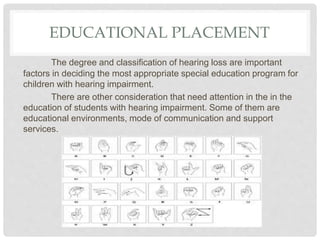
EDUCATIONAL PLACEMENT
The degree and classification of hearing loss are important
factors in deciding the most appropriate special education program for
children with hearing impairment.
There are other consideration that need attention in the in the
education of students with hearing impairment. Some of them are
educational environments, mode of communication and support
services.
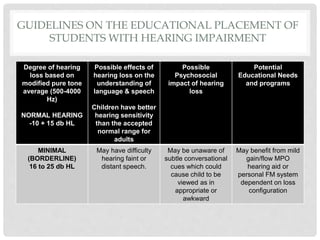
GUIDELINES ON THE EDUCATIONAL PLACEMENT OF
STUDENTS WITH HEARING IMPAIRMENT
Degree of hearing
loss based on
modified pure tone
average (500-4000
Hz)
NORMAL HEARING
-10 + 15 db HL
Possible effects of
hearing loss on the
understanding of
language & speech
Children have better
hearing sensitivity
than the accepted
normal range for
adults
Possible
Psychosocial
impact of hearing
loss
Potential
Educational Needs
and programs
MINIMAL
(BORDERLINE)
16 to 25 db HL
May have difficulty
hearing faint or
distant speech.
May be unaware of
subtle conversational
cues which could
cause child to be
viewed as in
appropriate or
awkward
May benefit from mild
gain/flow MPO
hearing aid or
personal FM system
dependent on loss
configuration
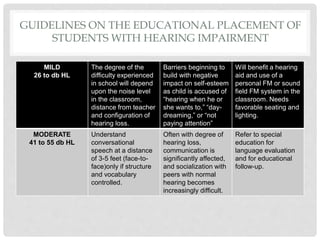
GUIDELINES ON THE EDUCATIONAL PLACEMENT OF
STUDENTS WITH HEARING IMPAIRMENT
MILD
26 to db HL
The degree of the
difficulty experienced
in school will depend
upon the noise level
in the classroom,
distance from teacher
and configuration of
hearing loss.
Barriers beginning to
build with negative
impact on self-esteem
as child is accused of
“hearing when he or
she wants to,” “day-
dreaming,” or “not
paying attention”
Will benefit a hearing
aid and use of a
personal FM or sound
field FM system in the
classroom. Needs
favorable seating and
lighting.
MODERATE
41 to 55 db HL
Understand
conversational
speech at a distance
of 3-5 feet (face-to-
face)only if structure
and vocabulary
controlled.
Often with degree of
hearing loss,
communication is
significantly affected,
and socialization with
peers with normal
hearing becomes
increasingly difficult.
Refer to special
education for
language evaluation
and for educational
follow-up.
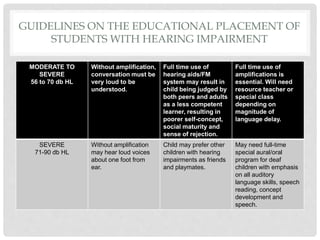
GUIDELINES ON THE EDUCATIONAL PLACEMENT OF
STUDENTS WITH HEARING IMPAIRMENT
MODERATE TO
SEVERE
56 to 70 db HL
Without amplification,
conversation must be
very loud to be
understood.
Full time use of
hearing aids/FM
system may result in
child being judged by
both peers and adults
as a less competent
learner, resulting in
poorer self-concept,
social maturity and
sense of rejection.
Full time use of
amplifications is
essential. Will need
resource teacher or
special class
depending on
magnitude of
language delay.
SEVERE
71-90 db HL
Without amplification
may hear loud voices
about one foot from
ear.
Child may prefer other
children with hearing
impairments as friends
and playmates.
May need full-time
special aural/oral
program for deaf
children with emphasis
on all auditory
language skills, speech
reading, concept
development and
speech.
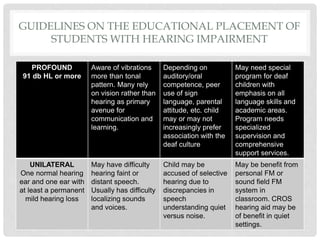
GUIDELINES ON THE EDUCATIONAL PLACEMENT OF
STUDENTS WITH HEARING IMPAIRMENT
PROFOUND
91 db HL or more
Aware of vibrations
more than tonal
pattern. Many rely
on vision rather than
hearing as primary
avenue for
communication and
learning.
Depending on
auditory/oral
competence, peer
use of sign
language, parental
attitude, etc. child
may or may not
increasingly prefer
association with the
deaf culture
May need special
program for deaf
children with
emphasis on all
language skills and
academic areas.
Program needs
specialized
supervision and
comprehensive
support services.
UNILATERAL
One normal hearing
ear and one ear with
at least a permanent
mild hearing loss
May have difficulty
hearing faint or
distant speech.
Usually has difficulty
localizing sounds
and voices.
Child may be
accused of selective
hearing due to
discrepancies in
speech
understanding quiet
versus noise.
May be benefit from
personal FM or
sound field FM
system in
classroom. CROS
hearing aid may be
of benefit in quiet
settings.
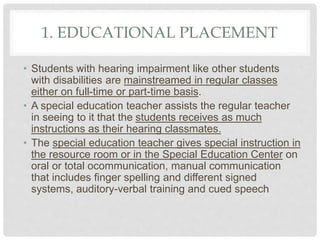
1. EDUCATIONAL PLACEMENT
• Students with hearing impairment like other students
with disabilities are mainstreamed in regular classes
either on full-time or part-time basis.
• A special education teacher assists the regular teacher
in seeing to it that the students receives as much
instructions as their hearing classmates.
• The special education teacher gives special instruction in
the resource room or in the Special Education Center on
oral or total ocommunication, manual communication
that includes finger spelling and different signed
systems, auditory-verbal training and cued speech
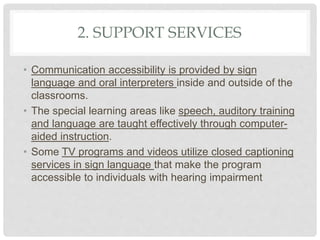
2. SUPPORT SERVICES
• Communication accessibility is provided by sign
language and oral interpreters inside and outside of the
classrooms.
• The special learning areas like speech, auditory training
and language are taught effectively through computer-
aided instruction.
• Some TV programs and videos utilize closed captioning
services in sign language that make the program
accessible to individuals with hearing impairment
SUGGESTIONS FOR TEACHING STUDENTS WITH
HEARING IMPAIRMENT IN A REGULAR CLASS
1. Promote the acceptance of the student with hearing impairment in the
regular class
• Welcome the student to your class
• Explain the student’s condition to the entire class, Emphasize that he or she can
learn together with the hearing students
• Make modifications in teaching as natural as possible.
• Accept the student as an individual with abilities and limitations
• Discuss the student’s condition with him or her
2. Be sure that the prescribed hearing aids and other amplification devices
are used.
• Understand and explain to the class that the hearing aid makes sound louder
but not necessarily clearer
• See to it that the special education teacher checks the student’s hearing aid or
other devices and that they are working properly.
• Encourage the students to take care of his or her hearing aid and to tell the
teacher when it is not functioning properly.
• Be sure your student has a spare battery at school
• Tell the special education teacher or the parent of the student’s hearing aid is
not working properly.
SUGGESTIONS FOR TEACHING STUDENTS WITH
HEARING IMPAIRMENT IN A REGULAR CLASS
3. Provide preferential seating
• Sit the student near the spot where you typically stay when teaching.
• Sit the student where he or she can easily watch your face without
straining to look up
• Sit the student away from sources of noise
• Sit the student where light is on your face and not in the student’s
eyes
• Sit the student so he or she can use the better ear
• Allow the student to transfer to other seats when necessary.
SUGGESTIONS FOR TEACHING STUDENTS WITH
HEARING IMPAIRMENT IN A REGULAR CLASS
4. Increase visual information
• Remember that your student read your lips and must see your face in to do so.
• Try to stay in one place will talking to the class so the student does not have to
lip read a “moving target.”
• Avoid talking when your back is turned to the class such as when you are writing
on the chalkboard
• Avoid covering your mouth or face when talking
• When reading in front of the class be sure that the student can lip read you
• Avoid standing infront of the window where the glare will make it difficult to see
your face
• Use visual aids, such as pictures and illustrations whenever possible
• Demonstrate what you want the student to understand whenever possible
• Use the chalkboard as much as possible.
SUGGESTIONS FOR TEACHING STUDENTS WITH
HEARING IMPAIRMENT IN A REGULAR CLASS
5. Minimize the classroom noise
• Seat the student away from noisy parts of the classroom
• Wait for the class to be quiet before talking to the students
6. Modify teaching procedures
• Be sure the students is watching and listening when you are talking
• Be sure the students understands what is said by asking him or her to repeat
information or answer questions
• Rephrase rather than repeat questions and instructions whenever necessary.
• Write keyword, new words, and other needed information on the chalkboard
• Repeat or rephrase things said by other students during classroom discussion
• Introduce new vocabulary words to the student in advance
• Ask the student to repeat if you cannot understand him or her.
• Be sure that he or she understands the lesson correctly
SUGGESTIONS FOR TEACHING STUDENTS WITH
HEARING IMPAIRMENT IN A REGULAR CLASS
7. Have realistic expectations
• Remember that the students cannot understand and grasp everything all of
the time, no matter how hard he/she tries.
• Be patient when the student ask for repetition
• Give the students a break from listening when he or she shows sign of
fatigue
• Expect the student to follow classroom routine
• Expect the student to abide by all the school rules such as attendance,
proper behavior, homework, and dependability as other students are
required to do
• Be alert for fluctuation of hearing. Report any observation to the special
education teacher

Students with hearing impairment.pptx

  • 1.
    A L LA , D E S I R E E FA E A . STUDENTS WITH HEARING IMPAIRMENT
  • 2.
    INCIDENCE AND PREVALENCE •In the Philippines, the conservative estimate that 2% of the population has hearing impairment and the number may increase if children below school age and persons who lose hearing sensitivity due to old age are included. • In the united states at lease 1 in every 22 newly born infants has some degree of hearing impairment. At least in 1000 infants have a severe or profound hearing impairment. In its latest report, the U.S Department of Education claimed that children with hearing impairment constitute 1.3% of pupils provided with education service and 11% of total age population.
  • 3.
    ETIOLOGY OF HEARINGIMPAIRMENT Hearing impairment are attributed to genetic and heredity factors, infections, environment and other traumatic factors. Some hearing impairment have unknown causes. • Genetic and heredity types of deafness occur in one out of one thousand live births. Causes are heredity and chromosomal abnormalities. • Infections such as maternal rubella, cytomegalovirus, hepatitis B virus, syphilis, mumps, and otitis media may occur during pregnancy or after birth. • Adventitious hearing loss can be attributed to environmental factors such as excessive and constant exposure to very loud noises.
  • 4.
    COMMON DISORDER ASSOCIATED WITHHEARING LOSS ATRESIA • Absence of the external ear canal • Usually unilateral or found in both ears • Often seen in conjunction with such syndromes as Cruzon’s Treacher Collins, Pierre robin • Usually congenital, but can be acquired (fungal infection, squamous cell carcinoma) • Results in conductive hearing loss ACOUSTIC NEUROMA • Benign, slow-growing tumor • Associated with NF-2, chromosomes 22, autosomal dominant • Found in the internal auditory canal • Prevalence1:100,000 • 75% have slowly progressive sensorineural hearing loss • Other symptoms include poor speech understanding on the affected side, facial numbness, unsteadiness
  • 5.
    COMMON DISORDER ASSOCIATED WITHHEARING LOSS FITSULA • Hole in or rupture of the oval or around window in the inner ear • May leak perilymph (clear fluid) into the middle ear • Caused by head injuries, diving, barotraumas, violent sneezing, etc. • Results in fluctuating and/or sudden sensorineural hearing loss • Can be complications of cholesteatoma • Dizziness can also be a symptom AUTOIMMUNE DISEASE • Associated with a variety of immune disorder such as HIV/AIDS • May be accompanied by chronic otitis media, nasal crusting, cough, iritis, etc. • Sensorineural hearing loss occurs in 20% of the patients.
  • 6.
    COMMON DISORDER ASSOCIATED WITHHEARING LOSS OTOTOXICITY • Can be caused by a wide variety of strong antibiotics such as amino glycosides gentamicin, kanamycin and other as well as chemotherapeutic agents such as cisplatin, or loop diuretics • Can result from exposure to various chemical agents in the environment • Characterized by a progressive high-frequency sensorineural hearing loss following such exposure CYTOMEGALOVIRUS • Most common congenital viral infection causes, hearing loss today, occuring in 1:1,000 live births • Contracted during pregnancy, during or after birth • Can result in sensorineural hearing loss as well as CNS, cardiac, optic and growth abnormalities • Symptoms may not be apparent at birth, with onset at about 18mnts • Progresses rapidly during 1st yr
  • 7.
    COMMON DISORDER ASSOCIATED WITHHEARING LOSS MENINGITIS • Neonatal infection, can be viral or bacterial • Most common cause of acquired sensorineural hearing loss • Hearing loss can range from mild to profound, and may be progressive • Symptoms may include headache, neck stiffness, photophobia, and suppurative otits media DOWN SYNDROME • Congenital chromosomal abnormality (trisomy 21) • 30% of these children have sensorineural hearing loss • Most have poor Eustachian tube function, resulting in chronic middle ear disease with associated conductive fluctuant hearing loss
  • 8.
    COMMON DISORDER ASSOCIATED WITHHEARING LOSS CHOLEASTEATOMA • Can be acquired or congenital • A benign growth of slow-growing skin tissue in the middle ear • Usually caused by recurring otitis media and negative middle ear pressure • Associated hearing loss is usually conductive, but may be sensorineural depending on the location of growth • Symptoms may include ear drainage, fullness, dizziness, facial weakness and recurring middle ear infections
  • 9.
    COMMON DISORDER ASSOCIATED WITHHEARING LOSS CRUZON’S SYNDROME • Congenital abnormality of external and middle ear • Inherited autosomal dominant disorder • “Frog face” appearance • One-third of these children have bilateral conductive hearing loss • Pinnas may be low set and rotated, with atresia • Often may be middle ear deformities WAARDENBURG SYNDROME • Autosomal hereditary dominant disorder • 20% have white forelock, 99% have increased distance between the eyes, 45%have irises of different colors • Depigmintation of the skin and eyebrows that meet over the bridge of the nose are is a common feature of this syndrome • 50% have mild to severe sensorineural hearing lose, which can be unilateral or bilateral that is progressive
  • 10.
    COMMON DISORDER ASSOCIATED WITHHEARING LOSS USHER SYNDROME • Autosomal recessive disorder • Occur in 6-12% of congenitally deaf children, and 3 in 100,000 of the general population • Involves retinitis pigmentosa and progressive moderate to serve sensorineural hearing loss • Can vary greatly in age of onset, severity and progression TEACHER COLLINS SYNDROME • Autosomal dominant cogenital abnormality of the external and middle ear • Facial anomalies such as depressed cheekbones, malformed pinna, receding chin, large fishlike mouth, and dental abnormalities • Poorly developed middle ear space with ossicles frequently absent or deformed • Can be associated with conductive and/or sensorineural hearing loss.
  • 11.
    COMMON DISORDER ASSOCIATED WITHHEARING LOSS PENDRED’S SYNDROME • Congenital abnormalities of the inner ear • Recessive endocrine-metabolic disorder occurring in 1 of 100,000 newborns • Associated with profound sensorineural hearing loss, which may develop during the first 10 years of life • Also associated with thyroid defect, resulting in a goiter during the second or third decade of life • 40% have vestibular problems • Often seen with a Mondini-life cochlear abnormality
  • 12.
    COMMON DISORDER ASSOCIATED WITHHEARING LOSS LYME DISEASE • Acquired disorder • Cause by tick-borne spirochete • Leading cause of facial paralysis in children • Symptoms include rash, headache, hearing loss, stiff neck, arthralgia, and fatigue • Hearing loss usually improves with antibiotic therapy TURNER SYNDROME • Aberrative of sex chromosomes, X chromosome is absent • Associated with abnormalities of the external and middle ear, including low set ears, auricle defect, middle ear abnormalities, and a Mondinilike cochlea • Can result in conductive and/or sensorineural hearing loss
  • 13.
    COMMON DISORDER ASSOCIATED WITHHEARING LOSS PIERRE ROBBIN SYNDROME • Autosomal dominant inheritance • Congenital abnormality of external and middle ear • Cleft palate and glossoptosis • Low set cupped ears, facial nerve abnormalities • Conductive hearing loss
  • 14.
    CHARACTERISTIC OF PERSONSWITH HEARING IMPAIRMENT Individuals with hearing impairment compose a wide diverse group of persons. Since the major effect of deafness is in language development, concomitant issues occur on intellectual and social development, speech and language development that are closely connected to educational concerns. Deafness is describe as an invisible handicapping condition because there are only few physical and observable manifestation to indicate its presence such as the absence of the outer ear, closed earn canal and fluid discharge from the ear.
  • 15.
    SOME OF THEOBSERVABLE BEHAVIORAL AND LEARNING CHARACTERISTICS OF A CHILD WITH HEARING IMPAIRMENT ARE AS FOLLOWS: • Cups hand behind the ear, cock ear/tilts head at an angle to catch sounds • Has strained or black facial expression with listening or talked to • Pays attention to vibration and vibrating objects • Moves closer to speak, watches face especially the mouth and the lips of the speaker when talked to • Less responsive to noise, voice, music and other sources of sounds • Uses more natural gestures, signs and movements to express self • Shows marked imitativeness at work and play • Often fails to respond to oral questions • Often asks for repetition of questions and statements • Often unable to follow oral directions and instructions • Has difficulty in associating concrete with abstract ideas • Ha poor general learning performance
  • 16.
    • The primaryeffect of a hearing impairment is on the development of speech and acquisition of language skills • The more sever the hearing loss is, the more difficult it is to acquire skills in listening, speech and communication, reading and writing. • The educational achievement of students with hearing impairment is 3-4 years below the age-appropriate levels of their hearing peers • Those with slight or mild hearing losses have a good amount of residual hearing to learn the skills in the curriculum. • Deaf person complains that hearing aid amplify sounds but do not necessarily make them clear and intelligible
  • 17.
    IDENTIFICATION AND ASSESSMENTOF CHILDREN WITH HEARING IMPAIRMENT Early identification of a hearing impairment increase the chances for the child to receive early treatment and special education intervention. The assessment program includes audiological evaluation, test of mental ability, and test of communication ability. 1. Audiological Evaluation Audiology is the science of testing and evaluating hearing ability to detect to describe hearing impairments. Audiological evaluation is done by an audiologist through the use of sophisticated instruments and techniques. The audiometer is an electronic device that generates sounds at different levels of intensity and frequency. The purpose is to determine frequencies of sounds that a particular person hears.
  • 18.
    INFORMAL HEARING TESTS A.Whisper test Is an efficient screening test for detecting hearing loss B. Conversational live voice test Provides a measure of the actual usability of voice systems, especially when voice quality is degraded C. Ball pen click test It is presented at a distance of 2-3cm from the test ear while the non-test ear occluded likewise, pure tone average was taken for each ear.
  • 19.
    2. Cognitive Assessment Theassessment tools that measure intellectual capacity of the children with hearing impairment do not rely primarily on verbal abilities. 3. Assessment of Communication Abilities Assessment of speech and language ability includes an analysis of the development of the form, content and use of language. 4. Social and Behavioral Assessment Hearing impairment brings about significant effects on social-emotional and personality development as a result of the restrictions in interactive experiences and communication activities with their age group.
  • 20.
    EDUCATIONAL PLACEMENT The degreeand classification of hearing loss are important factors in deciding the most appropriate special education program for children with hearing impairment. There are other consideration that need attention in the in the education of students with hearing impairment. Some of them are educational environments, mode of communication and support services.
  • 21.
    GUIDELINES ON THEEDUCATIONAL PLACEMENT OF STUDENTS WITH HEARING IMPAIRMENT Degree of hearing loss based on modified pure tone average (500-4000 Hz) NORMAL HEARING -10 + 15 db HL Possible effects of hearing loss on the understanding of language & speech Children have better hearing sensitivity than the accepted normal range for adults Possible Psychosocial impact of hearing loss Potential Educational Needs and programs MINIMAL (BORDERLINE) 16 to 25 db HL May have difficulty hearing faint or distant speech. May be unaware of subtle conversational cues which could cause child to be viewed as in appropriate or awkward May benefit from mild gain/flow MPO hearing aid or personal FM system dependent on loss configuration
  • 22.
    GUIDELINES ON THEEDUCATIONAL PLACEMENT OF STUDENTS WITH HEARING IMPAIRMENT MILD 26 to db HL The degree of the difficulty experienced in school will depend upon the noise level in the classroom, distance from teacher and configuration of hearing loss. Barriers beginning to build with negative impact on self-esteem as child is accused of “hearing when he or she wants to,” “day- dreaming,” or “not paying attention” Will benefit a hearing aid and use of a personal FM or sound field FM system in the classroom. Needs favorable seating and lighting. MODERATE 41 to 55 db HL Understand conversational speech at a distance of 3-5 feet (face-to- face)only if structure and vocabulary controlled. Often with degree of hearing loss, communication is significantly affected, and socialization with peers with normal hearing becomes increasingly difficult. Refer to special education for language evaluation and for educational follow-up.
  • 23.
    GUIDELINES ON THEEDUCATIONAL PLACEMENT OF STUDENTS WITH HEARING IMPAIRMENT MODERATE TO SEVERE 56 to 70 db HL Without amplification, conversation must be very loud to be understood. Full time use of hearing aids/FM system may result in child being judged by both peers and adults as a less competent learner, resulting in poorer self-concept, social maturity and sense of rejection. Full time use of amplifications is essential. Will need resource teacher or special class depending on magnitude of language delay. SEVERE 71-90 db HL Without amplification may hear loud voices about one foot from ear. Child may prefer other children with hearing impairments as friends and playmates. May need full-time special aural/oral program for deaf children with emphasis on all auditory language skills, speech reading, concept development and speech.
  • 24.
    GUIDELINES ON THEEDUCATIONAL PLACEMENT OF STUDENTS WITH HEARING IMPAIRMENT PROFOUND 91 db HL or more Aware of vibrations more than tonal pattern. Many rely on vision rather than hearing as primary avenue for communication and learning. Depending on auditory/oral competence, peer use of sign language, parental attitude, etc. child may or may not increasingly prefer association with the deaf culture May need special program for deaf children with emphasis on all language skills and academic areas. Program needs specialized supervision and comprehensive support services. UNILATERAL One normal hearing ear and one ear with at least a permanent mild hearing loss May have difficulty hearing faint or distant speech. Usually has difficulty localizing sounds and voices. Child may be accused of selective hearing due to discrepancies in speech understanding quiet versus noise. May be benefit from personal FM or sound field FM system in classroom. CROS hearing aid may be of benefit in quiet settings.
  • 25.
    1. EDUCATIONAL PLACEMENT •Students with hearing impairment like other students with disabilities are mainstreamed in regular classes either on full-time or part-time basis. • A special education teacher assists the regular teacher in seeing to it that the students receives as much instructions as their hearing classmates. • The special education teacher gives special instruction in the resource room or in the Special Education Center on oral or total ocommunication, manual communication that includes finger spelling and different signed systems, auditory-verbal training and cued speech
  • 26.
    2. SUPPORT SERVICES •Communication accessibility is provided by sign language and oral interpreters inside and outside of the classrooms. • The special learning areas like speech, auditory training and language are taught effectively through computer- aided instruction. • Some TV programs and videos utilize closed captioning services in sign language that make the program accessible to individuals with hearing impairment
  • 27.
    SUGGESTIONS FOR TEACHINGSTUDENTS WITH HEARING IMPAIRMENT IN A REGULAR CLASS 1. Promote the acceptance of the student with hearing impairment in the regular class • Welcome the student to your class • Explain the student’s condition to the entire class, Emphasize that he or she can learn together with the hearing students • Make modifications in teaching as natural as possible. • Accept the student as an individual with abilities and limitations • Discuss the student’s condition with him or her 2. Be sure that the prescribed hearing aids and other amplification devices are used. • Understand and explain to the class that the hearing aid makes sound louder but not necessarily clearer • See to it that the special education teacher checks the student’s hearing aid or other devices and that they are working properly. • Encourage the students to take care of his or her hearing aid and to tell the teacher when it is not functioning properly. • Be sure your student has a spare battery at school • Tell the special education teacher or the parent of the student’s hearing aid is not working properly.
  • 28.
    SUGGESTIONS FOR TEACHINGSTUDENTS WITH HEARING IMPAIRMENT IN A REGULAR CLASS 3. Provide preferential seating • Sit the student near the spot where you typically stay when teaching. • Sit the student where he or she can easily watch your face without straining to look up • Sit the student away from sources of noise • Sit the student where light is on your face and not in the student’s eyes • Sit the student so he or she can use the better ear • Allow the student to transfer to other seats when necessary.
  • 29.
    SUGGESTIONS FOR TEACHINGSTUDENTS WITH HEARING IMPAIRMENT IN A REGULAR CLASS 4. Increase visual information • Remember that your student read your lips and must see your face in to do so. • Try to stay in one place will talking to the class so the student does not have to lip read a “moving target.” • Avoid talking when your back is turned to the class such as when you are writing on the chalkboard • Avoid covering your mouth or face when talking • When reading in front of the class be sure that the student can lip read you • Avoid standing infront of the window where the glare will make it difficult to see your face • Use visual aids, such as pictures and illustrations whenever possible • Demonstrate what you want the student to understand whenever possible • Use the chalkboard as much as possible.
  • 30.
    SUGGESTIONS FOR TEACHINGSTUDENTS WITH HEARING IMPAIRMENT IN A REGULAR CLASS 5. Minimize the classroom noise • Seat the student away from noisy parts of the classroom • Wait for the class to be quiet before talking to the students 6. Modify teaching procedures • Be sure the students is watching and listening when you are talking • Be sure the students understands what is said by asking him or her to repeat information or answer questions • Rephrase rather than repeat questions and instructions whenever necessary. • Write keyword, new words, and other needed information on the chalkboard • Repeat or rephrase things said by other students during classroom discussion • Introduce new vocabulary words to the student in advance • Ask the student to repeat if you cannot understand him or her. • Be sure that he or she understands the lesson correctly
  • 31.
    SUGGESTIONS FOR TEACHINGSTUDENTS WITH HEARING IMPAIRMENT IN A REGULAR CLASS 7. Have realistic expectations • Remember that the students cannot understand and grasp everything all of the time, no matter how hard he/she tries. • Be patient when the student ask for repetition • Give the students a break from listening when he or she shows sign of fatigue • Expect the student to follow classroom routine • Expect the student to abide by all the school rules such as attendance, proper behavior, homework, and dependability as other students are required to do • Be alert for fluctuation of hearing. Report any observation to the special education teacher