CLASSIFICATION OF HEARING
IMPAIRMENT
01 Conductive hearing loss
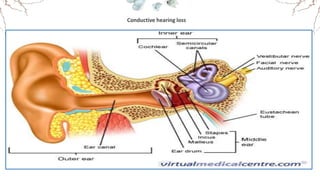
Occurs in the outer and middle ear thereby
blocking the passage of acoustic energy.
• Impacted cerumen results from excessive
build up of earwax in the auditory canal.
• Malformation, incomplete development, or
abnormal growth and improvement of the
ossicular chain can cause conductive
hearing loss.
• If the inner ear is intact, conductive
hearing impairment can be corrected
through surgical or medical treatment.
Conductive hearing loss
02 SENSORINEURAL HEARING IMPAIRMANENT
occurs in the inner ear.
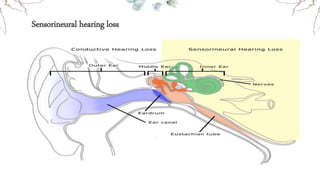
Sensorineural hearing loss
The sensitive mechanisms and auditory nerve may be damaged. When
the cochlea is impaired, neural energy delivered to the brain is
distorted.
Sensorineural hearing losses may be congenital or
adventitious because of illness and traumatic incidents.
Sensorineural hearing loss
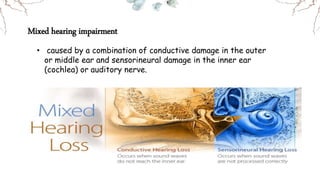
03 MIXED HEARING IMPAIRMENT
• caused by a combination of conductive damage in the outer
or middle ear and sensorineural damage in the inner ear
(cochlea) or auditory nerve.
Mixed hearing impairment
04 CENTRAL HEARING DISORDER
Central hearing disorder
• Any dysfunction in the central auditory nervous system
between the brain stem and the auditory cortex in the
brain.
Common Disorders Associated with Hearing Loss
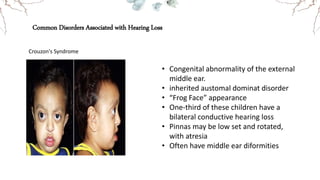
Crouzon's Syndrome
• Congenital abnormality of the external
middle ear.
• inherited austomal dominat disorder
• “Frog Face” appearance
• One-third of these children have a
bilateral conductive hearing loss
• Pinnas may be low set and rotated,
with atresia
• Often have middle ear diformities
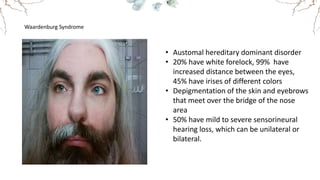
Waardenburg Syndrome
• Austomal hereditary dominant disorder
• 20% have white forelock, 99% have
increased distance between the eyes,
45% have irises of different colors
• Depigmentation of the skin and eyebrows
that meet over the bridge of the nose
area
• 50% have mild to severe sensorineural
hearing loss, which can be unilateral or
bilateral.
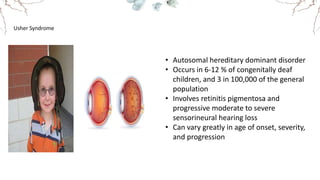
Usher Syndrome
• Autosomal hereditary dominant disorder
• Occurs in 6-12 % of congenitally deaf
children, and 3 in 100,000 of the general
population
• Involves retinitis pigmentosa and
progressive moderate to severe
sensorineural hearing loss
• Can vary greatly in age of onset, severity,
and progression
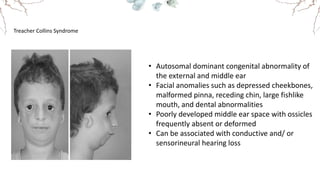
Treacher Collins Syndrome
• Autosomal dominant congenital abnormality of
the external and middle ear
• Facial anomalies such as depressed cheekbones,
malformed pinna, receding chin, large fishlike
mouth, and dental abnormalities
• Poorly developed middle ear space with ossicles
frequently absent or deformed
• Can be associated with conductive and/ or
sensorineural hearing loss
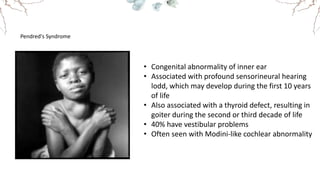
Pendred's Syndrome
• Congenital abnormality of inner ear
• Associated with profound sensorineural hearing
lodd, which may develop during the first 10 years
of life
• Also associated with a thyroid defect, resulting in
goiter during the second or third decade of life
• 40% have vestibular problems
• Often seen with Modini-like cochlear abnormality
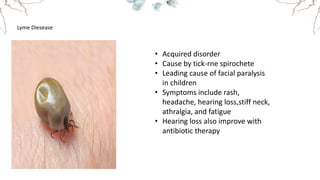
Lyme Diesease
• Acquired disorder
• Cause by tick-rne spirochete
• Leading cause of facial paralysis
in children
• Symptoms include rash,
headache, hearing loss,stiff neck,
athralgia, and fatigue
• Hearing loss also improve with
antibiotic therapy
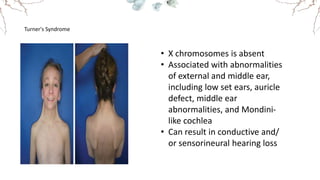
Turner's Syndrome
• X chromosomes is absent
• Associated with abnormalities
of external and middle ear,
including low set ears, auricle
defect, middle ear
abnormalities, and Mondini-
like cochlea
• Can result in conductive and/
or sensorineural hearing loss
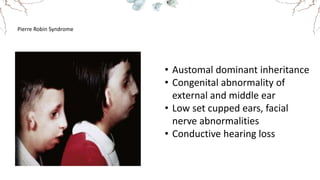
Pierre Robin Syndrome
• Austomal dominant inheritance
• Congenital abnormality of
external and middle ear
• Low set cupped ears, facial
nerve abnormalities
• Conductive hearing loss
Students with Hearing Impairment 2

Students with Hearing Impairment 2

  • 1.
  • 2.
    01 Conductive hearingloss Occurs in the outer and middle ear thereby blocking the passage of acoustic energy.
  • 3.
    • Impacted cerumenresults from excessive build up of earwax in the auditory canal. • Malformation, incomplete development, or abnormal growth and improvement of the ossicular chain can cause conductive hearing loss. • If the inner ear is intact, conductive hearing impairment can be corrected through surgical or medical treatment. Conductive hearing loss
  • 4.
  • 5.
    02 SENSORINEURAL HEARINGIMPAIRMANENT occurs in the inner ear.
  • 6.
    Sensorineural hearing loss Thesensitive mechanisms and auditory nerve may be damaged. When the cochlea is impaired, neural energy delivered to the brain is distorted. Sensorineural hearing losses may be congenital or adventitious because of illness and traumatic incidents.
  • 7.
  • 8.
    03 MIXED HEARINGIMPAIRMENT
  • 9.
    • caused bya combination of conductive damage in the outer or middle ear and sensorineural damage in the inner ear (cochlea) or auditory nerve. Mixed hearing impairment
  • 10.
  • 11.
    Central hearing disorder •Any dysfunction in the central auditory nervous system between the brain stem and the auditory cortex in the brain.
  • 12.
    Common Disorders Associatedwith Hearing Loss Crouzon's Syndrome • Congenital abnormality of the external middle ear. • inherited austomal dominat disorder • “Frog Face” appearance • One-third of these children have a bilateral conductive hearing loss • Pinnas may be low set and rotated, with atresia • Often have middle ear diformities
  • 13.
    Waardenburg Syndrome • Austomalhereditary dominant disorder • 20% have white forelock, 99% have increased distance between the eyes, 45% have irises of different colors • Depigmentation of the skin and eyebrows that meet over the bridge of the nose area • 50% have mild to severe sensorineural hearing loss, which can be unilateral or bilateral.
  • 14.
    Usher Syndrome • Autosomalhereditary dominant disorder • Occurs in 6-12 % of congenitally deaf children, and 3 in 100,000 of the general population • Involves retinitis pigmentosa and progressive moderate to severe sensorineural hearing loss • Can vary greatly in age of onset, severity, and progression
  • 15.
    Treacher Collins Syndrome •Autosomal dominant congenital abnormality of the external and middle ear • Facial anomalies such as depressed cheekbones, malformed pinna, receding chin, large fishlike mouth, and dental abnormalities • Poorly developed middle ear space with ossicles frequently absent or deformed • Can be associated with conductive and/ or sensorineural hearing loss
  • 16.
    Pendred's Syndrome • Congenitalabnormality of inner ear • Associated with profound sensorineural hearing lodd, which may develop during the first 10 years of life • Also associated with a thyroid defect, resulting in goiter during the second or third decade of life • 40% have vestibular problems • Often seen with Modini-like cochlear abnormality
  • 17.
    Lyme Diesease • Acquireddisorder • Cause by tick-rne spirochete • Leading cause of facial paralysis in children • Symptoms include rash, headache, hearing loss,stiff neck, athralgia, and fatigue • Hearing loss also improve with antibiotic therapy
  • 18.
    Turner's Syndrome • Xchromosomes is absent • Associated with abnormalities of external and middle ear, including low set ears, auricle defect, middle ear abnormalities, and Mondini- like cochlea • Can result in conductive and/ or sensorineural hearing loss
  • 19.
    Pierre Robin Syndrome •Austomal dominant inheritance • Congenital abnormality of external and middle ear • Low set cupped ears, facial nerve abnormalities • Conductive hearing loss