Using manipulatives to connect theory to practice.   By Aileen Machado, M. Ed & Daniela Fenu Foerch, M. Ed
Introduction to the Theory Accountability era: classrooms have lost the fun and exploration  Jerome Bruner Jean Piaget Lev Vygotsky Zoltan P. Dienes Constance Kamii
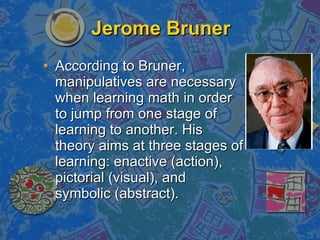
Jerome Bruner  According to Bruner, manipulatives are necessary when learning math in order to jump from one stage of learning to another.  His theory aims at three stages of learning: enactive (action), pictorial (visual), and symbolic (abstract).
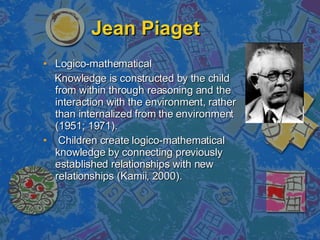
Jean Piaget Logico-mathematical Knowledge is constructed by the child from within through reasoning and the interaction with the environment, rather than internalized from the environment (1951; 1971). Children create logico-mathematical knowledge by connecting previously established relationships with new relationships (Kamii, 2000).
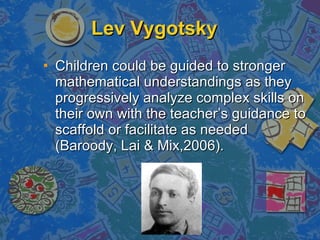
Lev Vygotsky Children could be guided to stronger mathematical understandings as they progressively analyze complex skills on their own with the teacher’s guidance to scaffold or facilitate as needed (Baroody, Lai & Mix,2006).
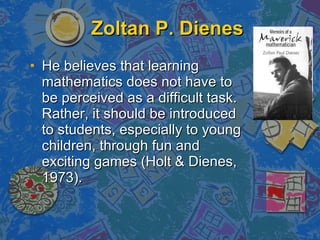
Zoltan P. Dienes He believes that learning mathematics does not have to be perceived as a difficult task. Rather, it should be introduced to students, especially to young children, through fun and exciting games (Holt & Dienes, 1973).
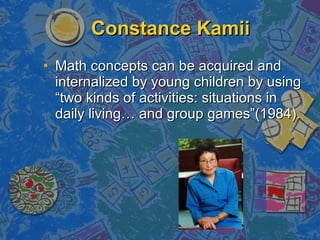
Constance Kamii Math concepts can be acquired and internalized by young children by using “two kinds of activities: situations in daily living… and group games”(1984).
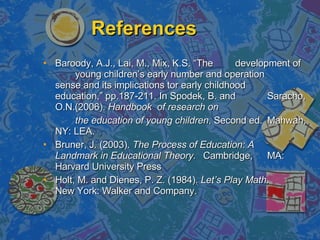
References Baroody, A.J., Lai, M., Mix, K.S. “The  development of  young children’s early number and operation  sense and its implications tor early childhood  education,” pp.187-211. In Spodek, B. and  Saracho, O.N.(2006).  Handbook  of research on  the education of young children , Second ed.  Mahwah, NY: LEA. Bruner, J. (2003).  The Process of Education: A  Landmark in Educational Theory.  Cambridge,  MA: Harvard University Press Holt, M. and Dienes, P. Z. (1984).  Let’s Play Math.  New York: Walker and Company.
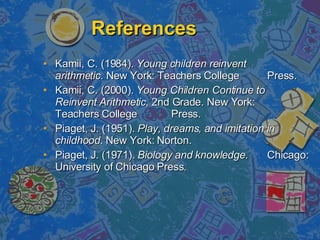
References Kamii, C. (1984).  Young children reinvent  arithmetic.  New York: Teachers College  Press.  Kamii, C. (2000).  Young Children Continue to  Reinvent Arithmetic,  2nd Grade. New York:  Teachers College  Press. Piaget, J. (1951).  Play, dreams, and imitation in  childhood . New York: Norton. Piaget, J. (1971).  Biology and knowledge .  Chicago: University of Chicago Press.

Math Manipulatives

  • 1.
    Using manipulatives toconnect theory to practice. By Aileen Machado, M. Ed & Daniela Fenu Foerch, M. Ed
  • 2.
    Introduction to theTheory Accountability era: classrooms have lost the fun and exploration Jerome Bruner Jean Piaget Lev Vygotsky Zoltan P. Dienes Constance Kamii
  • 3.
    Jerome Bruner According to Bruner, manipulatives are necessary when learning math in order to jump from one stage of learning to another. His theory aims at three stages of learning: enactive (action), pictorial (visual), and symbolic (abstract).
  • 4.
    Jean Piaget Logico-mathematicalKnowledge is constructed by the child from within through reasoning and the interaction with the environment, rather than internalized from the environment (1951; 1971). Children create logico-mathematical knowledge by connecting previously established relationships with new relationships (Kamii, 2000).
  • 5.
    Lev Vygotsky Childrencould be guided to stronger mathematical understandings as they progressively analyze complex skills on their own with the teacher’s guidance to scaffold or facilitate as needed (Baroody, Lai & Mix,2006).
  • 6.
    Zoltan P. DienesHe believes that learning mathematics does not have to be perceived as a difficult task. Rather, it should be introduced to students, especially to young children, through fun and exciting games (Holt & Dienes, 1973).
  • 7.
    Constance Kamii Mathconcepts can be acquired and internalized by young children by using “two kinds of activities: situations in daily living… and group games”(1984).
  • 8.
    References Baroody, A.J.,Lai, M., Mix, K.S. “The development of young children’s early number and operation sense and its implications tor early childhood education,” pp.187-211. In Spodek, B. and Saracho, O.N.(2006). Handbook of research on the education of young children , Second ed. Mahwah, NY: LEA. Bruner, J. (2003). The Process of Education: A Landmark in Educational Theory. Cambridge, MA: Harvard University Press Holt, M. and Dienes, P. Z. (1984). Let’s Play Math. New York: Walker and Company.
  • 9.
    References Kamii, C.(1984). Young children reinvent arithmetic. New York: Teachers College Press. Kamii, C. (2000). Young Children Continue to Reinvent Arithmetic, 2nd Grade. New York: Teachers College Press. Piaget, J. (1951). Play, dreams, and imitation in childhood . New York: Norton. Piaget, J. (1971). Biology and knowledge . Chicago: University of Chicago Press.