By shally bhardwaj
MATH WORKSHOP FOR PRIMARY
TEACHERS
The concept of big ideas requires students to understand basic concepts.
Develop inquiry and problem solving skills and connect these concepts and
skills to the real life situation.
BIG IDEAS
"Big ideas are really just large networks of interrelated concepts...whole
chunks of information store and retrieved as single entities rather than
isolated bits." (Van de Walle, 2001).
MORE ON BIG IDEAS
Big ideas need to be explicitly described and modeled by the teacher, and
students need time to actively manipulate the information and to discuss and
reflect with one another on the big ideas and the knowledge and skills along
with those principles
The big ideas in Geometry and Spatial Sense are:
•Properties of two-dimensional shapes and three dimensional figure
•Geometric relationships
•Location and movement
EXAMPLE OF BIG IDEAS
Helping children see, hear, and feel mathematics
Displaying and encouraging positive attitudes towards mathematics
Making resources available
Encouraging connections of various kinds
Valuing prior knowledge
Making meaningful home connections
Focusing on the big ideas of mathematics
PROBLEM SOLVING APPROACH
TO UNDERSTAND BIG IDEAS
A balance of shared guided and independent learning set in a
supportive and stimulating environment.
PROBLEM SOLVING AND CLASS
ROOM STRUCTURE
• a visible mathematics area in the room where core manipulatives are kept;
• manipulatives accessible to children throughout the day as needed, with
routines
established for their distribution and collection;
• manipulative storage bins or containers that are labelled for easy
identification and
clean-up;
• mathematical reference materials that are displayed around the room (e.g.,
calendar,
number lines, hundreds charts);
• computers that are accessible to all children;
• areas for instructional groupings (whole group, small group, individuals).
CLASS ROOM STRUCTURE FOR
PROBLEM SOLVING APPROACH IN
MATHEMATICS BIG IDEA LEARNING
• promote mathematical tasks that are worth talking about;
• model how to think aloud, and demonstrate how such thinking aloud is reflected
in oral dialogue or in written, pictorial, or graphic representations;
• encourage students to think aloud. This process of talking should always precede
a written strategy and should be an integral component of the conclusion of a
lesson;
• model correct mathematics language forms (e.g., line of symmetry) and
vocabulary;
• encourage talk at each stage of the problem-solving process. Students can talk
with a partner, in a group, in the whole class, or with the teacher;
• ask good questions and encourage students to ask themselves those kinds of
questions;
• ask students open-ended questions relating to specific topics or information;
COMMUNICATION IN PROBLEM
SOLVING
• encourage talk at each stage of the problem-solving process. Students can
talk with a partner, in a group, in the whole class, or with the teacher;
• ask good questions and encourage students to ask themselves those kinds of
questions;
• ask students open-ended questions relating to specific topics or information;
• encourage students to ask questions and seek clarification when they are
unsure or do not understand something;
• provide “wait time” after asking questions, to allow students time to
formulate a response
COMMUNICATION………….CONT.
• pair an English language learner with a peer who speaks the same first language
and also speaks English, and allow the students to converse about mathematical
ideas in their first language;
• model the ways in which questions can be answered;
• make the language explicit by discussing and listing questions that help students
think about and understand the mathematics they are using;
• give immediate feedback when students ask questions or provide explanations;
• encourage students to elaborate on their answer by saying, “Tell us more”;
• ask if there is more than one solution, strategy, or explanation;
• ask the question “How do you know?”
“Writing and talking are ways that learners can make their mathematical thinking
visible.”
(Whitin & Whitin, 2000, p. 2)
MORE ON COMMUNICATION
• Observation
• Interviews
• Conference
• Portfolio
• Tasks and daily work
• Journals and logs
• Self -assessment
HOW TO ASSESS STUDENTS AS
THEY PROBLEM SOLVE
Observation is probably the most important method for gaining assessment
information
about young students as they work and interact in the classroom. Teachers
should
focus their observation on specific skills, concepts, or characteristics, and
should record
their observations by using anecdotal notes or other appropriate recording
devices
OBSERVATION
Interviews are an effective tool for gathering information about young
children’s
mathematical thinking, understanding, and skills. Interviews can be formal
(Nantais, 1989)
or informal, and are focused on a specific task or learning experience.
Interviews include a
planned series of questions, and these questions and responses give teachers
information
about attitudes, skills, concepts, and/or procedures. According to Stigler
(1988):
INTERVIEWS
• Conferences/Conversations
A conference is useful for gathering information about a student’s general
progress
and for suggesting some direction. A conference or conversation might occur in a
one-to-one teaching situation or informally as a teacher walks around the room
while students are engaged in solving problems. A student-led conference, in
which
students share their portfolios or other evidence of learning with parents or
teachers,
is an effective way of helping children articulate their own learning and establish
new goals.
CONFERENCES/CONVERSATIONS
A portfolio is a purposeful collection of samples of a child’s work. These samples could
include paper-and-pencil tasks, models, photographs of the student at work, drawings,
journal entries, or other evidences of learning. This work is selected by the child and
includes a reflective component that allows the child to connect with his or her own
learning. Portfolios help to monitor growth over time (Jalbert, 1997; Stenmark, 1991).
Portfolio assessment allows all learners to show what they know and can do. A variety
of formats can be used, from a simple folder to a classroom portfolio treasure chest to
document the class’s mathematical growth.
PORTFOLIO
Daily classroom work provides an opportunity for immediate feedback and
remediation.
This instantaneous reflection by teachers allows them opportunities for
making immediate
accommodations to their programs.
TASKS AND DAILY WORK
Journals allow students to share what they know about a mathematical concept.
Mathematics journals can include written work, diagrams, drawings, stamps, stickers,
charts, or other methods of representing mathematics. Journals also offer students the
opportunity to describe how they feel about mathematics or about themselves as
mathematics learners. It is important to consider the importance of oral sharing and
the modelling of oral communication, which provides scaffolding for young children
who are not always able to communicate all their ideas in written form. Journals for
young children could be done orally with a tape recorder or as part of an interview
JOURNALS AND LOGS
Students need opportunities for self-reflection to think and talk
about their learning.
SELF ASSESSMENT
Getting started---------The teacher prepares the grade2 students for a
problem., by asking question.
Like,have you ever been to a grocery store.
Have you ever got free samples.
Why they give frees samples…………….may students reply ……..for trying
and to buy afterwards.
Today lets pretend you are the boss of the grocery store and you have 20
samples of mini packs of cookies. If you give one to each person .how many
of people will get the samples……………….. Answer could be 20 people
HOW TO USE PROBLEM SOLVING
PROCESS IN THE CLASS ROOM
But as a boss you feel that one sample is not enough .you want to give more
samples 3 or 4.
Look at the problem now how many people will get sample cookies ,if given 3
or 4.
Teacher says ……….you can use counters ,cubes, can have a partner ,can use
diagrams ,picture as ur strategies.
CONTINUED…………..
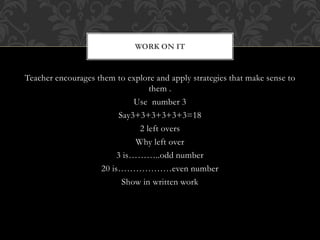
Teacher encourages them to explore and apply strategies that make sense to
them .
Use number 3
Say3+3+3+3+3+3=18
2 left overs
Why left over
3 is………..odd number
20 is………………even number
Show in written work
WORK ON IT
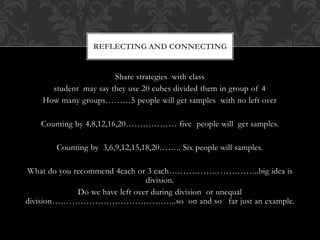
Share strategies with class
student may say they use 20 cubes divided them in group of 4
How many groups………5 people will get samples with no left over
Counting by 4,8,12,16,20……………… five people will get samples.
Counting by 3,6,9,12,15,18,20…….. Six people will samples.
What do you recommend 4each or 3 each…………………………..big idea is
division.
Do we have left over during division or unequal
division……………………………………..so on and so far just an example.
REFLECTING AND CONNECTING

Math workshop for primary teachers

  • 1.
    By shally bhardwaj MATHWORKSHOP FOR PRIMARY TEACHERS
  • 2.
    The concept ofbig ideas requires students to understand basic concepts. Develop inquiry and problem solving skills and connect these concepts and skills to the real life situation. BIG IDEAS
  • 3.
    "Big ideas arereally just large networks of interrelated concepts...whole chunks of information store and retrieved as single entities rather than isolated bits." (Van de Walle, 2001). MORE ON BIG IDEAS
  • 4.
    Big ideas needto be explicitly described and modeled by the teacher, and students need time to actively manipulate the information and to discuss and reflect with one another on the big ideas and the knowledge and skills along with those principles The big ideas in Geometry and Spatial Sense are: •Properties of two-dimensional shapes and three dimensional figure •Geometric relationships •Location and movement EXAMPLE OF BIG IDEAS
  • 5.
    Helping children see,hear, and feel mathematics Displaying and encouraging positive attitudes towards mathematics Making resources available Encouraging connections of various kinds Valuing prior knowledge Making meaningful home connections Focusing on the big ideas of mathematics PROBLEM SOLVING APPROACH TO UNDERSTAND BIG IDEAS
  • 6.
    A balance ofshared guided and independent learning set in a supportive and stimulating environment. PROBLEM SOLVING AND CLASS ROOM STRUCTURE
  • 7.
    • a visiblemathematics area in the room where core manipulatives are kept; • manipulatives accessible to children throughout the day as needed, with routines established for their distribution and collection; • manipulative storage bins or containers that are labelled for easy identification and clean-up; • mathematical reference materials that are displayed around the room (e.g., calendar, number lines, hundreds charts); • computers that are accessible to all children; • areas for instructional groupings (whole group, small group, individuals). CLASS ROOM STRUCTURE FOR PROBLEM SOLVING APPROACH IN MATHEMATICS BIG IDEA LEARNING
  • 8.
    • promote mathematicaltasks that are worth talking about; • model how to think aloud, and demonstrate how such thinking aloud is reflected in oral dialogue or in written, pictorial, or graphic representations; • encourage students to think aloud. This process of talking should always precede a written strategy and should be an integral component of the conclusion of a lesson; • model correct mathematics language forms (e.g., line of symmetry) and vocabulary; • encourage talk at each stage of the problem-solving process. Students can talk with a partner, in a group, in the whole class, or with the teacher; • ask good questions and encourage students to ask themselves those kinds of questions; • ask students open-ended questions relating to specific topics or information; COMMUNICATION IN PROBLEM SOLVING
  • 9.
    • encourage talkat each stage of the problem-solving process. Students can talk with a partner, in a group, in the whole class, or with the teacher; • ask good questions and encourage students to ask themselves those kinds of questions; • ask students open-ended questions relating to specific topics or information; • encourage students to ask questions and seek clarification when they are unsure or do not understand something; • provide “wait time” after asking questions, to allow students time to formulate a response COMMUNICATION………….CONT.
  • 10.
    • pair anEnglish language learner with a peer who speaks the same first language and also speaks English, and allow the students to converse about mathematical ideas in their first language; • model the ways in which questions can be answered; • make the language explicit by discussing and listing questions that help students think about and understand the mathematics they are using; • give immediate feedback when students ask questions or provide explanations; • encourage students to elaborate on their answer by saying, “Tell us more”; • ask if there is more than one solution, strategy, or explanation; • ask the question “How do you know?” “Writing and talking are ways that learners can make their mathematical thinking visible.” (Whitin & Whitin, 2000, p. 2) MORE ON COMMUNICATION
  • 11.
    • Observation • Interviews •Conference • Portfolio • Tasks and daily work • Journals and logs • Self -assessment HOW TO ASSESS STUDENTS AS THEY PROBLEM SOLVE
  • 12.
    Observation is probablythe most important method for gaining assessment information about young students as they work and interact in the classroom. Teachers should focus their observation on specific skills, concepts, or characteristics, and should record their observations by using anecdotal notes or other appropriate recording devices OBSERVATION
  • 13.
    Interviews are aneffective tool for gathering information about young children’s mathematical thinking, understanding, and skills. Interviews can be formal (Nantais, 1989) or informal, and are focused on a specific task or learning experience. Interviews include a planned series of questions, and these questions and responses give teachers information about attitudes, skills, concepts, and/or procedures. According to Stigler (1988): INTERVIEWS
  • 14.
    • Conferences/Conversations A conferenceis useful for gathering information about a student’s general progress and for suggesting some direction. A conference or conversation might occur in a one-to-one teaching situation or informally as a teacher walks around the room while students are engaged in solving problems. A student-led conference, in which students share their portfolios or other evidence of learning with parents or teachers, is an effective way of helping children articulate their own learning and establish new goals. CONFERENCES/CONVERSATIONS
  • 15.
    A portfolio isa purposeful collection of samples of a child’s work. These samples could include paper-and-pencil tasks, models, photographs of the student at work, drawings, journal entries, or other evidences of learning. This work is selected by the child and includes a reflective component that allows the child to connect with his or her own learning. Portfolios help to monitor growth over time (Jalbert, 1997; Stenmark, 1991). Portfolio assessment allows all learners to show what they know and can do. A variety of formats can be used, from a simple folder to a classroom portfolio treasure chest to document the class’s mathematical growth. PORTFOLIO
  • 16.
    Daily classroom workprovides an opportunity for immediate feedback and remediation. This instantaneous reflection by teachers allows them opportunities for making immediate accommodations to their programs. TASKS AND DAILY WORK
  • 17.
    Journals allow studentsto share what they know about a mathematical concept. Mathematics journals can include written work, diagrams, drawings, stamps, stickers, charts, or other methods of representing mathematics. Journals also offer students the opportunity to describe how they feel about mathematics or about themselves as mathematics learners. It is important to consider the importance of oral sharing and the modelling of oral communication, which provides scaffolding for young children who are not always able to communicate all their ideas in written form. Journals for young children could be done orally with a tape recorder or as part of an interview JOURNALS AND LOGS
  • 18.
    Students need opportunitiesfor self-reflection to think and talk about their learning. SELF ASSESSMENT
  • 19.
    Getting started---------The teacherprepares the grade2 students for a problem., by asking question. Like,have you ever been to a grocery store. Have you ever got free samples. Why they give frees samples…………….may students reply ……..for trying and to buy afterwards. Today lets pretend you are the boss of the grocery store and you have 20 samples of mini packs of cookies. If you give one to each person .how many of people will get the samples……………….. Answer could be 20 people HOW TO USE PROBLEM SOLVING PROCESS IN THE CLASS ROOM
  • 20.
    But as aboss you feel that one sample is not enough .you want to give more samples 3 or 4. Look at the problem now how many people will get sample cookies ,if given 3 or 4. Teacher says ……….you can use counters ,cubes, can have a partner ,can use diagrams ,picture as ur strategies. CONTINUED…………..
  • 21.
    Teacher encourages themto explore and apply strategies that make sense to them . Use number 3 Say3+3+3+3+3+3=18 2 left overs Why left over 3 is………..odd number 20 is………………even number Show in written work WORK ON IT
  • 22.
    Share strategies withclass student may say they use 20 cubes divided them in group of 4 How many groups………5 people will get samples with no left over Counting by 4,8,12,16,20……………… five people will get samples. Counting by 3,6,9,12,15,18,20…….. Six people will samples. What do you recommend 4each or 3 each…………………………..big idea is division. Do we have left over during division or unequal division……………………………………..so on and so far just an example. REFLECTING AND CONNECTING