Plan 1
The Big Picture of Daily Lesson Planning
Do Now:
Imagine that your first lesson plan is due tomorrow
  (Don’t worry, it isn’t). Write down 5-10 steps you
  would take in order to prepare.

Handout 1 (pg 55): Daily Lesson Planning Overview
  Self-Check: How many responses did you get
  correct? How many did you get in the right order?
Set 1 Review
What was the main point of SET1?
Effective planners are backwards planners who
  “Mind the GAP”: think about
  goals, assessments, and plans (in that order)
Virtual CS
• Template:
  – Anything that determines or serves as a pattern
  – Lesson plan templates give us a pattern or a
    model for how we think about teaching
Virtual CS
• Session Objective:
  – CM’s will select, defend, (and sometimes modify)
    only those lesson plan templates that would help
    the teacher backwards plan for student mastery
Virtual CS
• The Jigsaw Puzzle:
  – Template = the picture on the lid of the box
     • Guides our lesson planning
     • Provides us with a big picture understanding
     • Allows us to create a strong plan
        – Strong plans are the foundation for student achievement
In this session…
• Step One: How Students Learn
  – We’ll look at a framework for how students learn, and
    thus for how teachers should plan and teach
• Step Two: Characteristics of Effective Templates
  – We’ll learn what distinguishes an effective
    template, and look at several examples
• Step Three:
  – We’ll address the question of whether even strong
    templates can be modified to suit specific planning
    needs
Introduction to New Material: How Students Learn

• I Do = a segment where the teacher shows
  students what to do, and how and why to do it
• We Do = when the teacher offers support as a
  coaching, correcting, and supporting role

• You Do = when students are practicing
  independently, with minimal teacher
  intervention
Introduction to New Material: How Students Learn

• Opening = when the teacher sets students up to want
  to learn
• I Do = a segment where the teacher shows students
  what to do, and how and why to do it
• We Do = when the teacher offers support as a
  coaching, correcting, and supporting role
• You Do = when students are practicing
  independently, with minimal teacher intervention
• Closing = where students are asked to summarize and
  connect what they learned
Guided Practice: How Students Learn
• Handout 3 (pg 57): Planning Pitfalls, Part I –
  Scenarios

• Your Task
  – Read Scenarios
  – Decide which scenarios matches which pitfall,
    and discuss which part of our learning
    framework the teacher is not using effectively
Guided Practice: How Students Learn
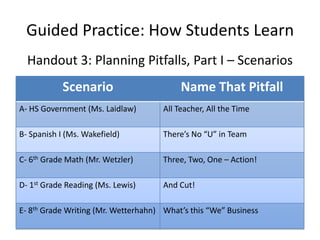
  Handout 3: Planning Pitfalls, Part I – Scenarios
            Scenario                      Name That Pitfall
A- HS Government (Ms. Laidlaw)       All Teacher, All the Time

B- Spanish I (Ms. Wakefield)         There’s No “U” in Team

C- 6th Grade Math (Mr. Wetzler)      Three, Two, One – Action!

D- 1st Grade Reading (Ms. Lewis)     And Cut!

E- 8th Grade Writing (Mr. Wetterhahn) What’s this “We” Business
Guided Practice: How Students Learn
Handout 4 (pg 60): Planning Pitfalls, Part II -Consequences

• Your Task
   – Read the student comment that corresponds with each pitfall
   – Brainstorm with your partner, specific consequences this
     pitfall will have for either students or for the teacher
      • What did the student’s comment tell you about how their learning
        suffered as a direct result of the pitfall?
      • Are the learning consequences for students short-term, long-term or
        both?
      • What other consequences are there to this pitfall? Will students be
        less invested in learning? Will the teacher potentially have increased
        difficulty managing the class?
Pitfall: Three, Two, One – Action!
• Pitfall = lack of strong opening
  – Students are unmotivated
     • Don’t know why it’s important
     • Curiosity is not piqued
     • No connection
  – Low investment
     • Opportunities for deep learning are missed
Pitfall: All Teacher All the Time
• Pitfall = teacher’s inability to balance the “I
  do” with the rest of the lesson, their inability
  to focus on key points, and their inability to
  present the content in a meaningful way
  – Students are confused – don’t know what is
    important and what is not
  – Students are bored
  – Students do not get meaningfully engaged with
    the content
Pitfall: What’s This “We” Business?
• Pitfall = because the teacher did not actively
  coach and correct students during the “We
  Do” portion of the lesson
  – Students don’t receive in-the-moment feedback
  – Students may harbor misconceptions
     • May lead to frustration
     • May lead to misbehavior
Pitfall: There’s No “U” in Team
• Pitfall = lack of “You Do”
  – Students have limited opportunity to internalize
    new knowledge/skill
  – Teacher doesn’t have a clear understanding of
    whether individual students have made progress
Pitfall: And Cut!
• Pitfall = the lack of a strong closing to
  summarize and connect the new knowledge
  and skills
  – Students don’t have a clear understanding of how
    what they learn on one day connects to anything
    they have done in the past or will do in the future
Pitfall Conclusion
If we don’t plan in a way that aligns to how
   students learn, the risk is that students won’t
   learn, and we know that isn’t an option.
Effective Lesson Planning Templates
Using a Strong template increases the likelihood
  that you will create an effective plan…which in
  turn increases the likelihood that your
  students will learn.
Characteristics of Effective Lesson Plan Templates

• Template = Anything that determines or
  serves as a pattern; a model
• Effective lesson plan templates guide teacher
  thinking in 2 ways:
  – They make backwards planning easier
     • They Mind the GAP: Goal, Assessment, Plan
  – They push us to plan in a way that maximizes
    student learning
Guided Practice: Effective Lesson Plan Templates

Handout 5 (pg 62)- Template Sort Packet
  – Your Task
     • With a partner: examine and discuss templates, sort
       templates into two groups: effective and non-effective
     • Criteria:
        – Will this template help me backwards plan? (Mind the GAP)
        – Will this template help me plan a sequence of methods that
          leads to student mastery? (I Do, We Do, You Do)
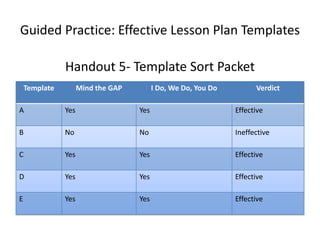
Guided Practice: Effective Lesson Plan Templates

               Handout 5- Template Sort Packet
    Template         Mind the GAP         I Do, We Do, You Do         Verdict

A              Yes                  Yes                         Effective

B              No                   No                          Ineffective

C              Yes                  Yes                         Effective

D              Yes                  Yes                         Effective

E              Yes                  Yes                         Effective
Template Evaluation
Handout 6 (pg 68) – Template Sort Response Guide

Directions:
Work and Discuss with a Partner
• Red the Template Evaluation
• Identify which template it matches (A, B, C, D, or E)
• Compare the evaluation to your own response
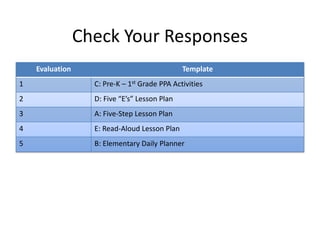
Check Your Responses
    Evaluation                                 Template
1                  C: Pre-K – 1st Grade PPA Activities
2                  D: Five “E’s” Lesson Plan
3                  A: Five-Step Lesson Plan
4                  E: Read-Aloud Lesson Plan
5                  B: Elementary Daily Planner
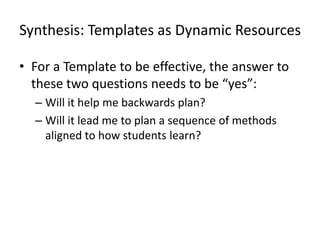
Synthesis: Templates as Dynamic Resources

• For a Template to be effective, the answer to
  these two questions needs to be “yes”:
  – Will it help me backwards plan?
  – Will it lead me to plan a sequence of methods
    aligned to how students learn?
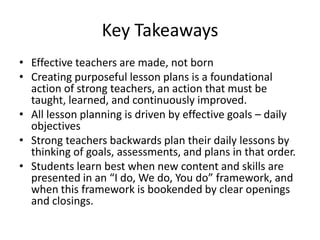
Key Takeaways
• Effective teachers are made, not born
• Creating purposeful lesson plans is a foundational
  action of strong teachers, an action that must be
  taught, learned, and continuously improved.
• All lesson planning is driven by effective goals – daily
  objectives
• Strong teachers backwards plan their daily lessons by
  thinking of goals, assessments, and plans in that order.
• Students learn best when new content and skills are
  presented in an “I do, We do, You do” framework, and
  when this framework is bookended by clear openings
  and closings.
Conclusion


Strong teachers start with strong plans. And
strong plans are guided by strong templates
that push teacher thinking in the right way.

Plan 1: Big Goals

  • 1.
    Plan 1 The BigPicture of Daily Lesson Planning
  • 2.
    Do Now: Imagine thatyour first lesson plan is due tomorrow (Don’t worry, it isn’t). Write down 5-10 steps you would take in order to prepare. Handout 1 (pg 55): Daily Lesson Planning Overview Self-Check: How many responses did you get correct? How many did you get in the right order?
  • 3.
    Set 1 Review Whatwas the main point of SET1? Effective planners are backwards planners who “Mind the GAP”: think about goals, assessments, and plans (in that order)
  • 4.
    Virtual CS • Template: – Anything that determines or serves as a pattern – Lesson plan templates give us a pattern or a model for how we think about teaching
  • 5.
    Virtual CS • SessionObjective: – CM’s will select, defend, (and sometimes modify) only those lesson plan templates that would help the teacher backwards plan for student mastery
  • 6.
    Virtual CS • TheJigsaw Puzzle: – Template = the picture on the lid of the box • Guides our lesson planning • Provides us with a big picture understanding • Allows us to create a strong plan – Strong plans are the foundation for student achievement
  • 7.
    In this session… •Step One: How Students Learn – We’ll look at a framework for how students learn, and thus for how teachers should plan and teach • Step Two: Characteristics of Effective Templates – We’ll learn what distinguishes an effective template, and look at several examples • Step Three: – We’ll address the question of whether even strong templates can be modified to suit specific planning needs
  • 8.
    Introduction to NewMaterial: How Students Learn • I Do = a segment where the teacher shows students what to do, and how and why to do it • We Do = when the teacher offers support as a coaching, correcting, and supporting role • You Do = when students are practicing independently, with minimal teacher intervention
  • 9.
    Introduction to NewMaterial: How Students Learn • Opening = when the teacher sets students up to want to learn • I Do = a segment where the teacher shows students what to do, and how and why to do it • We Do = when the teacher offers support as a coaching, correcting, and supporting role • You Do = when students are practicing independently, with minimal teacher intervention • Closing = where students are asked to summarize and connect what they learned
  • 10.
    Guided Practice: HowStudents Learn • Handout 3 (pg 57): Planning Pitfalls, Part I – Scenarios • Your Task – Read Scenarios – Decide which scenarios matches which pitfall, and discuss which part of our learning framework the teacher is not using effectively
  • 11.
    Guided Practice: HowStudents Learn Handout 3: Planning Pitfalls, Part I – Scenarios Scenario Name That Pitfall A- HS Government (Ms. Laidlaw) All Teacher, All the Time B- Spanish I (Ms. Wakefield) There’s No “U” in Team C- 6th Grade Math (Mr. Wetzler) Three, Two, One – Action! D- 1st Grade Reading (Ms. Lewis) And Cut! E- 8th Grade Writing (Mr. Wetterhahn) What’s this “We” Business
  • 12.
    Guided Practice: HowStudents Learn Handout 4 (pg 60): Planning Pitfalls, Part II -Consequences • Your Task – Read the student comment that corresponds with each pitfall – Brainstorm with your partner, specific consequences this pitfall will have for either students or for the teacher • What did the student’s comment tell you about how their learning suffered as a direct result of the pitfall? • Are the learning consequences for students short-term, long-term or both? • What other consequences are there to this pitfall? Will students be less invested in learning? Will the teacher potentially have increased difficulty managing the class?
  • 13.
    Pitfall: Three, Two,One – Action! • Pitfall = lack of strong opening – Students are unmotivated • Don’t know why it’s important • Curiosity is not piqued • No connection – Low investment • Opportunities for deep learning are missed
  • 14.
    Pitfall: All TeacherAll the Time • Pitfall = teacher’s inability to balance the “I do” with the rest of the lesson, their inability to focus on key points, and their inability to present the content in a meaningful way – Students are confused – don’t know what is important and what is not – Students are bored – Students do not get meaningfully engaged with the content
  • 15.
    Pitfall: What’s This“We” Business? • Pitfall = because the teacher did not actively coach and correct students during the “We Do” portion of the lesson – Students don’t receive in-the-moment feedback – Students may harbor misconceptions • May lead to frustration • May lead to misbehavior
  • 16.
    Pitfall: There’s No“U” in Team • Pitfall = lack of “You Do” – Students have limited opportunity to internalize new knowledge/skill – Teacher doesn’t have a clear understanding of whether individual students have made progress
  • 17.
    Pitfall: And Cut! •Pitfall = the lack of a strong closing to summarize and connect the new knowledge and skills – Students don’t have a clear understanding of how what they learn on one day connects to anything they have done in the past or will do in the future
  • 18.
    Pitfall Conclusion If wedon’t plan in a way that aligns to how students learn, the risk is that students won’t learn, and we know that isn’t an option.
  • 19.
    Effective Lesson PlanningTemplates Using a Strong template increases the likelihood that you will create an effective plan…which in turn increases the likelihood that your students will learn.
  • 20.
    Characteristics of EffectiveLesson Plan Templates • Template = Anything that determines or serves as a pattern; a model • Effective lesson plan templates guide teacher thinking in 2 ways: – They make backwards planning easier • They Mind the GAP: Goal, Assessment, Plan – They push us to plan in a way that maximizes student learning
  • 21.
    Guided Practice: EffectiveLesson Plan Templates Handout 5 (pg 62)- Template Sort Packet – Your Task • With a partner: examine and discuss templates, sort templates into two groups: effective and non-effective • Criteria: – Will this template help me backwards plan? (Mind the GAP) – Will this template help me plan a sequence of methods that leads to student mastery? (I Do, We Do, You Do)
  • 22.
    Guided Practice: EffectiveLesson Plan Templates Handout 5- Template Sort Packet Template Mind the GAP I Do, We Do, You Do Verdict A Yes Yes Effective B No No Ineffective C Yes Yes Effective D Yes Yes Effective E Yes Yes Effective
  • 23.
    Template Evaluation Handout 6(pg 68) – Template Sort Response Guide Directions: Work and Discuss with a Partner • Red the Template Evaluation • Identify which template it matches (A, B, C, D, or E) • Compare the evaluation to your own response
  • 24.
    Check Your Responses Evaluation Template 1 C: Pre-K – 1st Grade PPA Activities 2 D: Five “E’s” Lesson Plan 3 A: Five-Step Lesson Plan 4 E: Read-Aloud Lesson Plan 5 B: Elementary Daily Planner
  • 25.
    Synthesis: Templates asDynamic Resources • For a Template to be effective, the answer to these two questions needs to be “yes”: – Will it help me backwards plan? – Will it lead me to plan a sequence of methods aligned to how students learn?
  • 26.
    Key Takeaways • Effectiveteachers are made, not born • Creating purposeful lesson plans is a foundational action of strong teachers, an action that must be taught, learned, and continuously improved. • All lesson planning is driven by effective goals – daily objectives • Strong teachers backwards plan their daily lessons by thinking of goals, assessments, and plans in that order. • Students learn best when new content and skills are presented in an “I do, We do, You do” framework, and when this framework is bookended by clear openings and closings.
  • 27.
    Conclusion Strong teachers startwith strong plans. And strong plans are guided by strong templates that push teacher thinking in the right way.