By: Harkaran, Dhruvin, Tegbir, Harman
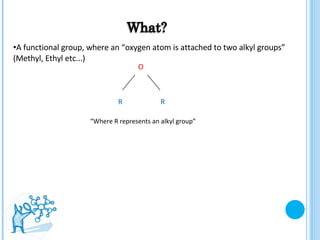
A functional group, where an “oxygen atom is attached to two alkyl groups” (Methyl, Ethyl etc...) O R R “ Where R represents an alkyl group”
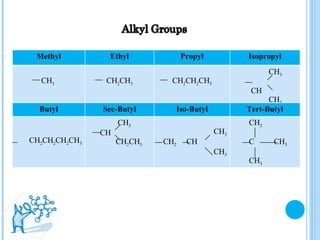
Methyl Ethyl Propyl Isopropyl CH 3   CH 2 CH 3 CH 2 CH 2 CH 3 CH 3   CH CH 3 Butyl Sec-Butyl Iso-Butyl Tert-Butyl CH 2 CH 2 CH 2 CH 3 CH 3 CH CH 2 CH 3 CH 3 CH 2  CH CH 3 CH 3 C  CH 3   CH 3
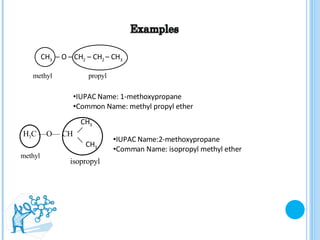
CH 3   – O – CH 2  – CH 2  – CH 3 methyl propyl IUPAC Name: 1-methoxypropane Common Name: methyl propyl ether H 3 C —O— CH CH 3 CH 3 methyl isopropyl IUPAC Name:2-methoxypropane Comman Name: isopropyl methyl ether
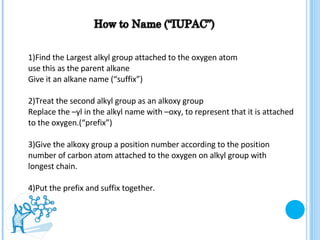
1)Find the Largest alkyl group attached to the oxygen atom use this as the parent alkane  Give it an alkane name (“suffix”) 2)Treat the second alkyl group as an alkoxy group  Replace the –yl in the alkyl name with –oxy, to represent that it is attached to the oxygen.(“prefix”) 3)Give the alkoxy group a position number according to the position number of carbon atom attached to the oxygen on alkyl group with longest chain. 4)Put the prefix and suffix together.
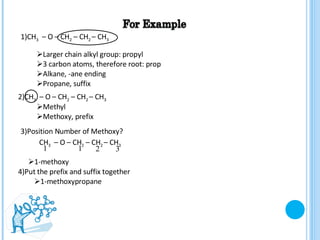
1)CH 3   – O – CH 2  – CH 2  – CH 3 Larger chain alkyl group: propyl 3 carbon atoms, therefore root: prop Alkane, -ane ending Propane, suffix 2)CH 3   – O – CH 2  – CH 2  – CH 3 Methyl Methoxy, prefix  3)Position Number of Methoxy? CH 3   – O – CH 2  – CH 2  – CH 3 4)Put the prefix and suffix together 1-methoxypropane 1 2 3 1 1-methoxy
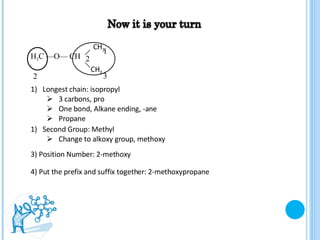
H 3 C —O— CH CH 3 CH 3 Longest chain: isopropyl 3 carbons, pro One bond, Alkane ending, -ane Propane Second Group: Methyl Change to alkoxy group, methoxy  3) Position Number: 2-methoxy 2 1 3 2 4) Put the prefix and suffix together: 2-methoxypropane
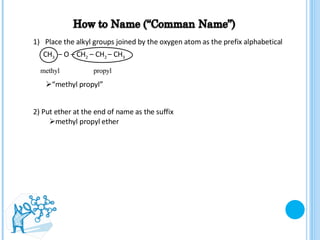
Place the alkyl groups joined by the oxygen atom as the prefix alphabetical CH 3   – O – CH 2  – CH 2  – CH 3 propyl methyl “ methyl propyl”  2) Put ether at the end of name as the suffix methyl propyl ether
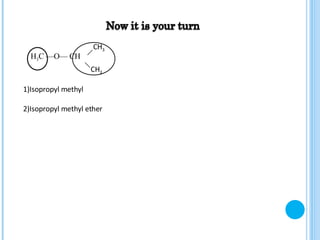
H 3 C —O— CH CH 3 CH 3 1)Isopropyl methyl 2)Isopropyl methyl ether
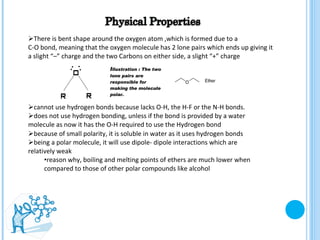
There is bent shape around the oxygen atom ,which is formed due to a  C-O bond, meaning that the oxygen molecule has 2 lone pairs which ends up giving it a slight “–” charge and the two Carbons on either side, a slight “+” charge I llustration : The two lone pairs are responsible for making the molecule polar. cannot use hydrogen bonds because lacks O-H, the H-F or the N-H bonds.  does not use hydrogen bonding, unless if the bond is provided by a water molecule as now it has the O-H required to use the Hydrogen bond because of small polarity, it is soluble in water as it uses hydrogen bonds being a polar molecule, it will use dipole- dipole interactions which are relatively weak reason why, boiling and melting points of ethers are much lower when compared to those of other polar compounds like alcohol
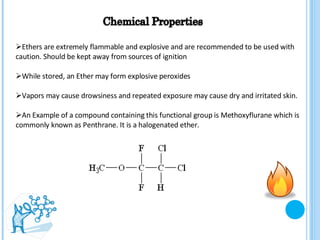
Ethers are extremely flammable and explosive and are recommended to be used with caution. Should be kept away from sources of ignition While stored, an Ether may form explosive peroxides Vapors may cause drowsiness and repeated exposure may cause dry and irritated skin. An Example of a compound containing this functional group is Methoxyflurane which is commonly known as Penthrane. It is a halogenated ether.
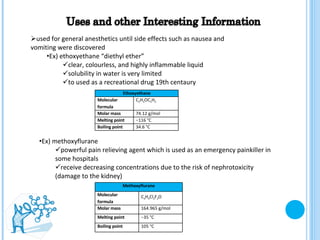
used for general anesthetics until side effects such as nausea and vomiting were discovered Ex) ethoxyethane “diethyl ether” clear, colourless, and highly inflammable liquid solubility in water is very limited to used as a recreational drug 19th centaury  Ex) methoxyflurane powerful pain relieving agent which is used as an emergency painkiller in some hospitals receive decreasing concentrations due to the risk of nephrotoxicity (damage to the kidney) Ethoxyethane Molecular formula C 2 H 5 OC 2 H 5 Molar mass 74.12 g/mol Melting point − 116 °C  Boiling point 34.6 °C  Methoxyflurane Molecular  formula C 3 H 4 Cl 2 F 2 O   Molar mass 164.965 g/mol Melting point − 35 °C Boiling point 105 °C
Polyethylene glycol (PEG) Type of polyether (Polyethers are compounds with more than one ether group) Properties  Molecular formula C2n+2H4n+6On+2 Molar mass 44n+62 Flash point 182 - 287 °C (The temperature at which any flammable material will burst into flame) PEG is soluble in water because of the presence of the OH group  Clinical Uses:  Used in laxatives (drugs or foods that induce bowel movements, loosen stools and used for  treatment against constipation) Used as lubricant for colonoscopy and bowel surgery  Other  Uses:  Used in a number of toothpastes to prevent chemical compounds from adhering in the toothpastes  injection of PEG leads to faster recovery of spinal injuries in research animals.  used in eye lubricant drops  Polyethylene glycol (PEG)
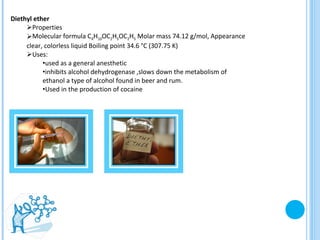
Diethyl ether Properties  Molecular formula C 4 H 10 OC 2 H 5 OC 2 H 5  Molar mass 74.12 g/mol, Appearance clear, colorless liquid Boiling point 34.6 °C (307.75 K) Uses: used as a general anesthetic  inhibits alcohol dehydrogenase ,slows down the metabolism of ethanol a type of alcohol found in beer and rum.  Used in the production of cocaine

Molecular Design

  • 1.
    By: Harkaran, Dhruvin,Tegbir, Harman
  • 2.
    A functional group,where an “oxygen atom is attached to two alkyl groups” (Methyl, Ethyl etc...) O R R “ Where R represents an alkyl group”
  • 3.
    Methyl Ethyl PropylIsopropyl CH 3 CH 2 CH 3 CH 2 CH 2 CH 3 CH 3 CH CH 3 Butyl Sec-Butyl Iso-Butyl Tert-Butyl CH 2 CH 2 CH 2 CH 3 CH 3 CH CH 2 CH 3 CH 3 CH 2 CH CH 3 CH 3 C CH 3 CH 3
  • 4.
    CH 3 – O – CH 2 – CH 2 – CH 3 methyl propyl IUPAC Name: 1-methoxypropane Common Name: methyl propyl ether H 3 C —O— CH CH 3 CH 3 methyl isopropyl IUPAC Name:2-methoxypropane Comman Name: isopropyl methyl ether
  • 5.
    1)Find the Largestalkyl group attached to the oxygen atom use this as the parent alkane Give it an alkane name (“suffix”) 2)Treat the second alkyl group as an alkoxy group Replace the –yl in the alkyl name with –oxy, to represent that it is attached to the oxygen.(“prefix”) 3)Give the alkoxy group a position number according to the position number of carbon atom attached to the oxygen on alkyl group with longest chain. 4)Put the prefix and suffix together.
  • 6.
    1)CH 3 – O – CH 2 – CH 2 – CH 3 Larger chain alkyl group: propyl 3 carbon atoms, therefore root: prop Alkane, -ane ending Propane, suffix 2)CH 3 – O – CH 2 – CH 2 – CH 3 Methyl Methoxy, prefix 3)Position Number of Methoxy? CH 3 – O – CH 2 – CH 2 – CH 3 4)Put the prefix and suffix together 1-methoxypropane 1 2 3 1 1-methoxy
  • 7.
    H 3 C—O— CH CH 3 CH 3 Longest chain: isopropyl 3 carbons, pro One bond, Alkane ending, -ane Propane Second Group: Methyl Change to alkoxy group, methoxy 3) Position Number: 2-methoxy 2 1 3 2 4) Put the prefix and suffix together: 2-methoxypropane
  • 8.
    Place the alkylgroups joined by the oxygen atom as the prefix alphabetical CH 3 – O – CH 2 – CH 2 – CH 3 propyl methyl “ methyl propyl” 2) Put ether at the end of name as the suffix methyl propyl ether
  • 9.
    H 3 C—O— CH CH 3 CH 3 1)Isopropyl methyl 2)Isopropyl methyl ether
  • 10.
    There is bentshape around the oxygen atom ,which is formed due to a C-O bond, meaning that the oxygen molecule has 2 lone pairs which ends up giving it a slight “–” charge and the two Carbons on either side, a slight “+” charge I llustration : The two lone pairs are responsible for making the molecule polar. cannot use hydrogen bonds because lacks O-H, the H-F or the N-H bonds. does not use hydrogen bonding, unless if the bond is provided by a water molecule as now it has the O-H required to use the Hydrogen bond because of small polarity, it is soluble in water as it uses hydrogen bonds being a polar molecule, it will use dipole- dipole interactions which are relatively weak reason why, boiling and melting points of ethers are much lower when compared to those of other polar compounds like alcohol
  • 11.
    Ethers are extremelyflammable and explosive and are recommended to be used with caution. Should be kept away from sources of ignition While stored, an Ether may form explosive peroxides Vapors may cause drowsiness and repeated exposure may cause dry and irritated skin. An Example of a compound containing this functional group is Methoxyflurane which is commonly known as Penthrane. It is a halogenated ether.
  • 12.
    used for generalanesthetics until side effects such as nausea and vomiting were discovered Ex) ethoxyethane “diethyl ether” clear, colourless, and highly inflammable liquid solubility in water is very limited to used as a recreational drug 19th centaury Ex) methoxyflurane powerful pain relieving agent which is used as an emergency painkiller in some hospitals receive decreasing concentrations due to the risk of nephrotoxicity (damage to the kidney) Ethoxyethane Molecular formula C 2 H 5 OC 2 H 5 Molar mass 74.12 g/mol Melting point − 116 °C Boiling point 34.6 °C Methoxyflurane Molecular formula C 3 H 4 Cl 2 F 2 O   Molar mass 164.965 g/mol Melting point − 35 °C Boiling point 105 °C
  • 13.
    Polyethylene glycol (PEG)Type of polyether (Polyethers are compounds with more than one ether group) Properties Molecular formula C2n+2H4n+6On+2 Molar mass 44n+62 Flash point 182 - 287 °C (The temperature at which any flammable material will burst into flame) PEG is soluble in water because of the presence of the OH group Clinical Uses: Used in laxatives (drugs or foods that induce bowel movements, loosen stools and used for treatment against constipation) Used as lubricant for colonoscopy and bowel surgery Other Uses: Used in a number of toothpastes to prevent chemical compounds from adhering in the toothpastes injection of PEG leads to faster recovery of spinal injuries in research animals. used in eye lubricant drops Polyethylene glycol (PEG)
  • 14.
    Diethyl ether Properties Molecular formula C 4 H 10 OC 2 H 5 OC 2 H 5 Molar mass 74.12 g/mol, Appearance clear, colorless liquid Boiling point 34.6 °C (307.75 K) Uses: used as a general anesthetic inhibits alcohol dehydrogenase ,slows down the metabolism of ethanol a type of alcohol found in beer and rum. Used in the production of cocaine