Structure &
components of the EC
business model
- Manohar Prasad
Business model
• Describes the basic framework of a business, the
method of doing business by which a company can
generate revenue to sustain itself.
• A business model identifies
– mkt segment that is being served (WHO)
– service that is being provided (WHAT)
– means by which the service is produced (HOW)
– And how the firm plans to make money over the longer
term using the Internet
• A firm’s business model also describes how the
organization is positioned in the industry value
chain
2www.tutorialvidya.com
Functions of a business model
• Articulating the value proposition
• Identifying a market segment
• Defining the structure of the firm’s value chain
• Specifying the revenue generation mechanisms for
the firm
• Describing the position of the firm within the value
network
• Formulating the competitive strategy to gain
advantage over rivals
3www.tutorialvidya.com
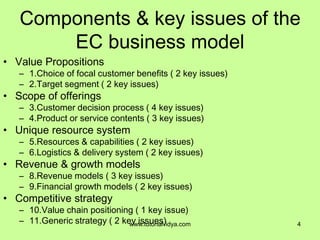
Components & key issues of the
EC business model
• Value Propositions
– 1.Choice of focal customer benefits ( 2 key issues)
– 2.Target segment ( 2 key issues)
• Scope of offerings
– 3.Customer decision process ( 4 key issues)
– 4.Product or service contents ( 3 key issues)
• Unique resource system
– 5.Resources & capabilities ( 2 key issues)
– 6.Logistics & delivery system ( 2 key issues)
• Revenue & growth models
– 8.Revenue models ( 3 key issues)
– 9.Financial growth models ( 2 key issues)
• Competitive strategy
– 10.Value chain positioning ( 1 key issue)
– 11.Generic strategy ( 2 key issues) 4www.tutorialvidya.com
1.Choice of focal customer benefits : key
issues
• A. Core products/services
– What value or benefit do we provide to our
customers?
– How unique is the value or benefit?
– Do those values satisfy customer’s demand?
– Do the products or services have strong
network effects?
– Are there substitutes for our products or
services?
5www.tutorialvidya.com
1.Choice of focal customer benefits : key
issues
• B. Supplement products/services:
– How important are the supplement products or
services?
– How do we increase customer value by
improving or redesigning business processes?
– How important is it to provide product
instructions, user training, and customer
services?
6www.tutorialvidya.com
2.Target segment
• A. Market attractiveness:
– How substantial is the market segment?
– Is the market under- or overserved?
– What is the growth rate of the market
segment?
– Which stage is the product in the product
lifecycle?
7www.tutorialvidya.com
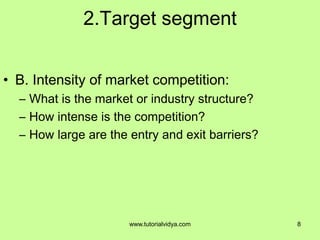
2.Target segment
• B. Intensity of market competition:
– What is the market or industry structure?
– How intense is the competition?
– How large are the entry and exit barriers?
8www.tutorialvidya.com
3.Customer decision process:
key issues
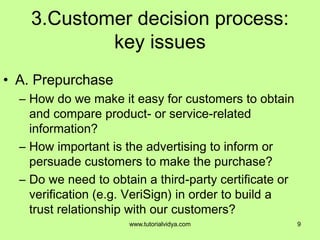
• A. Prepurchase
– How do we make it easy for customers to obtain
and compare product- or service-related
information?
– How important is the advertising to inform or
persuade customers to make the purchase?
– Do we need to obtain a third-party certificate or
verification (e.g. VeriSign) in order to build a
trust relationship with our customers?
9www.tutorialvidya.com
3.Customer decision process:
key issues
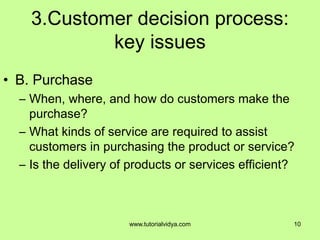
• B. Purchase
– When, where, and how do customers make the
purchase?
– What kinds of service are required to assist
customers in purchasing the product or service?
– Is the delivery of products or services efficient?
10www.tutorialvidya.com
3.Customer decision process:
key issues
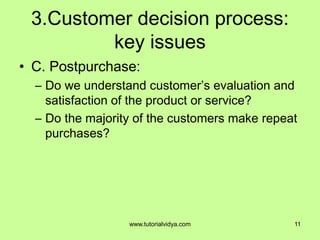
• C. Postpurchase:
– Do we understand customer’s evaluation and
satisfaction of the product or service?
– Do the majority of the customers make repeat
purchases?
11www.tutorialvidya.com
3.Customer decision process:
key issues
• D. Purchasing process:
– How important is it to offer customer assistance
in the whole process of purchasing a product?
– Can we identify the customer decision process
and be able to provide effective assistance?
– Do we have an effective e-commerce site that is
user friendly?
– How do we lower the transaction costs to make
it easy for customers to do business with us?
12www.tutorialvidya.com
4.Product or service contents:
Key issues
• A. Core product or service:
– Do we understand which business we are in?
– Do our products or services solve the
customers’ problems?
13www.tutorialvidya.com
4.Product or service contents:
Key issues
• B. Supplementary product or service:
– Do we build and maintain a set of digital assets in order
to know our customers better?
– How do we leverage on a single set of digital assets to
provide value across many different and disparate
markets?
• Digital assets the info in digital form a company collected
about its customers.
• Companies that create value with digital assets may be able to
reharvest them through a potentially infinite number of
transactions.
– How do we increase customers’ switching costs
(incurred by buyers when they switch to a different
supplier) from using our company’s products or
services? 14www.tutorialvidya.com
4.Product or service contents:
Key issues
• C.Core delivery process:
– Do we understand and take advantage of the economies
of scope in production and distribution of the product or
service?
• Supply-side economies of scope  cost of the joint production
of 2 or more products can be less than the cost of producing
them separately.
• Demand-side economies of scale  a single set of digital assets
can provide value for customers across many different and
disparate markets.
– What kinds of channel (digital and/or physical) do we
need to deliver our products or services?
– How efficient and effective are the products or services
being delivered?
15www.tutorialvidya.com
5.Resources & capabilities: key issues
• A. Specifying a resource system:
– Do we identify the resources (labour, capital, assets)
needed to build our core competencies or capabilities?
– Do we have all the necessary core capabilities to
support our scope of product or service offerings?
– Do we need to outsource and/or partner with others to
gain missing capabilities?
– Can we identify key players who can fill out the missing
capabilities?
– How important is the role of intellectual property rights
(patents and trademarks) in building capabilities? 16www.tutorialvidya.com
5.Resources & capabilities: key issues
• B. Assessing the quality of the resource system:
– How unique is our resource system?
– How difficult is it for competitors to imitate our system?
– Do each of the capabilities support the delivery of a
customer benefit?
– How well do the capabilities complement and support
each other?
– Are the specific resources mutually reinforcing? Are they
complementary?
– Does the online resource system support the offline
system? 17www.tutorialvidya.com
6.Logistics & delivery system:
key issues
• A. Integration
– Can we deliver a unique customer experience
through e-commerce?
– Are we able to achieve supply chain integration and
synchronization
• Applying Internet-based collaborative planning, forecasting,
and replenishment, CPFR
– Are we able to collaborate with business partners
across a common technical platform using common
e-business applications?
18www.tutorialvidya.com
8.Revenue models: key issues
• A.Product/service sales:
– Are our revenues primarily derived from
product sales or from complementary
products or services?
– Can we generate revenues from utilizing
intellectual properties?
19www.tutorialvidya.com
8.Revenue models: key issues
• B.
• E-commerce-related revenues:
– How do we identify new sources of revenues from e-
commerce
• Advertising, referrals, subscription, membership,
commissions, transactions, etc
– How do we use information to create value both
online and offline?
• Example: Fedex’s packaging tracking system
– Do our customers value the benefit of one-stop
shopping?
20www.tutorialvidya.com
8.Revenue models: key issues
• C.
• Pricing
– How do we test prices, segment customers, and adjust
to changes in supply and demand in real time?
– How do we analyze digital assets and experiment with
new ways of pricing?
– Are we able to implement innovative e-commerce pricing
methods?
• Like reverse auction, one-to-one bargaining?
– How do we build online brand equity to enhance loyalty
and to reduce price sensitivity? 21www.tutorialvidya.com
9.Financial growth models: key
issues
• A.
• Growth strategy:
– How should we develop new revenue growth?
• Deeper penetration into the current market
• New product development
• New market development and/or
• Completely new products and markets
22www.tutorialvidya.com
9.Financial growth models: key
issues
• B.
• Growth model:
– Do we need to spin off an online division to
establish a new company?
– Do we need to establish strategic alliances or
merge with other online/offline companies?
23www.tutorialvidya.com
10.Value chain positioning: Key
issues
• Value system or network
– Where do we position our products or services in an
industry value chain? Can we integrate or move
upstream or downstream to increase added values?
– How do we create value? Do we create customer value
as
• a partner in a supply chain (manufacturer or retailer)
• A value shop (professional service)
• A central player of a network (intermediary service)?
– Can we join a business ecosystem ( like online mega
sites such as Amazon.com) as a member to provide
products or services to the final customers?
• Business ecosystem a system in which companies work
cooperatively to support new products, satisfy customers, and
create the next round of innovations in key market segments. 24www.tutorialvidya.com
11.Generic strategy: key issues
• Competitive advantage:
– Do we have advantages over our competitors in
terms of marketing, cost structure, and product
or service differentiation?
– Do e-commerce and the Internet redefine the
competitive advantage in the market or industry
we are in?
25www.tutorialvidya.com
11.Generic strategy: key issues
• B:
• Generic strategy
– Which strategy should we pursue in order to
sustain our competitive advantages
• Increase entry barriers or
• block strategy, innovation or
• run strategy, and/or
• alliance or team-up strategy
26www.tutorialvidya.com
MANOHAR PRASAD
CO-FOUNDER & MANAGING DIRECTOR
WWW.TUTORIALVIDYA.COM
Thank you!
27www.tutorialvidya.com

Structure & components of e-business

  • 1.
    Structure & components ofthe EC business model - Manohar Prasad
  • 2.
    Business model • Describesthe basic framework of a business, the method of doing business by which a company can generate revenue to sustain itself. • A business model identifies – mkt segment that is being served (WHO) – service that is being provided (WHAT) – means by which the service is produced (HOW) – And how the firm plans to make money over the longer term using the Internet • A firm’s business model also describes how the organization is positioned in the industry value chain 2www.tutorialvidya.com
  • 3.
    Functions of abusiness model • Articulating the value proposition • Identifying a market segment • Defining the structure of the firm’s value chain • Specifying the revenue generation mechanisms for the firm • Describing the position of the firm within the value network • Formulating the competitive strategy to gain advantage over rivals 3www.tutorialvidya.com
  • 4.
    Components & keyissues of the EC business model • Value Propositions – 1.Choice of focal customer benefits ( 2 key issues) – 2.Target segment ( 2 key issues) • Scope of offerings – 3.Customer decision process ( 4 key issues) – 4.Product or service contents ( 3 key issues) • Unique resource system – 5.Resources & capabilities ( 2 key issues) – 6.Logistics & delivery system ( 2 key issues) • Revenue & growth models – 8.Revenue models ( 3 key issues) – 9.Financial growth models ( 2 key issues) • Competitive strategy – 10.Value chain positioning ( 1 key issue) – 11.Generic strategy ( 2 key issues) 4www.tutorialvidya.com
  • 5.
    1.Choice of focalcustomer benefits : key issues • A. Core products/services – What value or benefit do we provide to our customers? – How unique is the value or benefit? – Do those values satisfy customer’s demand? – Do the products or services have strong network effects? – Are there substitutes for our products or services? 5www.tutorialvidya.com
  • 6.
    1.Choice of focalcustomer benefits : key issues • B. Supplement products/services: – How important are the supplement products or services? – How do we increase customer value by improving or redesigning business processes? – How important is it to provide product instructions, user training, and customer services? 6www.tutorialvidya.com
  • 7.
    2.Target segment • A.Market attractiveness: – How substantial is the market segment? – Is the market under- or overserved? – What is the growth rate of the market segment? – Which stage is the product in the product lifecycle? 7www.tutorialvidya.com
  • 8.
    2.Target segment • B.Intensity of market competition: – What is the market or industry structure? – How intense is the competition? – How large are the entry and exit barriers? 8www.tutorialvidya.com
  • 9.
    3.Customer decision process: keyissues • A. Prepurchase – How do we make it easy for customers to obtain and compare product- or service-related information? – How important is the advertising to inform or persuade customers to make the purchase? – Do we need to obtain a third-party certificate or verification (e.g. VeriSign) in order to build a trust relationship with our customers? 9www.tutorialvidya.com
  • 10.
    3.Customer decision process: keyissues • B. Purchase – When, where, and how do customers make the purchase? – What kinds of service are required to assist customers in purchasing the product or service? – Is the delivery of products or services efficient? 10www.tutorialvidya.com
  • 11.
    3.Customer decision process: keyissues • C. Postpurchase: – Do we understand customer’s evaluation and satisfaction of the product or service? – Do the majority of the customers make repeat purchases? 11www.tutorialvidya.com
  • 12.
    3.Customer decision process: keyissues • D. Purchasing process: – How important is it to offer customer assistance in the whole process of purchasing a product? – Can we identify the customer decision process and be able to provide effective assistance? – Do we have an effective e-commerce site that is user friendly? – How do we lower the transaction costs to make it easy for customers to do business with us? 12www.tutorialvidya.com
  • 13.
    4.Product or servicecontents: Key issues • A. Core product or service: – Do we understand which business we are in? – Do our products or services solve the customers’ problems? 13www.tutorialvidya.com
  • 14.
    4.Product or servicecontents: Key issues • B. Supplementary product or service: – Do we build and maintain a set of digital assets in order to know our customers better? – How do we leverage on a single set of digital assets to provide value across many different and disparate markets? • Digital assets the info in digital form a company collected about its customers. • Companies that create value with digital assets may be able to reharvest them through a potentially infinite number of transactions. – How do we increase customers’ switching costs (incurred by buyers when they switch to a different supplier) from using our company’s products or services? 14www.tutorialvidya.com
  • 15.
    4.Product or servicecontents: Key issues • C.Core delivery process: – Do we understand and take advantage of the economies of scope in production and distribution of the product or service? • Supply-side economies of scope  cost of the joint production of 2 or more products can be less than the cost of producing them separately. • Demand-side economies of scale  a single set of digital assets can provide value for customers across many different and disparate markets. – What kinds of channel (digital and/or physical) do we need to deliver our products or services? – How efficient and effective are the products or services being delivered? 15www.tutorialvidya.com
  • 16.
    5.Resources & capabilities:key issues • A. Specifying a resource system: – Do we identify the resources (labour, capital, assets) needed to build our core competencies or capabilities? – Do we have all the necessary core capabilities to support our scope of product or service offerings? – Do we need to outsource and/or partner with others to gain missing capabilities? – Can we identify key players who can fill out the missing capabilities? – How important is the role of intellectual property rights (patents and trademarks) in building capabilities? 16www.tutorialvidya.com
  • 17.
    5.Resources & capabilities:key issues • B. Assessing the quality of the resource system: – How unique is our resource system? – How difficult is it for competitors to imitate our system? – Do each of the capabilities support the delivery of a customer benefit? – How well do the capabilities complement and support each other? – Are the specific resources mutually reinforcing? Are they complementary? – Does the online resource system support the offline system? 17www.tutorialvidya.com
  • 18.
    6.Logistics & deliverysystem: key issues • A. Integration – Can we deliver a unique customer experience through e-commerce? – Are we able to achieve supply chain integration and synchronization • Applying Internet-based collaborative planning, forecasting, and replenishment, CPFR – Are we able to collaborate with business partners across a common technical platform using common e-business applications? 18www.tutorialvidya.com
  • 19.
    8.Revenue models: keyissues • A.Product/service sales: – Are our revenues primarily derived from product sales or from complementary products or services? – Can we generate revenues from utilizing intellectual properties? 19www.tutorialvidya.com
  • 20.
    8.Revenue models: keyissues • B. • E-commerce-related revenues: – How do we identify new sources of revenues from e- commerce • Advertising, referrals, subscription, membership, commissions, transactions, etc – How do we use information to create value both online and offline? • Example: Fedex’s packaging tracking system – Do our customers value the benefit of one-stop shopping? 20www.tutorialvidya.com
  • 21.
    8.Revenue models: keyissues • C. • Pricing – How do we test prices, segment customers, and adjust to changes in supply and demand in real time? – How do we analyze digital assets and experiment with new ways of pricing? – Are we able to implement innovative e-commerce pricing methods? • Like reverse auction, one-to-one bargaining? – How do we build online brand equity to enhance loyalty and to reduce price sensitivity? 21www.tutorialvidya.com
  • 22.
    9.Financial growth models:key issues • A. • Growth strategy: – How should we develop new revenue growth? • Deeper penetration into the current market • New product development • New market development and/or • Completely new products and markets 22www.tutorialvidya.com
  • 23.
    9.Financial growth models:key issues • B. • Growth model: – Do we need to spin off an online division to establish a new company? – Do we need to establish strategic alliances or merge with other online/offline companies? 23www.tutorialvidya.com
  • 24.
    10.Value chain positioning:Key issues • Value system or network – Where do we position our products or services in an industry value chain? Can we integrate or move upstream or downstream to increase added values? – How do we create value? Do we create customer value as • a partner in a supply chain (manufacturer or retailer) • A value shop (professional service) • A central player of a network (intermediary service)? – Can we join a business ecosystem ( like online mega sites such as Amazon.com) as a member to provide products or services to the final customers? • Business ecosystem a system in which companies work cooperatively to support new products, satisfy customers, and create the next round of innovations in key market segments. 24www.tutorialvidya.com
  • 25.
    11.Generic strategy: keyissues • Competitive advantage: – Do we have advantages over our competitors in terms of marketing, cost structure, and product or service differentiation? – Do e-commerce and the Internet redefine the competitive advantage in the market or industry we are in? 25www.tutorialvidya.com
  • 26.
    11.Generic strategy: keyissues • B: • Generic strategy – Which strategy should we pursue in order to sustain our competitive advantages • Increase entry barriers or • block strategy, innovation or • run strategy, and/or • alliance or team-up strategy 26www.tutorialvidya.com
  • 27.
    MANOHAR PRASAD CO-FOUNDER &MANAGING DIRECTOR WWW.TUTORIALVIDYA.COM Thank you! 27www.tutorialvidya.com