Welcome to my
presentation
FINANCIAL MANAGEMENT WORK
TOPIC
A WORLD OF E- Commerce
Contents includes
Meaning
E-commerce types
Characteristics
Advantages
Disadvantages
Meaning of E-commerce
 Ecommerce, also known as electronic commerce or
internet commerce, refers to the buying and selling of
goods or services using the internet, and the transfer
of money and data to execute these transactions.
Ecommerce is often used to refer to the sale of
physical products online, but it can also describe any
kind of commercial transaction that is facilitated
through the internet.
 Whereas e-business refers to all aspects of operating
an online business, ecommerce refers specifically to
the transaction of goods and services.
TYPES OF E-COMMERCE
B2C
 B2B stands for business-
to-business, referring to a
type of transaction that
takes place between one
business and another.
B2B
 Refers to commerce
between two businesses
rather than between a
business and an individual
consumer. Transactions at
the wholesale level are
usually business-to-business,
while those at the retail level
are most often business-to-
consumer (B2C)
CONTINUE
C2B
 Customer to customer (C2C)
is a business model
whereby customers can
trade with each other,
typically in an online
environment. Two
implementations of C2C
markets are auctions and
classified advertisements.
C2C
 C2C is a business
model where customers
purchase goods from
other customers via a
third-party platform or
business.
CHARACTERISTICS OF E -
COMMERCE
 Establishment of business to business
 Electronic payment
 E distribution
 Extend of information
 Pre sale and post sales
 Customer relationship
ADVANTAGES OF E - COMMERCE
1 Progress facility
2 Provide increased
purchased
opportunity
3 Low staffin cost
[employee]
4 Increase profits
5 Increase customer
service and loyalty
6 Increase speed and
accurate
7 Reduction of paper
storage
8 Increase response
and time
DIS – ADVANTAGES OF E- COMMERCE
Security risk
High start up cost
Uncertainity
Lack of skill personal
Legal issues
Lack of information
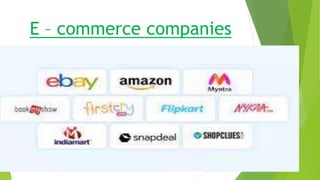
E – commerce companies
Years Internet
connectio
ns
Internet
users
Year Internet
connectio
ns
Internet
users
1995 0.002 0.01 2000 0.9 3.8
1996 0.05 0.25 2001 3.5 8
1997 0.09 0.45 2002
[projected]
4.5 15
1998 0.14 0.7 2003
[projected]
15 50
1999 0.28 1.4
GROTH OF INTERNET USERS
IN INDIA [In millions]
TOTAL E- COMMERS USERS IN INDIA
Year Total E-commers
transaction
Business to
consumer
Business to
business [in crores]
1998-1999 131 13 119
1999- 2000 450 50 400
2000-2001 1300 100 1100
A world of e-commerce

A world of e-commerce

  • 1.
  • 2.
    TOPIC A WORLD OFE- Commerce
  • 3.
  • 4.
    Meaning of E-commerce Ecommerce, also known as electronic commerce or internet commerce, refers to the buying and selling of goods or services using the internet, and the transfer of money and data to execute these transactions. Ecommerce is often used to refer to the sale of physical products online, but it can also describe any kind of commercial transaction that is facilitated through the internet.  Whereas e-business refers to all aspects of operating an online business, ecommerce refers specifically to the transaction of goods and services.
  • 5.
    TYPES OF E-COMMERCE B2C B2B stands for business- to-business, referring to a type of transaction that takes place between one business and another. B2B  Refers to commerce between two businesses rather than between a business and an individual consumer. Transactions at the wholesale level are usually business-to-business, while those at the retail level are most often business-to- consumer (B2C)
  • 6.
    CONTINUE C2B  Customer tocustomer (C2C) is a business model whereby customers can trade with each other, typically in an online environment. Two implementations of C2C markets are auctions and classified advertisements. C2C  C2C is a business model where customers purchase goods from other customers via a third-party platform or business.
  • 7.
    CHARACTERISTICS OF E- COMMERCE  Establishment of business to business  Electronic payment  E distribution  Extend of information  Pre sale and post sales  Customer relationship
  • 8.
    ADVANTAGES OF E- COMMERCE 1 Progress facility 2 Provide increased purchased opportunity 3 Low staffin cost [employee] 4 Increase profits 5 Increase customer service and loyalty 6 Increase speed and accurate 7 Reduction of paper storage 8 Increase response and time
  • 9.
    DIS – ADVANTAGESOF E- COMMERCE Security risk High start up cost Uncertainity Lack of skill personal Legal issues Lack of information
  • 10.
    E – commercecompanies
  • 11.
    Years Internet connectio ns Internet users Year Internet connectio ns Internet users 19950.002 0.01 2000 0.9 3.8 1996 0.05 0.25 2001 3.5 8 1997 0.09 0.45 2002 [projected] 4.5 15 1998 0.14 0.7 2003 [projected] 15 50 1999 0.28 1.4 GROTH OF INTERNET USERS IN INDIA [In millions]
  • 12.
    TOTAL E- COMMERSUSERS IN INDIA Year Total E-commers transaction Business to consumer Business to business [in crores] 1998-1999 131 13 119 1999- 2000 450 50 400 2000-2001 1300 100 1100