STROKE
Sumi Singh
Nepal Medical College andTeaching Hospital
 Stroke is defined as rapidly developing clinical signs of focal (or
global) disturbance of cerebral function, lasting more than 24
hours or leading to death, with no apparent cause other than
that of vascular origin(according toWHO adapted by American
Heart Association)
 It is common neurological emergency that can be treated with
time sensitive interventions.
 Ischemic stroke accounts for about 80% of all strokes,
intracerebral hemorrhage for 15% and subarachnoid
hemorrhage for 5%.
Global epidemiology of stroke
 Annually 15 million worldwide suffer a stroke -5 million die and
5 million are permanently disabled
 According toWHO Statistics cerebrovascular disease is the 2nd
cause of death worldwide.
 WHO estimates a stroke occurs in every 5 seconds
 Stroke related disability is the sixth most common cause of
reduced DALYs
 Stroke accounts for 10% of all deaths worldwide.
Arterial circulation of brain
Classification of Stroke
ACUTE ISCHEMIC
STROKE
Risk factor for stroke
Modifiable Non- modifiable
Blood pressure Age
Cigarette smoking Gender(male>female except at extreme of age)
Diabetes mellitus Race(Afro-caribbean>Asian>Eurpoean)
Excessive alcohol intake Heredity
Hyperlipidaemia High fibrinogen
Heart disease (Atrial fibrillation,Congestive
cardiac failure,Infective Endocarditis)
Previous vascular infraction
-myocardial infraction
-stroke
-peripherial vascular disease
Oestrogen containing drugs (OCP,HRT)
Polycythaemia
Cardiac causes
High risk:
 AF
 MS
 AMI
 recent IE
 dilated cardiomyopathy.
Moderate risk:
 Remote MI
 TR
 Hypertrophic myopathy
 aterial myxoma.
Pathophysiology of cerebral
Ischemia
 Normal cerebral blood flow at rest in the normal adult brain is
approx. 50 to 55ml/100g/min
 When blood flow decreases to 18ml/100g/min,the brain
reaches a threshold for electrical failure.
 When blood flow decreases to 8ml/100g/min.cell death can
result.
 These threshold mark the upper and lower blood flow limits of
the ischemic penumbra.
Clinical syndromes of cerebral
ischemia
 Transient Ischemic attacks
Condition in which symptoms resolve within 24hrs –is a
temporary and non marching neurological deficit of sudden
onset;attributed to focal ischemia of brain,retina,or cochlea
 Stroke:those events where symptoms last for >24hrs
 Progressing stroke:(stroke in evolution) in which the focal
neurological event worsens after patient 1st presents.
 Complete stroke:in which the focal deficit persists and is not
progressing.
■ Most vascular lesions develop suddenly with a matter of
minutes or hours , so should be considered in differential
diagnosis of patients with any neurological presentations.
■ Clinical presentation depends upon which arterial territory is
involved and the size of the lessions.
Presenting problems
 Weakness:unilateral weakness is sudden,
progresses rapidly and follows a hemiplegic
pattern.( UMN weakness of the face (7th nerve )is
often present.
 Speech disturbance: Dysphasia and dysarthria
are the most common presentation of disturbed
speech.
 Visual deficit: can be dt unilateral optic
ischaemia (called amaurosis fugax if transient)
Presenting problems
Ataxia :stroke causing damage to
cerebellum and its connections
Apraxia
Headache:it is rarely a dominant feature
(sudden severe headache is cardinal in
SAH )
Seizure: it is unusual in acute stroke.
Coma: is uncommon (if present in the 1st
24hrs ,usually indicates a SAH or intra
cerebral hemorrahge)
DIFFERENTIAL DIAGNOSIS
1.Chronic Subdural Haematoma
2.Rapidly growing CNSTumour
3.Metastasis to Brain
4.Seizure
5.Migraine
6.Metbolic causes
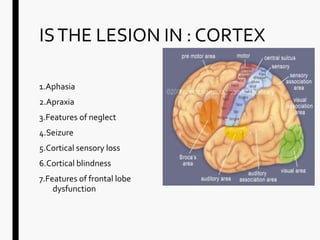
WHERE ISTHE LESION ??
1.CORTEX
2.INTERNALCAPSULE
3.BRAINSTEM
ISTHE LESION IN : CORTEX
1.Aphasia
2.Apraxia
3.Features of neglect
4.Seizure
5.Cortical sensory loss
6.Cortical blindness
7.Features of frontal lobe
dysfunction
ISTHE LESION IN : INTERNAL
CAPSULE
1.Dense Hemiplegia
2.Absence signs of
cortical involvement
ISTHE LESION IN:
BRAINSTEM
1.Crossed Hemiplegia
2.Lower motor neuron lesion of cranial nerves
WHICHVESSEL IS INVOLVED
?
WHICHVESSEL IS INVOLVED
1.ACA
Contalateral Hemiplegia,
Contralateral hemisensory loss,
Leg involvement
Face not involved
Urinary incontinence
Emotional lability
Memory loss, Confusion
Which vessel is involved
2.MCA
■ Contalateral Hemiparesis
Contralateral Hemisensory
loss
■ Face may be involved
■ Motor aphasia-
dominant hemisphere( Left MCA
territoty)
Post
Circulation/Vertebr
obasilar
■ LMN cranial nerve palsies
■ Vertgo,dizziness,diplopia,drop
attack,cortical blindness
■ Bilateral involvement
Investigations
 Risk factor analysis: full blood count, blood glucose, lipid profile
 Neuroimaging: CT or MRI (within 25 mins of patients arrival)
 Cardiac investigations: electrocardiogram(ECG), echocardiogram
 Vascular imaging: Duplex ultrasound of carotids
Magnetic resonance angiography(MRA)
CT angiography
Contrast angiography
 Lumbar puncture: to rule out subarachnoid haemorrhage
 Clotting screening
Management
 Airway :perform bedside swallow screen and keep patient
nil per oral
 Breathing : check respiratory rate and oxygen saturation and give
oxygen if saturation <95%
 Circulation: check peripheral perfusion,pulse and BP and treat
abnormalities with fluild replacement,anti-arrhythmics and inotropic
drugs
 Hydrations: if signs of dehydrations,give fliuds parenterally or by NG
 Nutrition:assess nutritional status and provide supplements if
necessary if dysphagia persists for >48hrs start NG feeding
 Blood pressure:unless there is heart /renal failure,evidence of
hypertensive encephalopathy /aortic dissection, do not
lower BP in 1st week as it may reduce cerebral perfusion.
 Blood glucose:check and treat when levels are >200mg/dl(by insulin or
glucose/potassium/insulin GKI
 Temperature:if pyrexic,investigate and treat the cause
Control with and antipyretics
 Pressure areas: treat infections
Maintain nutritions
Provide pressure relieving mattress
Mobilize the patient
 Check for constipation and urinary retentions.
Management
 The emergency neurological life support (ENLS) suggested
algorithm for the initial management of acute ischemia
Acute ischemic stroke
checklist for the first hour
 Labs: CBC, platelets, chemistries, PT/PTT,glucose
 IV access
 Supplemental oxygen to maintain sats> 94%
 Activate stroke code system (if available)
 NIHSS(national institute of health stroke scale)
 Administer t-PA if eligible
MEDICAL MANAGEMENT IN
ISCHAEMICCVA
IntravenousThrombolysis
■ IV rtPA (0.9 mg/kg to a 90-mg max)
■ 10% as a bolus, then the remainder over 60 min) within 3 h of
onset
IntravenousThrombolysis :
Indication
■ Clinical diagnosis of stroke
■ Onset of symptoms to time of drug administration <3 h
■ CT scan showing no hemorrhage or edema of >⅓ of the MCA
territory
IntravenousThrombolysis
Contraindications
■ Sustained BP >185/110 despite treatment
■ Platelets <100,000; HCT <25%
■ glucose <50 or >400 mg/dL
■ Use of heparin within 48 h and prolonged PTT, or elevated INR
■ Rapidly improving symptoms
■ Prior stroke or head injury within 3 months; prior intracranial hemorrhage
■ Major surgery in preceding 14 days
■ Minor stroke symptoms
■ Gastrointestinal bleeding in preceding 21 days
■ Coma or stupor
Secondary Prevention of
STROKE
1.Control of risk factors
2.Treatment/Control of hypertension
3.Treatment/Control of dyslipdaemia
4.Antiplatelet agents inTIA / Ischaemic Stroke
5.Use of warfarin in A.F. when indicated
Cardioembolic Stroke
Preventing Cardioembolic
Stroke
 Nonrheumatic atrial fibrillation is the most common cause of
cerebral embolism
Age (yrs) Risk factor Recommendation
< 65 0>1 Aspirin
Warfarin : INR 2-3
65-75 0>1 Aspirin/Warfarin
Warfarin : INR 2-3
>75 Warfarin
Rehabilitation / Physiotherapy
 Role – can’t be underestimated
 Improves neurologic outcomes and reduces mortality
 Physical, occupational, and speech therapy
 Goals also directed towards preventing the complications of immobility
(e.g., pneumonia, DVT and pulmonary embolism,
pressure sores of the skin, and muscle contractures
ACUTE HEMORRHAGIC
STROKE
LIFE SUPPORT (ENLS):
INTRACEREBRAL
HEMORRHAGE
■ Intracerebral hemorrhage (ICH) is a subset of stroke due to bleeding
within the parenchyma of the brain.
■ It is potentially lethal, and survival depends on ensuring an adequate
airway, reversal of coagulopathy, and proper diagnosis.
Introduction
■ Intracerebral hemorrhage (ICH) results from direct bleeding
into the brain.
■ Accounts for 10–15 % of all stroke.
■ It is considered an acute neurological emergency because of
the potential to treat or mitigate injury, and the risk of ongoing
secondary brain injury.
Aetiology
■ Chronic hypertension
■ Cerebral amyloid angiopathy
■ Coagulopathy
■ Sympathomimetic drugs such as cocaine
■ Arteriovenous malformations (avms)
■ Cerebral vasculitis
■ Rupture of saccular or mycotic aneurysm
■ Moya–Moya syndrome
Clinical Features
■ Focal neurological deficit
■ Headache
■ Progressive neurologic signs and symptoms
■ Acute severe hypertension
■ Decreased level of consciousness
Diagnostic Modalities
■ Non-contrast computed tomography (CT)
■ Magnetic resonance imaging (MRI)
■ CT Angiography
■ Blood Investigations (PT, INR, aPTT)
Interpreting the ICH CT Scan
■ Most frequently located in the basal ganglia, thalamus, pons
(brainstem), and cerebellum.
■ Goal : Locate the site and size of the hemorrhage
ABC/2Technique
■ A = Measure the largest hemorrhage diameter
■ B = perpendicular to this line, measure the largest hemorrhage
diameter on the same image
■ C = multiply the total number of CT slices with hemorrhage by
the slice thickness to obtain
■ If the hematoma area on a slice is approximately 25–75 % of the
hematoma area on the reference slice used to determine (a),
then this slice is considered half a hemorrhage slice
■ If the area is less than 25 % of the reference slice, the slice is not
considered a hemorrhage slice
■ Alternately, (c) can be assessed by measuring the largest
diameter, superior to inferior, that is seen on coronal or sagittal
images
CT Angiography
■ CT angiography can be done to look extravasation into the
hematoma and that this ‘‘spot sign’’
■ It indicates hematoma growth.
The ICH Score
■ The ICH Score is the most commonly used validated clinical
grading scale for patients with ICH, combining elements
related to patient demographics, clinical condition, and
neuroimaging findings that are readily available at the time of
hospital admission
■ Each point increase in the ICH Score is associated with an increased risk of
mortality and a decreased likelihood of good functional outcome
■ The ICH Score is best used as a communication tool among providers and
with patients or family members regarding a patient’s condition
MANAGEMENT
Anticipation of specific patient
care
Targeted assessment
Concise clinical assessment
Diagnosis using Neuroimaging
Stabilization (ABC)
Initial ‘‘golden hour”
management
(1)Stabilization and reassessment of the patient’s airway,
breathing, and circulation (ABCs).
(2) Rapid and accurate diagnosis using neuroimaging.
(3) Concise clinical assessment regarding ICH characteristics and
patient condition.
(4)Targeted assessment for potential early interventions including:
(a) Control of elevated blood pressure.
(b) Correction of coagulopathy.
(c) Need for early surgical intervention.
(5) Anticipation of specific patient care needs such as:
(a) Specific treatment aspects related to underlying ICH cause.
(b) Risk for early clinical deterioration and hematoma expansion.
(c) Need for intracranial pressure (ICP) or other neuromonitoring.
(d) Patient disposition from emergency department (ED).
ENLS intracerebral
hemorrhage protocol
Airway Management
■ Many ICH patients are obtunded or comatose, so airway
management (specifically the need for intubation for airway
protection) should be considered throughout the early
treatment course.
■ Thus, while ‘‘Airway’’ is listed under secondary treatment in the
ENLS ICH protocol it is concurrent with the initial evaluation.
■ In general, if an ICH patient is comatose, rapid sequence
intubation (RSI) should be undertaken, with a goal of
normoventilation
Primary Intervention: Blood
Pressure,
Coagulopathy, and Surgery
■ (a) acute control of elevated blood pressure
■ (b) correction of coagulopathy due to medications or
underlying medical conditions, and
■ (c) the need for urgent surgical hematoma evacuation
A) BP management
■ INTERACT2 andATACH, suggest that acutely lowering systolic
blood pressure to below 140 mmHg is safe and has good
functional outcome
■ IV beta-blockers and calcium-channel blockers are the most
commonly used medications for this indication
■ Labetalol is rapid acting, has mixed alpha and beta adrenergic
antagonism, and is commonly used in the ED in an initial IV
bolus dose of 5–20 mg.
■ Nicardipine is a calcium channel blocker of the dihydropyridine
family that is more selective for vascular smooth muscle.
■ Initial nicardipine dose of 5 mg/h as continuous IV infusion is
often used, with titration up every 5–15 min as needed, up to a
maximum of 15 mg/h.
■ If possible, nitroprusside should be avoided due to its potential
for
– cerebral vasodilation,
– disturbed cerebral autoregulation, and
– elevated ICP.
B) Coagulopathy
Management
■ Antithrombotic medications are a risk factor for the occurrence
of ICH, as well as for hematoma expansion if an ICH occurs
■ They are usually used for prevention and management of
Ischemic Stroke.
■ Includes warfarin, heparin, antiplatelet agents such as aspirin
and clopidogrel, and newer agents such as dabigatran,
rivaroxaban
■ Coagulopathies may be due to underlying medical conditions,
such as liver disease or hematologic malignances.
Treatment of coagulopathy
■ Urgent laboratory tests should include a complete blood count
(CBC) with platelet count, PT, an international normalized ratio
(INR), and a partial thromboplastin time (PTT).
■ Medical history of use of antithrombotic medications
■ Patients taking warfarin and whose INR is >1.4 should receive
agents to normalize the INR.
■ The most important principle is to reduce the INR as soon as
possible, ideally within minutes.
■ To reverse warfarin therapy include the administration of fresh
frozen plasma (FFP), vitamin K, prothrombin complex
concentrates (PCC), and the hemostatic agent recombinant
factorVIIa (rFVIIa).
FFP (Fresh Frozen Plasma)
■ FFP contains factors I (fibrinogen), II,V,VII, IX, X, XI, XIII, and
antithrombin.
■ Fairly large volumes of FFP (10–15 ml/kg) are often required for
full reversal of anticoagulation, and this places patients at risk
for volume overload and pulmonary edema
Prothrombin complex
concentrates
(PCC)
■ PCCs contain factors II, IX, X (and varying amounts ofVII,
depending on the specific preparation) with much higher
concentrations of clotting factors in smaller amounts of volume
than FFP.
■ PCCs can correct the INR within minutes, faster than FFP, and
with fewer cardiopulmonary complications
Vitamin K
■ Vitamin K 5–10 mg administered intravenously by slow IV
infusion, in conjunction with another more rapidly acting agent
(e.G., Ffp, pcc),
■ It typically takes hours after vitamin k administration for
reversal of warfarin-induced coagulopathy, but it has a more
long-lasting effect than pcc or ffp
C) Surgical Hematoma
Evacuation
■ Most patients with acute ICH do not require surgery for
removal of the hematoma, it is worthwhile to address the
option of surgery immediately after ICH diagnosis, since the
theoretical benefits of surgery include
– prevention of brain herniation
– improvement in elevated ICP, and
– removal of blood and blood degradation products that may
produce cytotoxic secondary brain injury.
Secondary Intervention:
■ HospitalAdmission
■ ICP Management
■ Seizures Management
Admission
■ Ideally, patients with acute ICH should be admitted to an ICU
based on the need for close monitoring of neurological and
hemodynamic condition
■ Monitor the risk for early deterioration from hematoma
expansion, cerebral edema, hydrocephalus, or airway
compromise
ICP Management
■ Current guidelines for ICP monitoring in ICH follow the
approach in severe traumatic brain injury, with ICP monitoring
recommended in patients with
– GCS less than 9,
– large hematomas with mass effect suggestive of elevated
ICP, or
– hydrocephalus.
■ As a goal, an ICP <20 mmHg should be maintained, with a
minimalCPP of 60 mmHg, adjusted based on an individual
patient’s cerebral autoregulation status
■ 30 degree Head of the bed elevation
■ Mannitol usually is given as a bolus of 0.25 g/kg to 1 g/kg body
weight; when urgent reduction of ICP is needed, an initial dose
of 1 g/kg body weight should be given.
■ Dexamethasone 4 mg every 6 hrly.Also helps with cerebral
edema
■ Maintain PaCO2 : 30 – 35 mm Hg (it can induce constriction of
cerebral arteries by alkalinizing theCSF.The resulting reduction
in cerebral blood volume decreases ICP)
■ Barbiturate coma should only be considered for patients with
refractory intracranial hypertension because of the serious
complications associated with high-dose barbiturates, and
because the neurologic examination becomes unavailable for
several days
Seizure Management
■ Current guidelines do not recommend routine use of
prophylactic anticonvulsants
■ Clinical seizures should be treated, and continuous EEG
monitoring should be performed in patients with inadequately
explained decreased level of consciousness.
■ Manage fever and hypoglycemia
■ The first 24 h are critical for blood pressure management,
identification of seizures, ICP management, and maintaining a
secure airway
References
■ 1. Emergency Neurological Life Support: Intracerebral
Hemorrhage; Edward C. Jauch, JoseA. Pineda, J. Claude
Hemphill
■ Rosen’s Emergency Medicine 7th Edition
Stroke- CVA

Stroke- CVA

  • 1.
    STROKE Sumi Singh Nepal MedicalCollege andTeaching Hospital
  • 2.
     Stroke isdefined as rapidly developing clinical signs of focal (or global) disturbance of cerebral function, lasting more than 24 hours or leading to death, with no apparent cause other than that of vascular origin(according toWHO adapted by American Heart Association)
  • 3.
     It iscommon neurological emergency that can be treated with time sensitive interventions.  Ischemic stroke accounts for about 80% of all strokes, intracerebral hemorrhage for 15% and subarachnoid hemorrhage for 5%.
  • 4.
    Global epidemiology ofstroke  Annually 15 million worldwide suffer a stroke -5 million die and 5 million are permanently disabled  According toWHO Statistics cerebrovascular disease is the 2nd cause of death worldwide.  WHO estimates a stroke occurs in every 5 seconds  Stroke related disability is the sixth most common cause of reduced DALYs  Stroke accounts for 10% of all deaths worldwide.
  • 5.
  • 6.
  • 7.
  • 8.
    Risk factor forstroke Modifiable Non- modifiable Blood pressure Age Cigarette smoking Gender(male>female except at extreme of age) Diabetes mellitus Race(Afro-caribbean>Asian>Eurpoean) Excessive alcohol intake Heredity Hyperlipidaemia High fibrinogen Heart disease (Atrial fibrillation,Congestive cardiac failure,Infective Endocarditis) Previous vascular infraction -myocardial infraction -stroke -peripherial vascular disease Oestrogen containing drugs (OCP,HRT) Polycythaemia
  • 9.
    Cardiac causes High risk: AF  MS  AMI  recent IE  dilated cardiomyopathy.
  • 10.
    Moderate risk:  RemoteMI  TR  Hypertrophic myopathy  aterial myxoma.
  • 11.
    Pathophysiology of cerebral Ischemia Normal cerebral blood flow at rest in the normal adult brain is approx. 50 to 55ml/100g/min  When blood flow decreases to 18ml/100g/min,the brain reaches a threshold for electrical failure.  When blood flow decreases to 8ml/100g/min.cell death can result.  These threshold mark the upper and lower blood flow limits of the ischemic penumbra.
  • 13.
    Clinical syndromes ofcerebral ischemia  Transient Ischemic attacks Condition in which symptoms resolve within 24hrs –is a temporary and non marching neurological deficit of sudden onset;attributed to focal ischemia of brain,retina,or cochlea  Stroke:those events where symptoms last for >24hrs  Progressing stroke:(stroke in evolution) in which the focal neurological event worsens after patient 1st presents.  Complete stroke:in which the focal deficit persists and is not progressing.
  • 14.
    ■ Most vascularlesions develop suddenly with a matter of minutes or hours , so should be considered in differential diagnosis of patients with any neurological presentations. ■ Clinical presentation depends upon which arterial territory is involved and the size of the lessions.
  • 15.
    Presenting problems  Weakness:unilateralweakness is sudden, progresses rapidly and follows a hemiplegic pattern.( UMN weakness of the face (7th nerve )is often present.  Speech disturbance: Dysphasia and dysarthria are the most common presentation of disturbed speech.  Visual deficit: can be dt unilateral optic ischaemia (called amaurosis fugax if transient)
  • 16.
    Presenting problems Ataxia :strokecausing damage to cerebellum and its connections Apraxia Headache:it is rarely a dominant feature (sudden severe headache is cardinal in SAH ) Seizure: it is unusual in acute stroke. Coma: is uncommon (if present in the 1st 24hrs ,usually indicates a SAH or intra cerebral hemorrahge)
  • 17.
    DIFFERENTIAL DIAGNOSIS 1.Chronic SubduralHaematoma 2.Rapidly growing CNSTumour 3.Metastasis to Brain 4.Seizure 5.Migraine 6.Metbolic causes
  • 18.
    WHERE ISTHE LESION?? 1.CORTEX 2.INTERNALCAPSULE 3.BRAINSTEM
  • 19.
    ISTHE LESION IN: CORTEX 1.Aphasia 2.Apraxia 3.Features of neglect 4.Seizure 5.Cortical sensory loss 6.Cortical blindness 7.Features of frontal lobe dysfunction
  • 20.
    ISTHE LESION IN: INTERNAL CAPSULE 1.Dense Hemiplegia 2.Absence signs of cortical involvement
  • 21.
    ISTHE LESION IN: BRAINSTEM 1.CrossedHemiplegia 2.Lower motor neuron lesion of cranial nerves
  • 22.
  • 23.
    WHICHVESSEL IS INVOLVED 1.ACA ContalateralHemiplegia, Contralateral hemisensory loss, Leg involvement Face not involved Urinary incontinence Emotional lability Memory loss, Confusion
  • 24.
    Which vessel isinvolved 2.MCA ■ Contalateral Hemiparesis Contralateral Hemisensory loss ■ Face may be involved ■ Motor aphasia- dominant hemisphere( Left MCA territoty) Post Circulation/Vertebr obasilar ■ LMN cranial nerve palsies ■ Vertgo,dizziness,diplopia,drop attack,cortical blindness ■ Bilateral involvement
  • 27.
    Investigations  Risk factoranalysis: full blood count, blood glucose, lipid profile  Neuroimaging: CT or MRI (within 25 mins of patients arrival)  Cardiac investigations: electrocardiogram(ECG), echocardiogram  Vascular imaging: Duplex ultrasound of carotids Magnetic resonance angiography(MRA) CT angiography Contrast angiography  Lumbar puncture: to rule out subarachnoid haemorrhage  Clotting screening
  • 28.
    Management  Airway :performbedside swallow screen and keep patient nil per oral  Breathing : check respiratory rate and oxygen saturation and give oxygen if saturation <95%  Circulation: check peripheral perfusion,pulse and BP and treat abnormalities with fluild replacement,anti-arrhythmics and inotropic drugs  Hydrations: if signs of dehydrations,give fliuds parenterally or by NG  Nutrition:assess nutritional status and provide supplements if necessary if dysphagia persists for >48hrs start NG feeding
  • 29.
     Blood pressure:unlessthere is heart /renal failure,evidence of hypertensive encephalopathy /aortic dissection, do not lower BP in 1st week as it may reduce cerebral perfusion.  Blood glucose:check and treat when levels are >200mg/dl(by insulin or glucose/potassium/insulin GKI  Temperature:if pyrexic,investigate and treat the cause Control with and antipyretics  Pressure areas: treat infections Maintain nutritions Provide pressure relieving mattress Mobilize the patient  Check for constipation and urinary retentions.
  • 30.
    Management  The emergencyneurological life support (ENLS) suggested algorithm for the initial management of acute ischemia
  • 32.
    Acute ischemic stroke checklistfor the first hour  Labs: CBC, platelets, chemistries, PT/PTT,glucose  IV access  Supplemental oxygen to maintain sats> 94%  Activate stroke code system (if available)  NIHSS(national institute of health stroke scale)  Administer t-PA if eligible
  • 33.
    MEDICAL MANAGEMENT IN ISCHAEMICCVA IntravenousThrombolysis ■IV rtPA (0.9 mg/kg to a 90-mg max) ■ 10% as a bolus, then the remainder over 60 min) within 3 h of onset
  • 34.
    IntravenousThrombolysis : Indication ■ Clinicaldiagnosis of stroke ■ Onset of symptoms to time of drug administration <3 h ■ CT scan showing no hemorrhage or edema of >⅓ of the MCA territory
  • 35.
    IntravenousThrombolysis Contraindications ■ Sustained BP>185/110 despite treatment ■ Platelets <100,000; HCT <25% ■ glucose <50 or >400 mg/dL ■ Use of heparin within 48 h and prolonged PTT, or elevated INR ■ Rapidly improving symptoms ■ Prior stroke or head injury within 3 months; prior intracranial hemorrhage ■ Major surgery in preceding 14 days ■ Minor stroke symptoms ■ Gastrointestinal bleeding in preceding 21 days ■ Coma or stupor
  • 36.
    Secondary Prevention of STROKE 1.Controlof risk factors 2.Treatment/Control of hypertension 3.Treatment/Control of dyslipdaemia 4.Antiplatelet agents inTIA / Ischaemic Stroke 5.Use of warfarin in A.F. when indicated
  • 37.
  • 38.
    Preventing Cardioembolic Stroke  Nonrheumaticatrial fibrillation is the most common cause of cerebral embolism Age (yrs) Risk factor Recommendation < 65 0>1 Aspirin Warfarin : INR 2-3 65-75 0>1 Aspirin/Warfarin Warfarin : INR 2-3 >75 Warfarin
  • 39.
    Rehabilitation / Physiotherapy Role – can’t be underestimated  Improves neurologic outcomes and reduces mortality  Physical, occupational, and speech therapy  Goals also directed towards preventing the complications of immobility (e.g., pneumonia, DVT and pulmonary embolism, pressure sores of the skin, and muscle contractures
  • 40.
  • 41.
  • 42.
    ■ Intracerebral hemorrhage(ICH) is a subset of stroke due to bleeding within the parenchyma of the brain. ■ It is potentially lethal, and survival depends on ensuring an adequate airway, reversal of coagulopathy, and proper diagnosis.
  • 43.
    Introduction ■ Intracerebral hemorrhage(ICH) results from direct bleeding into the brain. ■ Accounts for 10–15 % of all stroke. ■ It is considered an acute neurological emergency because of the potential to treat or mitigate injury, and the risk of ongoing secondary brain injury.
  • 44.
    Aetiology ■ Chronic hypertension ■Cerebral amyloid angiopathy ■ Coagulopathy ■ Sympathomimetic drugs such as cocaine ■ Arteriovenous malformations (avms) ■ Cerebral vasculitis ■ Rupture of saccular or mycotic aneurysm ■ Moya–Moya syndrome
  • 46.
    Clinical Features ■ Focalneurological deficit ■ Headache ■ Progressive neurologic signs and symptoms ■ Acute severe hypertension ■ Decreased level of consciousness
  • 47.
    Diagnostic Modalities ■ Non-contrastcomputed tomography (CT) ■ Magnetic resonance imaging (MRI) ■ CT Angiography ■ Blood Investigations (PT, INR, aPTT)
  • 49.
    Interpreting the ICHCT Scan ■ Most frequently located in the basal ganglia, thalamus, pons (brainstem), and cerebellum. ■ Goal : Locate the site and size of the hemorrhage
  • 51.
    ABC/2Technique ■ A =Measure the largest hemorrhage diameter ■ B = perpendicular to this line, measure the largest hemorrhage diameter on the same image ■ C = multiply the total number of CT slices with hemorrhage by the slice thickness to obtain
  • 53.
    ■ If thehematoma area on a slice is approximately 25–75 % of the hematoma area on the reference slice used to determine (a), then this slice is considered half a hemorrhage slice ■ If the area is less than 25 % of the reference slice, the slice is not considered a hemorrhage slice ■ Alternately, (c) can be assessed by measuring the largest diameter, superior to inferior, that is seen on coronal or sagittal images
  • 54.
    CT Angiography ■ CTangiography can be done to look extravasation into the hematoma and that this ‘‘spot sign’’ ■ It indicates hematoma growth.
  • 56.
    The ICH Score ■The ICH Score is the most commonly used validated clinical grading scale for patients with ICH, combining elements related to patient demographics, clinical condition, and neuroimaging findings that are readily available at the time of hospital admission
  • 58.
    ■ Each pointincrease in the ICH Score is associated with an increased risk of mortality and a decreased likelihood of good functional outcome ■ The ICH Score is best used as a communication tool among providers and with patients or family members regarding a patient’s condition
  • 59.
  • 60.
    Anticipation of specificpatient care Targeted assessment Concise clinical assessment Diagnosis using Neuroimaging Stabilization (ABC)
  • 61.
    Initial ‘‘golden hour” management (1)Stabilizationand reassessment of the patient’s airway, breathing, and circulation (ABCs). (2) Rapid and accurate diagnosis using neuroimaging. (3) Concise clinical assessment regarding ICH characteristics and patient condition.
  • 62.
    (4)Targeted assessment forpotential early interventions including: (a) Control of elevated blood pressure. (b) Correction of coagulopathy. (c) Need for early surgical intervention.
  • 63.
    (5) Anticipation ofspecific patient care needs such as: (a) Specific treatment aspects related to underlying ICH cause. (b) Risk for early clinical deterioration and hematoma expansion. (c) Need for intracranial pressure (ICP) or other neuromonitoring. (d) Patient disposition from emergency department (ED).
  • 64.
  • 65.
    Airway Management ■ ManyICH patients are obtunded or comatose, so airway management (specifically the need for intubation for airway protection) should be considered throughout the early treatment course. ■ Thus, while ‘‘Airway’’ is listed under secondary treatment in the ENLS ICH protocol it is concurrent with the initial evaluation. ■ In general, if an ICH patient is comatose, rapid sequence intubation (RSI) should be undertaken, with a goal of normoventilation
  • 66.
    Primary Intervention: Blood Pressure, Coagulopathy,and Surgery ■ (a) acute control of elevated blood pressure ■ (b) correction of coagulopathy due to medications or underlying medical conditions, and ■ (c) the need for urgent surgical hematoma evacuation
  • 67.
    A) BP management ■INTERACT2 andATACH, suggest that acutely lowering systolic blood pressure to below 140 mmHg is safe and has good functional outcome ■ IV beta-blockers and calcium-channel blockers are the most commonly used medications for this indication
  • 68.
    ■ Labetalol israpid acting, has mixed alpha and beta adrenergic antagonism, and is commonly used in the ED in an initial IV bolus dose of 5–20 mg.
  • 69.
    ■ Nicardipine isa calcium channel blocker of the dihydropyridine family that is more selective for vascular smooth muscle. ■ Initial nicardipine dose of 5 mg/h as continuous IV infusion is often used, with titration up every 5–15 min as needed, up to a maximum of 15 mg/h.
  • 70.
    ■ If possible,nitroprusside should be avoided due to its potential for – cerebral vasodilation, – disturbed cerebral autoregulation, and – elevated ICP.
  • 71.
    B) Coagulopathy Management ■ Antithromboticmedications are a risk factor for the occurrence of ICH, as well as for hematoma expansion if an ICH occurs ■ They are usually used for prevention and management of Ischemic Stroke. ■ Includes warfarin, heparin, antiplatelet agents such as aspirin and clopidogrel, and newer agents such as dabigatran, rivaroxaban
  • 72.
    ■ Coagulopathies maybe due to underlying medical conditions, such as liver disease or hematologic malignances.
  • 73.
    Treatment of coagulopathy ■Urgent laboratory tests should include a complete blood count (CBC) with platelet count, PT, an international normalized ratio (INR), and a partial thromboplastin time (PTT). ■ Medical history of use of antithrombotic medications ■ Patients taking warfarin and whose INR is >1.4 should receive agents to normalize the INR.
  • 74.
    ■ The mostimportant principle is to reduce the INR as soon as possible, ideally within minutes. ■ To reverse warfarin therapy include the administration of fresh frozen plasma (FFP), vitamin K, prothrombin complex concentrates (PCC), and the hemostatic agent recombinant factorVIIa (rFVIIa).
  • 75.
    FFP (Fresh FrozenPlasma) ■ FFP contains factors I (fibrinogen), II,V,VII, IX, X, XI, XIII, and antithrombin. ■ Fairly large volumes of FFP (10–15 ml/kg) are often required for full reversal of anticoagulation, and this places patients at risk for volume overload and pulmonary edema
  • 76.
    Prothrombin complex concentrates (PCC) ■ PCCscontain factors II, IX, X (and varying amounts ofVII, depending on the specific preparation) with much higher concentrations of clotting factors in smaller amounts of volume than FFP. ■ PCCs can correct the INR within minutes, faster than FFP, and with fewer cardiopulmonary complications
  • 77.
    Vitamin K ■ VitaminK 5–10 mg administered intravenously by slow IV infusion, in conjunction with another more rapidly acting agent (e.G., Ffp, pcc), ■ It typically takes hours after vitamin k administration for reversal of warfarin-induced coagulopathy, but it has a more long-lasting effect than pcc or ffp
  • 78.
    C) Surgical Hematoma Evacuation ■Most patients with acute ICH do not require surgery for removal of the hematoma, it is worthwhile to address the option of surgery immediately after ICH diagnosis, since the theoretical benefits of surgery include – prevention of brain herniation – improvement in elevated ICP, and – removal of blood and blood degradation products that may produce cytotoxic secondary brain injury.
  • 79.
    Secondary Intervention: ■ HospitalAdmission ■ICP Management ■ Seizures Management
  • 80.
    Admission ■ Ideally, patientswith acute ICH should be admitted to an ICU based on the need for close monitoring of neurological and hemodynamic condition ■ Monitor the risk for early deterioration from hematoma expansion, cerebral edema, hydrocephalus, or airway compromise
  • 81.
    ICP Management ■ Currentguidelines for ICP monitoring in ICH follow the approach in severe traumatic brain injury, with ICP monitoring recommended in patients with – GCS less than 9, – large hematomas with mass effect suggestive of elevated ICP, or – hydrocephalus.
  • 82.
    ■ As agoal, an ICP <20 mmHg should be maintained, with a minimalCPP of 60 mmHg, adjusted based on an individual patient’s cerebral autoregulation status
  • 83.
    ■ 30 degreeHead of the bed elevation ■ Mannitol usually is given as a bolus of 0.25 g/kg to 1 g/kg body weight; when urgent reduction of ICP is needed, an initial dose of 1 g/kg body weight should be given.
  • 84.
    ■ Dexamethasone 4mg every 6 hrly.Also helps with cerebral edema ■ Maintain PaCO2 : 30 – 35 mm Hg (it can induce constriction of cerebral arteries by alkalinizing theCSF.The resulting reduction in cerebral blood volume decreases ICP)
  • 85.
    ■ Barbiturate comashould only be considered for patients with refractory intracranial hypertension because of the serious complications associated with high-dose barbiturates, and because the neurologic examination becomes unavailable for several days
  • 86.
    Seizure Management ■ Currentguidelines do not recommend routine use of prophylactic anticonvulsants ■ Clinical seizures should be treated, and continuous EEG monitoring should be performed in patients with inadequately explained decreased level of consciousness. ■ Manage fever and hypoglycemia
  • 87.
    ■ The first24 h are critical for blood pressure management, identification of seizures, ICP management, and maintaining a secure airway
  • 88.
    References ■ 1. EmergencyNeurological Life Support: Intracerebral Hemorrhage; Edward C. Jauch, JoseA. Pineda, J. Claude Hemphill ■ Rosen’s Emergency Medicine 7th Edition

Editor's Notes

  • #5 Disability adjusted life year :daly
  • #10 Nvaf:non vascular atrial fibrillation
  • #17 dysphasia(indicates damage to the dominant frontal or parietal lobe) dysarthrria :non localising features reflecting weakness or incoordination of face,pharyanx,lips,tongues or palate