STRECHING FO
STRECHING FOR IMPAIRED
MOBILITY
Interventions to Increase
Mobility of Soft Tissues
Intervention to increase mobility
• Many therapeutic interventions have been
designed to improve the mobility of soft
tissues and consequently increase ROM and
flexibility.
• There are situations in which stretching
interventions are appropriate and safe.
• There are also instances when stretching
should not be implemented.
Interventions to Increase Mobility of
Soft Tissues
1. Manual or Mechanical/Passive or Assisted
Stretching
2. Self-Stretching
3. Neuromuscular Facilitation and Inhibition
Techniques
4. Soft Tissue Mobilization and Manipulation
5. Muscle Energy Techniques
6. Joint Mobilization/Manipulation
7. Neural Tissue Mobilization (Neuromeningeal
Mobilization)
Manual or Mechanical/Passive or Assisted
Stretching
• A sustained or intermittent external, end-range
stretch force, applied with overpressure and by
manual contact or a mechanical device, elongates a
shortened muscle tendon unit and periarticular
connective tissues by moving a restricted joint just
past the available ROM.
• If the patient is as relaxed as possible, it is called
passive stretching.
• If the patient assists in moving the joint through a
greater range, it is called assisted stretching.
Manual or Mechanical/Passive or
Assisted Stretching
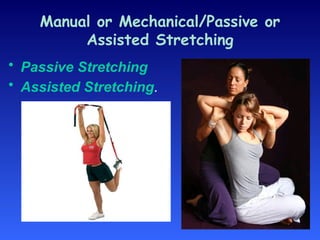
• Passive Stretching
• Assisted Stretching.
Self-Stretching
• Any stretching exercise that is carried out
independently by a patient after
instruction and supervision by a therapist
is referred as self-stretching.
• Active stretching is another term
sometimes used to denote self-stretching
procedures.
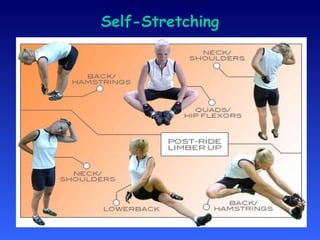
Self-Stretching
Neuromuscular Facilitation and
Inhibition Techniques
• Neuromuscular facilitation and inhibition
procedures are designed to relax tension in
shortened muscles reflexively prior to or during
muscle elongation.
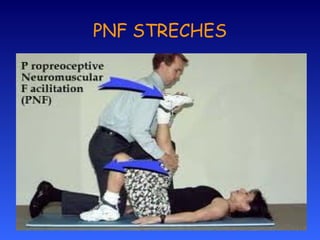
• Use of inhibition techniques to assist with muscle
elongation is associated with an approach to
exercise known as proprioceptive neuromuscular
facilitation (PNF).
• Authors called such stretches as PNF stretching
PNF STRECHES
Muscle Energy Techniques
• MET are manipulative procedures,
• evolved out of osteopathic medicine
• Designed to lengthen muscle and fascia
and to mobilize joints.
MET
• The procedures employ voluntary muscle
contractions by the patient in a precisely
controlled direction and intensity against a
counterforce applied by the practitioner.
• Principles of neuromuscular inhibition are
incorporated, another term used to
describe these techniques is Post isometric
relaxation.
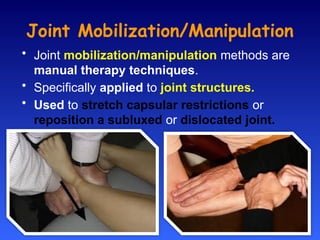
Joint Mobilization/Manipulation
• Joint mobilization/manipulation methods are
manual therapy techniques.
• Specifically applied to joint structures.
• Used to stretch capsular restrictions or
reposition a subluxed or dislocated joint.
Soft Tissue Mobilization and
Manipulation
• These techniques are designed
– to improve muscle extensibility and involve the
application of specific and progressive manual
forces (e.g. by means of sustained manual
pressure or slow, deep stroking)
• To effect change in the myofascial structures that can
bind soft tissues and impair mobility.
• Techniques, including friction massage,
myofascial release acupressure and
trigger point therapy.
STM
Neural Tissue Mobilization
(Neuromeningeal Mobilization)
• After trauma or surgical procedures, adhesions
or scar tissue may form around the meninges
and nerve roots or at the site of injury at the plexus
or peripheral nerves.
• Tension placed on the adhesions or scar tissue
leads to pain or neurological symptoms.
• After tests to determine neural tissue mobility
are conducted, the neural pathway is mobilized
through selective procedures.
Selective Stretching
• Overall function improved by
applying stretching techniques
selectively to some muscles and
joints.
• When determining which muscles is
to stretch,
• PT must always keep in mind the
functional needs of the patient and
the importance of maintaining a
balance between mobility and
stability for maximum functional
performance.
• Decision to allow restrictions to develop in
selected musculotendon units and joints is
usually made in patients with permanent
paralysis.
• E.g.
• In spinal cord injury patient, stability of the
trunk is necessary for independence in
sitting.
• With thoracic and cervical lesions, the patient does not
have active control of the back extensors.
• If hamstrings are routinely stretched to improve or
maintain their extensibility and moderate hypomobility is
allowed to develop in the extensors of low back,
• it will enables a patient to lean into the slightly shortened
structures and have some trunk stability for long-term
sitting.
• Patient must still have enough flexibility for independence in
dressing and transfers.
• Too much limitation of motion in the low back can
decrease function.
Overstretching and Hypermobility
• A stretch well beyond the normal length of muscle and
ROM of a joint and the surrounding soft tissues.
• Resulting in hypermobility.
– May be necessary for certain healthy individuals
with normal strength and stability participating in
sports that require extensive flexibility
– Overstretching becomes detrimental and creates
joint instability when muscles and supporting
structures are insufficient.
- Instability of a joint often causes pain and may
predispose a person to musculoskeletal injury.
Stretching Part.pptx therapeutics exercise

Stretching Part.pptx therapeutics exercise

  • 1.
    STRECHING FO STRECHING FORIMPAIRED MOBILITY
  • 2.
  • 3.
    Intervention to increasemobility • Many therapeutic interventions have been designed to improve the mobility of soft tissues and consequently increase ROM and flexibility. • There are situations in which stretching interventions are appropriate and safe. • There are also instances when stretching should not be implemented.
  • 4.
    Interventions to IncreaseMobility of Soft Tissues 1. Manual or Mechanical/Passive or Assisted Stretching 2. Self-Stretching 3. Neuromuscular Facilitation and Inhibition Techniques 4. Soft Tissue Mobilization and Manipulation 5. Muscle Energy Techniques 6. Joint Mobilization/Manipulation 7. Neural Tissue Mobilization (Neuromeningeal Mobilization)
  • 7.
    Manual or Mechanical/Passiveor Assisted Stretching • A sustained or intermittent external, end-range stretch force, applied with overpressure and by manual contact or a mechanical device, elongates a shortened muscle tendon unit and periarticular connective tissues by moving a restricted joint just past the available ROM. • If the patient is as relaxed as possible, it is called passive stretching. • If the patient assists in moving the joint through a greater range, it is called assisted stretching.
  • 8.
    Manual or Mechanical/Passiveor Assisted Stretching • Passive Stretching • Assisted Stretching.
  • 9.
    Self-Stretching • Any stretchingexercise that is carried out independently by a patient after instruction and supervision by a therapist is referred as self-stretching. • Active stretching is another term sometimes used to denote self-stretching procedures.
  • 10.
  • 11.
    Neuromuscular Facilitation and InhibitionTechniques • Neuromuscular facilitation and inhibition procedures are designed to relax tension in shortened muscles reflexively prior to or during muscle elongation. • Use of inhibition techniques to assist with muscle elongation is associated with an approach to exercise known as proprioceptive neuromuscular facilitation (PNF). • Authors called such stretches as PNF stretching
  • 12.
  • 13.
    Muscle Energy Techniques •MET are manipulative procedures, • evolved out of osteopathic medicine • Designed to lengthen muscle and fascia and to mobilize joints.
  • 14.
    MET • The proceduresemploy voluntary muscle contractions by the patient in a precisely controlled direction and intensity against a counterforce applied by the practitioner. • Principles of neuromuscular inhibition are incorporated, another term used to describe these techniques is Post isometric relaxation.
  • 15.
    Joint Mobilization/Manipulation • Jointmobilization/manipulation methods are manual therapy techniques. • Specifically applied to joint structures. • Used to stretch capsular restrictions or reposition a subluxed or dislocated joint.
  • 16.
    Soft Tissue Mobilizationand Manipulation • These techniques are designed – to improve muscle extensibility and involve the application of specific and progressive manual forces (e.g. by means of sustained manual pressure or slow, deep stroking) • To effect change in the myofascial structures that can bind soft tissues and impair mobility. • Techniques, including friction massage, myofascial release acupressure and trigger point therapy.
  • 17.
  • 18.
    Neural Tissue Mobilization (NeuromeningealMobilization) • After trauma or surgical procedures, adhesions or scar tissue may form around the meninges and nerve roots or at the site of injury at the plexus or peripheral nerves. • Tension placed on the adhesions or scar tissue leads to pain or neurological symptoms. • After tests to determine neural tissue mobility are conducted, the neural pathway is mobilized through selective procedures.
  • 19.
    Selective Stretching • Overallfunction improved by applying stretching techniques selectively to some muscles and joints. • When determining which muscles is to stretch, • PT must always keep in mind the functional needs of the patient and the importance of maintaining a balance between mobility and stability for maximum functional performance.
  • 20.
    • Decision toallow restrictions to develop in selected musculotendon units and joints is usually made in patients with permanent paralysis. • E.g. • In spinal cord injury patient, stability of the trunk is necessary for independence in sitting.
  • 21.
    • With thoracicand cervical lesions, the patient does not have active control of the back extensors. • If hamstrings are routinely stretched to improve or maintain their extensibility and moderate hypomobility is allowed to develop in the extensors of low back, • it will enables a patient to lean into the slightly shortened structures and have some trunk stability for long-term sitting. • Patient must still have enough flexibility for independence in dressing and transfers. • Too much limitation of motion in the low back can decrease function.
  • 22.
    Overstretching and Hypermobility •A stretch well beyond the normal length of muscle and ROM of a joint and the surrounding soft tissues. • Resulting in hypermobility. – May be necessary for certain healthy individuals with normal strength and stability participating in sports that require extensive flexibility – Overstretching becomes detrimental and creates joint instability when muscles and supporting structures are insufficient. - Instability of a joint often causes pain and may predispose a person to musculoskeletal injury.