Brandy Vanderheiden MFT SEP
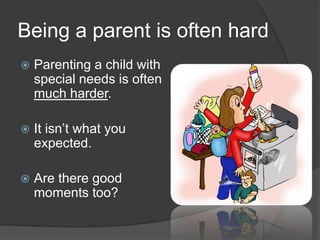
Being a parent is often hard
 Parenting a child with
special needs is often
much harder.
 It isn’t what you
expected.
 Are there good
moments too?
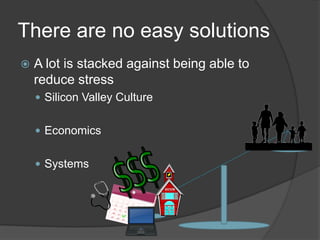
There are no easy solutions
 A lot is stacked against being able to
reduce stress
 Silicon Valley Culture
 Economics
 Systems
How can we get real relief?
Stress
management
is a temporary
strategy
(helpful, but
temporary)
Understand Stress Differently
 And you can see real change
When you are calm,
It is easier to figure out
solutions
You have more bandwidth
to deal with roadblocks in
systems
You have more patience
with the kids
Start here and you might
be able to shift what
seems insurmountable
Tonight:
 Understand stress differently
 Learn how you can support yourself and
your children
 Let’s try some exercises to expand your
tool kit
The key is regulation:
 Regulation is the
body’s ability to return
to a calm state after
stress.
 An autonomic
(involuntary) process
 It’s the time when
systems are in balance
and functioning at their
best.
Stress is a process in your
nervous system
 Work with your own system first
 Your family is its own nervous system
 Understand your child’s nervous system
 Supporting his system will improve overall
functioning and reduce stress for all
Homeostasis:
What goes up,
must come
down…except
when it doesn’t
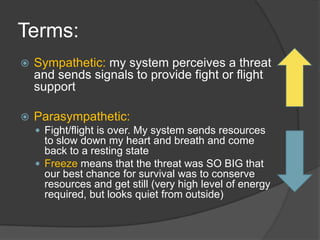
Terms:
 Sympathetic: my system perceives a threat
and sends signals to provide fight or flight
support
 Parasympathetic:
 Fight/flight is over. My system sends resources
to slow down my heart and breath and come
back to a resting state
 Freeze means that the threat was SO BIG that
our best chance for survival was to conserve
resources and get still (very high level of energy
required, but looks quiet from outside)
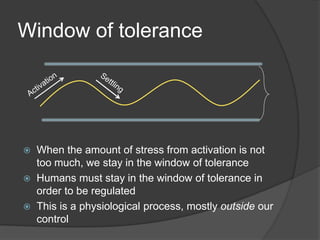
Window of tolerance
 When the amount of stress from activation is not
too much, we stay in the window of tolerance
 Humans must stay in the window of tolerance in
order to be regulated
 This is a physiological process, mostly outside our
control
When I am IN the window of
tolerance,
 I can
 “Use my words”
 “Make good choices”
 Remember my homework and what I
learned in class
 Connect with family and friends
 Be interested in new things
 Calm down when I get upset
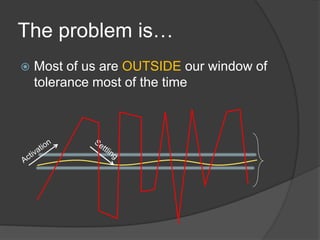
The problem is…
 Most of us are OUTSIDE our window of
tolerance most of the time
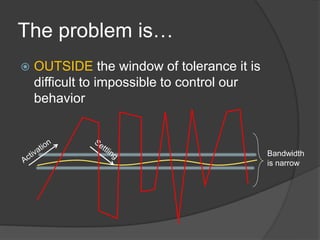
The problem is…
 OUTSIDE the window of tolerance it is
difficult to impossible to control our
behavior
Bandwidth
is narrow
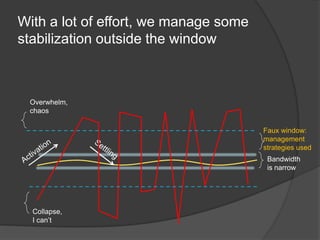
With a lot of effort, we manage some
stabilization outside the window
Faux window:
management
strategies used
Bandwidth
is narrow
Overwhelm,
chaos
Collapse,
I can’t
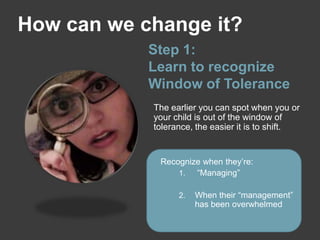
Step 1:
Learn to recognize
Window of Tolerance
The earlier you can spot when you or
your child is out of the window of
tolerance, the easier it is to shift.
Recognize when they’re:
1. “Managing”
2. When their “management”
has been overwhelmed
How can we change it?
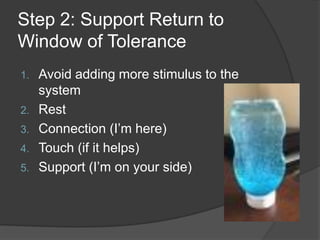
Step 2: Support Return to
Window of Tolerance
1. Avoid adding more stimulus to the
system
2. Rest
3. Connection (I’m here)
4. Touch (if it helps)
5. Support (I’m on your side)
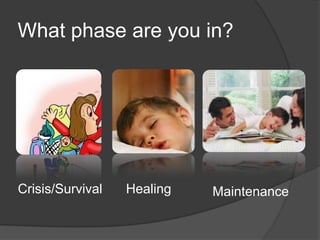
What phase are you in?
Crisis/Survival MaintenanceHealing
Grown up Support:
 Recruit help from partner or other adult
 Reduce obligations and commitments
 Schedule downtime
 Commit to self-care
 Cut back on phone/computer & news
 Do not skip meals
 Prioritize sleep
 Create action plan for when you get
overwhelmed
Support for kids
 Grown up support applies here, with
guidance and modification
 15 minutes per day of kid-guided activity
 Co-regulation
 The higher the upset, the fewer the words
 Parenting concepts do not land when
activation is high
 Create action plan for meltdowns &
overwhelm
Build “Calm Down” Toolkit
 Ask them what helps
 Exhale tends to reduce activation
(bubbles, pinwheels)
 “Cat presses” for arms & legs
 Modeling
 I spy game (pick a color; find 5 things
that color around the room)
 Take a break together
Questions
Little Village Class – 8 weeks
 4-5 year olds
 Concepts: Emotional regulation, making
friends, growing independence
 Tuesdays June 14-Aug 9
 Mountain View – CHAC Family
Resource Center
 Parents & kids learning together
Stay in touch
Brandy Vanderheiden MFT SEP
Office in Mountain View
650-281-9315
www.brandyvanderheiden.com
BrandyVanderheiden
Youhaveitinyoutoheal.wordpress.com
Thank you SELPA 1 CAC!

Stress Relief for Parents

  • 1.
  • 2.
    Being a parentis often hard  Parenting a child with special needs is often much harder.  It isn’t what you expected.  Are there good moments too?
  • 3.
    There are noeasy solutions  A lot is stacked against being able to reduce stress  Silicon Valley Culture  Economics  Systems
  • 4.
    How can weget real relief? Stress management is a temporary strategy (helpful, but temporary)
  • 5.
    Understand Stress Differently And you can see real change
  • 6.
    When you arecalm, It is easier to figure out solutions You have more bandwidth to deal with roadblocks in systems You have more patience with the kids Start here and you might be able to shift what seems insurmountable
  • 7.
    Tonight:  Understand stressdifferently  Learn how you can support yourself and your children  Let’s try some exercises to expand your tool kit
  • 8.
    The key isregulation:  Regulation is the body’s ability to return to a calm state after stress.  An autonomic (involuntary) process  It’s the time when systems are in balance and functioning at their best.
  • 9.
    Stress is aprocess in your nervous system  Work with your own system first  Your family is its own nervous system  Understand your child’s nervous system  Supporting his system will improve overall functioning and reduce stress for all
  • 10.
    Homeostasis: What goes up, mustcome down…except when it doesn’t
  • 11.
    Terms:  Sympathetic: mysystem perceives a threat and sends signals to provide fight or flight support  Parasympathetic:  Fight/flight is over. My system sends resources to slow down my heart and breath and come back to a resting state  Freeze means that the threat was SO BIG that our best chance for survival was to conserve resources and get still (very high level of energy required, but looks quiet from outside)
  • 12.
    Window of tolerance When the amount of stress from activation is not too much, we stay in the window of tolerance  Humans must stay in the window of tolerance in order to be regulated  This is a physiological process, mostly outside our control
  • 13.
    When I amIN the window of tolerance,  I can  “Use my words”  “Make good choices”  Remember my homework and what I learned in class  Connect with family and friends  Be interested in new things  Calm down when I get upset
  • 14.
    The problem is… Most of us are OUTSIDE our window of tolerance most of the time
  • 15.
    The problem is… OUTSIDE the window of tolerance it is difficult to impossible to control our behavior Bandwidth is narrow
  • 16.
    With a lotof effort, we manage some stabilization outside the window Faux window: management strategies used Bandwidth is narrow Overwhelm, chaos Collapse, I can’t
  • 17.
    Step 1: Learn torecognize Window of Tolerance The earlier you can spot when you or your child is out of the window of tolerance, the easier it is to shift. Recognize when they’re: 1. “Managing” 2. When their “management” has been overwhelmed How can we change it?
  • 18.
    Step 2: SupportReturn to Window of Tolerance 1. Avoid adding more stimulus to the system 2. Rest 3. Connection (I’m here) 4. Touch (if it helps) 5. Support (I’m on your side)
  • 19.
    What phase areyou in? Crisis/Survival MaintenanceHealing
  • 20.
    Grown up Support: Recruit help from partner or other adult  Reduce obligations and commitments  Schedule downtime  Commit to self-care  Cut back on phone/computer & news  Do not skip meals  Prioritize sleep  Create action plan for when you get overwhelmed
  • 21.
    Support for kids Grown up support applies here, with guidance and modification  15 minutes per day of kid-guided activity  Co-regulation  The higher the upset, the fewer the words  Parenting concepts do not land when activation is high  Create action plan for meltdowns & overwhelm
  • 22.
    Build “Calm Down”Toolkit  Ask them what helps  Exhale tends to reduce activation (bubbles, pinwheels)  “Cat presses” for arms & legs  Modeling  I spy game (pick a color; find 5 things that color around the room)  Take a break together
  • 23.
  • 24.
    Little Village Class– 8 weeks  4-5 year olds  Concepts: Emotional regulation, making friends, growing independence  Tuesdays June 14-Aug 9  Mountain View – CHAC Family Resource Center  Parents & kids learning together
  • 25.
    Stay in touch BrandyVanderheiden MFT SEP Office in Mountain View 650-281-9315 www.brandyvanderheiden.com BrandyVanderheiden Youhaveitinyoutoheal.wordpress.com
  • 26.