1
By: Tom Evans
LINK: http://bit.ly/1NGmCMA
1
Uh-Oh! Transition Times
and Meltdowns
Table of Contents
3. Tantrum vs. Meltdown
5. What is a Meltdown
6. Characteristics
7. Cognitive Debilitation
8. STAGE 1: Agitation/Escalation:
Child’s Response
9. 4 Step Model
10. Stages of Crisis
11. ABC’s of Behavior
13. Functions of Behavior: Interventions
14. Dealing With Unexpected Changes
15 Dealing With Mistakes
16. Triggers
17. Behavior Triggers
18. STAGE 1: Agitation Triggers
19. CONSEQUENCES
20. STG 1: Proactive Strategies
2
21. STG 1: Intervening
22. STG 1: Intervening Level B Teachable
23. STG 1: Intervening Level B “How to
Help”
26. STG 1: Intervening Level A Transition
28. Trying When It’s Hard
30. Transition Roadmap
31. STG 2: MELTDOWN- What Do You
Do?
34. STG 3: MELTDOWN/RECOVERY
35. STG 3: RECOVERY- What Do You
Do?
37. MELTDOWN Brainlock
38. Functions of Behavior Interventions
(School)
39. F.B.I. (Initial Stage)
40. F.B.I. (EFFECTIVE INTERVENTIONS)
41. F.B.I. (EFFECTIVE INTERVENTIONS-
Home Base)
42. F.B.I. Rage Stage
43. F.B.I. School Crisis Plan
44. F.B.I. Recovery
45. Resources
46. References
3
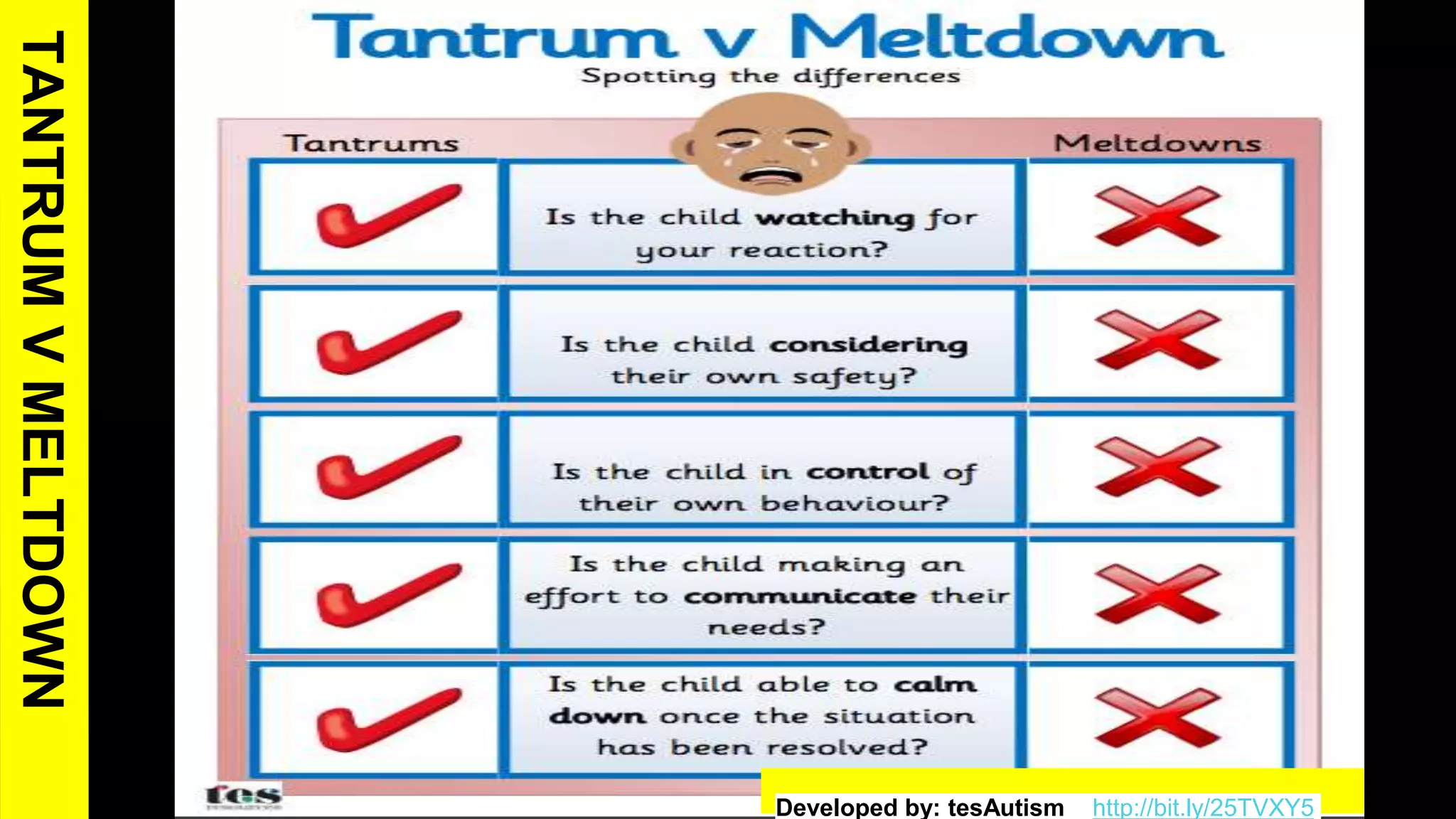
Developed by: tesAutism http://bit.ly/25TVXY5
Meltdown-Prone Children
❖ Difficulty managing/controlling frustration
➢ Frustrated more easily.
➢ Frustration Experience- Intense, disorganizing, and
overwhelming
➢ Inflexible, poor responses, NO regard for
consequences
➢ Few coping mechanisms
➢ “Thinking through” ways to resolve frustrating situations.
■ CAUSED BY: DEMANDS
Rebecca Klaw, 2006. Thoughtful Response. 4
Child’s Reaction-
❖ Unable to regulate EMOTIONS related to
FRUSTRATION
➢Unable to THINK clearly
➢Unable to SHIFT their thoughts
5Dr. Ross Greene, The Explosive Child, p. 21. Rebecca Klaw, 2006. Thoughtful Response.
6
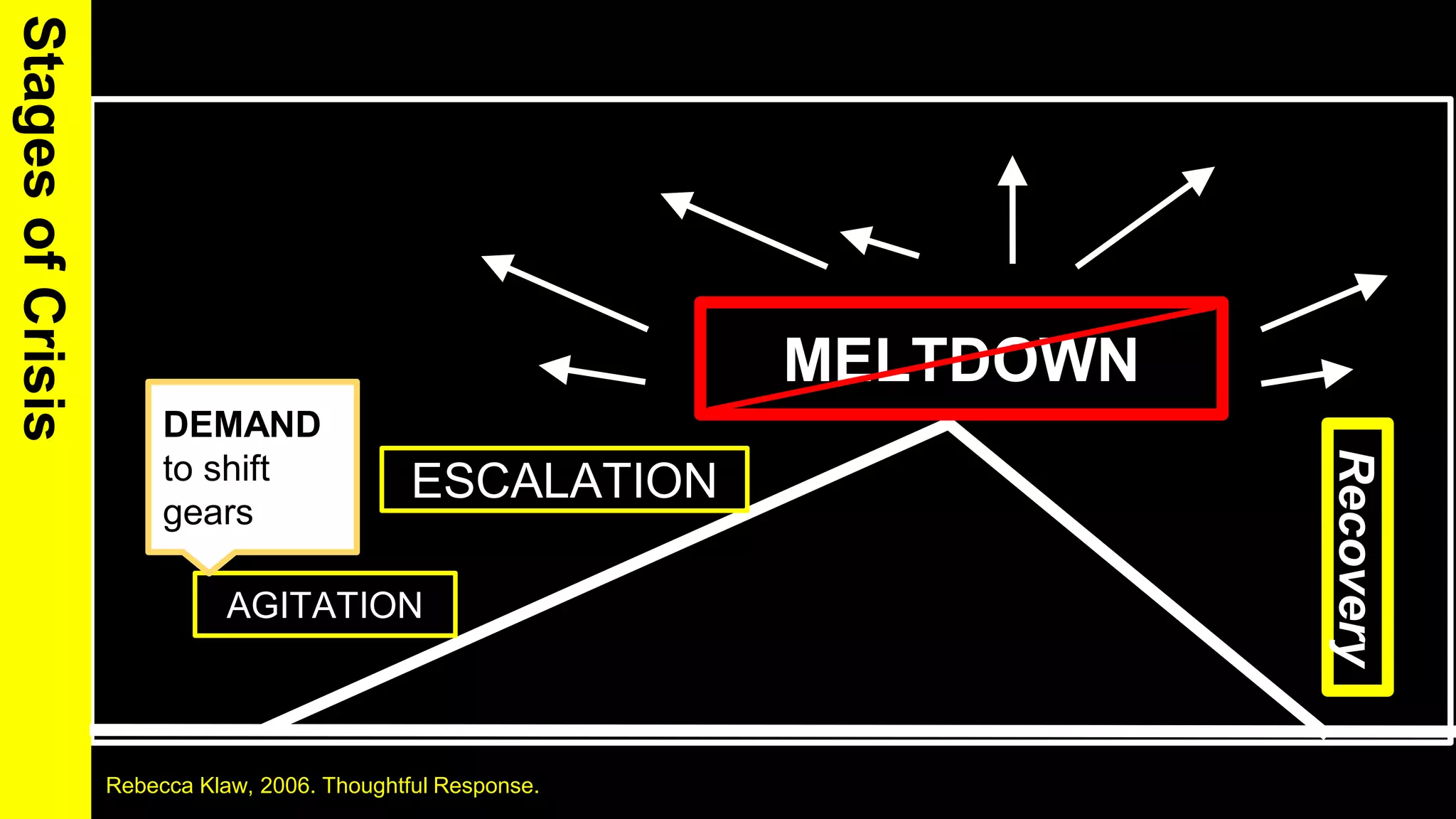
StagesofCrisis
AGITATION
ESCALATION
MELTDOWN
Rebecca Klaw, 2006. Thoughtful Response.
DEMAND
to shift
gears
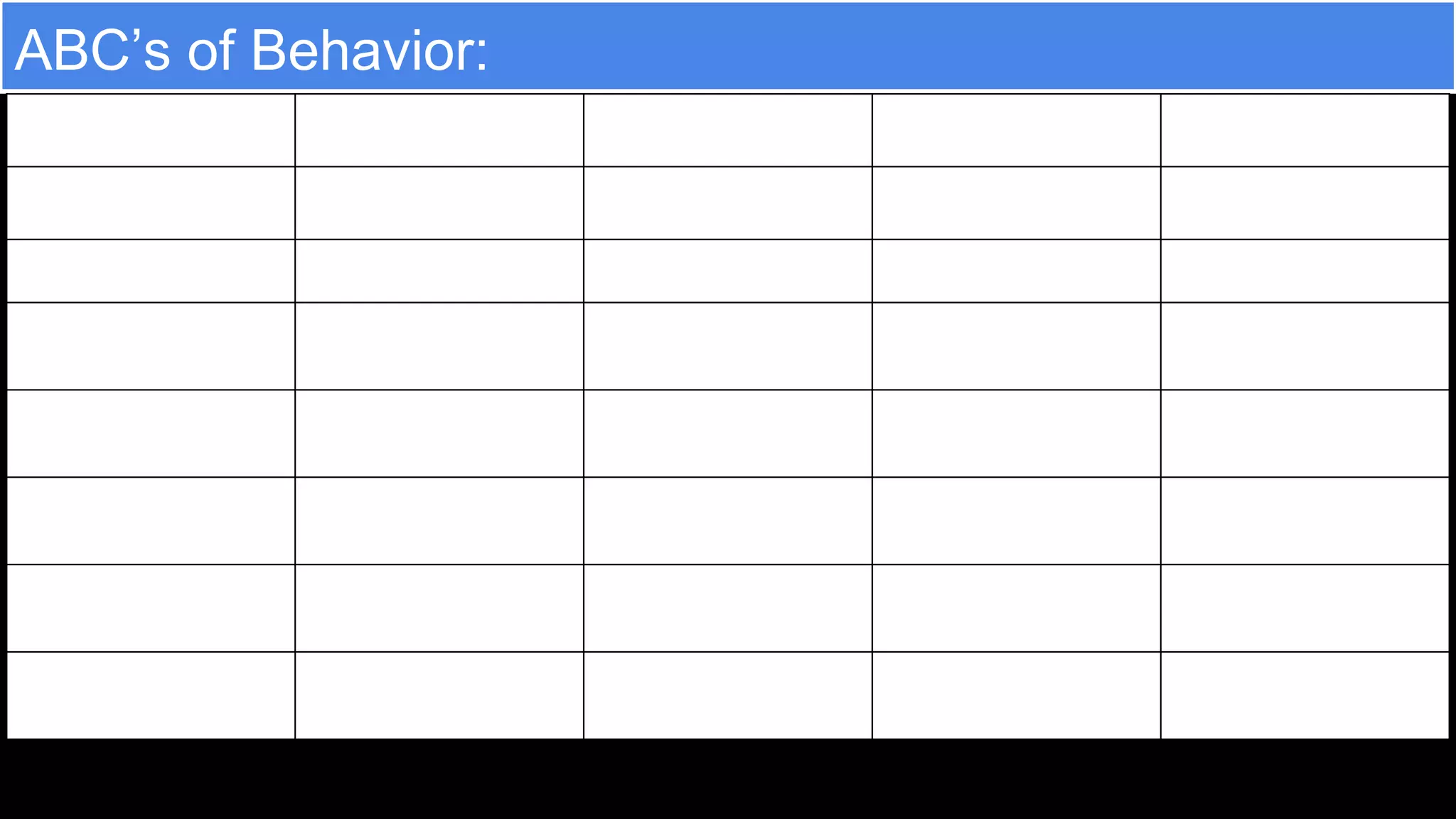
ABC’s of Behavior:
7
Date: Antecedent Behavior Consequence = Function
Before During After S.E.A.T.
8
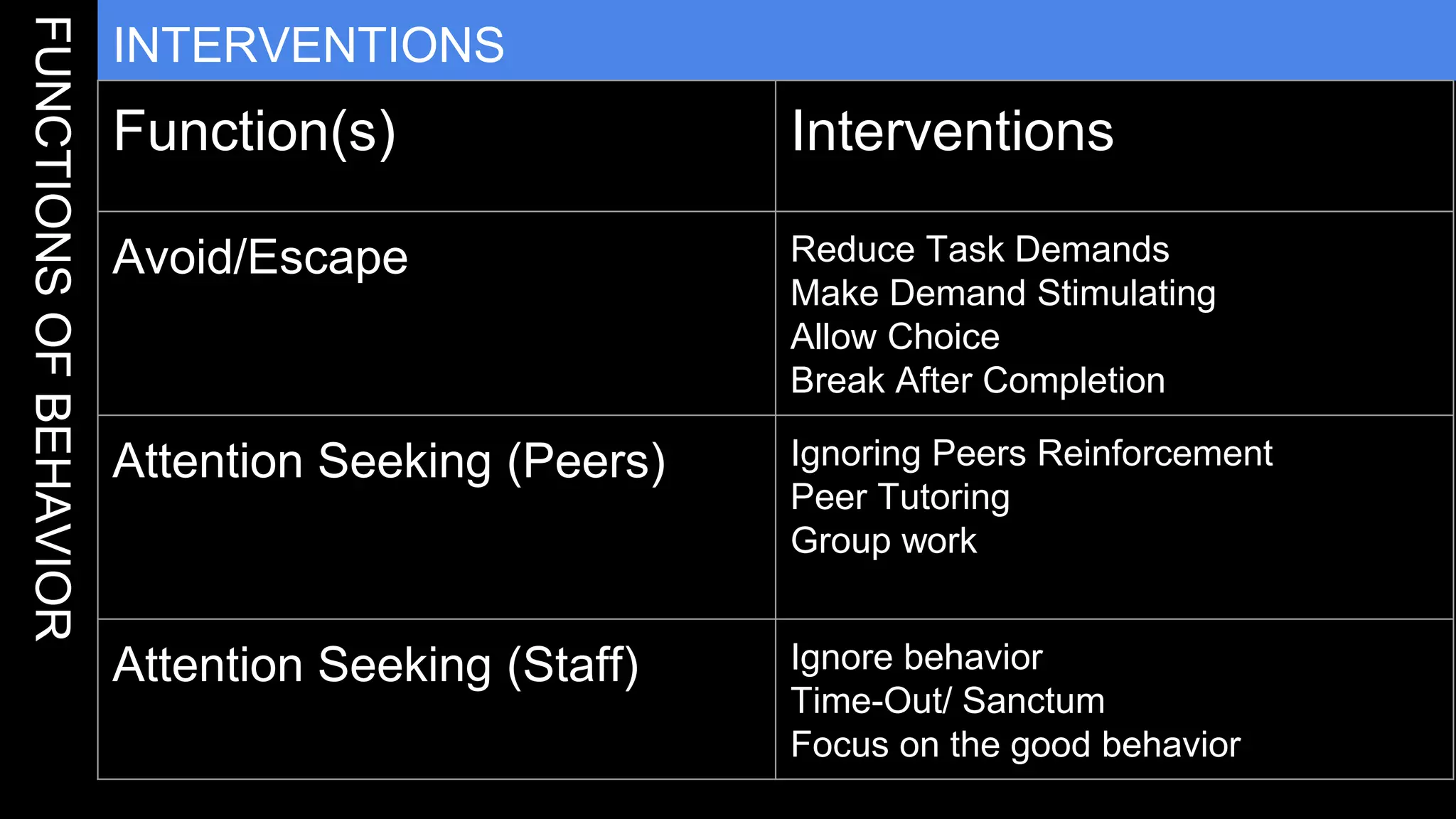
INTERVENTIONS
Function(s) Interventions
Avoid/Escape Reduce Task Demands
Make Demand Stimulating
Allow Choice
Break After Completion
Attention Seeking (Peers) Ignoring Peers Reinforcement
Peer Tutoring
Group work
Attention Seeking (Staff) Ignore behavior
Time-Out/ Sanctum
Focus on the good behavior
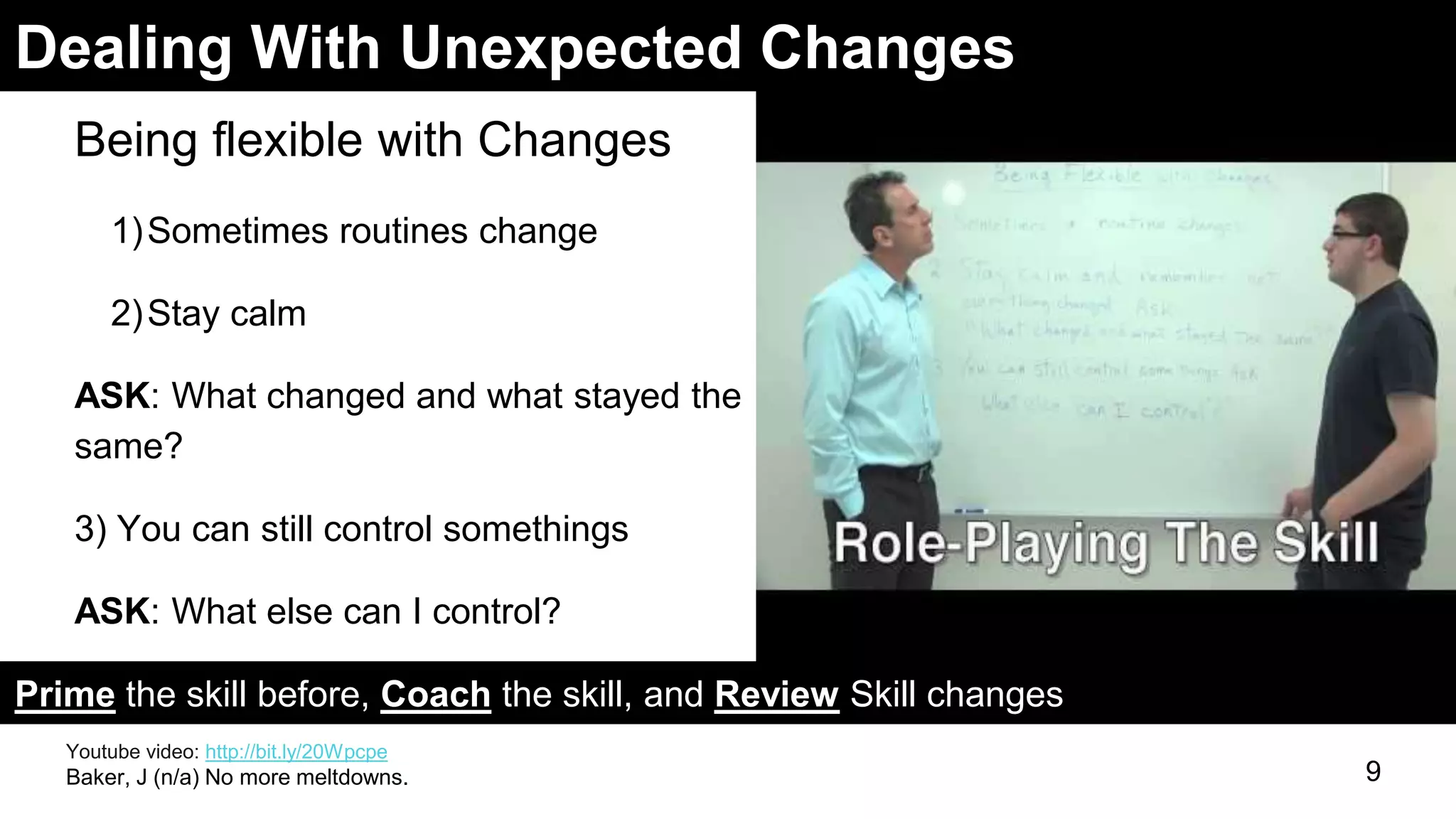
Dealing With Unexpected Changes
Being flexible with Changes
1)Sometimes routines change
2)Stay calm
ASK: What changed and what stayed the
same?
3) You can still control somethings
ASK: What else can I control?
9
Prime the skill before, Coach the skill, and Review Skill changes
Youtube video: http://bit.ly/20Wpcpe
Baker, J (n/a) No more meltdowns.
10
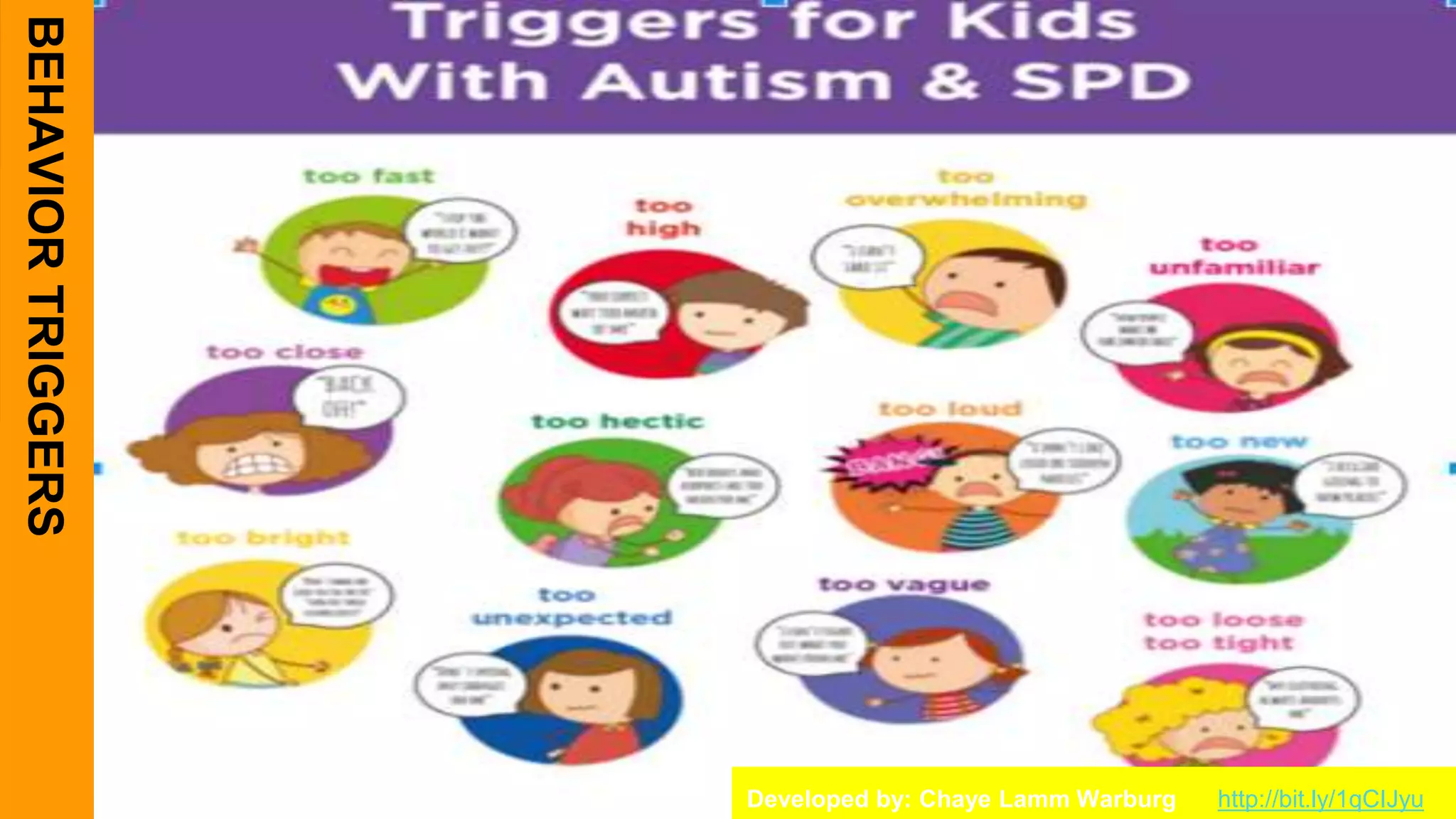
Developed by: Chaye Lamm Warburg http://bit.ly/1qCIJyu
“...very effective if a child is in a state of mind to
appreciate their meaning but don’t work nearly so
well if a child is not able to maintain such a state
of mind.”
11
Treating “out of control”, irrational, incoherent, destructive
and sometimes abusive behavior with consequences is
NOT routinely effective.
Dr. Ross Greene, The Explosive Child, p. 21. Rebecca Klaw, 2006. Thoughtful Response.
Proactive Strategies (ongoing)
❖Individualize Strategies (often include the following):
➢ Access to:
■ Communication, Choice, Quality of Life, Meaningful Reinforcers
➢ Predictability
➢ Environmental Adaptations
➢ Analysis of COMMON challenging behaviors (Look for the motive)
➢ Utilization of strengths and special interests- Vehicle to TEACH
❖ 12Dr. Ross Greene, The Explosive Child, p. 21. Rebecca Klaw, 2006. Thoughtful Response.
STAGE1:Agitation/Escalation
❖ Each child has their own
❖ Starts with REFUSAL
➢ “NO!”
➢ Falling to the floor;
➢ Not moving;
➢ Hitting, Kicking, Pinching, Biting; or Hiding
13
WARNING SIGNS
REASON Difficulty Shifting Attention/Transition
Rebecca Klaw, 2006. Thoughtful Response.
STAGE1:Agitation/Escalation
14
Intervening
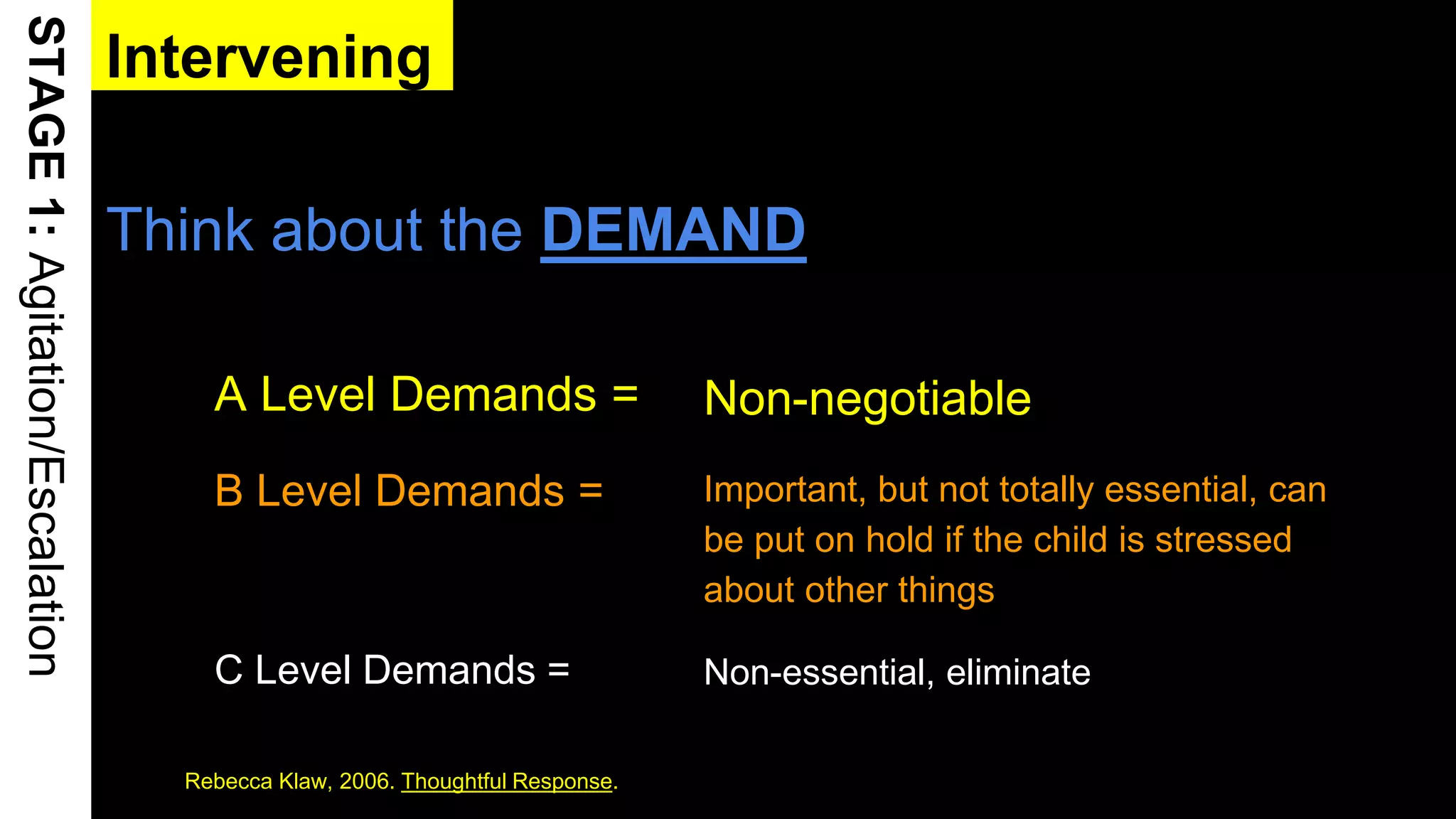
A Level Demands =
B Level Demands =
C Level Demands =
Non-negotiable
Important, but not totally essential, can
be put on hold if the child is stressed
about other things
Non-essential, eliminate
Think about the DEMAND
Rebecca Klaw, 2006. Thoughtful Response.
Level B (Teachable Moments)
Rebecca Klaw, 2006. Thoughtful Response.
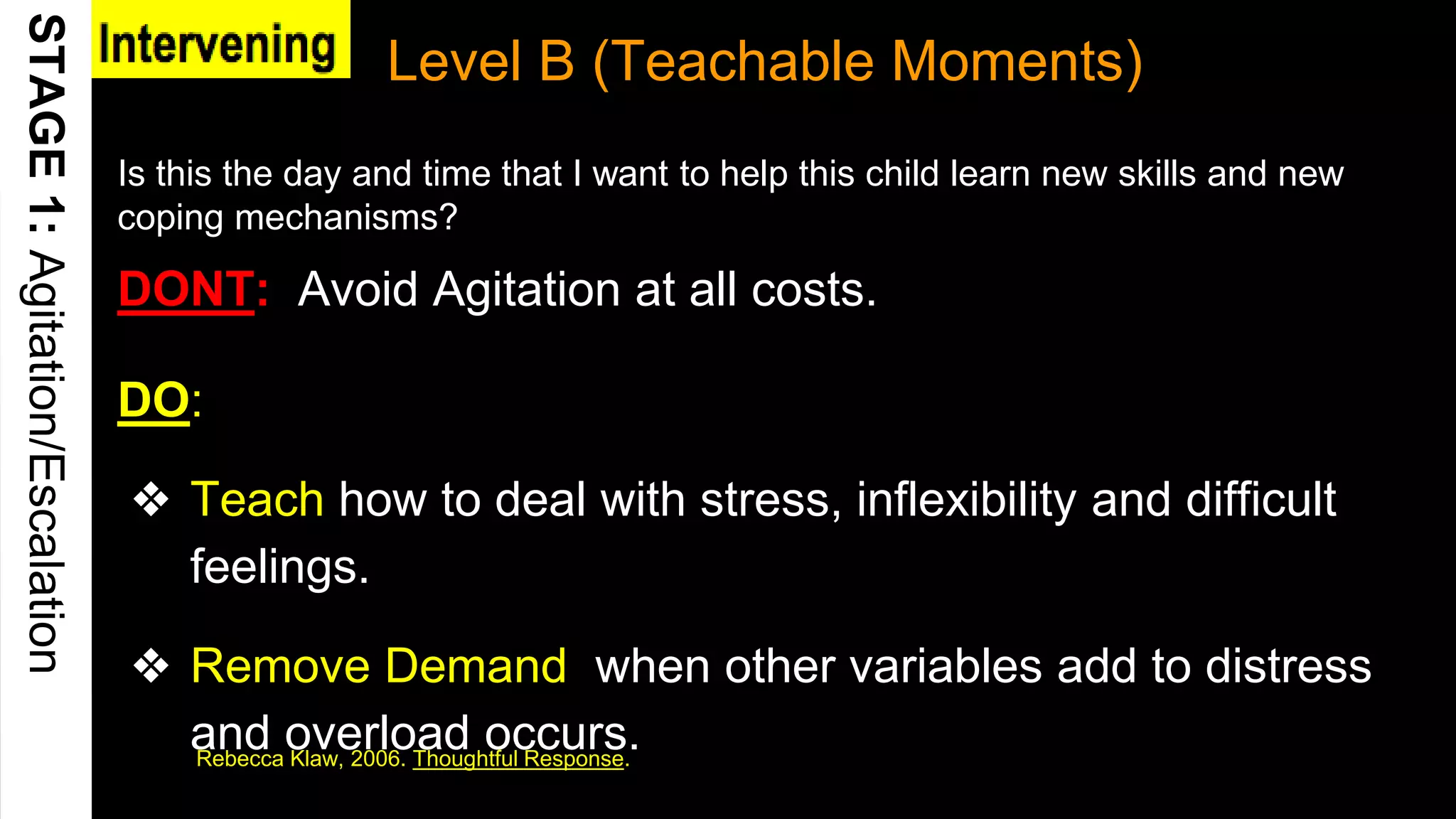
DO:
❖ Teach how to deal with stress, inflexibility and difficult
feelings.
❖ Remove Demand when other variables add to distress
and overload occurs.
15
Is this the day and time that I want to help this child learn new skills and new
coping mechanisms?
DONT: Avoid Agitation at all costs.
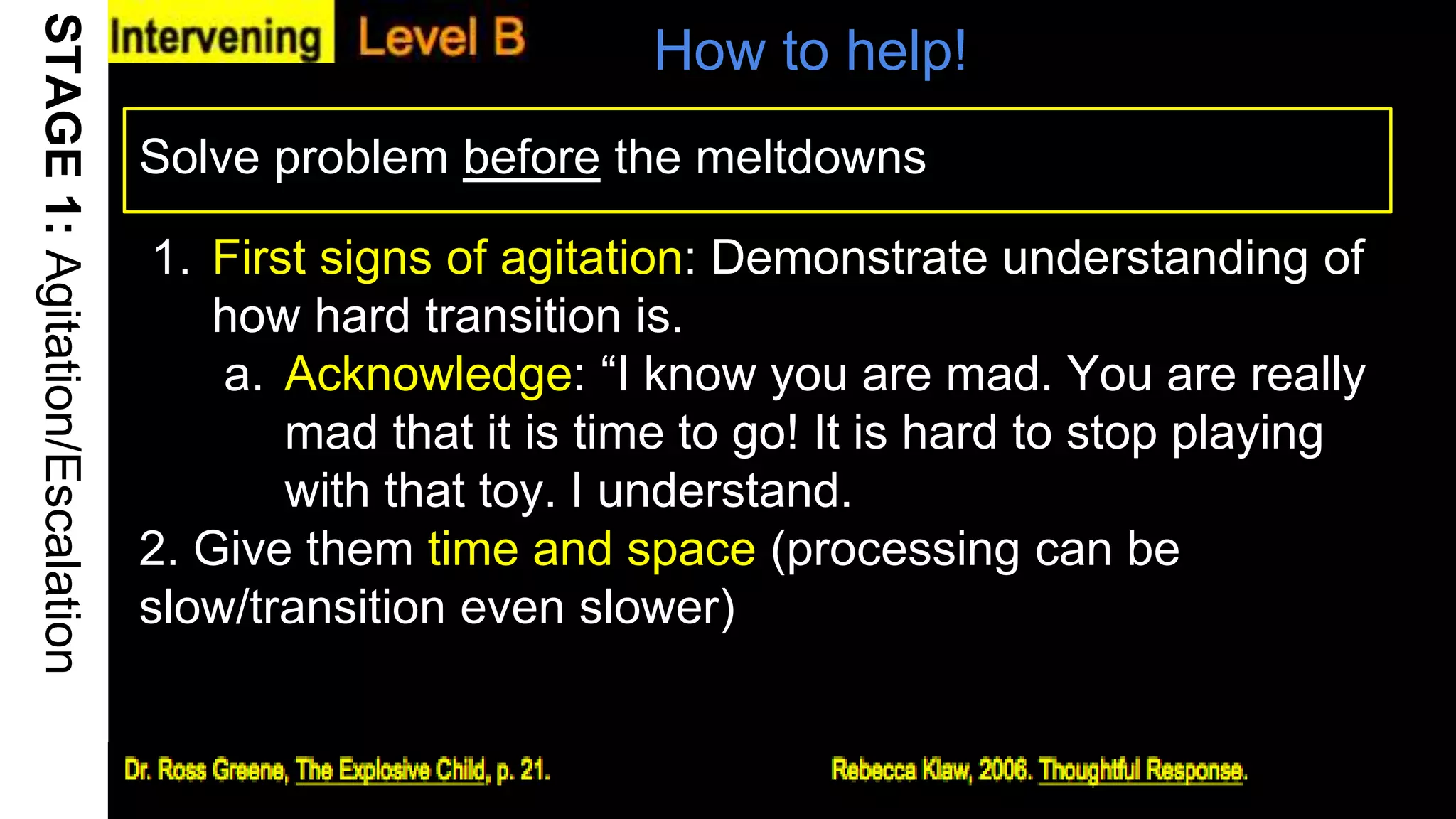
How to help!
Solve problem before the meltdowns
16
STAGE1:Agitation/Escalation
1. First signs of agitation: Demonstrate understanding of
how hard transition is.
a. Acknowledge: “I know you are mad. You are really
mad that it is time to go! It is hard to stop playing
with that toy. I understand.
2. Give them time and space (processing can be
slow/transition even slower)
STAGE1:Agitation/Escalation
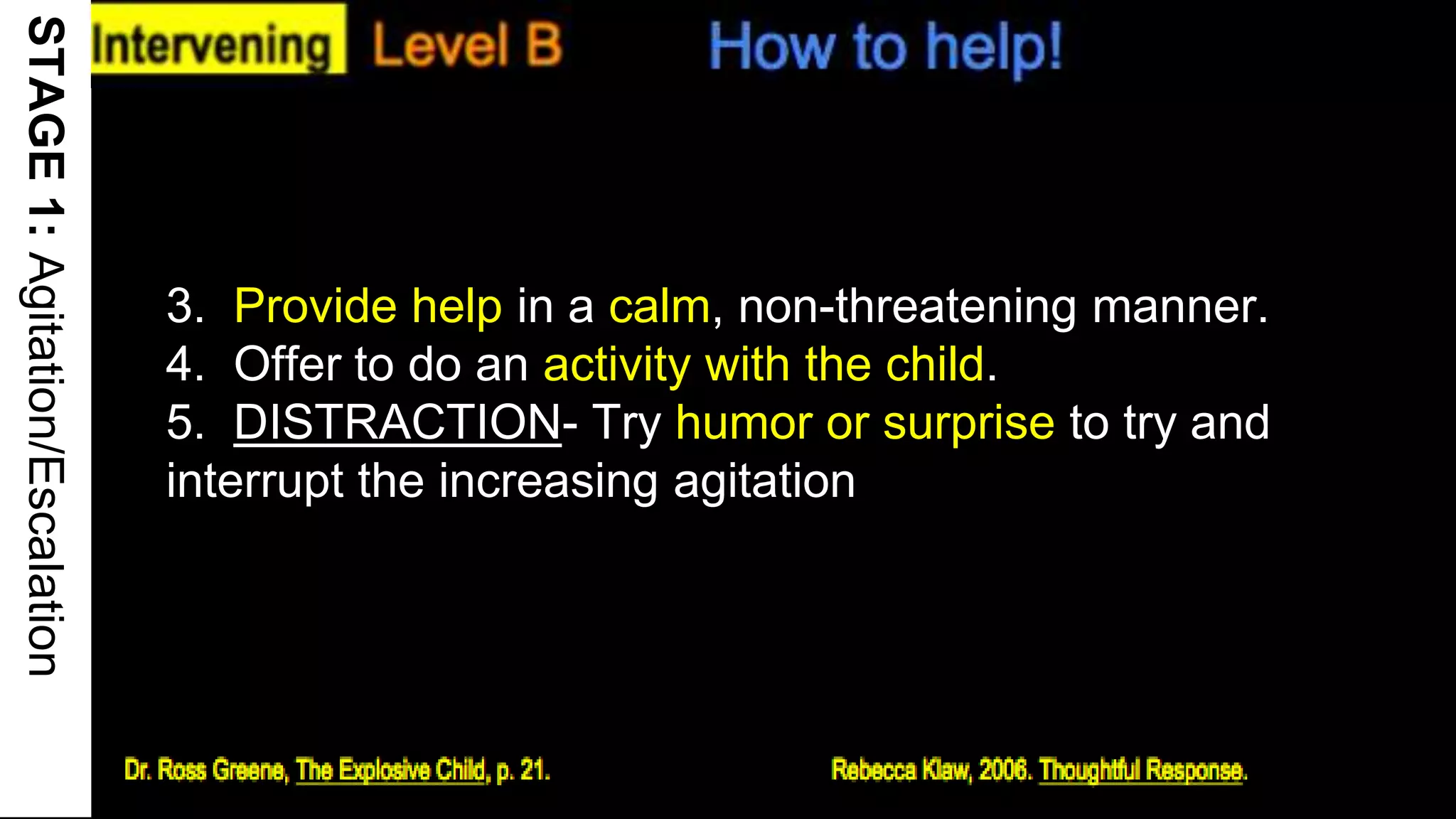
3. Provide help in a calm, non-threatening manner.
4. Offer to do an activity with the child.
5. DISTRACTION- Try humor or surprise to try and
interrupt the increasing agitation
17
Positive child response = Cognitively available child
❖ Frame the problem
■Get them to help with the solution.
●Uh-oh… we have a problem.
●Be flexible in how things are solved.
●Be open to the child’s solutions.
●Offering choices and suggestions.
18
STAGE1:Agitation/Escalation
Level A (Transition required)
19
STAGE1:Agitation/Escalation
How to help!
❖ Keep the child safe, healthy, clothed and fed.
➢ “Safety of all persons [and] ...property” (Myles & Aspy, 2016)
➢ If prescribed take medicine, go to school and go to
bed.
➢ Apply appropriate Level B Strategies.
Transitions We can’t compromise
Level B Strategies
❖ Calm the child
❖ Shift their attention to the request
➢ Apply appropriate Level B Strategies-
■ Empathy, Time and Space
■ Use humor (if appropriate), offer
help
20
STAGE1:Agitation/Escalation
❖ Use visual supports
❖ Decrease language
used
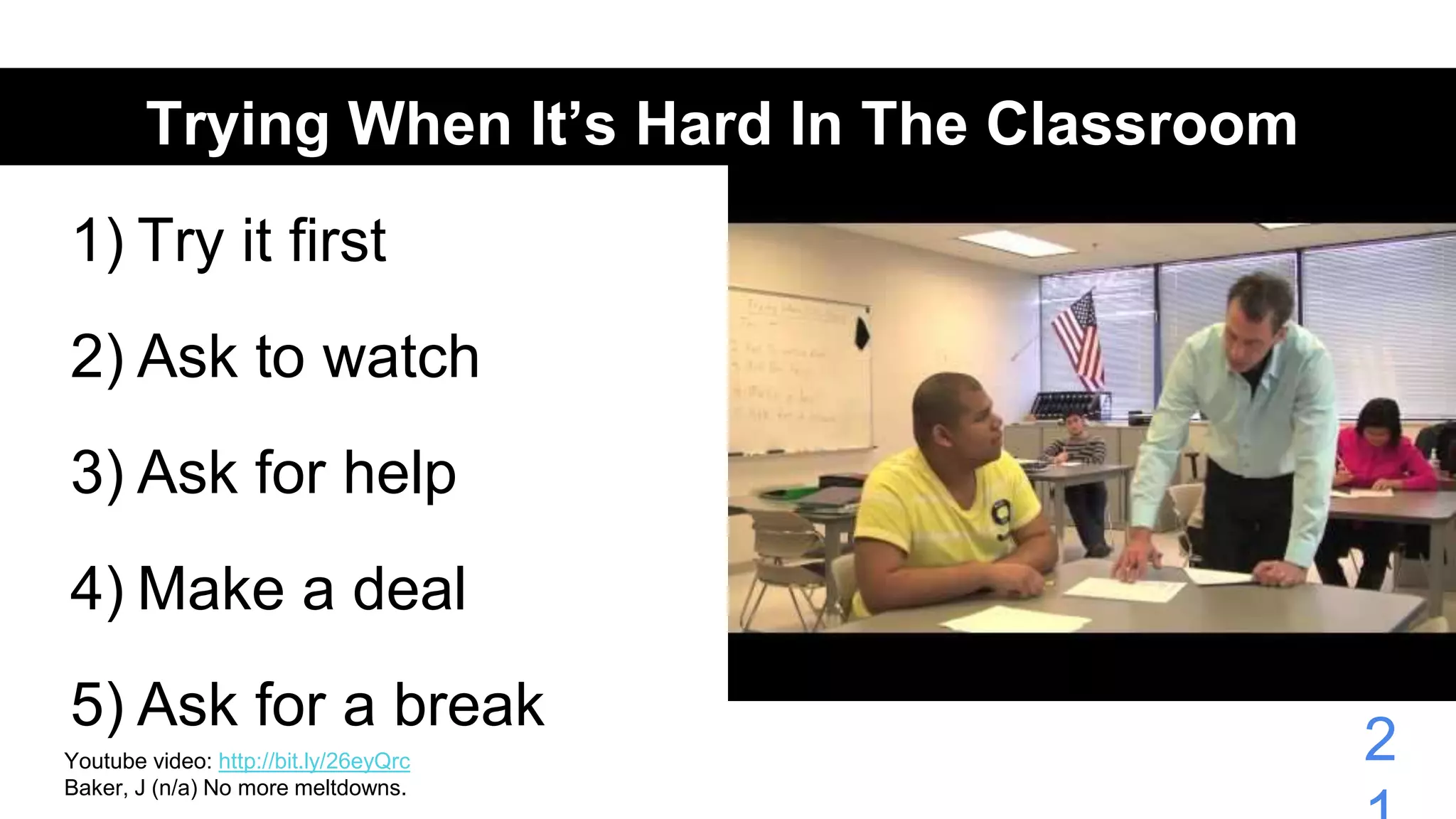
Trying When It’s Hard In The Classroom
1) Try it first
2) Ask to watch
3) Ask for help
4) Make a deal
5) Ask for a break
2Youtube video: http://bit.ly/26eyQrc
Baker, J (n/a) No more meltdowns.
Priming for Transition
BEFORE
❖ 5 Minute warning
❖ 1 Minute warning
❖ 10 Seconds
SCRIPT (Repeat steps)
❖ Compliment and encourage
calm behavior
❖ Empathetic comments
❖ You will be able to earn your
reward soon
❖ First success, be outlandish
with praise/immediate reward
22
STAGE2:Meltdown
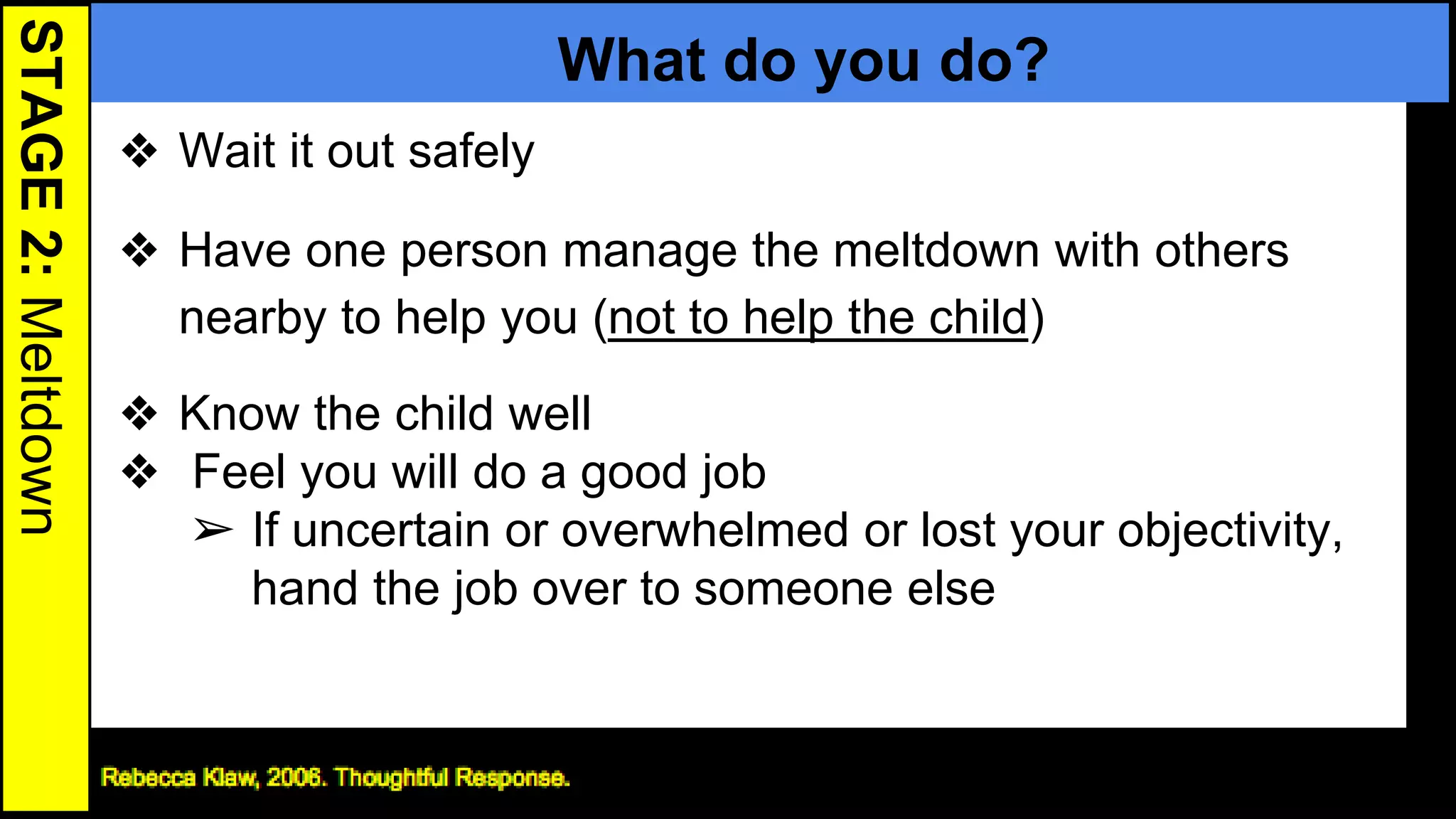
What do you do?
❖ Wait it out safely
❖ Have one person manage the meltdown with others
nearby to help you (not to help the child)
❖ Know the child well
❖ Feel you will do a good job
➢ If uncertain or overwhelmed or lost your objectivity,
hand the job over to someone else
23
STAGE2:Meltdown
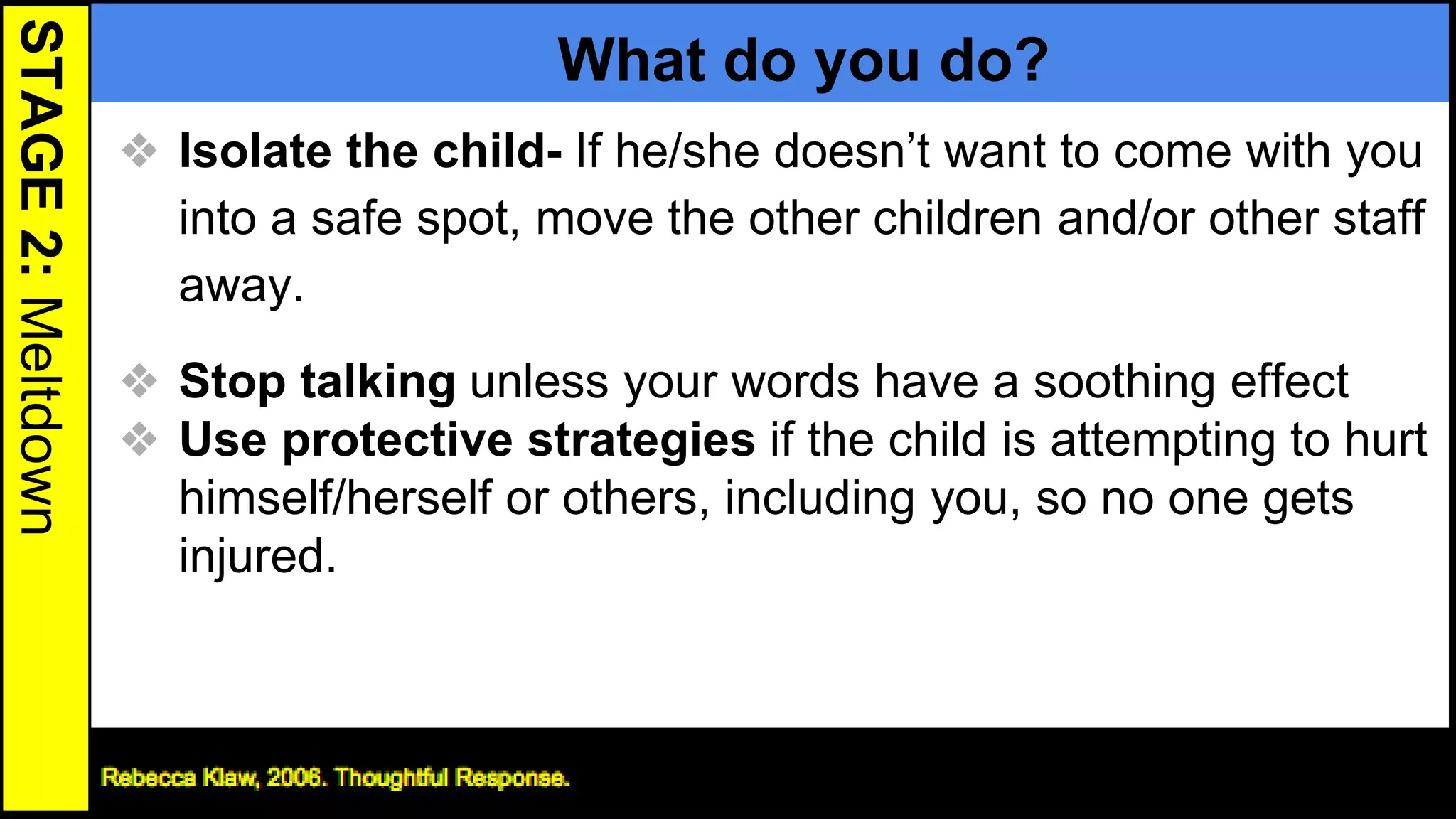
What do you do?
❖ Isolate the child- If he/she doesn’t want to come with you
into a safe spot, move the other children and/or other staff
away.
❖ Stop talking unless your words have a soothing effect
❖ Use protective strategies if the child is attempting to hurt
himself/herself or others, including you, so no one gets
injured.
24
STAGE2:Meltdown
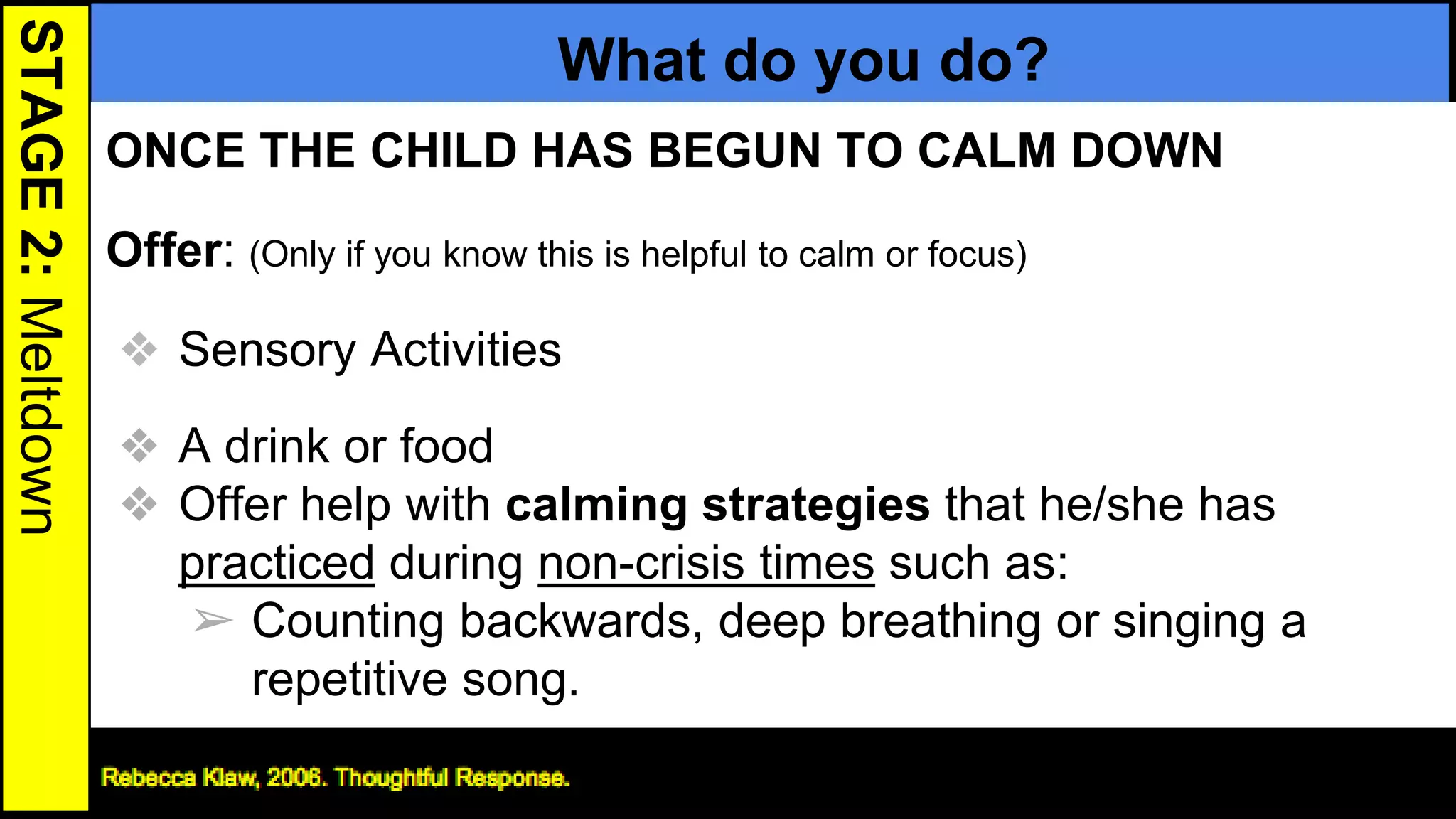
What do you do?
ONCE THE CHILD HAS BEGUN TO CALM DOWN
Offer: (Only if you know this is helpful to calm or focus)
❖ Sensory Activities
❖ A drink or food
❖ Offer help with calming strategies that he/she has
practiced during non-crisis times such as:
➢ Counting backwards, deep breathing or singing a
repetitive song.
25
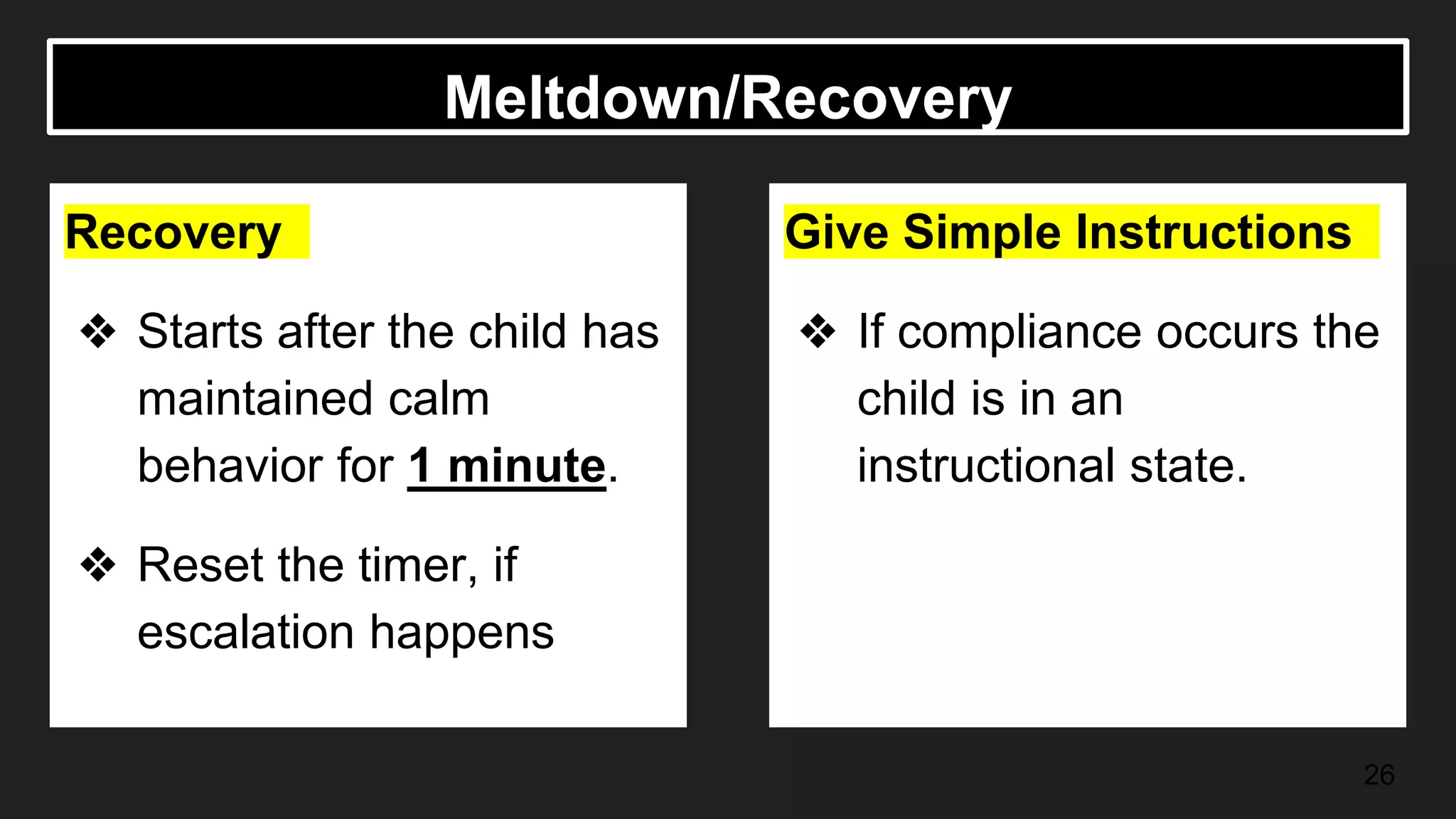
Meltdown/Recovery
Recovery
❖ Starts after the child has
maintained calm
behavior for 1 minute.
❖ Reset the timer, if
escalation happens
Give Simple Instructions
❖ If compliance occurs the
child is in an
instructional state.
❖ Continue instruction
26
STAGE3:Recovery
What do you do?
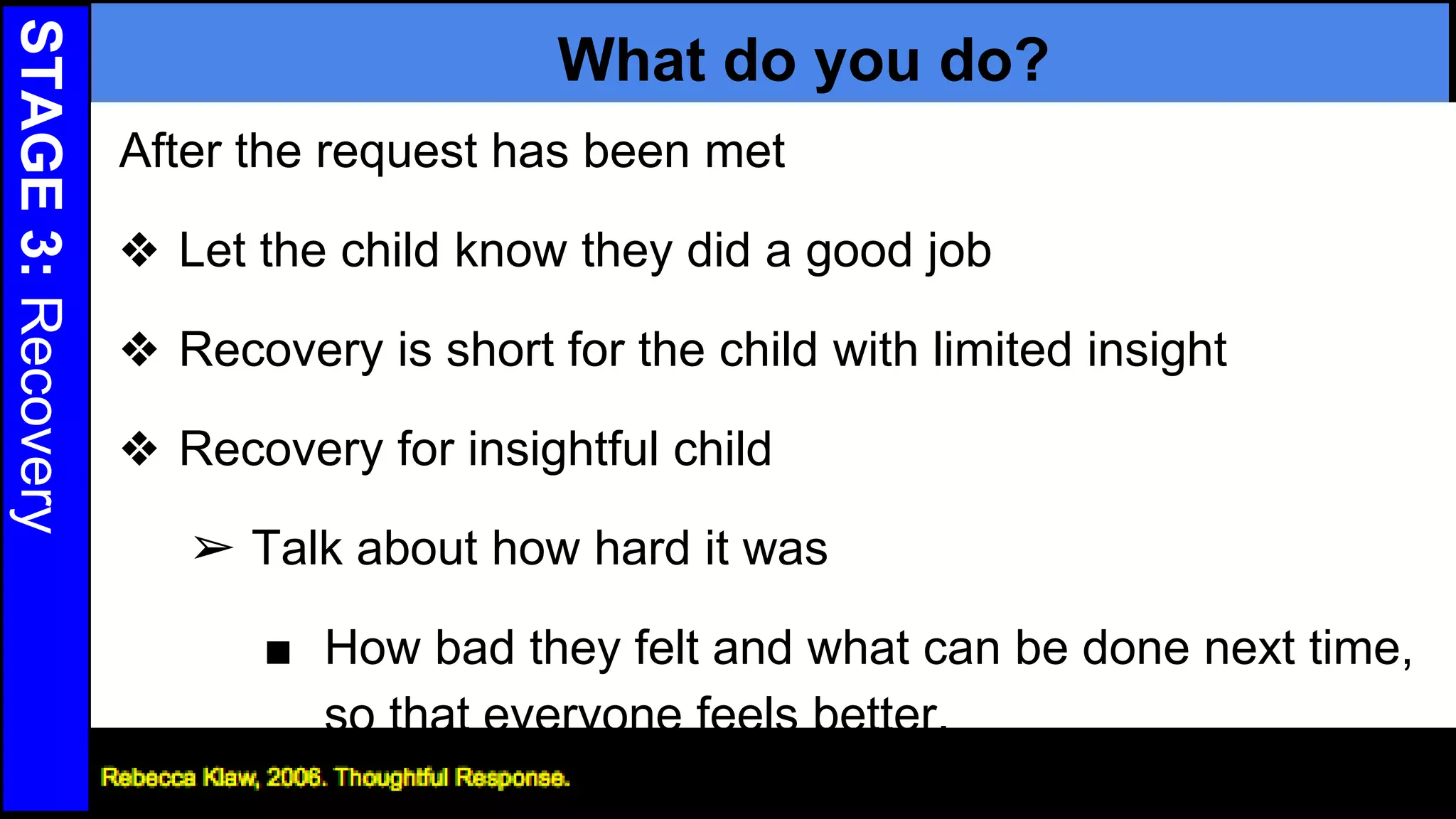
After the request has been met
❖ Let the child know they did a good job
❖ Recovery is short for the child with limited insight
❖ Recovery for insightful child
➢ Talk about how hard it was
■ How bad they felt and what can be done next time,
so that everyone feels better.
27
STAGE3:Recovery
What do you do?
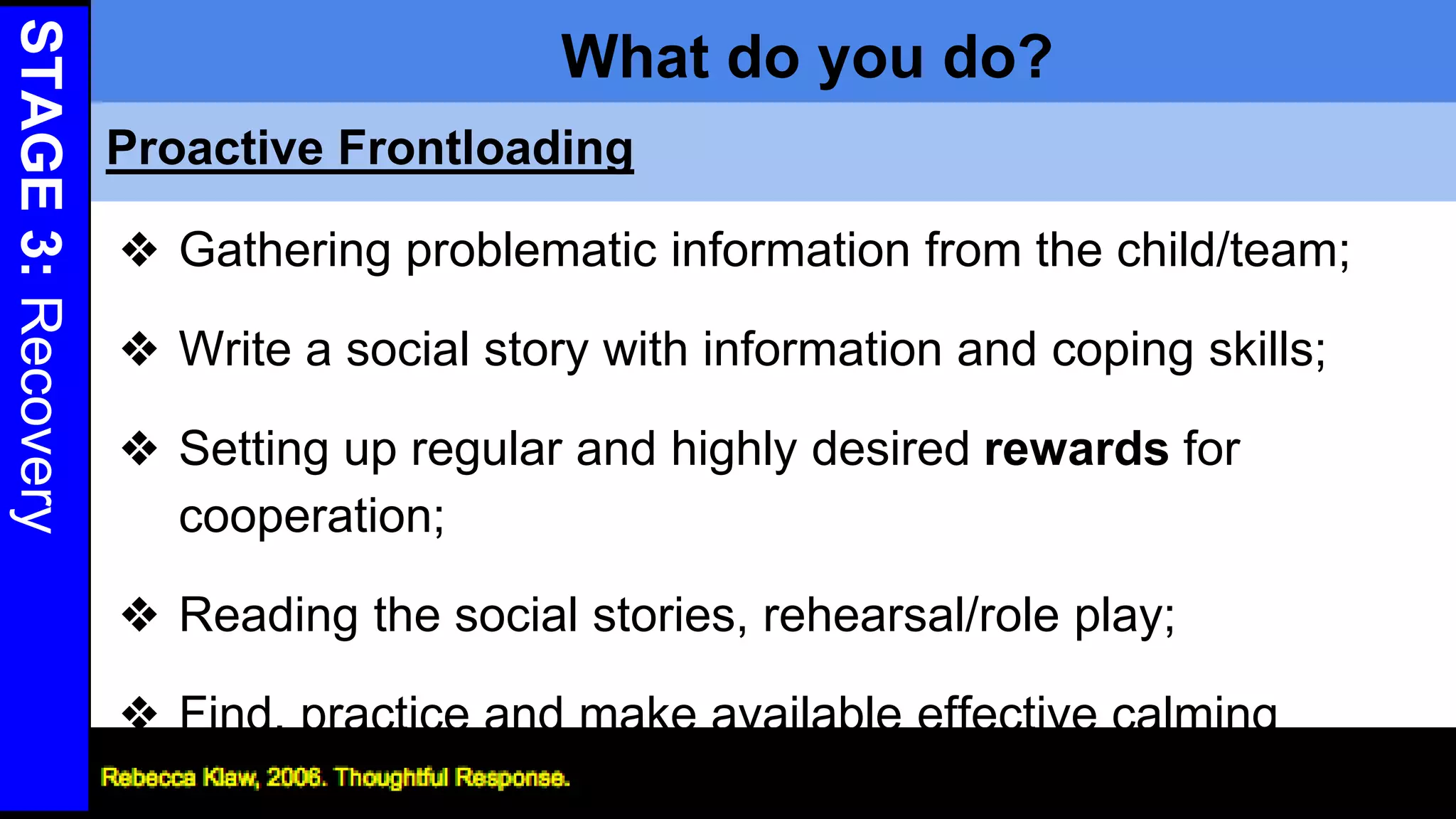
❖ Gathering problematic information from the child/team;
❖ Write a social story with information and coping skills;
❖ Setting up regular and highly desired rewards for
cooperation;
❖ Reading the social stories, rehearsal/role play;
❖ Find, practice and make available effective calming
methods 28
Proactive Frontloading
29
INTERVENTIONS
Myles & Aspy, 2016
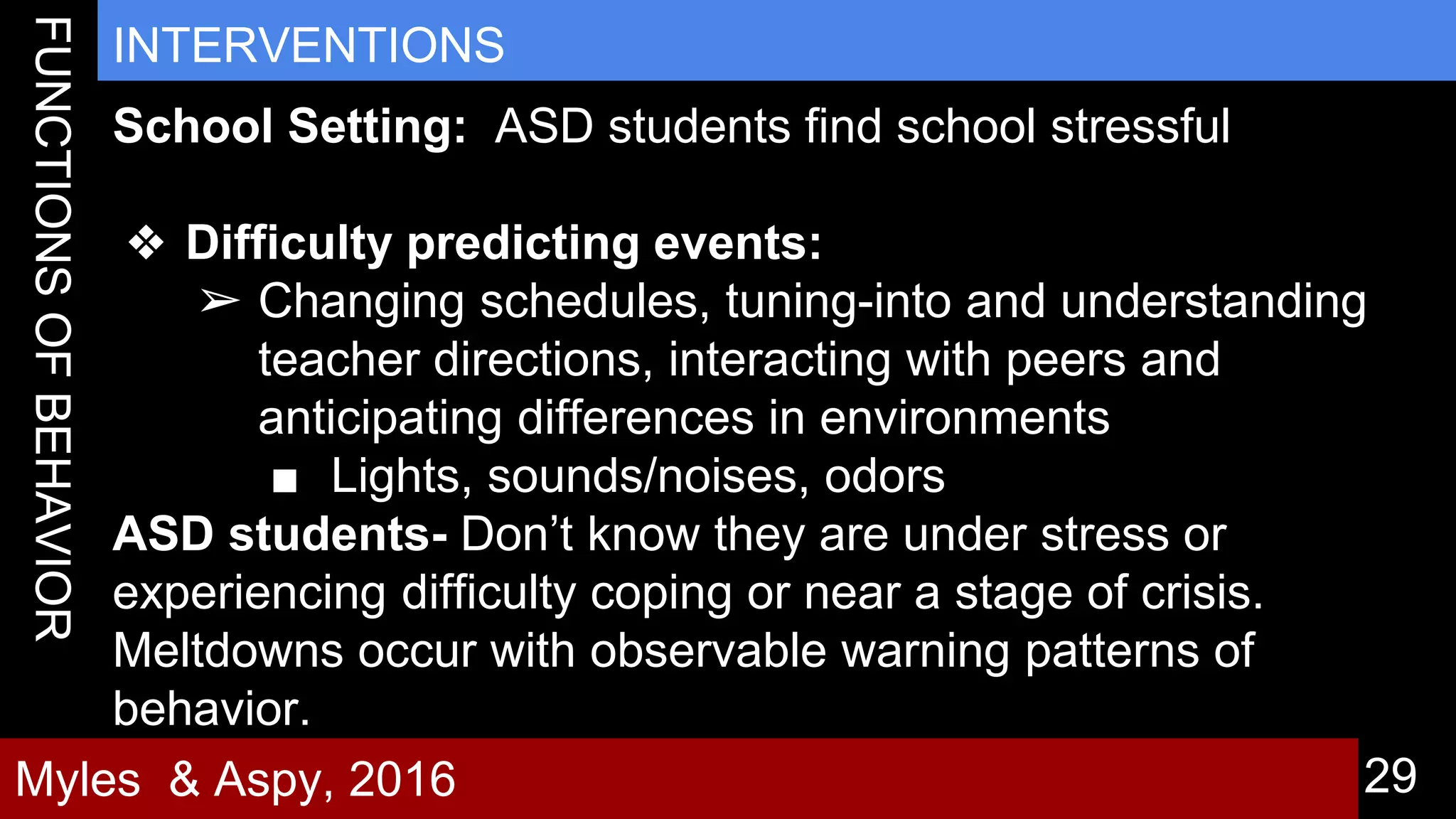
School Setting: ASD students find school stressful
❖ Difficulty predicting events:
➢ Changing schedules, tuning-into and understanding
teacher directions, interacting with peers and
anticipating differences in environments
■ Lights, sounds/noises, odors
ASD students- Don’t know they are under stress or
experiencing difficulty coping or near a stage of crisis.
Meltdowns occur with observable warning patterns of
behavior.
30
EFFECTIVE INTERVENTIONS
Myles & Aspy, 2016
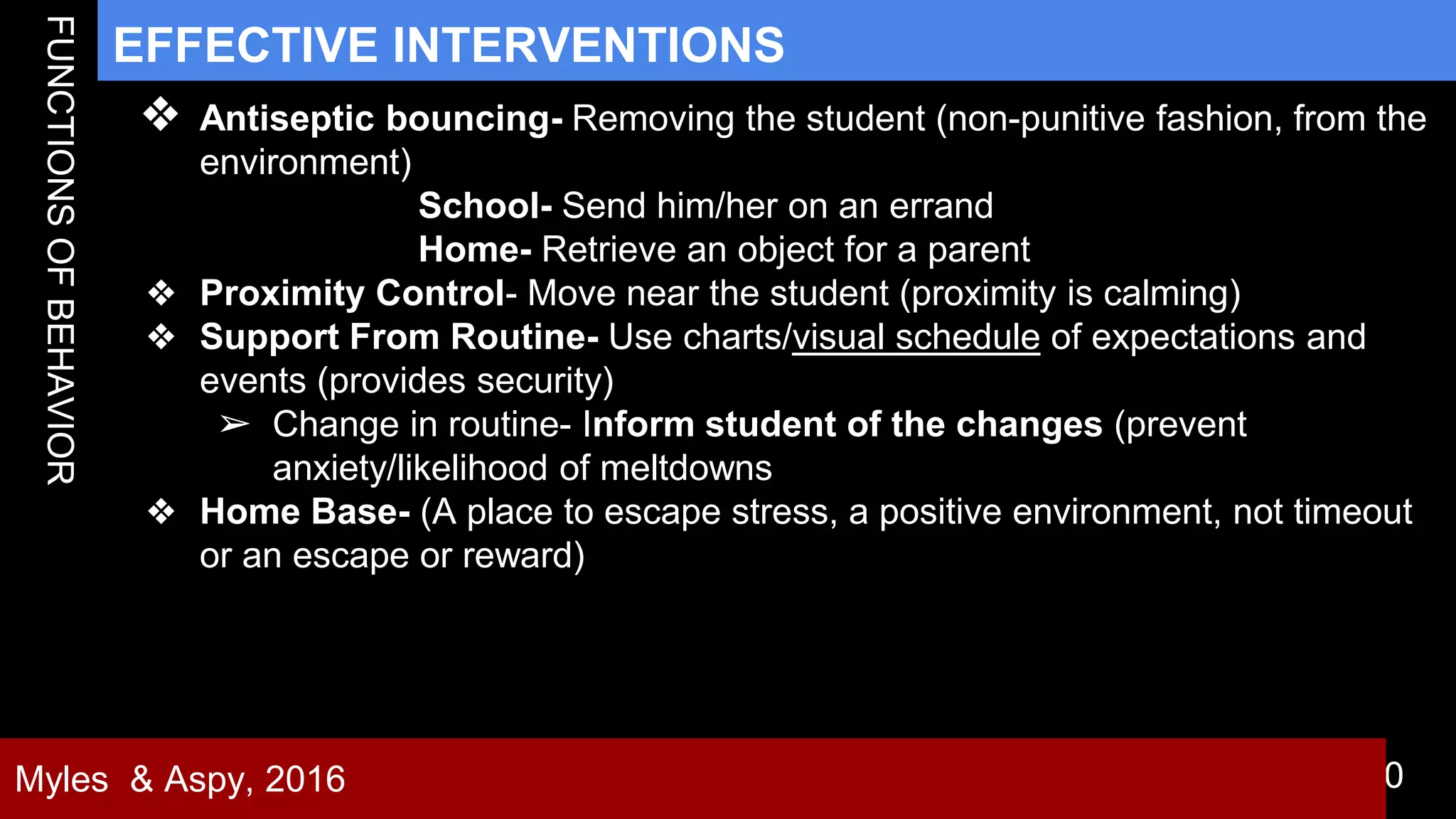
❖ Antiseptic bouncing- Removing the student (non-punitive fashion, from the
environment)
School- Send him/her on an errand
Home- Retrieve an object for a parent
❖ Proximity Control- Move near the student (proximity is calming)
❖ Support From Routine- Use charts/visual schedule of expectations and
events (provides security)
➢ Change in routine- Inform student of the changes (prevent
anxiety/likelihood of meltdowns
❖ Home Base- (A place to escape stress, a positive environment, not timeout
or an escape or reward)
31
EFFECTIVE INTERVENTIONS
Myles & Aspy, 2016
Home Base-
Purpose- To regain self-control
❖ Quiet place, with few visual or activity distractions
❖ Calming Activities (Carefully selected)
Times for Home Base-
❖ Beginning the day, review schedule, introduce routine
changes, to organize the child, priming and to regain
control
School- Resource room or
counselor’s office
Home- Child’s room
32
INTERVENTIONS
Myles & Aspy, 2016
School Crisis Plans should include:
a) Obtaining assistance from educators (crisis
teacher/principal,
b) Removing other students
c) Restrain as necessary
33
INTERVENTIONS
Myles & Aspy, 2016
Recovery Stage- The child can’t always remember what
happened.
a) Often not ready to learn
b) Work with them to become part of the routine
c) Direct the child to a highly motivating task (that is
easily completed and related to a special interest)
Resources
Baker, J. (n/a) No more meltdowns positive strategies for managing and preventing out of control
behavior.
Dr. Jed Baker’s Youtube Channel (Videos: “Dealing With Mistakes”, “Trying When It’s Hard,”
“Dealing With the Unexpected Changes.”)
TANTRUM V MELTDOWN Poster Developed by: tesAutism http://bit.ly/25TVXY5
Website: https://www.tes.com/teaching-resource/identifying-tantrums-and-meltdowns-6328104
Warburg, C.L. (n/a) Triggers for kids with autism & SPD (Poster). LINK: http://bit.ly/1qCIJyu.
34
References
Baker, J. (n/a) No more meltdowns. Positive strategies for managing and preventing out of control
behavior. Future Horizons INC. ISBN:9781935274278-ebook .EPUB.
Greene, R. (2001) The explosive child. Harper Collins.
Klaw, R. (2006) Thoughtful response to agitation, escalation and meltdowns in children with autism
spectrum disorders.
Myles, B.S., & Aspy, R. (2016). High-functioning autism and difficult moments: Practical solutions to
meltdowns. Shawnee Mission, KS: AAPC Publishing.
tesAutism. TANTRUM V MELTDOWN (Poster). Website: https://www.tes.com/teaching-
resource/identifying-tantrums-and-meltdowns-6328104
Warburg, C.L. Triggers for kids with autism & SPD (Poster). LINK: http://bit.ly/1qCIJyu
35

Meltdowns. Final Presentation

  • 1.
    1 By: Tom Evans LINK:http://bit.ly/1NGmCMA 1 Uh-Oh! Transition Times and Meltdowns
  • 2.
    Table of Contents 3.Tantrum vs. Meltdown 5. What is a Meltdown 6. Characteristics 7. Cognitive Debilitation 8. STAGE 1: Agitation/Escalation: Child’s Response 9. 4 Step Model 10. Stages of Crisis 11. ABC’s of Behavior 13. Functions of Behavior: Interventions 14. Dealing With Unexpected Changes 15 Dealing With Mistakes 16. Triggers 17. Behavior Triggers 18. STAGE 1: Agitation Triggers 19. CONSEQUENCES 20. STG 1: Proactive Strategies 2 21. STG 1: Intervening 22. STG 1: Intervening Level B Teachable 23. STG 1: Intervening Level B “How to Help” 26. STG 1: Intervening Level A Transition 28. Trying When It’s Hard 30. Transition Roadmap 31. STG 2: MELTDOWN- What Do You Do? 34. STG 3: MELTDOWN/RECOVERY 35. STG 3: RECOVERY- What Do You Do? 37. MELTDOWN Brainlock 38. Functions of Behavior Interventions (School) 39. F.B.I. (Initial Stage) 40. F.B.I. (EFFECTIVE INTERVENTIONS) 41. F.B.I. (EFFECTIVE INTERVENTIONS- Home Base) 42. F.B.I. Rage Stage 43. F.B.I. School Crisis Plan 44. F.B.I. Recovery 45. Resources 46. References
  • 3.
    3 Developed by: tesAutismhttp://bit.ly/25TVXY5
  • 4.
    Meltdown-Prone Children ❖ Difficultymanaging/controlling frustration ➢ Frustrated more easily. ➢ Frustration Experience- Intense, disorganizing, and overwhelming ➢ Inflexible, poor responses, NO regard for consequences ➢ Few coping mechanisms ➢ “Thinking through” ways to resolve frustrating situations. ■ CAUSED BY: DEMANDS Rebecca Klaw, 2006. Thoughtful Response. 4
  • 5.
    Child’s Reaction- ❖ Unableto regulate EMOTIONS related to FRUSTRATION ➢Unable to THINK clearly ➢Unable to SHIFT their thoughts 5Dr. Ross Greene, The Explosive Child, p. 21. Rebecca Klaw, 2006. Thoughtful Response.
  • 6.
  • 7.
    ABC’s of Behavior: 7 Date:Antecedent Behavior Consequence = Function Before During After S.E.A.T.
  • 8.
    8 INTERVENTIONS Function(s) Interventions Avoid/Escape ReduceTask Demands Make Demand Stimulating Allow Choice Break After Completion Attention Seeking (Peers) Ignoring Peers Reinforcement Peer Tutoring Group work Attention Seeking (Staff) Ignore behavior Time-Out/ Sanctum Focus on the good behavior
  • 9.
    Dealing With UnexpectedChanges Being flexible with Changes 1)Sometimes routines change 2)Stay calm ASK: What changed and what stayed the same? 3) You can still control somethings ASK: What else can I control? 9 Prime the skill before, Coach the skill, and Review Skill changes Youtube video: http://bit.ly/20Wpcpe Baker, J (n/a) No more meltdowns.
  • 10.
    10 Developed by: ChayeLamm Warburg http://bit.ly/1qCIJyu
  • 11.
    “...very effective ifa child is in a state of mind to appreciate their meaning but don’t work nearly so well if a child is not able to maintain such a state of mind.” 11 Treating “out of control”, irrational, incoherent, destructive and sometimes abusive behavior with consequences is NOT routinely effective. Dr. Ross Greene, The Explosive Child, p. 21. Rebecca Klaw, 2006. Thoughtful Response.
  • 12.
    Proactive Strategies (ongoing) ❖IndividualizeStrategies (often include the following): ➢ Access to: ■ Communication, Choice, Quality of Life, Meaningful Reinforcers ➢ Predictability ➢ Environmental Adaptations ➢ Analysis of COMMON challenging behaviors (Look for the motive) ➢ Utilization of strengths and special interests- Vehicle to TEACH ❖ 12Dr. Ross Greene, The Explosive Child, p. 21. Rebecca Klaw, 2006. Thoughtful Response. STAGE1:Agitation/Escalation
  • 13.
    STAGE1:Agitation/Escalation ❖ Each childhas their own ❖ Starts with REFUSAL ➢ “NO!” ➢ Falling to the floor; ➢ Not moving; ➢ Hitting, Kicking, Pinching, Biting; or Hiding 13 WARNING SIGNS REASON Difficulty Shifting Attention/Transition Rebecca Klaw, 2006. Thoughtful Response.
  • 14.
    STAGE1:Agitation/Escalation 14 Intervening A Level Demands= B Level Demands = C Level Demands = Non-negotiable Important, but not totally essential, can be put on hold if the child is stressed about other things Non-essential, eliminate Think about the DEMAND Rebecca Klaw, 2006. Thoughtful Response.
  • 15.
    Level B (TeachableMoments) Rebecca Klaw, 2006. Thoughtful Response. DO: ❖ Teach how to deal with stress, inflexibility and difficult feelings. ❖ Remove Demand when other variables add to distress and overload occurs. 15 Is this the day and time that I want to help this child learn new skills and new coping mechanisms? DONT: Avoid Agitation at all costs.
  • 16.
    How to help! Solveproblem before the meltdowns 16 STAGE1:Agitation/Escalation 1. First signs of agitation: Demonstrate understanding of how hard transition is. a. Acknowledge: “I know you are mad. You are really mad that it is time to go! It is hard to stop playing with that toy. I understand. 2. Give them time and space (processing can be slow/transition even slower)
  • 17.
    STAGE1:Agitation/Escalation 3. Provide helpin a calm, non-threatening manner. 4. Offer to do an activity with the child. 5. DISTRACTION- Try humor or surprise to try and interrupt the increasing agitation 17
  • 18.
    Positive child response= Cognitively available child ❖ Frame the problem ■Get them to help with the solution. ●Uh-oh… we have a problem. ●Be flexible in how things are solved. ●Be open to the child’s solutions. ●Offering choices and suggestions. 18 STAGE1:Agitation/Escalation
  • 19.
    Level A (Transitionrequired) 19 STAGE1:Agitation/Escalation How to help! ❖ Keep the child safe, healthy, clothed and fed. ➢ “Safety of all persons [and] ...property” (Myles & Aspy, 2016) ➢ If prescribed take medicine, go to school and go to bed. ➢ Apply appropriate Level B Strategies.
  • 20.
    Transitions We can’tcompromise Level B Strategies ❖ Calm the child ❖ Shift their attention to the request ➢ Apply appropriate Level B Strategies- ■ Empathy, Time and Space ■ Use humor (if appropriate), offer help 20 STAGE1:Agitation/Escalation ❖ Use visual supports ❖ Decrease language used
  • 21.
    Trying When It’sHard In The Classroom 1) Try it first 2) Ask to watch 3) Ask for help 4) Make a deal 5) Ask for a break 2Youtube video: http://bit.ly/26eyQrc Baker, J (n/a) No more meltdowns.
  • 22.
    Priming for Transition BEFORE ❖5 Minute warning ❖ 1 Minute warning ❖ 10 Seconds SCRIPT (Repeat steps) ❖ Compliment and encourage calm behavior ❖ Empathetic comments ❖ You will be able to earn your reward soon ❖ First success, be outlandish with praise/immediate reward 22
  • 23.
    STAGE2:Meltdown What do youdo? ❖ Wait it out safely ❖ Have one person manage the meltdown with others nearby to help you (not to help the child) ❖ Know the child well ❖ Feel you will do a good job ➢ If uncertain or overwhelmed or lost your objectivity, hand the job over to someone else 23
  • 24.
    STAGE2:Meltdown What do youdo? ❖ Isolate the child- If he/she doesn’t want to come with you into a safe spot, move the other children and/or other staff away. ❖ Stop talking unless your words have a soothing effect ❖ Use protective strategies if the child is attempting to hurt himself/herself or others, including you, so no one gets injured. 24
  • 25.
    STAGE2:Meltdown What do youdo? ONCE THE CHILD HAS BEGUN TO CALM DOWN Offer: (Only if you know this is helpful to calm or focus) ❖ Sensory Activities ❖ A drink or food ❖ Offer help with calming strategies that he/she has practiced during non-crisis times such as: ➢ Counting backwards, deep breathing or singing a repetitive song. 25
  • 26.
    Meltdown/Recovery Recovery ❖ Starts afterthe child has maintained calm behavior for 1 minute. ❖ Reset the timer, if escalation happens Give Simple Instructions ❖ If compliance occurs the child is in an instructional state. ❖ Continue instruction 26
  • 27.
    STAGE3:Recovery What do youdo? After the request has been met ❖ Let the child know they did a good job ❖ Recovery is short for the child with limited insight ❖ Recovery for insightful child ➢ Talk about how hard it was ■ How bad they felt and what can be done next time, so that everyone feels better. 27
  • 28.
    STAGE3:Recovery What do youdo? ❖ Gathering problematic information from the child/team; ❖ Write a social story with information and coping skills; ❖ Setting up regular and highly desired rewards for cooperation; ❖ Reading the social stories, rehearsal/role play; ❖ Find, practice and make available effective calming methods 28 Proactive Frontloading
  • 29.
    29 INTERVENTIONS Myles & Aspy,2016 School Setting: ASD students find school stressful ❖ Difficulty predicting events: ➢ Changing schedules, tuning-into and understanding teacher directions, interacting with peers and anticipating differences in environments ■ Lights, sounds/noises, odors ASD students- Don’t know they are under stress or experiencing difficulty coping or near a stage of crisis. Meltdowns occur with observable warning patterns of behavior.
  • 30.
    30 EFFECTIVE INTERVENTIONS Myles &Aspy, 2016 ❖ Antiseptic bouncing- Removing the student (non-punitive fashion, from the environment) School- Send him/her on an errand Home- Retrieve an object for a parent ❖ Proximity Control- Move near the student (proximity is calming) ❖ Support From Routine- Use charts/visual schedule of expectations and events (provides security) ➢ Change in routine- Inform student of the changes (prevent anxiety/likelihood of meltdowns ❖ Home Base- (A place to escape stress, a positive environment, not timeout or an escape or reward)
  • 31.
    31 EFFECTIVE INTERVENTIONS Myles &Aspy, 2016 Home Base- Purpose- To regain self-control ❖ Quiet place, with few visual or activity distractions ❖ Calming Activities (Carefully selected) Times for Home Base- ❖ Beginning the day, review schedule, introduce routine changes, to organize the child, priming and to regain control School- Resource room or counselor’s office Home- Child’s room
  • 32.
    32 INTERVENTIONS Myles & Aspy,2016 School Crisis Plans should include: a) Obtaining assistance from educators (crisis teacher/principal, b) Removing other students c) Restrain as necessary
  • 33.
    33 INTERVENTIONS Myles & Aspy,2016 Recovery Stage- The child can’t always remember what happened. a) Often not ready to learn b) Work with them to become part of the routine c) Direct the child to a highly motivating task (that is easily completed and related to a special interest)
  • 34.
    Resources Baker, J. (n/a)No more meltdowns positive strategies for managing and preventing out of control behavior. Dr. Jed Baker’s Youtube Channel (Videos: “Dealing With Mistakes”, “Trying When It’s Hard,” “Dealing With the Unexpected Changes.”) TANTRUM V MELTDOWN Poster Developed by: tesAutism http://bit.ly/25TVXY5 Website: https://www.tes.com/teaching-resource/identifying-tantrums-and-meltdowns-6328104 Warburg, C.L. (n/a) Triggers for kids with autism & SPD (Poster). LINK: http://bit.ly/1qCIJyu. 34
  • 35.
    References Baker, J. (n/a)No more meltdowns. Positive strategies for managing and preventing out of control behavior. Future Horizons INC. ISBN:9781935274278-ebook .EPUB. Greene, R. (2001) The explosive child. Harper Collins. Klaw, R. (2006) Thoughtful response to agitation, escalation and meltdowns in children with autism spectrum disorders. Myles, B.S., & Aspy, R. (2016). High-functioning autism and difficult moments: Practical solutions to meltdowns. Shawnee Mission, KS: AAPC Publishing. tesAutism. TANTRUM V MELTDOWN (Poster). Website: https://www.tes.com/teaching- resource/identifying-tantrums-and-meltdowns-6328104 Warburg, C.L. Triggers for kids with autism & SPD (Poster). LINK: http://bit.ly/1qCIJyu 35

Editor's Notes

  • #2 http://bit.ly/23Pevu0
  • #4 Website: https://www.tes.com/teaching-resource/identifying-tantrums-and-meltdowns-6328104
  • #5 Rebecca Klaw, 2006. Thoughtful Response. Demands to switch gears
  • #6  Unable to SHIFT their thoughts- from their agenda to your agenda even when faced with very meaningful consequences.
  • #8 Functions of Behavior- *Avoid/Escape- Removal undesired person, task or location *Attention Seeking- Attention Sensory- Can happen anytime, feels good or bad *Power- Desire to control Tangibles- Item specific
  • #9 Functions of behavior- 2014-2015 Professional Development Series Special Education Disabilities PD Part 2: Understanding ADHD and Other Health Impairments (OHI) Presented by: Melanie Garcia, Special Education Coordinator and Christina Saad, School Psychologist LINK: http://bit.ly/1ViR3QR Functions of Behavior and Interventions Typical function(s) of behavior Interventions Avoiding/Escaping task demands Reduce Task demands Make Task Stimulating Allow Choice of Task Attention Breaks Contingent on Task Completion Others? Obtaining Attention from peers Reinforce Peers for ignoring Use Group Contingency Peer Tutoring Others? Obtaining Attention from adults Ignore off-task behavior Time-Out Attend to On-task Behavior Others? Functions of Behavior- *Avoid/Escape- Removal undesired person, task or location *Attention Seeking- Attention Sensory- Can happen anytime, feels good or bad *Power- Desire to control Tangibles- Item specific
  • #10 Baker, J (n/a) No more meltdowns. Positive strategies for managing and preventing out of control behavior. Future Horizons INC. ISBN:9781935274278-ebook .EPUB. Youtube video: http://bit.ly/20Wpcpe
  • #11 Warburg, C.L. Triggers for kids with autism & SPD. LINK: http://bit.ly/1qCIJyu
  • #15 A Level Essential or consider deferring or delaying your request (C Level). Do they really need to put on their shoes? Does it really matter if they eat dessert before their pretzels? If it is really a C level request (not important), give them a choice (modeling appropriate, non-agitated communication) and accept their selection. Oh, you want your shoes off. Shoes on later. Okay, shoes later.
  • #16 If you decide that it is a B level request that is fueling their refusal and subsequent agitation, you need to decide if this is the day and time that you want to help this child learn new skills and new coping mechanisms. B level skills can provide you with the opportunity to teach more constructive and more effective ways of dealing with stress, inflexibility and difficult feelings. Agitation doesn’t have to be avoided at all costs. They can and should be seen as teachable moments. B level request can be removed if you realize that there are too many other variables contributing to distress. Example- If he/she is sick or tired, if there have been changes in routine, if there is sensory overload, do not choose this moment in time to teach your student about managing stress and frustration. Give the student true choices and accept their response.
  • #17 First signs of agitation: Demonstrate understanding of how hard transition is. Acknowledge: “I know you are mad. You are really mad that it is time to go! It is hard to stop playing with that toy. I understand. 2. Give them time and space (processing can be slow/transition even slower)
  • #18 3. Provide help in a calm, non-threatening manner. 4. Offer to do an activity with the child. 5. DISTRACTION- Try humor or surprise to try and interrupt the increasing agitation.
  • #19 Uh-oh… we have a problem- I want you to get ready to go home and you want to continue to play. What can we do about this that makes both you happy and me happy? Level B request flexible in how things are solved. Be open to the child’s solutions as long as it fits the parameters (a solution that makes both you and your student happy). Help the child with a solution by offering choices and suggestions.
  • #21 TRANSITION/Shift their attention to the request- Warn the child that they have 5 minutes left. Inform them that they will need to continue to remain calm when the time is up and transition to the next activity calmly. For the first time a child transitions successfully reward the child. Allow the child to either return to the previous activity or one of the choice for about 4 to 5 minutes and then set the timer. After the transition routine is established let the child know if they transition successfully they will get a... (token towards their next reward). When the child has 1 minute remain warn them again and repeat the importance of staying calm. Enthusiastically let them know you believe even though this is hard for them, you know they can successfully make this transition. When there is 10 seconds also let them know, enthusiastically provide encouragement again. Prepare the child for the transition by complimenting them on how calm they are right now. Let them know if they remain calm they will be able to earn their reward soon (EVANS, 2016). Empathy, time (for de-escalation and compliance, to use visual supports while decreasing the amount of language being used)
  • #22 Youtube video:http://bit.ly/26eyQrc Baker, J (n/a) No more meltdowns.
  • #23 TRANSITION/Shift their attention to the request- Warn the child that they have 5 minutes left. Inform them that they will need to continue to remain calm when the time is up and transition to the next activity calmly. For the first time a child transitions successfully reward the child. Allow the child to either return to the previous activity or one of the choice for about 4 to 5 minutes and then set the timer. After the transition routine is established let the child know if they transition successfully they will get a... (token towards their next reward). When the child has 1 minute remain warn them again and repeat the importance of staying calm. Enthusiastically let them know you believe even though this is hard for them, you know they can successfully make this transition. When there is 10 seconds also let them know, enthusiastically provide encouragement again. Prepare the child for the transition by complimenting them on how calm they are right now. Let them know if they remain calm they will be able to earn their reward soon (EVANS, 2016). Empathy, time (for de-escalation and compliance, to use visual supports while decreasing the amount of language being used)
  • #24 A level requests are usually the trigger for full escalations. For a child that is inflexible, rigid, and routine-bound (as many of our children with autism are), being told that he/she must or mustn’t do something is often intolerable. When the child finds that this limit can’t be changed or altered or negotiated but simply needs to be accepted, it can be very difficult. As the adult proceeds to follow-through with the requirement, the child becomes enraged. Now he/she can’t reason, his/her body often goes out of control and he/she becomes incoherent. This is the meltdown. What do you do? Wait it out safely Have one person manage the meltdown with others nearby to help you (not to help the child) The person who manages the meltdown should know the child well and should feel that they will do a good job. If you are uncertain or overwhelmed or if you have lost your objectivity, hand the job over to someone else
  • #25  What do you do? You need to isolate the child. If he/she doesn’t want to come with you into a safe spot, then move other children and/or other staff away. Stop talking unless your words have a soothing effect Use protective strategies if the child is attempting to hurt himself/herself or others, including you, so no one gets injured.
  • #26  What do you do? ONCE THE CHILD HAS BEGUN TO CALM DOWN, offer sensory activities such as rocking or deep pressure if, and only if, you know that this is helpful in reorganizing the child. Offer him a drink or something to eat if, and only if, you know that eating and drinking is helpful in calming and focusing this child. Offer to help the child with calming strategies that he/she has practiced during non-crisis times such as counting backwards, deep breathing or singing a repetitive song.
  • #27 TRANSITION/Shift their attention to the request- Warn the child that they have 5 minutes left. Inform them that they will need to continue to remain calm when the time is up and transition to the next activity calmly. For the first time a child transitions successfully reward the child. Allow the child to either return to the previous activity or one of the choice for about 4 to 5 minutes and then set the timer. After the transition routine is established let the child know if they transition successfully they will get a... (token towards their next reward). When the child has 1 minute remain warn them again and repeat the importance of staying calm. Enthusiastically let them know you believe even though this is hard for them, you know they can successfully make this transition. When there is 10 seconds also let them know, enthusiastically provide encouragement again. Prepare the child for the transition by complimenting them on how calm they are right now. Let them know if they remain calm they will be able to earn their reward soon (EVANS, 2016). Empathy, time (for de-escalation and compliance, to use visual supports while decreasing the amount of language being used)
  • #28 Recovery
  • #29 Recovery
  • #30 Myles, B.S., & Aspy, R. (2016). High-functioning autism and difficult moments: Practical solutions to meltdowns. Shawnee Mission, KS: AAPC Publishing. Myles, B.S., & Aspy, R. (2016). High-functioning autism and difficult moments: Practical solutions to meltdowns. Shawnee Mission, KS: AAPC Publishing. School Setting: ASD students find school stressful Difficulty predicting events (changing schedules, tuning-in to and understanding teacher directions, interacting with peers and anticipating differences in environments ((lights, sounds/noises, odors)) ASD students- Don’t know they are under stress or experiencing difficulty coping or near a stage of crisis. Meltdowns occur with observable warning patterns of behavior. -------------------------------------------------------------------------------------------------------------------------------------------------------------------- STAGES: Rumbling Stage, Rage Stage, and Recovery Stage (Myles & Southwick, 1999) Rumble Initial Stage- Behavior Changes appear minor Indicators of an Impending Crisis (Nail biting, tensing muscles or otherwise indicating discomfort) Escalated Behavior: Behavior more pronounced, including withdrawing from others or threatening others verbally or physically. Adult Intervention- (Don’t become part of a struggle) Effective Interventions- (Antiseptic bouncing, proximity control, support from routine and home base) Antiseptic bouncing- Removing the student (non punitive fashion, from the environment) School- Send him/her on an errand Home- Retrieve an object for a parent Proximity Control- Move near the student engaged in the target behavior (proximity is calming) Support From Routine- Use a chart or visual schedule of expectations and events (provides security) Advance Preparation for a change in routine Inform student of schedule changes (prevent anxiety/likelihood of meltdowns EXAMPLE: A student who is tapping their foot maybe redirected to his schedule and made aware that after he/she completes two more problems he will get to work on something of special interest EXAMPLE: While running errands, parents can use “Support From Routine” by alerting the child in the rumbling stage that their next stop will be at a store they enjoy. Home Base- (A place to escape stress, a positive environment, not timeout or an escape or reward) Purpose- To have a place where the child can regain self-control -A quiet place with few visual or activity distractions -Calming Activities should be selected carefully Times for Home Base- Beginning of the day, preview the day’s schedule, introduce routine changes, to organize the child, prime for specific subjects and to regain control School- (Structure supersedes location) -Resource room or counselor’s office Home- Child’s room Rage Stage- External Indicators (ie; Screaming, biting, hitting, kicking, destroying property or self-injury) Internal Indicators (ie; Withdrawal) Safety of all persons, protection of school, home, or property Best Intervention- Get the child to Home Base School Crisis Plans should include: Obtaining assistance from form educators (crisis teacher/principal, Removing other students Restraint as necessary Recovery Stage- The child can’t always remember what happened. Often not ready to learn Work with them to become part of the routine Direct the child to a highly motivating task (that is easily completed and related to a special interest)
  • #31 Myles, B.S., & Aspy, R. (2016). High-functioning autism and difficult moments: Practical solutions to meltdowns. Shawnee Mission, KS: AAPC Publishing. Effective Interventions- (Antiseptic bouncing, proximity control, support from routine and home base) Antiseptic bouncing- Removing the student (non punitive fashion, from the environment) School- Send him/her on an errand Home- Retrieve an object for a parent Proximity Control- Move near the student engaged in the target behavior (proximity is calming) Support From Routine- Use a chart or visual schedule of expectations and events (provides security) Advance Preparation for a change in routine Inform student of schedule changes (prevent anxiety/likelihood of meltdowns EXAMPLE: A student who is tapping their foot maybe redirected to his schedule and made aware that after he/she completes two more problems he will get to work on something of special interest EXAMPLE: While running errands, parents can use “Support From Routine” by alerting the child in the rumbling stage that their next stop will be at a store they enjoy. Home Base- (A place to escape stress, a positive environment, not timeout or an escape or reward)
  • #32  Home Base- (A place to escape stress, a positive environment, not timeout or an escape or reward) Purpose- To have a place where the child can regain self-control -A quiet place with few visual or activity distractions -Calming Activities should be selected carefully Times for Home Base- Beginning of the day, preview the day’s schedule, introduce routine changes, to organize the child, prime for specific subjects and to regain control School- (Structure supersedes location) -Resource room or counselor’s office Home- Child’s room Rage Stage- External Indicators (ie; Screaming, biting, hitting, kicking, destroying property or self-injury) Internal Indicators (ie; Withdrawal) Safety of all persons, protection of school, home, or property Best Intervention- Get the child to Home Base School Crisis Plans should include: Obtaining assistance from form educators (crisis teacher/principal, Removing other students Restraint as necessary Recovery Stage- The child can’t always remember what happened. Often not ready to learn Work with them to become part of the routine Direct the child to a highly motivating task (that is easily completed and related to a special interest)
  • #33 Myles, B.S., & Aspy, R. (2016). High-functioning autism and difficult moments: Practical solutions to meltdowns. Shawnee Mission, KS: AAPC Publishing. School Crisis Plans should include: Obtaining assistance from form educators (crisis teacher/principal, Removing other students Restraint as necessary
  • #34 Myles, B.S., & Aspy, R. (2016). High-functioning autism and difficult moments: Practical solutions to meltdowns. Shawnee Mission, KS: AAPC Publishing. Recovery Stage- The child can’t always remember what happened. Often not ready to learn Work with them to become part of the routine Direct the child to a highly motivating task (that is easily completed and related to a special interest)