STRESS MANAGEMENT   Dr. Kavita Singh Faculty of Management Studies University of Delhi Delhi - 110007
Definition of Stress Pattern of emotional state and physiological reactions occurring in response to demands from within or outside the organization. Eustress: Functional stress or positive stress Distress: Dysfunctional stress or negative stress
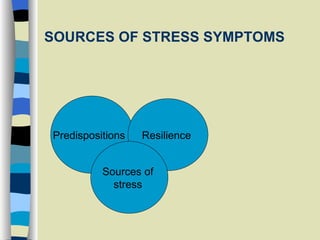
SOURCES OF STRESS SYMPTOMS Predispositions  Resilience  Sources of  stress
 
SOURCES OF STRESS WORK RELATED STRESS Occupational demands Conflict between work and non work – Role conflict Stress from uncertainty – Role ambiguity Overload or under load – doing too much or too little Responsibility for others – A heavy burden Lack of social support – The cost of isolation
SOURCES OF STRESS contd. STRESS OUTSIDE WORK Stressful daily events Daily hassles household hassles time pressure inner concerns environmental hassles financial responsibilities
STRESS  - SOME MAJOR EFFECTS Stress and task performance Stress and decision making Stress and psychological adjustments – Burnout physical exhaustion emotional exhaustion attitudinal exhaustion – depersonalization Low personal accomplishments
STRESS  - SOME MAJOR EFFECTS contd. Stress and Health Medical – Heart diseases, Ulcers, Cancer, Diabetes, Headache, Backache etc. Behavioural – Smoking, Accident proneness Psychological – Sleep disturbance, Depression INDIVIDUAL DIFFERNCES IN RESISTANCE TO STRESS Optimism – A buffer against stress Hardiness – Hi commitment, control and challenge Type ‘A’ behavioural pattern
MANAGING STRESS Personal approach Life style management- Diet and Exercise Physiological techniques - Relaxation and Meditation Cognitive techniques – Think yourself out of stress Behavioural techniques – Learn to react differently Organization based strategies Change in organization structure Change in the nature of the job Stress management programs employee assistance program counseling services
LIST OF STRESS MANAGEMENT PRINCIPLES It is not the stressor but the perception of the stress by us, which is important. We need to become aware before considering change. Let us make relaxation a part of our life. We need to think first before passing judgment. Balancing our anger balances our life. We need to wipe our anxiety before it wipes us out. Enjoy balanced meals at regular times and cherish the gift. Let us start an exercise program and keep exercising regularly. Do it now! Let us work on a plan, and then the plan will work for us.
THANK YOU!!!

Stress management

  • 1.
    STRESS MANAGEMENT Dr. Kavita Singh Faculty of Management Studies University of Delhi Delhi - 110007
  • 2.
    Definition of StressPattern of emotional state and physiological reactions occurring in response to demands from within or outside the organization. Eustress: Functional stress or positive stress Distress: Dysfunctional stress or negative stress
  • 3.
    SOURCES OF STRESSSYMPTOMS Predispositions Resilience Sources of stress
  • 4.
  • 5.
    SOURCES OF STRESSWORK RELATED STRESS Occupational demands Conflict between work and non work – Role conflict Stress from uncertainty – Role ambiguity Overload or under load – doing too much or too little Responsibility for others – A heavy burden Lack of social support – The cost of isolation
  • 6.
    SOURCES OF STRESScontd. STRESS OUTSIDE WORK Stressful daily events Daily hassles household hassles time pressure inner concerns environmental hassles financial responsibilities
  • 7.
    STRESS -SOME MAJOR EFFECTS Stress and task performance Stress and decision making Stress and psychological adjustments – Burnout physical exhaustion emotional exhaustion attitudinal exhaustion – depersonalization Low personal accomplishments
  • 8.
    STRESS -SOME MAJOR EFFECTS contd. Stress and Health Medical – Heart diseases, Ulcers, Cancer, Diabetes, Headache, Backache etc. Behavioural – Smoking, Accident proneness Psychological – Sleep disturbance, Depression INDIVIDUAL DIFFERNCES IN RESISTANCE TO STRESS Optimism – A buffer against stress Hardiness – Hi commitment, control and challenge Type ‘A’ behavioural pattern
  • 9.
    MANAGING STRESS Personalapproach Life style management- Diet and Exercise Physiological techniques - Relaxation and Meditation Cognitive techniques – Think yourself out of stress Behavioural techniques – Learn to react differently Organization based strategies Change in organization structure Change in the nature of the job Stress management programs employee assistance program counseling services
  • 10.
    LIST OF STRESSMANAGEMENT PRINCIPLES It is not the stressor but the perception of the stress by us, which is important. We need to become aware before considering change. Let us make relaxation a part of our life. We need to think first before passing judgment. Balancing our anger balances our life. We need to wipe our anxiety before it wipes us out. Enjoy balanced meals at regular times and cherish the gift. Let us start an exercise program and keep exercising regularly. Do it now! Let us work on a plan, and then the plan will work for us.
  • 11.