Mental Health
Dr. Safa Puliyakkadi
• Mental health – stigma and problem
statement.
• Mental illness - its types and causes.
• Mental health services and program and
prevention.
• Alcohol and drug dependence.
• Substance abuse, prevention and treatment.
WHO definition of health?
Mental health
“Ability to achieve a harmonious and balanced
satisfaction of his own potentially conflicting
instinctive drives in that it reaches an
integrated synthesis rather than the denial of
satisfaction to certain instinctive tendencies as
a means of avoiding the thwarting of others”
Problem Statement
• 10% point prevalence - WHO
• 450 million worldwide.
• “One in four people in the world affected by
mental or neurological disorder at some
point in their lives”
Are YOU mentally healthy ?
The characteristics of mentally
healthy person
1) Feels comfortable about himself
2) Feels right towards others
3) Meet demands of life
• Are you always worrying?
• Are you unable to concentrate because of
unrecognized reasons?
• Are you continuously unhappy without
justified cause?
• Do you lose your temper easily and often?
• Are you troubled by regular insomnia?
• Do you have wide fluctuations in your moods
from depression to elation, back to depression,
which incapacitate you?
• Do you continually dislike to be with people?
• Are you upset if the routine of your life is
disturbed?
• Do your children consistently get on your
nerves?
• Are you browned off and constantly bitter?
• Are you afraid without real cause?
• Are you always right and the other person
always wrong?
• Do you have numerous aches and pains for
which no doctor can find a physical cause?
Mental Illness- Types
Major (Psychosis)
• Schizophrenia
• Manic depressive psychosis
• Paranoia
Minor
• Neurosis
• Personality and character disorders.
Causes of Mental Illness
• Organic condition
• Heredity
• Social pathological causes
• Environmental factors
Crucial points in Life cycle
• Prenatal period.

• First 5 years
• School child.
• Adolescent period
• Old age
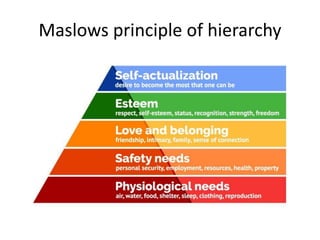
Maslows principle of hierarchy
Prevention
• Primary
• Secondary
• Tertiary
Mental health services
• Early diagnosis and treatment
• Rehabilitation.
• Group and individual psychotherapy.
• Mental health education
• Use of Modern Psychoactive drugs
• After care services.
Comprehensive Mental Health
Programme
• Integration of Psychiatric services with other
health services.
• Community Mental Health programme:
• In-patient services
• Out patient services
• Partial hospitalization
• Emergency and diagnostic services
• Education, Training and research
District Mental Health Program(DMHP)
• Recently revised for the 11th 5 year plan
• Deinstitutionalization of mental health care
and Community based intervention.
• Pilot tested by NIMHANS (1986- 1995)
– Mental health delivery was possible in primary
care settings.
Objectives
• 1. Sustainable basic mental health services to the
community and to integrate with other services.
• 2. Early detection and treatment of patients in the
community.
• 3. Patients and their relatives do not have to travel
long distances.
Objectives..
• 4. To take pressure off mental hospital.
• 5. To reduce the stigma attached towards
mental illness.
• 6. Treat and rehabilitate mental patients
within the community.
• 7.Detect, manage, and suitably refer cases of
epilepsy.
Alcohol and Drug Dependence
• Drug abuse : It is defined as self
administration of a drug for non-medical
reasons, in quantities and frequency which
impairs individuals ability and function and
result in Physical, Social and Emotional harm.
• Drug dependence: A state, psychic ,
sometimes into physical characterized by
compulsion to take the drug on periodic basis
to experience its effect
Dependence producing Drugs
• Alcohol.
• Opiods.
• Cannabinoids.
• Sedatives or hypnotics.
• Cocaine
• Caffeine
• Hallucinogens
• Tobacco
• Other volatile substances and steroids
Common drugs
• Amphetamines “Superman drugs”
• Cocaine
• Barbiturates
• Cannabis
• Heroin
• LSD
Alcohol
• 2 billion consume alcohol.
• Worldwide 2.3 million die from alcohol(6%
men ands 1% women).
• Alcohol • CNS depressant with physical
dependence.
• • Alcoholism is a disease.
• • It leads to suicides, economic crisis in family,
road traffic accidents and many health
problems.
• • Total family disorganization, crime and loss
of productivity for society.
Tobacco
• 1070 million males and 230 million females
smoke.
• China produces 1/3rd of cigarettes in the
world and is major consumer.
• Global adult tobacco survey: 48% (males) and
20%(females) including smokeless forms.
Tobacco
• More death than all substance combined.
• 30% of all cancer death.
• Respiratory and cardiovascular disorders.
• Women at higher risk due to obstetric
complications.
• Passives smoking is also dangerous and
withdrawal continues for more than a month.
Host factors
• Desire to experiment
• Sense of adventure
• Desire to escape
Environmental factors
• Unemployment
• Migration to cities
• Relaxed parental control
• Broken homes
• Areas where delinquency/drug using
gangs/drug trade common.
• Certain occupation.
Prevention
1) Legal approach
• Prohibition of sale to minors
• Restriction of sale from automatic vending
machines.
• Prohibition of smoking in schools
• Prohibition of smoking in public places
• Health warning on cigarettes
• Mandatory public health education
Symptoms of drug addiction
• Loss of interest in sports and daily routine
• Loss of apetite and body weight
• Unsteady gait, tremor
• Slurring of speech
• Injection marks on body
• Drowsiness
• Anxiety, depression
• Depersonalisation
Prevention
2)Educational approach:
• Programme for school children
• Information campaign.
.
Prevention
3)Community approach:
• Alternative activities
• Teen centres
• NGO
Treatment
• Identification and motivation.
• Detoxification.
• Post-detoxification and follow-up
• Simultaneous environment and social
intervention needed.
Rehabilitation
• • Mature attitude and avoiding discrimination.
• Preventing relapse through vocational
training and work. • Proper follow-up
Thank you !

Mental health

  • 1.
  • 2.
    • Mental health– stigma and problem statement. • Mental illness - its types and causes. • Mental health services and program and prevention. • Alcohol and drug dependence. • Substance abuse, prevention and treatment.
  • 3.
  • 4.
    Mental health “Ability toachieve a harmonious and balanced satisfaction of his own potentially conflicting instinctive drives in that it reaches an integrated synthesis rather than the denial of satisfaction to certain instinctive tendencies as a means of avoiding the thwarting of others”
  • 5.
    Problem Statement • 10%point prevalence - WHO • 450 million worldwide. • “One in four people in the world affected by mental or neurological disorder at some point in their lives”
  • 6.
  • 7.
    The characteristics ofmentally healthy person 1) Feels comfortable about himself 2) Feels right towards others 3) Meet demands of life
  • 8.
    • Are youalways worrying? • Are you unable to concentrate because of unrecognized reasons? • Are you continuously unhappy without justified cause? • Do you lose your temper easily and often? • Are you troubled by regular insomnia?
  • 9.
    • Do youhave wide fluctuations in your moods from depression to elation, back to depression, which incapacitate you? • Do you continually dislike to be with people? • Are you upset if the routine of your life is disturbed? • Do your children consistently get on your nerves?
  • 10.
    • Are youbrowned off and constantly bitter? • Are you afraid without real cause? • Are you always right and the other person always wrong? • Do you have numerous aches and pains for which no doctor can find a physical cause?
  • 11.
    Mental Illness- Types Major(Psychosis) • Schizophrenia • Manic depressive psychosis • Paranoia Minor • Neurosis • Personality and character disorders.
  • 13.
    Causes of MentalIllness • Organic condition • Heredity • Social pathological causes • Environmental factors
  • 14.
    Crucial points inLife cycle • Prenatal period. • First 5 years • School child. • Adolescent period • Old age
  • 15.
  • 16.
  • 17.
    Mental health services •Early diagnosis and treatment • Rehabilitation. • Group and individual psychotherapy. • Mental health education • Use of Modern Psychoactive drugs • After care services.
  • 18.
    Comprehensive Mental Health Programme •Integration of Psychiatric services with other health services. • Community Mental Health programme: • In-patient services • Out patient services • Partial hospitalization • Emergency and diagnostic services • Education, Training and research
  • 19.
    District Mental HealthProgram(DMHP) • Recently revised for the 11th 5 year plan • Deinstitutionalization of mental health care and Community based intervention. • Pilot tested by NIMHANS (1986- 1995) – Mental health delivery was possible in primary care settings.
  • 20.
    Objectives • 1. Sustainablebasic mental health services to the community and to integrate with other services. • 2. Early detection and treatment of patients in the community. • 3. Patients and their relatives do not have to travel long distances.
  • 21.
    Objectives.. • 4. Totake pressure off mental hospital. • 5. To reduce the stigma attached towards mental illness. • 6. Treat and rehabilitate mental patients within the community. • 7.Detect, manage, and suitably refer cases of epilepsy.
  • 23.
    Alcohol and DrugDependence • Drug abuse : It is defined as self administration of a drug for non-medical reasons, in quantities and frequency which impairs individuals ability and function and result in Physical, Social and Emotional harm. • Drug dependence: A state, psychic , sometimes into physical characterized by compulsion to take the drug on periodic basis to experience its effect
  • 24.
    Dependence producing Drugs •Alcohol. • Opiods. • Cannabinoids. • Sedatives or hypnotics. • Cocaine • Caffeine • Hallucinogens • Tobacco • Other volatile substances and steroids
  • 25.
    Common drugs • Amphetamines“Superman drugs” • Cocaine • Barbiturates • Cannabis • Heroin • LSD
  • 26.
    Alcohol • 2 billionconsume alcohol. • Worldwide 2.3 million die from alcohol(6% men ands 1% women).
  • 27.
    • Alcohol •CNS depressant with physical dependence. • • Alcoholism is a disease. • • It leads to suicides, economic crisis in family, road traffic accidents and many health problems. • • Total family disorganization, crime and loss of productivity for society.
  • 28.
    Tobacco • 1070 millionmales and 230 million females smoke. • China produces 1/3rd of cigarettes in the world and is major consumer. • Global adult tobacco survey: 48% (males) and 20%(females) including smokeless forms.
  • 29.
    Tobacco • More deaththan all substance combined. • 30% of all cancer death. • Respiratory and cardiovascular disorders. • Women at higher risk due to obstetric complications. • Passives smoking is also dangerous and withdrawal continues for more than a month.
  • 30.
    Host factors • Desireto experiment • Sense of adventure • Desire to escape
  • 31.
    Environmental factors • Unemployment •Migration to cities • Relaxed parental control • Broken homes • Areas where delinquency/drug using gangs/drug trade common. • Certain occupation.
  • 32.
    Prevention 1) Legal approach •Prohibition of sale to minors • Restriction of sale from automatic vending machines. • Prohibition of smoking in schools • Prohibition of smoking in public places • Health warning on cigarettes • Mandatory public health education
  • 33.
    Symptoms of drugaddiction • Loss of interest in sports and daily routine • Loss of apetite and body weight • Unsteady gait, tremor • Slurring of speech • Injection marks on body • Drowsiness • Anxiety, depression • Depersonalisation
  • 34.
    Prevention 2)Educational approach: • Programmefor school children • Information campaign. .
  • 35.
    Prevention 3)Community approach: • Alternativeactivities • Teen centres • NGO
  • 36.
    Treatment • Identification andmotivation. • Detoxification. • Post-detoxification and follow-up • Simultaneous environment and social intervention needed.
  • 37.
    Rehabilitation • • Matureattitude and avoiding discrimination. • Preventing relapse through vocational training and work. • Proper follow-up
  • 38.

Editor's Notes

  • #4 WHO expert committee in 1950: - Influenced by biologic and social factors. - Not static. - Harmonious relation to society. - Balanced satisfaction of individual drives. WHO expert committee in 1950: - Influenced by biologic and social factors. - Not static. - Harmonious relation to society. - Balanced satisfaction of individual drives.
  • #6 • India: mental morbidity: 18-20/1000. • 47 mental institutions in India with 10,329 beds. • 896000 adults 22,300 children were treated
  • #8 himself- Self respect- Estimates balanced. Accepts shortcoming. others - friendship and love –part of group- responsibility for fellowmen life - solves issues- takes own decision - not bowled over by emotions
  • #9 Warning signals
  • #11 William C Menninger Presidentof menninger foundation-Warning signals of poor mental health
  • #12 ICD-11 vast subject ,broad in its limits, difficult to define precisely
  • #14 Multifactorial. Toxic substances ,nutritional factors, psychotropic drugsMinerals, Infective agents, Trauma and Radiation
  • #17 • Primary: community basis improving social enviroinment. • Secondary: early diagnosis of mental illness by screening programs. • Provision of tretment facility and community resources. • Family based health services with counselling. • Tertiary: Reduced duration of illness, prevent further breakdown
  • #20 interesting note that mental health care was largely confined to mental hospitals till about 50 years. Change in approach to care occurred on the background of several observations that include scientifically proven efficacy of treatment, safety of medications, high cost of care in mental hospitals, poor quality of life of persons treated in institutions. Against this background, some developments occurred in India, which made it possible, to apply community-based models for mental health care. The district of Bellary in Karnataka was the first district where mental health care program for the population of district was pilot tested by NIMHANS between 1986- 1995. It was found that mental health delivery was possible in primary care settings. Primary care physicians can be trained in such a care
  • #21 To provide sustainable basic mental health services to the community and to integrate these with other services Early detection and treatment of patients in the community itself To see that the patients and their relatives do not have to travel long distances to go to hospitals or nursing homes in cities
  • #22 To take pressure off mental hospital by providing mental health care at primary level only. To reduce the stigma attached towards mental illness through change in attitude and public education 6. To treat and rehabilitate mental patients discharged from the mental hospital within the community. 7. To detect, manage, and suitably refer cases of epilepsy and ensure availability of anti-epileptic drugs and others so as to reduce stigma towards epilepsy
  • #26 Marijuana-garlic smell
  • #27 • Increasing usage among young people and women. • In India 20-30% males and 5% of females use alcohol Hereditary Socially acceptable form of intoxication.
  • #29 • Tobacco consumption decreasing in developed but increasing in developing countries.