Stress Management
Agustin J. Cruz, MS, MPA, LPC
Simple Intervention Clinical Director
Special Education Teacher (2006-2008)
Retired Master Sergeant
USAF (1986 – 2006)
Stress: * Tracy Woodard-Meyers, Ph.D.
Director, Women’s and Gender Studies
Professor, Sociology
Valdosta State University
Stress Definition:
o Non-specific RESPONSE to any pressure or demand
(stressor) from outside or from within yourself
What Does Stress Do?
o Enhances life
o Helpful and Essential
o Creative
o Productive
o Make Changes
o Carry out tasks
What is Stress
• Stress is your body's way of responding to any kind of
demand. It can be caused by both good and bad
experiences. When people feel stressed by something
going on around them, their bodies react by releasing
chemicals into the blood. These chemicals give people
more energy and strength, which can be a good thing if
their stress is caused by physical danger. But this can
also be a bad thing, if their stress is in response to
something emotional and there is no outlet for this extra
energy and strength.
Different types of Stress
• Many different things can cause stress -- from physical
(such as fear of something dangerous) to emotional
(such as worry over your family or job.) Identifying what
may be causing you stress is often the first step in
learning how to better deal with your stress. Some of the
most common sources of stress are:
• Survival Stress - You may have heard the phrase "fight or
flight" before. This is a common response to danger in all
people and animals. When you are afraid that someone
or something may physically hurt you, your body
naturally responds with a burst of energy so that you will
be better able to survive the dangerous situation (fight)
or escape it all together (flight). This is survival stress.
Different type of Stress
• Internal Stress - Have you ever caught yourself worrying about things you can do
nothing about or worrying for no reason at all? This is internal stress and it is one
of the most important kinds of stress to understand and manage. Internal stress
is when people make themselves stressed. This often happens when we worry
about things we can't control or put ourselves in situations we know will cause us
stress. Some people become addicted to the kind of hurried, tense, lifestyle that
results from being under stress. They even look for stressful situations and feel
stress about things that aren't stressful.
• Environmental Stress - This is a response to things around you that cause stress,
such as noise, crowding, and pressure from work or family. Identifying these
environmental stresses and learning to avoid them or deal with them will help
lower your stress level.
• Fatigue and Overwork - This kind of stress builds up over a long time and can
take a hard toll on your body. It can be caused by working too much or too hard
at your job(s), school, or home. It can also be caused by not knowing how to
manage your time well or how to take time out for rest and relaxation. This can
be one of the hardest kinds of stress to avoid because many people feel this is out
of their control. Later in this course we will show you that you DO have options
and offer some useful tips for dealing with fatigue.
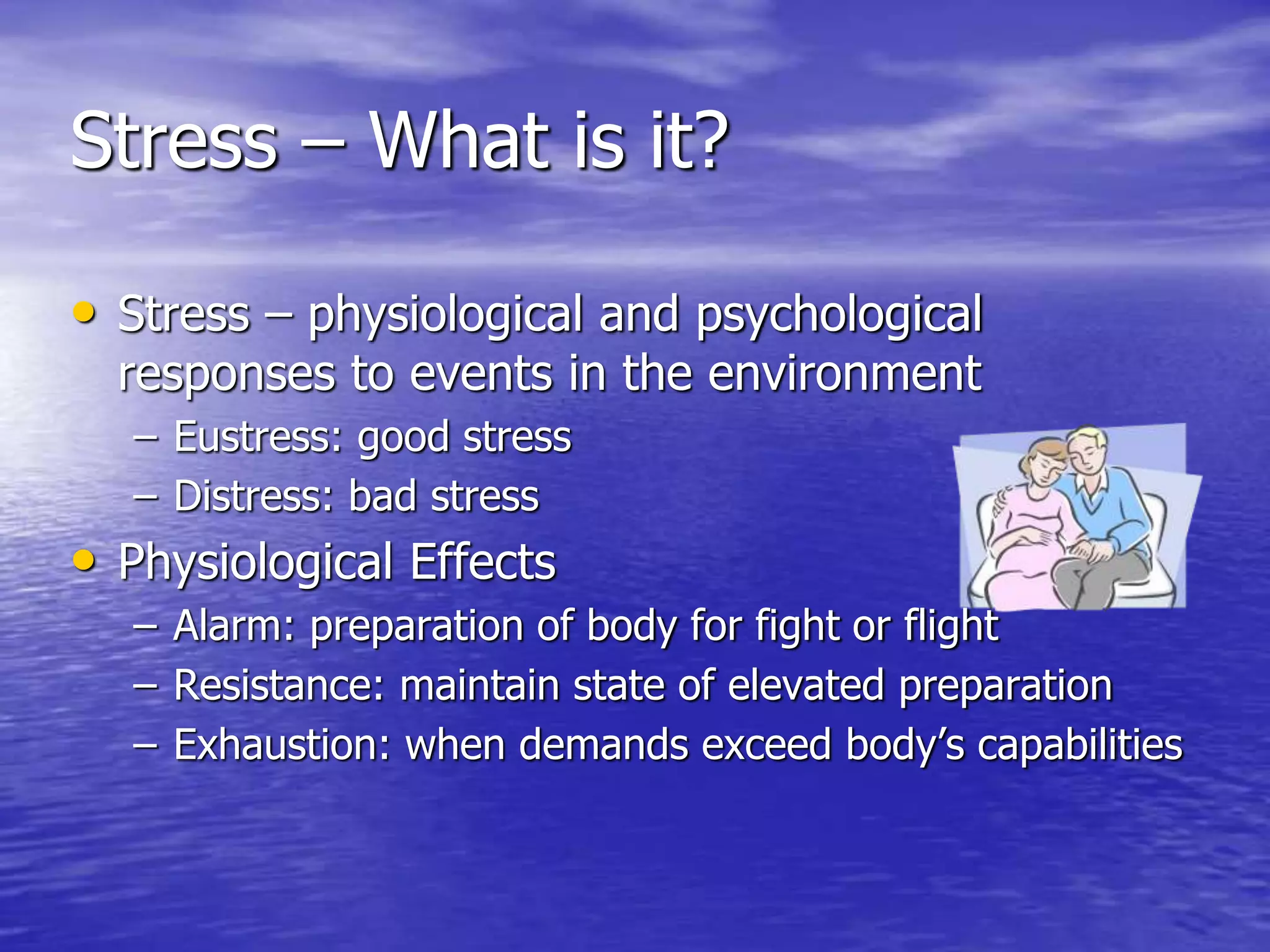
Stress – What is it?
• Stress – physiological and psychological
responses to events in the environment
– Eustress: good stress
– Distress: bad stress
• Physiological Effects
– Alarm: preparation of body for fight or flight
– Resistance: maintain state of elevated preparation
– Exhaustion: when demands exceed body’s capabilities
Stress – More Background
• Where does stress come from?
– Major life events?
– Daily hassles: frequency, intensity, duration
– Changing body/changing lifestyle
– Lack of support from (family or father of the child)
– Money, insurance, doctor visits
– Community safety/home
environment
– Relationships
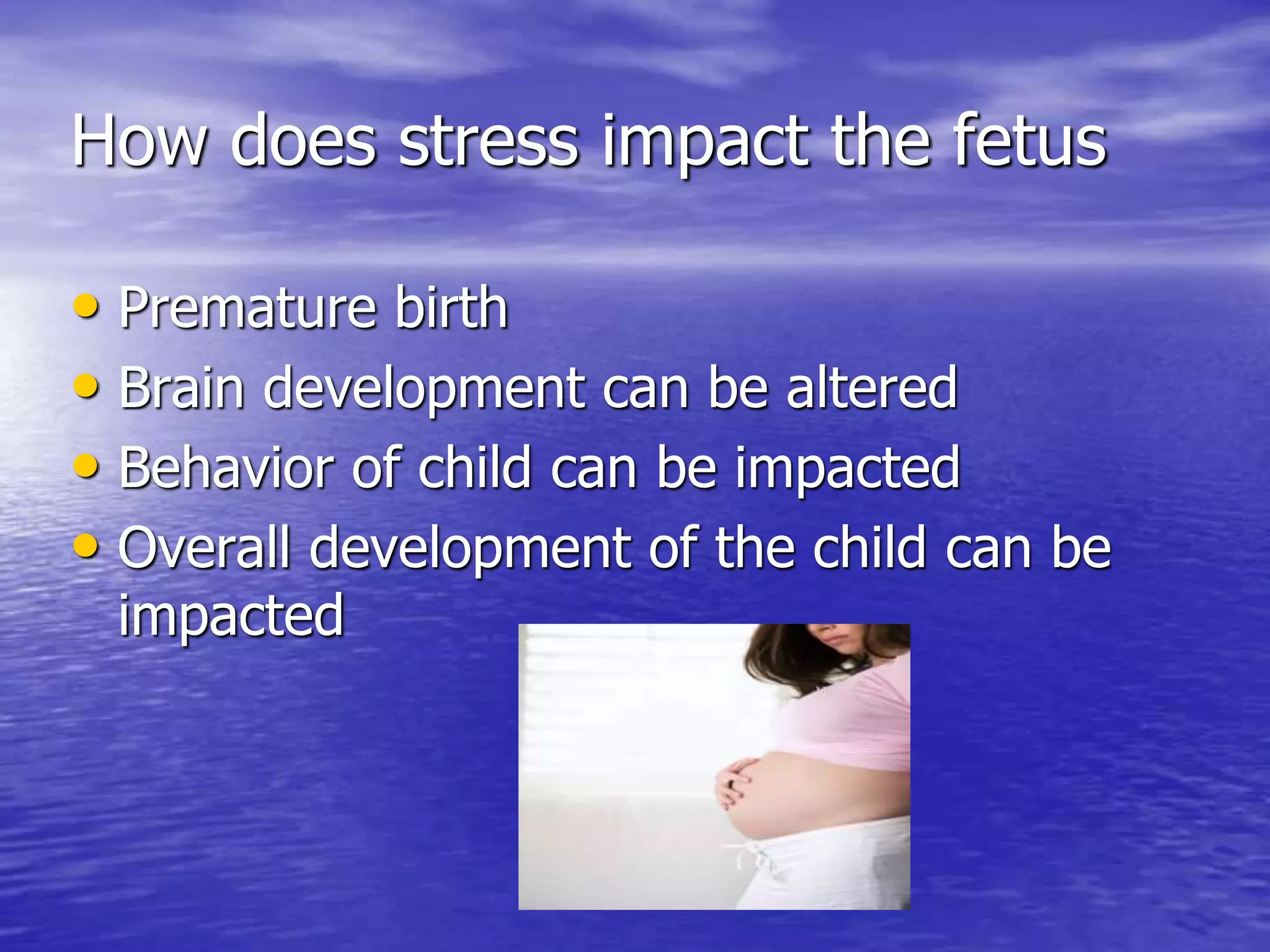
How does stress impact the fetus
• Premature birth
• Brain development can be altered
• Behavior of child can be impacted
• Overall development of the child can be
impacted
Negative Effects of Stress
. Physical
- Weight gain/loss
- Unexpected hair loss
- Heart palpitations
- High blood pressure
2. Emotional
- Mood swings
- Anxiety
- Can lead to depression
• Can also lead to unhealthy coping strategies (i.e. alcohol,
drugs, etc)
How to cope with stress
• Recognize that we all experience stress but
stress does not have to become a way of
life
• Be willing to focus on the one person that
you can control (YOU!)
• Keep lines of communication open with
those you love
Stress management strategies
• Shift your perspective: the way you think
has a profound impact on your stress level:
Do you see the glass half empty or half full
• Practice relaxation techniques: deep
breathing, music, calm place
• Bring more fun and laughter into your life
Stress management strategies
• Develop effective time management
• Give yourself permission to relax
• Positive self talk (avoid consistent
negative self talk)
• Organizational skills
• Exercise
Stress management techniques
• Identify the triggers of your stress
• Early warning signs (build up, tension etc)
• High tension (anger): judgment is clouded
• Explosion
Other Helpful tips
• Changing perceptions and expectations
• Break jobs/tasks into manageable parts
• Set reasonable/realistic goals
• Avoid procrastination
• Set boundaries
• Don’t compromise your values/beliefs
• Schedule “me” time
Benefits of Stress Management
• Physical health gets better
-more energy and stamina
• Emotions stabilized
-positive attitude
-hopeful/happier
• Ability to focus improved
-able to learn and achieve
The Key Word Is….
Balance
Tracy Woodard-Meyers, Ph.D.
Preventing Distress
Yassen’s Ecological Model
• Personal
– Physical
• Body Work (exercise/Yoga)
• Sleep
• Nutrition
• Journal
– Psychological
• Life Balance
• Relaxation
• Contact with Nature
• Creative Expression
• Self Awareness
• Humor/Fun
• Meditation
• Spiritual Practice
– Social
• Social Support
• Talking it out
• Getting help
• Activism
Tracy Woodard-Meyers, Ph.D.
Preventing Distress
– Professional
• Balance
• Boundaries/Limits
• Getting Support/Help
• Debriefing/Defusing
• Plans for Coping
• Professional Training
• Self Awareness
• Replenishing (relaxation, Vacation, Fun, Humor)
Tracy Woodard-Meyers, Ph.D.
Coping Strategies
• HOW a person copes is the most significant factor
in consequences of stressor response
• Effectiveness of coping depends on a person’s
– Appraisal: perception or meaning give to stressor
– Coping Resources: personal or situational
characteristics that mediate stressor effects or assist in
coping efforts
• Personal Characteristics: personality types, health,
values, beliefs, skills
• Material and Environmental Resources: money, access
to services
• Interpersonal Resources: networks for social support
• Uplifts: positive daily events
Tracy Woodard-Meyers, Ph.D.
Inadequate Coping Strategies
• Coping abilities are inadequate = stress gets out of control
and person experiences DISTRESS
• DISTRESS:
– Negative aspect of stress
– When stress gets out of control it becomes a
Destructive Force
– Can only push self so hard for so long
– When stress exceeds limits, mind and/or body breaks
down and stressor related symptoms occur
• Physiological and Psychological symptoms range from mild to
severe
– Negative impact on health, personalities, job, families
Tracy Woodard-Meyers, Ph.D.

Stress and Distress

  • 1.
    Stress Management Agustin J.Cruz, MS, MPA, LPC Simple Intervention Clinical Director Special Education Teacher (2006-2008) Retired Master Sergeant USAF (1986 – 2006)
  • 2.
    Stress: * TracyWoodard-Meyers, Ph.D. Director, Women’s and Gender Studies Professor, Sociology Valdosta State University Stress Definition: o Non-specific RESPONSE to any pressure or demand (stressor) from outside or from within yourself What Does Stress Do? o Enhances life o Helpful and Essential o Creative o Productive o Make Changes o Carry out tasks
  • 3.
    What is Stress •Stress is your body's way of responding to any kind of demand. It can be caused by both good and bad experiences. When people feel stressed by something going on around them, their bodies react by releasing chemicals into the blood. These chemicals give people more energy and strength, which can be a good thing if their stress is caused by physical danger. But this can also be a bad thing, if their stress is in response to something emotional and there is no outlet for this extra energy and strength.
  • 4.
    Different types ofStress • Many different things can cause stress -- from physical (such as fear of something dangerous) to emotional (such as worry over your family or job.) Identifying what may be causing you stress is often the first step in learning how to better deal with your stress. Some of the most common sources of stress are: • Survival Stress - You may have heard the phrase "fight or flight" before. This is a common response to danger in all people and animals. When you are afraid that someone or something may physically hurt you, your body naturally responds with a burst of energy so that you will be better able to survive the dangerous situation (fight) or escape it all together (flight). This is survival stress.
  • 5.
    Different type ofStress • Internal Stress - Have you ever caught yourself worrying about things you can do nothing about or worrying for no reason at all? This is internal stress and it is one of the most important kinds of stress to understand and manage. Internal stress is when people make themselves stressed. This often happens when we worry about things we can't control or put ourselves in situations we know will cause us stress. Some people become addicted to the kind of hurried, tense, lifestyle that results from being under stress. They even look for stressful situations and feel stress about things that aren't stressful. • Environmental Stress - This is a response to things around you that cause stress, such as noise, crowding, and pressure from work or family. Identifying these environmental stresses and learning to avoid them or deal with them will help lower your stress level. • Fatigue and Overwork - This kind of stress builds up over a long time and can take a hard toll on your body. It can be caused by working too much or too hard at your job(s), school, or home. It can also be caused by not knowing how to manage your time well or how to take time out for rest and relaxation. This can be one of the hardest kinds of stress to avoid because many people feel this is out of their control. Later in this course we will show you that you DO have options and offer some useful tips for dealing with fatigue.
  • 6.
    Stress – Whatis it? • Stress – physiological and psychological responses to events in the environment – Eustress: good stress – Distress: bad stress • Physiological Effects – Alarm: preparation of body for fight or flight – Resistance: maintain state of elevated preparation – Exhaustion: when demands exceed body’s capabilities
  • 7.
    Stress – MoreBackground • Where does stress come from? – Major life events? – Daily hassles: frequency, intensity, duration – Changing body/changing lifestyle – Lack of support from (family or father of the child) – Money, insurance, doctor visits – Community safety/home environment – Relationships
  • 8.
    How does stressimpact the fetus • Premature birth • Brain development can be altered • Behavior of child can be impacted • Overall development of the child can be impacted
  • 9.
    Negative Effects ofStress . Physical - Weight gain/loss - Unexpected hair loss - Heart palpitations - High blood pressure 2. Emotional - Mood swings - Anxiety - Can lead to depression • Can also lead to unhealthy coping strategies (i.e. alcohol, drugs, etc)
  • 10.
    How to copewith stress • Recognize that we all experience stress but stress does not have to become a way of life • Be willing to focus on the one person that you can control (YOU!) • Keep lines of communication open with those you love
  • 11.
    Stress management strategies •Shift your perspective: the way you think has a profound impact on your stress level: Do you see the glass half empty or half full • Practice relaxation techniques: deep breathing, music, calm place • Bring more fun and laughter into your life
  • 12.
    Stress management strategies •Develop effective time management • Give yourself permission to relax • Positive self talk (avoid consistent negative self talk) • Organizational skills • Exercise
  • 13.
    Stress management techniques •Identify the triggers of your stress • Early warning signs (build up, tension etc) • High tension (anger): judgment is clouded • Explosion
  • 14.
    Other Helpful tips •Changing perceptions and expectations • Break jobs/tasks into manageable parts • Set reasonable/realistic goals • Avoid procrastination • Set boundaries • Don’t compromise your values/beliefs • Schedule “me” time
  • 15.
    Benefits of StressManagement • Physical health gets better -more energy and stamina • Emotions stabilized -positive attitude -hopeful/happier • Ability to focus improved -able to learn and achieve
  • 16.
    The Key WordIs…. Balance
  • 17.
  • 18.
  • 19.
    Preventing Distress Yassen’s EcologicalModel • Personal – Physical • Body Work (exercise/Yoga) • Sleep • Nutrition • Journal – Psychological • Life Balance • Relaxation • Contact with Nature • Creative Expression • Self Awareness • Humor/Fun • Meditation • Spiritual Practice – Social • Social Support • Talking it out • Getting help • Activism Tracy Woodard-Meyers, Ph.D.
  • 20.
    Preventing Distress – Professional •Balance • Boundaries/Limits • Getting Support/Help • Debriefing/Defusing • Plans for Coping • Professional Training • Self Awareness • Replenishing (relaxation, Vacation, Fun, Humor) Tracy Woodard-Meyers, Ph.D.
  • 21.
    Coping Strategies • HOWa person copes is the most significant factor in consequences of stressor response • Effectiveness of coping depends on a person’s – Appraisal: perception or meaning give to stressor – Coping Resources: personal or situational characteristics that mediate stressor effects or assist in coping efforts • Personal Characteristics: personality types, health, values, beliefs, skills • Material and Environmental Resources: money, access to services • Interpersonal Resources: networks for social support • Uplifts: positive daily events Tracy Woodard-Meyers, Ph.D.
  • 22.
    Inadequate Coping Strategies •Coping abilities are inadequate = stress gets out of control and person experiences DISTRESS • DISTRESS: – Negative aspect of stress – When stress gets out of control it becomes a Destructive Force – Can only push self so hard for so long – When stress exceeds limits, mind and/or body breaks down and stressor related symptoms occur • Physiological and Psychological symptoms range from mild to severe – Negative impact on health, personalities, job, families Tracy Woodard-Meyers, Ph.D.