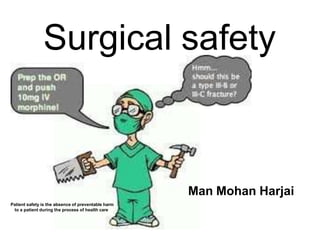
Surgical safety
Man Mohan Harjai
Patient safety is the absence of preventable harm
to a patient during the process of health care
Magnitude of the problem
• 234 million operations
globally
» 1:25
» Live births
• 1 million deaths
• 7 million disabling
complications
• >50% preventable
NEJM Jan 2009
Magnitude of the problem
– 50-60% of all hosp adm will require surgery
– Major complications: 3 -16%
– Deaths: 0.4 - 0.8%
(Developing countries: 5-10% mortality)
– Surgical site infections 14%
NEJM Jan 2009
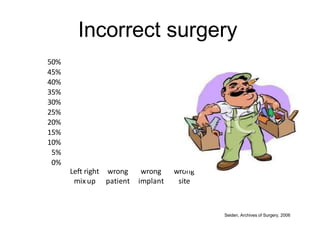
Incorrect surgery
50%
45%
40%
35%
30%
25%
20%
15%
10%
5%
0%
Left right
mixup
wrong
patient
wrong
implant
wrong
site
Seiden, Archives of Surgery, 2006
Incorrect surgery
– There are between 1500 and 2500 wrong site surgery
incidents every year in the United States (Seiden, Archives of
Surgery, 2006)
– In a survey of 1050 hand surgeons, 21% reported
having performed wrong-site surgery at least once
during their careers (Classen, New England Journal of Medicine, 1992)
Causes: Management related
• Lack of protocols and checks
• Shortfalls in training
• Lack of supervision of junior surgeons
when performing surgeries
• Understaffing
• Time constraints
• Inadequate equipment
• Communication breakdown
Causes: Surgeon related
• Inappropriate or delayed referrals
• Improper planning of the operations
• Operating outside ones expertise
• Lack of teamwork skills
• Communication breakdown at various
levels between
-Operating surgeon and assistant surgeon and the patient
-Anesthetist and the surgeon/patient
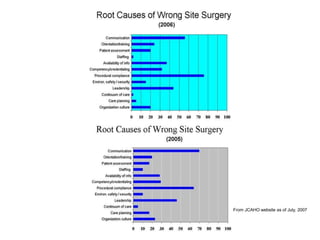
From JCAHO website as of July, 2007
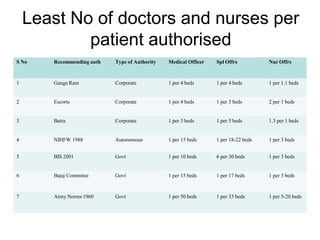
Least No of doctors and nurses per
patient authorised
S No Recommending auth Type of Authority Medical Officer Spl Offrs Nur Offrs
1 Ganga Ram Corporate 1 per 4 beds 1 per 4 beds 1 per 1.1 beds
2 Escorts Corporate 1 per 4 beds 1 per 3 beds 2 per 1 beds
3 Batra Corporate 1 per 3 beds 1 per 5 beds 1.3 per 1 beds
4 NIHFW 1988 Autonomous 1 per 15 beds 1 per 18-22 beds 1 per 3 beds
5 BIS 2001 Govt 1 per 10 beds 6 per 30 beds 1 per 3 beds
6 Bajaj Commitee Govt 1 per 15 beds 1 per 17 beds 1 per 3 beds
7 Army Norms 1960 Govt 1 per 50 beds 1 per 33 beds 1 per 5-20 beds
Commercial aviation has many errors
But few crashes
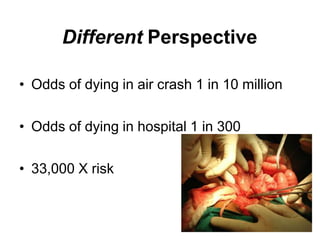
Different Perspective
• Odds of dying in air crash 1 in 10 million
• Odds of dying in hospital 1 in 300
• 33,000 X risk
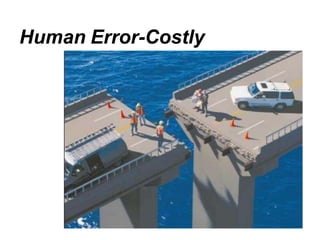
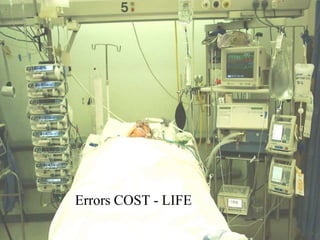
Human Error-Costly
Errors COST - LIFE
Surgeon
• Long hours over a number of
years spent in surgical training
may make a surgeon competent
but that does not always translate
into safe surgeon
Surgeon
• At the beginning of the surgical career the
surgeon learns “how to operate”
• Then with experience “when to operate”
• It is only with maturity he or she realizes
“when not to operate”
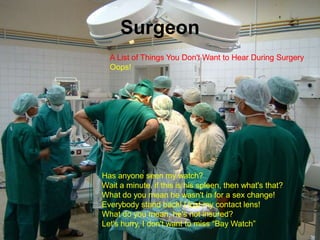
Has anyone seen my watch?
Wait a minute, if this is his spleen, then what's that?
What do you mean he wasn't in for a sex change!
Everybody stand back! I lost my contact lens!
What do you mean, he's not insured?
Let's hurry, I don't want to miss “Bay Watch”
Surgeon
A List of Things You Don't Want to Hear During Surgery
Oops!
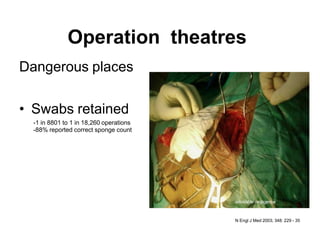
Operation theatres
Dangerous places
• Swabs retained
-1 in 8801 to 1 in 18,260 operations
-88% reported correct sponge count
N Engl J Med 2003; 348: 229 - 35
avoidable negligence
Operation theatres
Dangerous places
Clamps left in situ
Wrong side surgery
Anaesthesia deaths
•
•
•
N Engl J Med 2003; 348: 229 - 35
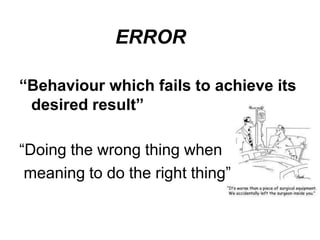
ERROR
“Behaviour which fails to achieve its
desired result”
“Doing the wrong thing when
meaning to do the right thing”
Make Headlines!
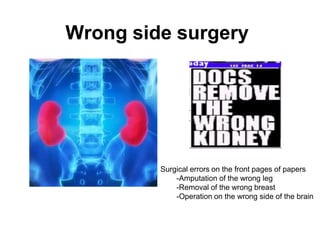
Wrong side surgery
Surgical errors on the front pages of papers
-Amputation of the wrong leg
-Removal of the wrong breast
-Operation on the wrong side of the brain
When a patient dies-----
• Medical case
–What happened?
•Surgical case
–What did you do?
Conventional approach to any failure
• “Blame and Shame”
• Not helpful in improving patient safety or
reducing the incidence of severe complications
– concealed
– rather than studied, understood and prevented
Report an event
To prevent the next
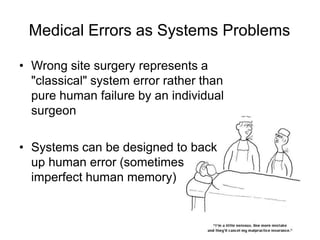
Medical Errors as Systems Problems
• Wrong site surgery represents a
"classical" system error rather than
pure human failure by an individual
surgeon
• Systems can be designed to back
up human error (sometimes
imperfect human memory)
To err is human . . .
To cover up is unforgivable . . .
To fail to learn is inexcusable . . .
- Liam Donaldson
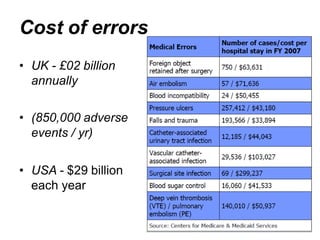
Cost of errors
• UK - £02 billion
annually
• (850,000 adverse
events / yr)
• USA - $29 billion
each year
Lessons from Aviation
Industry decided to look
beyond pilot error or
individual failure
Mandatory reporting of
any mishap within 24hrs
Pilots are taught to
acknowledge their own
limitations
Susceptibility to error
• Surgeons and nurses tend to downplay
the effects of stress and fatigue
• This denial is ingrained from the time of
medical college & residency
• Leads to adverse events
• This attitudes of personal invulnerability –
needs change to prevent errors
Sexton et al BMJ 2000; 320: 745 - 9
Zero Error state is impossible
• It is important
not to blame individuals for what
went wrong
but
to understand why what they did at
the time made sense to them
Sidney Dekker
Expected to work error free
• In an environment
– we perform multiple concurrent tasks
– in a setting of very high workload
– with often-minimal organisational support
Methods to prevent errors
• System of universal
reporting
(anonymous)
• Human factors
• Situational awareness
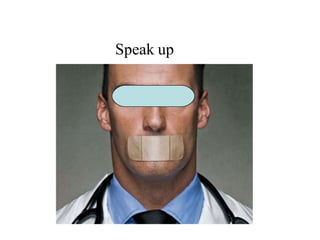
• Speak up
• Red flags
• Standard Operating
Procedures
• Safety checklists
(WHO)
• Briefing and
Debriefing
• Scripted handoffs
Human Factors
• 90% communication breakdowns occur verbally
– 40% the information was transmitted in an inaccurate
fashion
– 50% it was never transmitted at all
• Written orders and checklists should support
inter-individual verbal communication including
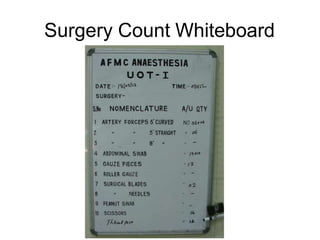
– the count of sponges and surgical instruments
– in order to reduce the incidence of adverse events
American College of Surgeons' closed claims study
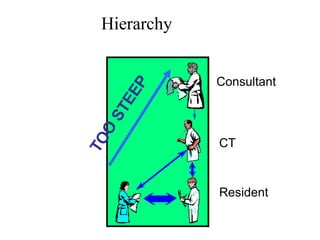
Standard Operating Procedure
(SOP):
CT
Resident
Consultant
Hierarchy
Speak up
Surgery Count Whiteboard
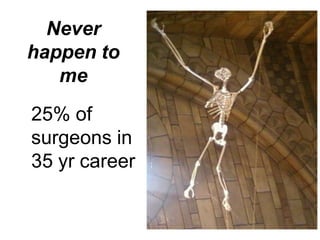
Never
happen to
me
25% of
surgeons in
35 yr career
Leadership-WHO
WAPS (World alliance for patient safety)
Global Patient safety challenges
2005 - Clean care is safer care
2007 - Safe surgery saves lives
2010 - Tackling antimicrobial resistance
What Can an Operating Room
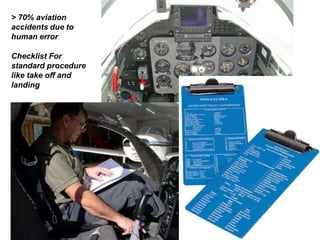
Learn from a Cockpit?
> 70% aviation
accidents due to
human error
Checklist For
standard procedure
like take off and
landing
Ten Objectives of
Safe Surgery Saves Lives
1. Correct patient / correct site
2. Prevent harm from anaesthetics
3. Prepare for airway emergencies
4. Prepare for high blood loss
5. Avoid allergies
6. Minimize surgical site infections
7. Prevent retention of instruments/ sponges
8. Accurately secure and identify specimens
9. Effectively communicate critical information
10. Establish surveillance of capacity/ volume/ results
Check list
Aim
• Timely and efficient steps
Pre, intra and post op
• Follow a few critical steps
minimize common risks
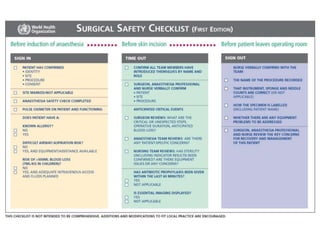
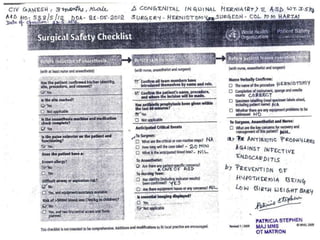
Surgical Safety Checklist (WHO)
19 item checklist
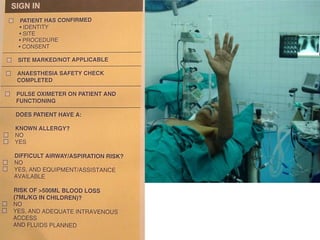
• Sign In (before induction of anaesthesia)
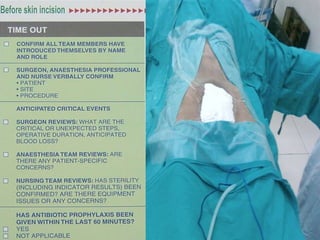
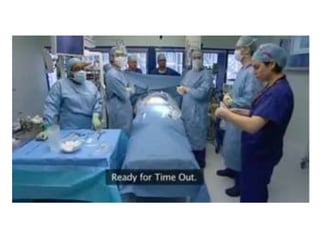
• Time out (before skin incision)
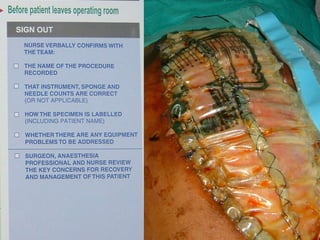
• Sign out (before patient leaves OT)
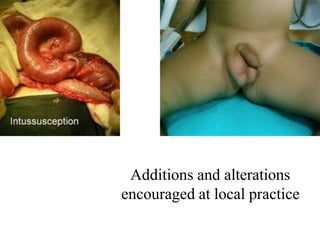
Additions and alterations
encouraged at local practice
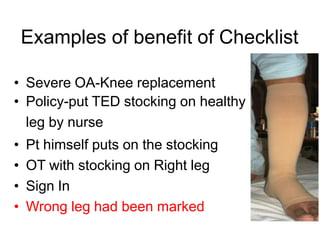
Examples of benefit of Checklist
• Severe OA-Knee replacement
• Policy-put TED stocking on healthy
leg by nurse
• Pt himself puts on the stocking
• OT with stocking on Right leg
• Sign In
• Wrong leg had been marked
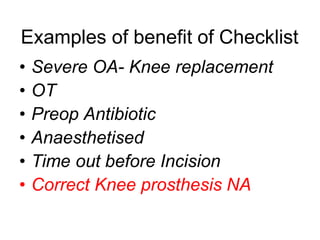
Examples of benefit of Checklist
• Severe OA- Knee replacement
• OT
• Preop Antibiotic
• Anaesthetised
• Time out before Incision
• Correct Knee prosthesis NA
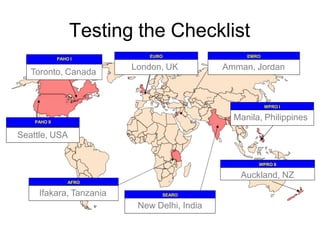
Testing the Checklist
London, UK
EURO EMRO
WPRO I
SEARO
AFRO
PAHO I
Amman, Jordan
Toronto, Canada
New Delhi, India
Manila, Philippines
Ifakara, Tanzania
WPRO II
Auckland, NZ
PAHO II
Seattle, USA
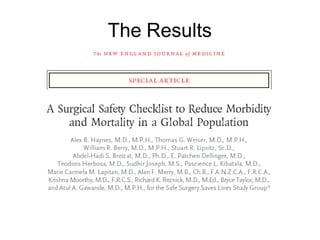
The Results
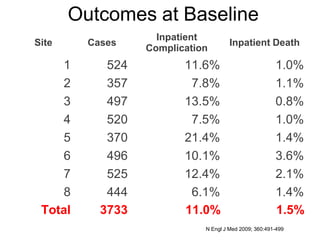
Site
Inpatient
Complication
Cases Inpatient Death
1 524 11.6% 1.0%
2 357 7.8% 1.1%
3 497 13.5% 0.8%
4 520 7.5% 1.0%
5 370 21.4% 1.4%
6 496 10.1% 3.6%
7 525 12.4% 2.1%
8 444 6.1% 1.4%
Total 3733 11.0% 1.5%
Outcomes at Baseline
N Engl J Med 2009; 360:491-499
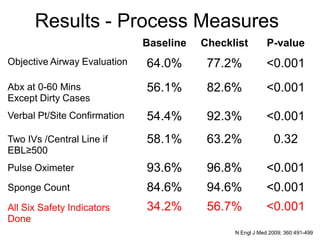
Results - Process Measures
Baseline Checklist P-value
64.0% 77.2% <0.001
56.1% 82.6% <0.001
54.4% 92.3% <0.001
58.1% 63.2% 0.32
93.6% 96.8% <0.001
84.6% 94.6% <0.001
34.2% 56.7% <0.001
Objective Airway Evaluation
Abx at 0-60 Mins
Except Dirty Cases
Verbal Pt/Site Confirmation
Two IVs /Central Line if
EBL≥500
Pulse Oximeter
Sponge Count
All Six Safety Indicators
Done
N Engl J Med 2009; 360:491-499
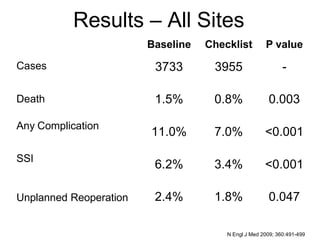
Results – All Sites
Baseline Checklist P value
3733 3955 -
1.5% 0.8% 0.003
11.0% 7.0% <0.001
6.2% 3.4% <0.001
2.4% 1.8% 0.047
Cases
Death
Any Complication
SSI
Unplanned Reoperation
N Engl J Med 2009; 360:491-499
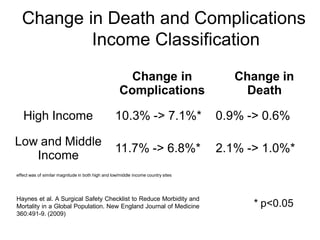
Change in Death and Complications
Income Classification
Change in
Complications
Change in
Death
High Income
Low and Middle
Income
10.3% -> 7.1%* 0.9% -> 0.6%
11.7% -> 6.8%* 2.1% -> 1.0%*
* p<0.05
Haynes et al. A Surgical Safety Checklist to Reduce Morbidity and
Mortality in a Global Population. New England Journal of Medicine
360:491-9. (2009)
effect was of similar magnitude in both high and low/middle income country sites
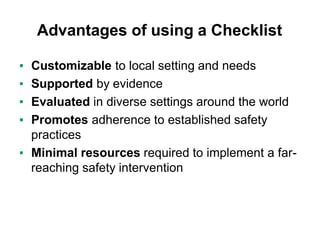
Advantages of using a Checklist
▪ Customizable to local setting and needs
▪ Supported by evidence
▪ Evaluated in diverse settings around the world
▪ Promotes adherence to established safety
practices
▪ Minimal resources required to implement a far-
reaching safety intervention
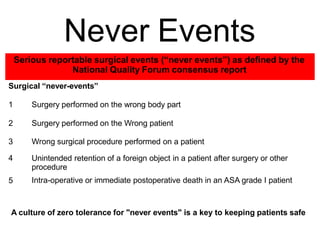
Never Events
Serious reportable surgical events (“never events”) as defined by the
National Quality Forum consensus report
Surgical “never-events”
1 Surgery performed on the wrong body part
2 Surgery performed on the Wrong patient
3 Wrong surgical procedure performed on a patient
4 Unintended retention of a foreign object in a patient after surgery or other
procedure
Intra-operative or immediate postoperative death in an ASA grade I patient
5
A culture of zero tolerance for "never events" is a key to keeping patients safe
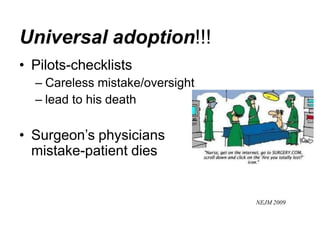
Universal adoption!!!
• Pilots-checklists
– Careless mistake/oversight
– lead to his death
• Surgeon’s physicians
mistake-patient dies
NEJM 2009
What papers say
• Interprofessional checklist briefings reduced
the number of communication failures by 34%
Arch Surg. 2008
• Makes operations safer everywhere
BMJ 2009
• Handover errors 39% - 12%
Paediatr Anaesth. 2007
• Giving antibiotics within two hours of incision
reduced the risk of surgical site infection by
one third
Joint Commission, Sentinel Event Statistics, 2006
Currently surgical teams do most of the
right things, on most patients, most of the
time
The checklist helps us do all the right
things, on all the patients, all of the time
Reality check
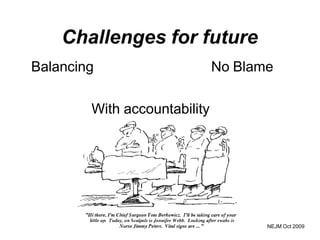
Challenges for future
Balancing No Blame
With accountability
NEJM Oct 2009
How we can achieve………..
• Developing a culture of safety
• Show support from the top and the middle
• Promote reporting
• Involve and communicate with patients and the
public
• Exhibit dogged and determined leadership
• Integrate the effort
• Provide recurrent training
• Implement solutions to prevent harm
Conclusion
Error
• Is a starting point
– not a conclusion
• Demands explanation
– Is not an explanation for trouble
– Not from individual
– From the system
– To prevent such errors being repeated
Conclusion
• The surgical safety can be enhanced by
implementation of surgical time-out
paradigm as a quality control tool for
standard surgical care
▪vision
Every surgical patient in Shri Mata Vaishno Devi Narayana
Superspeciality Hospital will receive the highest quality and
safest care in all surgical settings
▪purpose
Develop an integrated system for hospital surgical teams to
provide the highest quality of care and the safest environment
using evidence based medicine in the surgical setting
Conclusion
SURGICAL SAFETY.pptx

SURGICAL SAFETY.pptx

  • 1.
    Surgical safety Man MohanHarjai Patient safety is the absence of preventable harm to a patient during the process of health care
  • 2.
    Magnitude of theproblem • 234 million operations globally » 1:25 » Live births • 1 million deaths • 7 million disabling complications • >50% preventable NEJM Jan 2009
  • 3.
    Magnitude of theproblem – 50-60% of all hosp adm will require surgery – Major complications: 3 -16% – Deaths: 0.4 - 0.8% (Developing countries: 5-10% mortality) – Surgical site infections 14% NEJM Jan 2009
  • 4.
  • 5.
    Incorrect surgery – Thereare between 1500 and 2500 wrong site surgery incidents every year in the United States (Seiden, Archives of Surgery, 2006) – In a survey of 1050 hand surgeons, 21% reported having performed wrong-site surgery at least once during their careers (Classen, New England Journal of Medicine, 1992)
  • 6.
    Causes: Management related •Lack of protocols and checks • Shortfalls in training • Lack of supervision of junior surgeons when performing surgeries • Understaffing • Time constraints • Inadequate equipment • Communication breakdown
  • 7.
    Causes: Surgeon related •Inappropriate or delayed referrals • Improper planning of the operations • Operating outside ones expertise • Lack of teamwork skills • Communication breakdown at various levels between -Operating surgeon and assistant surgeon and the patient -Anesthetist and the surgeon/patient
  • 8.
    From JCAHO websiteas of July, 2007
  • 9.
    Least No ofdoctors and nurses per patient authorised S No Recommending auth Type of Authority Medical Officer Spl Offrs Nur Offrs 1 Ganga Ram Corporate 1 per 4 beds 1 per 4 beds 1 per 1.1 beds 2 Escorts Corporate 1 per 4 beds 1 per 3 beds 2 per 1 beds 3 Batra Corporate 1 per 3 beds 1 per 5 beds 1.3 per 1 beds 4 NIHFW 1988 Autonomous 1 per 15 beds 1 per 18-22 beds 1 per 3 beds 5 BIS 2001 Govt 1 per 10 beds 6 per 30 beds 1 per 3 beds 6 Bajaj Commitee Govt 1 per 15 beds 1 per 17 beds 1 per 3 beds 7 Army Norms 1960 Govt 1 per 50 beds 1 per 33 beds 1 per 5-20 beds
  • 10.
    Commercial aviation hasmany errors But few crashes
  • 11.
    Different Perspective • Oddsof dying in air crash 1 in 10 million • Odds of dying in hospital 1 in 300 • 33,000 X risk
  • 12.
  • 13.
  • 14.
    Surgeon • Long hoursover a number of years spent in surgical training may make a surgeon competent but that does not always translate into safe surgeon
  • 15.
    Surgeon • At thebeginning of the surgical career the surgeon learns “how to operate” • Then with experience “when to operate” • It is only with maturity he or she realizes “when not to operate”
  • 16.
    Has anyone seenmy watch? Wait a minute, if this is his spleen, then what's that? What do you mean he wasn't in for a sex change! Everybody stand back! I lost my contact lens! What do you mean, he's not insured? Let's hurry, I don't want to miss “Bay Watch” Surgeon A List of Things You Don't Want to Hear During Surgery Oops!
  • 17.
    Operation theatres Dangerous places •Swabs retained -1 in 8801 to 1 in 18,260 operations -88% reported correct sponge count N Engl J Med 2003; 348: 229 - 35 avoidable negligence
  • 18.
    Operation theatres Dangerous places Clampsleft in situ Wrong side surgery Anaesthesia deaths • • • N Engl J Med 2003; 348: 229 - 35
  • 19.
    ERROR “Behaviour which failsto achieve its desired result” “Doing the wrong thing when meaning to do the right thing”
  • 20.
  • 21.
    Wrong side surgery Surgicalerrors on the front pages of papers -Amputation of the wrong leg -Removal of the wrong breast -Operation on the wrong side of the brain
  • 22.
    When a patientdies----- • Medical case –What happened? •Surgical case –What did you do?
  • 23.
    Conventional approach toany failure • “Blame and Shame” • Not helpful in improving patient safety or reducing the incidence of severe complications – concealed – rather than studied, understood and prevented Report an event To prevent the next
  • 24.
    Medical Errors asSystems Problems • Wrong site surgery represents a "classical" system error rather than pure human failure by an individual surgeon • Systems can be designed to back up human error (sometimes imperfect human memory)
  • 25.
    To err ishuman . . . To cover up is unforgivable . . . To fail to learn is inexcusable . . . - Liam Donaldson
  • 26.
    Cost of errors •UK - £02 billion annually • (850,000 adverse events / yr) • USA - $29 billion each year
  • 27.
    Lessons from Aviation Industrydecided to look beyond pilot error or individual failure Mandatory reporting of any mishap within 24hrs Pilots are taught to acknowledge their own limitations
  • 28.
    Susceptibility to error •Surgeons and nurses tend to downplay the effects of stress and fatigue • This denial is ingrained from the time of medical college & residency • Leads to adverse events • This attitudes of personal invulnerability – needs change to prevent errors Sexton et al BMJ 2000; 320: 745 - 9
  • 29.
    Zero Error stateis impossible • It is important not to blame individuals for what went wrong but to understand why what they did at the time made sense to them Sidney Dekker
  • 30.
    Expected to workerror free • In an environment – we perform multiple concurrent tasks – in a setting of very high workload – with often-minimal organisational support
  • 31.
    Methods to preventerrors • System of universal reporting (anonymous) • Human factors • Situational awareness • Speak up • Red flags • Standard Operating Procedures • Safety checklists (WHO) • Briefing and Debriefing • Scripted handoffs
  • 32.
    Human Factors • 90%communication breakdowns occur verbally – 40% the information was transmitted in an inaccurate fashion – 50% it was never transmitted at all • Written orders and checklists should support inter-individual verbal communication including – the count of sponges and surgical instruments – in order to reduce the incidence of adverse events American College of Surgeons' closed claims study
  • 33.
  • 34.
  • 35.
  • 37.
  • 38.
  • 39.
    Leadership-WHO WAPS (World alliancefor patient safety) Global Patient safety challenges 2005 - Clean care is safer care 2007 - Safe surgery saves lives 2010 - Tackling antimicrobial resistance
  • 40.
    What Can anOperating Room Learn from a Cockpit?
  • 41.
    > 70% aviation accidentsdue to human error Checklist For standard procedure like take off and landing
  • 43.
    Ten Objectives of SafeSurgery Saves Lives 1. Correct patient / correct site 2. Prevent harm from anaesthetics 3. Prepare for airway emergencies 4. Prepare for high blood loss 5. Avoid allergies 6. Minimize surgical site infections 7. Prevent retention of instruments/ sponges 8. Accurately secure and identify specimens 9. Effectively communicate critical information 10. Establish surveillance of capacity/ volume/ results
  • 44.
    Check list Aim • Timelyand efficient steps Pre, intra and post op • Follow a few critical steps minimize common risks
  • 45.
    Surgical Safety Checklist(WHO) 19 item checklist • Sign In (before induction of anaesthesia) • Time out (before skin incision) • Sign out (before patient leaves OT)
  • 47.
  • 50.
    Examples of benefitof Checklist • Severe OA-Knee replacement • Policy-put TED stocking on healthy leg by nurse • Pt himself puts on the stocking • OT with stocking on Right leg • Sign In • Wrong leg had been marked
  • 53.
    Examples of benefitof Checklist • Severe OA- Knee replacement • OT • Preop Antibiotic • Anaesthetised • Time out before Incision • Correct Knee prosthesis NA
  • 57.
    Testing the Checklist London,UK EURO EMRO WPRO I SEARO AFRO PAHO I Amman, Jordan Toronto, Canada New Delhi, India Manila, Philippines Ifakara, Tanzania WPRO II Auckland, NZ PAHO II Seattle, USA
  • 58.
  • 59.
    Site Inpatient Complication Cases Inpatient Death 1524 11.6% 1.0% 2 357 7.8% 1.1% 3 497 13.5% 0.8% 4 520 7.5% 1.0% 5 370 21.4% 1.4% 6 496 10.1% 3.6% 7 525 12.4% 2.1% 8 444 6.1% 1.4% Total 3733 11.0% 1.5% Outcomes at Baseline N Engl J Med 2009; 360:491-499
  • 60.
    Results - ProcessMeasures Baseline Checklist P-value 64.0% 77.2% <0.001 56.1% 82.6% <0.001 54.4% 92.3% <0.001 58.1% 63.2% 0.32 93.6% 96.8% <0.001 84.6% 94.6% <0.001 34.2% 56.7% <0.001 Objective Airway Evaluation Abx at 0-60 Mins Except Dirty Cases Verbal Pt/Site Confirmation Two IVs /Central Line if EBL≥500 Pulse Oximeter Sponge Count All Six Safety Indicators Done N Engl J Med 2009; 360:491-499
  • 61.
    Results – AllSites Baseline Checklist P value 3733 3955 - 1.5% 0.8% 0.003 11.0% 7.0% <0.001 6.2% 3.4% <0.001 2.4% 1.8% 0.047 Cases Death Any Complication SSI Unplanned Reoperation N Engl J Med 2009; 360:491-499
  • 62.
    Change in Deathand Complications Income Classification Change in Complications Change in Death High Income Low and Middle Income 10.3% -> 7.1%* 0.9% -> 0.6% 11.7% -> 6.8%* 2.1% -> 1.0%* * p<0.05 Haynes et al. A Surgical Safety Checklist to Reduce Morbidity and Mortality in a Global Population. New England Journal of Medicine 360:491-9. (2009) effect was of similar magnitude in both high and low/middle income country sites
  • 63.
    Advantages of usinga Checklist ▪ Customizable to local setting and needs ▪ Supported by evidence ▪ Evaluated in diverse settings around the world ▪ Promotes adherence to established safety practices ▪ Minimal resources required to implement a far- reaching safety intervention
  • 64.
    Never Events Serious reportablesurgical events (“never events”) as defined by the National Quality Forum consensus report Surgical “never-events” 1 Surgery performed on the wrong body part 2 Surgery performed on the Wrong patient 3 Wrong surgical procedure performed on a patient 4 Unintended retention of a foreign object in a patient after surgery or other procedure Intra-operative or immediate postoperative death in an ASA grade I patient 5 A culture of zero tolerance for "never events" is a key to keeping patients safe
  • 65.
    Universal adoption!!! • Pilots-checklists –Careless mistake/oversight – lead to his death • Surgeon’s physicians mistake-patient dies NEJM 2009
  • 66.
    What papers say •Interprofessional checklist briefings reduced the number of communication failures by 34% Arch Surg. 2008 • Makes operations safer everywhere BMJ 2009 • Handover errors 39% - 12% Paediatr Anaesth. 2007 • Giving antibiotics within two hours of incision reduced the risk of surgical site infection by one third Joint Commission, Sentinel Event Statistics, 2006
  • 67.
    Currently surgical teamsdo most of the right things, on most patients, most of the time The checklist helps us do all the right things, on all the patients, all of the time Reality check
  • 68.
    Challenges for future BalancingNo Blame With accountability NEJM Oct 2009
  • 69.
    How we canachieve……….. • Developing a culture of safety • Show support from the top and the middle • Promote reporting • Involve and communicate with patients and the public • Exhibit dogged and determined leadership • Integrate the effort • Provide recurrent training • Implement solutions to prevent harm
  • 70.
    Conclusion Error • Is astarting point – not a conclusion • Demands explanation – Is not an explanation for trouble – Not from individual – From the system – To prevent such errors being repeated
  • 71.
    Conclusion • The surgicalsafety can be enhanced by implementation of surgical time-out paradigm as a quality control tool for standard surgical care
  • 72.
    ▪vision Every surgical patientin Shri Mata Vaishno Devi Narayana Superspeciality Hospital will receive the highest quality and safest care in all surgical settings ▪purpose Develop an integrated system for hospital surgical teams to provide the highest quality of care and the safest environment using evidence based medicine in the surgical setting Conclusion