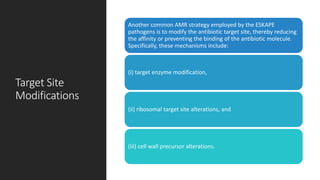
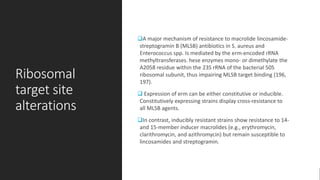
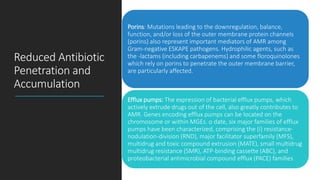
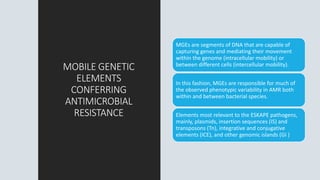
The document discusses ESKAPE pathogens, which are Enterococcus faecium, Staphylococcus aureus, Klebsiella pneumoniae, Acinetobacter baumannii, Pseudomonas aeruginosa, and Enterobacter species. These pathogens were designated a priority by the WHO in 2017 for developing new antibiotics. The document then describes various mechanisms by which ESKAPE pathogens have developed resistance to antibiotics, including enzymatic inactivation or modification of antibiotics, modifications of antibiotic target sites, reduced antibiotic accumulation, and biofilm formation. It also discusses how mobile genetic elements facilitate the spread of antibiotic resistance genes among bacteria.

![Antibiotic
Inactivation/Alteration
One of the most common AMR mechanisms employed by ESKAPE
pathogens involves the production of enzymes that irreversibly
destroy or neutralize antibiotics.
Such enzymes are particularly prevalent among the Gram-negative
pathogens and comprise those:
(i) that destroy the active antibiotic site (e.g., hydrolytic cleavage
of the lactam ring by -lactamases) or
(ii) that covalently modify key structural elements of the drug to
hinder bacterial target site interaction (e.g., aminoglycoside-
modifying enzymes [AMEs] that catalyze hydroxyl/amino group
modifcations).](https://image.slidesharecdn.com/eskapepathogens-230713115434-e65a01a6/85/ESKAPE-Pathogens-pptx-8-320.jpg)