Strength Training for Triathletes
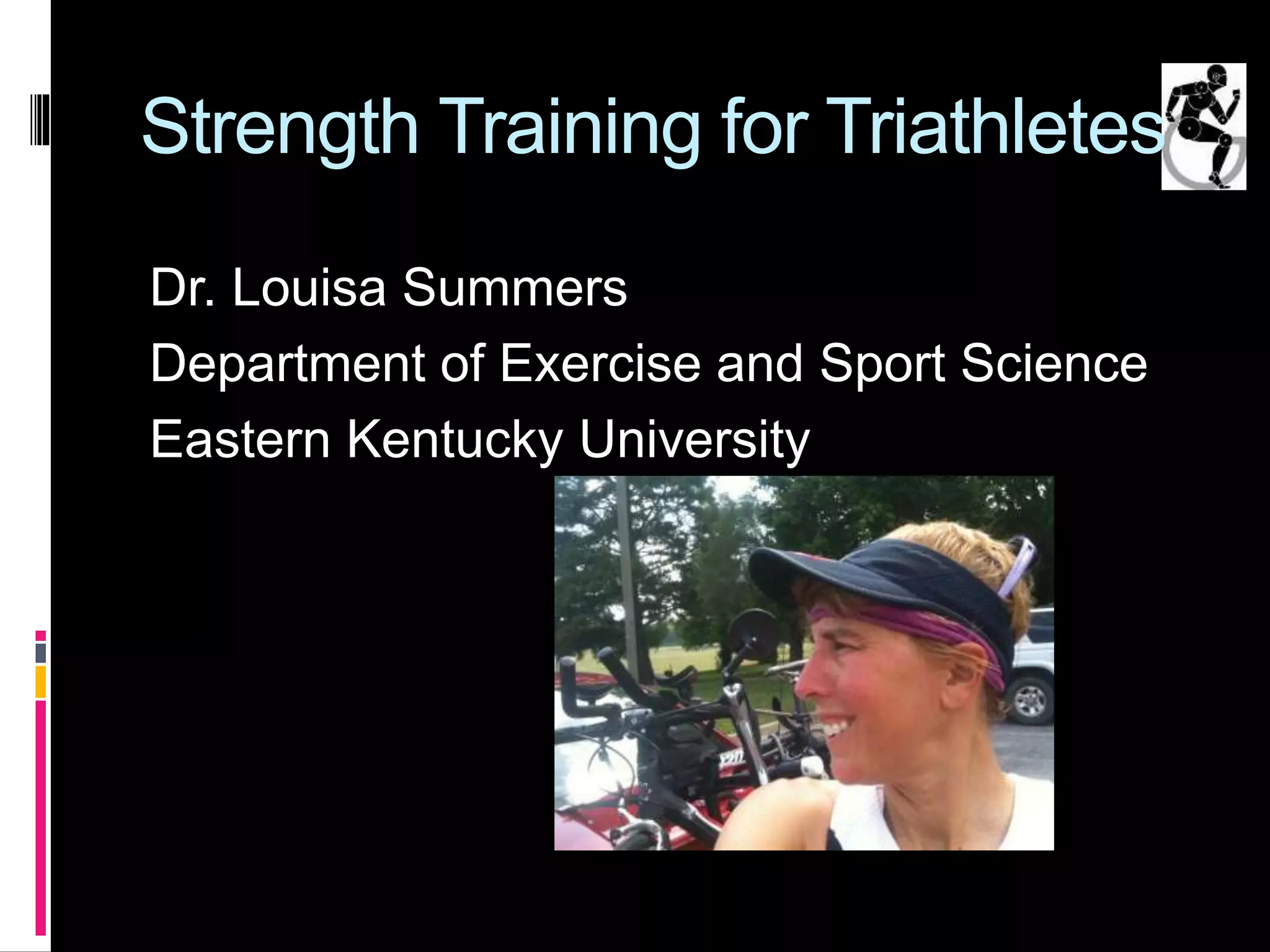
Dr. Louisa Summers
Department of Exercise and Sport Science
Eastern Kentucky University
How did we get here?
Main Reference
Core Research
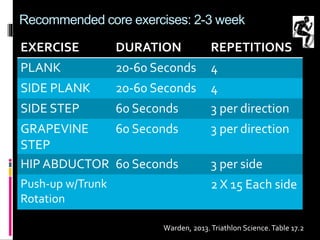
Recommended core exercises: 2-3 week
EXERCISE DURATION REPETITIONS
PLANK 20-60 Seconds 4
SIDE PLANK 20-60 Seconds 4
SIDE STEP 60 Seconds 3 per direction
GRAPEVINE
STEP
60 Seconds 3 per direction
HIP ABDUCTOR 60 Seconds 3 per side
Push-up w/Trunk
Rotation
2 X 15 Each side
Warden, 2013.Triathlon Science.Table 17.2
Why?
Research says?
WHEN TO DO IT?
Anatomical Adaptation - 4-6 weeks
Table 18.2 ANATOMICAL
ADAPTATION
Exercises (in order)
Total sessions 8 to 12 Leg Press
Sessions per
week
2 to 3 Lat Pull-down
Squat
Sets per session 3 to 5 Chest Press
Reps per set 20-30 PersonalWeakness (Leg
Curls, Heel Raise, Knee
Extension)
RecoveryTime 60-90 sec’s Seated Row
Core Exercises
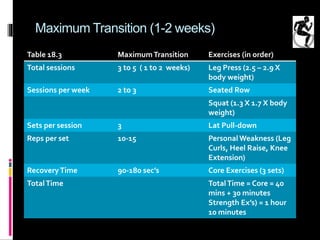
Maximum Transition (1-2 weeks)
Table 18.3 MaximumTransition Exercises (in order)
Total sessions 3 to 5 ( 1 to 2 weeks) Leg Press (2.5 – 2.9 X
body weight)
Sessions per week 2 to 3 Seated Row
Squat (1.3 X 1.7 X body
weight)
Sets per session 3 Lat Pull-down
Reps per set 10-15 Personal Weakness (Leg
Curls, Heel Raise, Knee
Extension)
RecoveryTime 90-180 sec’s Core Exercises (3 sets)
TotalTime TotalTime = Core = 40
mins + 30 minutes
Strength Ex’s) = 1 hour
10 minutes
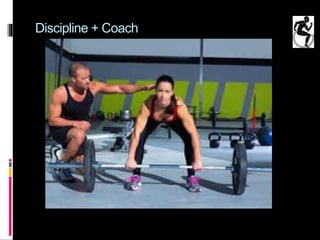
Discipline + Coach
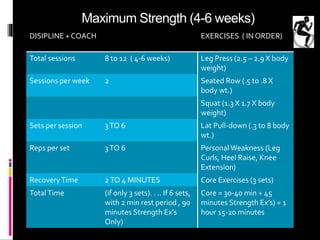
Maximum Strength (4-6 weeks)
DISIPLINE + COACH EXERCISES ( IN ORDER)
Total sessions 8 to 12 ( 4-6 weeks) Leg Press (2.5 – 2.9 X body
weight)
Sessions per week 2 Seated Row (.5 to .8 X
body wt.)
Squat (1.3 X 1.7 X body
weight)
Sets per session 3TO 6 Lat Pull-down (.3 to 8 body
wt.)
Reps per set 3TO 6 PersonalWeakness (Leg
Curls, Heel Raise, Knee
Extension)
RecoveryTime 2TO 4 MINUTES Core Exercises (3 sets)
TotalTime (if only 3 sets). . .. If 6 sets,
with 2 min rest period , 90
minutes Strength Ex’s
Only)
Core = 30-40 min + 45
minutes Strength Ex’s) = 1
hour 15-20 minutes
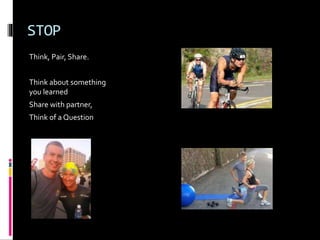
STOP
Think, Pair, Share.
Think about something
you learned
Share with partner,
Think of a Question
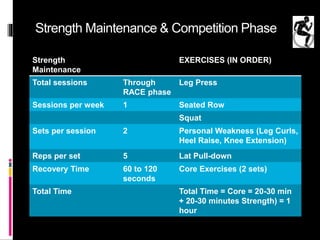
Strength Maintenance & Competition Phase
Strength
Maintenance
EXERCISES (IN ORDER)
Total sessions Through
RACE phase
Leg Press
Sessions per week 1 Seated Row
Squat
Sets per session 2 Personal Weakness (Leg Curls,
Heel Raise, Knee Extension)
Reps per set 5 Lat Pull-down
Recovery Time 60 to 120
seconds
Core Exercises (2 sets)
Total Time Total Time = Core = 20-30 min
+ 20-30 minutes Strength) = 1
hour
Well – Built Triathlete
Without Strength . . .
Phase I – Post-season & Pre-season
Oct – January
Foundational
Strength &
Stability
Phase II -Feb – May
End of Pre-season and Early Racing
Synchronization
& Power
Phase III – Main Racing
June - October
Race season
Performance
Differences in authors and approaches
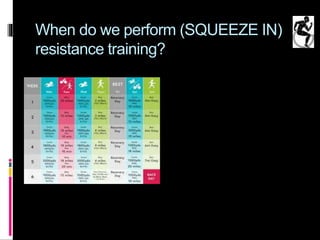
When do we perform (SQUEEZE IN)
resistance training?
What can we “get rid of” when there is so much to do
Review
 Core –
 Strength -
 When – do I do the heavy/ strength phase
 How do I do this? machines OR Squat bar
 OR – get a coach for 6 weeks
 Age 25-40 – maybe get coach + more
functional
 Ages 41-80 – maybe use machines more
 MUST DO STRENGTH TRAINING - IT IS
ONE OF THE FOUR PILLARS
References.
Core Strength:
Sato, K & Mokha M. (2009). DoesCore strength training influence running kinetics, lower-extremity
stability and 5000-M performance in runners? J Strength & Conditioning Research, 23 (1), 133-140.
StrengthTraining –
1. (Tudor, 2007. interview by D.W. Warden, November 28, 2007).
2. Bompa,T.O. Periodization:Theory and Methodology of training (4th edition), p. 316).
Champaign, IL: Human Kinetics, 1999).
Bikers & Cyclers:
5.(Hickson, Dvorak, Gorostiaga, Kurowski & Foster, 1988). Potential for strength and endurance
training to amplify endurance performance. J App Phys 65 (5), 2285-2290.
6.Marcinik, Potts, Schlaback,Will, Dawson, Hurley (1991).Effects of strength training on lactate
threshold and endurance performance Med Sc Sp Ex, 23 (6) 739-743.
7.Paavolainen, Hakkinen, Hamalainen, Nummela, & Rusko, 1999. Explosive strength training
improves 5K running time. J App Phy 89(5), 1527-1533.
8. (Mikkola,Vesterinen,Taipale, Capostagno, Hakkinen, Nummela 2011), Effect of resistance
training regimesn on treadmill running and neuromuscular performance in recreational endurance
runners, J of Sport Science, 29 (13), 1359-1371.
11.Yamamoto, Lopez, Klau, Casa, Kraemer,Armstrong, Maresh, (2008).The effects of endurance
distance running, performance among highly trained runners:A systematic review. J Str
Conditioning Research, 22 (6), 2036.
12.Yamamoto, Klau, Casa, Armstrong, Maresh, (2010).The effects of resistance training on road
cycling performance among highly trained cyclists:A systematic review. J Str Conditioning
Research, 24 (2), 560.

Strength training for triathletes

  • 1.
    Strength Training forTriathletes Dr. Louisa Summers Department of Exercise and Sport Science Eastern Kentucky University
  • 2.
    How did weget here?
  • 3.
  • 5.
  • 6.
    Recommended core exercises:2-3 week EXERCISE DURATION REPETITIONS PLANK 20-60 Seconds 4 SIDE PLANK 20-60 Seconds 4 SIDE STEP 60 Seconds 3 per direction GRAPEVINE STEP 60 Seconds 3 per direction HIP ABDUCTOR 60 Seconds 3 per side Push-up w/Trunk Rotation 2 X 15 Each side Warden, 2013.Triathlon Science.Table 17.2
  • 7.
  • 8.
  • 9.
  • 10.
    Anatomical Adaptation -4-6 weeks Table 18.2 ANATOMICAL ADAPTATION Exercises (in order) Total sessions 8 to 12 Leg Press Sessions per week 2 to 3 Lat Pull-down Squat Sets per session 3 to 5 Chest Press Reps per set 20-30 PersonalWeakness (Leg Curls, Heel Raise, Knee Extension) RecoveryTime 60-90 sec’s Seated Row Core Exercises
  • 11.
    Maximum Transition (1-2weeks) Table 18.3 MaximumTransition Exercises (in order) Total sessions 3 to 5 ( 1 to 2 weeks) Leg Press (2.5 – 2.9 X body weight) Sessions per week 2 to 3 Seated Row Squat (1.3 X 1.7 X body weight) Sets per session 3 Lat Pull-down Reps per set 10-15 Personal Weakness (Leg Curls, Heel Raise, Knee Extension) RecoveryTime 90-180 sec’s Core Exercises (3 sets) TotalTime TotalTime = Core = 40 mins + 30 minutes Strength Ex’s) = 1 hour 10 minutes
  • 12.
  • 13.
    Maximum Strength (4-6weeks) DISIPLINE + COACH EXERCISES ( IN ORDER) Total sessions 8 to 12 ( 4-6 weeks) Leg Press (2.5 – 2.9 X body weight) Sessions per week 2 Seated Row (.5 to .8 X body wt.) Squat (1.3 X 1.7 X body weight) Sets per session 3TO 6 Lat Pull-down (.3 to 8 body wt.) Reps per set 3TO 6 PersonalWeakness (Leg Curls, Heel Raise, Knee Extension) RecoveryTime 2TO 4 MINUTES Core Exercises (3 sets) TotalTime (if only 3 sets). . .. If 6 sets, with 2 min rest period , 90 minutes Strength Ex’s Only) Core = 30-40 min + 45 minutes Strength Ex’s) = 1 hour 15-20 minutes
  • 14.
    STOP Think, Pair, Share. Thinkabout something you learned Share with partner, Think of a Question
  • 15.
    Strength Maintenance &Competition Phase Strength Maintenance EXERCISES (IN ORDER) Total sessions Through RACE phase Leg Press Sessions per week 1 Seated Row Squat Sets per session 2 Personal Weakness (Leg Curls, Heel Raise, Knee Extension) Reps per set 5 Lat Pull-down Recovery Time 60 to 120 seconds Core Exercises (2 sets) Total Time Total Time = Core = 20-30 min + 20-30 minutes Strength) = 1 hour
  • 16.
    Well – BuiltTriathlete
  • 18.
  • 19.
    Phase I –Post-season & Pre-season Oct – January Foundational Strength & Stability
  • 20.
    Phase II -Feb– May End of Pre-season and Early Racing Synchronization & Power
  • 21.
    Phase III –Main Racing June - October Race season Performance
  • 22.
    Differences in authorsand approaches
  • 23.
    When do weperform (SQUEEZE IN) resistance training?
  • 24.
    What can we“get rid of” when there is so much to do
  • 25.
    Review  Core – Strength -  When – do I do the heavy/ strength phase  How do I do this? machines OR Squat bar  OR – get a coach for 6 weeks  Age 25-40 – maybe get coach + more functional  Ages 41-80 – maybe use machines more  MUST DO STRENGTH TRAINING - IT IS ONE OF THE FOUR PILLARS
  • 26.
    References. Core Strength: Sato, K& Mokha M. (2009). DoesCore strength training influence running kinetics, lower-extremity stability and 5000-M performance in runners? J Strength & Conditioning Research, 23 (1), 133-140. StrengthTraining – 1. (Tudor, 2007. interview by D.W. Warden, November 28, 2007). 2. Bompa,T.O. Periodization:Theory and Methodology of training (4th edition), p. 316). Champaign, IL: Human Kinetics, 1999). Bikers & Cyclers: 5.(Hickson, Dvorak, Gorostiaga, Kurowski & Foster, 1988). Potential for strength and endurance training to amplify endurance performance. J App Phys 65 (5), 2285-2290. 6.Marcinik, Potts, Schlaback,Will, Dawson, Hurley (1991).Effects of strength training on lactate threshold and endurance performance Med Sc Sp Ex, 23 (6) 739-743. 7.Paavolainen, Hakkinen, Hamalainen, Nummela, & Rusko, 1999. Explosive strength training improves 5K running time. J App Phy 89(5), 1527-1533. 8. (Mikkola,Vesterinen,Taipale, Capostagno, Hakkinen, Nummela 2011), Effect of resistance training regimesn on treadmill running and neuromuscular performance in recreational endurance runners, J of Sport Science, 29 (13), 1359-1371. 11.Yamamoto, Lopez, Klau, Casa, Kraemer,Armstrong, Maresh, (2008).The effects of endurance distance running, performance among highly trained runners:A systematic review. J Str Conditioning Research, 22 (6), 2036. 12.Yamamoto, Klau, Casa, Armstrong, Maresh, (2010).The effects of resistance training on road cycling performance among highly trained cyclists:A systematic review. J Str Conditioning Research, 24 (2), 560.

Editor's Notes

  • #3 Learn something new Apply and give direction to ‘age-groupers’/weekend warriors/people between 25-39, then 40-65. What? When? Why? What can we “throw out to save time”.
  • #4 Learn something new Apply and give direction to ‘age-groupers’/weekend warriors/people between 25-39, then 40-65. What? When? Why? What can we “throw out to save time”.
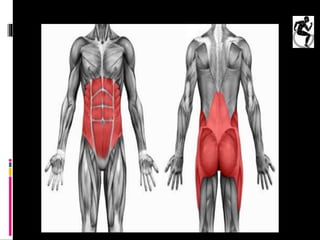
  • #5 What Muscles? All movement starts at the core (Warden, 2013). Co-contraction of transverses abdominis and multifidus muscles occurred before any movement of the limbs. (25) Any muscle between buttocks & chest: transvererses abdominis, multifidus, internal oblique, paraspinal, and gluteaus minimus, gluteal medius.
  • #6 Why Exercise Core? Research: all linked to injury prevention! Injury Prevention: ITBS directly related to gluteal medius. Injured runners enrolled 6-week rehabilitation program 22/24 were pain free and able to return to running. At 6-months, no reports of re-injury. Hamstring injury: 24 athletes, 10 triathletes and runners, put into core or hamstring strengthening/stretching program. CORE EXERCISES WERE: Side steps, crossover steps, multiple bridges, push-up stabilization w/trunk rotation. .. . In first 2 weeks, HAM streth/strengh group significant re-injury rate, NO core. After 1 year, 70% of HAM reinjury, vs. 1% of CORE group. PERFORMANCE: all related to injury prevention. 5K time decreased by 30 seconds (ref 31). Sato, K & Mokha M. (2009). Does Core strength training influence running kinetics, lower-exremity stablility and 5000-M performance in runners? J Strength & Conditioning Research, 23 (1), 133-140. Hodges PW, & Richardson CA (1997). Contraction of the abdominal muscles associated with movement of the lower limb. Physical Therapy, 77(2), 132-142. Reasonable Explanation is that core strength would positively affect the biomechanics of the swim, run and bike, therefore improve performance(Warden, 2013). Proper running position could not be maintained without core strength to support the position. In swimming the core becomes the primary mover as there is relatively little resistance for the limbs to utilize.
  • #7 How Exercise Core? ITBS – and hamstring injury study:CORE EXERCISES WERE: Side steps, crossover steps, multiple bridges, push-up stabilization w/trunk rotation. .. . Six Exercises from Triathlon Science book – 3 week Plank, Side Plank (side bridge), Side step, Grapevine Step, Hip Abductor, Push – up stabilization with Trunk Rotation When Exercise Core? No Dry-Land swimming. Not effective. . No research to support improvements, therefore, Exercise Core on Swim day’s before or after swim sessions.
  • #8  Dr. Tudor Bompa “Father of Modern Periodization” was once asked about the biggest mistakes that triathletes make (), and he responded, 1) not using evidence-based training methods, and 2) not implementing a year-round strength training program. “(Tudor, 2007. interview by D.W. Warden, November 28, 2007). . . The development of strength should be the prime concern of anyone who attempts to improve an athletes performance. (Bompa, 1999). Muscular Endurance – is made up of two abilities: 1) muscular strength & muscular endurance. Although some strength is developed during endurance training, true force can only be developed through specific and dedicated strength training program (Warden, 2013). Myths- contrary to specificity, . . Swim, bike, run, . . Little need for explosive force, power. . . Stealing time away from precious endurance training, . . And worse the cause of weight gain that leads to reduced economy and performance. BENEFITS- Bikers and runners, added strength sessions 3/week for 10 weeks. Leg strength increase and thigh girth remained unchanged. Bikers cycling time to exhaustion at 80% VO2max went from 71 -80 minutes.(Hickson, Dvorak, Gorostiaga, Kurowski & Foster, 1988) Also, 12 weeks at 75% of VOXmax resulted in an 33% increase. (6) 5K run time improved, w/o increase in VO2max – sprint events (7) Endurance runners – 3 groups – Heavy - high load, explosive (high power) and high duration (Mus. Endurance) for 8 weeks. All groups improved but mus. End had greatest gain. (Mikkola, Vesterinen, Taipale, Capostagno, Hakkinen, Nummela 2011),
  • #9  Cycling and Running Economy . . Eight well-trained runners verses n=9 controls, 3/wk for 8 weeks in addition to regular training. Strength training group IN economy by 5%, which contributed to 21% improvement in time to exhaustion at max aerobic threshold. Triathletes – n=15 assigned to endurance only, or endurance plus 2 sessions of strength training 14 weeks. Endurance + strength had sig. improvement in running economy. Meta-analysis – (11) – ‘resistance training likely has a positive effect on endurance running performance or running economy. Yamamoto, Lopez, Klau, Casa, Kraemer, Armstrong, Maresh, (2008). “(12) replacing a portion of a cyclist’s endurance training with resistance training will results in improved time trail performance and maximal power. Yamamoto, Klau, Casa, Armstrong, Maresh, (2010). Strength Training – Swimming Greater Strength – YES, Better swimming – NO. Yes, College swimmers - dry –land has been used for years, but despite changes in dry-land strength 25-33%, no change in distance per stroke, swim power, or swimming performance tests (22). Although in contrast to cycling and running, and depite improvements in upper body strength, it does not enhance swimming performance. (26).
  • #10 Gym – Based Strength Training – “The Triathletes Training Bible” – Joe Friel (28) proposes FOUR distinct Periodized Strength Training Phases: Anatomical Adaptation - Maximum Transition Maximum Strength Strength Maintenance Competition Phase (Warden, 2013).
  • #11 Who does this apply to? Someone who has never lifted weights or someone over age 55 or 60. Notice the rep’s of 20-30. This is for tendon/sheath development. Length of phase a very long time. Again who does this apply to? And when would you really have them do this for 4-6 weeks. . . . I tried it, rep’s of 20, not 30. I did a two sets of 15-20 rep’s in the first two weeks back after a one month off –season. After 2 weeks, I was ready to add weight and go back to set’s of 10-12. I take all of sept/oct off. First race is usually 10K in Georegtown KY, First Saturday in Novemeber. It starts my season. Then I lift Nov – Dec. .. Then quit :( January I start swimming 3-4/week, run 2 week, bike 1 week. Focus on swim, long runs. This is when I should be focusing on weight training. But I fail. … to .
  • #12 I usually hit this about 2 weeks into it. For you clients, over 50, 60 years old realistically one would probably do AA stage 20-30 reps for 2 weeks, and then drop down to 10-15 rep’s 2weeks. Problem here is the TIME: if you continue with 3 sets of CORE – 40 minutes, + 30 strength long time. Ideally, Drop to 2 sets of CORE, and then 30 mins strength. . Later try for total time of 40 minutes.
  • #13 DISIPLINE + COACH Reps per set 3 TO 6 Recovery Time 2 TO 4 MINUTES LEGS tired, fatigued, performance may decrease, muscle mass increases This is where CHANGE occurs. . . When in racing season are you going to do this?
  • #14 Maximum Strength This is primary phase of gym-based strength training. Power is developed for triathlete. .. Needed for climbing, (both run/bike), passing, and finishing a race. Endurance and speed training may suffer during this phase, as it increases significant fatigue. It should be periodized so that this phase ends by first part of the base training phase. Most importantly, the strength sessions should be AFTER an endurance set, which allows quality endurance set and improves results from strength session (29).
  • #23 3 phases rather than 5 Functional nature of the exercises Uses body weight and more jumps/power development More ‘synchronization’ power movements in Phase 3 Challenges – HOW someone over 50 without a coach/fitness trainer Meet with coach 1/ 6 weeks, then every other week. . Costly seniors on fixed income (tight with money). Could you do the exercises without a bar? Medicine ball with handles for seniors/age groupers Could you implement Phase 3 –without a strength coach?
  • #24 Sample training plans Well-Build Triathlete (Dixon, 2014).
  • #25 Stretching- no research to show that it is beneficial Swim – Dry Land – no research to show it improves performance (non-injured shoulders/people) However,
  • #26 Core – Strength When – do I do the heavy/ strength phase – tired How – do I use machines + Squat bar OR – get a coach for 6 weeks Age 25-40 – maybe get coach + more functional Ages 41-80 – maybe use machines more MUST DO STRENGTH TRAINING - IT IS ONE OF THE FOUR PILLARS
  • #27 Core Strength: Sato, K & Mokha M. (2009). Does Core strength training influence running kinetics, lower-extremity stability and 5000-M performance in runners? J Strength & Conditioning Research, 23 (1), 133-140. Strength Training – 1. (Tudor, 2007. interview by D.W. Warden, November 28, 2007). 2. Bompa, T.O. Periodization: Theory and Methodology of training (4th edition), p. 316). Champaign, IL: Human Kinetics, 1999). Bikers & Cyclers: 5.(Hickson, Dvorak, Gorostiaga, Kurowski & Foster, 1988). Potential for strength and endurance training to amplify endurance performance. J App Phys 65 (5), 2285-2290. 6.Marcinik, Potts, Schlaback, Will, Dawson, Hurley (1991).Effects of strength training on lactate threshold and endurance performance Med Sc Sp Ex, 23 (6) 739-743. 7.Paavolainen, Hakkinen, Hamalainen, Nummela, & Rusko, 1999. Explosive strength training improves 5K running time. J App Phy 89(5), 1527-1533. 8. (Mikkola, Vesterinen, Taipale, Capostagno, Hakkinen, Nummela 2011), Effect of resistance training regimesn on treadmill running and neuromuscular performance in recreational endurance runners, J of Sport Science, 29 (13), 1359-1371. 11. Yamamoto, Lopez, Klau, Casa, Kraemer, Armstrong, Maresh, (2008). The effects of endurance distance running, performance among highly trained runners: A systematic review. J Str Conditioning Research, 22 (6), 2036. 12. Yamamoto, Klau, Casa, Armstrong, Maresh, (2010). The effects of resistance training on road cycling performance among highly trainined cyclists: A systematic review. J Str Conditioning Research, 24 (2), 560.