Strength Training
& Endurance
Building Your Strongest
Performance One Rep At A Time!
Will Kirousis MS, CSCS, CISSN | @willkirousis | will@tri-hard.com
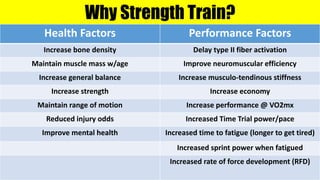
Why Strength Train?
Health Factors Performance Factors
Increase bone density Delay type II fiber activation
Maintain muscle mass w/age Improve neuromuscular efficiency
Increase general balance Increase musculo-tendinous stiffness
Increase strength Increase economy
Maintain range of motion Increase performance @ VO2mx
Reduced injury odds Increased Time Trial power/pace
Improve mental health Increased time to fatigue (longer to get tired)
Increased sprint power when fatigued
Increased rate of force development (RFD)
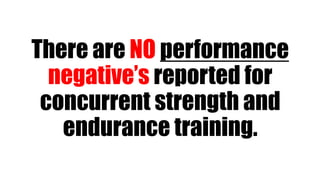
There are NO performance
negative’s reported for
concurrent strength and
endurance training.
“I’ll get to big!” No, no you wont!
• Adenosine monophosphate-
activated protein kinase
(AMPK) via endurance
training may slow/moderate
Mammalian target of
rapamycin (mTOR) activation
thus decreasing strength
training based myofibrillar
protein synthesis.
• Thus, the adaptive signaling
pathway of concurrent
training significantly reduces
the muscle hypertrophy
possible from training.
Cardinale, M., Newton, R. & Nosaka, K. (2011). Strength and
Conditioning Biological Principles and Practical Applications. Wiley-
Blackwell Inc., West Sussex, UK.
Build more horsepower!
• Max force increase, results in needing to use less of max @ submax levels.
• This allows greater fatigue resistance and the potential to perform greater
amounts of work over increasing durations.
Which one is working
harder @ 30mph?
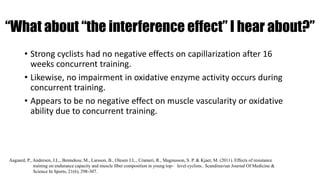
“What about “the interference effect” I hear about?”
• Strong cyclists had no negative effects on capillarization after 16
weeks concurrent training.
• Likewise, no impairment in oxidative enzyme activity occurs during
concurrent training.
• Appears to be no negative effect on muscle vascularity or oxidative
ability due to concurrent training.
Aagaard, P., Andersen, J.L., Bennekou, M., Larsson, B., Olesen J.L., Crameri, R., Magnusson, S. P. & Kjaer, M. (2011). Effects of resistance
training on endurance capacity and muscle fiber composition in young top- level cyclists.. Scandinavian Journal Of Medicine &
Science In Sports, 21(6), 298-307.
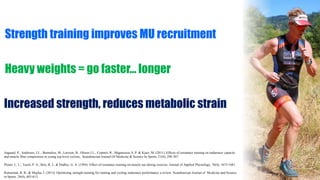
Strength training improves MU recruitment
Heavy weights = go faster… longer
Increased strength, reduces metabolic strain
Aagaard, P., Andersen, J.L., Bennekou, M., Larsson, B., Olesen J.L., Crameri, R., Magnusson, S. P. & Kjaer, M. (2011). Effects of resistance training on endurance capacity
and muscle fiber composition in young top-level cyclists.. Scandinavian Journal Of Medicine & Science In Sports, 21(6), 298-307.
Ploutz, L. L., Tesch, P. A., Biro, R. L. & Dudley, G. A. (1994). Effect of resistance training on muscle use during exercise. Journal of Applied Physiology, 76(4), 1675-1681.
Ronnestad, B. R., & Mujika, I. (2013). Optimizing strength training for running and cycling endurance performance a review. Scandinavian Journal of Medicine and Science
in Sports. 24(4), 603-613.
Adding Strength to your training program:
Don’t break your dam!
Total stress load yields your odds for underperformance, burnout,
overtraining/under-recovery. Your Perception matters.
In Other Words… Don’t Cross The Red
Line Of DOOM!!!
Red Line = Max Adaptable Load
Endurance Training Load
Strength Training Load
Strength Training BEFORE?
ENDURANCE TRAINING
Strength Training AFTER?
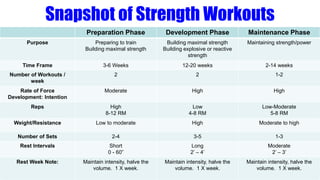
Snapshot of Strength Workouts
Preparation Phase Development Phase Maintenance Phase
Purpose Preparing to train
Building maximal strength
Building explosive or reactive
strength
Maintaining strength/power
Time Frame 3-6 Weeks 12-20 weeks 2-14 weeks
Number of Workouts /
week
2 2 1-2
Rate of Force
Development: Intention
Moderate High High
Reps High
8-12 RM
Low
4-8 RM
Low-Moderate
5-8 RM
Weight/Resistance Low to moderate High Moderate to high
Number of Sets 2-4 3-5 1-3
Rest Intervals Short
0 - 60”
Long
2’ – 4’
Moderate
2’ – 3’
Rest Week Note: Maintain intensity, halve the
volume. 1 X week.
Maintain intensity, halve the
volume. 1 X week.
Maintain intensity, halve the
volume. 1 X week.
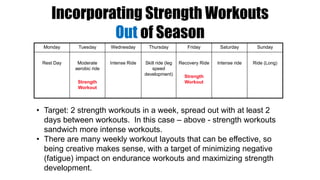
Incorporating Strength Workouts
Out of Season
Monday Tuesday Wednesday Thursday Friday Saturday Sunday
Rest Day Moderate
aerobic ride
Strength
Workout
Intense Ride Skill ride (leg
speed
development)
Recovery Ride
Strength
Workout
Intense ride Ride (Long)
• Target: 2 strength workouts in a week, spread out with at least 2
days between workouts. In this case – above - strength workouts
sandwich more intense workouts.
• There are many weekly workout layouts that can be effective, so
being creative makes sense, with a target of minimizing negative
(fatigue) impact on endurance workouts and maximizing strength
development.
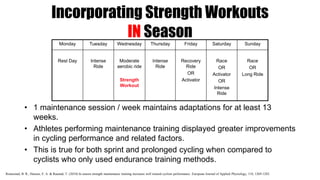
Incorporating Strength Workouts
IN Season
Monday Tuesday Wednesday Thursday Friday Saturday Sunday
Rest Day Intense
Ride
Moderate
aerobic ride
Strength
Workout
Intense
Ride
Recovery
Ride
OR
Activator
Race
OR
Activator
OR
Intense
Ride
Race
OR
Long Ride
• 1 maintenance session / week maintains adaptations for at least 13
weeks.
• Athletes performing maintenance training displayed greater improvements
in cycling performance and related factors.
• This is true for both sprint and prolonged cycling when compared to
cyclists who only used endurance training methods.
Ronnestad, B. R., Hansen, E. A. & Raastad, T. (2010) In season strength maintenance training increases well trained cyclists performance. European Journal of Applied Physiology, 110, 1269-1282.
Workout Structure Example
• Warm up
• Workout
• High energy level change
• Bilateral squat/deadlift/Olympic lift or explosive plyometric – drop jump, stair bound etc.
• Push
• Chest press, pushup, overhead press, rotational press, etc.
• Single leg dominant level change
• Bulgarian split squat, split squat, lunge variations, step up variations, single leg squat, single leg deadlift,
etc.
• Pull
• Rowing motions, pull ups, pull downs
• Connector/core
• Chopping patterns, bridging and planking, variations of bridges and planks, farmers walks, lateral
bending, exaggerated marching, trunk flexion/rotation/extension or combination exercises.
• Cool down
Warming up is about:• Getting ready to move – aggressively.
• Increasing temperature
• Increasing range of motion
• Increasing balance/coordination
• Increasing work output readiness
• Going from light to moderately intense
• 10-15’ total duration
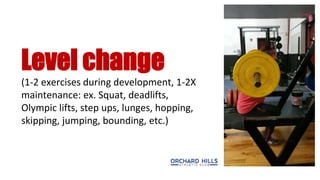
Level change
(1-2 exercises during development, 1-2X
maintenance: ex. Squat, deadlifts,
Olympic lifts, step ups, lunges, hopping,
skipping, jumping, bounding, etc.)
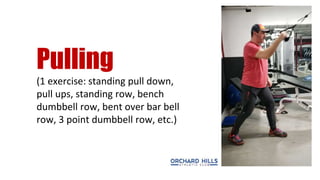
Pulling
(1 exercise: standing pull down,
pull ups, standing row, bench
dumbbell row, bent over bar bell
row, 3 point dumbbell row, etc.)
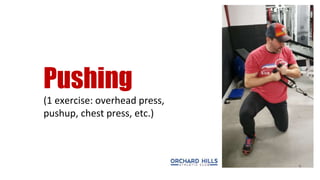
Pushing
(1 exercise: overhead press,
pushup, chest press, etc.)
Connector’s
(Core)
(1-2 exercises: stability ball roll outs,
plank variations, bridging variations,
chopping motions, etc.)
Cooling Down
10-20’ which can include:
• Self massage
• Light stretching or relaxing yoga
• Walking
• Deep relaxation exercise
Wrapping Up: Strength Keys
Simple. Do the basics great.
Heavy and or explosive (If your sport includes running).
4-12RM, 2-5 sets, 2-4’ RI
Rate of Force Development: intention = high!
1-2 exercises w/ lower body extension focus per workout.
2X week during prep/build phases (Post/Pre season)
1X week during maintenance phases (in season)
References / Suggested Readings
Aagaard, P., Andersen, J.L., Bennekou, M., Larsson, B., Olesen J.L., Crameri, R., Magnusson, S. P. & Kjaer, M. (2011). Effects of resistance
training on endurance capacity and muscle fiber composition in young top-level cyclists.. Scandinavian Journal Of Medicine &
Science In Sports, 21(6), 298-307.
Beattie, K., Kenny, I. C., Lyons, M. & Carson, B. P. (2014). The effect of strength training on performance in endurance athletes. Sports
Medicine, 44, 845-865.
Bieuzen, F., Vercruyssen, F., Hausswirth, C. & Brisswalter, J. (2007). Relationship between strength level and pedal rate. International Journal of
Sports Medicine, 28(7), 585-589.
Cardinale, M., Newton, R. & Nosaka, K. (2011). Strength and Conditioning Biological Principles and Practical Applications. Wiley-Blackwell
Inc., West Sussex, UK.
Keily, J. (2016) A new understanding of stress and the implications for our cultural training paradigm. IAAF.
Keily, J. (2016). Abrief history of nearly everything to do with stress, epigenetics and training theory. Institute of Coaching and Performance,
University of Central Lancashire.
Mujika, I. (2012) Endurance Training Science & Practice. Inigo Mujika S.L.U., Vittoria-Gastiez, ESP.
Mujika, I., Ronnestad, B. R. & Martin, D. T. (2016). Effects of increased muscle strength and muscle mass on endurance cycling performance.
International Journal of Sports Physiology and Performance, 11, 283-289.
Komi, P. V. (2003). Strength and Power in Sport, Second Ed. International Olympic Committee, Blackwell Science, Ltd. Oxford, UK.
Ploutz, L. L., Tesch, P. A., Biro, R. L. & Dudley, G. A. (1994). Effect of resistance training on muscle use during exercise. Journal of Applied
Physiology, 76(4), 1675-1681.
Radcliffe, J. C. & Farentinos, R. C. (1999). High Powered Plyometrics. Human Kinetics, Champaign, IL.
Ronnestad, B. R., & Mujika, I. (2013). Optimizing strength training for running and cycling endurance performance a review. Scandinavian
Journal of Medicine and Science in Sports. 24(4), 603-613.
Ronnestad, B. R, Hansen, J., Hollan. I. & Ellefsen, S. (2015) Strength training improves performance and pedaling characteristics in elite
cyclists. Scandinavian Journal of Medicine and Science in Sports. 25, 89-98.
Ronnestad, B. R., Hansen, E. A. & Raastad, T. (2010) In season strength maintenance training increases well trained cyclists performance.
European Journal of Applied Physiology, 110, 1269-1282.
Questions?
Will Kirousis
will@tri-hard.com
978.466.5151
www.tri-hard.com

Race mania-2019-strength endurance

  • 1.
    Strength Training & Endurance BuildingYour Strongest Performance One Rep At A Time! Will Kirousis MS, CSCS, CISSN | @willkirousis | will@tri-hard.com
  • 2.
    Why Strength Train? HealthFactors Performance Factors Increase bone density Delay type II fiber activation Maintain muscle mass w/age Improve neuromuscular efficiency Increase general balance Increase musculo-tendinous stiffness Increase strength Increase economy Maintain range of motion Increase performance @ VO2mx Reduced injury odds Increased Time Trial power/pace Improve mental health Increased time to fatigue (longer to get tired) Increased sprint power when fatigued Increased rate of force development (RFD)
  • 4.
    There are NOperformance negative’s reported for concurrent strength and endurance training.
  • 5.
    “I’ll get tobig!” No, no you wont! • Adenosine monophosphate- activated protein kinase (AMPK) via endurance training may slow/moderate Mammalian target of rapamycin (mTOR) activation thus decreasing strength training based myofibrillar protein synthesis. • Thus, the adaptive signaling pathway of concurrent training significantly reduces the muscle hypertrophy possible from training. Cardinale, M., Newton, R. & Nosaka, K. (2011). Strength and Conditioning Biological Principles and Practical Applications. Wiley- Blackwell Inc., West Sussex, UK.
  • 6.
    Build more horsepower! •Max force increase, results in needing to use less of max @ submax levels. • This allows greater fatigue resistance and the potential to perform greater amounts of work over increasing durations. Which one is working harder @ 30mph?
  • 7.
    “What about “theinterference effect” I hear about?” • Strong cyclists had no negative effects on capillarization after 16 weeks concurrent training. • Likewise, no impairment in oxidative enzyme activity occurs during concurrent training. • Appears to be no negative effect on muscle vascularity or oxidative ability due to concurrent training. Aagaard, P., Andersen, J.L., Bennekou, M., Larsson, B., Olesen J.L., Crameri, R., Magnusson, S. P. & Kjaer, M. (2011). Effects of resistance training on endurance capacity and muscle fiber composition in young top- level cyclists.. Scandinavian Journal Of Medicine & Science In Sports, 21(6), 298-307.
  • 8.
    Strength training improvesMU recruitment Heavy weights = go faster… longer Increased strength, reduces metabolic strain Aagaard, P., Andersen, J.L., Bennekou, M., Larsson, B., Olesen J.L., Crameri, R., Magnusson, S. P. & Kjaer, M. (2011). Effects of resistance training on endurance capacity and muscle fiber composition in young top-level cyclists.. Scandinavian Journal Of Medicine & Science In Sports, 21(6), 298-307. Ploutz, L. L., Tesch, P. A., Biro, R. L. & Dudley, G. A. (1994). Effect of resistance training on muscle use during exercise. Journal of Applied Physiology, 76(4), 1675-1681. Ronnestad, B. R., & Mujika, I. (2013). Optimizing strength training for running and cycling endurance performance a review. Scandinavian Journal of Medicine and Science in Sports. 24(4), 603-613.
  • 9.
    Adding Strength toyour training program: Don’t break your dam! Total stress load yields your odds for underperformance, burnout, overtraining/under-recovery. Your Perception matters.
  • 10.
    In Other Words…Don’t Cross The Red Line Of DOOM!!! Red Line = Max Adaptable Load Endurance Training Load Strength Training Load
  • 11.
    Strength Training BEFORE? ENDURANCETRAINING Strength Training AFTER?
  • 12.
    Snapshot of StrengthWorkouts Preparation Phase Development Phase Maintenance Phase Purpose Preparing to train Building maximal strength Building maximal strength Building explosive or reactive strength Maintaining strength/power Time Frame 3-6 Weeks 12-20 weeks 2-14 weeks Number of Workouts / week 2 2 1-2 Rate of Force Development: Intention Moderate High High Reps High 8-12 RM Low 4-8 RM Low-Moderate 5-8 RM Weight/Resistance Low to moderate High Moderate to high Number of Sets 2-4 3-5 1-3 Rest Intervals Short 0 - 60” Long 2’ – 4’ Moderate 2’ – 3’ Rest Week Note: Maintain intensity, halve the volume. 1 X week. Maintain intensity, halve the volume. 1 X week. Maintain intensity, halve the volume. 1 X week.
  • 13.
    Incorporating Strength Workouts Outof Season Monday Tuesday Wednesday Thursday Friday Saturday Sunday Rest Day Moderate aerobic ride Strength Workout Intense Ride Skill ride (leg speed development) Recovery Ride Strength Workout Intense ride Ride (Long) • Target: 2 strength workouts in a week, spread out with at least 2 days between workouts. In this case – above - strength workouts sandwich more intense workouts. • There are many weekly workout layouts that can be effective, so being creative makes sense, with a target of minimizing negative (fatigue) impact on endurance workouts and maximizing strength development.
  • 14.
    Incorporating Strength Workouts INSeason Monday Tuesday Wednesday Thursday Friday Saturday Sunday Rest Day Intense Ride Moderate aerobic ride Strength Workout Intense Ride Recovery Ride OR Activator Race OR Activator OR Intense Ride Race OR Long Ride • 1 maintenance session / week maintains adaptations for at least 13 weeks. • Athletes performing maintenance training displayed greater improvements in cycling performance and related factors. • This is true for both sprint and prolonged cycling when compared to cyclists who only used endurance training methods. Ronnestad, B. R., Hansen, E. A. & Raastad, T. (2010) In season strength maintenance training increases well trained cyclists performance. European Journal of Applied Physiology, 110, 1269-1282.
  • 15.
    Workout Structure Example •Warm up • Workout • High energy level change • Bilateral squat/deadlift/Olympic lift or explosive plyometric – drop jump, stair bound etc. • Push • Chest press, pushup, overhead press, rotational press, etc. • Single leg dominant level change • Bulgarian split squat, split squat, lunge variations, step up variations, single leg squat, single leg deadlift, etc. • Pull • Rowing motions, pull ups, pull downs • Connector/core • Chopping patterns, bridging and planking, variations of bridges and planks, farmers walks, lateral bending, exaggerated marching, trunk flexion/rotation/extension or combination exercises. • Cool down
  • 16.
    Warming up isabout:• Getting ready to move – aggressively. • Increasing temperature • Increasing range of motion • Increasing balance/coordination • Increasing work output readiness • Going from light to moderately intense • 10-15’ total duration
  • 17.
    Level change (1-2 exercisesduring development, 1-2X maintenance: ex. Squat, deadlifts, Olympic lifts, step ups, lunges, hopping, skipping, jumping, bounding, etc.)
  • 18.
    Pulling (1 exercise: standingpull down, pull ups, standing row, bench dumbbell row, bent over bar bell row, 3 point dumbbell row, etc.)
  • 19.
    Pushing (1 exercise: overheadpress, pushup, chest press, etc.)
  • 20.
    Connector’s (Core) (1-2 exercises: stabilityball roll outs, plank variations, bridging variations, chopping motions, etc.)
  • 21.
    Cooling Down 10-20’ whichcan include: • Self massage • Light stretching or relaxing yoga • Walking • Deep relaxation exercise
  • 22.
    Wrapping Up: StrengthKeys Simple. Do the basics great. Heavy and or explosive (If your sport includes running). 4-12RM, 2-5 sets, 2-4’ RI Rate of Force Development: intention = high! 1-2 exercises w/ lower body extension focus per workout. 2X week during prep/build phases (Post/Pre season) 1X week during maintenance phases (in season)
  • 23.
    References / SuggestedReadings Aagaard, P., Andersen, J.L., Bennekou, M., Larsson, B., Olesen J.L., Crameri, R., Magnusson, S. P. & Kjaer, M. (2011). Effects of resistance training on endurance capacity and muscle fiber composition in young top-level cyclists.. Scandinavian Journal Of Medicine & Science In Sports, 21(6), 298-307. Beattie, K., Kenny, I. C., Lyons, M. & Carson, B. P. (2014). The effect of strength training on performance in endurance athletes. Sports Medicine, 44, 845-865. Bieuzen, F., Vercruyssen, F., Hausswirth, C. & Brisswalter, J. (2007). Relationship between strength level and pedal rate. International Journal of Sports Medicine, 28(7), 585-589. Cardinale, M., Newton, R. & Nosaka, K. (2011). Strength and Conditioning Biological Principles and Practical Applications. Wiley-Blackwell Inc., West Sussex, UK. Keily, J. (2016) A new understanding of stress and the implications for our cultural training paradigm. IAAF. Keily, J. (2016). Abrief history of nearly everything to do with stress, epigenetics and training theory. Institute of Coaching and Performance, University of Central Lancashire. Mujika, I. (2012) Endurance Training Science & Practice. Inigo Mujika S.L.U., Vittoria-Gastiez, ESP. Mujika, I., Ronnestad, B. R. & Martin, D. T. (2016). Effects of increased muscle strength and muscle mass on endurance cycling performance. International Journal of Sports Physiology and Performance, 11, 283-289. Komi, P. V. (2003). Strength and Power in Sport, Second Ed. International Olympic Committee, Blackwell Science, Ltd. Oxford, UK. Ploutz, L. L., Tesch, P. A., Biro, R. L. & Dudley, G. A. (1994). Effect of resistance training on muscle use during exercise. Journal of Applied Physiology, 76(4), 1675-1681. Radcliffe, J. C. & Farentinos, R. C. (1999). High Powered Plyometrics. Human Kinetics, Champaign, IL. Ronnestad, B. R., & Mujika, I. (2013). Optimizing strength training for running and cycling endurance performance a review. Scandinavian Journal of Medicine and Science in Sports. 24(4), 603-613. Ronnestad, B. R, Hansen, J., Hollan. I. & Ellefsen, S. (2015) Strength training improves performance and pedaling characteristics in elite cyclists. Scandinavian Journal of Medicine and Science in Sports. 25, 89-98. Ronnestad, B. R., Hansen, E. A. & Raastad, T. (2010) In season strength maintenance training increases well trained cyclists performance. European Journal of Applied Physiology, 110, 1269-1282.
  • 24.